

What Is a Sales Engineer? The Practitioner's Guide to B2B's Most Underrated Role
You're halfway through a deal cycle. The VP of Engineering on the buyer side just asked a question about your API's rate-limiting architecture, and your AE is staring at the ceiling. That's the moment a sales engineer earns their keep - and it's the moment most career guides completely ignore.
If you've been wondering what a sales engineer actually does and whether the role is worth pursuing, that scenario is the answer in miniature.
Quick Summary
A sales engineer is the person responsible for the technical win - proving to a prospect's technical stakeholders that the product actually solves their problem. Part demo artist, part solutions architect, part translator between engineering and business.
Median salary sits around $121K per BLS, but that number is misleading for SaaS. RepVue data pegs median OTE at $200K, with top performers clearing $320K+. Job growth is projected at 5% through 2034, which sounds modest until you realize AI-native companies are flipping the traditional sales org on its head, running 2:1 or 3:1 SE-to-AE ratios. If you're an engineer who's good with people and wants to double your comp without becoming a people manager, this is the role.
The Real Definition
The core mission is simple: get the technical win. That means proving - through demos, proof-of-concept deployments, architecture reviews, and technical deep dives - that your product meets the prospect's requirements. The AE owns the commercial relationship. The SE owns the technical evaluation.
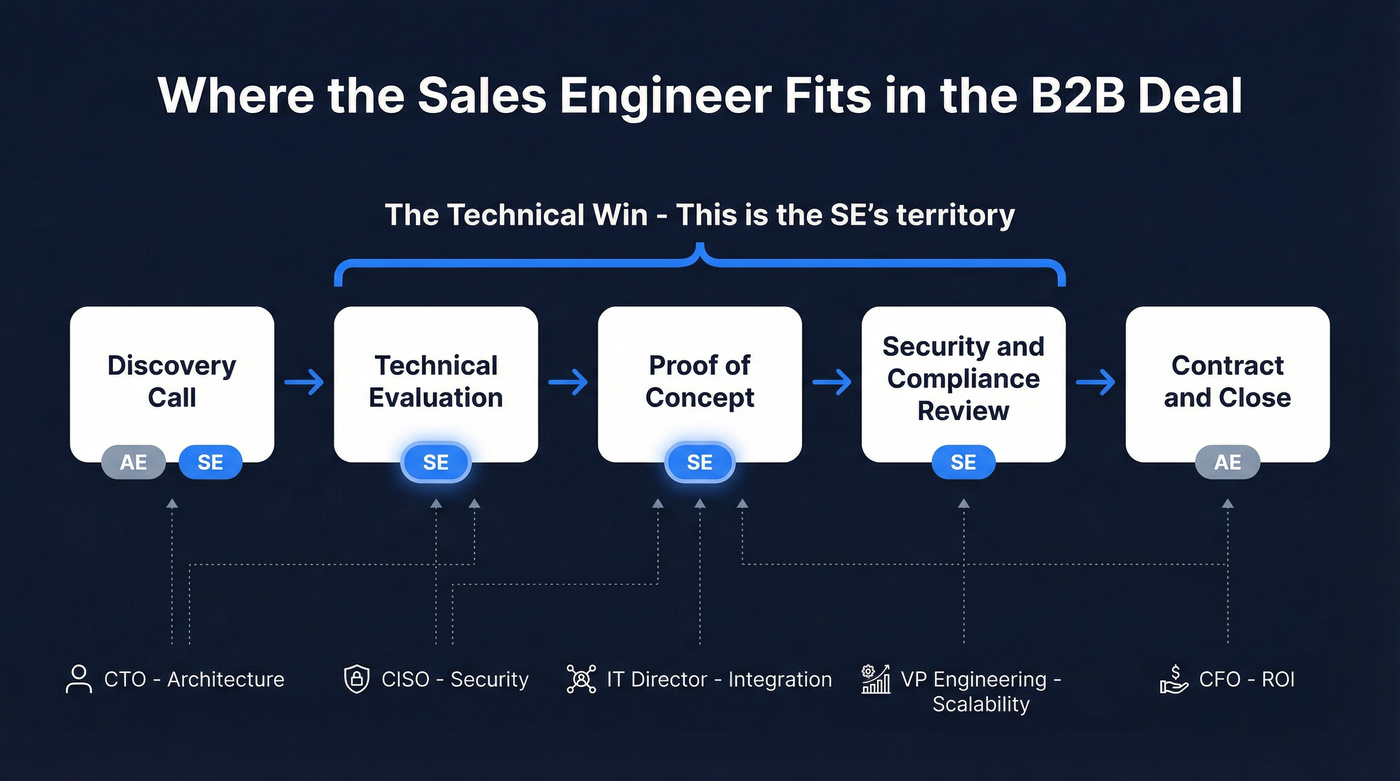
Here's what it isn't: traditional sales. In most orgs, SEs don't cold call. They don't negotiate pricing. They don't do the "always be closing" thing that makes engineers break out in hives. A common concern from engineers considering the switch is whether the role is "shady sales." It's not. The role is consultative - you're the trusted technical advisor in the room, and your credibility depends on being honest about what the product can and can't do. That tension between genuine customer advocacy and your vendor obligations is real, and the best SEs lean into it rather than pretending it doesn't exist. Buyers can smell dishonesty instantly, and once you lose technical credibility, you never get it back.
That matters more than ever because B2B buying committees now average six to ten stakeholders. You're not convincing one person. You're navigating a CTO who cares about architecture, a security lead who cares about compliance, an IT director who cares about integration, and a CFO who just wants the ROI slide. The SE is the only person in the sales org who can credibly speak to all of them on technical terms.
Day-to-Day Responsibilities
Forget the job description bullet points. Here's what a typical day looks like for an SE at a mid-market SaaS company.
Morning triage - email and Slack first. Check which deals moved overnight, which AEs need help, and whether any PoC environments broke. Then a standup with the sales team to align on demos and flag deals needing technical support.
Customer-facing work - two to four demos or technical deep dives, depending on deal stage. Some are first-call discoveries where you're asking more questions than answering. Others are late-stage architecture reviews where the prospect's engineering team is trying to poke holes in your solution. Between calls, you're prepping decks, customizing demo environments, pulling verified contacts for the buying committee, and scrambling to finish an RFP response that's due tomorrow.
Internal sync - late afternoon is for syncing with product and engineering on feature requests, updating CRM notes, and following up on PoC action items.
End-of-quarter chaos - it's 6 PM on the last Thursday of Q4. Your AE just got a verbal commit from the economic buyer, but the CISO wants one more security review before signing. You're building a custom architecture diagram, pulling compliance docs, and scheduling a call for 7 AM Friday. For nearly 80% of SEs, the deals they support are in the $100K range - big enough that every stakeholder's concern gets a thorough answer.
Sales Engineer vs. Every Other Title
The pre-sales world has a naming problem. The same role gets called nine different things depending on the company, the industry, and apparently the mood of whoever wrote the job posting. People also confuse the SE with a technical sales representative - a role that typically carries a full quota and handles the entire sales cycle for less complex products, whereas the SE focuses exclusively on the technical evaluation within larger deals.
| Title | Typical Function | Notes |
|---|---|---|
| Sales Engineer | Pre-sales demos + PoCs | The default title across most industries |
| Solutions Engineer | Same as SE, newer branding | Watch for post-sales overlap |
| Solutions Consultant | Consultative, integration-heavy | Sometimes a services role in disguise |
| Solutions Architect | Pre-sales design + scoping | Pre-sales at AWS, often post-sales elsewhere |
| Customer Engineer | Google's term for SE | Google-specific |
| Pre-sales Engineer | Explicitly pre-sales | Less common but unambiguous |
| Field SE | On-site, travel-heavy | Hardware and enterprise |
| Applications Engineer | Legacy hardware/industrial | Can mean R&D at some companies |
| Channel SE | Supports partner sales | Indirect sales motion |
| Technical Sales Rep | Full-cycle sales with technical depth | Carries own quota; common in mid-market |
Two titles deserve extra caution. "Systems Engineer" can mean actual R&D systems engineering - not pre-sales at all. And "Solution Architect" flips between pre-sales and post-sales depending on the org.
Ignore the title, read the job description. If it mentions demos, PoCs, and working with AEs, it's a sales engineering role regardless of what they call it.
Salary & Compensation in 2026
The BLS median of $121,520 is technically accurate and practically useless if you're evaluating a SaaS SE role. That number blends merchant wholesalers, durable goods (21% of SE jobs), manufacturing, and software - and the comp structures are wildly different.
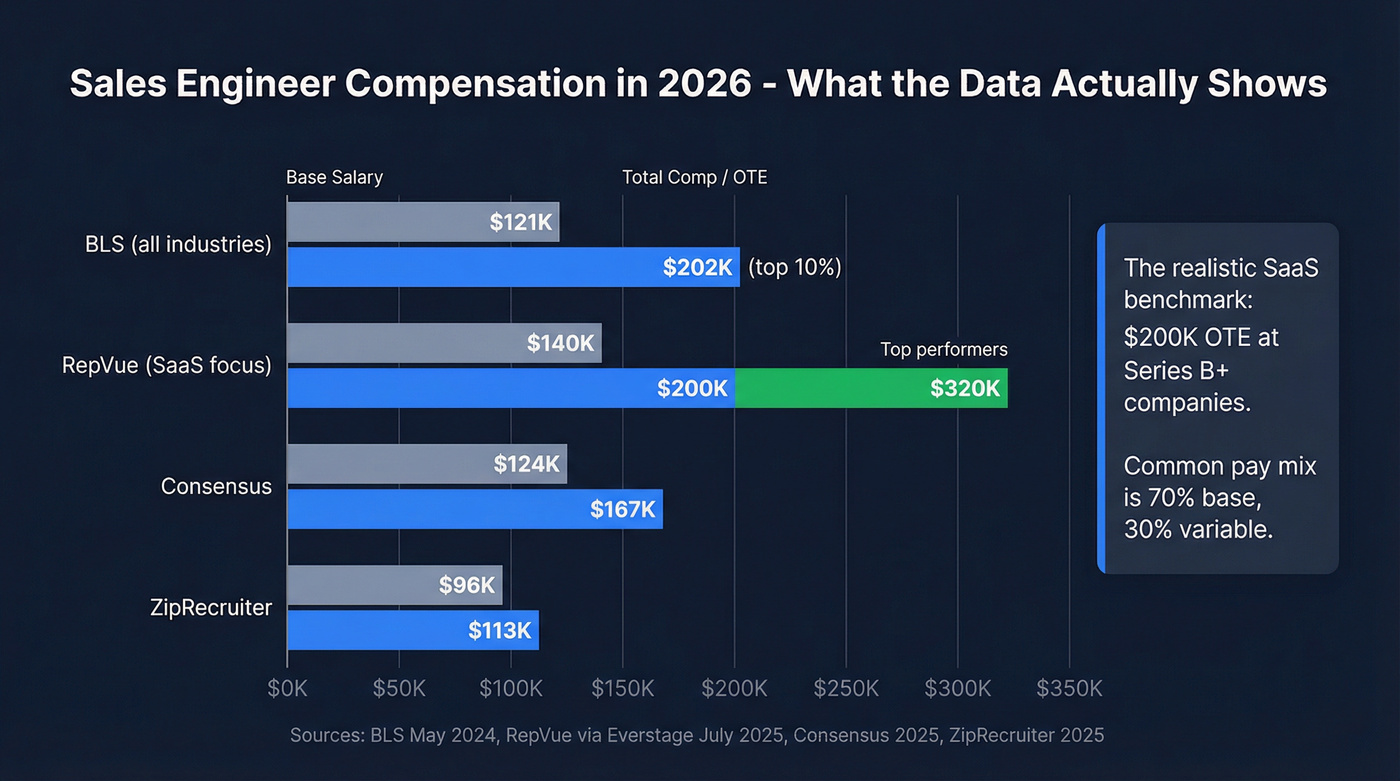
Here's what the data actually looks like across sources:
| Source | Base Salary | Total Comp / OTE | Top Performers | Date |
|---|---|---|---|---|
| BLS | $121,520 (median) | Top 10% > $202,670 | - | May 2024 |
| RepVue (via Everstage) | $140,000 (median) | $200,000 | $320K+ | July 2025 |
| Consensus | ~$123,946 | ~$167,000 | - | 2025 |
| ZipRecruiter | ~$96,194 (avg) | $75K-$112.5K range | - | 2025 |
The RepVue numbers are the most representative for SaaS. If you're interviewing at a Series B+ software company, $200K OTE is the realistic benchmark for a mid-level SE.
Pay mix splits matter too. In SaaS and enterprise tech, 70/30 base-to-variable is a common structure. Companies where the SE has heavier deal ownership sometimes push to 60/40. Hardware and support-heavy roles tend toward 80/20, with less variable comp at stake. By experience level, expect roughly $88K-$90K base at entry level, $140K at mid-career with three to seven years, and $150K+ base for senior SEs. Variable comp on top of that gets you to the OTE numbers above.
Here's the thing: if your company's average deal size is under $25K, you probably don't need a dedicated SE. A technically sharp AE or technical sales rep with good product training can handle the demo. SEs earn their salary on complex, multi-stakeholder deals where the technical evaluation is a genuine gate to the purchase decision. Anything less, and you're overpaying for a capability the deal doesn't require.

SEs spend hours pulling verified contacts for buying committees with 6-10 stakeholders. Prospeo gives you 98% accurate emails and 125M+ verified mobile numbers - so you reach the CTO, CISO, and IT director directly instead of chasing aliases.
Stop prepping contacts manually. Find every stakeholder in one search.
Skills That Actually Matter
| Technical Skills | Human Skills |
|---|---|
| Product architecture - understanding how your product fits into the customer's existing stack | Discovery questioning - uncovering the real problem behind the stated problem |
| Demo delivery - live, polished, and adaptable when the prospect throws a curveball | Technical storytelling - translating features into business outcomes for non-technical buyers |
| API and integration knowledge - most enterprise deals hinge on how the product connects | Objection handling under pressure - especially security, compliance, and "why not build it ourselves" |
| PoC execution - standing up environments, managing timelines, proving value in weeks | Multi-stakeholder navigation - reading the room when six people have six different priorities |
| Relevant certs - AWS/Azure for cloud, Salesforce Admin for CRM, Cisco for networking | Honest communication - saying "we can't do that" earns more trust than faking it |
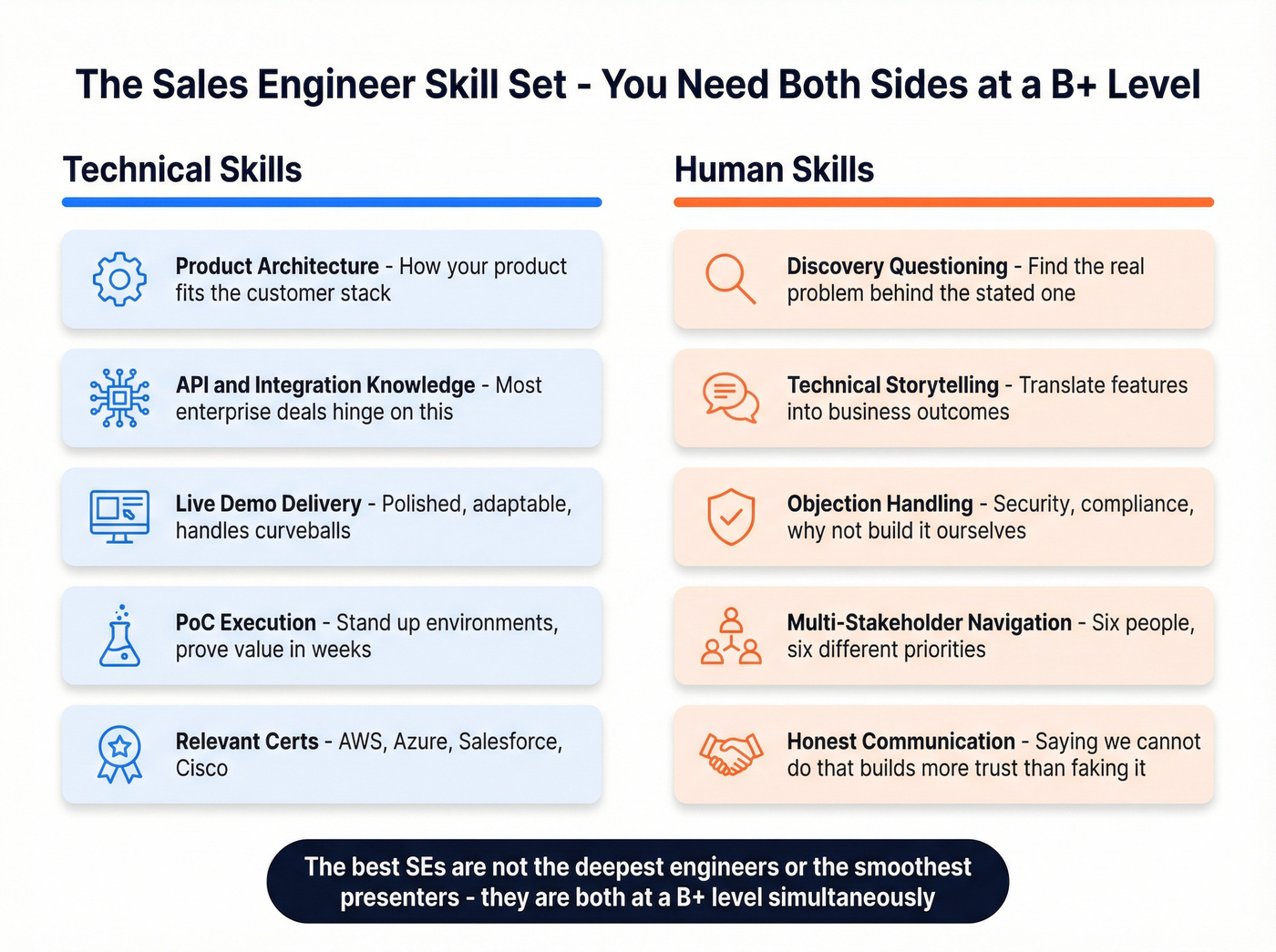
The best SEs aren't the deepest engineers or the smoothest presenters. They're the ones who can do both at a B+ level simultaneously.
The Modern SE Tool Stack
The presales software market is projected to grow from $94B to $179B by 2031. Let's break down what actually matters in a modern SE's stack.
If you're building repeatable demos and evaluations, a simple product demo checklist helps keep every deal consistent.
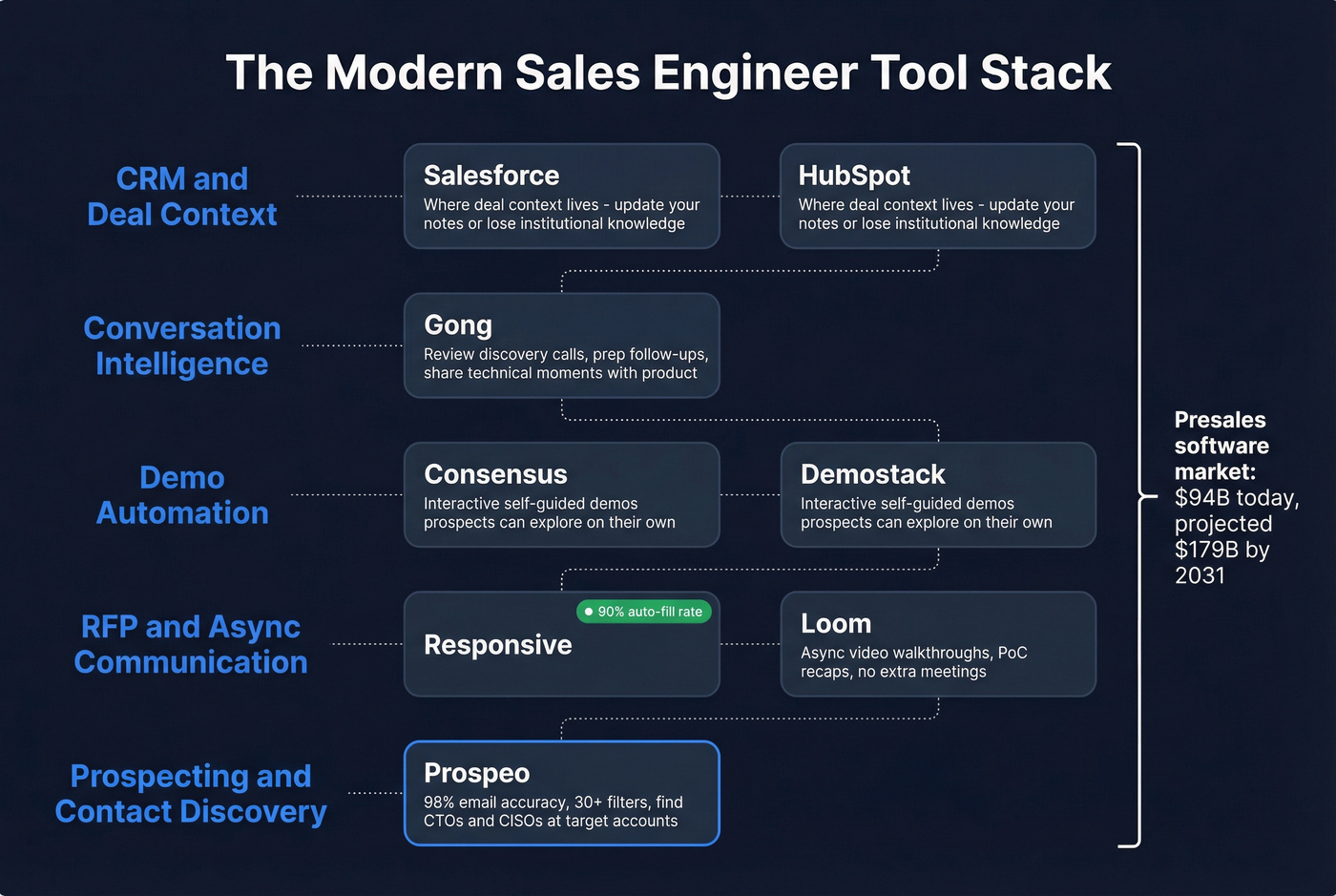
Your CRM - Salesforce or HubSpot - is non-negotiable. This is where deal context lives, and SEs who don't update their CRM notes lose institutional knowledge between calls. Pair it with Gong for conversation intelligence: reviewing discovery calls, prepping for follow-ups, and sharing technical moments with product teams.
For demo automation, Consensus and Demostack let SEs create interactive, self-guided demos that prospects can explore independently. RFP automation through Responsive saves real time - one study reported a 90% auto-fill rate and 8x faster turnaround after implementation. Loom handles async video walkthroughs, PoC recaps, and follow-up explanations without scheduling another call.
On the prospecting side, we've found that SEs often need to track down the right technical decision-makers - CTOs, VPs of Engineering, security leads - before they can even start the technical evaluation. Tools like Prospeo make that faster with 98% email accuracy and 30+ search filters tuned for finding specific roles at target accounts. If you want a broader view of what works now, start with these sales prospecting techniques.

The best sales engineers customize every demo and PoC for the right audience. With 30+ filters - including technographics, buyer intent, and department headcount - Prospeo helps you map the entire technical buying committee before your first call.
Know exactly who's evaluating your product before you walk into the room.
How AI Is Reshaping the Role in 2026
A $3M+ annual deal recently closed primarily by a Head of Sales Engineering who ran the relationship, the pilot, the business case, and the onsite close. The sales team mainly helped with pricing. That's where the role is heading - SEs as deal architects, not demo jockeys.
AI isn't replacing sales engineers. It's replacing the parts of the job SEs hate - RFP busywork, demo environment setup, call note transcription - while making the strategic parts more important.
The structural shift is dramatic. AI-native companies are running 2:1 or 3:1 SE-to-AE ratios, inverting the traditional model where one SE supported multiple AEs. SDR/BDR headcount dropped 36% across 400+ B2B companies surveyed by Emergence Capital. SE headcount? Down only 14%. The role isn't shrinking - it's absorbing responsibilities that used to belong to other functions. And 41% of demo views happen outside business hours, which means async demo tools are extending the SE's reach without extending their calendar.
Buyers are changing too. G2's data shows GenAI chatbots are trusted by 17.2% of buyers for final purchase decisions, compared to just 9.3% for vendor salespeople. The human who still earns trust? The technical expert who can go deep on architecture and answer the hard questions honestly. That's the SE.
If you're trying to quantify the impact of these shifts, it helps to track funnel metrics and pipeline health as the org rebalances.
How to Become a Sales Engineer
There's no single path in. The most common entry points:
- Engineers who realize they like talking to customers more than writing code
- Support engineers and CSMs who've been doing informal pre-sales work for years and want the title and comp to match
- AEs with genuine technical chops who want to stop carrying a full quota and go deeper on solutions
A bachelor's degree in engineering, computer science, or a related field is typical per BLS, but it's not a hard requirement in SaaS. Strong SEs come from IT consulting, technical support, and self-taught technical backgrounds. What matters is product fluency and the ability to command a room.
Progression typically runs: SE for two to four years, Senior SE for one to three years, then SE Manager or Principal SE, then Director or VP of Solutions Engineering. From there, some go into product leadership, others into GTM strategy, and a growing number move into CRO-track roles as the SE function gains strategic weight.
If you're evaluating offers, make sure you understand OTE in Sales and how variable comp is actually calculated.
The Interview Process
Expect four stages. Behavioral interviews cover deal experience, cross-functional collaboration, and how you handle ambiguity. Technical pre-sales rounds test your ability to explain complex concepts clearly - not just that you know the material, but that you can teach it.
The live demo is where most candidates succeed or fail. Plan a narrative arc, lead with value over features, engage the audience with questions, and anticipate objections on security, integration, and ROI. Treat it like a real customer call, not a presentation. The consensus on r/salesengineers is consistent: the best demo is the one where you talked less than the prospect.
Is Sales Engineering Right for You?
Yes, it's sales. But it's not the kind of sales that makes engineers uncomfortable. In most orgs, SEs don't carry an individual revenue quota. You're not cold calling. You're not negotiating contracts. You're the technical expert that the buyer actually wants to talk to.
Is it repetitive? Honestly, yes - you'll give the same demo dozens of times. But discovery is different every time. The problems change, the stakeholders change, the objections change. If you can find energy in solving puzzles for different people, the repetition fades into the background.
The comp is the strongest argument. A senior software engineer at a mid-tier company tops out at $180K-$220K total comp. A senior SE at the same company clears $200K-$250K with less on-call stress. The highest-paying verticals - SaaS, cybersecurity, cloud infrastructure - regularly push OTE past $250K for experienced SEs. Skip this role if you want pure engineering depth or hate presenting to groups. But if you're energized by the intersection of technology and people, there's nothing else in B2B tech that pays this well for the work-life balance you get.
If you're moving into a more outbound-heavy SE motion, keep a set of sales follow-up templates handy for post-demo momentum.
Sales Engineer FAQ
Do sales engineers carry a quota?
Most SEs don't carry an individual revenue quota - they share a team or overlay quota tied to the AE's deals. Variable comp is typically 20-30% of base, paid on team attainment or technical win metrics like PoC conversion rate.
What's the difference between a sales engineer and an account executive?
The AE owns the commercial relationship - pricing, negotiation, contract. The SE owns the technical evaluation - demos, PoCs, architecture questions. In most orgs, the AE can't close without the SE's technical win. They're complementary roles, not competing ones.
Do you need a computer science degree?
No. A CS or engineering degree helps for infrastructure and security products, but many SEs come from IT consulting, support, or self-taught backgrounds. Product fluency, clear communication, and comfort presenting to senior stakeholders matter more than formal credentials.
What tools do sales engineers use daily?
CRM (Salesforce/HubSpot) for deal context, Gong for call review, demo automation for self-guided experiences, RFP tools for response management, and prospecting platforms for finding verified emails and direct dials on technical decision-makers. The specific stack depends on your company's sales motion.
Is sales engineering a good career in 2026?
One of the strongest in B2B tech. BLS projects 5% growth through 2034, but the real signal is structural: AI-native companies are running higher SE-to-AE ratios while SDR headcount declines. Median OTE in SaaS sits at $200K+, and the role is gaining strategic weight as buyers demand deeper technical engagement earlier in the cycle.