

What Is Account Planning? (And Why Most Companies Get It Wrong)
Your VP just told the team to "start doing real account planning." The QBR is in three weeks. Someone pulls up a template from Google Docs, fills in revenue numbers and a few contact names, and calls it done. That document will never be opened again - and everyone knows it.
So what is account planning, really? Fewer than 20% of companies have fully embedded this discipline into their business operations. The other 80% treat it as a quarterly chore. Here's how to be in the 20%.
The Short Version
- Account planning is a living discipline, not a quarterly document you build before QBR and forget
- Limit plans to 5-10 key accounts per rep - depth beats breadth every time
- Every plan needs a stakeholder map built on verified, current contact data
- Review action items every 2 weeks, not every quarter
- A strong account management plan connects strategy to daily execution so nothing falls through the cracks
Account Planning Defined
Account planning is the strategic process of researching, prioritizing, and building growth roadmaps for your highest-value accounts. It's not a template. It's not a slide deck. It's a discipline that connects what you know about a customer's business to specific actions your team will take to grow revenue.
In B2B sales, this means identifying the accounts that matter most, mapping the people who influence buying decisions, understanding their goals and pain points, and building a coordinated plan to expand the relationship. The Pareto principle applies directly: 80% of future profits are likely to come from 20% of current customers](https://kapta.com/resources/key-account-management-blog/key-account-management/account-based-marketing-and-key-account-management). The planning process is how you figure out which 20% to invest in and what "invest" actually looks like.
Not from B2B sales? In advertising, "account planning" means something entirely different - it's the strategic discipline of translating consumer insights into creative briefs. Valid use of the term, but not what we're covering here. This guide is about B2B revenue growth: identifying, mapping, and expanding your most valuable customer relationships.
Account Planning vs. Account Management vs. ABM
These three terms get tangled constantly. Let's untangle them.
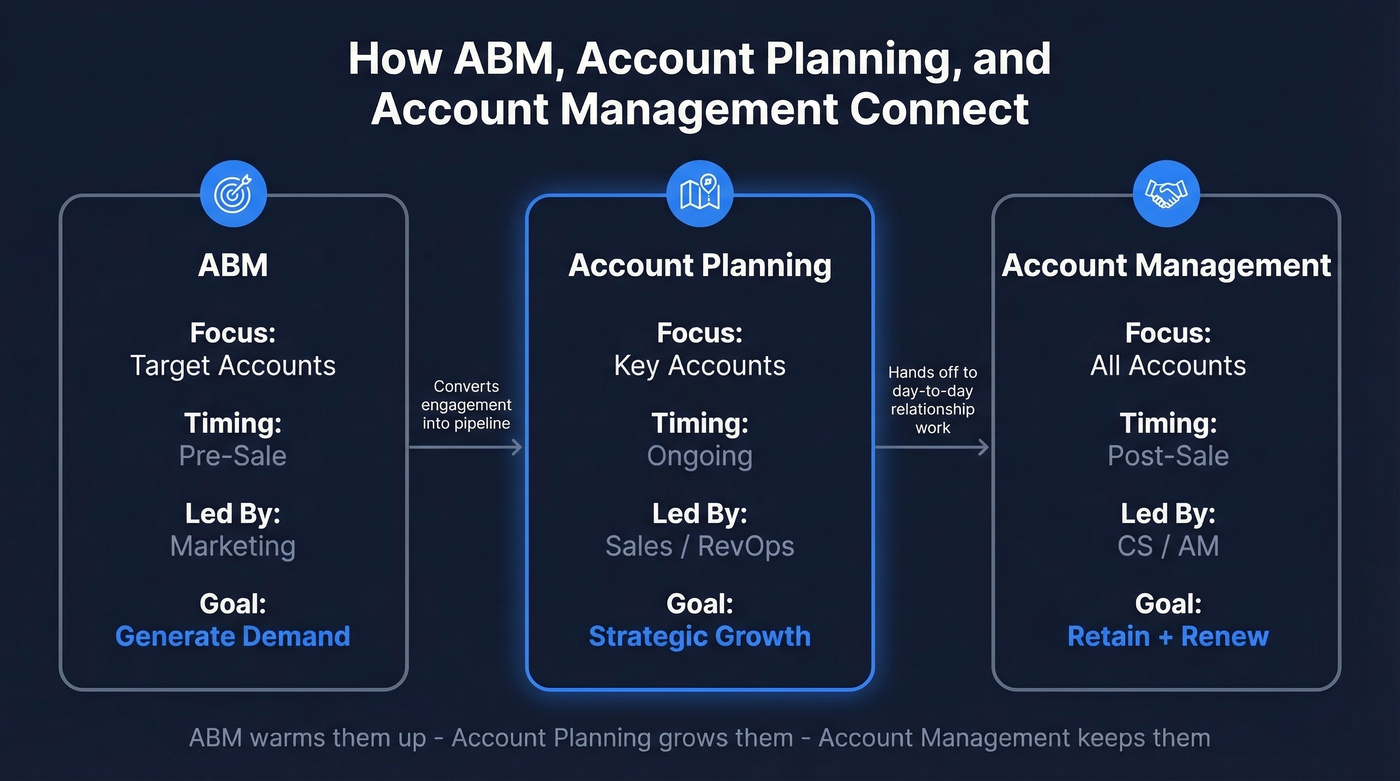
ABM is upstream - it's how marketing targets and warms high-value accounts before sales gets involved. Account planning is where sales builds a growth roadmap for specific accounts. Account management is the downstream, day-to-day relationship work: renewals, support escalations, check-in calls.
Think of it as a three-part model: ABM generates awareness and engagement, account-based selling converts that engagement into customers and pipeline, and strategic planning ensures you're growing the relationship over time.
| Focus | Timing | Led By | Goal | |
|---|---|---|---|---|
| ABM | Target accounts | Pre-sale | Marketing | Generate demand |
| Account Planning | Key accounts | Ongoing | Sales / RevOps | Strategic growth |
| Account Management | All accounts | Post-sale | CS / AM | Retain + renew |
Why Strategic Account Plans Matter
The numbers make the case. Structured planning drives 28% faster sales cycles and 35% higher close rates. The probability of selling to an existing customer runs 60-70%, compared to 5-20% for a brand-new prospect. If you're not planning how to grow your best accounts, you're leaving the easiest revenue on the table.
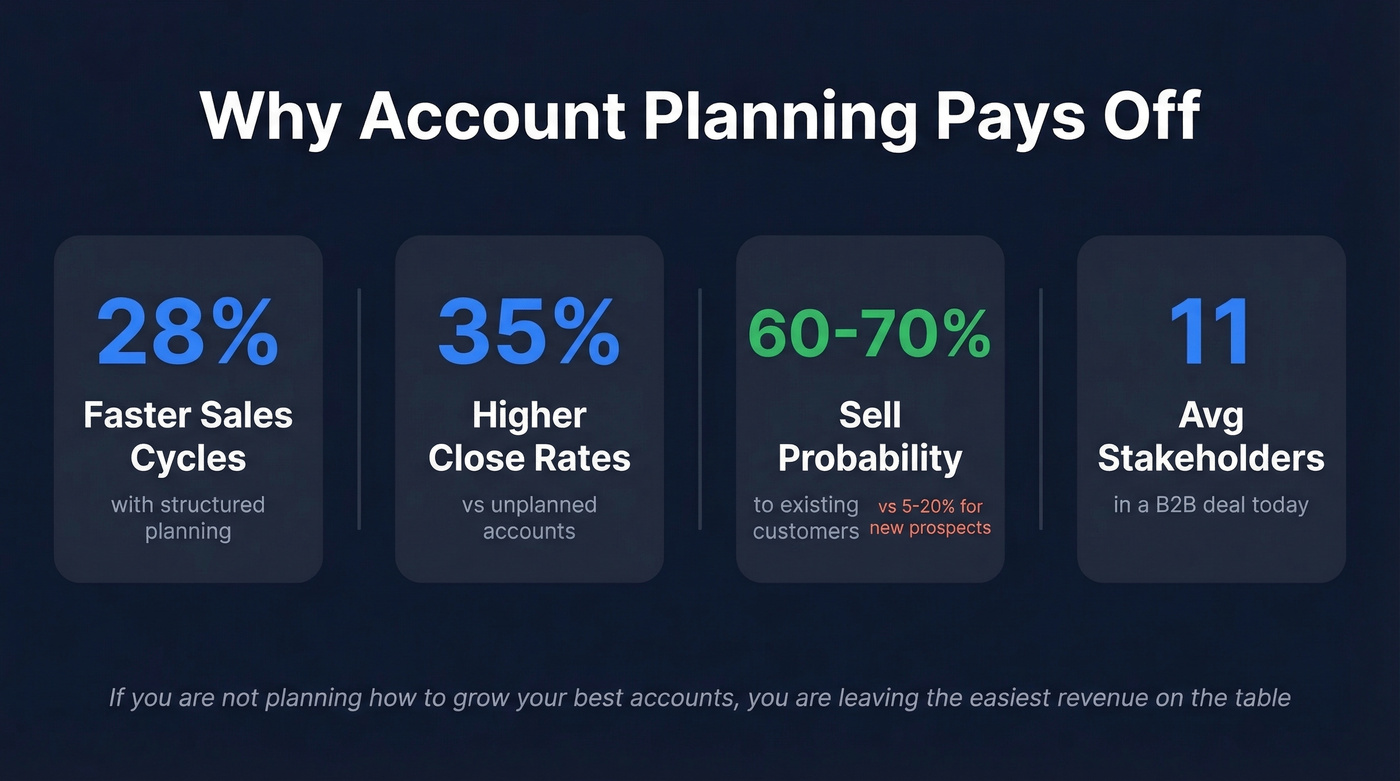
Here's the complexity problem: the average B2B deal now involves 11 stakeholders. You can't navigate that many relationships with a mental model and a few CRM notes. You need a map - who influences the decision, who controls the budget, who's your champion, and who's quietly blocking you. A rigorous planning process forces you to build that map before you need it, and that's what separates reps who close expansion deals from reps who get blindsided by stakeholders they never knew existed.
Then there's the time problem. Reps spend up to 65% of their time on non-revenue activities. A good plan cuts that waste by replacing "figure it out" with a specific list of actions, owners, and deadlines. Less scrambling, more selling.
Why Most Account Plans Fail
Look, most plans are QBR homework. A rep fills in a template the week before the quarterly business review, presents it to leadership, and then the document sits untouched until the next QBR. That's not planning. That's performance.
Ask any rep who's been through a few QBR cycles. We've seen reps with 20 plans who can't name the champion in a single one.
The core problem is the static vs. dynamic gap. A static plan is a quarterly chore - manual research, a snapshot of the org chart, some revenue targets, done. A dynamic plan is a living document connected to real-time signals: job changes, funding events, competitive moves, stakeholder departures. The static version is dead the moment it's finished.
Stale data is the silent killer. Org charts change constantly. If your stakeholder map was built months ago and hasn't been refreshed, it's probably outdated. Your "champion" left for another company. The economic buyer moved to a different division. You're executing against a ghost org chart.
The other failure pattern: trying to plan too many accounts. A rep with 20 shallow documents has nothing strategic. A rep with 5 deep plans has actual intelligence.

Stale org charts kill account plans. Prospeo refreshes 300M+ profiles every 7 days - not every 6 weeks like competitors. Build stakeholder maps with 98% verified emails and 125M+ direct dials so your account plans stay connected to real people, not ghost contacts.
Stop planning against an org chart that expired last quarter.
How to Build an Account Plan
Step 1: Tier Your Accounts
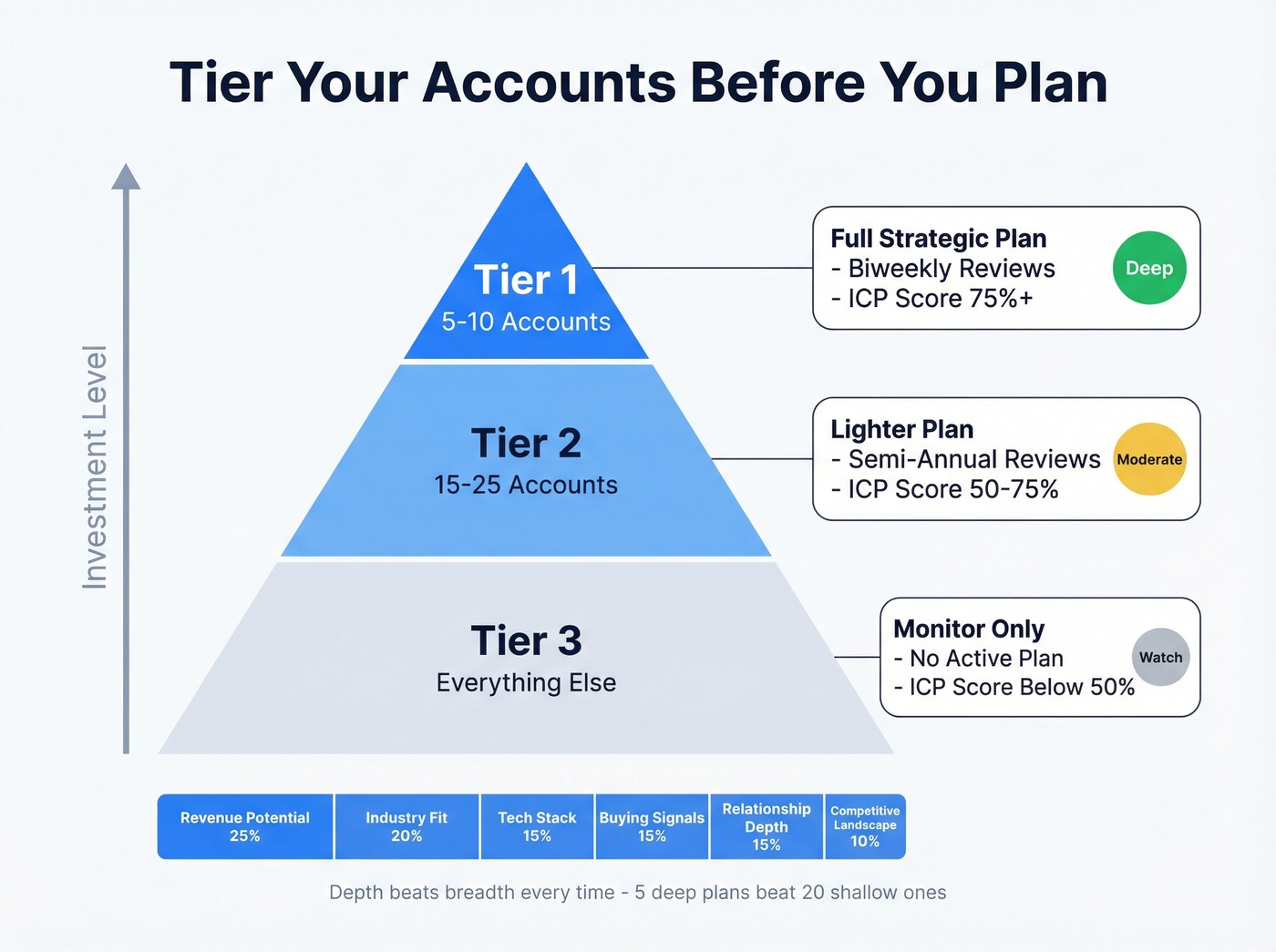
Not every account deserves a plan. Build an ICP scorecard with weighted criteria and score each account against them.
| Criteria | Weight | What to Evaluate |
|---|---|---|
| Revenue potential | 25% | Current spend + expansion opportunity |
| Industry fit | 20% | Alignment with your strongest verticals |
| Tech stack alignment | 15% | Compatibility with your product |
| Buying signals | 15% | Funding, hiring, leadership changes |
| Relationship depth | 15% | Champion access, exec relationships |
| Competitive landscape | 10% | Incumbent strength, switching cost |
Accounts scoring above 75% get a full strategic plan. The 50-75% range gets a lighter version. Below 50%, monitor but don't invest planning time. For tier sizing, aim for 5-10 Tier 1 accounts per team with biweekly reviews, 15-25 Tier 2 accounts with semi-annual reviews, and everything else as monitor-only.
Step 2: Research the Account
Before you touch a template, understand the business. What are their strategic priorities this year? Who are their competitors? What's happening in their industry? Look for compelling events - leadership changes, funding rounds, M&A activity, product launches, earnings calls that signal budget shifts.
This isn't about filling in a "company overview" box. It's about understanding the account well enough to have a conversation their current vendor can't. The research phase should take hours for a Tier 1 account, not minutes.
Step 3: Map Your Stakeholders
With 11 stakeholders in the average B2B deal, this is where most plans either succeed or fall apart. For each account, identify and categorize every relevant contact:
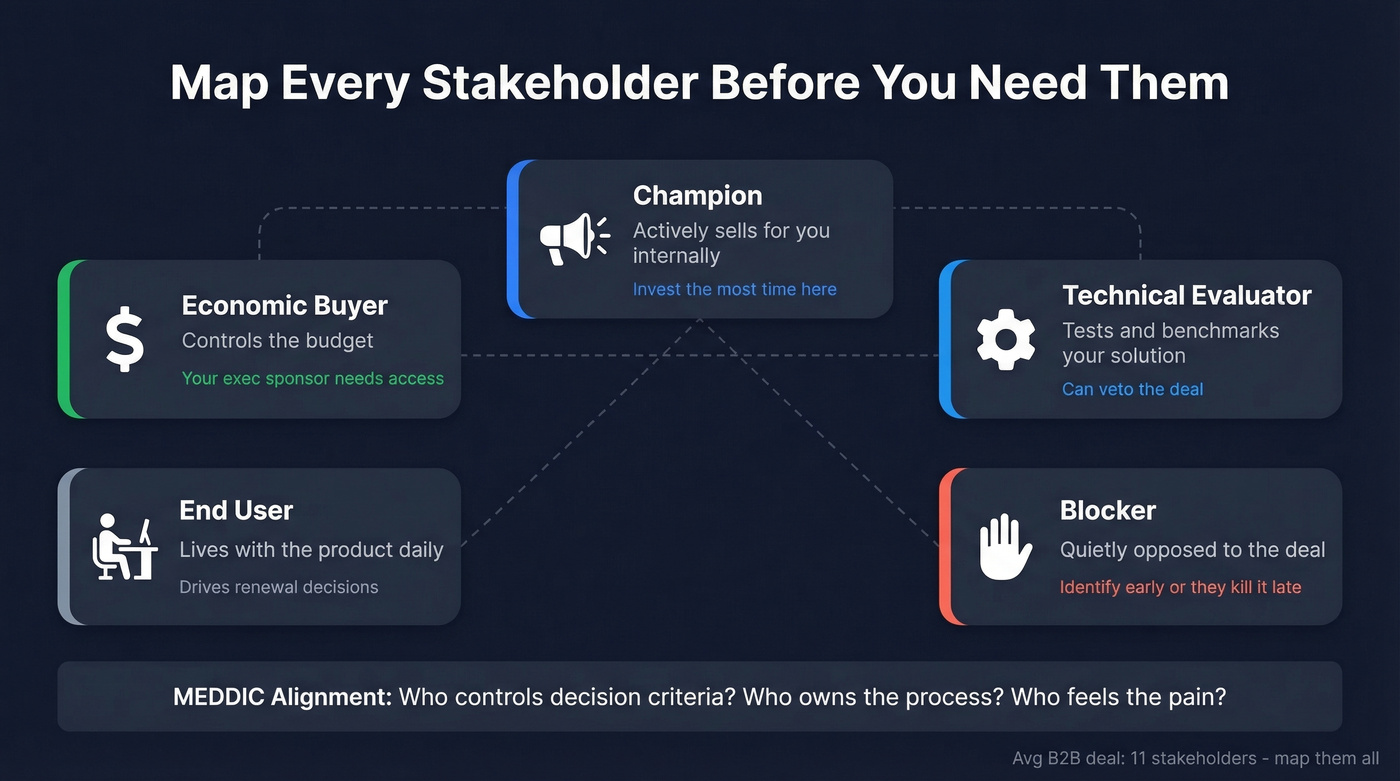
- Economic Buyer - Controls the budget. Your exec sponsor needs a line to this person. (More on this in our guide to the economic buyer.)
- Champion - Actively selling for you internally. Invest the most time here.
- Technical Evaluators - Will test, benchmark, and potentially veto your solution.
- End Users - Live with the product daily. Their satisfaction drives renewals.
- Blockers - Quietly opposed. Identify them early or they'll kill the deal late.
Map reporting relationships and influence patterns. Tie this directly to MEDDIC: who controls the decision criteria, who owns the decision process, and who's feeling the pain you solve?
Before you map anyone, verify they still work there. Prospeo refreshes contact data every 7 days and verifies emails at 98% accuracy - upload a target company, filter by department and seniority, and export verified contacts in minutes.

Step 4: Define Objectives and Whitespace
Now connect what you know about the account to specific growth opportunities. Where are you already delivering value? Where are there gaps - departments you haven't reached, products they haven't adopted, problems they're solving with a competitor or a manual workaround?
Align your objectives to their goals, not yours. "Expand to 50 seats" is your goal. "Help their ops team cut manual reporting by 40%" is their goal. Frame every objective from the customer's perspective, and the expansion takes care of itself. This is where account strategy becomes concrete - you're not pushing product, you're solving problems the customer already has.
Step 5: Build the Action Plan
This is where plans go from strategic to operational. Every action item needs three things: an owner, a due date, and a status.
❌ "Schedule executive sponsor meeting"
✅ "Sarah schedules VP-level intro with their CTO by March 15 - Status: Pending"
Be specific about every next step. Who's sending the case study? Who's coordinating the technical deep-dive? Who's nurturing the champion with relevant content? In our experience, the plans that actually drive revenue read like project trackers, not strategy decks.
Step 6: Review and Iterate
Review action items every two weeks. Not quarterly. Not monthly. Every two weeks. The biweekly cadence is non-negotiable - it's the difference between a living plan and a dead document.
The biweekly review doesn't need to be a formal meeting. A 15-minute standup where reps report on action item progress and flag blockers is enough. Revisit the full strategic plan quarterly. Update the stakeholder map, reassess whitespace, and adjust objectives based on what you've learned. Connect the plan to your CRM so updates flow both ways - deal stage changes should trigger plan reviews, and plan insights should inform deal strategy.
Three Phases of the Process
While the step-by-step above covers the tactical build, it helps to zoom out and see the three phases every successful team cycles through:
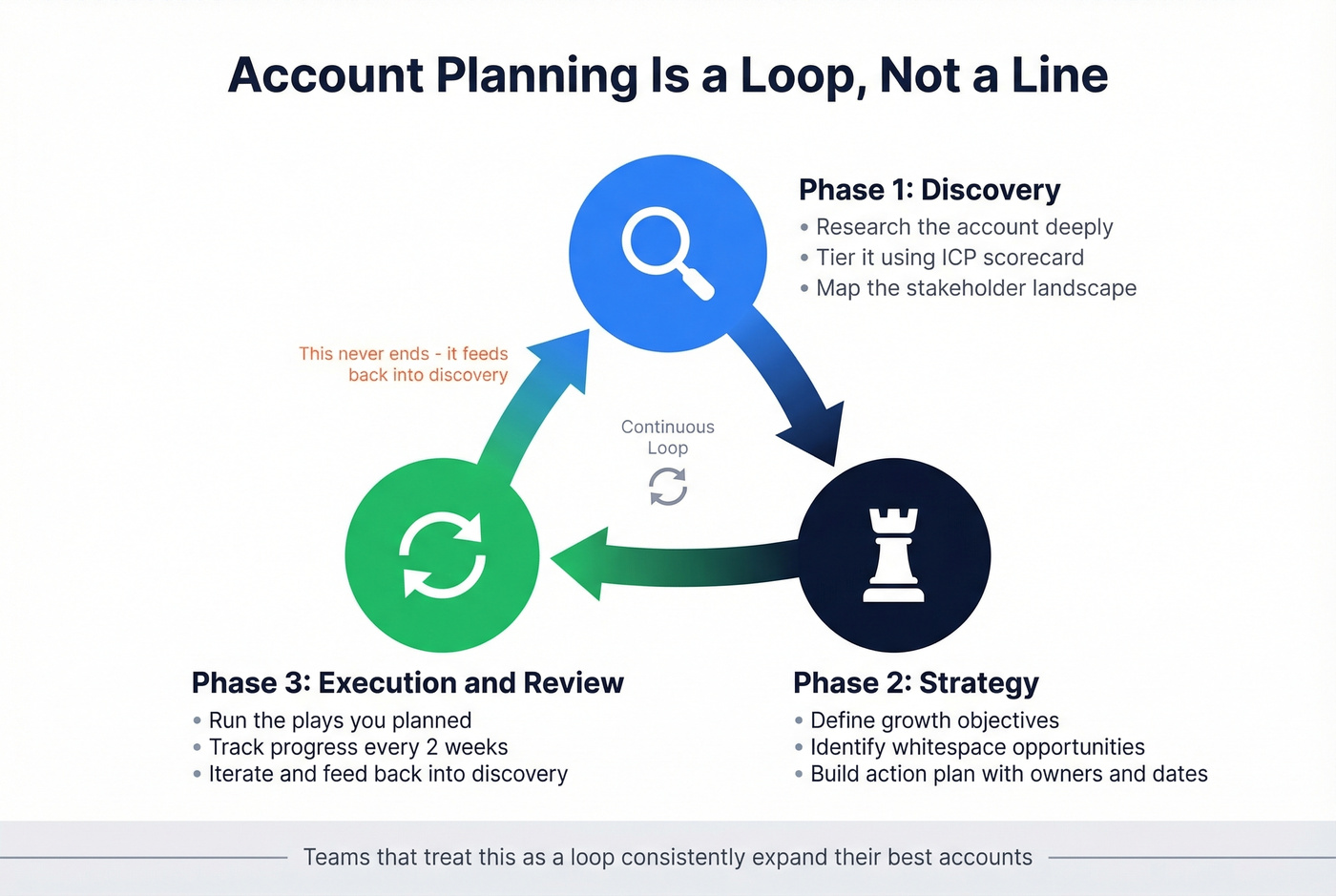
- Discovery - Research the account, tier it, and map the stakeholder landscape. This is where you invest time understanding the business before proposing anything.
- Strategy - Define objectives, identify whitespace, and build the action plan with owners and deadlines. Insight turns into a coordinated growth roadmap.
- Execution & Review - Run the plays, track progress biweekly, and iterate. This phase never truly ends - it feeds back into discovery as you learn more about the account.
Teams that treat these as a continuous loop rather than a one-time exercise are the ones that consistently expand their best accounts.
Frameworks for Stronger Plans
MEDDIC is the strongest framework for this discipline because it forces you to answer the questions that actually determine whether a deal closes. Companies adopting MEDDIC report 20-30% higher close rates.
Here's what each component maps to in your plan:
- Metrics - What quantifiable outcomes does the customer need? This defines your value proposition.
- Economic Buyer - Who controls the budget? This is the person your executive sponsor needs to reach.
- Decision Criteria - What factors will they evaluate? This shapes your competitive positioning.
- Decision Process - What steps do they follow to buy? This determines your timeline.
- Identify Pain - What problem are they trying to solve? This is your entry point.
- Champion - Who inside the account is actively selling for you? This is the person you invest in most.
Complement MEDDIC with a SWOT analysis for competitive positioning within the account - where you're strong, where you're vulnerable, and where competitors have an opening.
5 Mistakes That Kill Account Plans
1. Planning for too many accounts. If a rep has more than five full strategic plans, none of them are strategic. Limit plans to five per salesperson and make each one count. The rest get lighter treatment or monitoring only.
2. Internal focus instead of customer-centric. Plans built around "our revenue target" and "our product roadmap" miss the point. Every section should reflect the customer's objectives, initiatives, and challenges. If you can't articulate their top three priorities, you haven't done enough research.
3. No owners or due dates on action items. An action plan without accountability is a wish list. Every item needs a name, a date, and a status. Review these biweekly - not at the next QBR.
4. Annual review cadence instead of biweekly. Markets move. Stakeholders change. Competitors make moves. A plan reviewed once a year is fiction by month three.
5. Building stakeholder maps on stale contact data. Your champion left two months ago and you didn't notice. The new VP of Engineering isn't in your CRM. Contact data decays fast, and if your enrichment tool only refreshes every six weeks, your map is already behind.
Account Planning Tools
CRMs track transactions. KAM tools track relationships. You need both - and you need clean data feeding into everything.
| Category | Tool | Starting Price | Best For |
|---|---|---|---|
| Data & Enrichment | Prospeo | Free (75 emails/mo) | Verified stakeholder maps |
| Data & Enrichment | Apollo | ~$49/user/mo (annual) | Prospecting + sequences |
| CRM | Salesforce | Custom pricing | Enterprise sales teams |
| CRM | HubSpot | Free; Sales Hub ~$15/mo | SMB and mid-market |
| CRM | Pipedrive | $14-$79/user/mo | Small sales teams |
| KAM Platform | Kapta | Custom pricing | Mid-market key accounts |
| KAM Platform | DemandFarm | Custom pricing | Enterprise planning |
| KAM Platform | Altify | Custom pricing | Salesforce-native enterprise |
| Collaboration | Notion | Free; Plus ~$10/user/mo | Flexible plan templates |
| Collaboration | Asana | Free; paid plans vary | Cross-functional task tracking |
Real talk: most teams don't need a dedicated KAM platform. If you have fewer than 20 key accounts and your CRM is reasonably configured, a Notion workspace with a solid template and a data enrichment tool will get you 80% of the way there at 10% of the cost. KAM platforms like Kapta and DemandFarm earn their price tag when you're managing dozens of key accounts across multiple teams and need relationship health scoring, whitespace analytics, and org chart visualization that CRMs don't handle natively. Altify is the pick if you're already deep in the Salesforce ecosystem. Skip the KAM platform if you're a team of five with 10 accounts - you'll spend more time configuring it than using it.
The average B2B deal involves 11 stakeholders. Prospeo's 30+ search filters - including job changes, department headcount, and buyer intent across 15,000 topics - let you map every decision-maker in your Tier 1 accounts with verified contact data. At $0.01 per email, deep account intelligence costs less than a coffee.
Map all 11 stakeholders before your competitor finds the first one.
FAQ
What's the difference between account planning and account management?
Account management is day-to-day relationship work - renewals, support, check-ins. Account planning is the strategic layer: researching the account, mapping stakeholders, and building a revenue expansion roadmap. Management keeps the account healthy; planning makes it grow. A solid account management plan bridges both by turning strategic insights into daily AM priorities.
How many accounts should one rep plan for?
Cap it at five full strategic plans per rep. Tier 1 accounts (5-10 across the team) get deep plans with biweekly action reviews. Trying to plan 20+ accounts produces 20 useless documents nobody references after QBR.
How often should you update an account plan?
Review action items every two weeks and revisit the full strategic plan quarterly. If you're only touching the plan before QBR, it's already dead - the stakeholder map is stale and action items are irrelevant.
What frameworks work best?
MEDDIC is the strongest fit - it forces you to map the economic buyer, decision process, and champion, which are the exact elements that determine whether your plan translates into closed revenue. Complement it with SWOT for competitive positioning within the account.
How do you keep stakeholder data current?
Use a data enrichment tool with a fast refresh cycle. The industry average sits around six weeks, which means your stakeholder map is already outdated by the time you finish building it. Weekly refreshes and real-time email verification keep your map reflecting who's actually in-seat - not who was there last quarter.