

What Is Lead Enrichment (and Why Is Your CRM Full of Dead Data)?
Monday morning. Your SDR pulls up 200 "enriched" leads from last quarter's campaign. Forty-seven emails bounce before lunch. Another thirty have job titles from two roles ago. That's not a data problem - it's a lead enrichment failure that costs roughly 546 hours per year in wasted SDR productivity. About 30% of B2B contact records go stale within 12 months, and most teams don't notice until sequences start failing.
So what is lead enrichment, really? And why do so many teams still get it wrong?
The Short Version
- Lead enrichment = automatically filling in missing data on your leads - job title, company size, verified email, direct phone, intent signals - so reps can actually reach the right person.
- Your CRM data decays ~22.5% per year. Enrichment isn't a one-time project. It's ongoing, or it's worthless.
- The differentiator is verification and refresh frequency. Any tool can append data. The ones worth paying for verify it and keep it fresh.
Lead Enrichment Defined
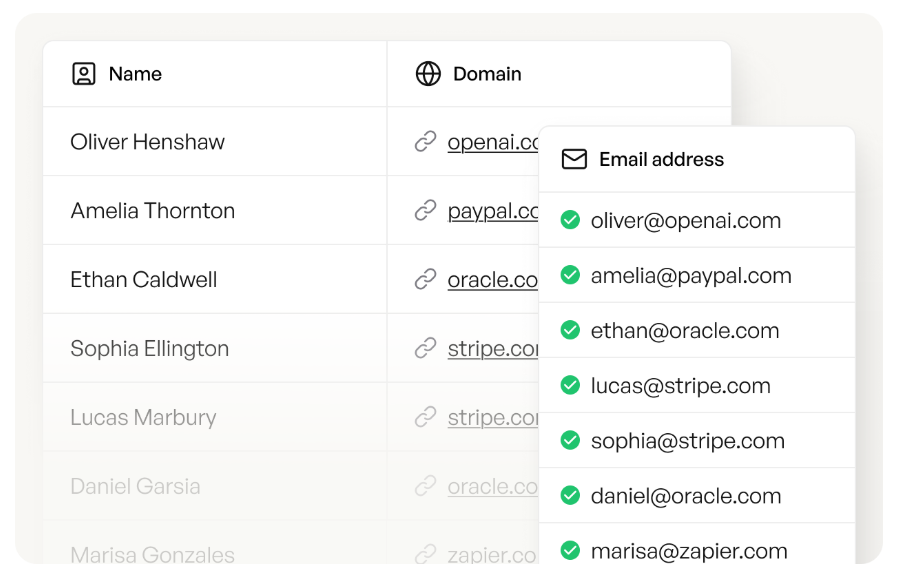
Lead enrichment is the process of gathering and appending additional data to existing lead records. A prospect fills out a form with their name and email. Enrichment fills in everything else: company size, industry, job title, seniority, tech stack, direct phone number, even buying intent signals.
It's not the same as data cleansing. Cleansing fixes what you already have - deduplication, formatting, removing invalid records. Enrichment adds what's missing. Most teams need both, but they solve different problems.
The data comes from two places: first-party sources like your CRM history, website behavior, and form submissions, and third-party providers that match leads against external professional databases. The best results come from combining both, and understanding the different types - real-time, batch, and waterfall - helps you decide which approach fits your workflow.
The Data Decay Problem
B2B data doesn't sit still. People change jobs, get promoted, switch companies, update phone numbers. The benchmark is brutal: ~22.5% annual decay across your entire database, with some fields rotting much faster than others.
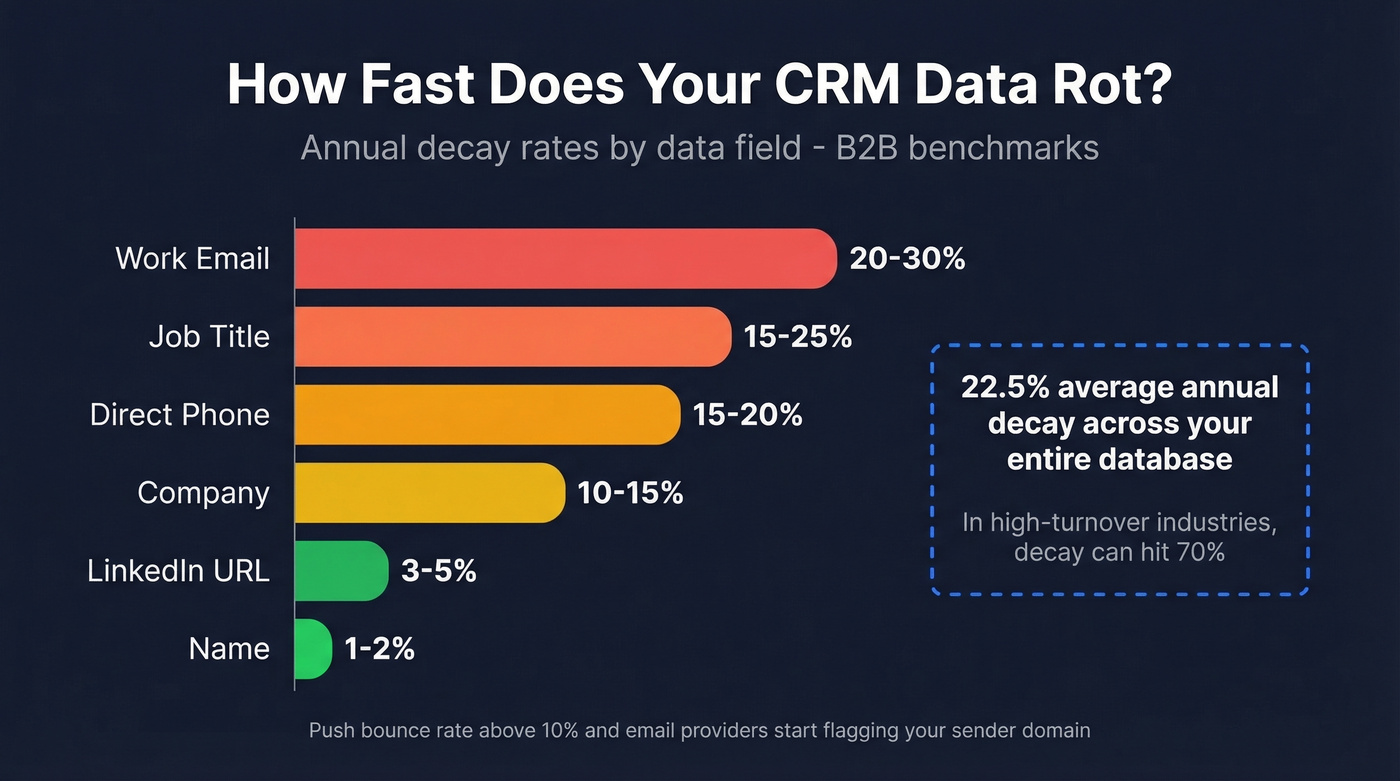
| Data Field | Annual Decay Rate |
|---|---|
| Work Email | 20-30% |
| Job Title | 15-25% |
| Direct Phone | 15-20% |
| Company | 10-15% |
| LinkedIn URL | 3-5% |
| Name | 1-2% |
Job titles decay fastest. In high-turnover industries, overall decay can hit 70%. Push your bounce rate above 10% and email providers start flagging your sender domain, reducing inbox placement by 15% or more. Even your good emails stop landing.
Here's the thing: with remote work now the default in many industries, mobile numbers have become more valuable than office direct dials. Your enrichment strategy should reflect that shift.
This is why refresh frequency matters more than database size. A provider that refreshes every six weeks is giving you stale data by design. Prospeo runs a 7-day refresh cycle against that six-week industry average - the difference between catching a job change in days versus months.
Types of Enrichment Data
What you need depends on your workflow - ICP matching, outreach execution, or timing. Choosing the right data types up front prevents you from paying for fields your reps never use.
| Category | What It Includes | Primary Use Case |
|---|---|---|
| Firmographic | Industry, size, revenue, HQ | ICP matching, routing |
| Demographic | Title, seniority, department | Persona targeting |
| Contact | Verified email, direct phone, mobile | Outreach execution |
| Technographic | Tech stack, platforms used | Solution-fit messaging |
| Intent | Topic research, content signals | Timing outreach |
| Financial | Funding, revenue growth, hiring | Prioritizing accounts |
Most teams start with contact and firmographic data because those directly feed outreach. Technographic and intent data come next - they're what separate spray-and-pray from targeted prospecting. If you're selling a Salesforce integration, knowing a prospect already runs Salesforce is worth more than knowing their zip code.
How Does It Work in Practice?
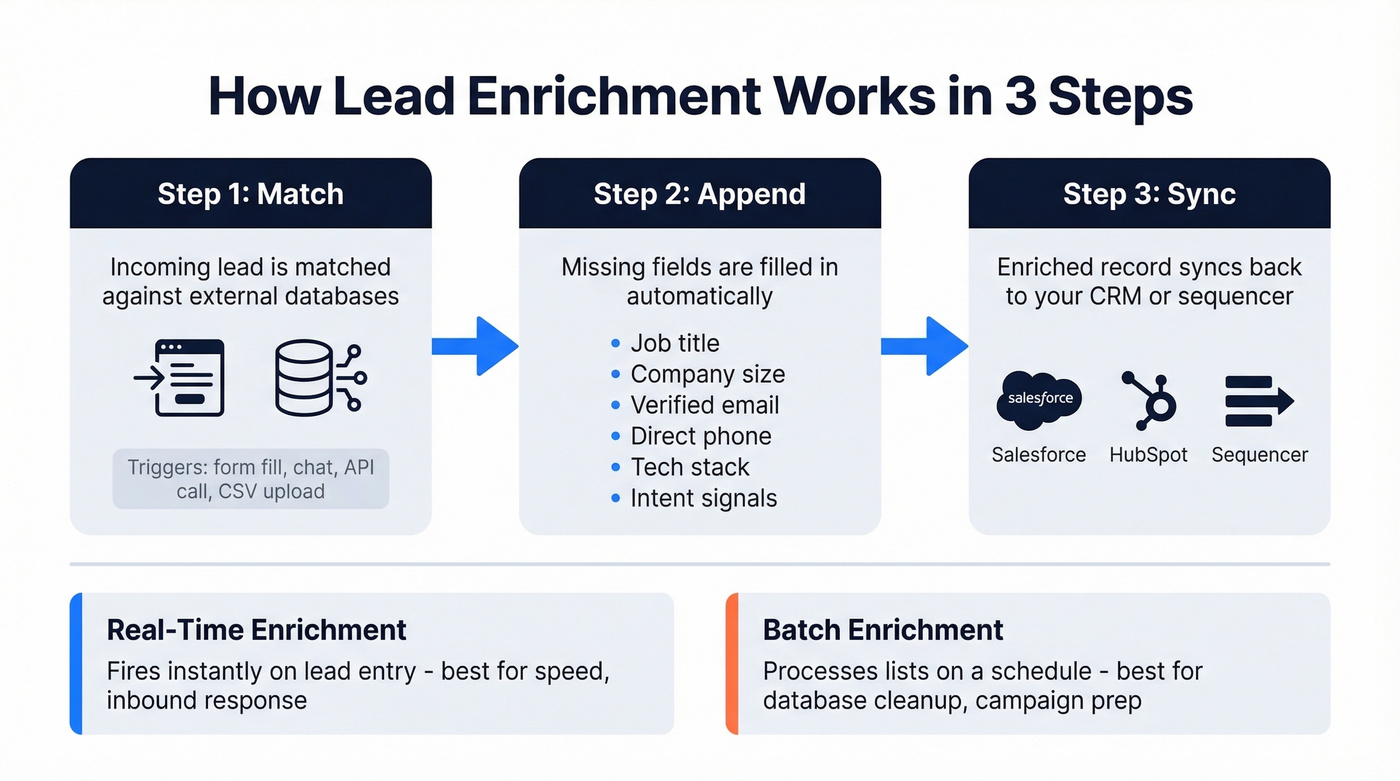
The core process is three steps: match the incoming lead against external databases, append the missing fields, and sync the enriched record back to your CRM or sequencer. How it plays out depends on whether you need speed or scale.
Real-Time vs. Batch
Real-time enrichment fires the moment a lead enters your system - form fill, inbound chat, API call. Responding within five minutes dramatically increases the chances of contacting and converting a lead. Picture 400 webinar registrants hitting your CRM simultaneously. You need enrichment and routing to happen before the SDR even opens Salesforce.
Batch enrichment processes a CSV or list on a schedule. Good for cleaning existing databases or prepping campaign lists. Cheaper, but slower.
Modern enrichment platforms increasingly use AI and NLP to improve this process - running real-time verification against multiple signals, extracting structured data from unstructured sources, and continuously refreshing records without manual triggers. Tools that don't invest in ML-powered verification are falling behind fast.
Waterfall Enrichment
No single enrichment provider covers everything. Match rates vary widely - expect 60-95% depending on your ICP, geography, and input data quality. That means a meaningful chunk of your leads come back empty from any one source.
Waterfall enrichment solves this by running leads through multiple providers sequentially. A concrete example: a Slack chatbot captures an inbound request, triggers a Clearbit lookup for firmographic data, then routes the enriched lead into Marketo for scoring and nurture - all without a human touching the record. You can layer in custom inference logic too, mapping a title like "Network Architect" to function: IT, subfunction: Networking, to improve routing accuracy.
This approach yields materially higher match rates than relying on a single provider. It's more complex to set up, but it's how serious RevOps teams operate.

Prospeo enriches CRM and CSV records with 50+ data points per contact at a 92% match rate - refreshed every 7 days, not 6 weeks. 98% email accuracy means your SDRs stop burning domains on dead addresses.
Stop enriching leads that bounce. Start with data that's verified this week.
Five Mistakes That Kill Your Pipeline
1. Relying on one provider. Every enrichment vendor promises 90%+ accuracy. The consensus on r/agency is more honest: "bounces shoot up and titles are outdated" regardless of which single tool you pick. Waterfall or go home.
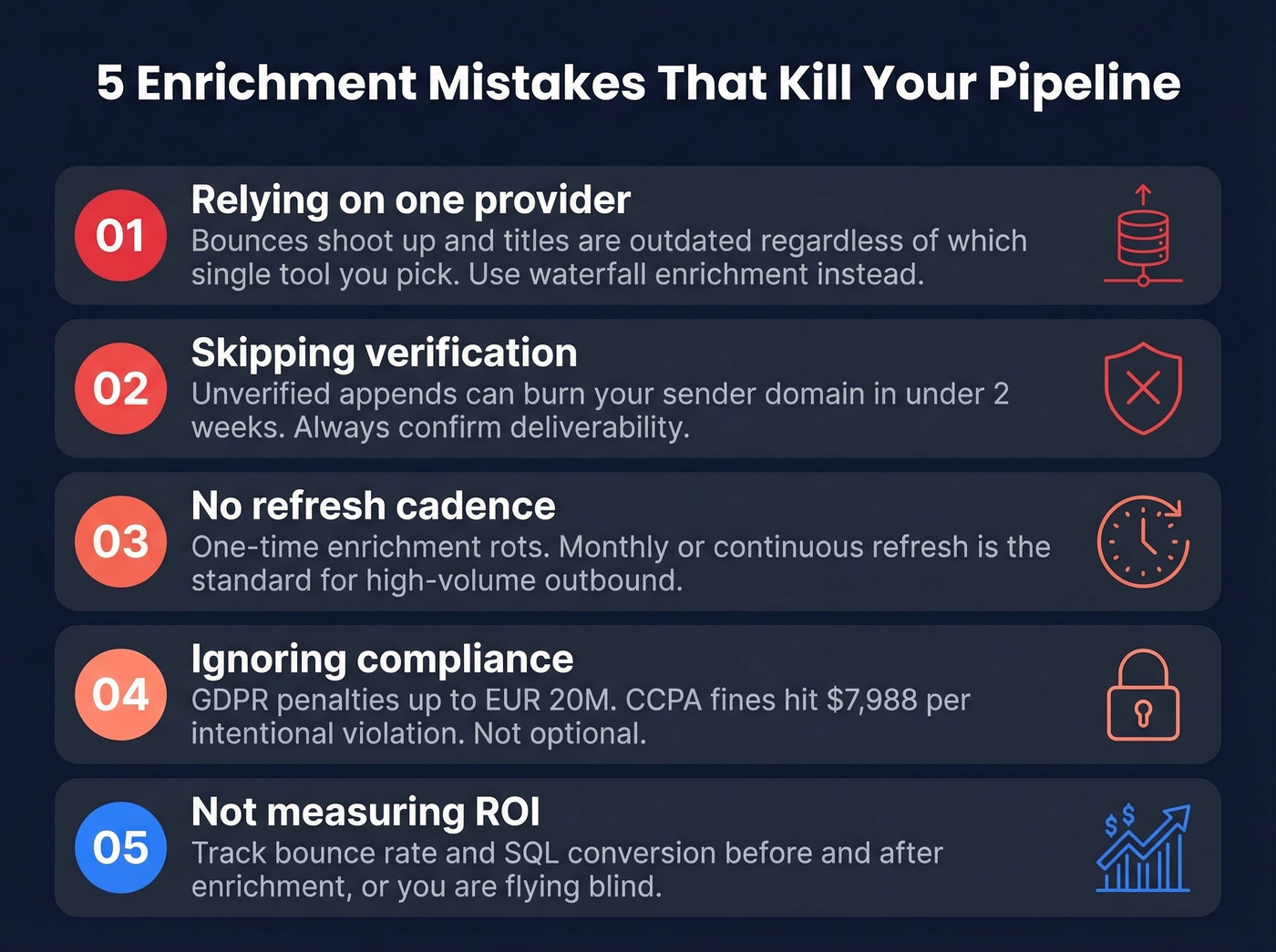
2. Skipping verification. Appending an email address means nothing if you don't confirm it's deliverable. This is the mistake that gets sender domains flagged. We've seen teams burn perfectly good domains in under two weeks because they trusted unverified appends. (If you're troubleshooting deliverability, start with email bounce rate benchmarks and fixes.)
3. No refresh cadence. One-time enrichment rots. If you enriched your database in January and haven't touched it since, a big chunk of those work emails are already dead. Quarterly refresh is a baseline; monthly or continuous enrichment is standard for teams running high-volume outbound.
4. Ignoring compliance. GDPR penalties run up to EUR 20M. CCPA fines hit $7,988 per intentional violation. "We didn't know" isn't a defense.
5. Not measuring ROI. If you aren't tracking bounce rate and SQL conversion before and after enrichment, you're flying blind. Tie it back to lead generation metrics so you can see the full funnel impact.
What It Costs in 2026
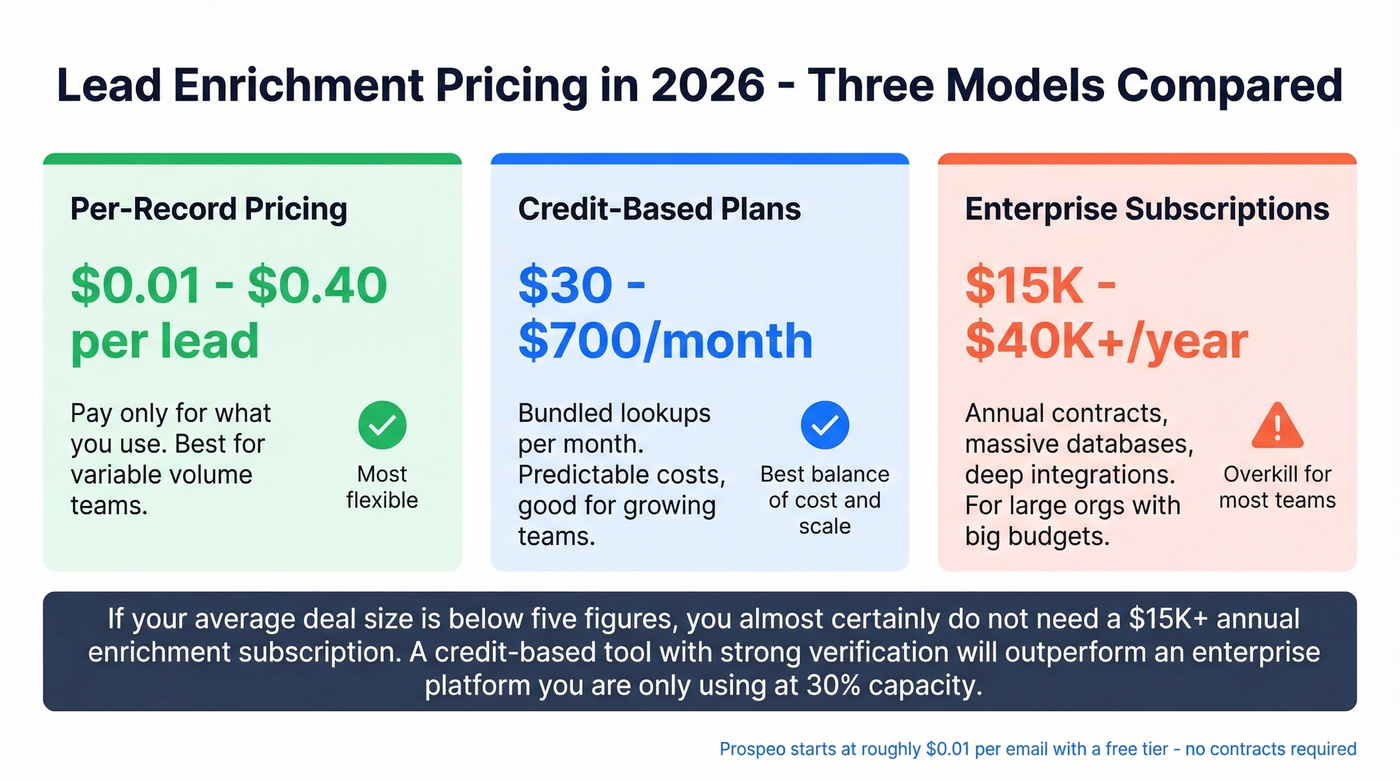
Pricing falls into three models. Per-record pricing charges $0.01-$0.40 per enriched lead. Credit-based plans bundle lookups per month for $30-$700/month. Enterprise subscriptions lock you into annual contracts at $15-40K+ per year.
| Tool | Pricing Model | Starting Price | Best For |
|---|---|---|---|
| Prospeo | Credit-based | ~$0.01/email; free tier | Teams wanting verified data without contracts |
| Apollo | Per-user sub | $59/user/mo (free tier) | All-in-one prospecting |
| Kaspr | Per-user sub | $49/user/mo (free plan) | EMEA contact data |
| Breeze Intelligence | Credit packs | $30-$700/mo | HubSpot-native enrichment |
| Enricher.io | Credit-based | $279/user/mo (10K credits) | High-volume API enrichment |
| ZoomInfo | Enterprise sub | ~$15-40K/yr | Large orgs, big budgets |
| Cognism | Enterprise sub | ~$1-3K/mo | EMEA compliance teams |
Let's be honest: if your average deal size sits below five figures, you almost certainly don't need a $15K+ annual enrichment subscription. A credit-based tool with strong verification will outperform an enterprise platform you're only using at 30% capacity.
Tools Worth Considering
You don't need 17 enrichment tools. You need two or three that verify their data and refresh it regularly. (If you're comparing vendors, our roundup of data enrichment services breaks down the tradeoffs.)
Prospeo
Prospeo solves the problem most enrichment tools create: data that looks complete but still bounces. The platform covers 300M+ professional profiles and returns 50+ data points per enrichment, with a 98% email accuracy rate backed by a proprietary 5-step verification process that includes catch-all handling, spam-trap removal, and honeypot filtering.
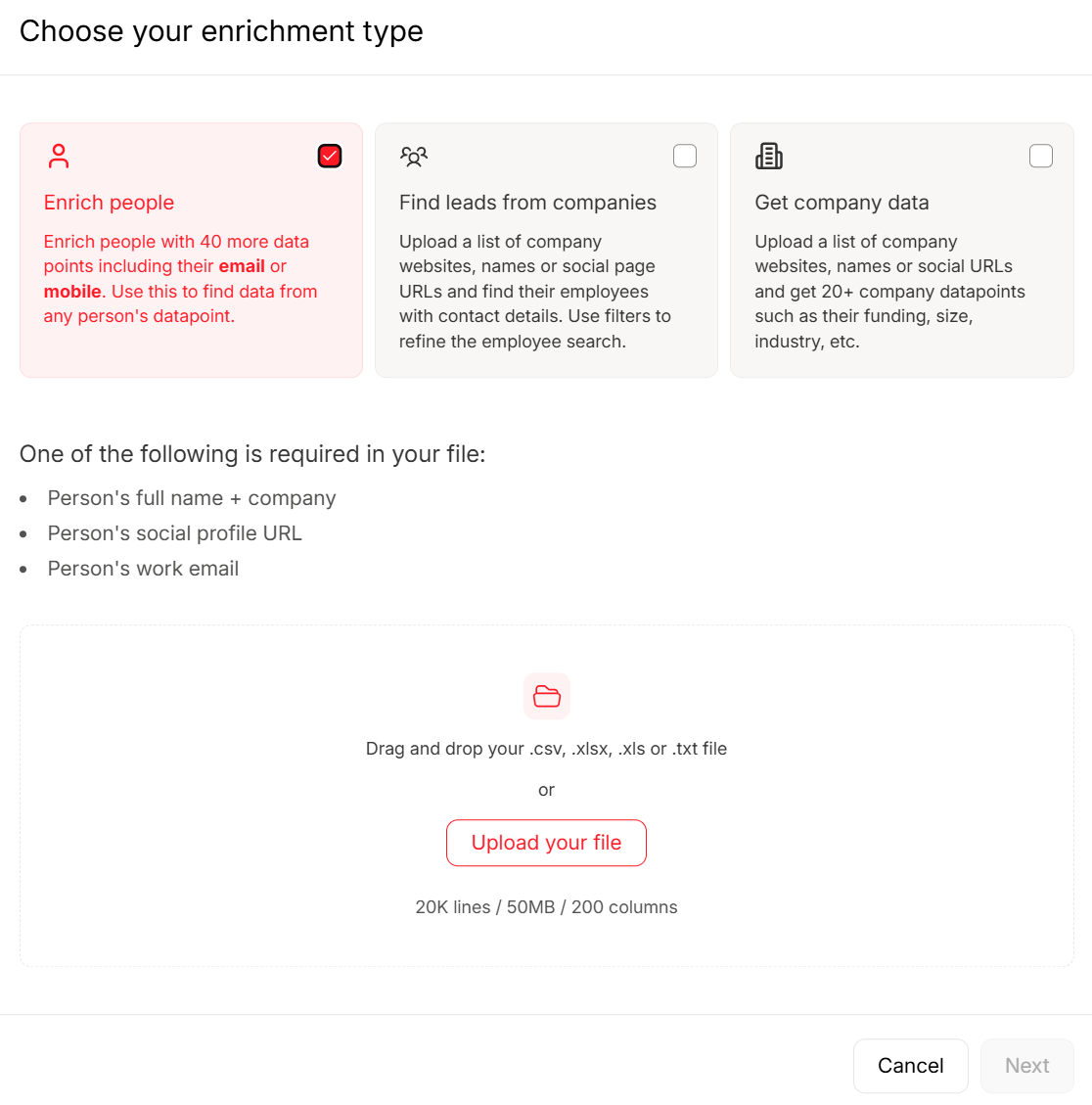
The 7-day refresh cycle is the real differentiator - it directly addresses the decay problem that makes most enrichment data unreliable within weeks. Intent data tracks 15,000 topics via Bombora, so you're layering buying signals alongside contact fields. Meritt went from a 35% bounce rate to under 4% after switching, tripling their pipeline from $100K to $300K per week. Pricing starts free with 75 emails/month, and paid plans run roughly $0.01 per email. No contracts required.
Waterfall enrichment works best when your primary source is already strong. Prospeo's 143M+ verified emails, 125M+ mobile numbers, and intent data across 15,000 topics give your pipeline a foundation that doesn't decay between refreshes.
Get enrichment that stays fresh at $0.01 per email - no contracts, no sales calls.
Apollo
Apollo bundles prospecting, sequencing, and enrichment into one platform with a 275M+ contact database and a generous free tier. Paid plans run $59-$149/user/month. For teams that want one tool handling everything from list building to email sequences, it's the obvious starting point. The tradeoff: email accuracy runs lower than dedicated verification tools, so high-volume outbound teams often need a separate verification step before launching sequences. If you're building a stack, start with a shortlist of SDR tools that cover prospecting + outreach.
ZoomInfo
The enterprise default - massive database, strong intent data, deep integrations. Also $15-40K+ per year with mandatory annual contracts. ZoomInfo wins on US database depth and workflow breadth, but it gets expensive fast once you add seats and modules. For a 10-seat Series A team, that's real money for features you'll never turn on.
Cognism
Skip this if you're selling exclusively into North America. But if EMEA is your market and GDPR compliance is non-negotiable, Cognism belongs on your shortlist. Custom pricing typically runs $1-3K/month, with strong European phone number coverage that most US-first providers can't match.
Breeze Intelligence (Clearbit)
Credit packs from $30-$700/month. If your entire stack runs on HubSpot, this is the simplest option for enrichment - but you're locked into that ecosystem, and the data depth doesn't match standalone providers.
Kaspr
European contact data at $49/user/month with a free plan. Solid for EMEA-focused teams who need accessible pricing without enterprise commitments. Pairs well with a verification tool for outbound campaigns.
Measuring Enrichment ROI
In our experience, the results compound faster than most teams expect. One mid-sized B2B SaaS company saw lead accuracy jump 62%, SQL-to-customer conversions rise 37%, and customer acquisition cost drop 21% after implementing enrichment. Email bounce rates went from 18% to under 4%. High-intent leads converted at 3.1x the rate of standard leads.
Cleaner data means better segmentation, tighter personalization, and fewer wasted touches. Track these KPIs to measure your own ROI:
- Email bounce rate - should drop below 4% with proper enrichment and verification
- SQL conversion rate - better data means better qualification (pair this with a clear lead scoring model)
- Customer acquisition cost - less waste on bad leads = lower CAC
- Speed-to-lead - enrichment should compress the time from form fill to first touch
Compliance: GDPR, CCPA, and Enrichment
Enrichment doesn't exempt you from privacy law. GDPR penalties run up to EUR 20M or 4% of global revenue. CCPA fines hit $7,988 per intentional violation.
For B2B enrichment, the most common lawful basis under GDPR is legitimate interest - but you need to document it. One flag most teams miss: if enriched data feeds automated decision-making like predictive lead scoring, GDPR Article 22 kicks in. Prospects have the right not to be subject to solely automated decisions with significant effects.
Your practical checklist: document your lawful basis for each enrichment use case, honor opt-outs promptly, audit your enrichment sources for compliance posture, and minimize fields to what you actually need. Data minimization isn't optional under GDPR - it's a core principle.
FAQ
What's the difference between lead enrichment and data cleansing?
Cleansing removes duplicates, fixes formatting errors, and deletes invalid records. Enrichment adds new data points - job title, company size, verified email, direct phone - to incomplete records. They solve different problems, and most teams need both running in parallel.
How often should I re-enrich my database?
At minimum, quarterly. B2B data decays ~22.5% per year, so monthly or continuous enrichment is standard for outbound-heavy teams. Tools with automatic 7-day refresh cycles handle this without manual intervention - compared to the six-week industry average, that's the difference between current data and stale records.
What's a realistic enrichment match rate?
Expect 60-95% depending on your ICP, geography, and input data quality. Email plus company domain inputs produce the highest matches. Waterfall enrichment across multiple providers pushes you toward the top of that range.
Can I use enriched data for cold outreach under GDPR?
Yes, if you have a lawful basis - typically legitimate interest for B2B outreach. You must document that basis, honor opt-outs promptly, and only collect data fields you actually need.
What's waterfall enrichment?
Running a lead through multiple enrichment providers sequentially. If Provider A can't find a verified email, the lead passes to Provider B, then C. This approach yields higher match rates than any single provider, which is why serious RevOps teams treat it as standard practice.
Your CRM is decaying right now - roughly 22.5% of it will be dead by this time next year. The question isn't whether you need lead enrichment. It's whether you'll set up a system that keeps data fresh automatically, or keep losing 546 hours a year chasing ghosts.