

What Is MBO in Sales? Guide + Scorecard Template (2026)
Your VP of Sales just announced that next quarter, 20% of variable comp is shifting from commission to MBOs. Your top AE is already updating their resume. That reaction tells you everything about how most companies implement Management by Objectives - and why it's worth understanding how to do it right.
MBO stands for Management by Objectives, a compensation mechanism that rewards reps for hitting specific, measurable goals beyond standard quota attainment. Peter Drucker coined the term in his 1954 book The Practice of Management, and the framework has since been adopted by companies like Hewlett-Packard, Xerox, and Intel. The core idea is simple: instead of paying reps only when revenue hits the bank, you define strategic objectives - pipeline quality, account penetration, CRM hygiene, customer retention - and tie real money to them.
The distinction from commission matters. Commission is transactional: close deal, get paid. MBOs reward predefined, measurable objectives aligned to company strategy, which means they can incentivize work that doesn't show up on a bookings report but absolutely drives long-term revenue.
MBOs are getting more attention for good reason. Remote and hybrid teams make activity harder to observe, AI tools are reshaping rep workflows, and quarterly agility matters more than annual planning cycles. MBOs give leaders a structured way to reward the behaviors that matter right now.
Here's the thing: MBOs are the right tool for complex sales roles - and the wrong tool for everything else. If your sales cycle is short and high-velocity and attribution is clean, just pay commission. Don't overcomplicate it.
Do You Actually Need MBOs?
Before you redesign your comp plan, run through this checklist:
- MBO = Management by Objectives - a comp mechanism rewarding reps for hitting specific, non-commission goals.
- Best for: complex sales cycles, non-revenue work (SEs, CSMs), strategic account management.
- Skip MBOs if: your cycle is short and attribution is clean. Commission works fine.
- Bonus sizing rule: SHRM guidance recommends MBO-related bonuses represent at least 10% of a rep's compensation package. Teams that set MBO pools at 5% of variable often wonder why nobody changes behavior.
- Three objectives max. If a rep can't recite them from memory, the plan is broken.
MBO vs OKR vs KPI
These three acronyms get thrown around interchangeably. They shouldn't. They solve different problems.
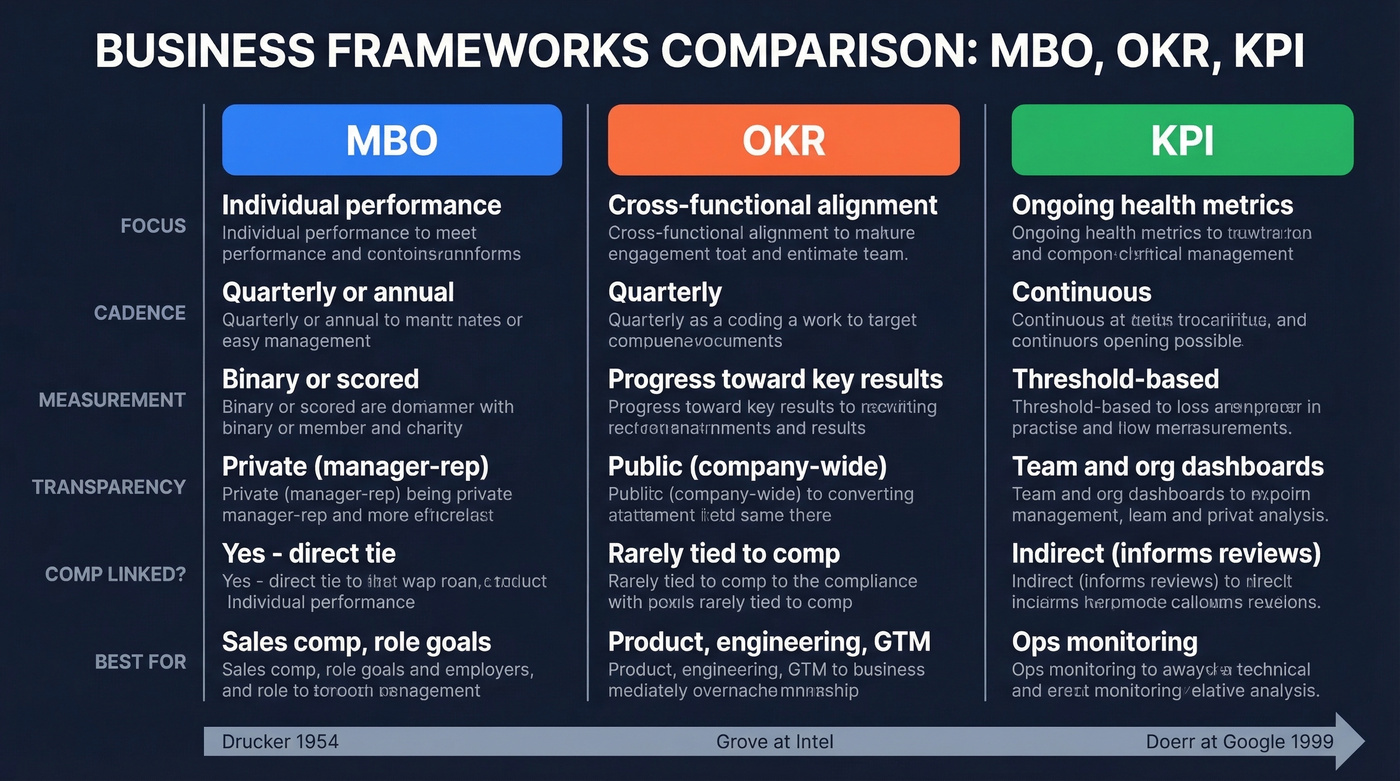
| Dimension | MBO | OKR | KPI |
|---|---|---|---|
| Focus | Individual performance | Cross-functional alignment | Ongoing health metrics |
| Cadence | Quarterly / annual | Quarterly | Continuous |
| Measurement | Binary or scored | Progress toward key results | Threshold-based |
| Transparency | Manager-rep (private) | Company-wide (public) | Team/org dashboards |
| Reward linkage | Direct comp tie | Rarely tied to comp | Indirect (informs reviews) |
| Best for | Sales comp, role-specific goals | Product, engineering, GTM alignment | Ops monitoring |
OKRs evolved from MBOs - Andy Grove adapted Drucker's framework at Intel, and John Doerr carried the evolved version to Google in 1999. The key evolution was making goals public and collaborative rather than top-down and comp-linked.
The decision rule is straightforward. Use MBOs when goals tie to comp. Use OKRs for cross-functional alignment. Use KPIs to track ongoing health.
How MBO Compensation Works
MBO comp follows a cascade: company priorities flow down to team objectives, which translate into individual goals. Each objective needs to be SMART - specific, measurable, achievable, relevant, and time-bound. "Improve pipeline quality" isn't an MBO. "Increase average deal size to $45K by Q2 end" is.
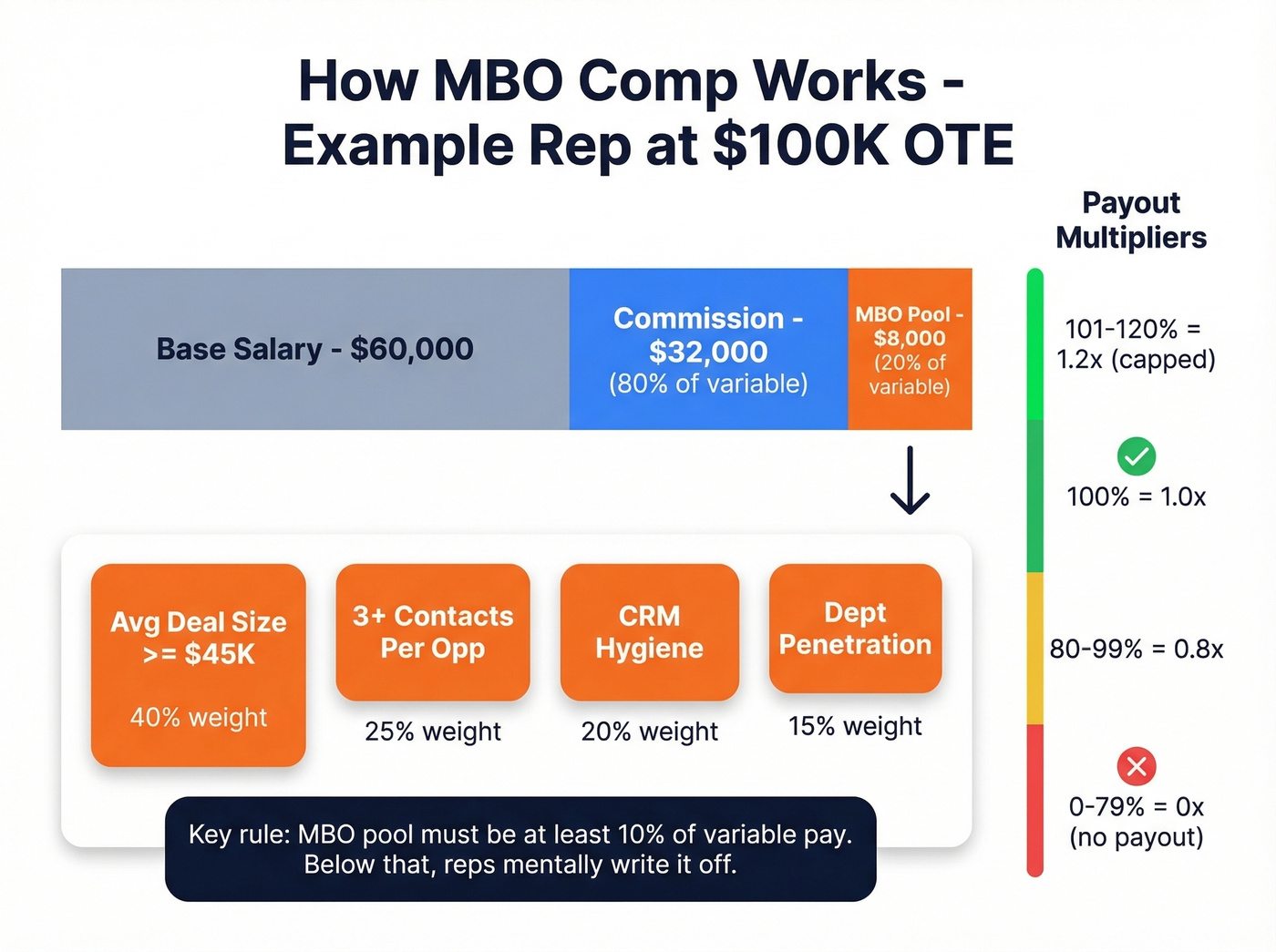
The math sits inside your existing variable pay structure. Most sales orgs run a 60/40 or 70/30 base-to-variable split, with the variable portion divided between commission and MBO bonuses. The MBO component typically represents 10-20% of variable pay. For a rep with $100K OTE on a 60/40 split, the $40K variable breaks down as $32K commission and $8K MBO pool.
That 10% floor matters. Anything less and reps mentally write it off - it's not worth changing behavior for $2K when a single deal pays more.
With average quota attainment sitting at just 74%, management by objectives gives leadership a way to reward productive behavior even when bookings fall short. Most plans pay out quarterly, with partial attainment tiers so reps don't feel like it's all-or-nothing.
One stat that should worry every comp admin: 66% of companies have over- or underpaid commissions in the past year. Adding MBO complexity to an already error-prone process requires clean tracking and clear scoring bands.

Your reps can't hit multi-threading MBOs if they can't find verified contacts. Prospeo gives AEs 300M+ profiles with 98% email accuracy and 125M+ verified mobiles - so "3+ contacts per opportunity" stops being aspirational and starts being automatic.
Give your reps the data to actually hit their MBOs.
Sales MBO Examples by Role
AE Objectives
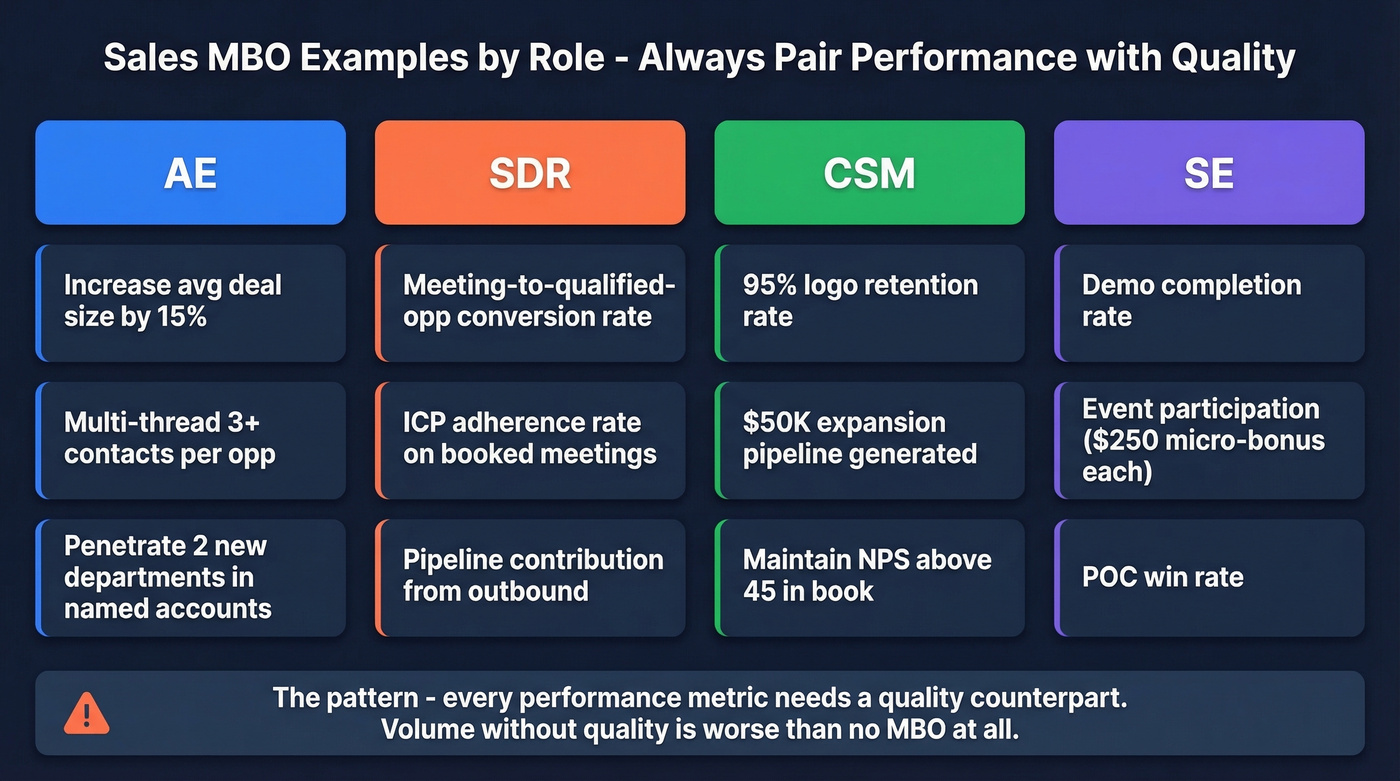
AEs typically get MBOs around deal quality and strategic behavior: increase average deal size by 15%, multi-thread into 3+ contacts per opportunity, or penetrate two new departments within named accounts. These objectives push AEs beyond "close anything that moves" toward deals that actually stick and expand over time, which is exactly the kind of behavior that commission alone won't reward. (If you're building the activity layer behind these goals, start with a clean list of sales activities that map to pipeline outcomes.)
SDR Objectives
SDR MBOs should kill activity theater. The objectives that actually work:
- Percentage of meetings converting to qualified opportunities
- ICP adherence rate - are they booking meetings with the right personas?
- Pipeline contribution from outbound versus inbound
We've watched SDR teams hit 150% of meeting targets while generating zero pipeline. Volume MBOs without quality counterparts are worse than no MBOs at all. If you're rebuilding the outbound motion, borrow a few proven sales prospecting techniques before you lock the scorecard.
CSM Objectives
Retention rate, expansion revenue, and NPS form the CSM trifecta. A CSM MBO might target 95% logo retention, $50K in expansion pipeline generated, or maintaining an NPS above 45 within their book of business. These are the roles where MBOs shine brightest, because CSMs rarely have a clean commission trigger but absolutely drive revenue through renewals and upsells. (For retention-heavy scorecards, it helps to standardize your churn analysis inputs first.)
SE Objectives
Your SE team spent 30% of last quarter on webinars, demos, and internal training. Their commission checks don't reflect any of it.
MBOs solve exactly this problem. SE objectives might include demo completion rates, event participation with micro-bonuses like $250 per event, technical training delivery, or POC win rates. In our experience, SEs are the role where MBOs make the single biggest difference in perceived fairness. Looking across these examples, the pattern is clear: the best objectives pair a performance metric with a quality counterpart.
MBO Scorecard Template
Most MBO plans fail at the scoring stage because nobody built a clear payout model upfront. Here's a plug-and-play scorecard with real numbers.
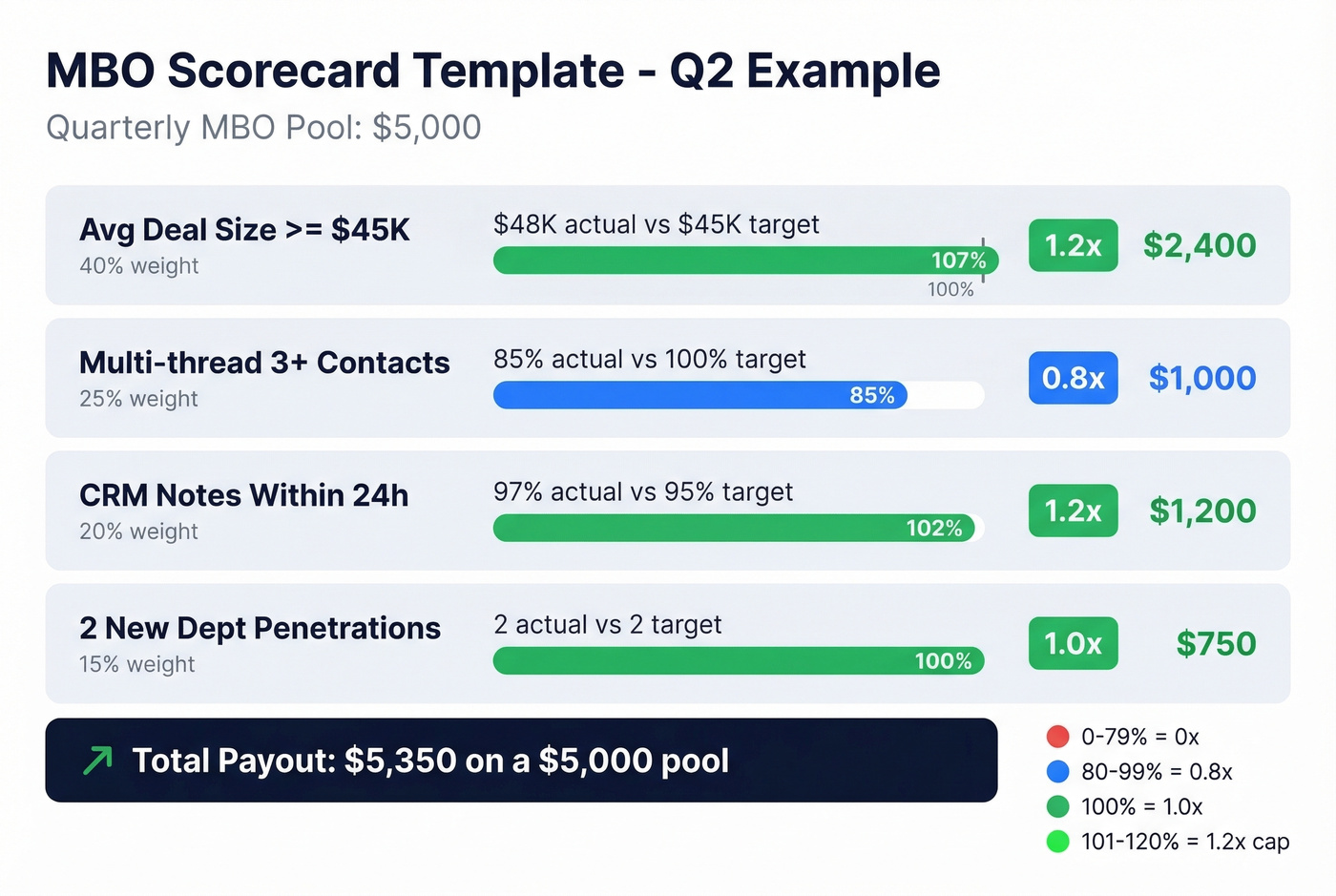
Assumptions: $5,000 quarterly MBO pool. Four objectives weighted to 100%.
| Objective | Weight | Target | Actual | Score | Payout |
|---|---|---|---|---|---|
| Avg deal size >= $45K | 40% | $45,000 | $48,000 | 107% -> 1.2x | $2,400 |
| 3+ contacts per opp | 25% | 100% | 85% | 85% -> 0.8x | $1,000 |
| CRM notes within 24h | 20% | 95% | 97% | 102% -> 1.2x | $1,200 |
| 2 new dept penetrations | 15% | 2 | 2 | 100% -> 1.0x | $750 |
| Total | 100% | $5,350 |
Scoring bands:
- 0-79% attainment = 0x (no payout)
- 80-99% = 0.8x
- 100% = 1.0x
- 101-120% = 1.2x (capped at 120%)
The cap matters. Without it, reps game one objective at the expense of others. The 0-79% cliff matters too - it signals that "close enough" doesn't count. This rep earned $5,350 on a $5,000 pool because they overperformed on three objectives and still got partial credit on the one they missed.
Why Reps Distrust MBOs
Let's be honest: you've probably been handed an MBO plan where the objectives were vague, the scoring was subjective, and the payout showed up three months late. That's not an MBO problem. That's a leadership problem.
A common concern in practitioner discussions - and one that comes up constantly on r/sales - is that MBOs are "far less quantifiable" than commission and therefore easier for leadership to manipulate. Goalposts move mid-quarter. Scoring feels arbitrary. Reps see MBOs as a way to extract extra daily labor without fairly compensating it.
The Wells Fargo disaster is the extreme version: 5,300+ employees created sham accounts because incentives rewarded a single metric without a quality check. The fix is paired metrics - every performance indicator needs a quality counterpart. "Meetings booked" pairs with "meetings that convert." "Accounts opened" pairs with "account profitability at 90 days."
Research by Rodgers & Hunter (1991) found that companies with high CEO commitment to MBO showed a 56% gain in productivity versus just 6% where leadership treated it as a checkbox exercise. Most MBO plans fail because leadership treats them as a cost-control lever, not a performance tool.
There's a more fundamental issue most comp teams overlook: the data itself. MBOs tied to meetings booked or pipeline created are only as reliable as the contact data feeding them. If a quarter of your emails bounce, reps miss targets through no fault of their own. Tools like Prospeo verify emails at 98% accuracy on a 7-day refresh cycle, so MBO measurements reflect actual performance rather than data decay. If you're diagnosing why outreach isn't converting, start with your email bounce rate and work backward.
How to Implement MBOs in 5 Steps
1. Define 2-3 company priorities for the quarter. Not ten. Not five. Two or three. Revenue growth, market expansion, customer retention - pick the ones that actually matter right now. We've seen teams run five or six objectives per rep. It never works.
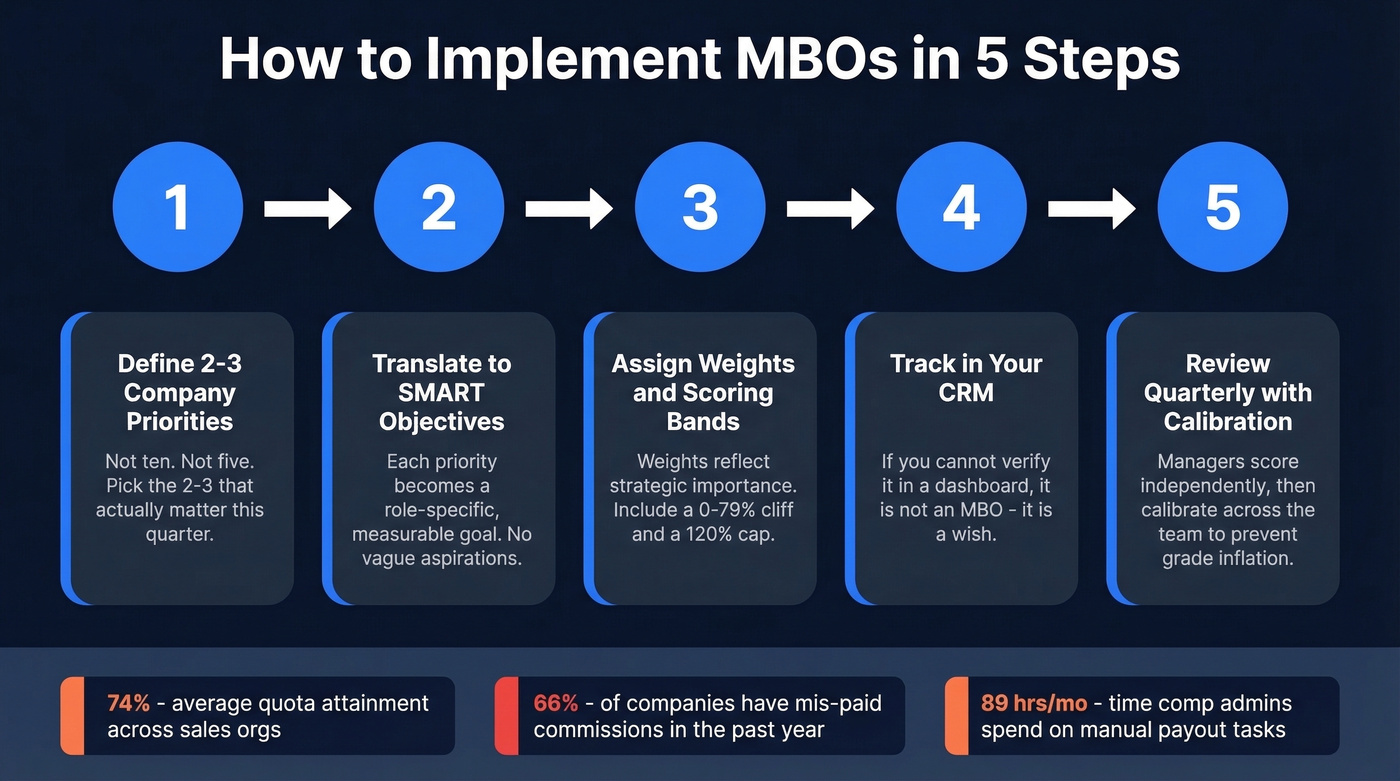
2. Translate into SMART objectives per role. Each priority becomes a role-specific, measurable goal. "Improve retention" for the company becomes "maintain 95% logo retention within your book" for CSMs.
3. Assign weights and scoring bands. Use the scorecard template above. Weights should reflect strategic importance - don't spread them evenly just to seem fair.
4. Track in your CRM with system-verifiable metrics. If you can't verify it in your CRM, it's not an MBO - it's a wish. Every objective needs a dashboard or report that both the rep and manager can see in real time. For outbound-activity objectives, verified contact data is non-negotiable; otherwise you're scoring reps on noise. If your CRM setup is messy, it’s worth tightening the basics of sales process optimization before you roll MBOs out.
5. Review quarterly with calibration sessions. Managers score independently, then calibrate across the team to prevent grade inflation. Comp admins already spend 89 hours per month on manual payout tasks - don't add to that burden with ambiguous scoring. If you're formalizing the cadence, a lightweight QBR structure can keep reviews consistent.
SDR MBOs only work when reps prospect the right personas. Prospeo's 30+ filters - buyer intent, technographics, department headcount - ensure every meeting is ICP-qualified. At $0.01 per email, better targeting costs less than bad meetings.
Kill activity theater with data that hits the right accounts.
FAQ
What does MBO stand for in sales?
Management by Objectives - a compensation framework that rewards reps for hitting specific, measurable goals beyond standard commission. Common objectives include deal quality, account penetration, CRM hygiene, and customer retention metrics tied directly to quarterly payouts.
How much should an MBO bonus be?
At least 10% of a rep's total compensation package. Below that threshold, the incentive won't change behavior. Most effective plans allocate 10-20% of variable pay to MBOs, with quarterly payouts and partial-attainment tiers.
How do you track MBO attainment?
Every objective needs a system-verifiable metric in your CRM - no spreadsheet honor systems. For outbound-activity MBOs, verified contact data keeps scoring accurate by ensuring bounced emails and bad numbers don't skew results.
Can these sales MBO examples scale across team sizes?
The examples in this guide scale from individual contributors to full teams. For smaller orgs, start with one or two objectives per rep - deal size and CRM hygiene are the most common starting points. Larger teams can layer in role-specific objectives like the AE, SDR, CSM, and SE examples outlined above, adjusting weights based on quarterly priorities.