

What Is Mid-Market? The Only Guide That Reconciles Every Definition
Your new VP of Sales says mid-market means 500+ employees. Your CRO says it's $50M+ in revenue. The board deck from last quarter defines it as "$10M-$1B." Everyone's right, and that's the problem.
Mid-market is one of the most used and least agreed-upon terms in B2B, and the definition you pick has real consequences for territories, comp plans, and pipeline targets. Understanding what mid-market actually means - and how it differs from adjacent segments - is the first step to building a sales motion that works.
Quick Answer: The Baseline
The most widely accepted baseline comes from the National Center for the Middle Market (NCMM): $10M-$1B in annual revenue. That covers roughly 200,000 U.S. companies and about one-third of U.S. private-sector gross receipts.
For sales and GTM purposes, employee count is more actionable - most teams land on 100-2,000 employees - because revenue is nearly impossible to verify for private companies. Gartner narrows the revenue band to $50M-$1B and defines midsize by either revenue or headcount (100-1,000 employees).
There's no single correct definition. The one that matters is the one your org uses to assign territories and comp plans. Everything below helps you pick yours.
Common Segmentation Definitions
Five respected authorities draw the line in five different places.
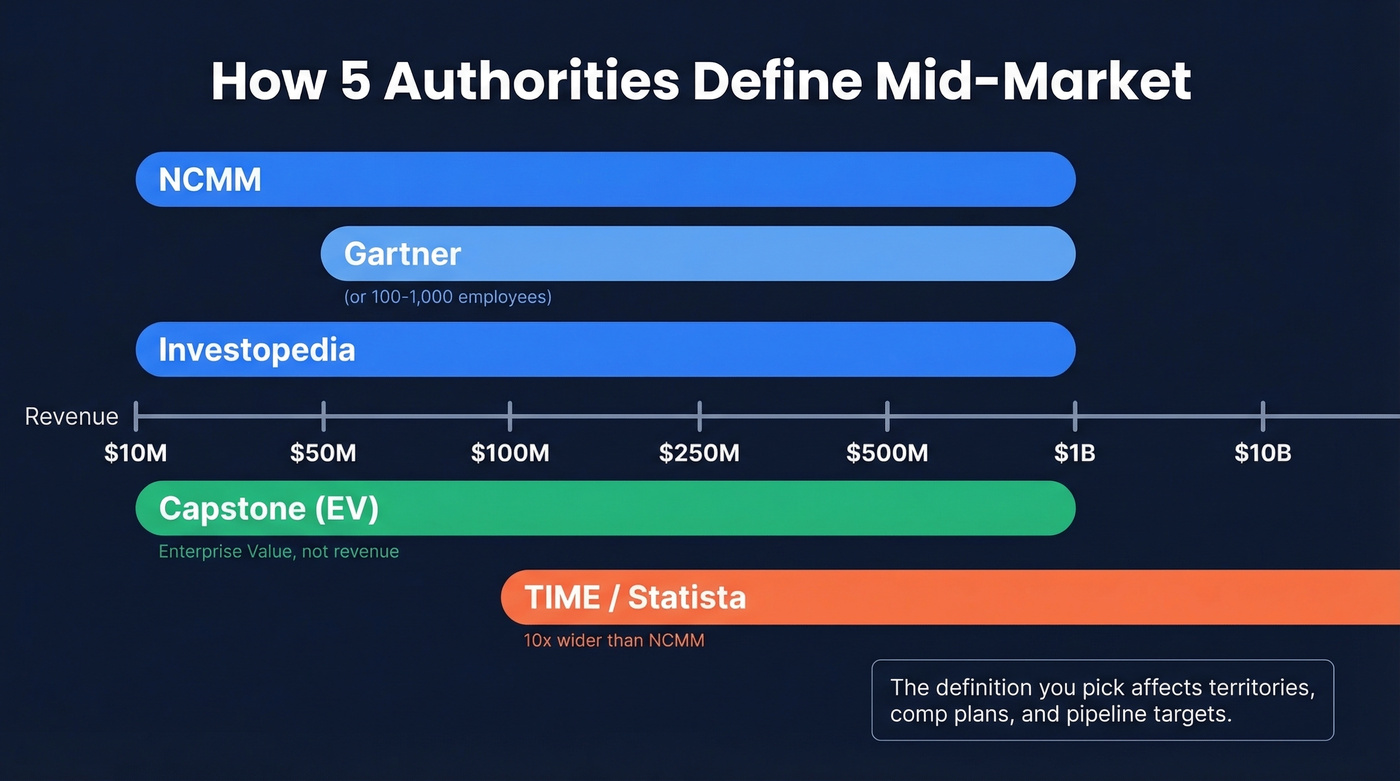
| Source | Revenue Range | Employee Range | Notes |
|---|---|---|---|
| NCMM | $10M-$1B | - | Most cited baseline |
| Gartner | $50M-$1B | 100-1,000 | Revenue or headcount |
| Investopedia | $10M-$1B | - | Commonly cited baseline |
| Capstone | $10M-$1B (EV) | 100-2,000 | Enterprise value |
| TIME Best Midsize (Statista) | $100M-$10B | - | 10x wider than NCMM |
That TIME ranking deserves a double-take. Their "midsize" eligibility goes up to $10B in revenue - ten times the NCMM ceiling. A company that's solidly "enterprise" under one framework qualifies as "midsize" under another.
The NCMM Standard ($10M-$1B Revenue)
The National Center for the Middle Market provides the most commonly referenced definition: businesses earning between $10M and $1B in annual revenue. This covers 200,000+ U.S. companies, about one-third of U.S. private-sector gross receipts, and approximately 48-50 million jobs. It's the definition most people default to when they don't specify a source, and for good reason - it captures the broadest useful range without stretching into absurdity.
Gartner's Definition ($50M-$1B)
Gartner takes a tighter approach, defining midsize enterprises as $50M-$1B in annual revenue or 100-1,000 employees. The dual criteria matter. A 150-person company doing $30M in revenue qualifies on headcount but not revenue. Many B2B SaaS companies use a similar band when they talk about their middle-market segments, even if they don't cite Gartner directly.
The M&A / Enterprise Value Definition
Investment bankers think about the middle market differently. Capstone Partners defines it by enterprise value and breaks it into three tiers:
- Lower Middle Market: $10M-$250M EV
- Middle Middle Market: $250M-$500M EV
- Upper Middle Market: $500M-$1B EV
Roughly 70% of privately-owned businesses are held by baby boomers nearing retirement in the next two decades, and that exit pipeline is overwhelmingly in this segment. The EV tiers determine which PE firms and advisors are relevant. Buyer consolidation trends are accelerating this dynamic as PE firms roll up lower-mid-market companies into platform plays.
The EU Gap Worth Knowing
If you sell internationally, brace yourself: the European Union's SME definition caps out at EUR 50M in revenue and 250 employees. A company that's solidly mid-market in the U.S. can be classified as a large enterprise under EU frameworks.
This isn't academic - it affects how prospects self-identify and how you should segment accounts across regions. Teams expanding into DACH markets encounter this mismatch constantly, since the German concept of "Mittelstand" overlaps with but doesn't match U.S. definitions. Always confirm which framework your prospect operates under before segmenting.
How Sales Teams Actually Define It
None of those academic definitions map cleanly to how sales orgs segment their books of business. In practice, "mid-market" is an internal GTM operating model, not a fixed economic category.
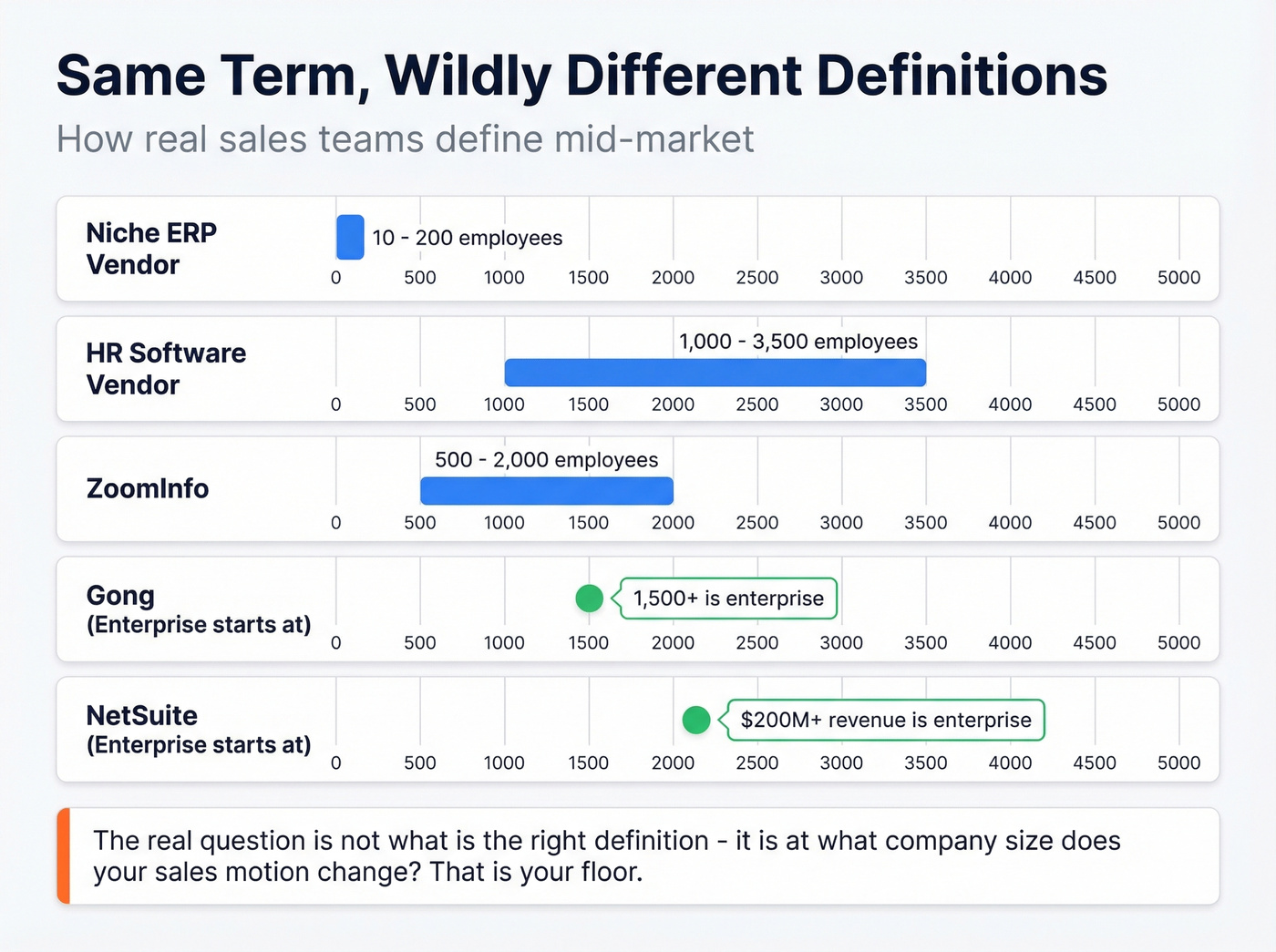
The variation is wild. In one r/sales thread, a rep selling niche ERP software defined mid-market as 10-200 employees. In the same thread, an HR software rep said it starts at 1,000 employees and runs to 3,500. Both were right for their contexts.
Named SaaS companies draw their own lines too. A former NetSuite rep shared that enterprise started at $200M+ in revenue. Gong treats enterprise as $500M+ revenue or 1,500+ employees. ZoomInfo's own content uses 500-2,000 employees as the mid-market band.
Here's the thing: the segment is whatever your org needs it to be based on your product's complexity, your ACV, and how you staff your sales team. A PLG tool with $5K deals and a consultative platform with $150K deals will never agree on where "mid-market" starts. They shouldn't try to.
We've seen teams waste months debating the "right" definition when the real question is simpler: at what company size does your sales motion change? That's your floor.

Once you've defined your mid-market segment, you need to actually find those accounts. Prospeo's database covers 300M+ profiles with 30+ filters - including headcount range, revenue band, department size, and funding stage - so you can build lists that match your exact mid-market definition, not someone else's.
Stop debating definitions. Start filling pipeline with the right accounts.
Why the Mid-Market Matters
The latest available NCMM data showed year-over-year revenue growth accelerating to 11.7% across 1,005 surveyed firms, even as employment growth stayed flat. Middle-market companies are getting more productive, not just bigger.
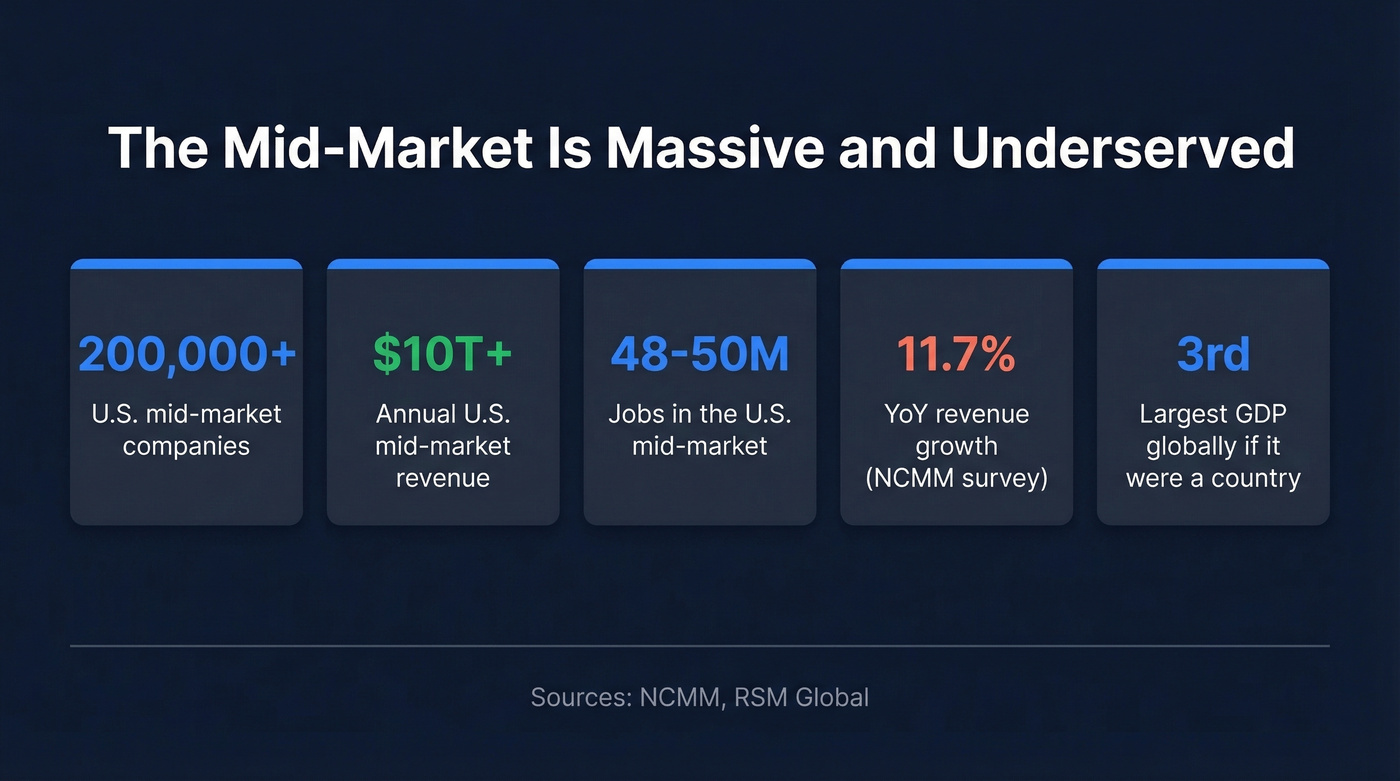
This is the most underserved segment in B2B. Most vendors either automate everything for SMB or assign a dedicated team for enterprise. Mid-market customers get neither - and yet the economic footprint is enormous. In the U.S. alone, these companies generate over $10 trillion in annual revenue and employ 48-50 million people. If the U.S. middle market were its own country, it'd have the third-largest GDP globally.
RSM estimates 20 million companies form the global middle market, employing half a billion people, generating $10 trillion in annual turnover, and contributing roughly 10% of global GDP. At least a quarter of all containerized exports support small and medium-sized companies.
For sales teams, this translates to a massive addressable market that's structurally underserved. Enterprise vendors ignore these companies because the deal sizes don't justify the sales motion. SMB vendors can't support their complexity. If you can nail the mid-market motion, you're competing against fewer well-positioned alternatives.
Let's be honest: most B2B companies should be selling mid-market before they go upmarket. Enterprise deals are sexier on a board slide, but mid-market deals close faster, expand predictably, and don't require a 12-person deal team. If your average deal size is under $50K, you probably don't need an enterprise motion at all - you need a great mid-market one.
Examples of Mid-Market Companies
Definitions are abstract. Here are real companies that fit squarely in the segment under the NCMM framework:
| Company | Ticker | Revenue (FY 2023) | Industry |
|---|---|---|---|
| DigitalOcean | DOCN | $576M | Cloud infrastructure |
| BlackLine | BL | $523M | Finance automation |
| CorVel | CRVL | $678M | Healthcare/risk mgmt |
| STAAR Surgical | STAA | $312M | Medical devices |
All four are publicly traded, which is why we can cite exact revenue. That itself proves the point: private mid-market companies rarely disclose revenue, which is exactly why headcount is the more usable filter for prospecting.
The industry diversity matters too. Mid-market isn't a sector - it's a size band. A cloud infrastructure company and a medical device manufacturer can both qualify while having nothing else in common, which is why a verticalized sales strategy works so well here. You can tailor messaging to each industry without changing your core ICP.
SMB vs Mid-Market vs Enterprise
These segments differ not just by size, but by how the buying process works.
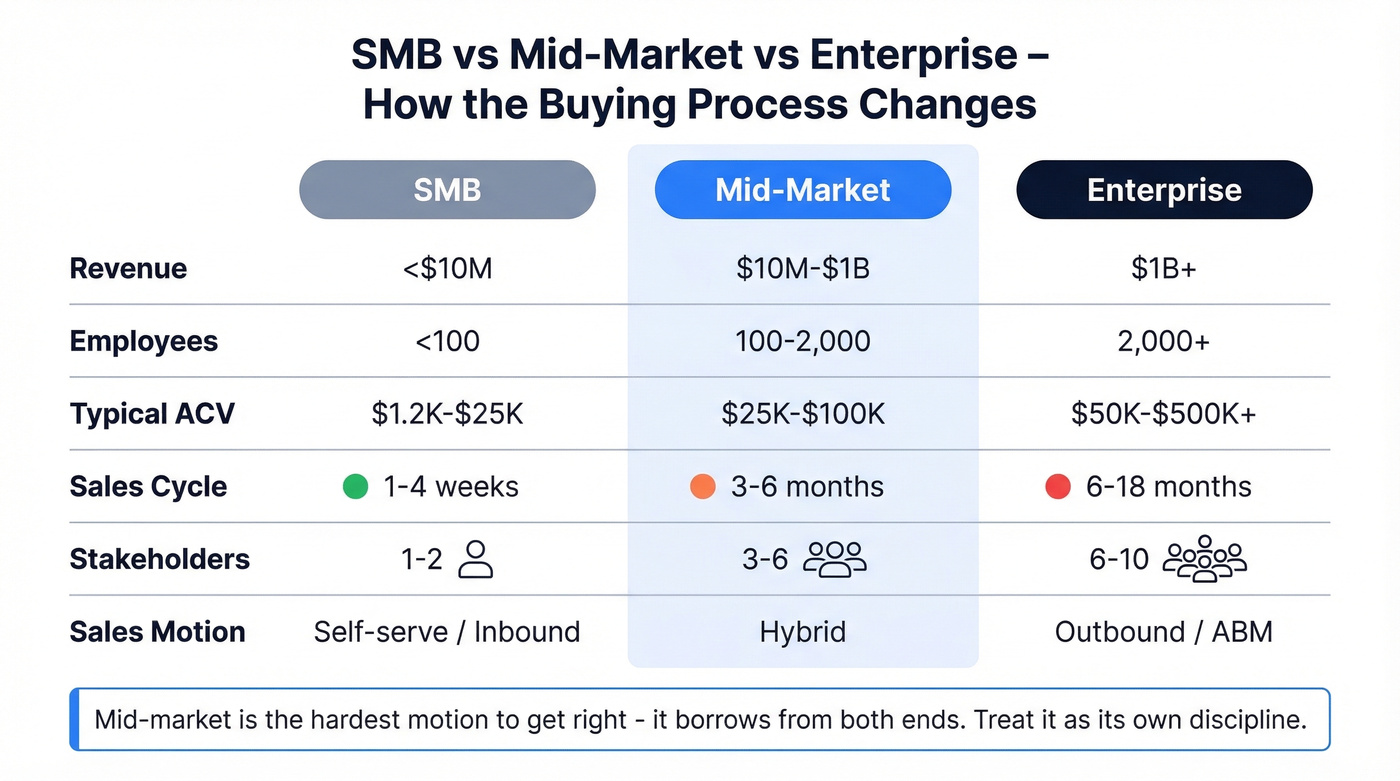
| Dimension | SMB | Mid-Market | Enterprise |
|---|---|---|---|
| Revenue | <$10M | $10M-$1B | $1B+ |
| Employees | <100 | 100-2,000 | 2,000+ |
| Typical ACV | $1.2K-$25K | $25K-$100K | $50K-$500K+ |
| Sales cycle | 1-4 weeks | 3-6 months | 6-18 months |
| Stakeholders | 1-2 | 3-6 | 6-10 |
| Sales motion | Self-serve / inbound | Hybrid | Outbound / ABM |
The sales cycle difference is where most teams feel the impact. An SMB deal can close in a single call. A mid-market deal requires multiple stakeholders, a business case, and often a pilot or POC. Enterprise deals involve procurement, legal review, security questionnaires, and sometimes board approval.
Some orgs add sub-segments within these bands - "lower mid-market" for 100-500 employees, "upper mid-market" for 500-2,000, or even "prosumer" for sophisticated small teams that buy like larger companies. These micro-segments can sharpen territory assignments, but don't overcomplicate things until your core three tiers are working.
The mid-market motion is the hardest to get right because it borrows from both ends. You need enough automation to handle volume but enough personalization to navigate multi-stakeholder deals. Teams that treat mid-market as "enterprise lite" or "big SMB" usually underperform. It's its own discipline.
How to Prospect Mid-Market Accounts
Once you've defined what mid-market means for your org, the next step is turning that definition into a target account list. Employee count is the most useful starting filter because it's publicly observable - revenue data for private companies is unreliable at best.
Start with headcount as your primary filter, then layer on secondary criteria like industry, tech stack, funding stage, and buyer intent signals. Technographics are especially valuable for mid-market prospecting because these companies are actively building their tech stacks - they're not locked into 10-year enterprise contracts yet. In our experience, teams that start with headcount filters build cleaner lists than those chasing revenue estimates from third-party databases that haven't been updated in months.
Prioritize Your TAM
Not all mid-market accounts are created equal. Once you have a broad list, build a prioritized TAM by scoring accounts on fit signals: tech stack overlap, recent funding, hiring velocity, and intent data. This ensures your reps spend time on high-value accounts rather than working a flat, unranked list.
Layering in competitor displacement data adds another dimension - if a prospect is using a tool you replace well, they move up the priority stack.
Expand Into New Verticals
When your current vertical is saturated, mid-market is often the best place to test new industries. The deal sizes justify customization but don't require the full enterprise localization playbook. For teams selling to a new vertical, start with mid-market accounts where buying committees are smaller and decisions move faster. The same logic applies to emerging geographies - mid-market companies in Southeast Asia, Latin America, and parts of Eastern Europe are often more receptive to new vendors than entrenched enterprise buyers.
Run Targeted Campaigns
For outbound and paid channels, audience targeting works best when your segments are tight. Use your mid-market definition to build audience lists for LinkedIn and Google Ads campaigns. Dynamic segmentation lets you adjust targeting criteria as you learn which firmographic and intent signals convert, rather than locking into a static list.
The workflow is straightforward: define your segment, filter by observable criteria, verify contacts, then launch outreach. Prospeo's B2B database handles this end-to-end - you can filter across 30+ criteria including employee count, revenue range, technographics, and intent data covering 15,000 topics. Every email comes back 98% verified on a 7-day refresh cycle, so you're not burning your domain on stale data.
If you're building lists at scale, it helps to standardize your firmographic filters and keep your ideal customer profile scoring consistent across regions.
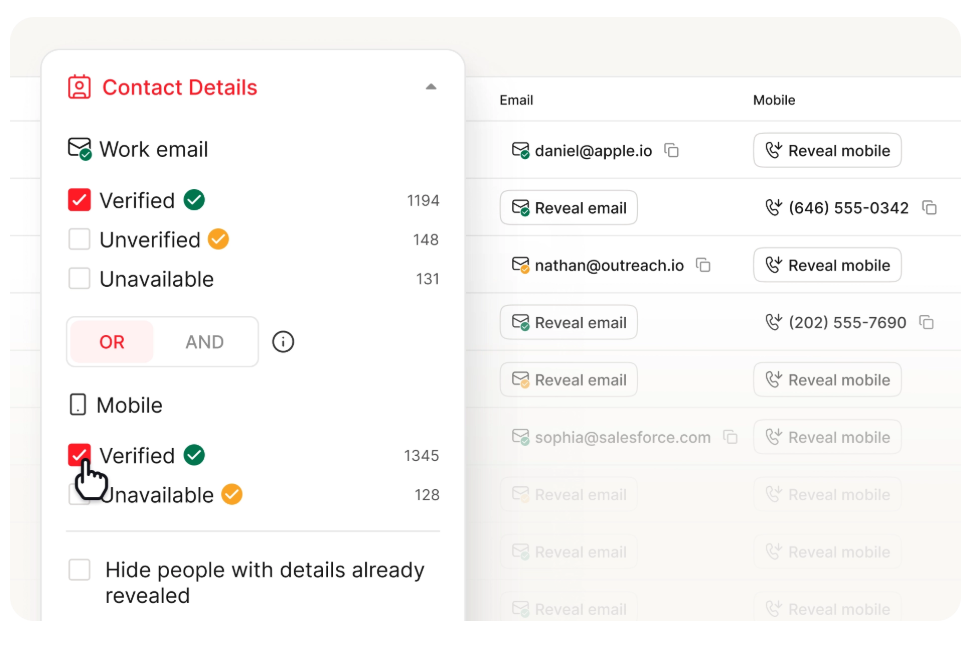
Mid-market is the most underserved segment in B2B - and the hardest to get accurate contact data for. Private companies don't publish revenue, org charts go stale fast, and generic databases lump them in with SMB. Prospeo refreshes every 7 days, verifies emails at 98% accuracy, and lets you filter by headcount growth and hiring signals to isolate true mid-market buyers.
Reach mid-market decision-makers with data that's never more than a week old.
FAQ
Is mid-market the same as middle market?
Yes. "Mid-market" is more common in sales and SaaS contexts; "middle market" dominates in finance and M&A. They describe the same segment - $10M-$1B revenue or 100-2,000 employees depending on the source.
How many employees does a mid-market company have?
Most definitions converge on 100-2,000, though SaaS orgs vary widely. ZoomInfo uses 500-2,000; Gartner caps at 1,000. Match the threshold to the point where your sales motion changes complexity.
What revenue qualifies as mid-market?
The NCMM standard is $10M-$1B in annual revenue. Gartner narrows it to $50M-$1B. For most B2B teams, $10M-$1B is the safest default since it captures the full range of companies that buy like mid-market.
What's the difference between mid-market and enterprise?
Enterprise typically means $1B+ revenue or 2,000+ employees. The real difference is the buying process: enterprise deals run 6-18 months with 6-10 stakeholders, procurement gates, and legal review. Mid-market deals close in 3-6 months with 3-6 stakeholders.
How do I build a list of mid-market companies?
Define your headcount thresholds first, then use a B2B database to filter by employee count, tech stack, and intent signals. Skip the manual research on private company revenue - it's a time sink that rarely pays off. Start with observable data and refine from there.