

What Is Mid-Market Sales? Definition, Benchmarks, and Playbook for 2026
You just got promoted from SMB AE to mid-market. Or maybe your VP walked into the all-hands and announced the team is "moving upmarket." Either way, nobody handed you a playbook - and every company you talk to defines the segment differently. Dock calls it "the messy middle" between transactional SMB and bureaucratic enterprise, and that's about the most honest framing you'll find.
Let's fix the confusion.
The 30-Second Version
- Definition: Mid-market companies generate $50M-$1B in annual revenue, with 100-1,000 employees (per Gartner's framework).
- Sales cycles: 2-6 months on average, up to a year for upper-mid-market deals.
- Stakeholders per deal: 2-6 decision-makers. Enough to require multi-threading, not enough to need a war room.
- Win rates: Plan for 20-25% after ICP refinement.
- AE compensation: Median $90k base / $175k OTE. Top performers clear $391k.
- Market growth: Mid-market revenue grew 11.7% YoY through 2025, with AI as the leading investment priority.
- The opportunity: Deals large enough to move the number, short enough to forecast.
What Counts as Mid-Market?
There's no universal standard. Gartner defines midsize businesses as $50M-$1B in revenue or 100-1,000 employees. ZoomInfo uses a headcount model: 500-2,000 employees. Dock's practitioner-oriented range lands at $50M-$1B revenue with 200-1,000 employees. Most SaaS companies stretch the definition to fit their TAM narrative.
| Framework | Revenue Range | Employee Range |
|---|---|---|
| Gartner | $50M-$1B | 100-1,000 |
| ZoomInfo | - | 500-2,000 |
| Dock | $50M-$1B | 200-1,000 |
| Common SaaS | $10M-$1B | 100-999 |
A Gartner analyst put it bluntly: everyone has their own definition, so ask vendors what they actually mean by "midsize" before assuming alignment.
Before you accept a mid-market AE role, ask exactly how the company segments. Your territory could include 200-person startups or 2,000-person corporations depending on who drew the lines. That distinction changes your deal size, cycle length, and comp trajectory entirely.
SMB vs. Mid-Market vs. Enterprise
Stop treating mid-market like a problem to solve. For a lot of B2B teams, it's the sweet spot.
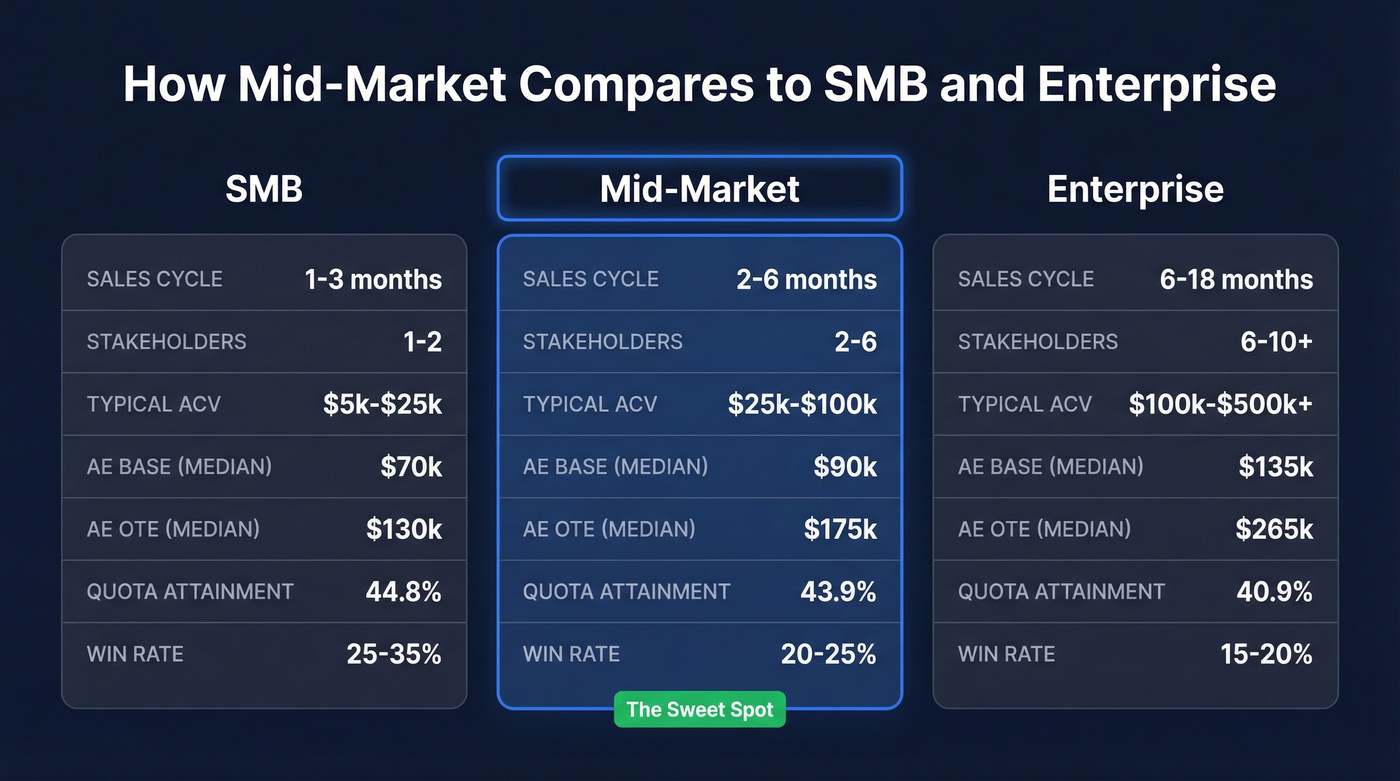
| Metric | SMB | Mid-Market | Enterprise |
|---|---|---|---|
| Sales cycle | 1-3 months | 2-6 months | 6-18 months |
| Stakeholders | 1-2 | 2-6 | 6-10+ |
| Typical ACV | $5k-$25k | $25k-$100k | $100k-$500k+ |
| AE Base (median) | $70k | $90k | $135k |
| AE OTE (median) | $130k | $175k | $265k |
| Quota attainment | 44.8% | 43.9% | 40.9% |
| Win rate (est.) | 25-35% | 20-25% | 15-20% |
This segment is the most underrated in B2B. You get real deal complexity - multi-threading, procurement, technical evaluations - without the 12-month enterprise cycles that destroy pipeline predictability. The comp is strong, quota attainment is the second-highest across segments, and the skills you build transfer directly to enterprise when you're ready.
As one Dock AE described the shift from SMB: "In SMB you're protecting your time - if the deal isn't moving, move on. Mid-market is worth the patience. You need to be buttoned up." That mindset change is the single biggest adjustment for reps moving upmarket.
Why This Segment Matters in 2026
The National Center for the Middle Market surveyed 1,005 firms and found mid-market revenue growth hit 11.7% YoY by year-end 2025. That's outpacing most of the economy.
Technology investment - particularly AI - is driving it. Mid-market leaders are pouring budget into productivity tools rather than headcount growth. Good news if you're selling software. It also means buyers are more sophisticated than they were two years ago: they've done the research, they have opinions, and they're comparing you to three competitors before your first call.
The flip side: these buyers are cautious. Teams that used to close in 60 days now run 90-120 day cycles. Patience and pipeline coverage matter more than ever.

Known-contact deals close at 37% vs. 19% for cold outreach. Mid-market reps can't afford bounced emails when multi-threading across 2-6 stakeholders. Prospeo delivers 98% email accuracy and 125M+ verified mobile numbers - so you reach the economic buyer, champion, and technical buyer on the first attempt.
Stop doing data cleanup. Start closing mid-market deals.
How Mid-Market Deals Actually Work
Five Roles in Every Deal
Mid-market buying committees typically include 2-6 people - fewer than enterprise, but enough to kill your deal if you're single-threaded.
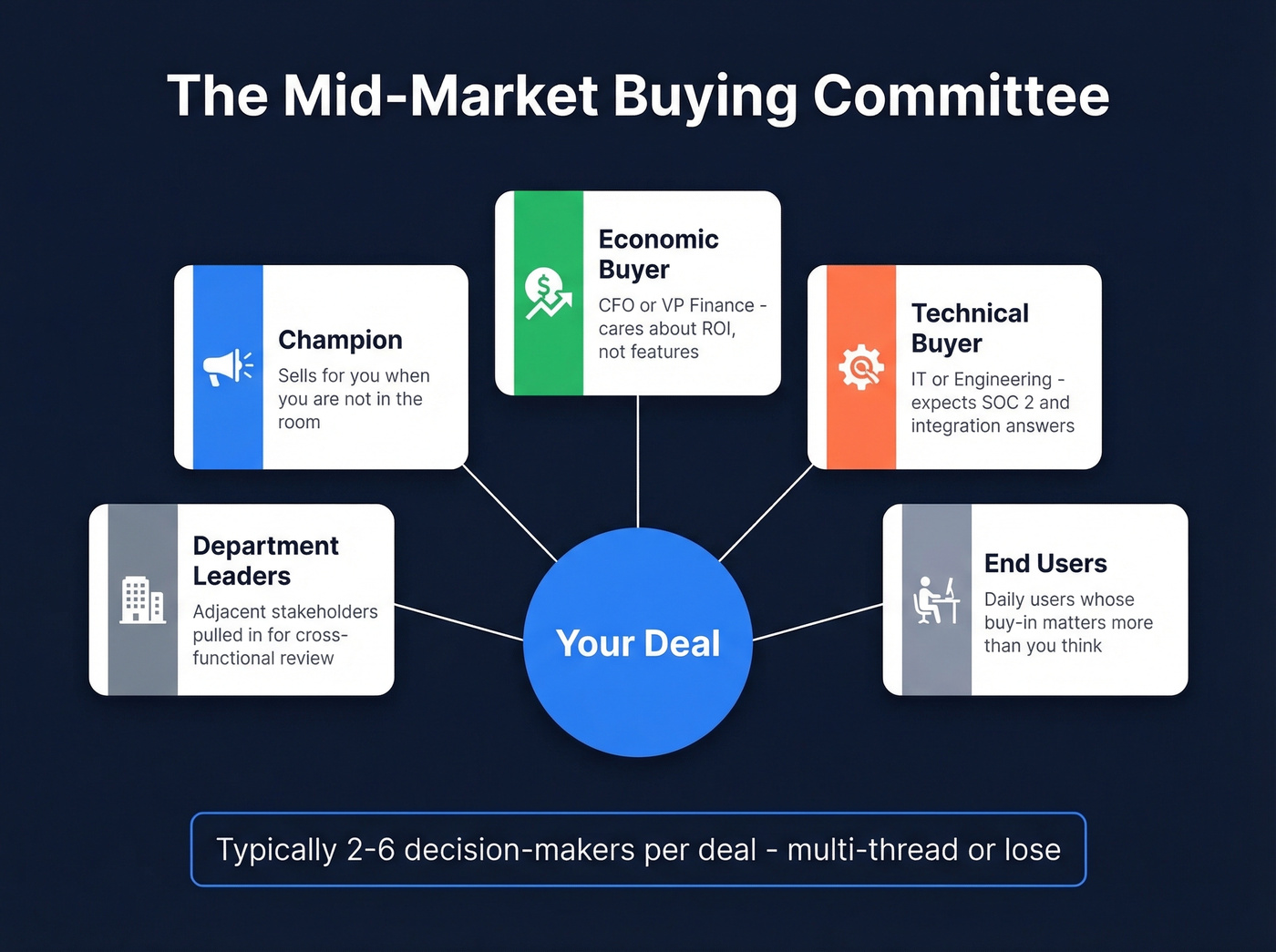
Champion - your internal advocate who sells on your behalf when you're not in the room. Economic Buyer - CFO, COO, or VP of Finance who cares about ROI, not features. Technical Buyer - IT or engineering, and expect SOC 2 questions and integration scrutiny. End Users - the people who'll use the product daily, whose buy-in matters more than most reps realize. Department Leaders - adjacent stakeholders pulled in for cross-functional impact assessments.
The best qualification framework for this segment is MEDDIC. It maps stakeholders, decision criteria, and the paper process - exactly the complexity that separates these deals from SMB. Your job is buyer enablement: arm your champion with the internal business case, give them materials to sell when you're not in the room, and make the path to purchase frictionless.
Why Data Quality Decides Win Rates
Here's a stat that should change how you prospect: according to Champify's 2025 Impact Report, known-contact deals close at 37% vs. 19% for cold outreach. Nearly double the win rate - and the gap starts with data quality.
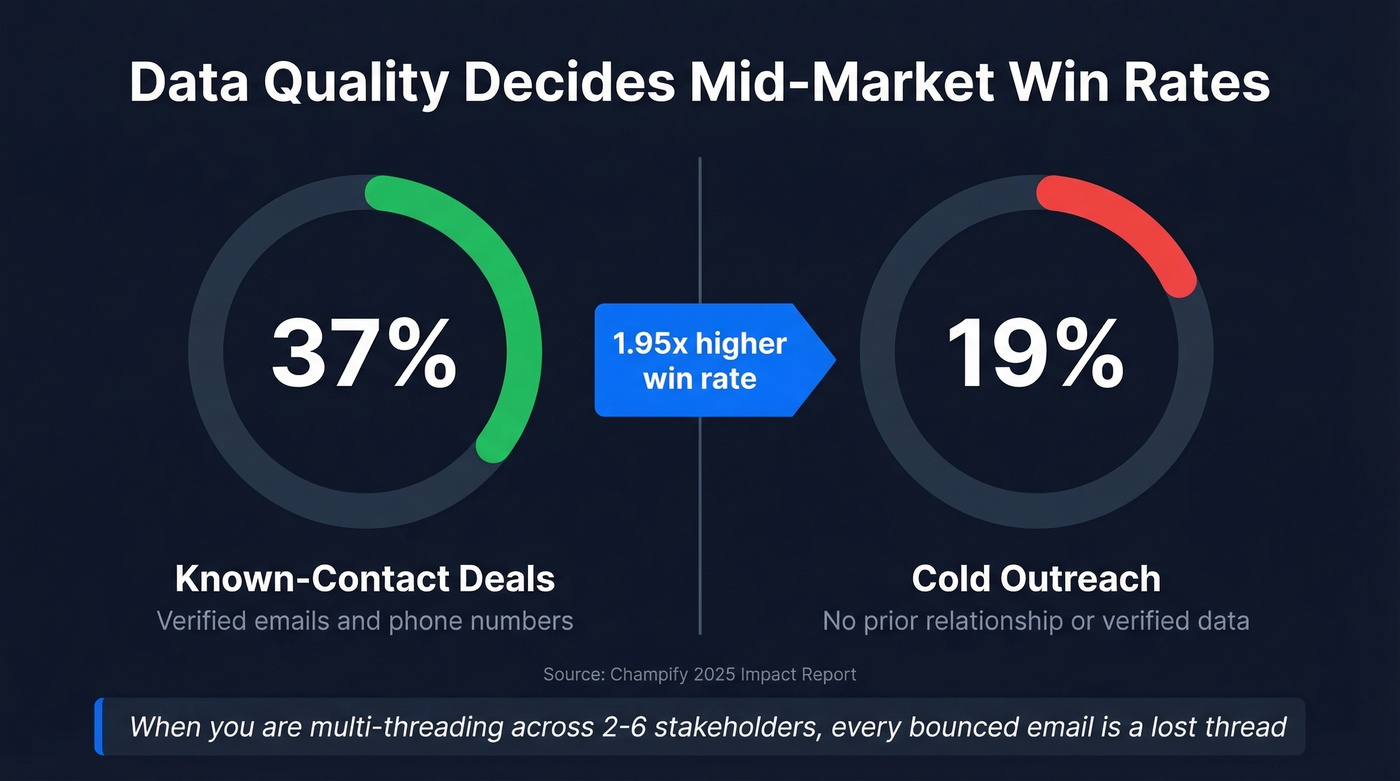
If your reps are chasing bounced emails and disconnected phone numbers, they aren't selling. They're doing data cleanup. When you're managing 50-100+ accounts simultaneously, that inefficiency compounds fast.
Mid-Market AE Compensation
RepVue's 2026 data puts the median mid-market AE at $90k base and $175k OTE. Sybill's 2025 bands are slightly wider: $75k-$95k base and $140k-$200k OTE. Top performers hit $391k.
Here's the thing: if you're choosing between a mid-market and an enterprise offer, look at quota attainment, not OTE. Mid-market AEs hit quota at 43.9%, compared to 40.9% for enterprise. Enterprise OTE is higher on paper, but a lower percentage of reps actually get there. A $175k OTE at a company where half the team hits plan is worth more than $265k OTE where only a third do.
Ask what percentage of the team hit quota over the last 3-4 quarters before accepting any offer. OTE is a model, not a guarantee. One AE on r/sales summed it up bluntly: mid-market can feel like "fairly easy" money once you're ramped - but only if the territory and product-market fit are right.
A Mid-Market Sales Strategy That Works
Most guides tell you to "be consultative." That's not a strategy. That's a platitude.
Define Your ICP Tighter Than You Think
A 200-person SaaS company and a 900-person manufacturing firm are both "mid-market," but they buy completely differently. Sub-segment ruthlessly.
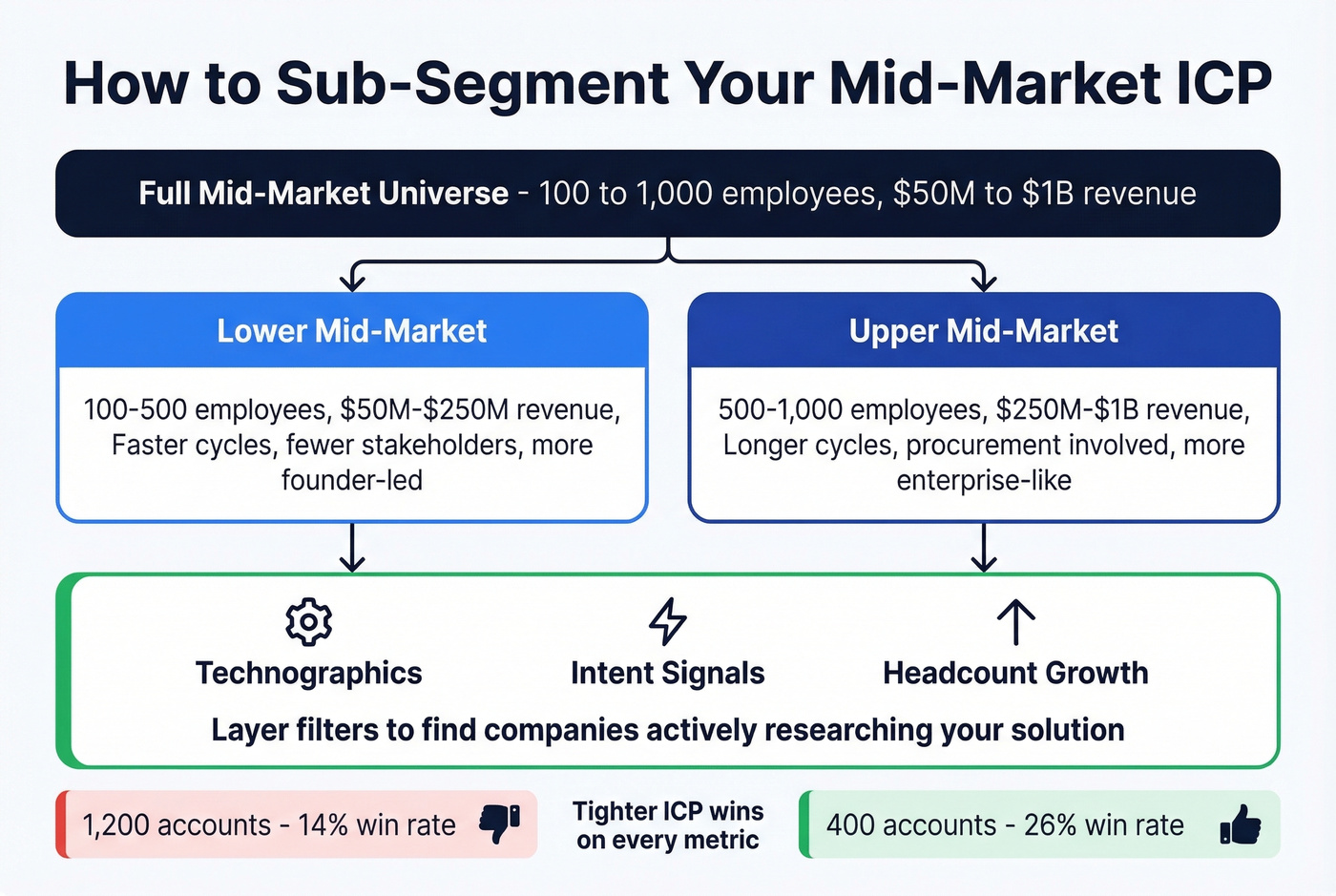
Split your territory into lower-mid-market (100-500 employees, $50M-$250M revenue) and upper-mid-market (500-1,000 employees, $250M-$1B revenue). Layer in technographics and intent signals to identify companies actively researching solutions like yours. We ran a bake-off last year where the team with a narrower ICP of 400 accounts closed at 26% versus 14% for the team working 1,200 accounts. The tighter list won on every metric - win rate, cycle time, and revenue per rep.
Build a Clean Prospect List
Once your ICP is defined, you need a list that doesn't waste your time. Most teams stumble here - they're managing too many accounts for manual research but selling deals too complex for spray-and-pray.
Prospeo handles this well. Its 30+ search filters - including buyer intent powered by Bombora, technographics, headcount growth, funding, and department-level headcount - let you build an ICP-matched list in minutes. At roughly $0.01 per email with 98% accuracy, you can test it on a single territory before rolling out, since there aren't any annual commitments. The 7-day data refresh means you're not emailing people who changed jobs two months ago.
Skip this approach if your total addressable list is under 50 accounts - at that scale, manual research and warm intros will outperform any database.

Your mid-market ICP needs to be tighter than you think. Prospeo's 30+ search filters - including headcount growth, funding, technographics, and buyer intent across 15,000 topics - let you pinpoint the exact 200-1,000 employee companies ready to buy. All data refreshed every 7 days, not 6 weeks.
Build a mid-market pipeline that actually converts for $0.01 per lead.
Building a Dedicated Sales Team
A bad sales hire costs $150k-$750k when you factor in salary, ramp time, lost pipeline, and opportunity cost. In this segment, where ramp takes 3-6 months and territory recovery takes longer, the stakes are even higher.
Mid-market needs its own playbook - not a scaled-down enterprise motion or a scaled-up SMB one. Dedicated AEs, territory models based on account complexity rather than just geography, and ramp programs that teach multi-threading and procurement navigation from day one. In our experience, teams that treat this segment as a transitional step between SMB and enterprise consistently underperform teams that build for it specifically.
Mid-Market Sales FAQ
Is mid-market easier than enterprise?
Different, not easier. Cycles are shorter (2-6 months vs. 6-18 months), but you're managing significantly more accounts simultaneously. You need enterprise-level consultative skills combined with SMB-level pace management.
What's a typical deal size?
Most mid-market SaaS deals fall between $25k-$100k ACV. Upper-mid-market deals can reach $150k+ depending on the product and seat count.
How many stakeholders are involved?
Typically 2-6 decision-makers - enough to require multi-threading and a strong internal champion who can navigate the buying committee on your behalf.
What qualification framework works best?
MEDDIC. It maps stakeholders, decision criteria, the paper process, and the champion's influence - exactly the complexity this segment introduces over SMB.