

What Is Sales Support? Roles, Pay & KPIs (2026)
Your VP of Sales just told you to "build out sales support" with zero budget and no job description. Or maybe you're a rep drowning in CRM updates, quote requests, and contract chasing - wondering why nobody's handling this stuff so you can actually sell.
Either way, you're in the right place. This guide covers what sales support is, who does it, what it pays, and how to build the function so it actually works.
The Quick Version
Sales support is the operational backbone that keeps reps selling instead of doing admin. The average US salary for a sales support specialist is $57,450. The function covers CRM hygiene, quote prep, lead qualification, and cross-department coordination. If your reps spend more time on data entry than on discovery calls, you need better support infrastructure.
Sales Support Defined
Sales support is the collection of people, processes, and tools that handle everything a salesperson needs but shouldn't be doing themselves. That breaks into four buckets:
- Administrative - order processing, contract management, quote prep, pricing approvals, scheduling
- Intelligence - market research, competitive analysis, lead qualification, pre-call account research
- Communication - cross-department liaison, internal escalation management, customer handoff coordination
- Data management - CRM hygiene, contact verification and enrichment, pipeline reporting
Think of it as the system that keeps revenue-generating reps focused on revenue-generating activities. Without it, your closers become expensive data-entry clerks.
Why It Matters for Revenue
Here's the number that justifies every support hire: sales reps spend 28% of their week selling and 72% on non-selling work like manual tasks, planning, and maintaining deal records.
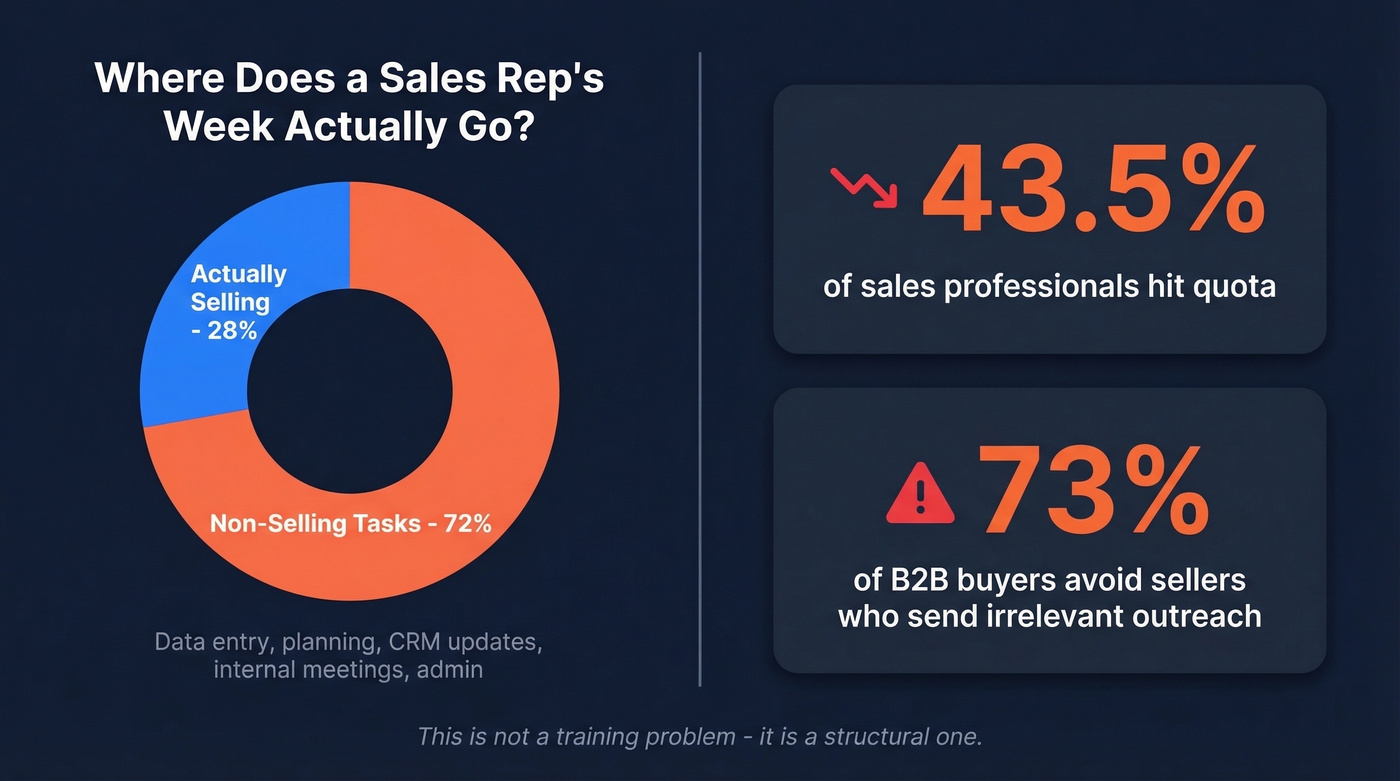
Only 43.5% of sales professionals hit quota. That's not a training problem. It's a structural one.
And here's what should alarm every support team: 73% of B2B buyers avoid sellers who send irrelevant outreach. When reps work from dirty data and cobbled-together research, they don't just waste time - they actively repel buyers. A strong B2B support function exists to fix exactly this.
Support vs. Enablement vs. Ops
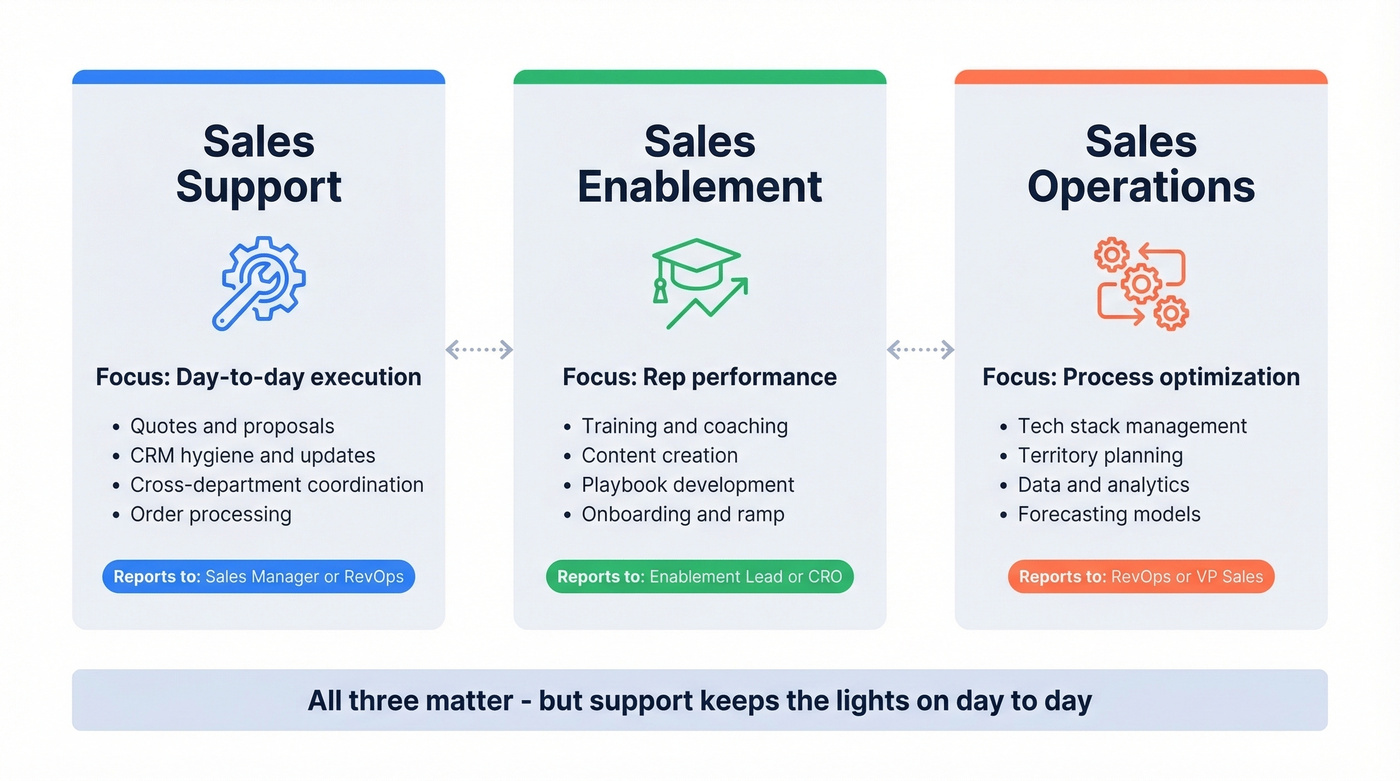
These three functions get confused constantly. Here's the cleanest distinction, drawn from Sales Enablement Collective's boundary definitions:
| Support | Enablement | Operations | |
|---|---|---|---|
| Focus | Day-to-day execution | Rep performance | Process optimization |
| Daily work | Quotes, CRM, coordination | Training, coaching, content | Tech stack, data, territory |
| Key KPIs | FRT, SLA compliance | Win rate, ramp time | Close rate, CAC |
| Reports to | Sales manager or RevOps | Enablement lead or CRO | RevOps or VP Sales |
Support handles tactical daily requests. Enablement makes reps better at selling. Ops builds the systems everything runs on. Between 2018 and 2020, sales operations roles grew 38% - a sign of how seriously companies take this infrastructure. All three matter, but support keeps the lights on day-to-day.
Let's be honest: most orgs blur these lines, and that's fine at smaller scale. The problems start when you're at 30+ reps and nobody can tell where support ends and ops begins.

The article says it plainly: CRM data decays 30%+ per year, and reps won't trust records they can't rely on. Prospeo refreshes every 7 days - not every 6 weeks - delivering 98% email accuracy and 50+ data points per enrichment. That's the data quality layer your sales support function is missing.
Stop making your support team clean up bad data manually.
Salary Benchmarks (2026)
The average base salary for a US sales support specialist is $57,450/year, based on 683 salary profiles updated February 2026. The range runs from $43K at the 10th percentile to $78K at the 90th.
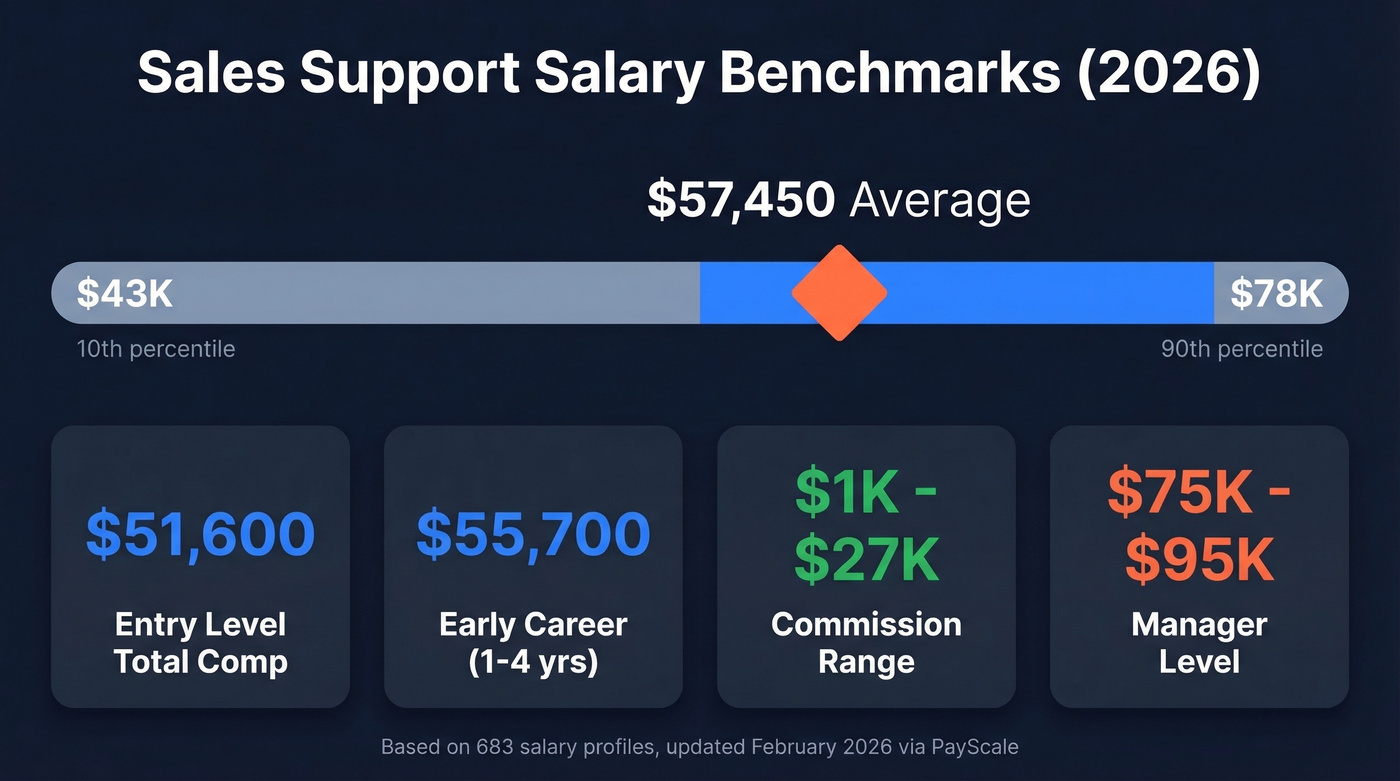
Entry-level specialists average around $51,600 in total comp. Early-career professionals with 1-4 years land closer to $55,700. Variable compensation adds real upside: commissions range from $1K to $27K, with bonuses between $657 and $10K. Coordinators sit slightly below; managers push into $75K-$95K depending on team size.
A frequent question on r/sales and similar communities is whether support is a dead-end career. It isn't. It's one of the clearest on-ramps into sales ops, enablement, or AE roles - especially if you develop strong CRM and data skills along the way.
How to Measure Sales Support
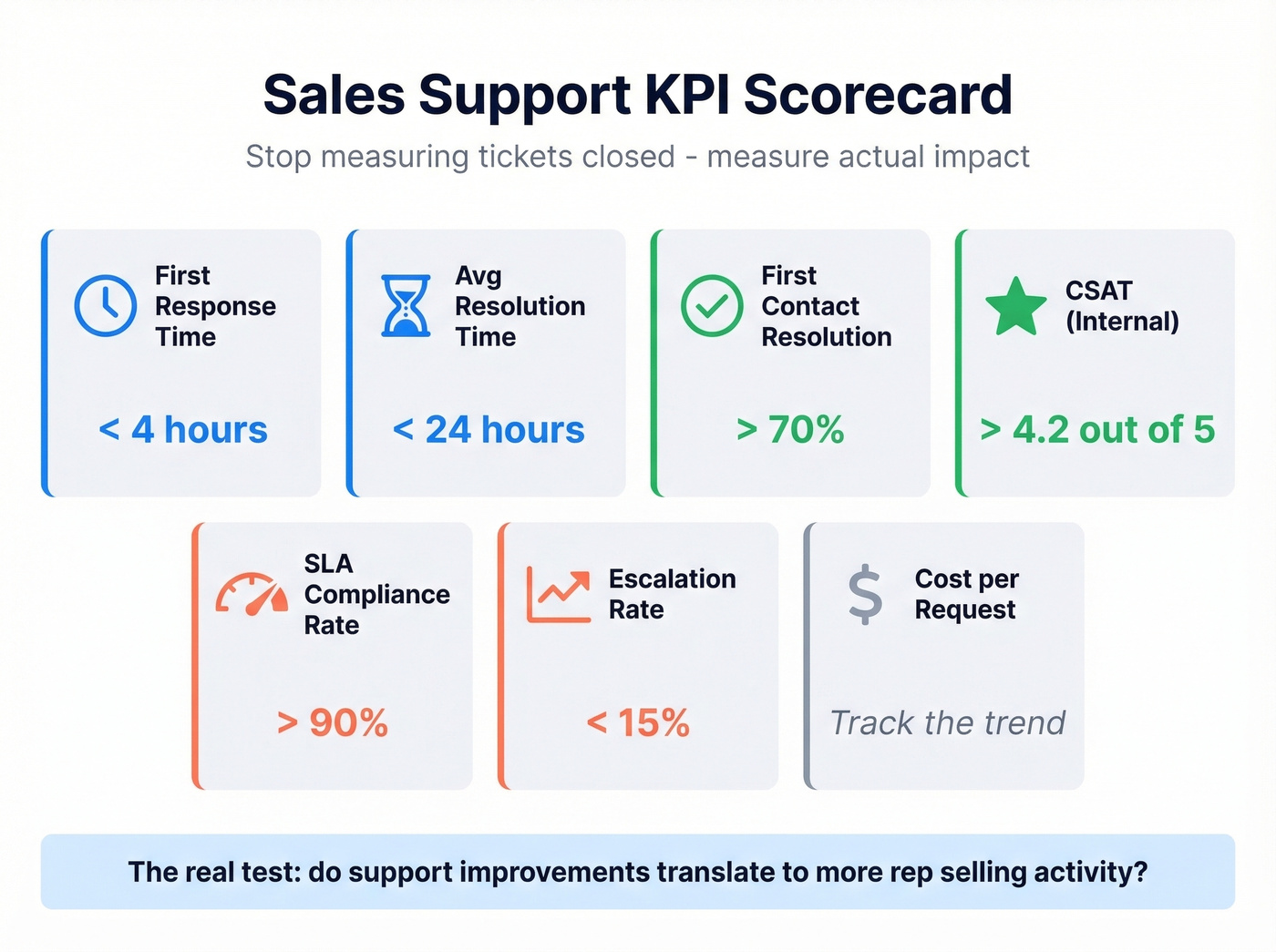
Most teams measure support by "tickets closed," which tells you almost nothing about impact. Here's a scorecard framework adapted from operational KPI best practices:
| Category | Metric | Starter target |
|---|---|---|
| Efficiency | First Response Time | < 4 hours |
| Efficiency | Avg Resolution Time | < 24 hours |
| Quality | First Contact Resolution | > 70% |
| Quality | CSAT (internal) | > 4.2/5 |
| Productivity | SLA Compliance Rate | > 90% |
| Compliance | Escalation Rate | < 15% |
| Cost | Cost per Request | Track trend, not absolute |
The real test: track whether support improvements translate to more rep activity. If your team targets 50 dials/day, measure whether support is removing the friction that keeps them from hitting it. Top-performing B2B sales orgs that invest in automation free up roughly 20% of sellers' capacity and see productivity gains around 30%. That's the business case for investing in support tooling, not just headcount.
Essential Tools for the Stack
Here's the thing - Microsoft Office isn't a sales support tech stack. Here's what a modern function actually needs.
CRM
Salesforce pricing depends heavily on edition and add-ons, but many teams end up in the $80-165/user/mo range once they add the features they actually need. HubSpot offers a free CRM tier, with Sales Hub plans commonly starting around $20/user/mo for smaller teams.
Data Quality and Verification
This is where most stacks have a gap, and it's the one that quietly kills everything else. Your CRM data decays fast - some estimates put B2B contact decay at 30%+ per year - and reps won't trust records they can't rely on. Prospeo handles this with 98% email accuracy, a 7-day data refresh cycle, and direct Salesforce/HubSpot enrichment. The free tier gives you 75 verified emails per month, enough to test the workflow before committing budget.
If you're comparing vendors, start with a shortlist of data enrichment services and a dedicated email verifier (see Bouncer alternatives).
Communication and Automation
Slack's free tier covers day-to-day coordination for many teams. For workflow automation, use your CRM's native tools first - most teams underuse the features they're already paying for. Zapier or Make (often $20-50/mo) can bridge gaps between tools. Don't buy a dedicated automation platform until you've maxed out what you have.
A common starting ratio is one support specialist per 8-12 account executives, though this varies by deal complexity and sales cycle length. We've seen teams stretch to 1:15 with strong automation, and we've seen 1:6 ratios at companies with complex enterprise deals.
Building a Strategy That Scales
Hot take: Most sales support failures aren't about hiring the wrong people. They're about building the function wrong from day one. A coherent strategy starts with identifying which non-selling tasks consume the most rep time, then systematically eliminating or reassigning them.
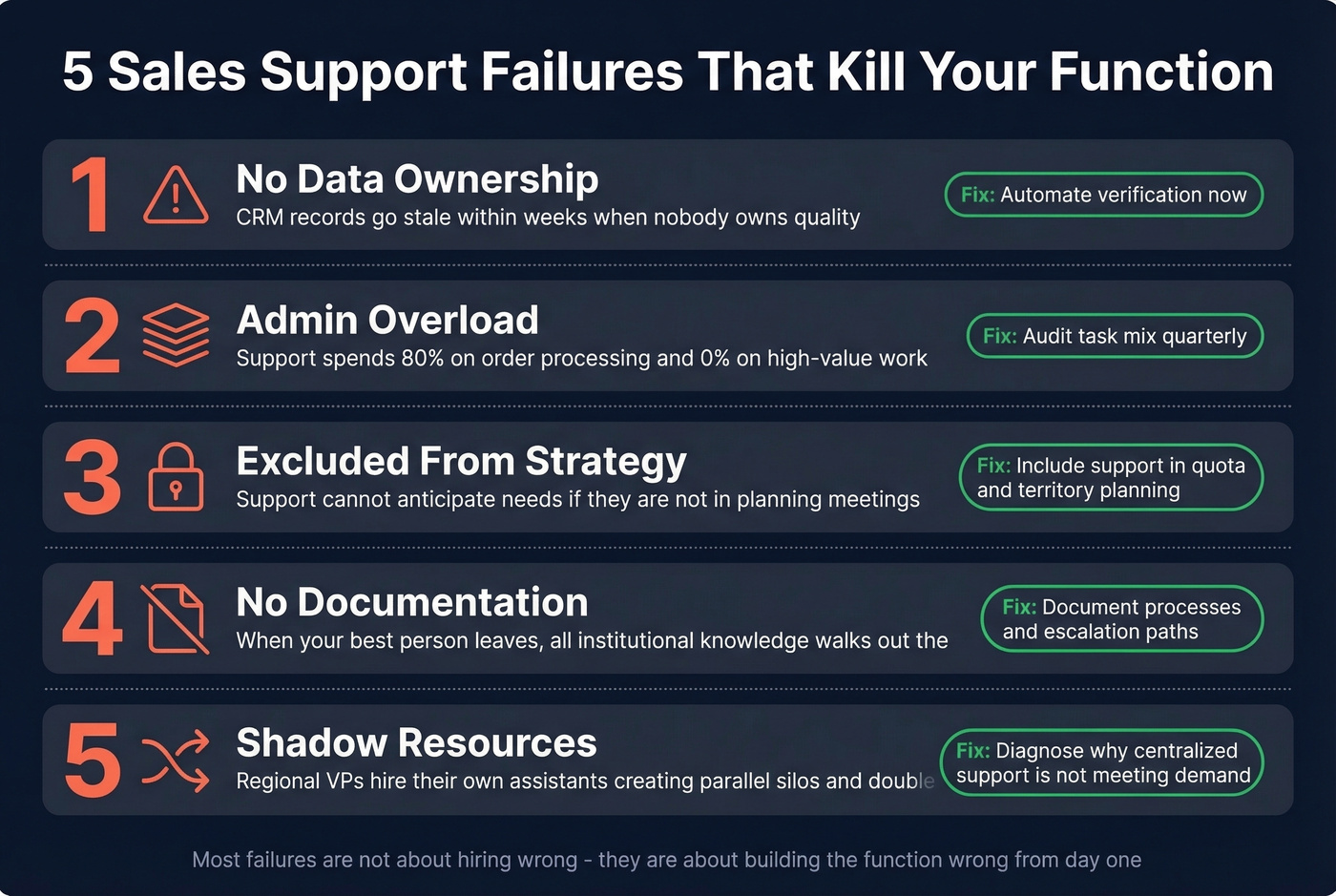
Here are the five patterns we see over and over again.
1. No data ownership
If nobody owns CRM data quality, records go stale within weeks. Automate contact verification so your CRM doesn't rot. This is the single highest-ROI fix for most support teams, and it's the one that gets deprioritized because "we'll clean it up next quarter." You won't. Automate it now.
2. Admin overload crowding out high-value work
When support spends 80% of their time on order processing and 0% on lead qualification, you've built a back office, not a support function. Audit the task mix quarterly.
3. Excluding support from strategy discussions
If support isn't in the room when you set quotas or plan territories, they can't anticipate what reps will need. We've watched teams scramble through entire quarters because nobody told support about a new vertical push until week three.
4. No documentation
When your best support person leaves and takes all the institutional knowledge with them, you're starting over. Document processes and escalation paths. This isn't glamorous work, but it's the difference between a function that survives turnover and one that collapses.
5. Shadow resources and duplicate teams
Skip this pattern if you want to keep your sanity: instead of fixing a broken process, a regional VP hires their own "assistant" in a parallel silo. Two people, zero standardization, double the cost. If you spot shadow support roles forming, that's a signal your centralized function isn't meeting demand - fix the root cause.
If your sales support team is burning hours on contact research and CRM hygiene, the problem isn't headcount - it's your data stack. Prospeo enriches your CRM directly via Salesforce and HubSpot integrations, returning verified emails, mobiles, and 50+ data points at $0.01 per lead. Free tier included, no sales call required.
Free your support team from data entry - start with 75 free verified emails.
FAQ
Is sales support a good career path?
Yes. The average specialist salary is $57,450 with commission potential up to $27K, and demand keeps growing as companies invest in revenue productivity. It's one of the fastest on-ramps into sales ops, enablement, or closing roles.
Should support be in-house or outsourced?
In-house if your team exceeds roughly 10 reps and needs deep product knowledge. Outsource overflow tasks like data cleaning or after-hours coverage. Most mid-market teams run a hybrid model - core support in-house, data enrichment automated through tools like Prospeo.
What tools should a support team prioritize first?
Start with your CRM, add a contact verification tool for data quality, and use Slack for coordination. Don't buy more until you've maxed out native CRM automation - most teams underuse what they already pay for.
How does sales support differ from sales enablement?
Sales support handles day-to-day tactical execution - quotes, CRM updates, scheduling, data hygiene. Enablement focuses on making reps better sellers through training, coaching, and content. Support keeps the engine running; enablement tunes the engine for performance.