

What to Include in a Buyer Persona (2026 Checklist)
You spent two weeks building personas. You interviewed customers, debated stock photos, argued over whether "Marketing Mary" should be 34 or 37. Then the deck went into a shared drive and nobody opened it again.
That's painfully common. 71% of organizations that beat revenue targets have documented buyer personas - yet plenty of teams still build personas that don't influence a single real decision. The problem isn't that teams skip personas. It's that they stuff them with the wrong things.
Get the contents right and you get a tool that shapes messaging, shortens sales cycles, and filters bad-fit leads before they waste your pipeline. Get it wrong and you get a poster.
Essential Buyer Persona Fields
If the persona doesn't explain why someone buys now, chooses you, or says no, it's decoration.
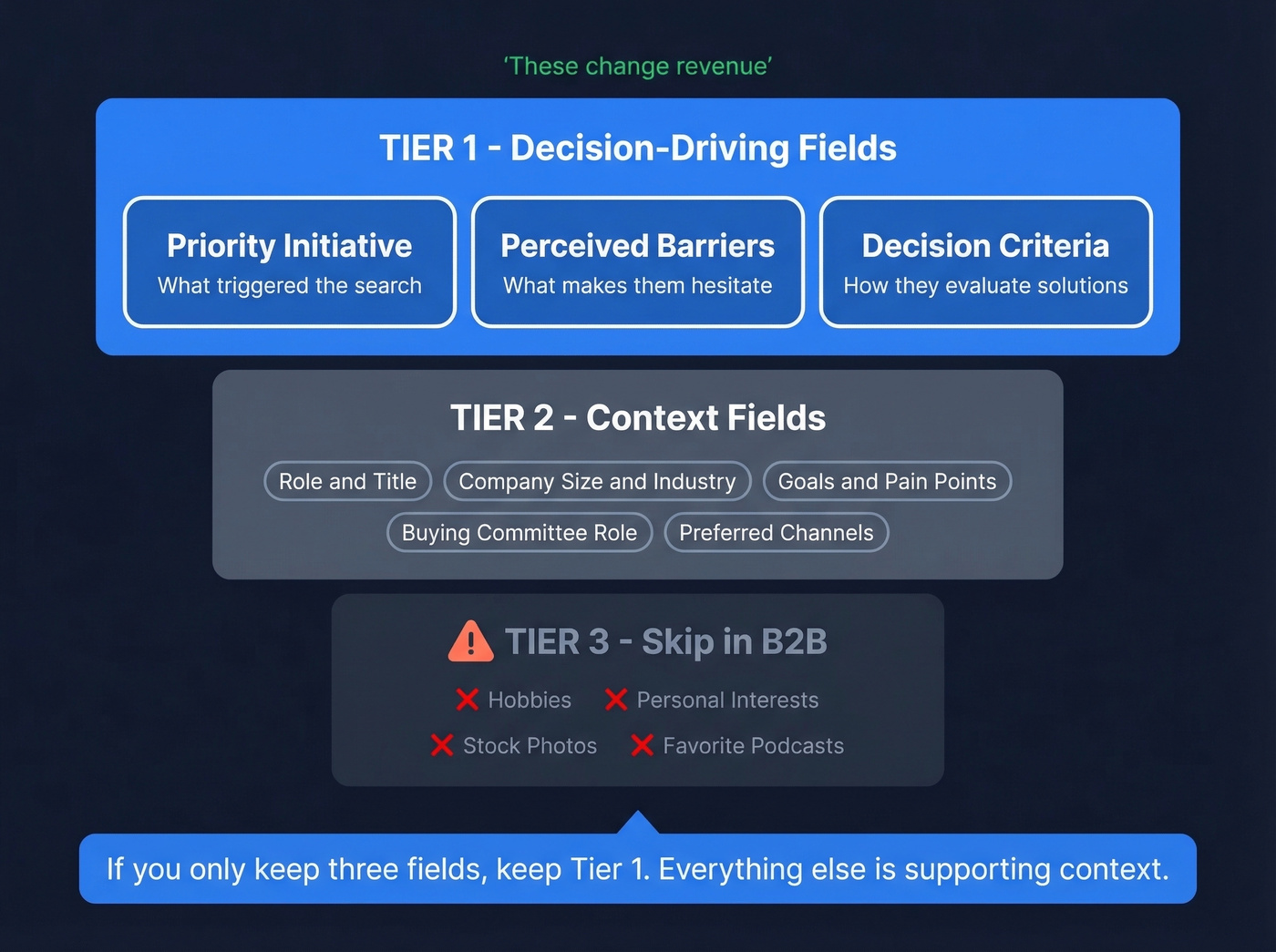
Tier 1 - Decision-driving fields (these change revenue):
- Priority Initiative - what triggered the search
- Perceived Barriers - what makes them hesitate or choose a competitor
- Decision Criteria - how they evaluate solutions
Tier 2 - Context fields:
- Demographics and firmographics: role, company size, industry
- Goals, pain points, buying committee role
- Preferred channels and content formats
Tier 3 - Skip in B2B unless directly relevant:
- Hobbies, personal interests, stock photos, favorite podcasts
If you only keep three fields, keep Tier 1. Everything else is supporting context.
The Decision Layer
Most persona templates are upside-down. They prioritize identity details over decision drivers. Adele Revella's 5 Rings of Buying Insight framework flips that, and we think it's the best foundation for any B2B persona:
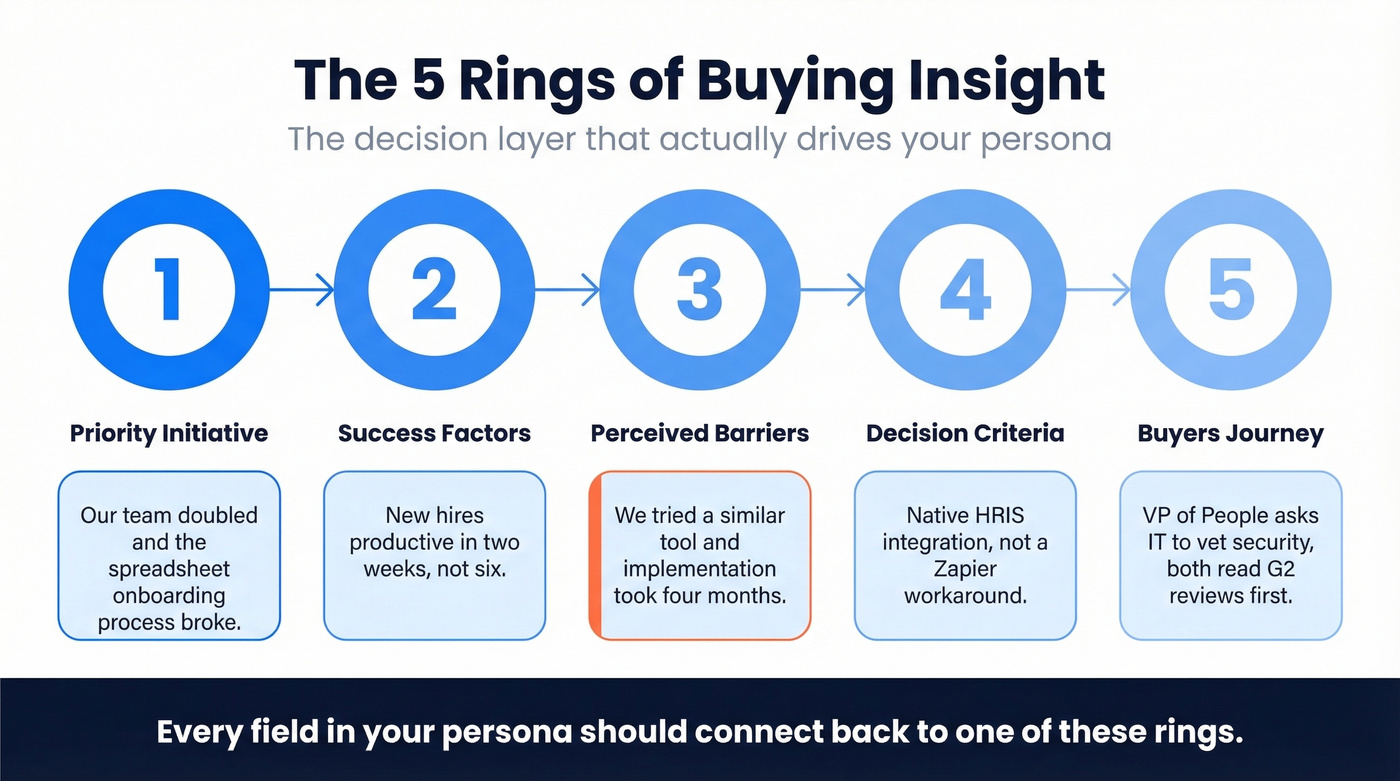
- Priority Initiative. The trigger that made the buyer act now. Example: "Our team doubled and the spreadsheet-based onboarding process broke."
- Success Factors. The buyer's definition of "this worked" - their words, not your value props. Example: "New hires productive within two weeks, not six."
- Perceived Barriers. Fears or past experiences pushing them toward a competitor or back to doing nothing. Example: "We tried a similar tool two years ago and implementation took four months."
- Decision Criteria. Specific capabilities buyers use to judge you. Example: "Native HRIS integration, not a Zapier workaround."
- Buyer's Journey. Who's involved, what sources they trust, what happens before a vendor call. Example: "VP of People asks IT to vet security; both read G2 reviews before agreeing to a demo."
Every field in your persona should connect back to one of these rings. Understanding buyer decision behavior - rather than demographic sketches - is what separates useful documents from shelfware.
The Context Layer
Context fields aren't useless. They're just not the main event.
| Field | B2B | B2C |
|---|---|---|
| Core identity | Role, title, seniority | Age, location, lifestyle |
| Organization | Company size, industry | N/A |
| Motivation | Goals, KPIs, career risk | Values, aspirations |
| Purchase process | Budget authority, committee | Individual decision |
| Channels | Industry events, peer referrals | Social, search, retail |
Don't confuse a persona with a target audience segment. Segments group people by shared traits; personas map individual decision behavior. And in B2B, you're not building one persona - you're mapping a buying committee: the decision-maker, the influencer, the champion, and the end user, plus evaluators in IT, finance, legal, or security depending on the deal.
What to Leave Out
Here's the thing: Revella's biggest critique of most personas is that "you describe the buyer, not the buyer's decision." In B2B, gender, marital status, and hobbies are almost never relevant unless they directly change how the deal gets evaluated.
Skip fictional names, stock photos, and generic descriptors like "tech-savvy" or "values efficiency." Keep age range only if generational tech preferences matter. Keep location only if regional compliance or language affects the deal. If a field doesn't influence how someone buys, it doesn't belong.

You just mapped the decision fields, context layers, and negative personas. Now turn those attributes into a live prospect list. Prospeo's 30+ search filters - including buyer intent across 15,000 topics, company size, role, and technographics - match directly to the persona fields you built. 98% email accuracy means your outreach actually lands.
Stop describing buyers in slide decks. Start reaching them.
Add a Negative Persona
Every B2B team needs at least one negative persona. If you don't know who you're excluding, you're wasting budget on leads that'll never close.
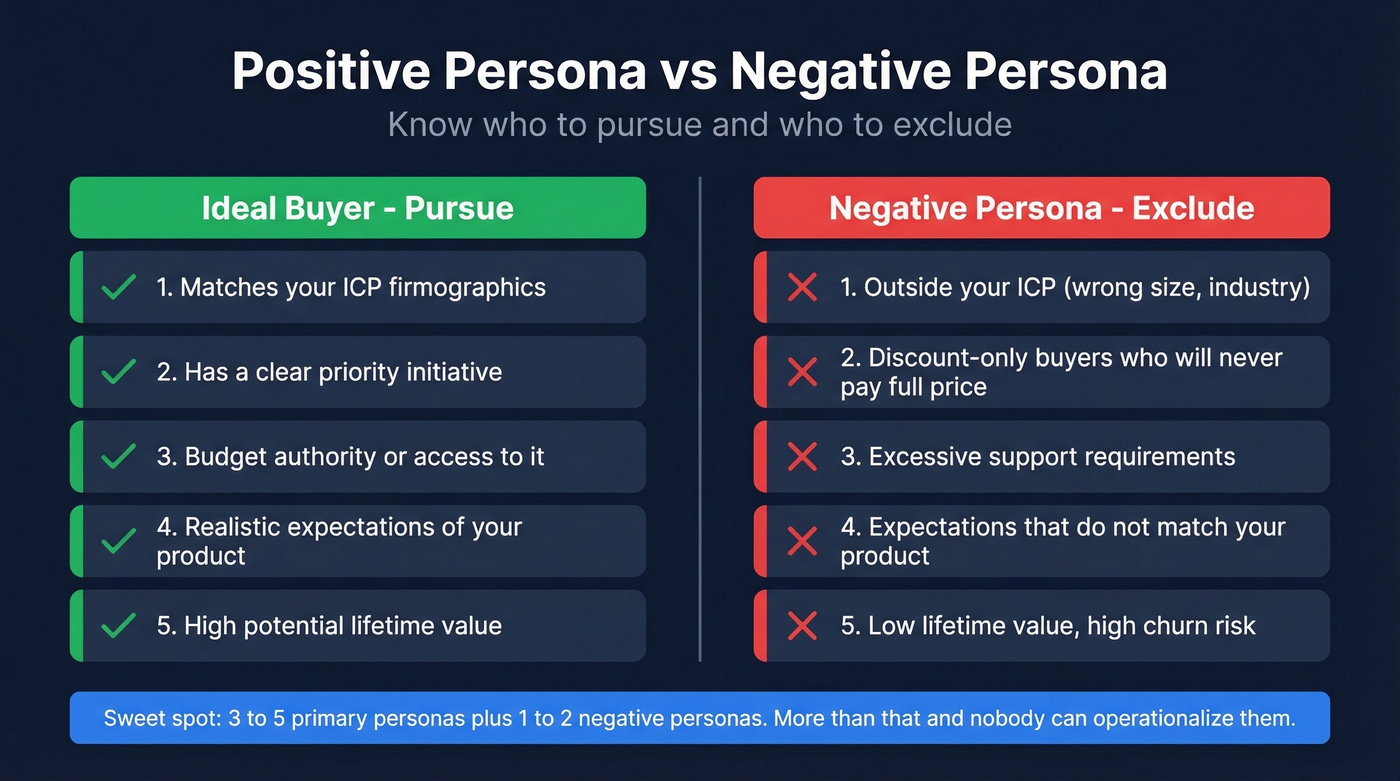
Document the signals: low lifetime value, excessive support requirements, discount-only buyers who'll never pay full price, companies outside your ICP, and prospects whose expectations don't match your product. Three to five primary personas plus one or two negative personas is the sweet spot. More than that and nobody can operationalize them - the consensus on r/sales backs this up, with most experienced reps saying anything beyond five personas just creates confusion.
How to Build Personas With Real Data
One team lifted conversions 40% just by changing an asset type and headline based on buyer interview feedback. Analytics show what people do; interviews explain why. If you only have time for one method, pick interviews.
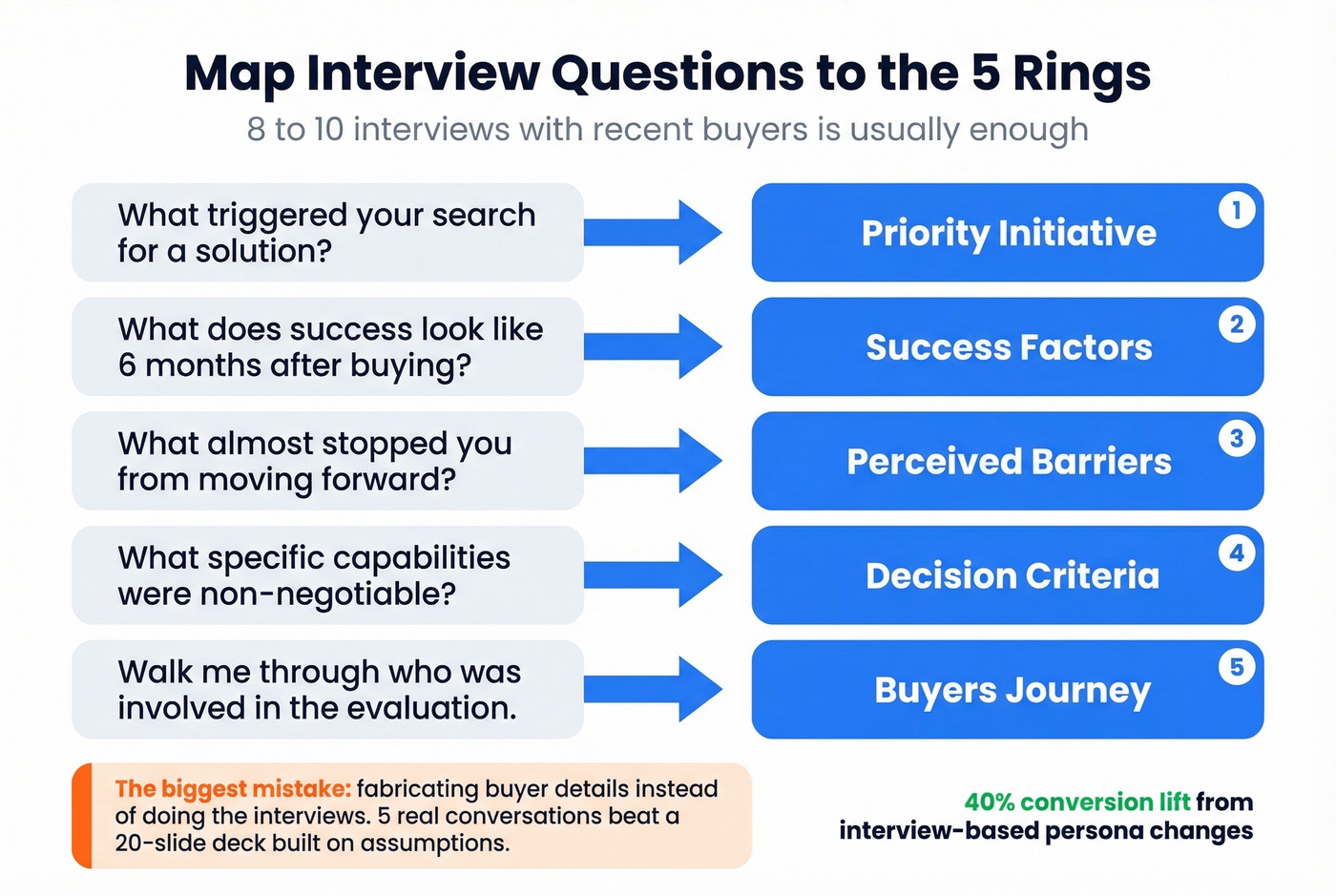
Map questions directly to the 5 Rings:
- "What triggered your search for a solution?" → Priority Initiative
- "What does success look like 6 months after buying?" → Success Factors
- "What almost stopped you from moving forward?" → Perceived Barriers
- "What specific capabilities were non-negotiable?" → Decision Criteria
- "Walk me through who was involved in the evaluation." → Buyer's Journey
We've found that eight to ten interviews with recent buyers - won and lost deals - is usually enough to surface the main patterns. Supplement with CRM data, support tickets, and sales call recordings to validate what you hear. The biggest mistake teams make is fabricating buyer details instead of doing the interviews; a persona built on five real conversations will outperform a twenty-slide deck built on assumptions every single time.
Turn Your Persona Into a Prospect List
A persona sitting in a slide deck doesn't generate pipeline. The real test is whether you can take those firmographic, role, and behavioral attributes and find actual people who match.
Let's say your persona is a VP of People at a mid-market SaaS company with 200-500 employees, currently evaluating HRIS tools. Map those attributes - company size, industry, role, intent signals - into a B2B database with the right firmographic filters. Prospeo's 30+ search filters, including buyer intent data across 15,000 topics, are built around exactly these kinds of persona attributes. Run the search, export verified contacts, push them into your outreach tool or CRM. That's how a persona stops being a document and starts filling your calendar.

A persona without real contacts is just a poster on a shared drive. Prospeo turns firmographic and behavioral attributes into verified emails and direct dials - 300M+ profiles refreshed every 7 days, not 6 weeks. Export matches straight to HubSpot, Salesforce, or your outreach tool. 75 free emails/month, no contracts.
Your persona is built. Fill your pipeline with the people it describes.
Keep Personas Current
A persona isn't a project. It's a system. Companies with documented, regularly updated personas see 10-30% funnel improvement when they actually operationalize them.
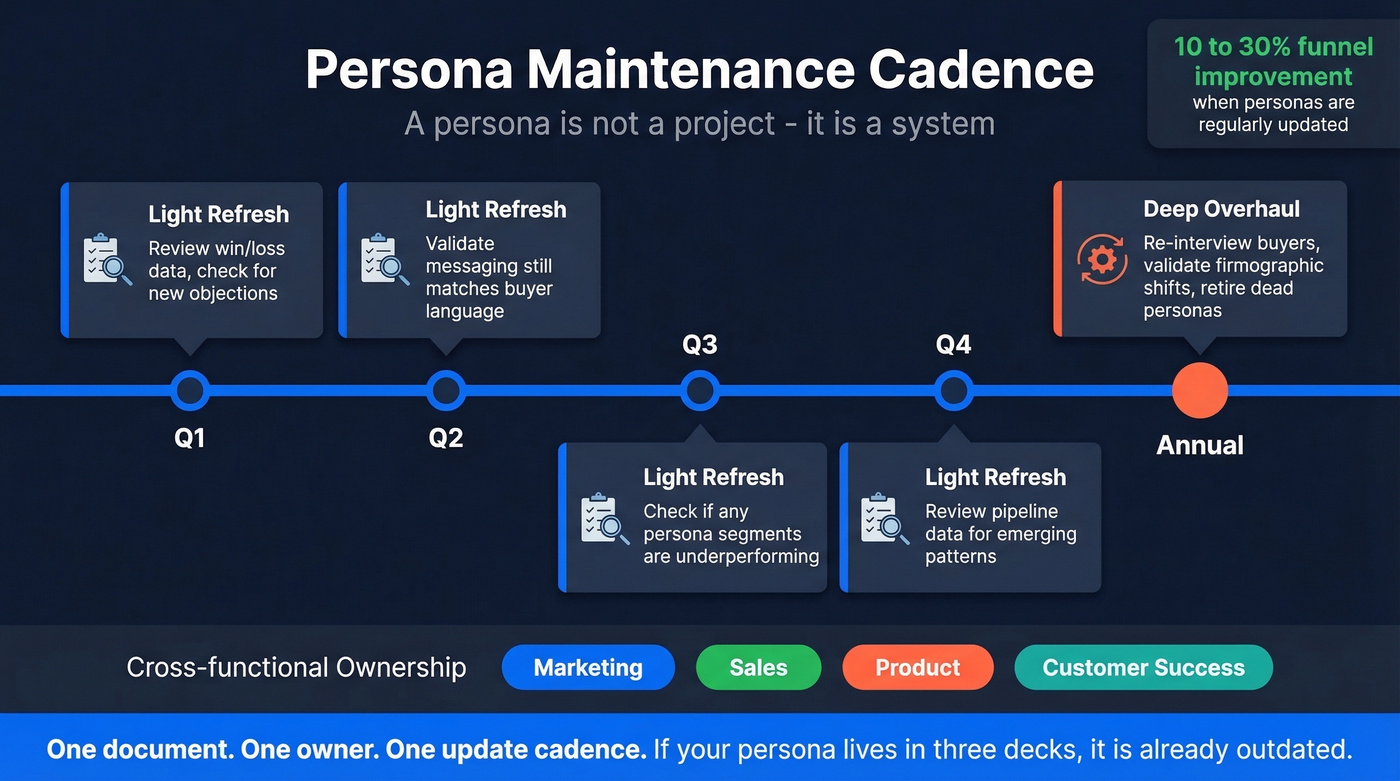
In our experience, the moment a persona requires more than one page, adoption drops fast. Here's what works: do a light refresh quarterly by reviewing win/loss data and checking for new objections. Do a deep overhaul annually - re-interview buyers, validate firmographic shifts, retire personas that no longer drive revenue. Assign cross-functional ownership across marketing, sales, product, and CS. Maintain a single source of truth: one document, one owner, one update cadence. If your persona lives in three different decks, it's already outdated.
Most teams don't need better personas. They need fewer, sharper ones that actually get opened.
Buyer Persona FAQ
How many buyer personas should a company have?
Three to five primary personas plus one or two negative personas works for most B2B orgs. If two personas get the same email sequence, they're probably the same persona. Merge them and sharpen the decision-layer fields instead.
What's the difference between a buyer persona and an ICP?
An ICP defines the ideal company - industry, size, tech stack, budget range. A buyer persona defines the individual inside that company: their triggers, barriers, decision criteria, and journey. You need both. The ICP narrows your target account list; the persona shapes how you talk to the humans at those accounts.
How do I turn a buyer persona into an outbound list?
Map your persona's firmographic and role attributes into a B2B database with intent and technographic filters. From there, export verified emails and direct dials for the people who actually match your persona, then sequence them the same week. Skip this step if your persona is still based on assumptions rather than real buyer interviews - bad inputs just mean you'll reach the wrong people faster.
What's the biggest mistake teams make with buyer personas?
Filling templates with assumptions instead of real buyer data. Teams that skip interviews and guess at motivations end up with fictional characters, not decision models. Eight to ten conversations with recent won and lost deals will surface more actionable insight than any workshop brainstorm.