


7 Best Yesware Alternatives for 2026
A RevOps lead we work with ran a Yesware renewal last quarter and barely recognized the product. Vendasta acquired Yesware in October 2022, then relaunched it inside the Vendasta Marketplace in February 2025 with deeper Vendasta CRM integration and heavy agency/SMB positioning. If you're a direct sales team that relied on Yesware for inbox tracking and sequences, the product's trajectory isn't pointed at you anymore.
This list is for those direct sales teams. If you're an agency already living in Vendasta CRM, the new direction might actually work in your favor - but that's a different conversation.
Why Teams Leave Yesware in 2026
Four reasons keep coming up:
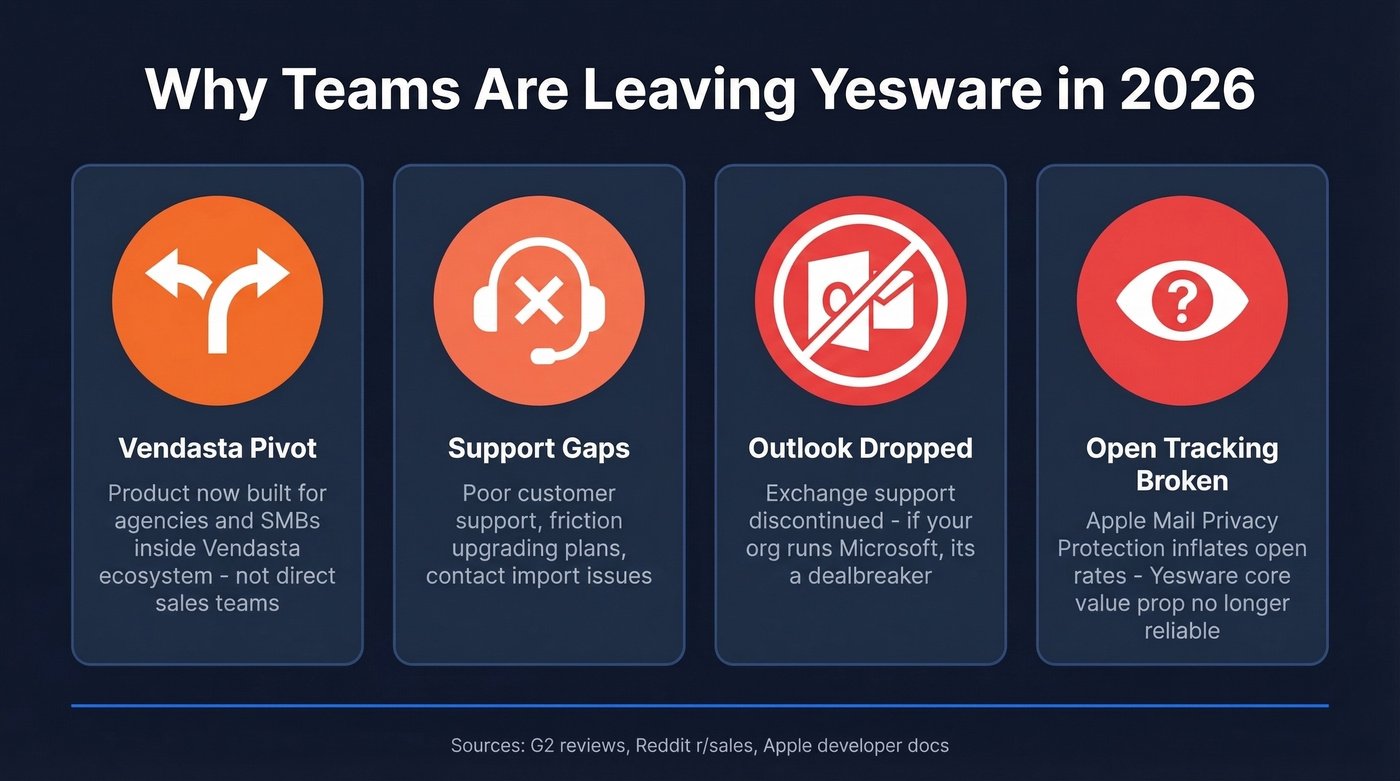
The Vendasta pivot. Since the Marketplace launch, Yesware has been pushed hard inside the Vendasta ecosystem. If you're not in that world, it feels like the product is evolving away from your workflow. Because it is.
Support and reliability gaps. Yesware holds a 4.4/5 on G2 with 821 reviews, but the recurring negatives are consistent: poor customer support, friction upgrading subscriptions, and issues importing contacts. Death by a thousand paper cuts.
Outlook Exchange support dropped. Yesware discontinued support for Outlook Exchange, stranding a chunk of users overnight. Some teams also relied on Yesware's device and IP-address open details to spot internal forwarding - useful intelligence that most modern tools de-emphasize as open tracking gets noisier. If your org runs Microsoft, that's a dealbreaker.
Open tracking is broken industry-wide. Apple Mail Privacy Protection pre-loads tracking pixels, inflating open rates across every pixel-based tool. Yesware's open tracking - once its core value prop - now produces numbers you can't trust. The free plan caps you at 10 campaign recipients per month, and Salesforce features are locked behind the Enterprise tier at $85/seat/mo billed monthly. That's a lot of friction for diminishing returns.
What Yesware Still Does Well
Credit where it's due: the Gmail sidebar is clean, template management is intuitive, and the meeting scheduler works. For a solo rep who just needs read receipts and a few canned responses, it's fine. The problem is that "fine" doesn't justify the pricing or the platform risk when better options exist at every price point.
Our Picks (TL;DR)
- Best if your real problem is bad contact data, not bad sending tools - Prospeo. 98% email accuracy, pairs with any sender on this list. Use if your bounce rate is above 5%.
- Best 1:1 Yesware replacement for Gmail teams - Mixmax. Tracking, templates, sequences, all inside your inbox.
- Best for high-volume cold email at scale - Saleshandy. Unlimited email accounts, built-in warm-up, starts at $25/mo.
Comparison Table
Pricing & Features
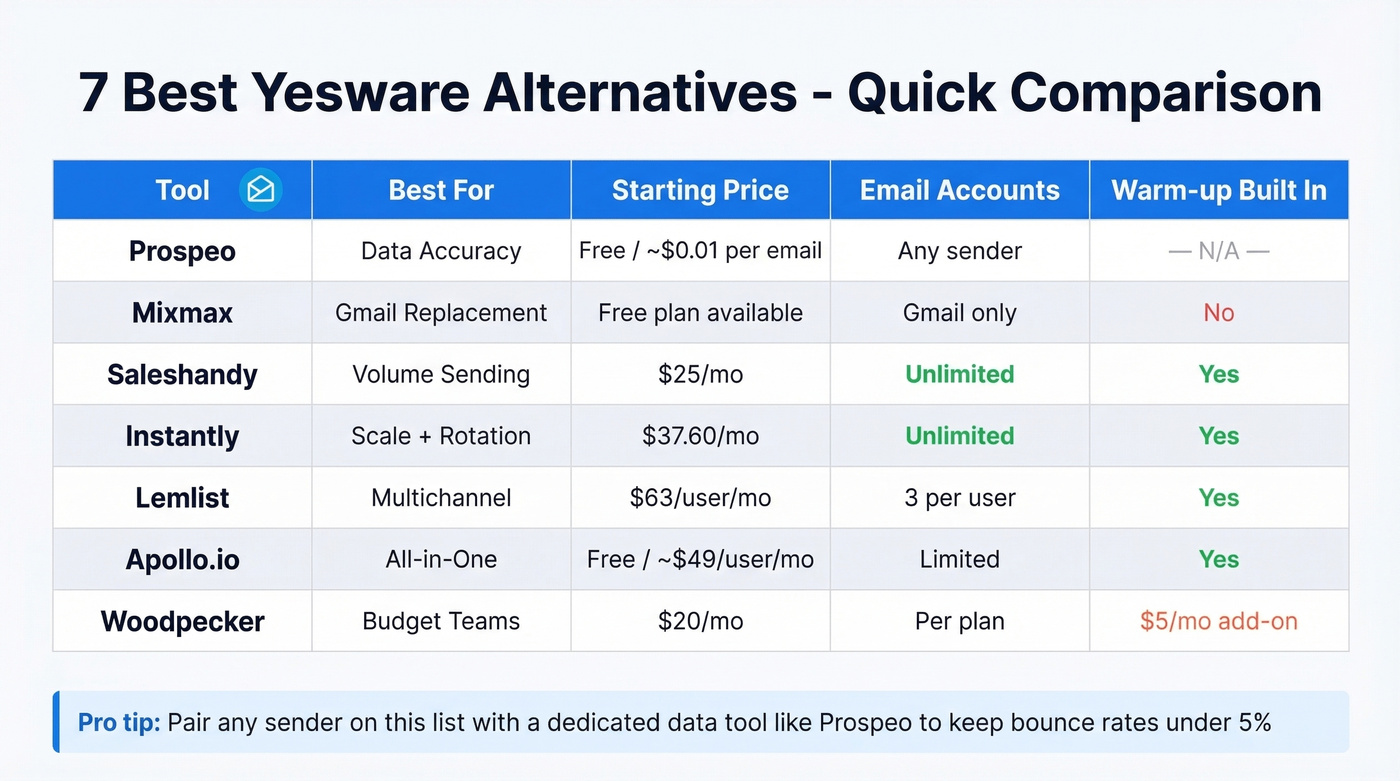
| Tool | Best For | Starting Price | Warm-up | CRM Integration |
|---|---|---|---|---|
| Prospeo | Data accuracy | Free / ~$0.01/email | N/A | Salesforce/HubSpot |
| Mixmax | Gmail replacement | Free plan available | No | Salesforce |
| Saleshandy | Volume sending | $25/mo (annual) | Yes | Yes (Pro+) |
| Instantly | Scale + rotation | $37.60/mo (annual) | Yes | From $37.90/mo (annual) |
| Lemlist | Multichannel | $63/user/mo (annual) | Yes | Yes |
| Apollo.io | All-in-one | Free / ~$49/user/mo | Yes | Built-in CRM |
| Woodpecker | Budget teams | $20/mo | $5/mo add-on | $20/mo add-on |
Sending & Data
| Tool | Email Accounts | Data / Prospecting |
|---|---|---|
| Prospeo | Any sender | 300M+ profiles, 98% accuracy |
| Mixmax | Gmail only | No |
| Saleshandy | Unlimited | Limited |
| Instantly | Unlimited | 450M+ leads |
| Lemlist | 3/user | 600M+ leads |
| Apollo.io | Limited | Yes |
| Woodpecker | Per plan | No |

Every Yesware alternative on this list fixes sending. None of them fix the bouncing contacts that tank your campaigns. Prospeo's 300M+ profiles refresh every 7 days with 98% email accuracy - so whichever sender you pick, the data actually lands.
Stop blaming your sending tool when your data is the problem.
The 7 Best Tools to Replace Yesware
Prospeo - Best for Data Accuracy
Most alternatives on this list fix sending. Prospeo fixes the data that makes sending work. If 20-30% of your list is bouncing, no sequence tool will save you - you need better contacts upstream.
Prospeo's database covers 300M+ professional profiles, 143M+ verified emails, and 125M+ verified mobile numbers, all on a 7-day refresh cycle. Typical enterprise data providers refresh around six weeks, and that gap matters more than people realize: stale data is the #1 reason cold email campaigns underperform, and most teams blame their sending tool when the real problem is dead addresses. With 30+ search filters - including intent data across 15,000 topics, technographics, job changes, and headcount growth - you can build targeted lists without stitching together three different tools. The 92% API match rate and 83% enrichment match rate mean the data actually comes back when you query it.

Email accuracy runs 98%. Across customer deployments, teams have booked 26% more meetings compared to ZoomInfo and 35% more compared to Apollo - largely because fewer emails bounce and more land in primary inboxes. The Chrome extension has 40,000+ users with native integrations into Saleshandy, Instantly, Lemlist, and Clay, so you can plug it into whatever sender you choose from this list.
Pricing is credit-based at roughly $0.01 per email. Free tier gives you 75 verified emails plus 100 Chrome extension credits per month. No contracts, no sales calls required.
Mixmax - Best 1:1 Replacement
If you're a Gmail team that just wants tracking, templates, and sequences without leaving your inbox, Mixmax is the closest thing to a drop-in Yesware replacement.
After a 14-day trial, you're automatically moved to Mixmax Free - no credit card surprise, no downgrade hassle. The free plan includes email tracking, meeting scheduling, and basic sequences, which is already more generous than Yesware's free plan. Inbox Copilot runs $29/user/mo on annual billing, and the full Suite is $89/user/mo. Teams of 5+ get bundled pricing through a sales conversation.
The strength is simplicity. Reps don't need to learn a new platform - everything lives in Gmail. In our experience implementing Mixmax for teams migrating off Yesware, the biggest win is onboarding speed: reps are productive on day one because the interface feels like their inbox, not a separate app. The tradeoff is obvious. It's Gmail-first. If your org is on Microsoft, skip to Saleshandy or Instantly below.
Saleshandy - Best for Volume
Saleshandy is built for teams that need to send a lot of cold email without paying per seat. It starts at $25/mo on annual billing with unlimited email accounts and built-in warm-up - two things Yesware never offered.
The Starter plan caps you at 2,000 active prospects and 6,000 emails per month. That's tight for any real outbound motion. The Pro plan at $69/mo unlocks 30,000 prospects and 150,000 emails, plus Salesforce, HubSpot, and Pipedrive integrations. For agencies running multiple client campaigns, Scale at $139/mo on annual billing adds whitelabeling and 240,000 emails per month.
Use this if you're scaling cold email volume and want transparent operational caps instead of per-seat pricing. One heads-up: when teams move from inbox tools like Yesware to dedicated senders like Saleshandy, the first surprise is usually deliverability setup. You need separate sending domains, proper SPF/DKIM, and warm-up time before you can hit real volume. Budget two weeks for that.
Instantly - Best for Scale
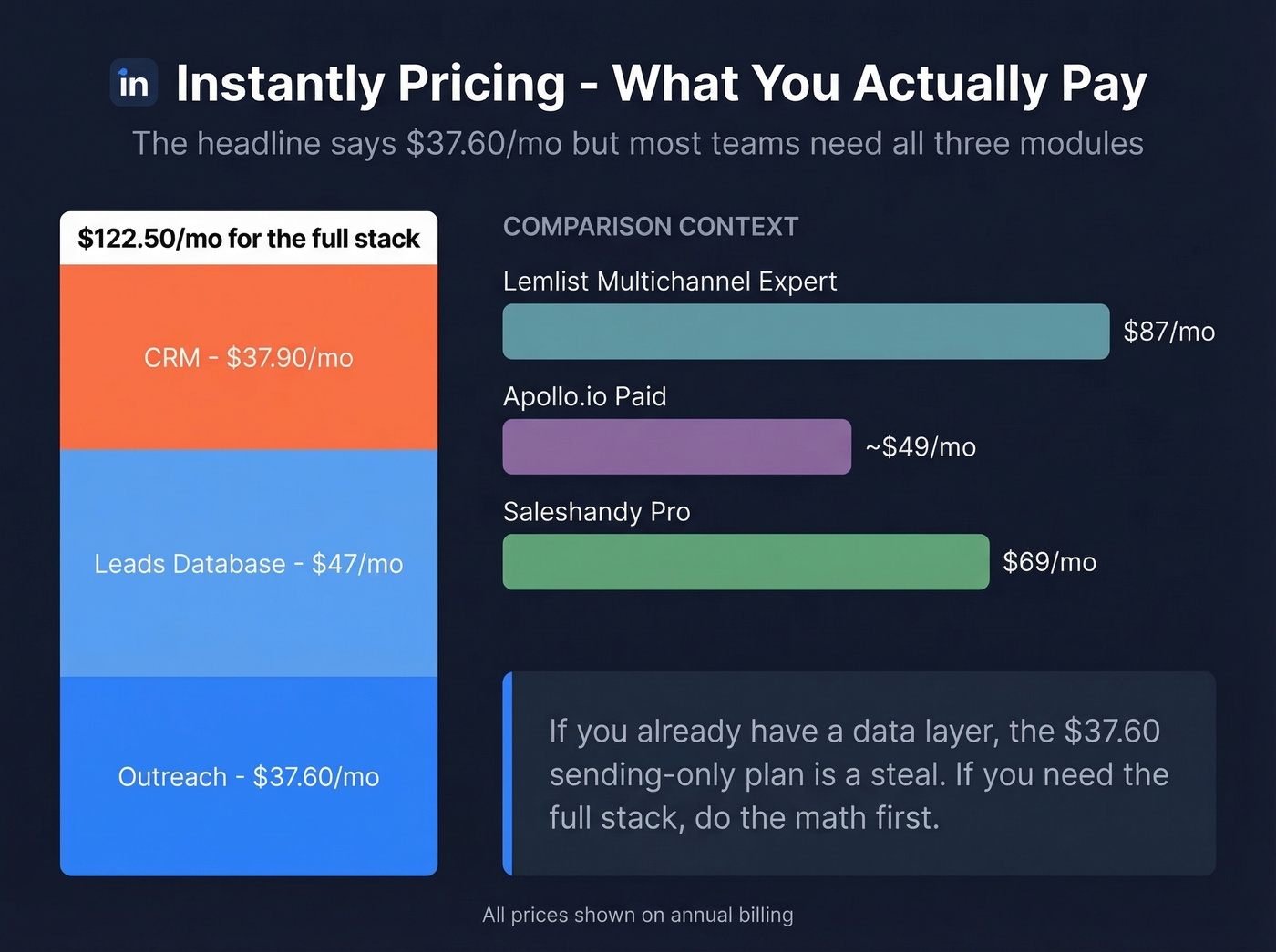
Instantly's headline pricing looks aggressive: Outreach Growth at $37.60/mo yearly, unlimited email accounts, unlimited warm-up. But here's the thing - Instantly sells three separate modules. Add the Leads database at $47/mo and CRM at $37.90/mo and you're at $122.50/mo minimum for the full stack.
The sender rotation and warm-up infrastructure is genuinely strong. It's the best deliverability toolkit on this list for high-volume senders. The 450M+ lead database is a nice bonus if you don't already have a data source. Just go in with eyes open on the real cost. We've seen a lot of teams sign up for the $37.60 plan and realize they need two more modules within the first month.
Instantly is the best cold email infrastructure on this list. But the modular pricing means you're often paying more than Lemlist or Apollo while getting less functionality. If you already have a data layer, the $37.60 sending-only plan is a steal. If you need the full stack, do the math first.
Lemlist - Best for Multichannel
Lemlist combines email, automation steps, and a built-in dialer in one platform. Email Pro starts at $63/user/mo on annual billing; Multichannel Expert at $87/user/mo adds LinkedIn steps and VoIP calling.
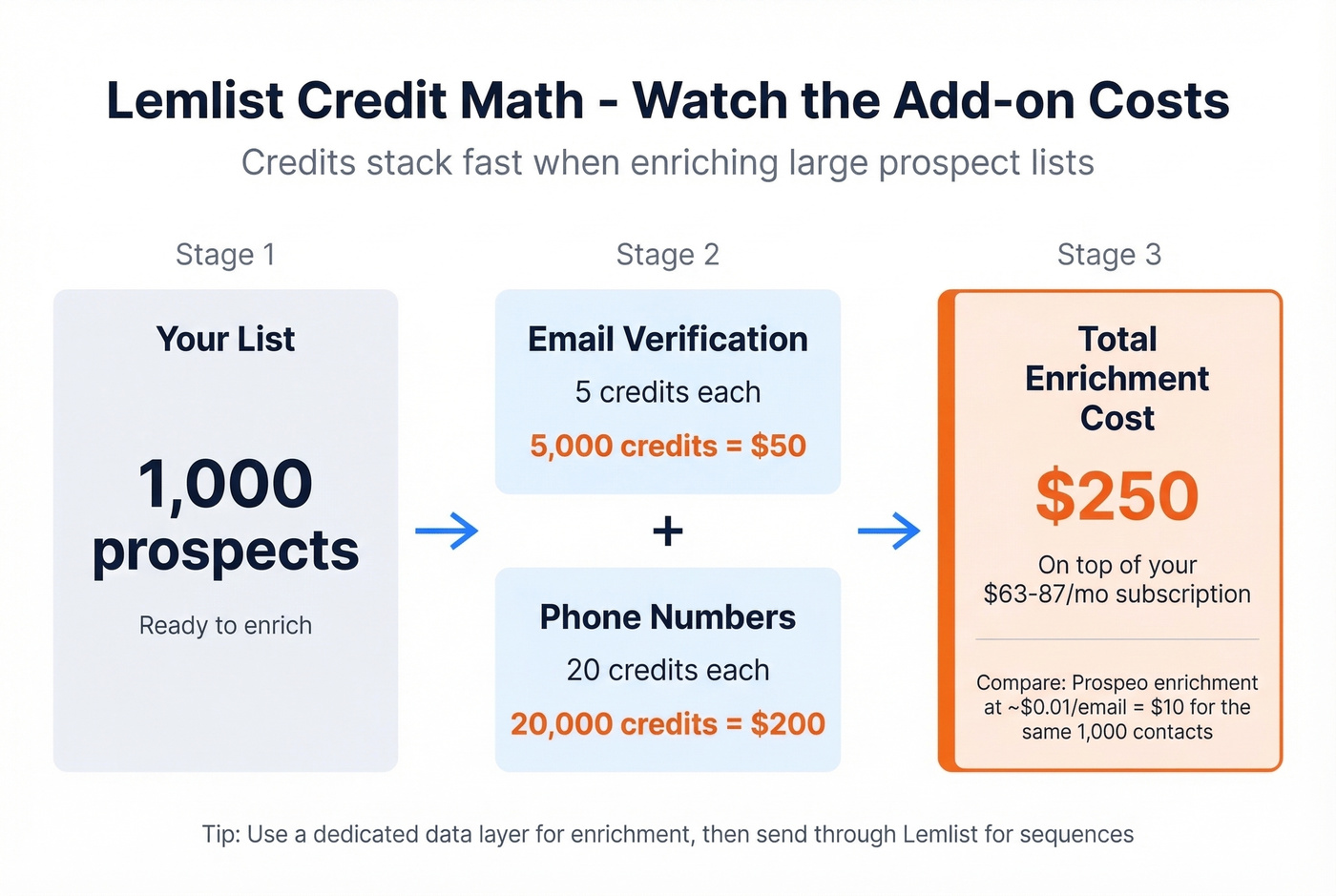
The credit math needs attention. Verified emails cost 5 credits each ($0.05/email), phone numbers cost 20 credits ($0.20/number). Those add-on costs stack fast if you're enriching large lists. The 600M+ leads database is impressive on paper, but verify contacts through a dedicated data layer before sending if deliverability matters to you.
A word on LinkedIn automation: if you add social steps, treat it as a separate risk surface. LinkedIn actively restricts accounts that automate connection requests and messages. Use conservative daily limits, separate sender domains for email, and don't run LinkedIn automation from your primary profile. The consensus on r/sales is pretty clear - the failure mode is usually an overeager rep who cranks LinkedIn volume to 100 connections/day and gets restricted within a week.
Apollo.io - All-in-One Option
Apollo combines a prospecting database, email sequences, and a lightweight CRM in one platform. Free tier available, paid plans from roughly $49/user/mo. It's the most popular Yesware comparison on G2 for a reason - it does a lot under one roof.
The weakness is email accuracy, which lags behind dedicated verification tools. Apollo's database is large but refresh cycles are slower, and bounce rates tend to run higher than what you'd get from a purpose-built data platform. If deliverability is already shaky - say you've been flagged by Google or Microsoft in the past six months - don't rely on an all-in-one database without running verification on top. The convenience of "everything in one place" isn't worth much if 15% of your emails bounce and your domain reputation tanks further.
For early-stage teams that want to start prospecting today without stitching together three tools, Apollo is the fastest path to first meetings. Just layer in verification before you scale.
Woodpecker - Budget Pick
Woodpecker starts at $20/mo and does exactly one thing well: cold email for small teams. CRM integrations are a $20/mo add-on, warm-up is $5/mo per inbox.
The catch: those add-ons add up. Once you include them, you're at $45/user/mo; for a team of three reps that's $135/mo total - not far from Saleshandy Pro, which includes warm-up and integrations out of the box. Woodpecker also lacks a serious deliverability stack: no sender rotation, no inbox placement testing, no built-in data. It's a good fit for a two-person SDR team sending 500 emails a week. Beyond that, you'll outgrow it fast. Skip this if you're planning to scale past five reps in the next six months.
What to Audit Before You Switch
Before you migrate off Yesware, run through this checklist. Most teams skip it and spend the first month fixing avoidable problems.
- Export your templates and sequences. Yesware doesn't make this easy. Screenshot or copy every template, sequence step, and merge field mapping. No tool imports Yesware data natively.
- Check your tracking domain. If you set up a custom tracking domain in Yesware, you'll need to reconfigure DNS for your new tool. Miss this and your tracked links break. (If you need a quick explainer, see tracking domain.)
- Audit Salesforce activity capture. Yesware logs emails as Salesforce activities. Your new tool may log them differently - or not at all on lower plans. Map this before you switch, not after.
- Review unsubscribe handling. Every tool handles opt-outs differently. Make sure your suppression list transfers cleanly - sending to someone who already unsubscribed is a CAN-SPAM violation and a deliverability killer.
- Test deliverability baseline. Send a test batch from your new tool before going live. If inbox placement is below 80%, fix your sending infrastructure before scaling. Use an email deliverability guide to troubleshoot systematically.
If you're on Outlook: your options narrow significantly. Mixmax and Lemlist are Gmail-only for their core inbox experience. Saleshandy, Instantly, and Woodpecker are more platform-agnostic because they don't depend on a Gmail sidebar workflow. Apollo works with both but the Gmail integration is stronger.
How to Choose the Right Alternative
Let's keep this simple. Match the tool to your actual bottleneck:
Just need inbox tracking and templates? Mixmax. It's the closest Yesware replacement and the transition is painless for Gmail teams.
Scaling cold email volume? Saleshandy or Instantly, depending on whether you want transparent caps or maximum sender rotation. Both are strong; Saleshandy is simpler, Instantly has better deliverability infrastructure.
Need multichannel outreach? Lemlist gives you email, LinkedIn, and calling in one seat. Just respect LinkedIn's automation limits or you'll lose your account.
Your data is the real problem? Fix it first, then pick a sender. Switching from Yesware to another sending tool won't help if 30% of your list is dead addresses. We've seen this pattern repeatedly - teams blame the sequencer when the upstream data is the actual bottleneck. The workflow is straightforward: enrich and verify your contacts, push clean data to your sequencer, then monitor bounce rates weekly. If you need a broader stack view, start with outbound lead generation tools and then narrow down.

Most teams exploring Yesware alternatives don't need a more complex tool. They need cleaner data and a simpler sender. Start there. If you're rebuilding your outbound motion, borrow a few sales prospecting techniques that still work in 2026.
Teams switching off Yesware cut bounce rates from 35% to under 4% after plugging Prospeo into their new stack. At $0.01/email with native integrations into Saleshandy, Instantly, and Lemlist, it pairs with every sender on this list - no contracts, no sales calls.
Pair 98% accurate data with any sender on this list for free.
FAQ
What happened to Yesware?
Vendasta acquired Yesware in October 2022 and relaunched it inside the Vendasta Marketplace in February 2025 with deeper Vendasta CRM integration and agency/SMB positioning. Direct sales teams outside the Vendasta ecosystem are the most affected by this shift.
Is Yesware still free?
Yes, but the free plan caps you at 10 campaign recipients per month. Salesforce features require the Enterprise plan at $85/seat/mo monthly or $65/seat/mo annually. For most teams running real outbound, the free tier is too limited to be useful.
What's the best free alternative to Yesware?
Mixmax offers a free plan with email tracking, scheduling, and basic sequences - more generous than Yesware's free tier. Prospeo's free plan gives you 75 verified emails plus 100 Chrome extension credits monthly, which is better if bad data is your core issue rather than sending features.
Does Yesware work with Outlook?
Yesware dropped Outlook Exchange support entirely. If your team runs Microsoft, Saleshandy ($25/mo) or Instantly ($37.60/mo) are stronger fits - both are platform-agnostic and don't depend on a Gmail sidebar workflow.
Why are my Yesware open rates unreliable?
Apple Mail Privacy Protection pre-loads tracking pixels automatically, registering "opens" that never happened. This inflates open rates across every pixel-based tool, not just Yesware. Click tracking and reply rates are far more trustworthy - treat opens as directional only.