


Zoho CRM Alternatives: 9 Options With Real Pricing and Honest Opinions
A small business owner on r/smallbusiness recently estimated they'd lost 15 hours in a single month "fighting the tool instead of selling" - reports crashing, email threads dropping, mobile app lagging during client calls. That's not an isolated story. Zoho CRM packs an impressive feature set at a low entry price, but the gap between what's advertised and what actually works smoothly is where teams start shopping for Zoho CRM alternatives.
Looking for open-source options like Odoo or SuiteCRM? That's a different list. This one covers commercial CRMs with paid support and real customer service.
Our Picks (TL;DR)
- HubSpot Sales Hub - Easiest transition from Zoho. Best free tier on the market. Ideal for teams under 20 reps who value support and usability over raw customization. Starts free; paid from ~$18-$20/user/mo.
- Pipedrive - Pure sales pipeline tool with zero bloat. If your team lives in the pipeline view and doesn't need marketing automation baked in, Pipedrive gets out of your way. Starts at $14/seat/mo.
- Freshsales - The budget pick. $9/user/mo gets you built-in phone, email, and chat. Hard to beat for cash-strapped teams.
Why Teams Leave Zoho CRM
Zoho CRM sits at 4.1/5 on G2 with 2,885 reviews. Not bad - but noticeably behind HubSpot (4.4/5, 13,567 reviews) and Salesforce (4.4/5, 25,486 reviews).
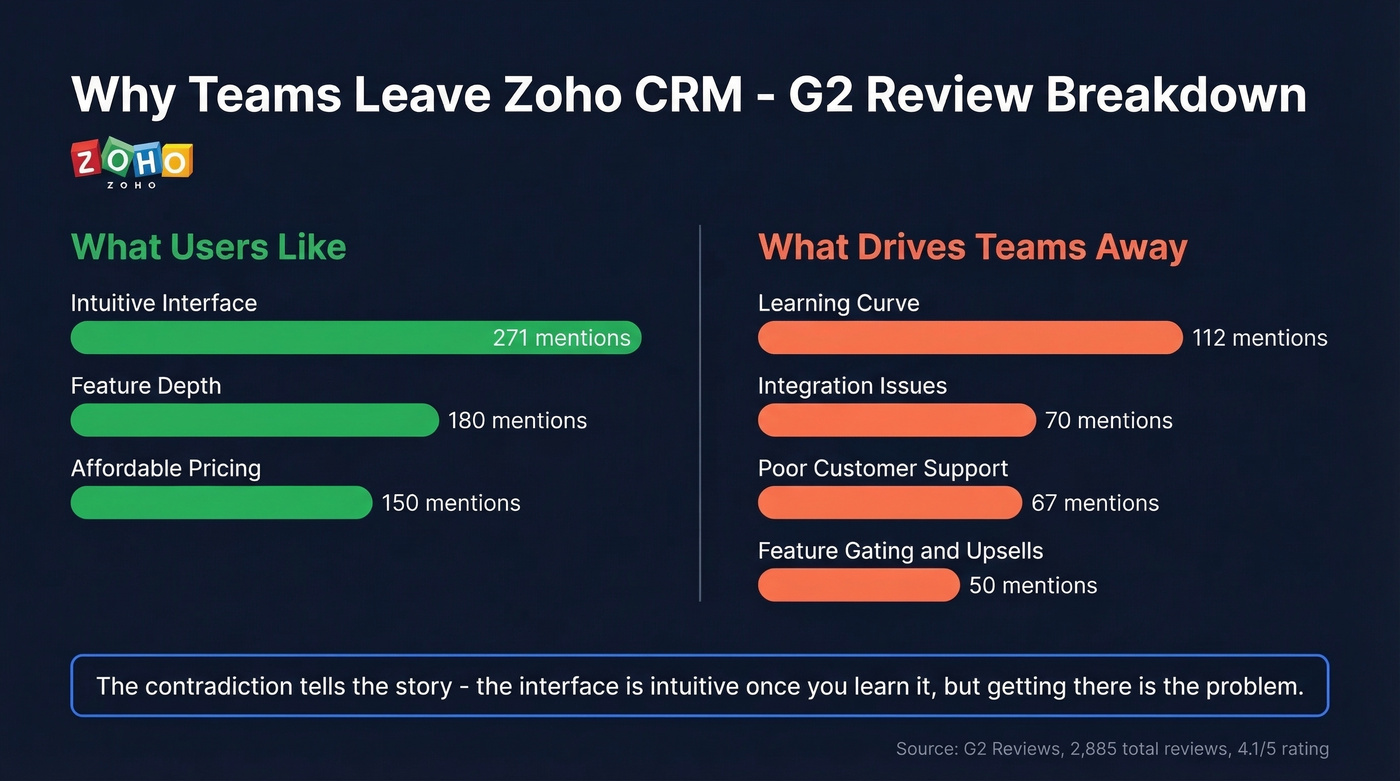
The most-mentioned positive on G2? "Intuitive interface" at 271 mentions. The top complaint? Learning curve at 112 mentions. That contradiction tells you everything: the interface is intuitive once you learn it, but getting there is the problem. Poor customer support clocks in at 67 mentions, and integration issues at 70. For a platform that markets itself as part of a broader ecosystem, that integration number stings.
Then there's feature gating. Zoho's AI assistant, Zia, is heavily tiered - many of the Zia capabilities people actually want sit in Enterprise and above. On the Standard plan, you're capped at 250 mass emails per day per org. That's a hard ceiling for any team running outbound at scale, and the only way past it is to upgrade.
Zoho also distinguishes between "Org users" and "Team users," where Team users can't access AI, reports, dashboards, automation controls, or key Google/Microsoft integrations - a detail that catches cross-functional teams off guard when they try to loop in marketing or customer success.
Many teams don't just buy Zoho CRM. They get sold on Zoho One - the full suite at around $40-$50/user/mo. It sounds like a deal until you realize you're paying for a huge bundle of apps and only using a few. The "Zoho One trap" is real: teams sign up for the ecosystem, use CRM plus maybe Projects and Campaigns, and end up subsidizing a bookkeeping app they never opened. To be fair, Zoho's storage pricing is generous at $4/4GB/month compared to $250/GB/month at some competitors. But cheap storage doesn't help if the CRM itself is hard to use and support takes days to respond.
Not every team needs to replace Zoho entirely. Some just need to layer on better tools for specific workflows - like contact data quality or field sales tracking. But if you're past that point, here's what's worth evaluating.
Quick Comparison Table
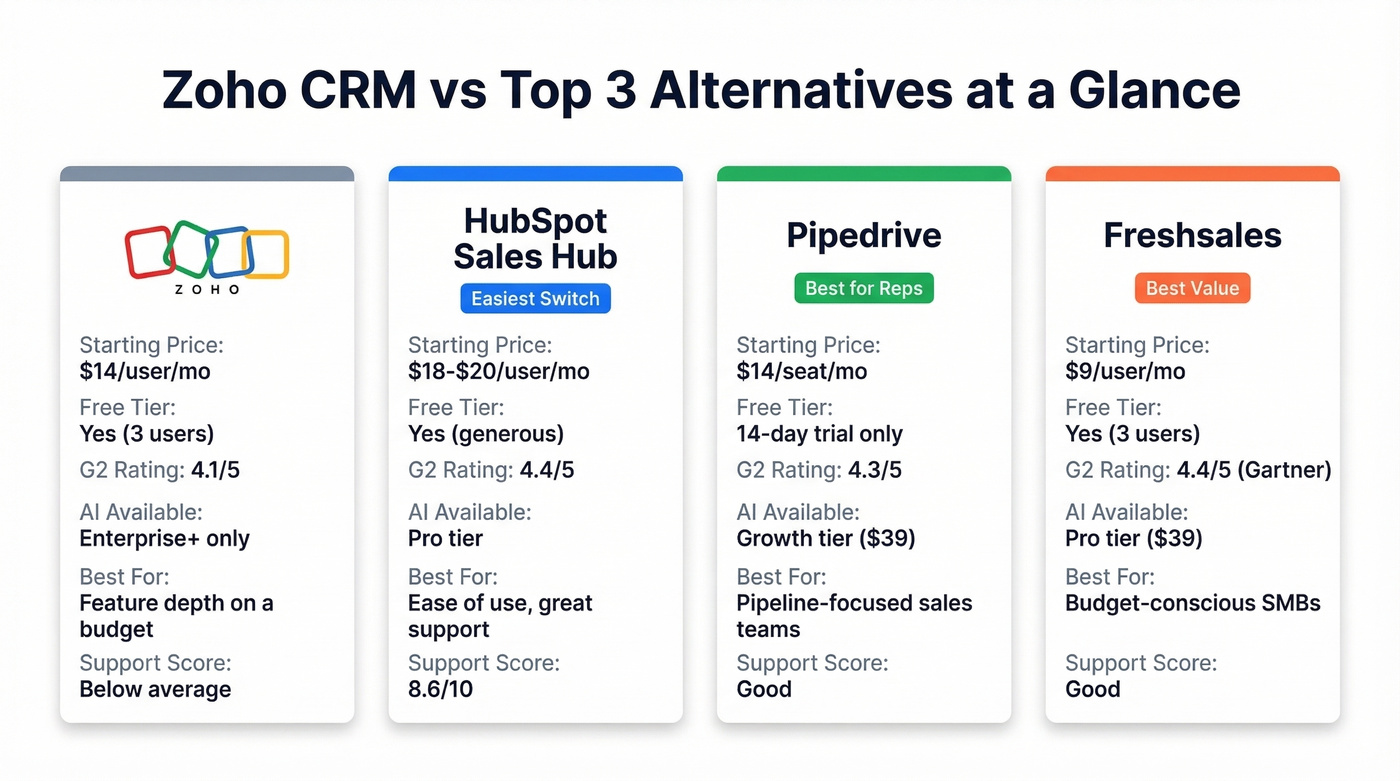
| Tool | Best For | Starting Price | Free Tier | G2/Gartner Rating | AI Tier |
|---|---|---|---|---|---|
| Zoho CRM | Feature depth, budget | $14/user/mo | Yes (3 users) | 4.1/5 (G2) | Enterprise+ |
| HubSpot Sales Hub | Ease of use, support | ~$18-$20/user/mo | Yes (generous) | 4.4/5 (G2) | Pro tier |
| Pipedrive | Pipeline management | $14/seat/mo | 14-day trial | 4.3/5 (G2) | Growth ($39/seat/mo) |
| Freshsales | Budget-conscious SMBs | $9/user/mo | Yes (3 users) | 4.4/5 (Gartner) | Pro ($39/user/mo) |
| Salesforce | Enterprise scale | $25/user/mo | Yes (2 users) | 4.4/5 (G2) | Agentforce ($550/user/mo) |
| Dynamics 365 | Microsoft ecosystem | ~$65/user/mo | No | 4.4/5 (Gartner) | ~$150+/user/mo |
| Monday CRM | Visual pipeline teams | ~$12/seat/mo | Yes (limited) | - | - |
| SugarCRM | Mid-market (15+ reps) | $59/user/mo | No | - | Sell Premier ($135/user/mo) |
| Insightly | SMB CRM + projects | $29/user/mo | Trial only | 4.2/5 (Gartner) | - |

A new CRM won't fix bad contact data. Teams leaving Zoho often discover their pipeline was built on outdated emails and wrong numbers. Prospeo gives you 300M+ profiles with 98% email accuracy and a 7-day refresh cycle - so every record in your new CRM actually connects to a real buyer.
Start your CRM migration with data you can actually trust.
Best Alternatives to Zoho CRM
HubSpot Sales Hub
Use this if: You want the smoothest possible transition from Zoho, your team is under 20 reps, and you value support quality and onboarding resources. HubSpot's ease-of-use score on G2 is 8.7 - meaningfully higher than most competitors. The free CRM tier is genuinely usable, not just a demo. If you want more context on what counts as a CRM (and what doesn't), see these examples of a CRM.
Skip this if: You need deep customization at a low price point. HubSpot gets expensive fast. Starter runs ~$18-$20/user/mo, but Professional jumps to $90/user/mo and Enterprise hits $150/user/mo on annual billing.
We've seen teams migrate from Zoho to HubSpot in under a week for small pipelines, and the support difference alone justifies the switch for many. HubSpot's 8.6 support score on G2 is a measurable upgrade over Zoho's 67 complaints about response times. The platform is designed so Sales, Marketing, and Service tools work together without you constantly duct-taping apps together - something Zoho promises but doesn't always deliver.
Pipedrive
Pipedrive renamed its plans in 2025, so if you're seeing "Essential" or "Advanced" in other articles, those names are outdated. Current pricing: Lite $14, Growth $39, Premium $59, Ultimate $79 per seat/mo on annual billing. AI tools start at the Growth tier for $39/seat/mo, which is cheaper than many CRM "AI" upgrades.
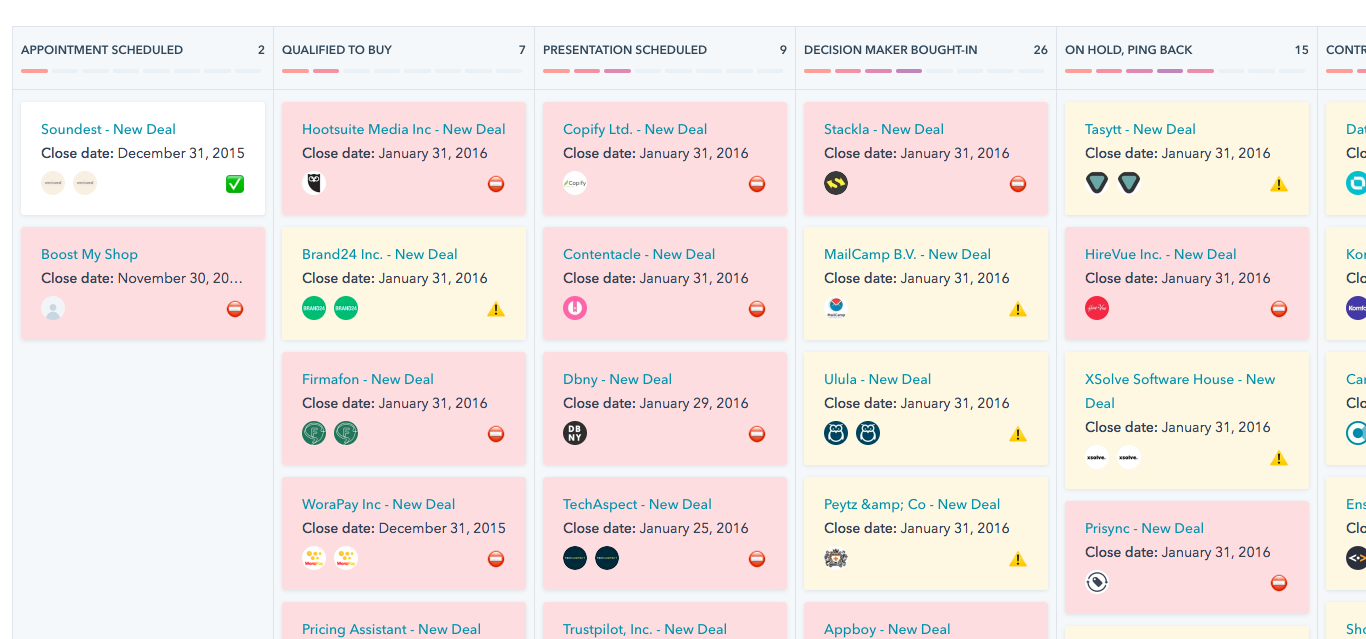
Pipeline-first design means every screen revolves around deals. Reps who live in pipeline view feel at home immediately. The 14-day free trial doesn't require a credit card, and G2 reviewers give it 4.3/5 across 2,959 reviews.
Here's the thing: add-ons add up. LeadBooster is $32.50/mo, Campaigns $13.33/mo, Web Visitors $41/mo. A fully loaded Pipedrive seat can run $120+/mo, and there's no free tier - just the trial. If you need email nurture sequences beyond basic campaigns, you'll need another tool alongside it. Pipedrive is the obvious pick for sales-focused teams that don't want an all-in-one platform. It does one thing - deal tracking - and does it well. If you're building a modern outbound stack, it also helps to understand sequence management.

Freshsales
Freshsales Growth at $9/user/mo is the cheapest paid CRM on this list, and it includes built-in phone, email, and chat. The free plan supports 3 users - same as Zoho - but with a cleaner interface and less feature-gating friction.
The ecosystem is thinner than HubSpot's. Freshworks has other products like Freshdesk and Freshmarketer, but the integration depth between them doesn't feel as unified as HubSpot's platform approach. That said, the AI story is compelling: Freddy AI unlocks at the Pro tier ($39/user/mo) with contact scoring, AI-generated sales emails, and pipeline insights, while Enterprise ($59/user/mo) adds forecasting and governance features. The 21-day free trial is the longest on this list - a full week longer than Pipedrive's. For budget-constrained teams, start here.
Salesforce Sales Cloud
Salesforce is the CRM you graduate to, not the one you start with. The pricing page looks approachable - a free tier for up to 2 users, Starter at $25/user/mo, Pro at $100, Enterprise at $175, Unlimited at $350, and the new Agentforce tier at $550/user/mo. But the free tier is extremely limited, and the $25 Starter price is a loss leader. Nobody stays there.
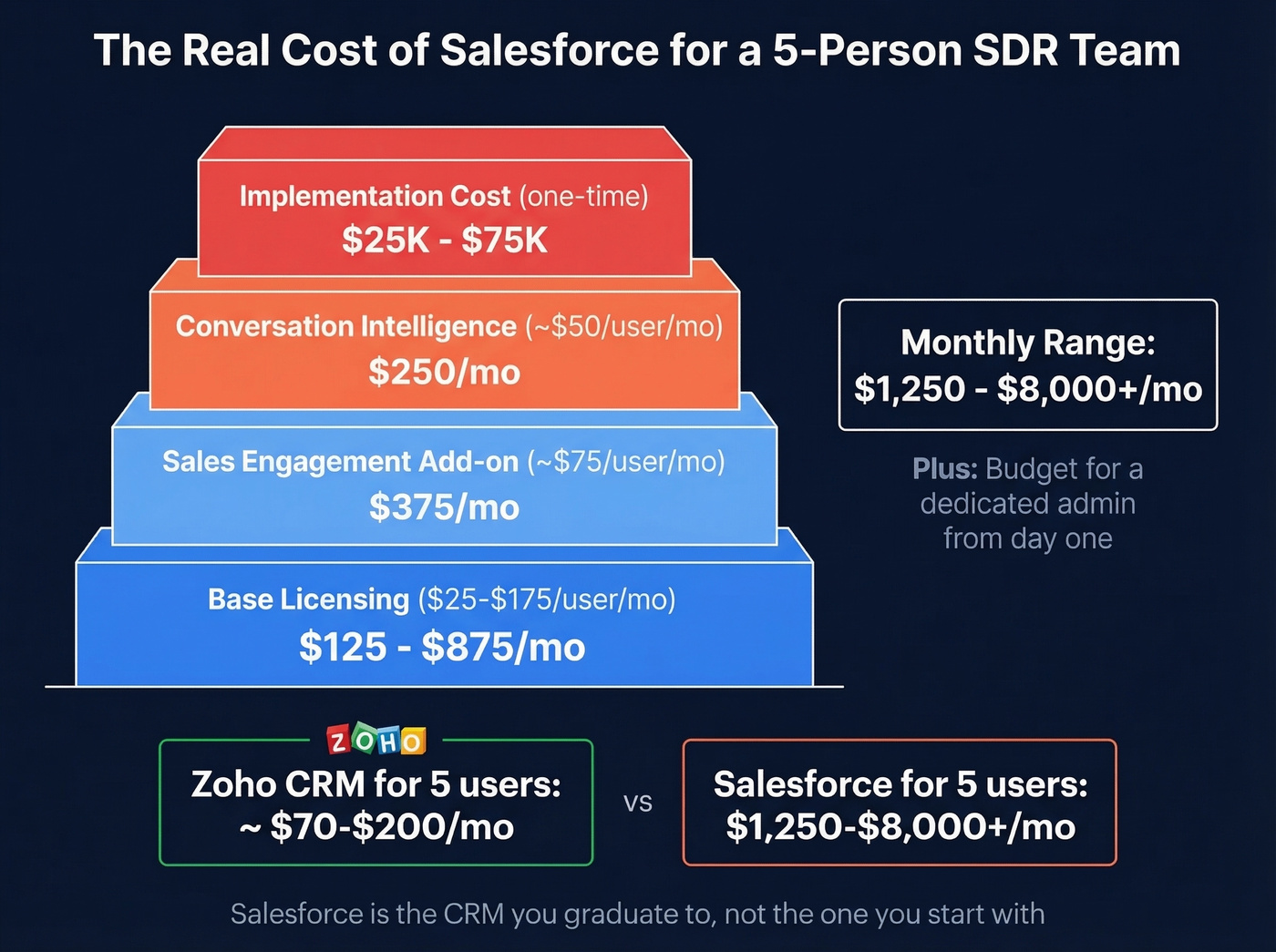
A mid-market Salesforce implementation runs $25K-$75K before you've paid a single month of licensing. Add-ons like Sales Engagement (~$75/user/mo) and Conversation Intelligence (~$50/user/mo) stack on top. A 5-person SDR team can run $1,250 to $8,000+/month depending on configuration. The consensus on r/salesforce is clear: budget for a dedicated admin from day one.
G2: 4.4/5 with 25,486 reviews - the most-reviewed CRM on the platform. Best for teams with 25+ reps, dedicated admin resources, and the budget to do it right. If you're a 6-person team leaving Zoho because it's too complex, Salesforce isn't the answer. If you're comparing CRM total cost, this deeper breakdown of Salesforce pricing helps.
Microsoft Dynamics 365
If your company already lives in Outlook, Teams, and Excel, Dynamics 365 is the path of least resistance. CRM modules start around $65/user/mo and scale to $300+/user/mo depending on which capabilities you stack. Copilot AI is available at the Enterprise tier (~$150+/user/mo).
Dynamics isn't flashy, but the Microsoft integration depth is unmatched - emails sync natively from Outlook, meeting notes flow from Teams, and Excel-based reporting feels familiar to finance teams who'll never learn a BI tool. Best for organizations with 50+ employees already paying for Microsoft 365 E3/E5 licenses. If you're not already in the Microsoft ecosystem, the onboarding cost and complexity make this a hard sell.
Monday CRM
Monday CRM is a strong option for teams that think in boards rather than tables - visual, drag-and-drop, and easy to adopt. Pricing starts around ~$12/seat/mo, with Enterprise on custom pricing that typically lands around $40-$60/seat/mo.
Most comparison articles overlook it, but for teams that want a lightweight CRM without the overhead of Salesforce or the complexity of Zoho, Monday deserves a trial. The tradeoff: it's less powerful for advanced sales automation and lead scoring than HubSpot or Pipedrive. Think of it as the CRM for teams that hate CRMs.
SugarCRM
SugarCRM prices at $59/$85/$135 per user/mo - but every plan carries a 15-user minimum. That's a minimum annual commitment of ~$10,620/year before you've customized anything.
If you have fewer than 15 reps, SugarCRM isn't for you. Period. For mid-market teams that clear that bar, Sugar's process automation and on-premise deployment options are genuine differentiators. But most teams reading this article won't qualify.
Insightly
Insightly starts at $29/user/mo and bundles CRM with project management - useful for services firms that track deals and deliverables in one place. It's a solid SMB option, but limited compared to HubSpot or Pipedrive for pure sales pipeline management. If you're a consulting firm or agency that needs deal tracking and project delivery in one tool, Insightly is worth a look. For everyone else, the other options on this list offer more for the money.
Which Alternative Fits Your Team Size
Let's be honest: if your average deal size is under $10K, you probably don't need anything more sophisticated than HubSpot Free or Pipedrive Lite. The CRM isn't what closes deals at that price point - your outreach quality and data accuracy are. If you want to tighten the basics, start with these sales prospecting techniques.
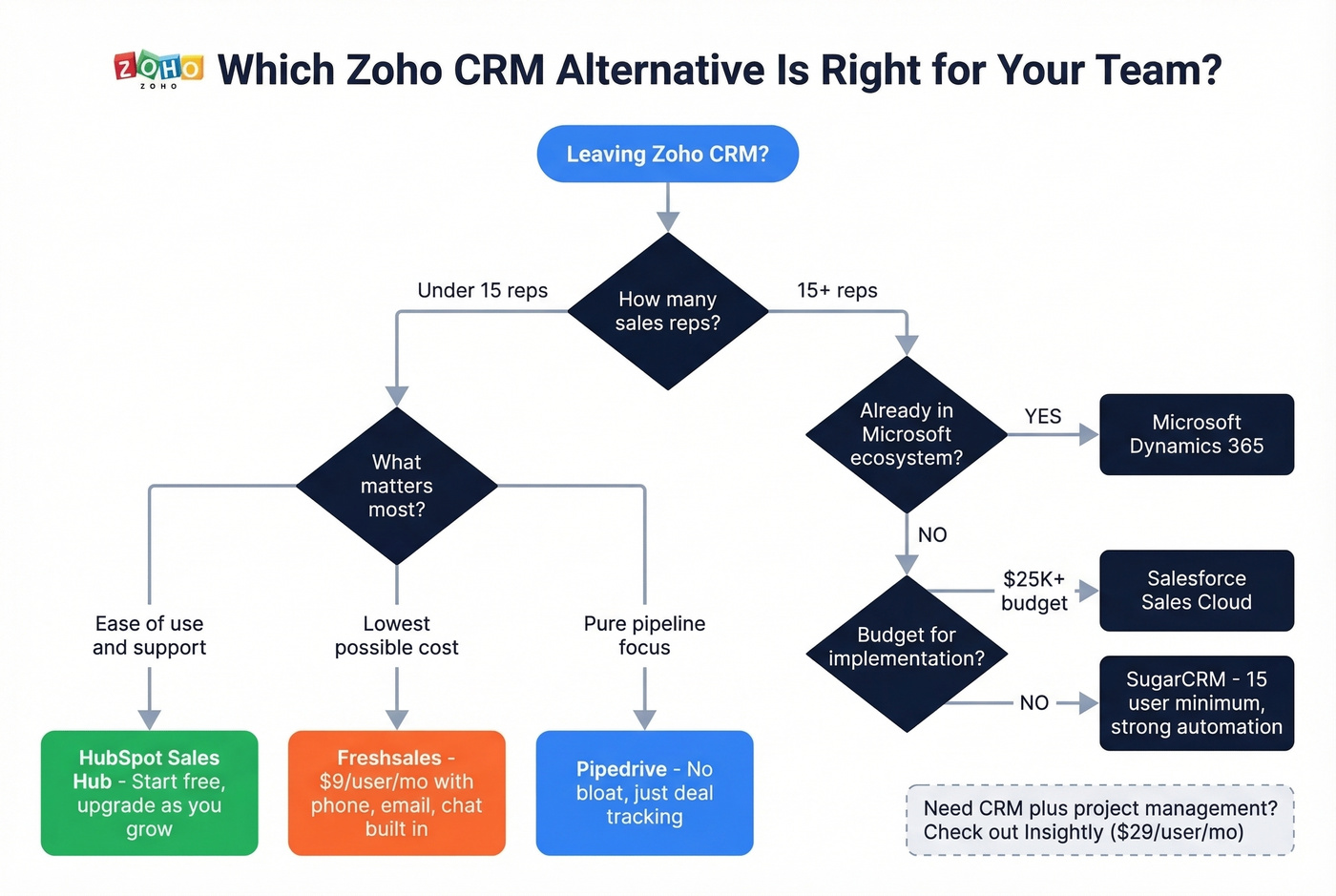
Here's a quick framework:
- Solo / 1-3 users - Freshsales Free or HubSpot Free. Don't pay for a CRM until you've outgrown the free tier.
- 4-10 reps - HubSpot Starter (~$18-$20/user/mo) or Pipedrive Lite/Growth ($14-$39/seat/mo). Both are fast to set up and don't require a dedicated admin.
- 11-25 reps - HubSpot Professional ($90/user/mo) or Pipedrive Premium ($59/seat/mo). You'll want workflow automation and better reporting at this stage.
- 25-100 reps - Salesforce Pro/Enterprise ($100-$175/user/mo) or Dynamics 365. Budget for implementation and at least a part-time admin.
- 100+ reps - Salesforce Enterprise/Unlimited. There's a reason it dominates at this scale.
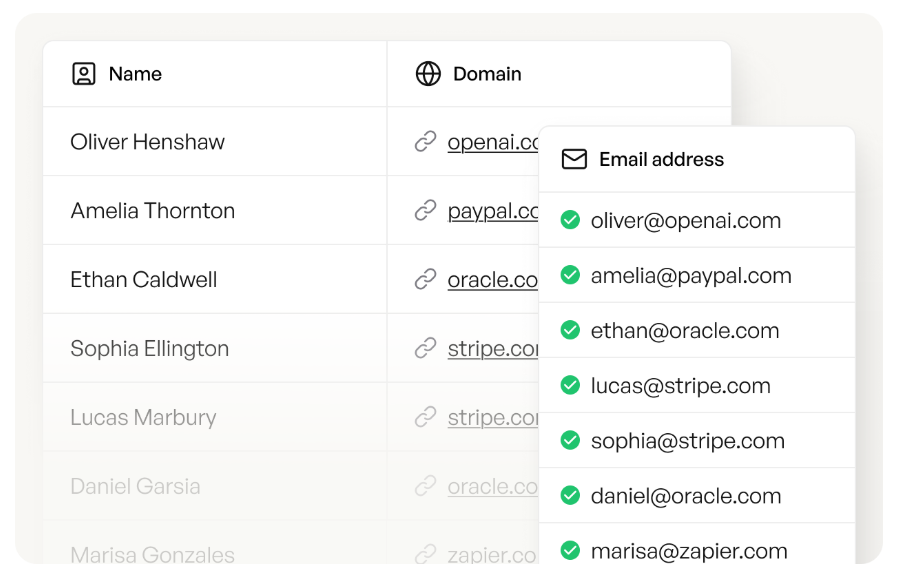
Clean Your Data Before You Migrate
Here's a mistake we've seen teams make over and over: they export 20,000 contacts from Zoho, import them into HubSpot or Pipedrive, and immediately start running sequences on stale data. Bounce rates spike. Domain reputation tanks. The new CRM gets blamed for a problem that existed before the migration. If you're seeing bounces, this guide on email bounce rate is a useful reference.
Exporting Zoho contacts and importing them into a new CRM doesn't fix bad data - it just moves it.
The fix is straightforward. Export your contacts as a CSV from Zoho, then run that file through an enrichment tool like Prospeo - 83% of leads come back with updated contact data, including 50+ data points per record at 98% email accuracy. Dead email addresses get flagged before they ever hit your sequencer, and the 7-day refresh cycle means the data you're importing is current, not six weeks stale. One of our customers, Stack Optimize, built to $1M ARR while keeping client deliverability above 94% and bounce rates under 3% - that kind of data hygiene starts before the CRM migration, not after. If you're evaluating vendors, compare options in our roundup of data enrichment services.
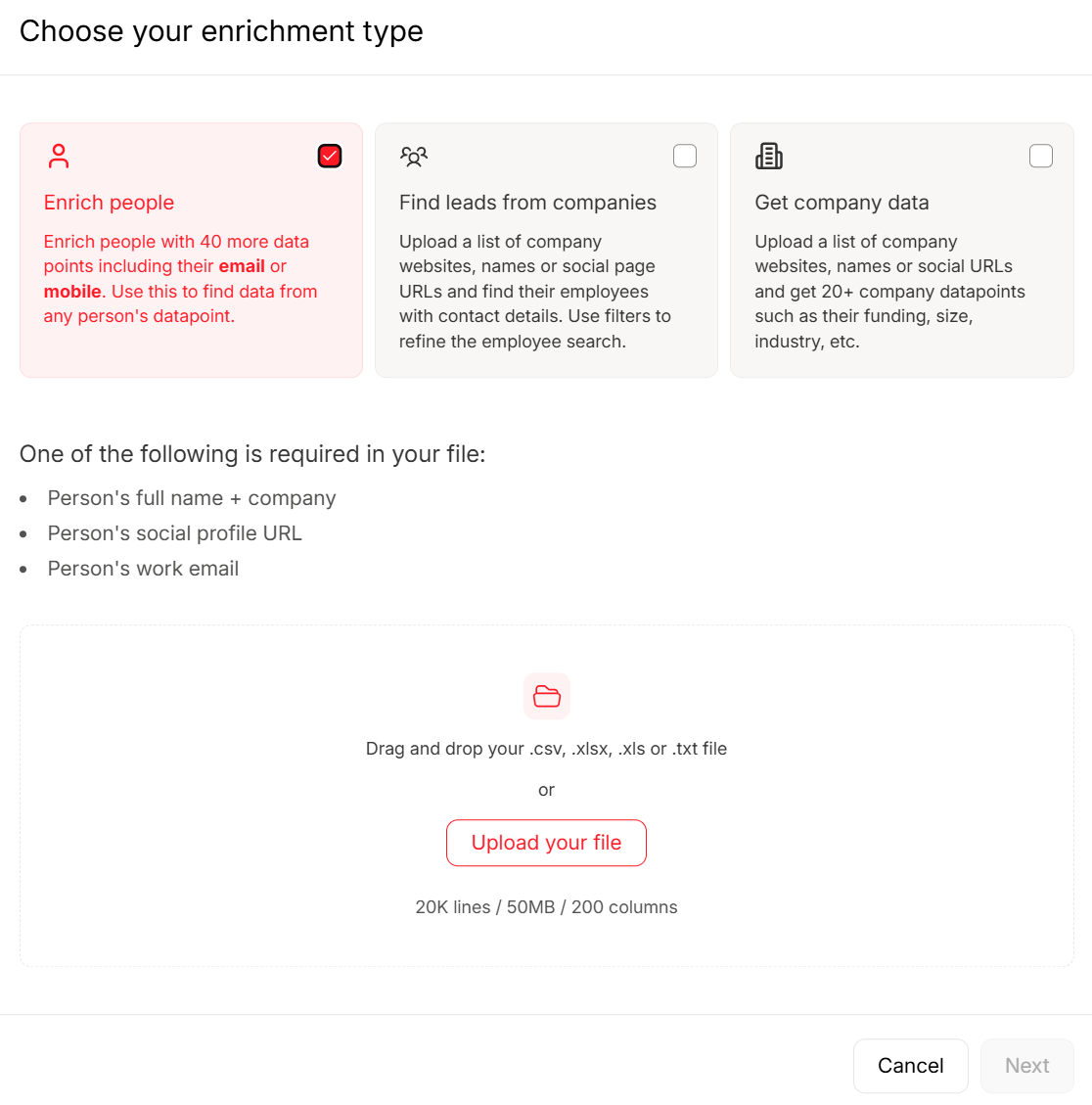
Once your data is clean, import into your new CRM with confidence. The migration itself - for most SMB teams - takes a few days to two weeks. The data cleanup is what separates a smooth transition from a deliverability disaster. If outbound is part of your motion, it’s also worth reviewing email deliverability basics before you ramp volume.
Zoho's 250 mass email cap isn't your only outbound bottleneck - bad data is. Prospeo's 143M+ verified emails and 125M+ direct dials at $0.01/email mean your new CRM stays clean from day one. No feature-gating, no annual contracts, no fighting the tool.
Pair your new CRM with the data platform 15,000+ companies rely on.
FAQ
Is Zoho CRM really free?
Yes, for up to 3 users - but severely limited. No AI, a 250 mass email/day cap for the entire org, and tight automation limits on lower tiers. Most teams outgrow it within months and face a jump to higher editions for the features they actually need. The free tier is a trial in disguise.
What's the cheapest Zoho CRM alternative?
Freshsales Growth at $9/user/mo on annual billing is the lowest-cost paid option and includes built-in phone, email, and chat. For zero cost, both Freshsales and HubSpot offer free plans supporting 3+ users with enough functionality to run a small pipeline.
Can I migrate my data from Zoho to another CRM?
Yes - export contacts as a CSV from Zoho, clean the file with an enrichment tool to flag bounced emails and update stale records, then import into your new CRM. Most SMB migrations take a few days to two weeks depending on customization complexity and data volume.
Is HubSpot better than Zoho CRM?
For ease of use and support quality, yes - HubSpot scores 8.7 on G2's ease-of-use metric versus Zoho's lower marks. For raw feature count at a low entry price, Zoho still wins. Choose HubSpot if you value simplicity and responsive support; stick with Zoho if you prioritize configurability and cost savings and have the patience to learn the system.