

The 80/20 Rule in Sales: Stop Nodding Along and Start Using It
84% of sales reps didn't meet quota last year, and the average rep spends only a third of their time actually selling. The 80/20 rule in sales isn't a fun fact for your next team meeting - it's a diagnostic tool that tells you exactly where your effort is leaking.
The Short Version
Export your closed-won deals, rank them by revenue, and find the 20% of accounts driving 80% of results. Then allocate your time accordingly. Apply the same lens to your pipeline, your prospecting channels, and your discovery calls. And fix your contact data before you do anything else - bad emails are one of the fastest ways to waste outbound volume and tank deliverability.
What 80/20 Actually Means
The Pareto Principle comes from Italian economist Vilfredo Pareto, who noticed that 20% of Italy's population owned 80% of the land. The ratio shows up everywhere in nature, economics, and - relentlessly - in B2B sales.
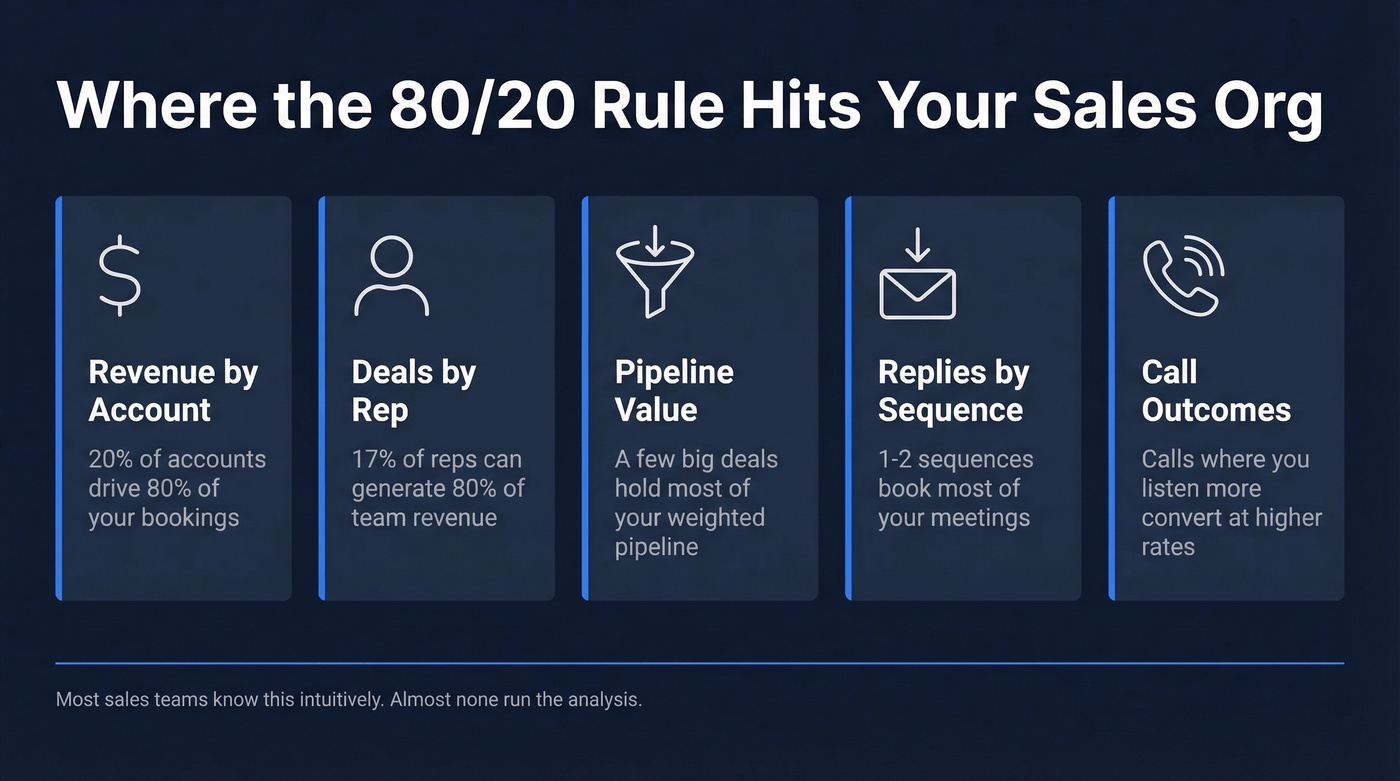
It hits your revenue in predictable ways:
- Revenue by account. A small slice of your customer base generates the vast majority of your bookings.
- Closed deals by rep. A handful of reps consistently outperform the rest by a wide margin.
- Pipeline value by opportunity. Most of your weighted pipeline sits in a few high-value deals.
- Replies by sequence. One or two sequences drive most of your booked meetings. The rest are noise.
- Call outcomes by talk time. The calls where you listen more and pitch less convert at dramatically higher rates.
Most sales teams know this intuitively. Almost none actually run the analysis.
The Data Behind the Pareto Principle in Sales
A consultant working with a mid-market sales org found that 17% of the team generated 80% of revenues. Not 20%. Seventeen percent. The distribution was even more skewed than Pareto predicted.
The profit picture is worse. When you factor in cost of sale, the top 20% of customers deliver 250%+ of profits, about 60% of your accounts break even, and the bottom 20% actively leak money - consuming support, demanding discounts, and churning before they ever pay back their cost to acquire customer.
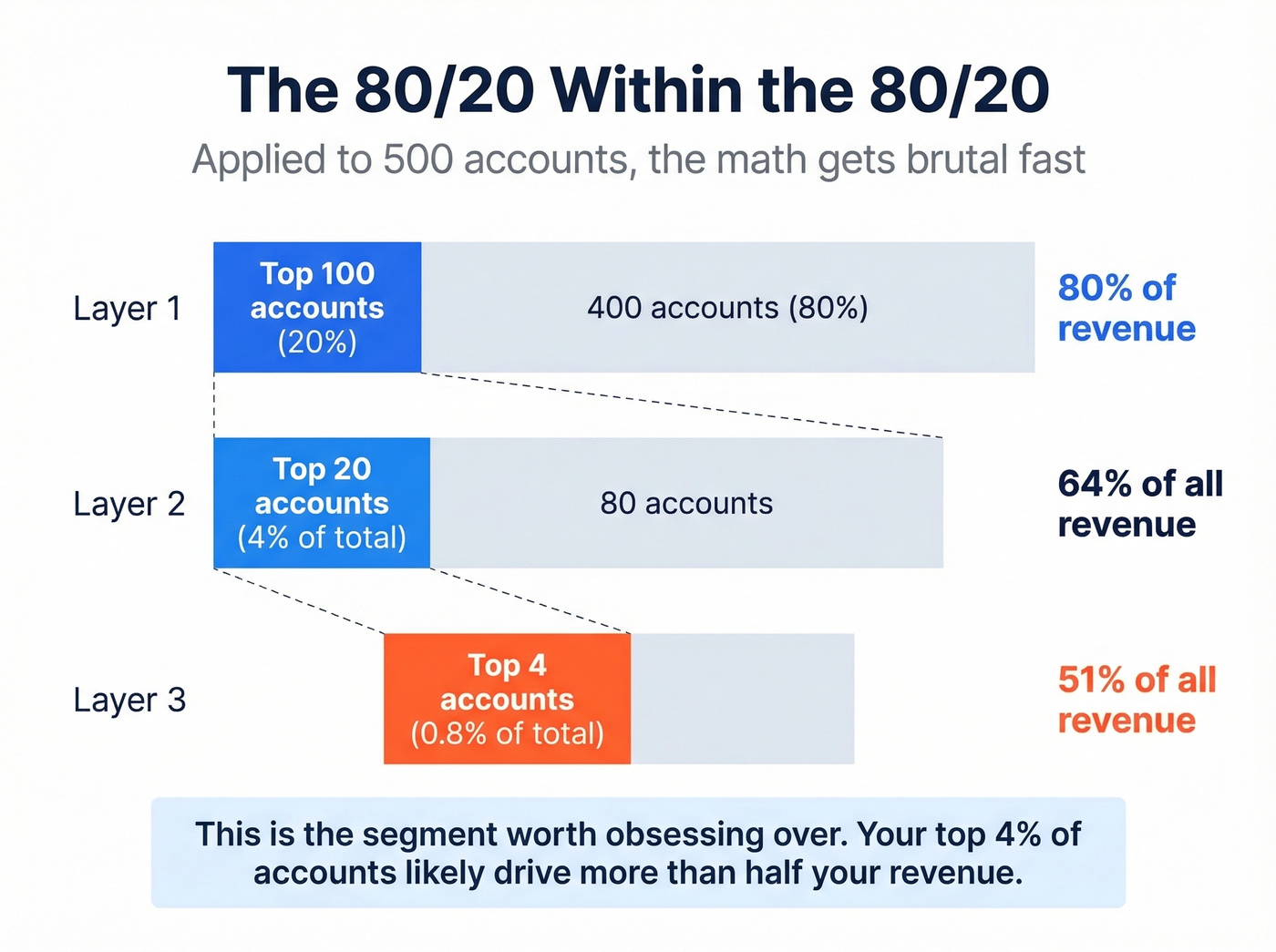
Perry Marshall's recursive framing takes the math one layer deeper: there's an 80/20 within the top 20%. If you have 500 accounts, the top 100 drive ~80% of sales. But the top 20 of those 100 - just 4% of your total - drive 64% of all sales. That's the segment worth obsessing over.
Some argue the pattern is just statistical noise. It doesn't matter. Even if the distribution is partly random, the practical implication is identical: a small number of accounts and reps drive most of your results, and your time allocation should reflect that.
| Pattern | What the data shows |
|---|---|
| Revenue by account | Top 20% → ~80% of revenue |
| Revenue by rep | 17% of one team → 80% of revenue |
| Profit by account | Top 20% → 250%+ of profits |
| Recursive layer | Top 4% → 64% of sales |

Your 80/20 analysis is only as good as the data behind it. Stale contacts and bounced emails mean your top 20% of accounts never even see your message. Prospeo refreshes every record every 7 days - not the 6-week industry average - so your segmentation reflects reality. 98% email accuracy. $0.01 per lead.
Fix the data first, and the 80/20 math works in your favor.
Find Your Top 20% in Your CRM
This takes about 30 minutes. No fancy BI tool required.
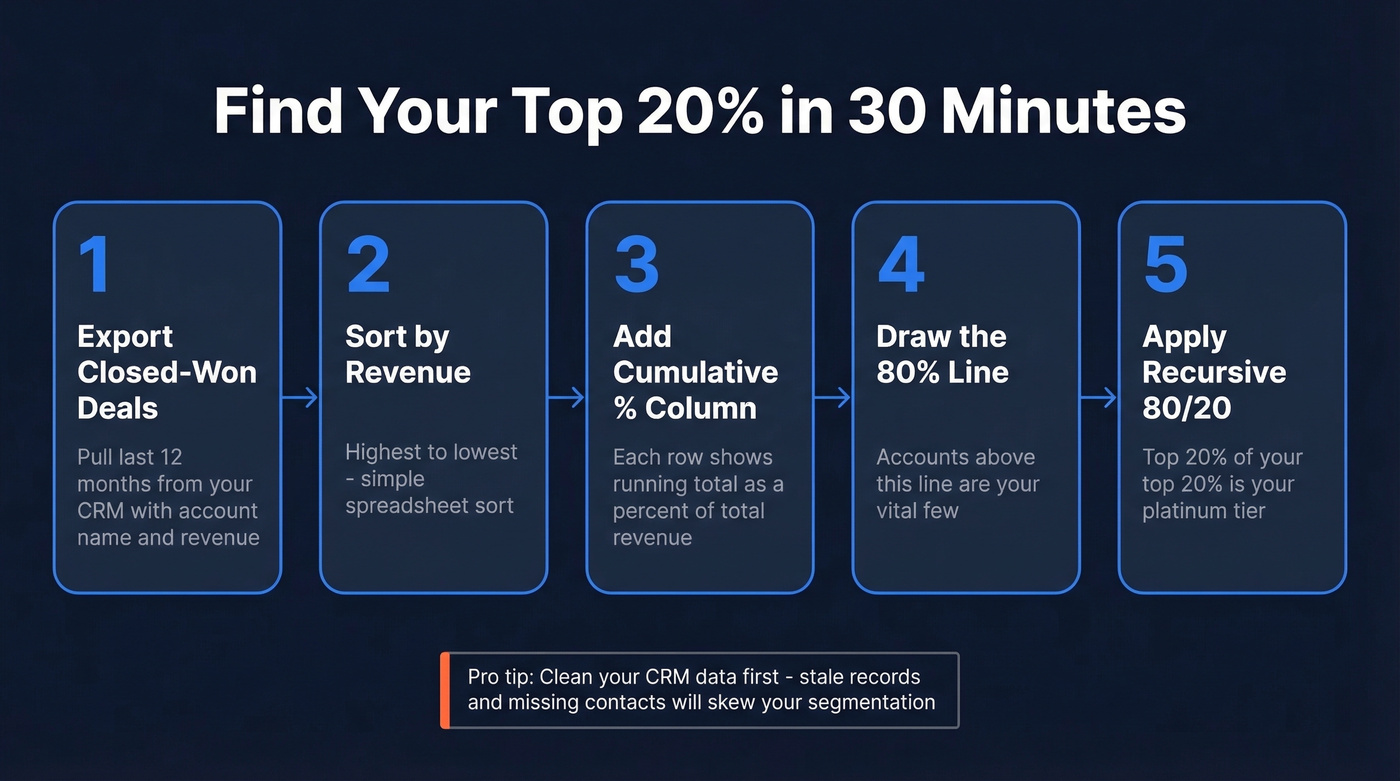
- Export closed-won deals from the last 12 months. Include account name and total revenue.
- Sort by revenue, highest to lowest.
- Add a cumulative percentage column. Each row shows the running total as a percentage of total revenue.
- Draw the 80% line. The accounts above this line are your vital few.
- Apply recursive 80/20 to the top segment. The top 20% of your top 20% is your platinum tier.
Use the RFM heuristic to validate: rank by recency, frequency, and monetary value. Accounts that score high on all three are your safest bets for expansion. Before you run this analysis, clean your CRM data - stale records and missing contacts will skew everything. Running your account list through Prospeo's enrichment takes minutes and ensures your segmentation reflects reality, not last year's org chart.
| Account | Revenue | Cumulative % |
|---|---|---|
| Acme Corp | $420K | 28% |
| Bolt Industries | $310K | 49% |
| Crane Co. | $195K | 62% |
| Delta Group | $140K | 71% |
| Echo Ltd. | $95K | 78% |
| Foxtrot Inc. | $52K | 81% ← cutoff |
| Golf Systems | $38K | 84% |
| Hotel Digital | $27K | 86% |
| India Partners | $18K | 87% |
| Juliet Corp | $12K | 88% |
Six accounts. That's where 81% of your revenue lives.
Where Else to Apply It
Pipeline Reviews
Focus review time on three categories: late-stage deals that can close this quarter, stalled deals that haven't advanced in 30 days, and newly added opportunities that need qualification pressure. A healthy pipeline carries a 4-6x coverage multiple against quota. Below 4x, you don't have a closing problem - you have a creation problem.
Stop running pipeline reviews as status updates where reps narrate their deal notes. Pipeline reviews are execution meetings. Every deal discussed should leave with a dated, buyer-driven next step or get moved to nurture. No exceptions.
Prospecting Channels and Data
Most outbound teams have a dirty secret: a huge chunk of their activity produces nothing. We've seen the pattern repeatedly - 5,000 emails sent, 16 meetings booked, and 12 of those meetings came from a single ICP segment. The other 4,500 emails were wasted motion.
Personalized B2B emails generate 14% higher open rates and 10% higher click-through rates than generic blasts. Large untargeted lists get 67% fewer replies. The math is clear: narrow your targeting and go deeper on fewer, better-fit accounts.
None of that matters if your contact data bounces. Keep your bounce rate below 2% and your spam complaint rate below 0.01% - those are the guardrails that protect your domain. Snyk's 50-person AE team cut bounces from 35% to under 5% and grew AE-sourced pipeline 180% after switching to verified data. That's the 80/20 rule applied to data quality: fix the input, and the output takes care of itself. (If you want to go deeper, start with an email deliverability guide and email bounce rate benchmarks.)

Discovery Calls
A founder on r/Entrepreneur put it perfectly: 80% of the call should be the prospect talking about their company and their problems. If you're talking more than that, you're selling too much.
The remaining 20% of your talk time? Spend it on only 20% of your solution - the specific slice that maps directly to the pain points the prospect just told you about. Don't vomit your entire capability list. Use the prospect's own language to position the relevant piece. We've watched reps transform their close rates simply by shutting up and listening. It's the cheapest improvement you'll ever make.
Time and Activity Management
Reps spend a third of their time selling. The rest goes to admin, CRM updates, internal meetings, and searching for contact data. Automation can save about 5 hours per week per rep. Here's the thing: most teams try to systematize everything at once, which is itself an 80/20 violation. Document the 20% of workflows that drive 80% of your team's output first. (If you need a starting list, use these sales activities as a baseline.)
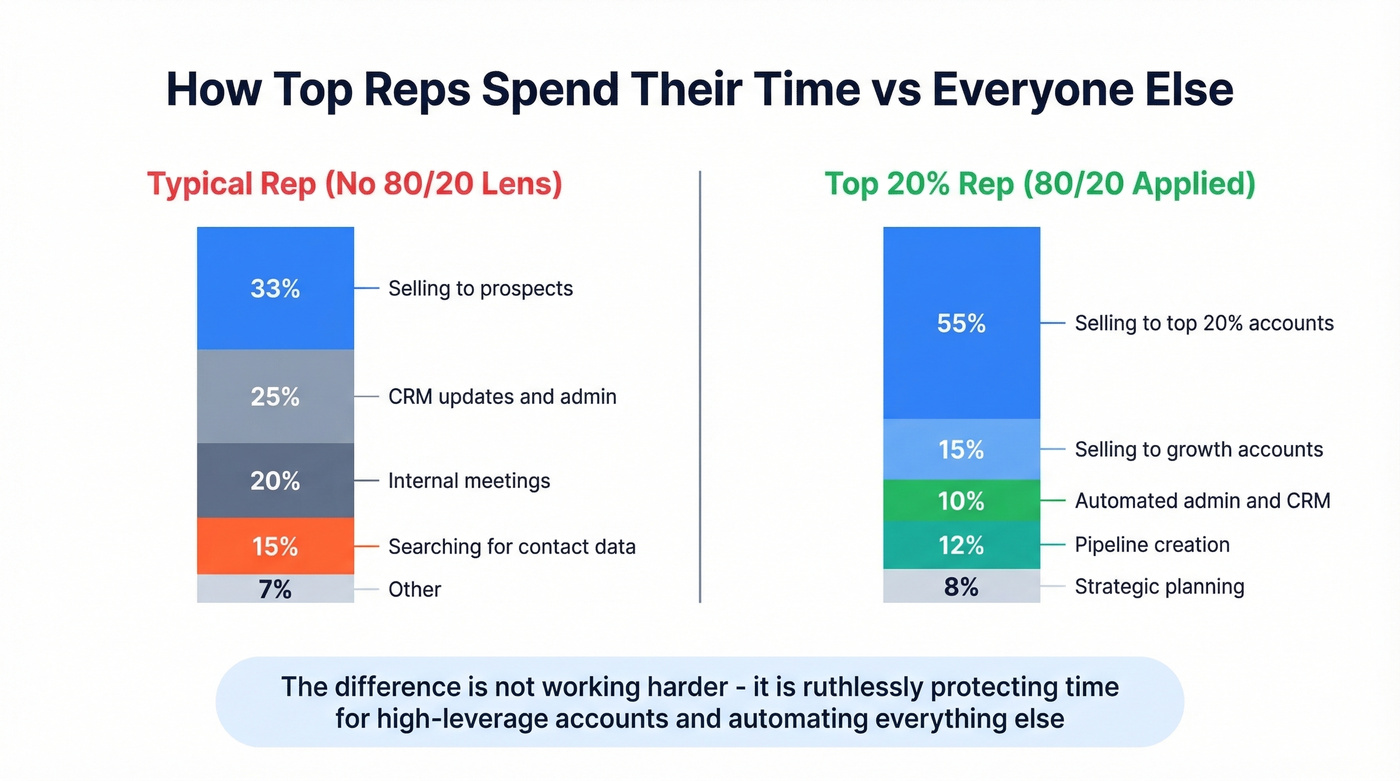
Map your Pareto distribution:
- Identify the 20% of activities that directly create pipeline or advance deals
- Automate or delegate the rest - CRM data entry, list building, meeting scheduling
- Block calendar time for the high-leverage work and protect it
- Audit weekly: did you spend 80% of selling time on your top 20% of accounts?
Let's be honest about deal size, too. If your average deal is under $10K, you probably don't need a 12-step outbound sequence hitting every persona at every account. You need 50 perfect-fit accounts with verified contact data and a tight three-step sequence. Applying the 80/20 rule in sales motion design means most teams should be running fewer, sharper campaigns - not more. (For practical options, see sales prospecting techniques and a B2B cold email sequence.)
The 80/20 rule isn't about doing less. It's about doing the right things more. The top 20% of reps aren't coasting - they're working the right accounts, with clean data, saying the right things.
Snyk's 50-person AE team applied the 80/20 rule to data quality: they switched to Prospeo's verified contacts, cut bounces from 35% to under 5%, and grew AE-sourced pipeline 180%. When 80% of your outbound effort goes to waste on bad numbers and dead emails, the highest-leverage fix isn't a new sequence - it's better inputs.
Stop burning volume on the wrong 80%. Start with verified data.
The Danger of Over-Concentrating
Most 80/20 advice tells you to fire the bottom 80% of your customers. Don't.
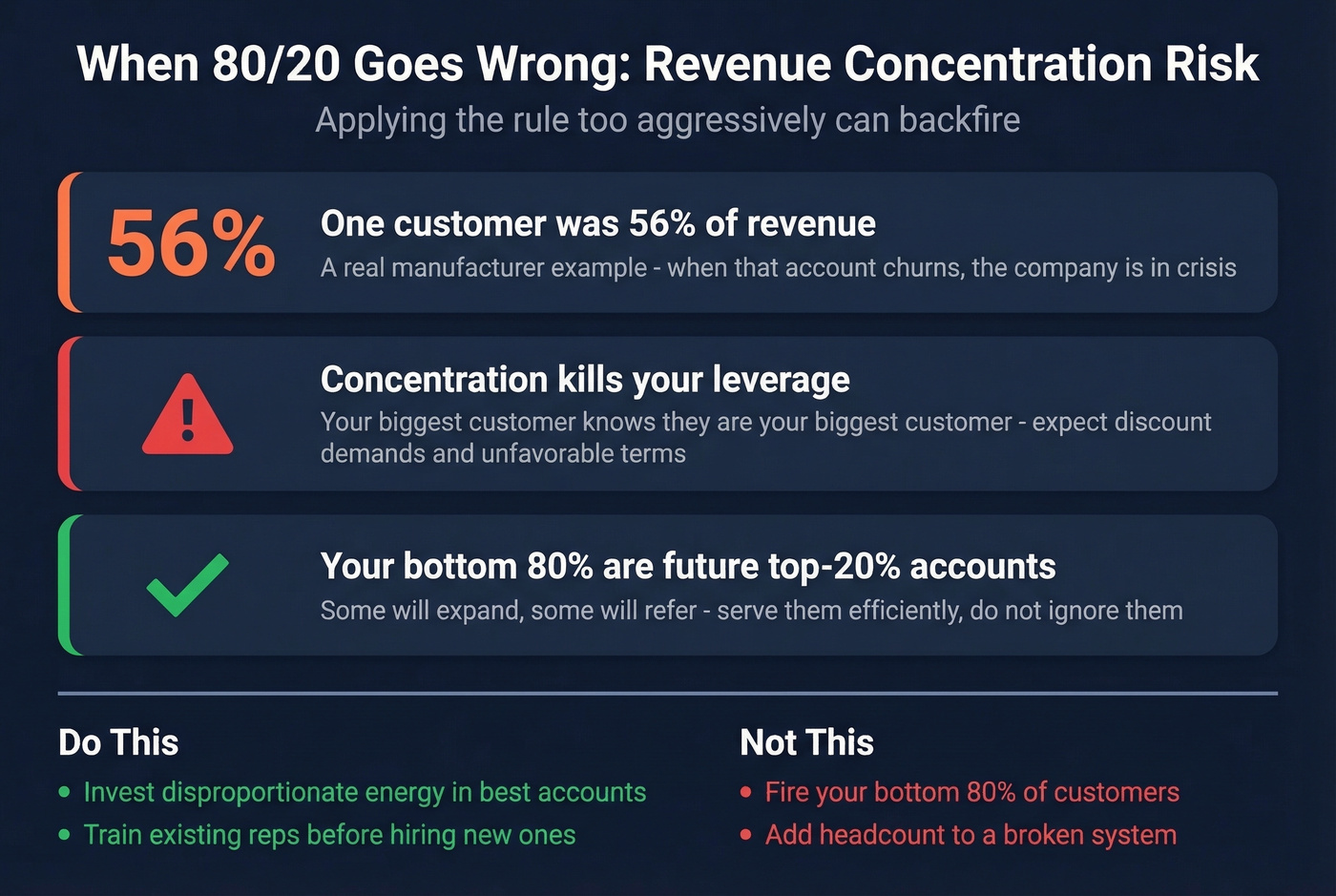
One consultant shared a cautionary example - a manufacturer whose largest customer represented 56% of revenue. That's not a customer relationship; that's a survival risk. If that account churns, the company is in crisis. Concentration at that level destroys your valuation, your negotiating leverage, and your ability to plan.
Your bottom 80% of customers aren't dead weight - they're your pipeline for future top-20% accounts. Some will expand. Some will refer. The goal isn't to ignore them; it's to serve them efficiently while investing disproportionate energy in your best accounts.
The same logic applies to your team. Hiring more reps is the lazy answer when 17% of your team drives 80% of revenue. Train and equip the reps you have. Fix their data. Sharpen their discovery process. Improve their targeting. That's a higher-ROI investment than adding headcount to a broken system. (If you're building a coaching plan, a 30-60-90 day plan for sales reps helps structure it.)
FAQ
Is it always exactly 80/20?
No. Real distributions vary - some teams see 90/10, others 70/30. The exact ratio matters less than the underlying truth: a small minority of inputs drives a disproportionate majority of results. Run the analysis on your own data to find your actual split.
How often should I re-run the analysis?
Quarterly at minimum. Customer value shifts as contracts renew, expand, or churn. Your top 20% list from January will look different by July. Set a calendar reminder - it takes 30 minutes and prevents you from optimizing around stale data.
Does 80/20 apply to outbound prospecting?
Absolutely. Most teams find that a small subset of ICP segments and sequences drive the vast majority of booked meetings. Audit your outbound data, then verify contacts for your top-20% target accounts before you send a single email. Sending to unverified lists is the fastest way to burn a domain.
Can I use the Pareto principle to prioritize which reps to coach?
Yes. Identify the reps in your 60th-80th percentile - they're closest to breaking into the top tier. Coaching bottom-quartile reps yields diminishing returns, while top performers often self-correct. Investing in that middle band typically produces the highest per-rep revenue lift.