

9 Steps to Build a Go-To-Market Strategy Backed by Real Numbers
95% of new products fail - and GTM execution is one of the fastest ways to turn a good product into a bad launch. BCG data shows companies with mature go-to-market strategies outperform laggards by roughly 4% compound annual revenue growth and 6% profit growth. These 9 steps give you a system with measurable inputs and outputs, not strategy theater.
Quick version: Validate your ICP with 15 interviews before writing positioning. Pick your GTM motion based on ACV thresholds, not vibes. Focus on 2-3 channels - the average company runs 10.5 half-baked efforts. Triangulate pricing across three methods. Measure 3-5 KPIs obsessively, optimizing one at a time.
What Is a Go-To-Market Strategy?
A GTM strategy answers five questions for a specific product launch or market entry: who buys, how you position against alternatives, which channels reach buyers, what sales motion closes them, and which metrics prove it's working. It's not a marketing plan - marketing is one input. The go-to-market process is a cross-functional system spanning product, sales, pricing, demand generation, and measurement.
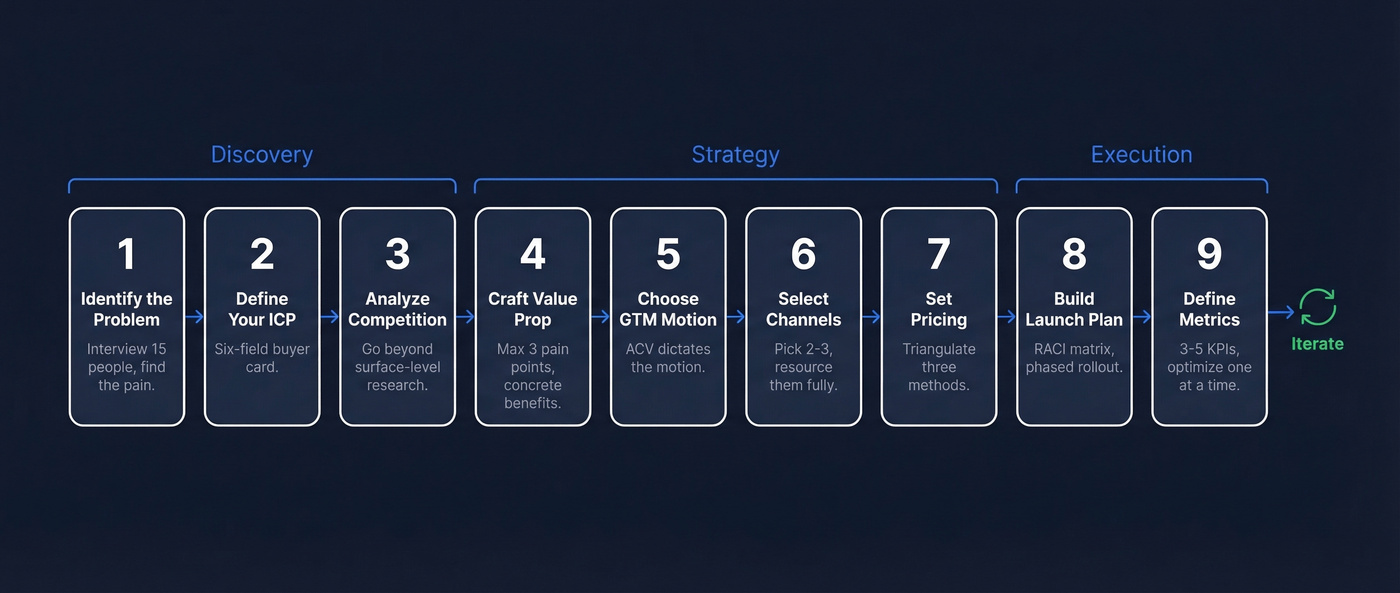
The 9 GTM Strategy Steps
Step 1 - Identify the Problem Worth Solving
Don't start with your product. Start with the pain.
Interview 15 people who match your target profile and ask open-ended questions about their workflow, frustrations, and current workarounds. If 8+ of 15 describe the same pain unprompted, you have signal. Fewer than that, and you're building on assumptions.
We've seen teams skip this and spend six months marketing to an ICP that doesn't exist. The two GTM killers that show up over and over are vague ICPs and premature channel investment - both of which stem from skipping real customer conversations.
Step 2 - Define Your ICP
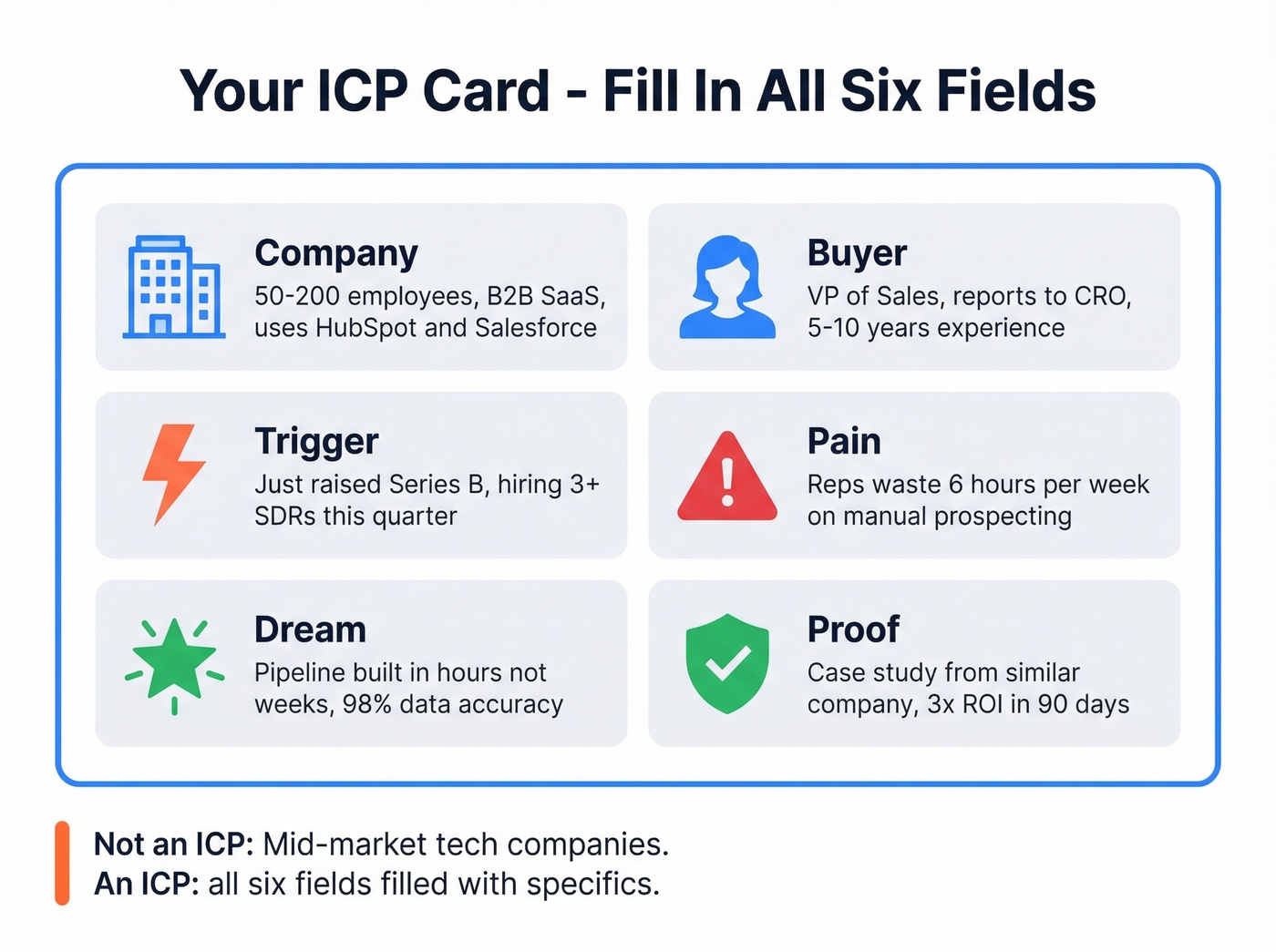
Your ICP isn't "mid-market SaaS companies." It's a card with six fields: Company (size, industry, tech stack), Buyer (title, seniority, department), Trigger (what event creates urgency), Pain (the specific problem from Step 1), Dream (what success looks like), and Proof (why they'd believe you).
If you want a starting point, use an Ideal Customer Profile Template and adapt it to your market.
Step 3 - Analyze the Competitive Landscape
Most teams stop at surface-level analysis: market size, obvious competitors, trend reports. That's table stakes.
The real insight lives in hidden layers - shadow workflows, support ticket patterns, and how buyers actually evaluate. One company found that customers spent 73% of evaluation time building internal consensus rather than comparing features. That single finding completely changed their sales enablement approach, shifting resources from feature comparison sheets to internal champion toolkits.
If you're doing this seriously, build a lightweight competitive intelligence strategy and keep it updated weekly during launch.
Step 4 - Craft Your Value Proposition
Pick a maximum of three pain points your product solves better than alternatives. More than three and you dilute the message. Map each feature to a concrete benefit - not "AI-powered analytics" but "cut forecast prep from 4 hours to 20 minutes."
Test messaging with real prospects before launch. If they can't repeat your value prop back in their own words, it's not landing. (If you need a tighter one-liner, steal from these sample elevator pitches.)
Step 5 - Choose Your GTM Motion
Here's the thing: your ACV dictates your motion, not your preference. This is one of the most consequential decisions in the entire framework because it shapes every downstream choice.
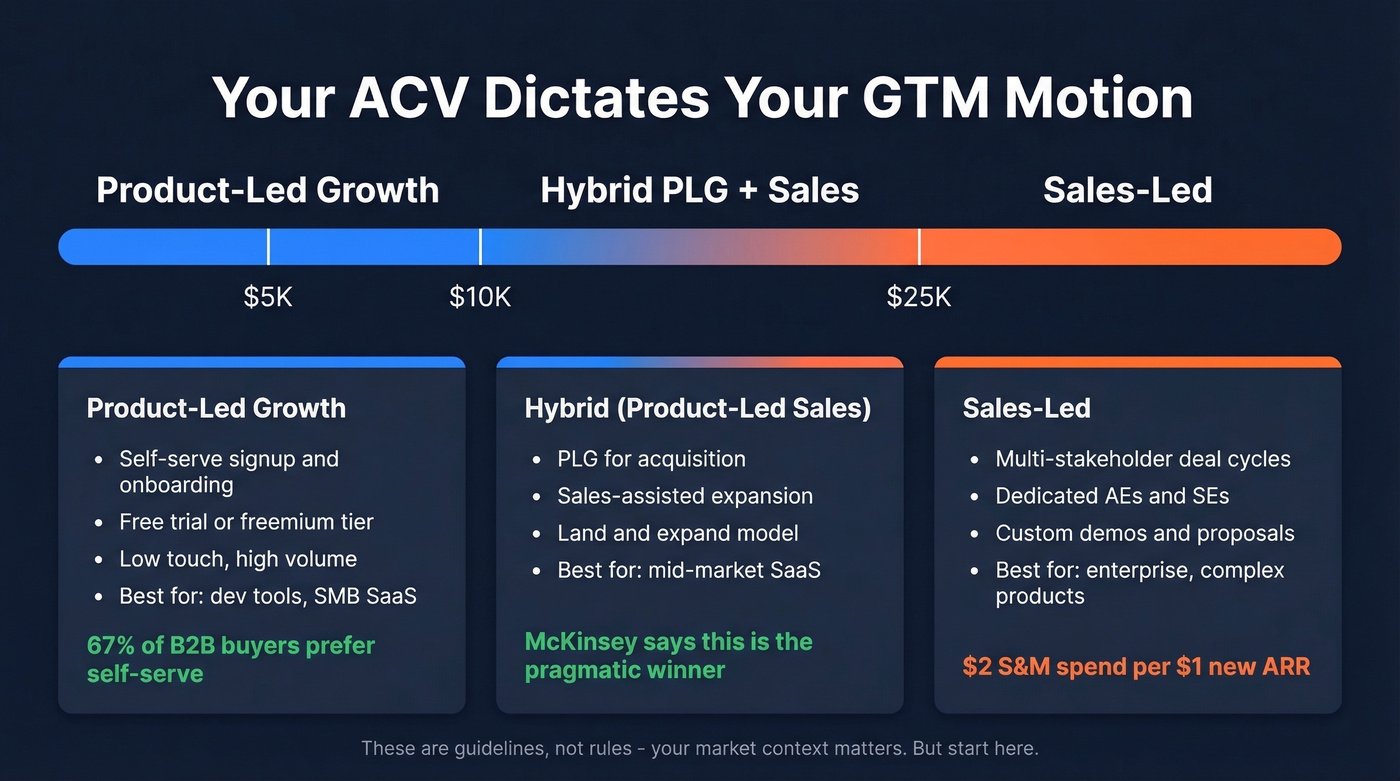
- Under $10K ACV typically fits product-led growth best, especially under $5K for true self-serve.
- $5K-$25K ACV usually favors a hybrid: PLG acquisition with sales-assisted expansion.
- Above $25K ACV typically needs a sales-led motion with multi-stakeholder deal management (see enterprise B2B sales).
67% of B2B buyers prefer self-serve evaluation before talking to sales, which is why free trials and freemium tiers are becoming table stakes at lower price points.
A McKinsey analysis of 107 public B2B SaaS companies found that most PLG adopters don't actually outperform - a small subset of high-performers drives the gap. The pragmatic winner is product-led sales: a hybrid combining self-serve acquisition with enterprise sales motions. Companies are spending $2 in S&M for every $1 of new ARR, up 14% since 2024. In our experience, efficiency matters more than motion purity.
Step 6 - Select Your Channels
The average company runs 10.5 GTM efforts - 5 core channels plus 5.5 experimental initiatives. Most of those experiments are half-baked. Pick 2-3 core channels, resource them properly, and prove they work before adding more.
For outbound email, the benchmarks are clear: timeline-based hooks pull a 10% reply rate versus 4.4% for problem hooks. Average outbound reply rates dropped from 6.8% to 5.8% year-over-year, making every percentage point of list quality count. Your outbound channel is only as good as your data - if you're launching into a new market and can't afford domain reputation damage, a 98% email accuracy rate and weekly data refreshes aren't nice-to-haves, they're survival basics.
If outbound is part of your mix, align it with modern sales prospecting techniques and a clean lead generation workflow.

Step 7 - Set Your Pricing
Don't let finance set pricing alone. Triangulate between three methods: value-based (what's the outcome worth to the buyer?), competitor-based (where do alternatives sit?), and cost-based (what's your floor?).
If your value-based price is 3x your competitor-based price, you either have a positioning problem or a genuinely differentiated product. Figure out which before you launch.
Step 8 - Build Your Launch Plan
A launch plan isn't a Gantt chart. It's a readiness checklist with clear owners.
Build a RACI matrix - who owns sales enablement docs, who reviews marketing assets, who handles partner alignment and support readiness. Plan a phased rollout: soft launch to a controlled cohort, then expand. The first 72 hours after launch are diagnostic gold. Run daily stand-ups during launch week, set up real-time dashboards for your core KPIs, and have a decision framework for what triggers a pivot versus what's normal noise.
To keep execution tight, define your sales activities and instrument the right funnel metrics before day one.
Step 9 - Define Metrics and Iterate
Pick 3-5 metrics and optimize one at a time.
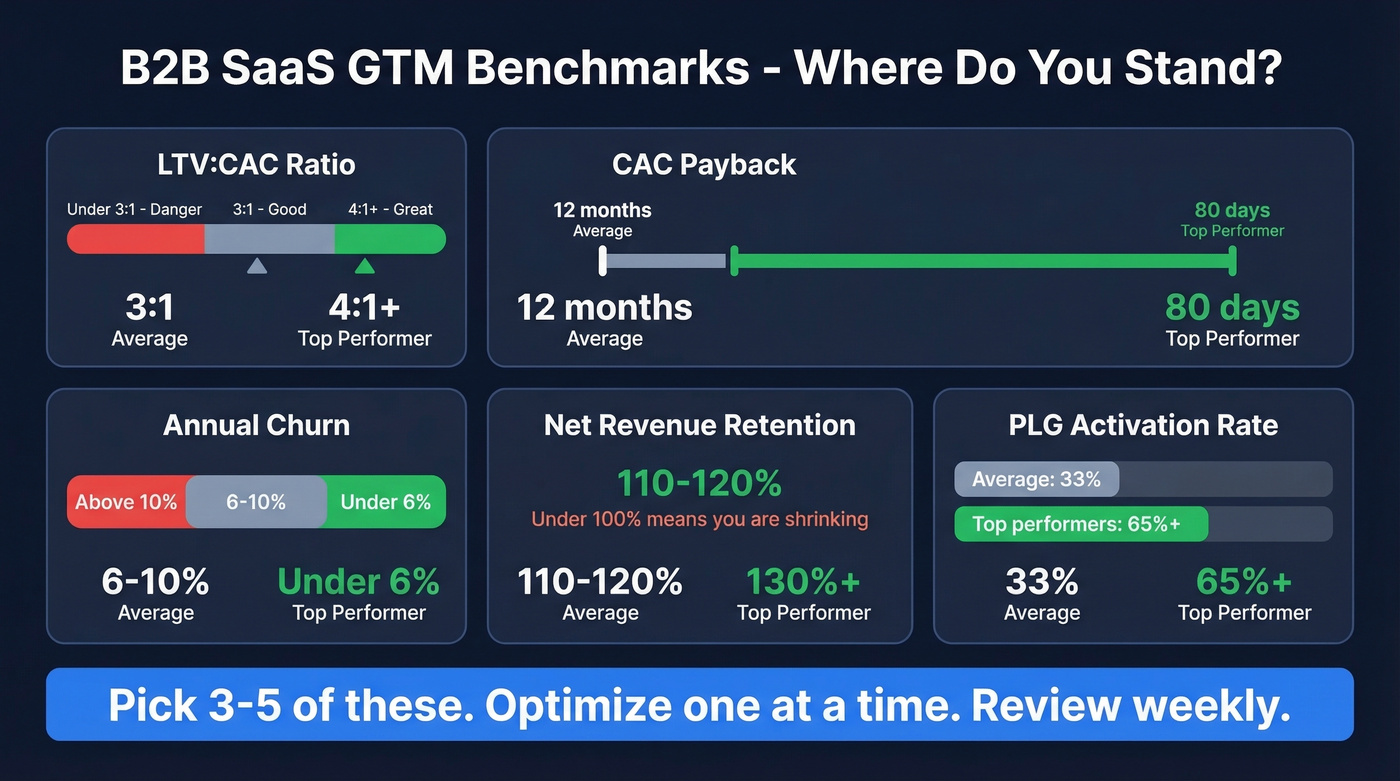
Common B2B SaaS targets include LTV:CAC of 3:1 or better, CAC payback under 12 months, annual churn around 6-10%, and NRR above 110-120%. Top-performer targets push further: CAC payback under 80 days and LTV:CAC above 4:1. For PLG motions, track activation rate - top performers hit 65%+ versus a 33% average. That gap is where revenue hides.
A GTM strategy isn't a document you finish. It's a system you iterate on weekly based on what the numbers tell you.

Step 6 says pick 2-3 channels and resource them properly. If outbound is one of them, your list quality determines everything. Prospeo delivers 98% email accuracy on a 7-day refresh cycle - so you're not burning domain reputation on day one of your GTM launch.
Don't let bad data kill your go-to-market before it starts.
GTM Mistakes That Kill Launches
Let's be honest - we've watched smart teams make every one of these mistakes.
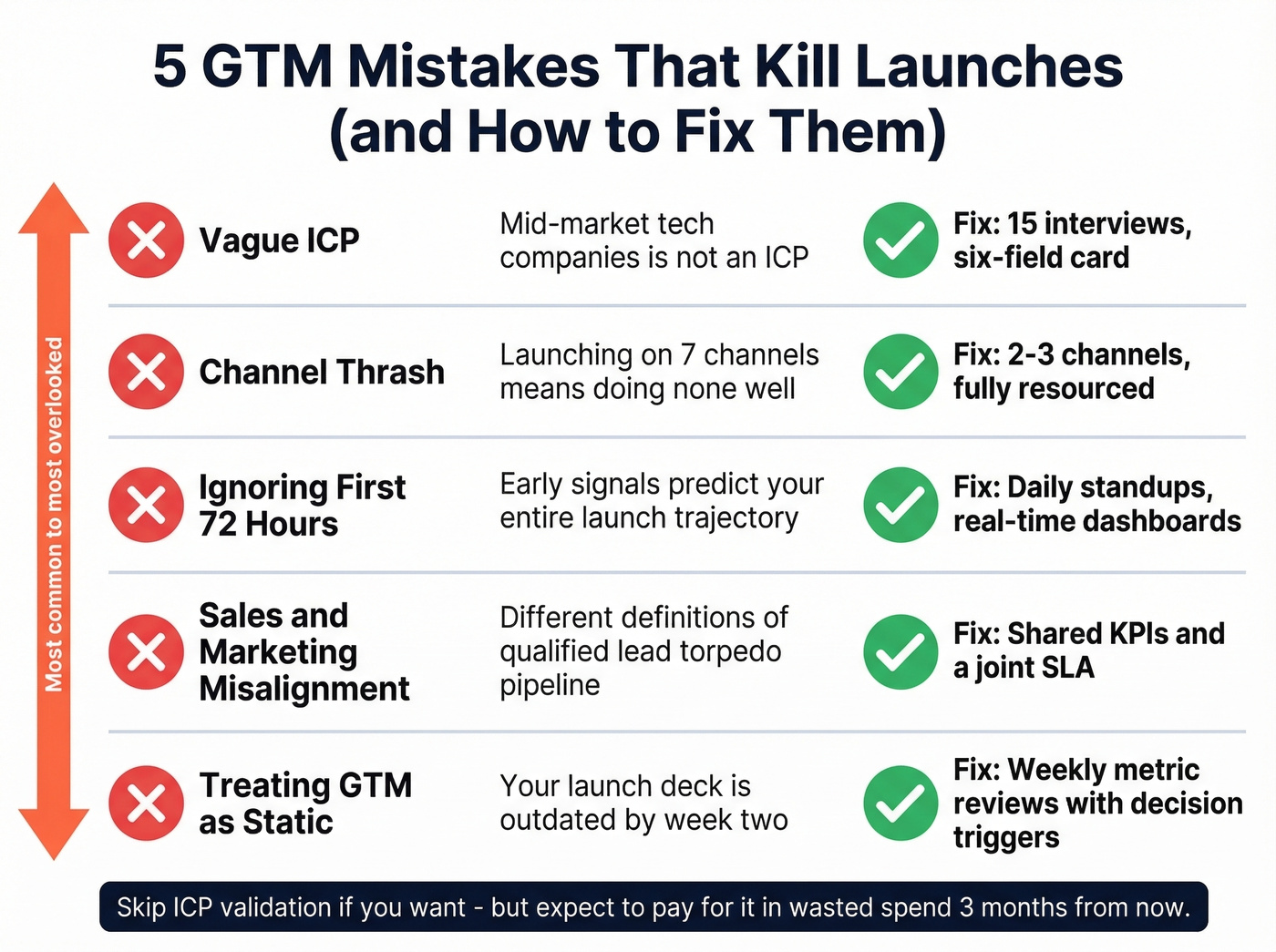
- Vague ICP. "Mid-market tech companies" isn't an ICP. Fill out the six-field card. Fix: 15 interviews first.
- Channel thrash. Launching on 7 channels simultaneously means doing none well. Fix: 2-3 channels, fully resourced.
- Ignoring the first 72 hours. Early signals predict launch trajectory. Fix: daily stand-ups and real-time dashboards.
- Sales/marketing misalignment. Different definitions of "qualified lead" torpedo pipeline. Fix: shared KPIs and a joint SLA.
- Treating GTM as static. The deck from launch week is already outdated by the time you present it. Fix: weekly metric reviews with decision triggers.
Skip the ICP validation step if you want - but expect to pay for it in wasted ad spend and confused sales reps three months from now.
Real GTM Examples Worth Studying
Brex didn't try to be a bank for everyone. They built a corporate card exclusively for startups, nailed a hyper-specific buyer persona, and expanded from there. The lesson: a narrow ICP with deep product-market fit beats a broad market entry every time.
Gong turned their own product data into a content moat. By publishing original research on what top sellers actually do differently, they built thought leadership that generated inbound demand before the sales team ever picked up the phone. The consensus on r/sales is that Gong's content strategy is one of the best examples of earned authority in B2B - and it all started with data they already had.
Monzo used waitlist scarcity combined with referral queue-jumping. You could skip the line by inviting friends, turning waiting into a viral acquisition channel. Brilliant for consumer, and the principle - making access feel scarce and social - translates to B2B beta launches too.
Most teams don't need a more sophisticated go-to-market strategy. They need to do the boring parts - ICP validation, channel focus, weekly metric reviews - with actual discipline. The companies that win aren't running some secret playbook. They're just not skipping Step 1.
FAQ
What's the difference between a GTM strategy and a marketing plan?
A GTM strategy is a cross-functional framework covering product, sales, marketing, pricing, and channels for a specific market entry. A marketing plan is the ongoing demand generation engine. GTM is the launch system; marketing is one component that continues after launch.
How long does it take to build a GTM strategy?
Most B2B companies need 2-6 weeks. The bottleneck is ICP validation - those 15 interviews take time. Teams that rush past validation spend months fixing problems interviews would've caught in week one.
What are the essential go-to-market process steps?
They break into three phases: discovery (problem validation, ICP definition, competitive analysis), strategy (value proposition, GTM motion, channel selection, pricing), and execution (launch plan, metrics, iteration). Following a structured process keeps cross-functional teams aligned and prevents the most common failure modes - vague targeting and channel thrash.
What tools do I need to execute a GTM strategy?
At minimum: a CRM (HubSpot's free tier works), a prospecting platform like Prospeo for verified emails and direct dials, and a sequencing tool like Instantly or Smartlead. That's typically $100-$1,000+/mo for a small team depending on seats and sending volume.
You just defined your ICP with six fields. Now turn it into a real pipeline. Prospeo's 30+ search filters - buyer intent, technographics, job changes, headcount growth, funding - let you operationalize that ICP card into verified contacts at $0.01 per email.
Go from ICP definition to qualified prospect list in minutes.