

The 95-5 Rule: What It Actually Means and How to Use It
You've sat in a QBR where someone asked why last month's brand campaign didn't generate pipeline. The 95-5 rule is the answer - and it's the most important mental model in B2B marketing that most teams still ignore.
Here's the short version: the rule is a heuristic, not a law. Your real in-market percentage depends on purchase frequency and decision window. Stop measuring every campaign by this week's pipeline. And when you do reach the roughly 5% who are in-market, data accuracy is everything - bad emails waste your best at-bats.
What Is the 95-5 Rule?
Professor John Dawes of the Ehrenberg-Bass Institute observed that up to 95% of people or firms aren't in the market for many goods and services at any given time. The observation was so intuitive he never bothered to write it down until 2021, when he was prompted to formalize it.
Peter Weinberg and Jon Lombardo then popularized the concept via Marketing Week, framing it as the antidote to short-termist demand gen thinking. Most advertising reaches out-of-market buyers. Its real job is building memory links to the brand - not generating clicks this quarter.
One quick note: don't confuse this with Will Guidara's "95/5 rule" from Unreasonable Hospitality, which is a budgeting principle about spending 5% "foolishly" for outsized guest experience impact. Different concept entirely.
The Math Behind It
Dawes' logic is straightforward. If corporations change a service provider - their principal bank, for instance - once every five years on average, roughly 20% are in-market in any given year. Narrow that to a quarter and you're at about 5%.
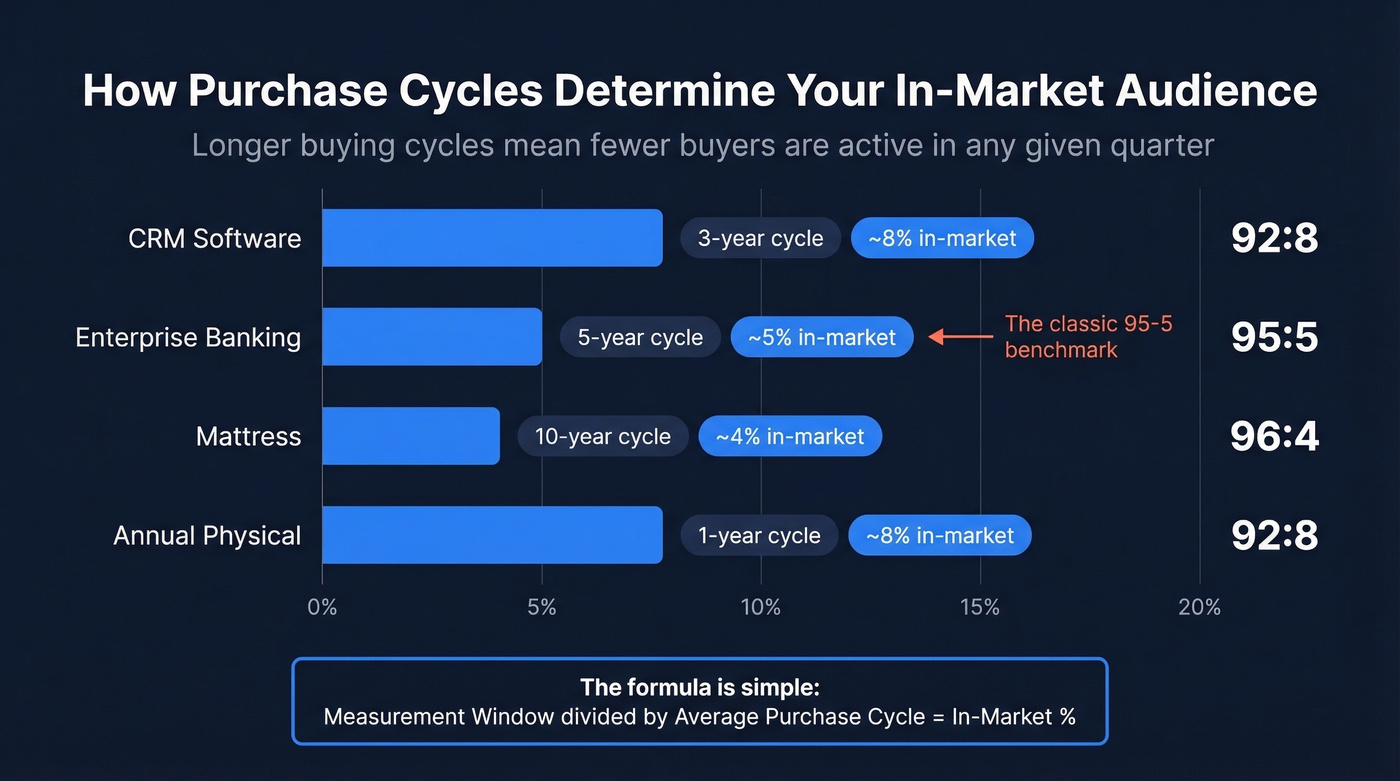
The logic extends beyond B2B. Any category with long interpurchase cycles follows the same math: divide your measurement window by the average time between purchases.
Summit Partners broke this down across several categories:
| Category | Purchase Cycle | Decision Window | Quarterly In-Market % | Ratio |
|---|---|---|---|---|
| CRM software | 3 years | 90 days | ~8% | 92:8 |
| Enterprise banking | 5 years | 90 days | ~5% | 95:5 |
| Mattress | 7 years | 90 days | ~4% | 96:4 |
| Annual physical | 1 year | 30 days | ~8%/month | 92:8 |
A CRM vendor has a meaningfully larger in-market audience than an enterprise banking provider in any given quarter. That difference should change how you allocate budget.
Why This Matters for B2B
Weinberg and Lombardo's surveys found that 95% of B2B marketers expect significant sales within two weeks of a campaign. Think about that for a second. If 80% of companies switch business banks once every five years, roughly 1% are in-market in any two-week window. The gap between marketer expectations and buyer reality is enormous - and as one r/PPC commenter put it, marketers treat ad spend like a real-time faucet (money in, revenue out) while the 95-5 framework is the cold shower.
6sense's 2025 Buyer Experience Report makes this concrete. Their study of nearly 4,000 B2B buyers found that 95% of the time, the winning vendor was already on the Day One shortlist. The pre-contact favorite wins roughly 80% of deals, and 94% of buyers had already ranked their preferred vendors before the first sales conversation. Buying cycles compressed from 11.3 to 10.1 months between 2024 and 2025, and first contact shifted earlier - from 69% to 61% of the journey. Much of this evaluation happens before sellers ever get involved, in channels you can't easily track or attribute.
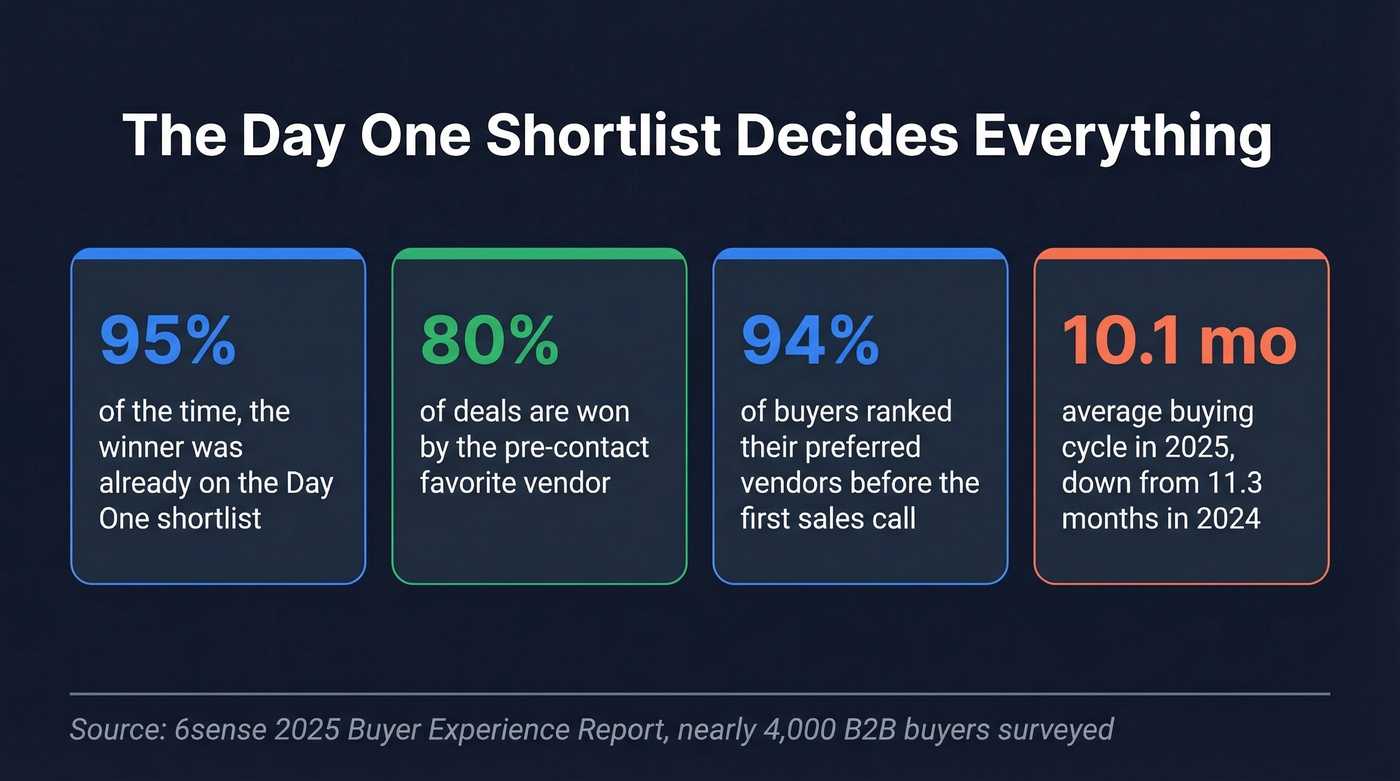
If you're not already in a buyer's consideration set when they enter the market, you've probably already lost.

If the winning vendor is already on the Day One shortlist 95% of the time, the contacts who ARE in-market are the ones you absolutely cannot miss. Prospeo tracks 15,000 intent topics via Bombora so you can identify the 5% actively buying - then reach them with 98% verified emails and 125M+ direct dials.
Stop spraying the 95%. Start converting the 5% that's ready to buy.
Is the 5% Figure Too Low?
Forrester pushed back, calling it more like "the 85-15 variable." Their research across B2B martech categories found roughly 15.6% of organizations plan to change their primary marketing technology provider within 12 months. ABM platforms see 23% planning to change, data providers 21%, CDPs 18%.
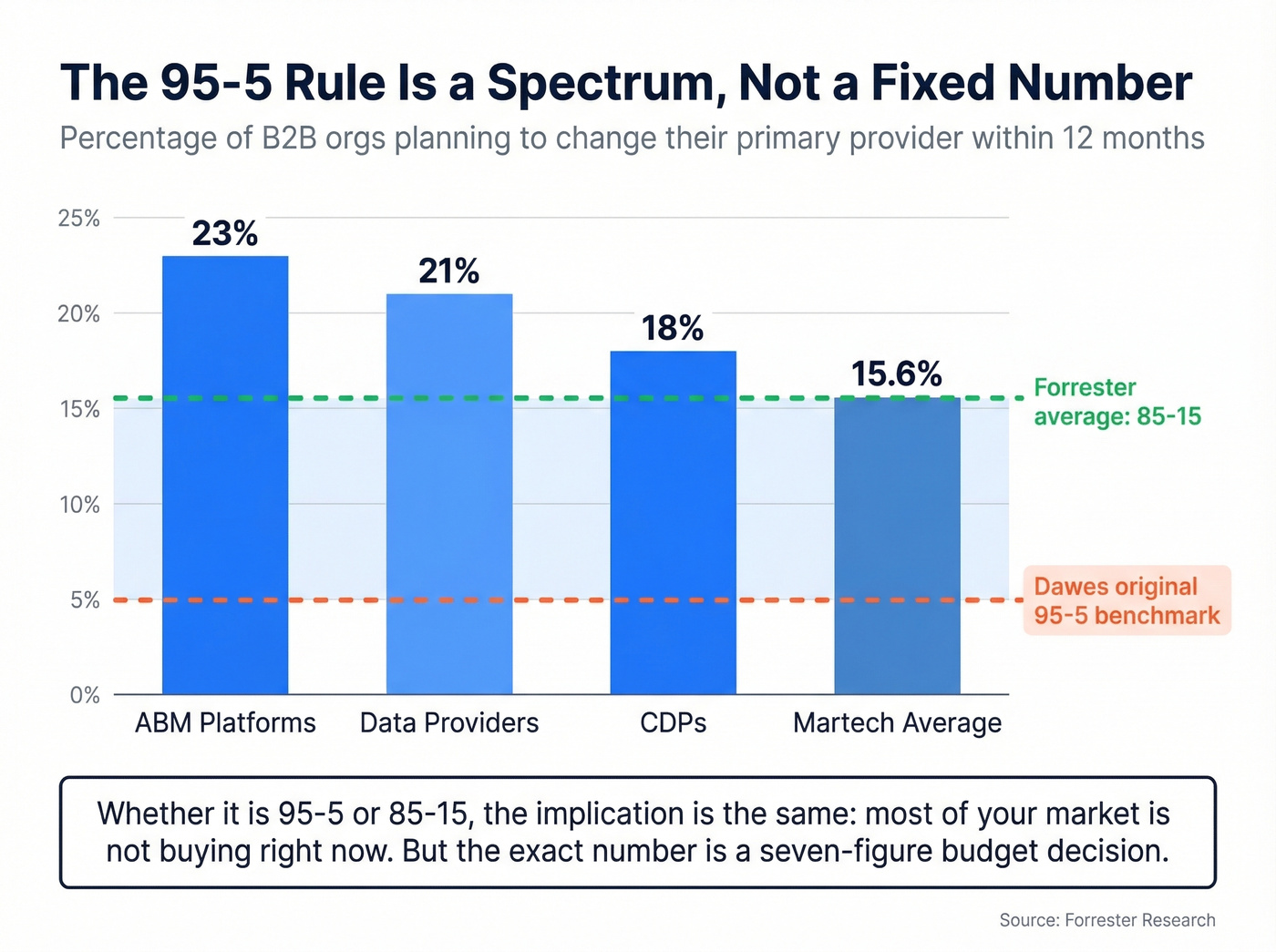
Forrester's right that 5% is too precise. But whether it's 95:5 or 85:15, the implication is identical: most of your market isn't buying right now. Getting the number right has real budget implications, though. Forrester's worked example: reaching 100,000 people with 12 impressions per week at $60 CPM costs $3.7M annually. The exact in-market percentage is a seven-figure decision.
How to Apply the 95-5 Rule
Lead with the Problem, Not the Product
Gong's early playbook is the best example we've seen. For their first year, they had a hard rule: no talking about the product. They obsessed over creating the most engaging sales content on the planet, using insider language like "pipeline" and "end of quarter" to signal peer credibility rather than vendor positioning. Because the vast majority of buyers are out of market at any given moment, Gong's content needed to build memory structures that would pay off months or years later - not drive demo requests that week.
Map Category Entry Points
Jenni Romaniuk's 7W framework - from the same Ehrenberg-Bass research behind How Brands Grow - identifies when and why buyers think about your category: why, when, where, while, with whom, with what, and how feeling. Each is a category entry point, a mental trigger. The goal is to "catch buyers as they fall" into the market. Dawes' benchmarks are humbling: even market leaders often see only 20-50% CEP linkage.
Measure Mental Availability
Most dashboards track MQLs. The 95-5 rule demands you track how often your brand comes to mind across category entry points - that's mental availability, and it's what actually predicts future market share. If you aren't measuring it, you're flying blind on the thing that matters most.
Run Two Motions at Once
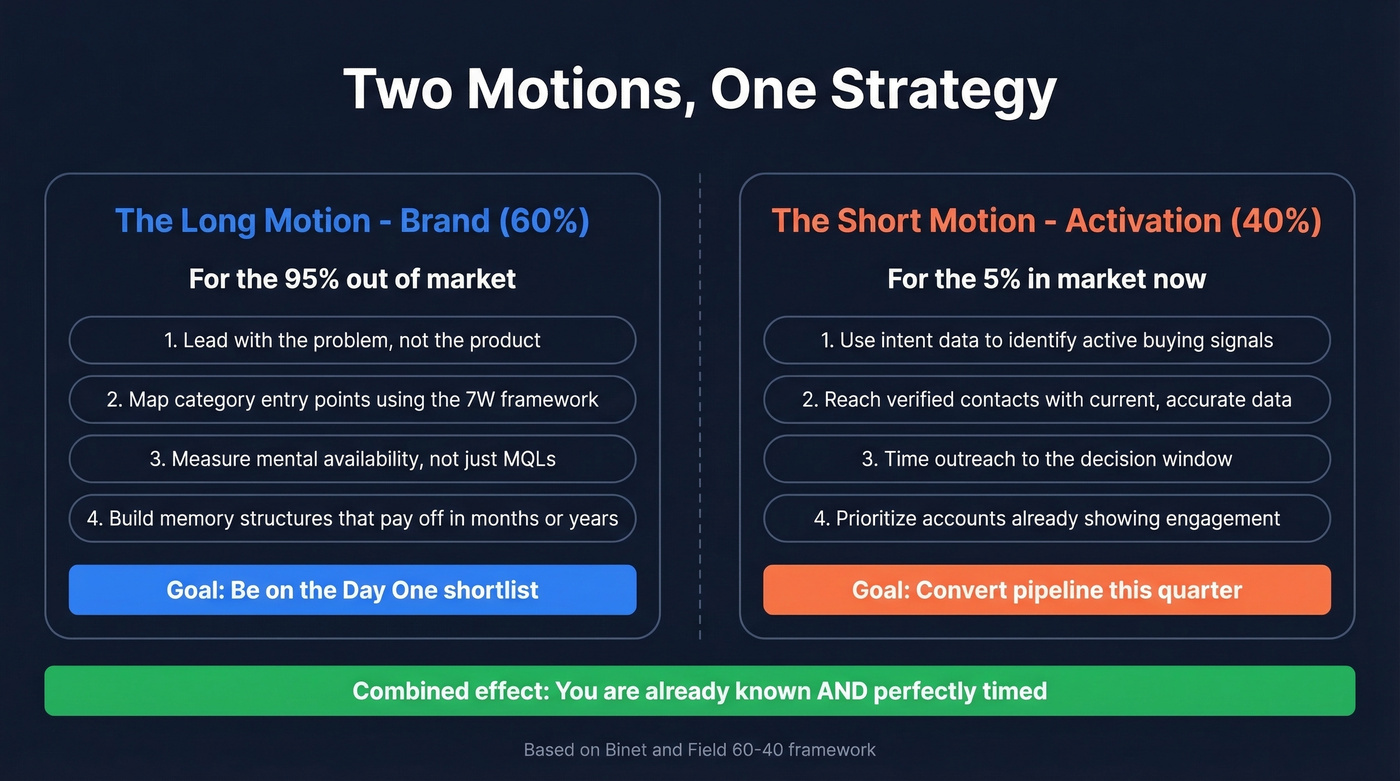
This connects to Binet and Field's 60:40 framework: a long motion for the 95% (brand) and a short motion for the 5% (conversion). We've watched teams burn through their entire TAM with bottom-funnel campaigns in under a year, then wonder why pipeline plateaus.
Let's be honest: if your average deal size is under $15k, you probably don't need a sophisticated ABM stack. But you absolutely need a brand that buyers recognize before they start searching for solutions. The rule is easy to understand and brutally hard to operationalize inside organizations that live on monthly pipeline reviews.
Reaching the In-Market 5%
Most articles about the 95-5 rule stop at "build your brand." That's incomplete.
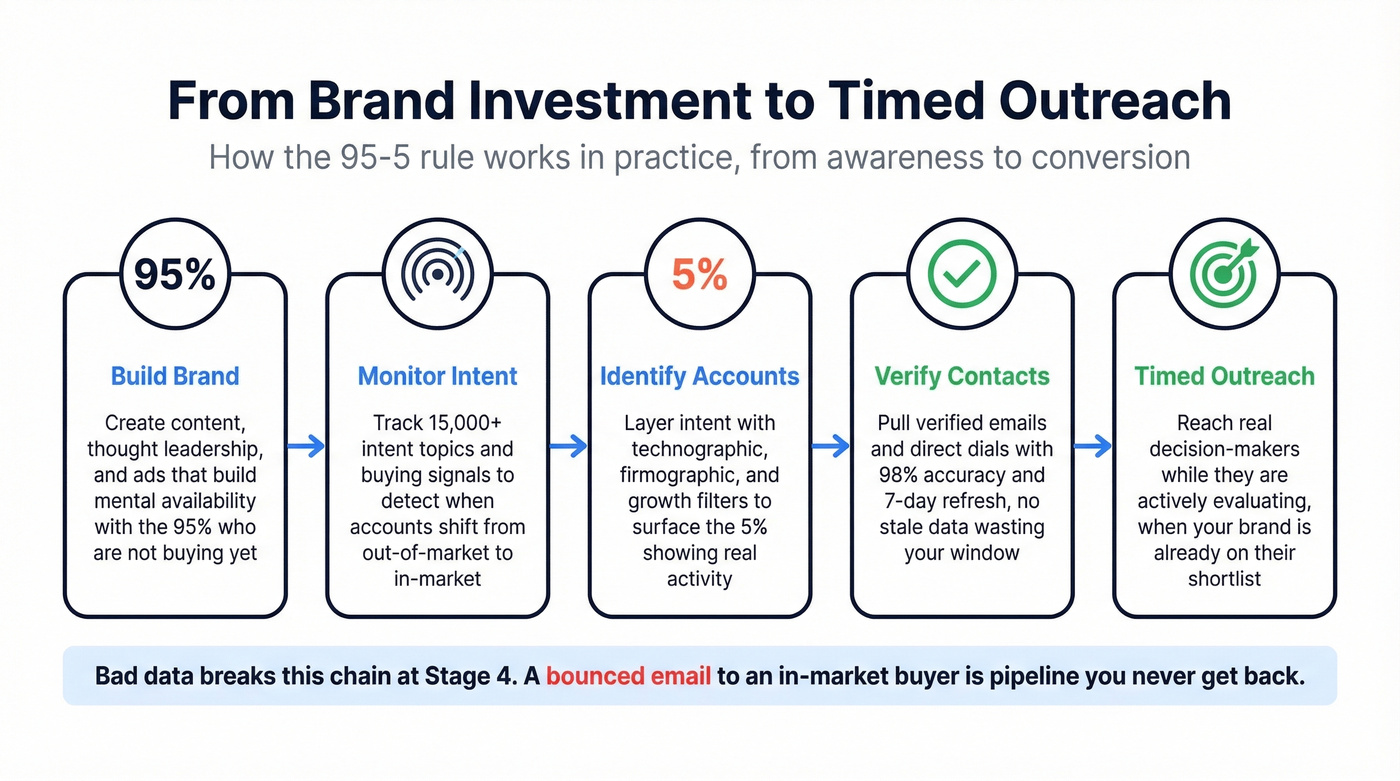
The real challenge is combining long-term brand building with precise identification of the small percentage who are in-market right now. If 95% of your outreach hits out-of-market buyers, the contacts who ARE in-market are the ones you can't afford to miss. Bounced emails and dead phone numbers waste your best at-bats - and in our experience, bad data is the single fastest way to squander a perfectly timed outreach window.
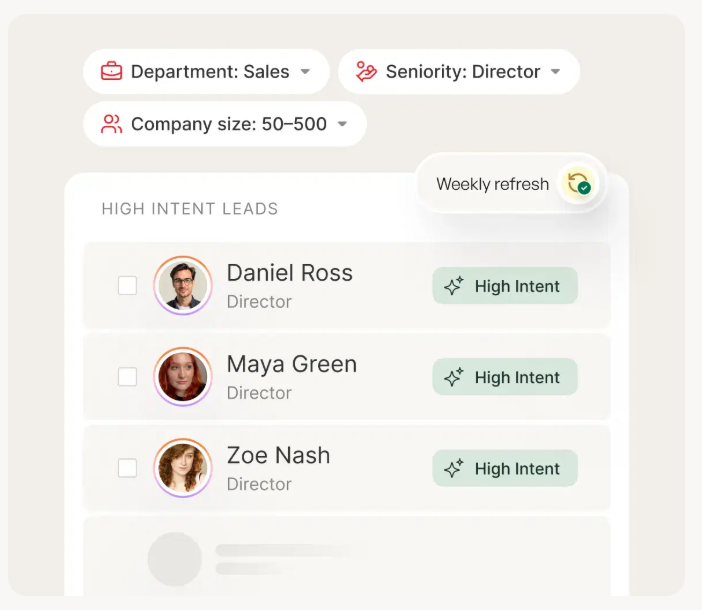
This is where intent data earns its keep. Prospeo tracks 15,000 intent topics via Bombora and layers them with technographic and company growth filters across 300M+ profiles, so you can surface accounts showing active buying signals rather than guessing. With 98% email accuracy and a 7-day data refresh cycle, the contacts you pull are current - not six weeks stale.
Intent data doesn't replace brand investment. It complements it. You build the brand so you're on the Day One shortlist, then use intent signals to time your outreach to accounts that are actually moving. Skip intent data if your category has a purchase cycle under six months - at that point, the in-market window is wide enough that broad targeting works fine.
Bad data turns your best at-bats into bounced emails and voicemails to nobody. Prospeo's 7-day data refresh cycle means you're reaching real buyers with current contact info - not stale records from six weeks ago. At $0.01 per email, wasting your in-market window on dead data is a choice.
Every bounced email to an in-market buyer is pipeline you'll never get back.
FAQ
Who created the 95-5 rule?
Professor John Dawes of the Ehrenberg-Bass Institute coined the observation. He never formally published it - the idea was so intuitive he didn't write it down until 2021. Peter Weinberg and Jon Lombardo then popularized it via Marketing Week, connecting it to B2B brand strategy.
Is the 95-5 ratio the same for every industry?
No. The actual in-market percentage depends on purchase frequency and decision window. Forrester's research puts B2B martech categories at roughly 85:15, while enterprise banking sits closer to 95:5. Calculate your own ratio by dividing your measurement window by the average interpurchase time.
How do I find the 5% who are actually in-market?
Buyer intent data is one of the most reliable signals. Tools like Prospeo layer intent tracking with job role, company growth, and technographic filters to surface accounts showing active buying signals. Pair that with sustained brand investment so you're already on the shortlist when those accounts start evaluating.
Does the 95-5 rule mean demand gen is useless?
Not at all - it means demand gen alone is insufficient. Short-term activation captures the roughly 5% already in-market, which is essential. The rule argues you also need sustained brand building for the 95% who'll enter the market later. Binet and Field's research suggests a roughly 60:40 split between brand and activation spend for optimal long-term growth.