

ABM Funnel Stages: The Framework That Drives Pipeline
Marketing says it worked - look at the engagement scores, the ad clicks, the webinar signups. Sales says it didn't - where are the meetings? Two dashboards, same quarter, completely different stories.
That disconnect isn't a reporting problem. It's a failure to define ABM funnel stages clearly enough that both teams agree on what "working" means. 71.2% of organizations now run ABM, but most still can't explain where deals stall. The average ABM program delivers 137% ROI - when the funnel actually works.
The Quick Version
A simple 4-stage model: Identify, Engage, Convert, Expand. What separates programs that generate pipeline from programs that generate dashboards comes down to shared stage definitions between sales and marketing, verified contact data, and stage-specific metrics tied to revenue - not vanity engagement numbers. The funnel math section below shows exactly how many target accounts you need to hit a revenue goal.
ABM Funnel vs. Traditional Funnel
The traditional demand gen funnel casts wide and filters down. ABM flips it: start narrow with high-fit accounts, then expand your reach within those accounts. You're not generating leads. You're engaging entire buying committees.
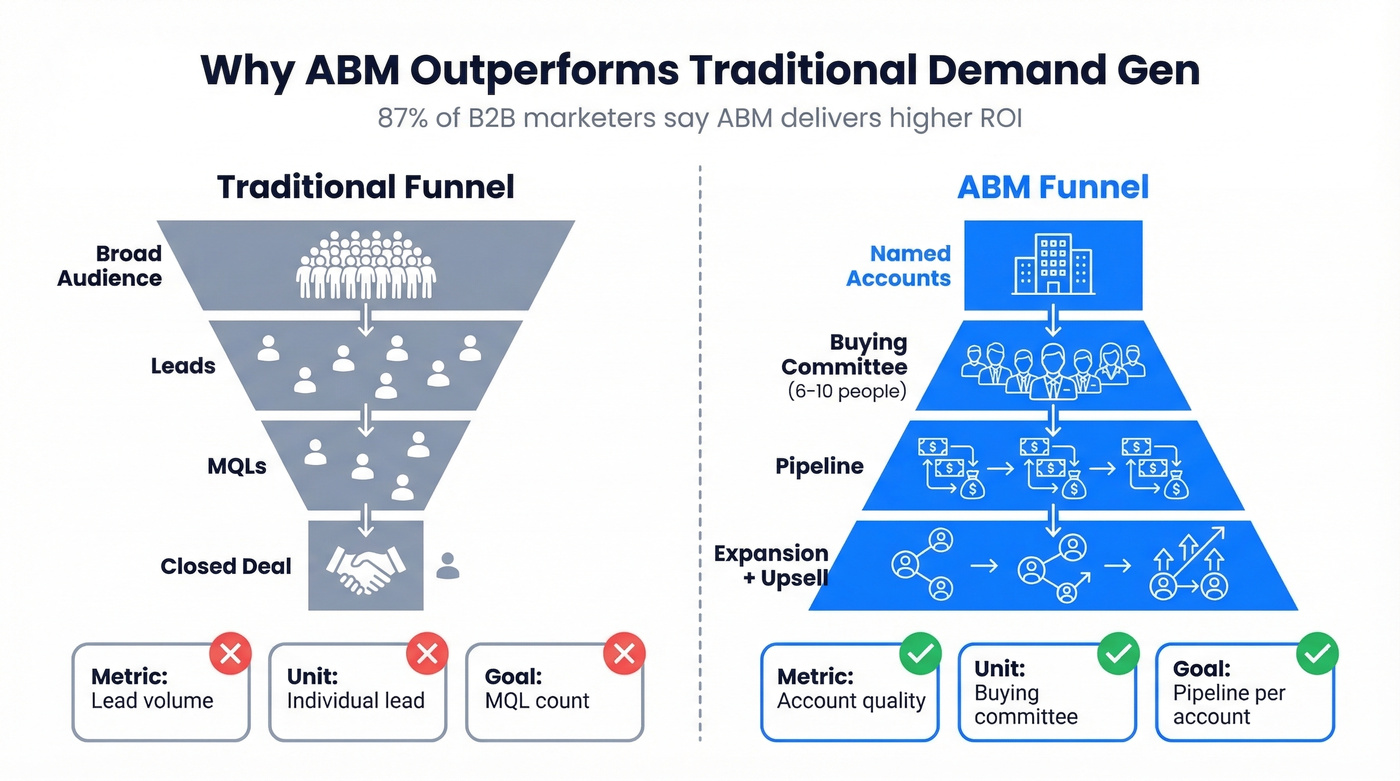
| Dimension | Traditional Funnel | ABM Funnel |
|---|---|---|
| Starting point | Broad audience | Named accounts |
| Success metric | Lead volume | Account quality |
| Buying unit | Individual lead | 6-10 stakeholders |
| End state | Closed deal | Expansion + upsell |
| ROI signal | MQL count | Pipeline per account |
87% of B2B marketers report ABM delivers better ROI than traditional approaches. The reason is structural: engaging an entire buying committee instead of hoping one MQL converts means higher win rates and larger deal sizes. This is also why the MQL vs. ABM metrics debate matters so much - individual lead scores tell you almost nothing about whether a buying committee is actually moving through your funnel.
The 4 ABM Funnel Stages
Stage 1: Identify
This is where your funnel lives or dies. Define your ICP, build a target account list, score accounts on fit, intent, and engagement using the Demandbase model, and map 6-10 stakeholders per account with verified contact data.
One nuance most teams miss: you're mapping the buying committee, not just finding the VP's email. An intern downloading a whitepaper isn't the same signal as a CFO viewing your pricing page. Account-level targeting means distinguishing between the two - and if your data can't tell you who's who within an account, you're flying blind before you've even started outreach.
Marketing owns list building and scoring. Sales validates account selection and adds context from existing relationships. Shared ownership here prevents every downstream problem.
Transition trigger: Account meets fit threshold and shows intent - topic surge, job posting, or funding event.
Track: Target account coverage rate, account penetration rate. 20-30% penetration is strong for enterprise programs.
Stage 2: Engage
Here's the stat that should shape your entire engagement strategy: when three stakeholders from the same account engage with your brand, you're 50% more likely to convert that account from opportunity to closed-won. That's the entire argument for committee-level targeting over single-lead outreach.
The benchmark is 7-14 touchpoints before conversion. Micro-messages beat mass nurture - 45-second personalized videos, behavior-triggered check-ins, content mapped to each persona's role. We've found that teams who align content to specific personas within the buying committee see engagement scores climb 2-3x faster than teams blasting the same sequence to everyone.
Skip the generic nurture drip. If you're sending the same email to the CFO and the end user, you're wasting both their time and yours.
Track: Account engagement score, engaged contacts per account, content interaction by persona.
Stage 3: Convert
Meeting booked. Opportunity opened. Closed-won. This is where sales and marketing alignment either pays off or falls apart.
If the AE's first email ignores everything the account did during the Engage stage, you've destroyed the context that earned the meeting. Aligned teams see 38% higher win rates - and in our experience, the fix is almost never new tech. It's shared definitions and shared accountability. One team that rebuilt around unified data and stage-aligned personalization hit a 63% meeting-to-opportunity conversion rate within 90 days. That wasn't a technology change. It was a process change.
Also: make sure your CRM attribution is clean. Cookie blocking and lead-gen sync failures create false negatives that make ABM look broken when it's actually working.
Track: Meeting-to-opportunity rate, pipeline value per account, sales cycle length vs. non-ABM deals.
Stage 4: Expand
Most teams treat closed-won as the finish line. It's the midpoint.
Post-sale ABM is the highest-ROI motion most programs never build, and it's not close. Retention and expansion use the same playbook as pre-sale ABM - map new stakeholders, track intent signals for adjacent products, run multi-touch sequences. We've watched teams skip this stage entirely, then wonder why net revenue retention sits at 95% instead of 120%+. The bow-tie model exists for a reason.
Track: Expansion revenue per account, net revenue retention, cross-sell pipeline.

Stage 1 demands verified contact data for every stakeholder on the buying committee. Prospeo gives you 300M+ profiles with 30+ filters - intent signals, technographics, headcount growth, funding - so you build target account lists that actually convert. 98% email accuracy means your engaged-to-opportunity rate doesn't collapse from bounces.
Stop mapping buying committees with bad data. Start with 98% accuracy.
ABM Funnel Math
Let's backsolve from a revenue goal.
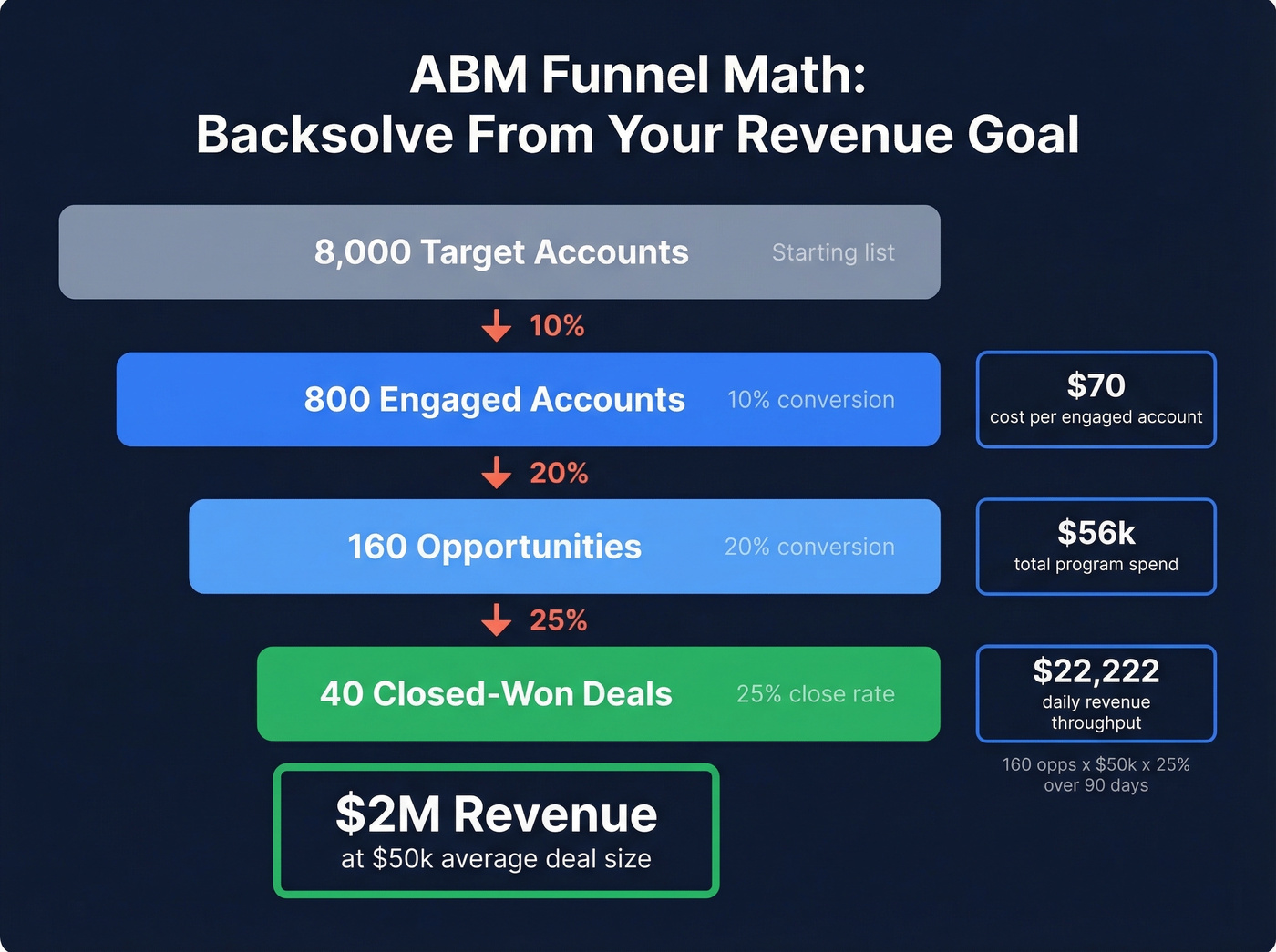
| Stage | Conversion Rate | Accounts Needed |
|---|---|---|
| Target accounts | - | 8,000 |
| Engaged (1+ signal) | 10% | 800 |
| Opportunity | 20% | 160 |
| Closed-won ($50k ADS) | 25% | 40 = $2M |
A $2M revenue goal at $50k average deal size needs 40 wins. At a 25% close rate, that's 160 opportunities. At 20% engaged-to-opp, you need 800 engaged accounts. At 10% target-to-engaged, your list starts at 8,000.
Budget translation: at roughly $70 cost per engaged account, you're looking at ~$56k in program spend. Expected revenue throughput gives you the daily check: (160 opps x $50k x 25%) / 90-day cycle = ~$22,222/day. Replace these assumptions with your own conversion data after the first quarter.
Why Most ABM Funnels Stall
The vanity metrics trap. Your dashboard shows 2,000 ad clicks, 400 content downloads, and 85 webinar registrants. Sales sees zero meetings. The threads on r/b2bmarketing are full of this exact pattern - ABM programs that produce activity but not pipeline. If your stage definitions don't connect engagement to revenue, you're measuring noise.
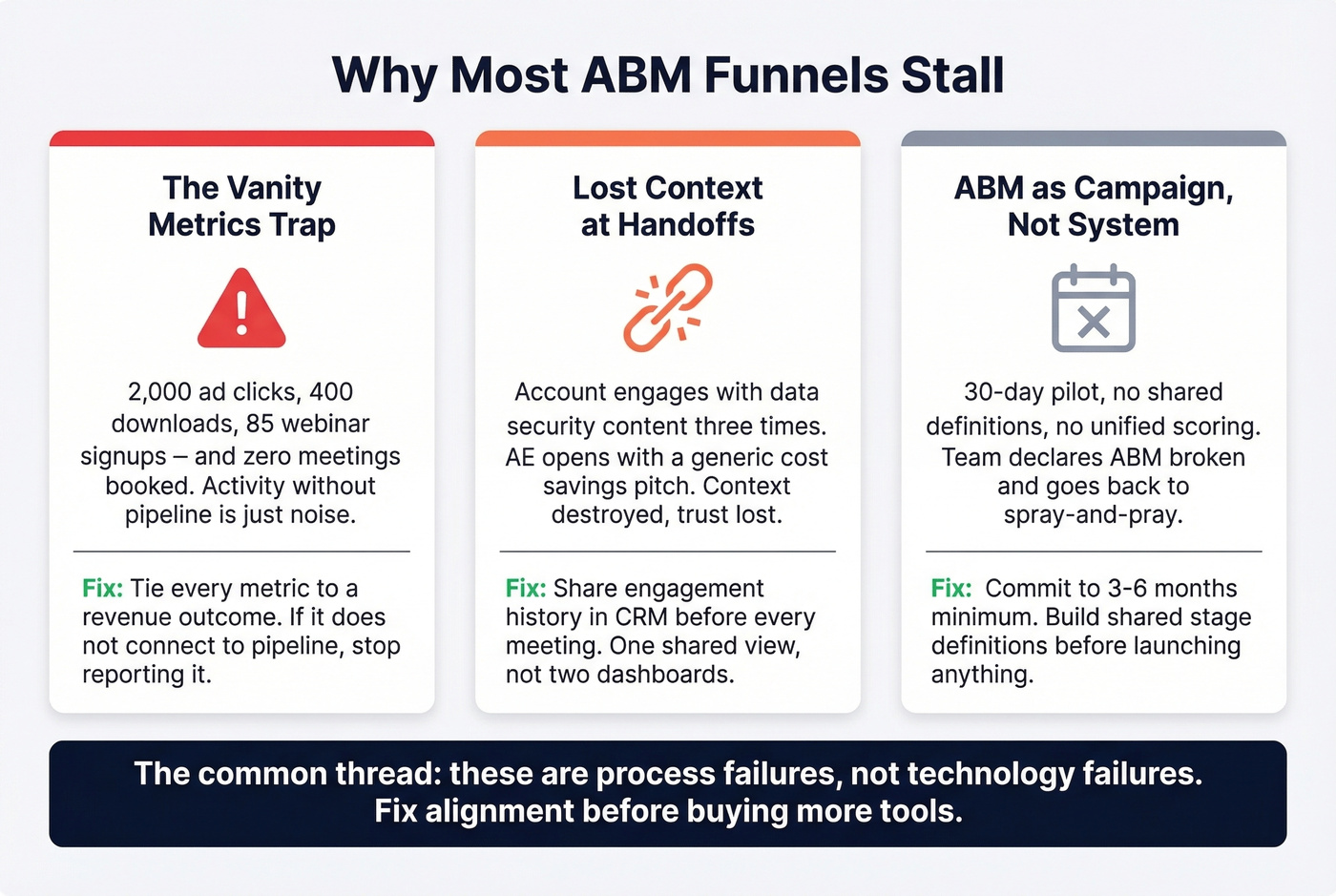
Lost context between stages. An account engages with three pieces of content about data security, books a meeting - and the AE opens with a generic pitch about cost savings. The handoff destroyed every signal marketing generated. Most funnel issues aren't top-of-funnel problems. They're context problems at the seams.
ABM as campaign, not system. No shared stage definitions. No unified scoring. No accountability. Teams run a "pilot" for 30 days, declare ABM doesn't work, and go back to spray-and-pray. ABM programs need 3-6 months before showing significant pipeline impact. The team that hit 63% meeting-to-opp conversion rebuilt around unified data and stage definitions - that took 90 days of disciplined execution, not a month-long experiment.
Getting Started With Your ABM Funnel
Here's the thing: the best framework for your account-based funnel stages is worthless if 35-40% of your emails bounce. Data quality is stage zero.
Start with a composable stack - your CRM, a verified data provider, and intent signals. You don't need a $35k-$1M+ platform investment on day one. Win rates climb from 15-20% early to 35-45% as your program matures, but only if the foundation is clean. We've seen teams spend six figures on orchestration platforms while their contact data bounces at 30%+. That's building on sand.
Prospeo fits the data layer here: 30+ search filters including buyer intent, technographics, funding events, and headcount growth let you build ICP-matched target account lists from day one, while the 7-day data refresh cycle keeps your buying committee maps current instead of stale. Start free with 75 verified emails per month, map your first buying committees, and see what clean data does to your bounce rates before committing budget to anything else.
If you want a deeper playbook beyond stages, use this as your next step: ABM process and how to measure ABM success.
Your funnel math falls apart when 35% of emails bounce. Prospeo's 5-step verification and 7-day data refresh keep contact data current across every account in your pipeline - from Identify through Expand. At $0.01 per email, scaling to 8,000 target accounts doesn't break your $56k program budget.
Verified emails and direct dials for every stakeholder in every target account.
ABM Funnel FAQ
How many accounts should an ABM funnel target?
It depends on your tier. 1:1 programs target 5-10 accounts with $30k-$100k+ budgets per account. 1:few targets 10-100. 1:many scales to 1,000+. Most mid-market programs start with 150-500 accounts and expand as conversion data matures.
How long before ABM funnel stages show ROI?
Expect 3-6 months for meaningful pipeline impact. Early programs see 15-20% win rates; mature programs reach 35-45%. Across a survey of 771 marketers, average ABM ROI came in at 137% - but that's across programs with real runway, not 30-day pilots.
What's the difference between MQL and MQA in ABM?
An MQL is a single lead who hit a scoring threshold. An MQA (marketing qualified account) measures buying committee engagement across the entire account - which is what account-based funnels actually track. Your MQA scoring should reflect real committee coverage, not one person downloading a whitepaper.
What tools do I need to run an ABM funnel?
At minimum: a CRM like HubSpot or Salesforce, a verified contact data provider, and an intent signal source. Add an ad platform for display targeting and you've got a functional stack without enterprise pricing. You can always layer on orchestration tools as your program matures and the data justifies the spend.