Target Accounts: How to Build, Tier, and Activate Your ABM List
Your CMO just told you to "do ABM." You nodded, walked back to your desk, and immediately hit the same wall that 39% of B2B marketers cite as their biggest challenge: figuring out which target accounts to actually pursue. The strategy, the personalization, the orchestration - none of it matters if you're pointed at the wrong companies.
ABM delivers better returns for most teams. 76% of marketers get higher ROI with ABM than with any other marketing approach. But programs that don't nail account selection? They burn budget sending bespoke content to companies that were never going to buy.
What You Need (Quick Version)
Three things make a target account program produce pipeline:
- A clear ICP. Company-level, not persona-level. Firmographics, technographics, and behavioral signals that define your best-fit accounts.
- A tiered list of 50-200 accounts. For 1:1 ABM, start with 10-50. For programmatic 1:many, scale to 500-1,000+. More on sizing below.
- Verified contact data for the buying committee at each account. Roughly 10 decision-makers per deal. Without accurate emails and direct dials, your beautiful ABM strategy dies at execution.
You don't need a $20K+ ABM platform to start. You need a spreadsheet, a clear ICP, and a way to verify contacts. The rest is sequencing.
What Are Target Accounts?
A target account is a company you've deliberately chosen to pursue because it matches your ideal customer profile and represents meaningful revenue potential. It's the opposite of waiting for inbound leads to self-select - you're picking the companies, then building engagement strategies around them.
Demandbase frames the distinction well: your account targeting strategy defines who you're going after, while ABM defines how you engage them. They're related but not the same. You can have a target account list without running full ABM, and you should - even outbound-heavy sales teams benefit from deliberate account selection.
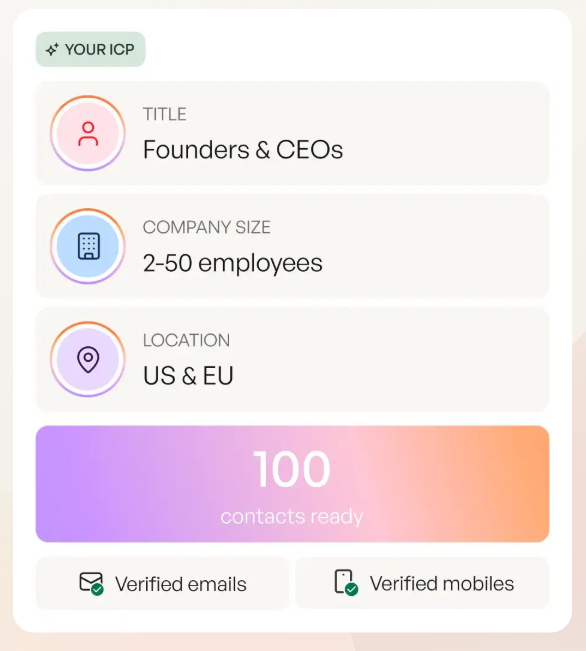
One distinction that trips people up: your ICP isn't the same as your buyer persona. The ICP describes the company - industry, revenue range, tech stack, headcount. The persona describes the person - VP of Marketing, Director of IT, CFO. You need both, but the ICP comes first because it determines which companies make the list.
The numbers back this up. Marketers running ABM report a 58% increase in deal size and 67% improved sales-marketing alignment. Forrester also found that 75% of businesses say ABM improves upsell and cross-sell revenue - gains that compound once you're focused on accounts that actually fit.
How to Build a Target Account List
Define Your ICP First
Every target account list starts with a clear ICP. Skip this step and you'll end up with a list that reflects gut feelings and executive pet accounts rather than data-driven selection.
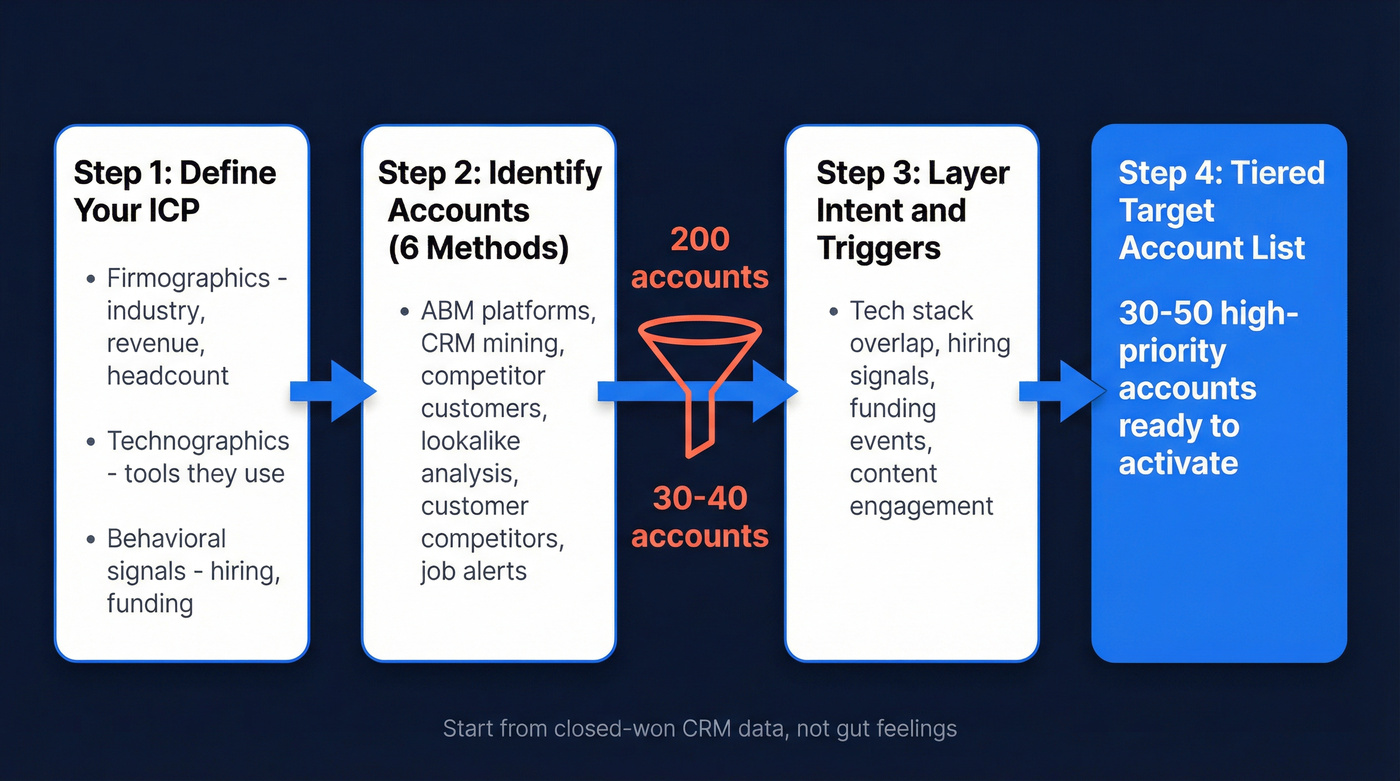
Your ICP should include:
- Firmographics: industry, employee count, revenue range, geography, growth stage
- Technographics: what tools they already use, especially ones you integrate with or replace
- Behavioral signals: hiring patterns, funding events, expansion signals, content consumption
Pull your ICP inputs from your CRM's closed-won data. Look at your best 20-30 customers and find the patterns. What industries? What revenue range? What tech stack? The ICP isn't aspirational - it's empirical.
Six Ways to Identify the Right Accounts
Once your ICP is locked, here are six proven methods to populate your list:
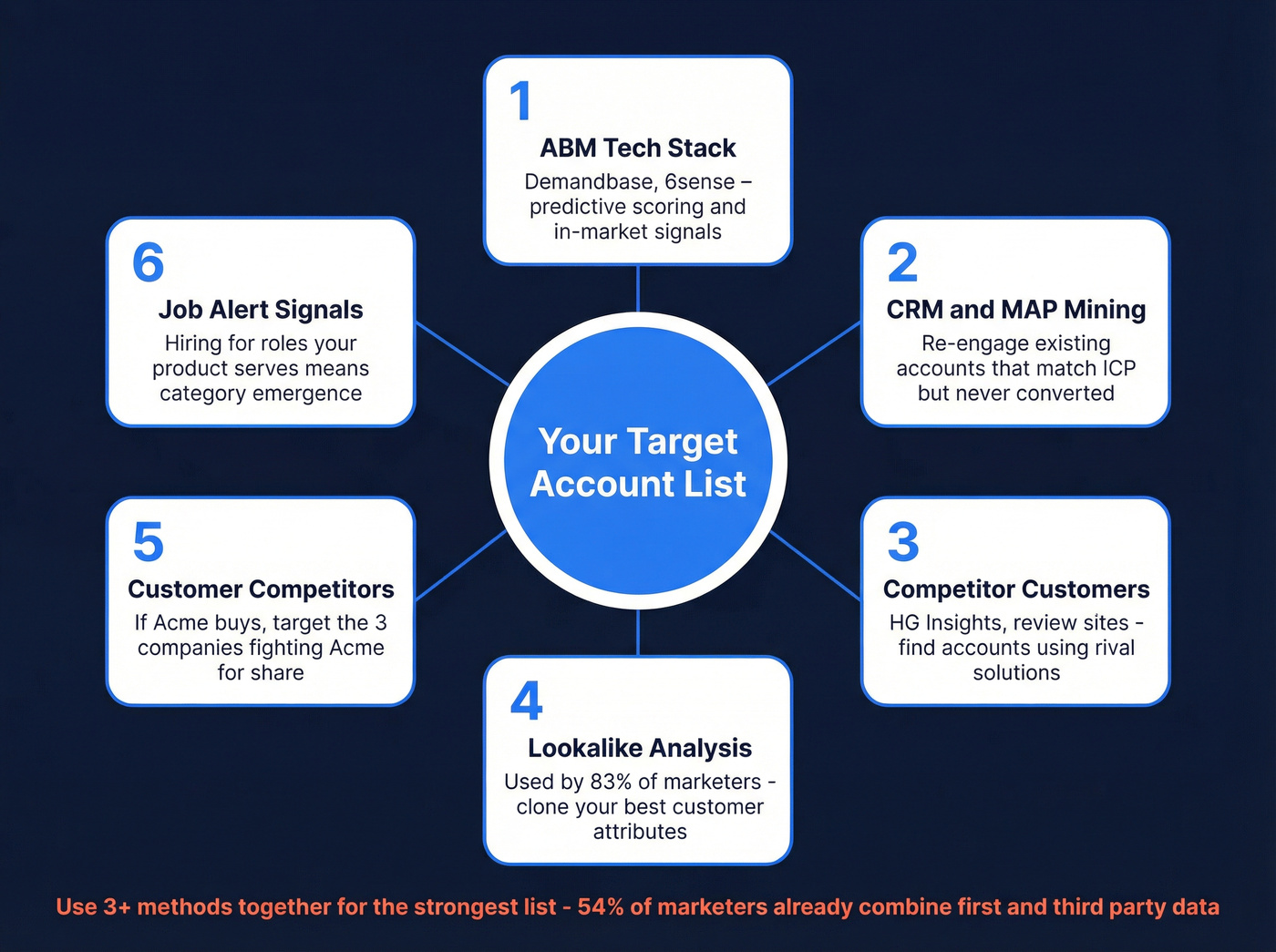
- Use your ABM tech stack. Platforms like Demandbase and 6sense score accounts against your ICP automatically, layering predictive signals and in-market behavior.
- Mine your CRM and MAP. Your existing database already contains accounts that match your ICP but haven't converted. Re-engage them before buying new data.
- Target competitors' customers. Tools like HG Insights or manual research through review sites reveal who's using competing solutions - and who might be ready to switch.
- Run lookalike analysis. 83% of marketers use lookalike modeling to expand their account lists. Take your best customers and find companies that share the same attributes.
- Research your customers' competitors. If your product works for Acme Corp, it probably works for the three companies fighting Acme for market share. Tools like Owler surface these relationships quickly, and this angle is surprisingly underused.
- Set up job alerts for persona titles. When companies start hiring for roles your product serves - say, "Head of Revenue Operations" - that's a category-emergence signal worth tracking.
Teams using at least three of these methods simultaneously build stronger lists than those relying on a single source. 54% of marketers already combine first- and third-party data for account selection. The ones who don't are leaving signal on the table.
Filter With Intent and Triggers
Raw ICP matching gives you a long list. Intent data and trigger events turn it into a prioritized one.
Say you sell cybersecurity software to financial services. You start with ~200 firms that match your firmographic criteria (500+ employees, financial services vertical). Then you layer:
- Technographics: Which ones already use tools you integrate with - Okta, Splunk, CrowdStrike?
- Trigger events: Which are hiring CISOs or expanding their IT teams?
That ~200 becomes 30-40 high-priority accounts. That's a list you can actually work.
How to Tier Your Target Accounts
Not every account on your list deserves the same investment. Tiering matches resources to opportunity - and it's the difference between a focused ABM program and an expensive spray-and-pray campaign wearing ABM's clothes.
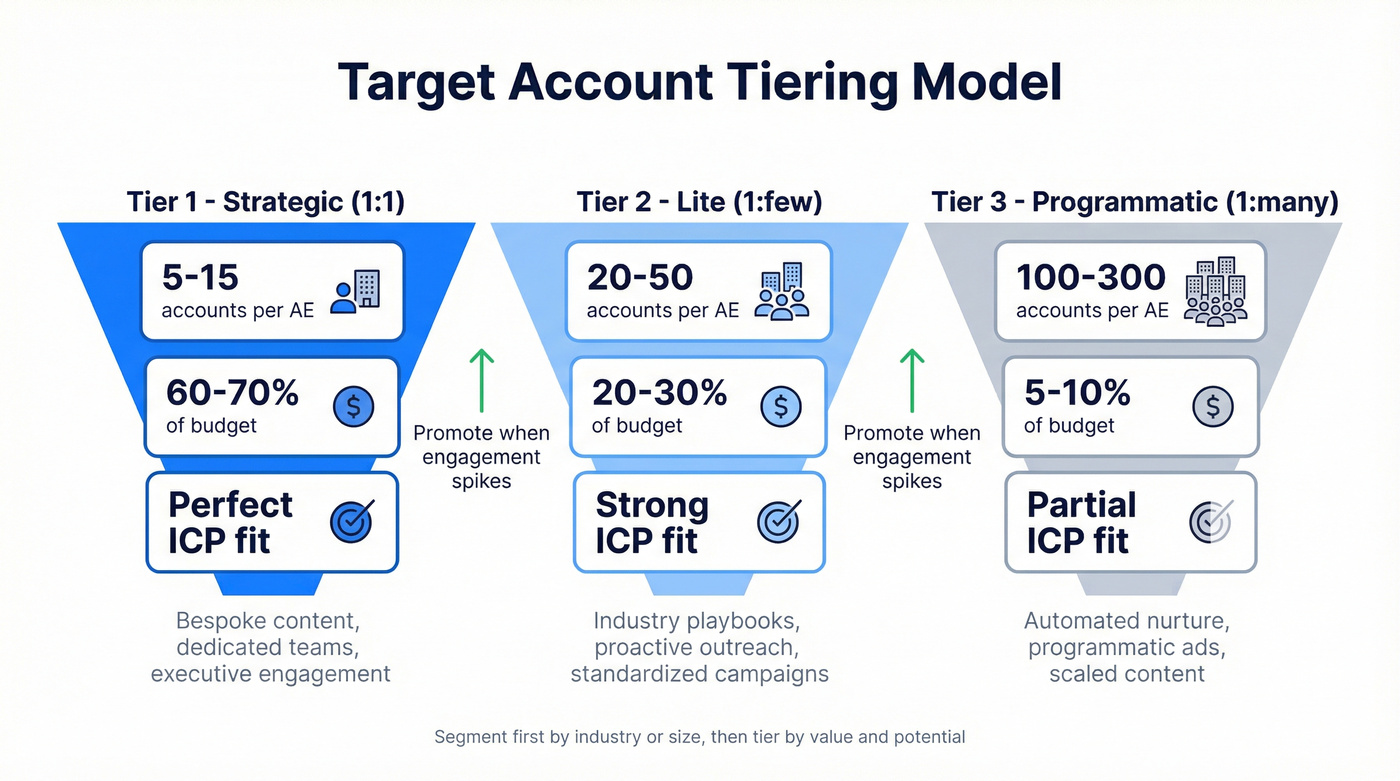
| Tier 1 | Tier 2 | Tier 3 | |
|---|---|---|---|
| ICP Fit | Perfect | Strong | Partial |
| ABM Motion | Strategic (1:1) | Lite (1:few) | Programmatic (1:many) |
| Accounts per AE | 5-15 | 20-50 | 100-300 |
| Resource Share | 60-70% | 20-30% | 5-10% |
| Engagement | Bespoke, dedicated | Standardized + proactive | Automated nurture |
Tier 1 accounts are your dream customers - perfect ICP fit, significant revenue potential, and strategic value beyond just the deal. Think logo recognition, expansion potential, or vertical credibility. These get dedicated teams, custom content, and executive-level engagement. You're spending 60-70% of your ABM budget here.
Tier 2 accounts are strong fits with real growth potential. They get standardized campaigns with proactive outreach - industry-specific playbooks rather than fully bespoke experiences. The goal is to nurture them toward Tier 1 status over time.
Tier 3 is your broader set. These accounts meet some ICP criteria but don't warrant heavy investment yet. Automated nurture sequences, programmatic advertising, and scaled content do the heavy lifting. When engagement signals spike, promote them up.
One thing to keep straight: tiering isn't the same as segmentation. Segmentation groups accounts by shared characteristics like industry, size, or region. Tiering ranks them by value and potential. You segment first, then tier within segments.
How Invoca Tiered 4,500 Accounts
Invoca's ABM program offers a concrete example of tiering at scale.
What made their approach interesting was the use of non-traditional attributes beyond standard firmographics. They layered in paid search spend and web-versus-mobile traffic mix - signals that directly correlated with their product's value proposition. Invoca also factored in whether prospects had 1-800 numbers or call centers, signals directly tied to their call-analytics product that no predictive tool would surface on its own. Tools like Datanyze, SimilarWeb, InsideView, and EverString provided the data.
For Tier 1 selection, Invoca didn't rely purely on algorithms. A human ops team - marketing and sales leadership together - handpicked the top-tier accounts. Tier 2 and Tier 3 bucketing was more automated. Then individual reps picked 10-20 focus accounts from their assigned list. That human layer at the top is something we see in every successful ABM program. Algorithms can score; humans need to validate.

You just built a tiered target account list. Now you need verified emails and direct dials for 10+ decision-makers at each one. Prospeo gives you 30+ filters - including buyer intent, technographics, and headcount growth - to find the exact buying committee at your Tier 1 accounts. 98% email accuracy. 125M+ verified mobiles. $0.01 per email.
Stop building ABM lists you can't actually activate.
How Many Accounts Should You Target?
The right number depends entirely on your ABM motion:
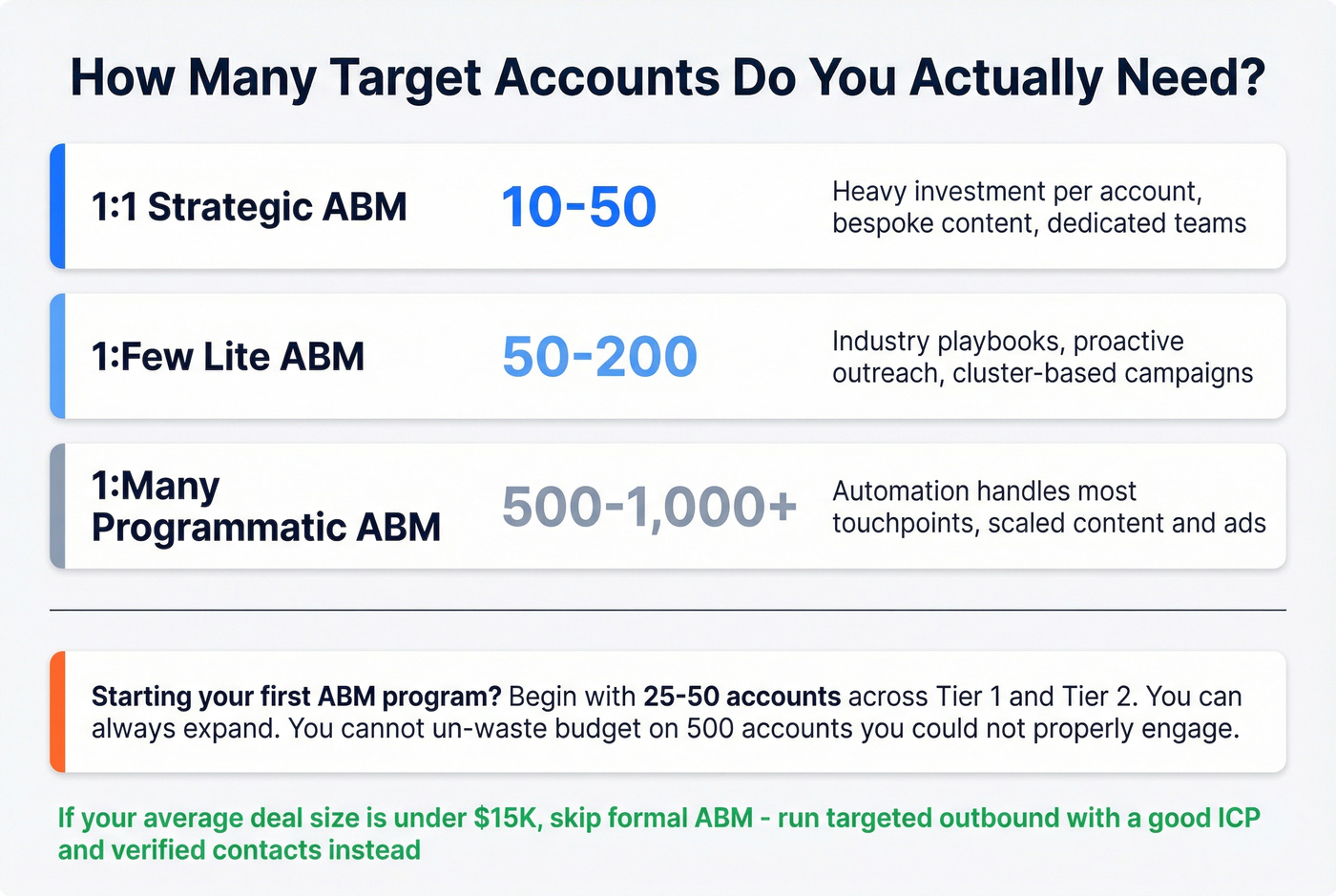
Quick benchmarks:
- 1:1 or 1:few ABM: 10-50 accounts with heavy investment per account
- 1:many / programmatic ABM: 500-1,000+ accounts with automation handling most touchpoints
More isn't better. We've seen teams build lists of 2,000 "target" accounts and then treat every single one the same - which means none of them get the focused attention that makes ABM work. Invoca had 4,500 accounts in their system, but reps focused on just 10-20 each. The list is a universe; the focus is what drives deals.
Ask any ABM practitioner what kills their program, and you'll hear the same answer: the list was wrong from the start. The consensus on r/sales and r/marketing echoes this - debates about whether to start with 25 or 100 accounts miss the point entirely, because the answer depends on your tier structure and team capacity, not an arbitrary number.
Here's the thing: if your average deal size is under $15K, you probably don't need a formal ABM program at all. Run targeted outbound with a good ICP and verified contacts. Save ABM for deals where the unit economics justify the per-account investment.
If you're launching your first ABM program, start with 25-50 accounts across Tier 1 and Tier 2. You can always expand. You can't un-waste the budget you spent on 500 accounts you couldn't properly engage.
From Accounts to Contacts
Every ABM guide tells you how to pick accounts. Almost none tell you what to do next: find the actual humans you need to reach.
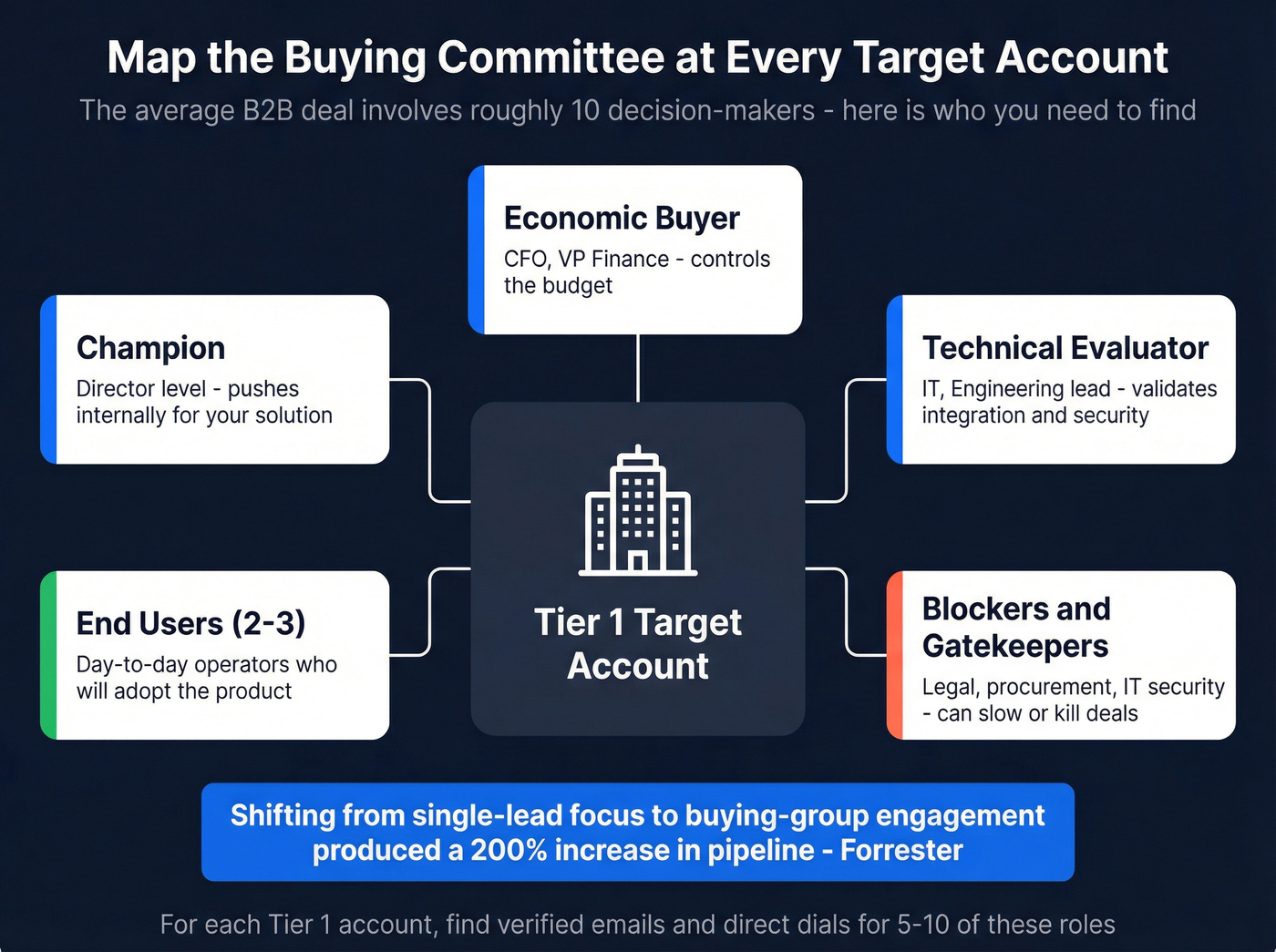
The average B2B purchase involves roughly 10 decision-makers. For a Tier 1 account, you need verified contact data for 5-10 of them - the economic buyer, the technical evaluator, the champion, the end users who'll push for adoption. This is the buying committee, and mapping it is where account programs either accelerate or stall.
Forrester research found that shifting from single-lead focus to buying-group engagement produced a 200% increase in win rates and an 800% increase in opportunity progression. Those aren't marginal gains.
Here's where most teams hit a wall. You've built a beautiful tiered list of 50 accounts. You know the job titles you need to reach. But when you pull contact data from your existing tools, half the emails bounce and the phone numbers go to switchboards. Single-digit deliverability on your first sequence isn't a data problem - it's a program killer.

Layering intent data and trigger events on your ICP is smart. Prospeo tracks 15,000 intent topics via Bombora and surfaces job change signals, funding events, and headcount growth - so you know which target accounts are in-market right now. Data refreshes every 7 days, not the 6-week industry average.
Turn your static target account list into a live pipeline signal.
Three Mistakes That Kill ABM Programs
Picking the Wrong Accounts
The most expensive ABM mistake happens before a single ad runs or email sends. Teams build lists based on executive wishlists, brand recognition, or loose firmographic filters - without validating against actual win/loss data or getting sales input.
Let's be honest: if your sales team didn't help build the list, they won't work it. Involve AEs in account selection from day one. Cross-reference your ICP against closed-won patterns, not aspirational logos.
Sales and Marketing Misalignment
46% of businesses say alignment is their biggest ABM challenge, and 93% say it's crucial to success. Those numbers aren't contradictory - they're a warning. Everyone agrees alignment matters; almost half can't achieve it.
The fix isn't a quarterly meeting. It's shared KPIs, joint account planning sessions, and a single source of truth for account engagement data. When both teams coordinate outreach against the same accounts and share signals in real time, results compound. If marketing is measuring MQLs and sales is measuring pipeline, you're running two programs that happen to share a name. Only 52% of companies even measure ABM ROI, which means nearly half are flying blind on whether their program works at all.
Thinking in Leads Instead of Accounts
This is the subtlest mistake and the hardest to fix.
A single contact at an account downloads a whitepaper, and the SDR team pounces. Another contact at the same account goes dark, and the account gets deprioritized. Both reactions are wrong. ABM requires account-level qualification - set engagement thresholds across the buying group, not just one thread. The buying committee has 10 people; you need signal from several of them before making resource decisions. Don't drop accounts prematurely because one conversation stalled.
Tools for ABM in 2026
You don't need every tool in every category. Here's the stack breakdown organized by function:
| Category | Tools | Approx. Pricing |
|---|---|---|
| ABM Platforms (Enterprise) | Demandbase, 6sense, Terminus | $20-100K+/yr |
| ABM Platforms (Mid-Market) | RollWorks, HubSpot (Marketing/Sales Hub) | ~$10-25K/yr; from $800/mo |
| Intent Data | Bombora (also via Prospeo) | $25-50K/yr standalone |
| Enrichment & Verification | Prospeo | Free tier; paid ~$0.01/email |
| Sales Intelligence | Apollo.io, ZoomInfo, LinkedIn Sales Navigator | From $49/mo; $15-40K/yr; from $99/mo |
| Sales Engagement | Outreach, Salesloft | ~$100-150/user/mo |
If you're already on HubSpot, their native Target Accounts feature lets you tag and track accounts directly in the CRM - no separate platform needed. For teams running enterprise ABM with a six-figure budget, platforms like Demandbase or 6sense handle orchestration, intent, and advertising in one stack. Skip the enterprise platforms if you're a Series A company doing ABM for the first time - Apollo's free tier plus a verification layer like Prospeo gets you surprisingly far without a platform commitment.
FAQ
What is a target account in sales?
A target account is a company specifically selected for focused sales and marketing engagement because it closely matches your ideal customer profile. Unlike inbound leads that self-select, these accounts are proactively chosen based on firmographic fit, revenue potential, and strategic value - then assigned to reps with dedicated outreach plans.
How do you create a target account list?
Start with your ICP - firmographics, technographics, and revenue potential - then layer intent signals and trigger events to prioritize. Validate against CRM win/loss data and get direct sales input before finalizing. The strongest lists combine at least three identification methods: CRM mining, lookalike analysis, and intent data.
How many accounts should an SDR have?
For 1:1 ABM, 5-15 Tier 1 accounts per rep. For 1:few, 20-50. For programmatic ABM, 100-300+ per rep with automation handling most touchpoints. Invoca's reps focused on just 10-20 despite having thousands in the system - concentration beats coverage.
What's the difference between target accounts and named accounts?
Named accounts are specific companies assigned to individual reps, while target accounts form the broader strategic list that feeds those assignments. Think of target accounts as the universe and named accounts as the rep-level subset. Both terms describe deliberately selected companies, but at different levels of ownership.
How do you find verified contacts at target accounts?
Map the buying committee - typically ~10 decision-makers per deal - then use an enrichment tool to pull verified emails and direct dials. Bad contact data is the top reason account-based campaigns fail at the execution layer, so verification matters more here than in any other outbound motion.