

How to Generate ABM Leads That Actually Convert
Your VP of Marketing just declared you're "doing ABM now." There's a Slack channel, a slide deck with the word "orchestration" on it, and a target account list pulled from last quarter's closed-won deals. Six weeks later, SDRs are blasting the same sequences to slightly different companies and calling it account-based.
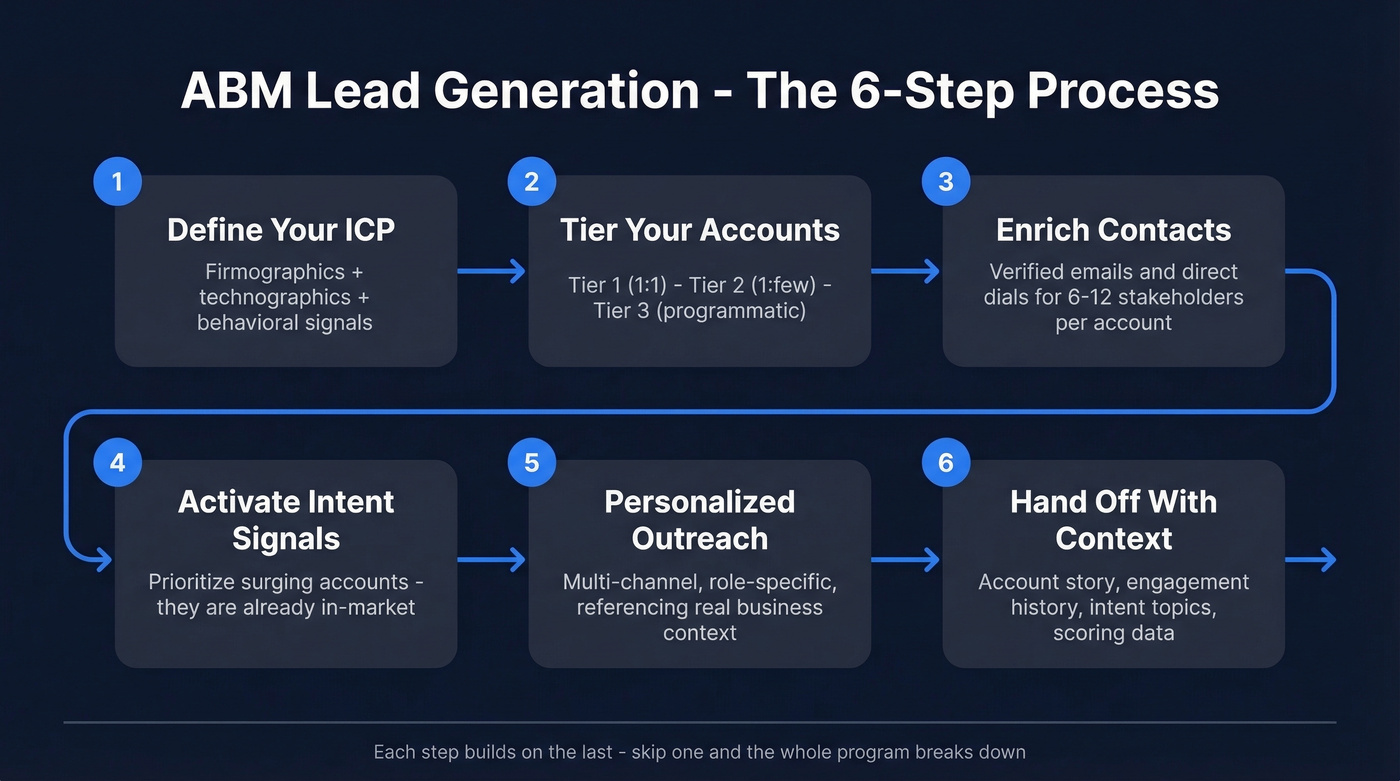
Sound familiar? You're not alone - 71% of companies say they're running ABM, but the consensus on r/b2bmarketing is blunt: most of what passes for ABM is just outbound with a company name swapped in. Generating real ABM leads goes deeper - alignment, focused lists, multi-channel coordination across the buying committee. Let's talk about how to actually do it.
What You Need to Start
ABM leads require three things most teams skip:
- A tiered target account list. Not "every company that fits our ICP," but accounts ranked by fit, intent, and revenue potential - with different playbooks for each tier.
- Verified contact data for the full buying committee. Enterprise deals involve 6-12 stakeholders. One champion isn't enough. You need the CFO, the end user, and the procurement lead.
- Account-level scoring that replaces traditional lead scoring. Individual MQL counts will actively mislead you in ABM. Score the account, not the contact - marketing qualified accounts become your real unit of measurement.
Here's the thing: you don't need a $50k+ platform to start. A CRM, a data enrichment tool like Prospeo for verified buying committee contacts, and a free plan from 6sense for intent signals can get you moving fast. Add the enterprise platform once you've proven the model.
ABM vs. Traditional Lead Gen
The decision isn't ABM or lead gen - it's knowing when each approach earns its keep. Walker Sands frames it well: lead gen is volume, ABM is precision. They solve different problems. Account-based marketing's origins trace back to the early 1990s, but it really took off in the 2010s as B2B platforms matured enough to support it.
| Dimension | Account-Based Leads | Traditional Lead Gen |
|---|---|---|
| Targeting | Pre-selected accounts | Anyone who engages |
| Unit | Account + buying committee | Individual lead |
| Key metric | Account penetration | CPL / MQL count |
| Sales cycle | Longer, higher value | Shorter, lower ACV |
| Content | Tier-specific, personalized | Broad appeal |
Choose ABM when you have a defined list of high-value accounts, complex multi-stakeholder deals, or you're expanding within existing customers. Choose lead gen when you're entering a new market, selling a lower-ticket product, or need to fill top-of-funnel fast. Most mature teams run both - ABM for enterprise targets, lead gen for everything else.
If your average deal size sits below $10k-$15k, you probably don't need ABM-level orchestration. A well-run outbound motion with good data will outperform a half-baked ABM program every time. ABM earns its complexity premium only when deal sizes justify the per-account investment.
How to Generate ABM Leads
Define Your ICP
Start with firmographics (industry, revenue, headcount), then layer in technographics and behavioral signals like hiring patterns and funding rounds. The mistake most teams make is stopping at firmographics. A 500-person SaaS company running Salesforce and actively hiring SDRs is a fundamentally different prospect than a 500-person SaaS company on HubSpot with a frozen headcount - and that difference should shape your entire approach before you build a single list.
Tier Your Accounts
Not every target account deserves the same investment. Tier 1 accounts (your top 10-25) get fully custom, 1:1 campaigns - personalized content, executive outreach, maybe even direct mail. Tier 2 (50-100 accounts) gets 1:few treatment: industry-specific messaging, tailored ads, multi-threaded outreach. Tier 3 (hundreds or thousands) gets programmatic ABM - automated sequences, targeted display, lighter personalization.
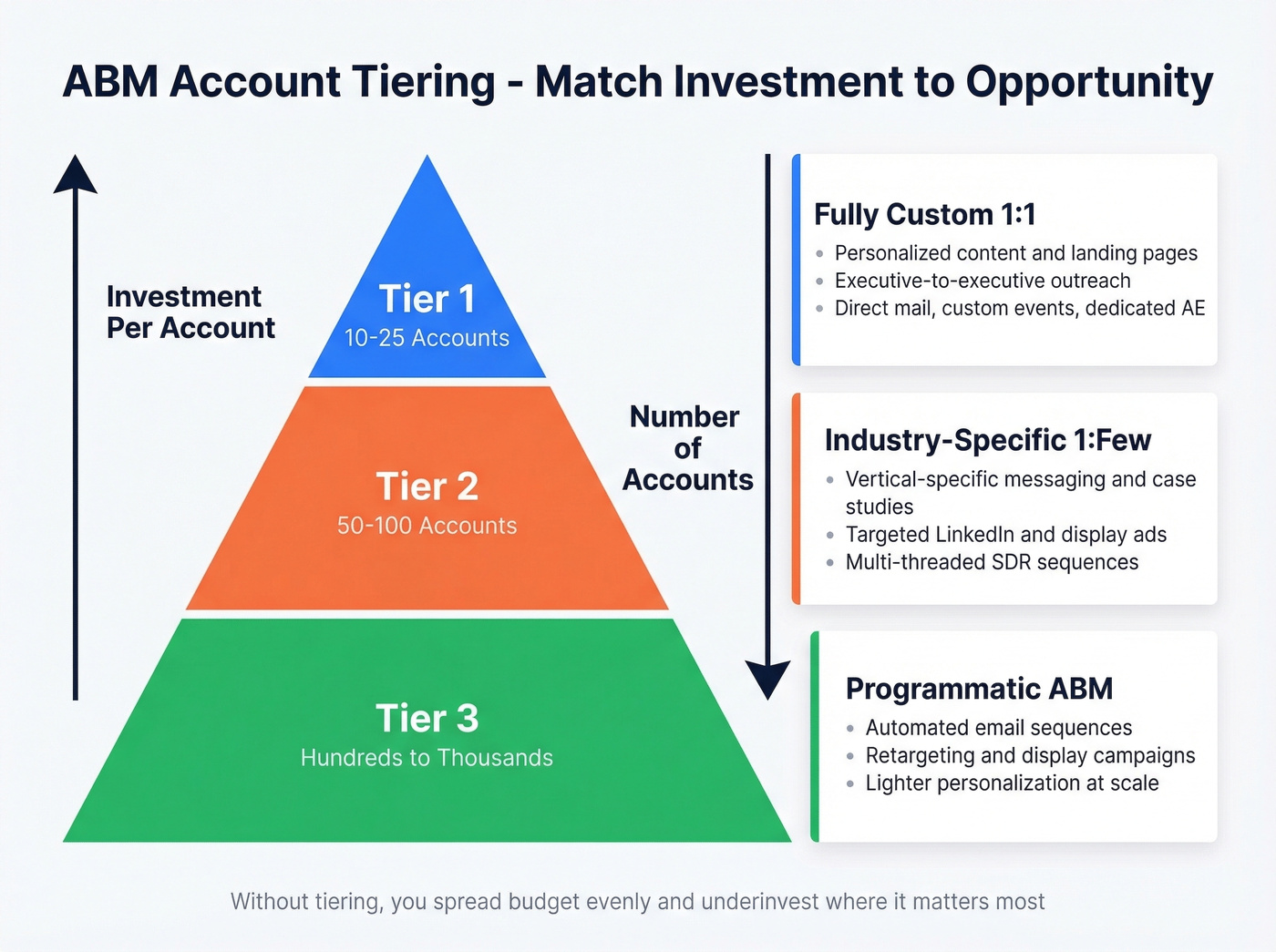
Without tiering, you'll spread budget evenly and underinvest where it matters most.
Enrich with Verified Contact Data
ABM lives or dies on contact coverage. You need verified emails and direct dials for 6-12 stakeholders per account - not just the one person who downloaded your whitepaper. Your enrichment target: 80% of key firmographic and contact fields populated across your target list. Poor-quality contact data doesn't just waste SDR time. It creates GDPR and CCPA liability, and verified, compliance-ready data sources reduce legal exposure while improving deliverability.

We've found that Prospeo handles this particularly well for ABM use cases. Its database covers 300M+ professional profiles with 143M+ verified emails and 125M+ verified mobile numbers at 98% email accuracy, refreshed on a 7-day cycle - which matters when you're mapping buying committees that change quarterly. The 30+ search filters, including buyer intent powered by Bombora, technographics, and headcount growth, let you build account-specific contact lists without stitching together three different tools.
Activate Intent Signals
Raw contact data without timing is just a phone book. Layer in intent signals - topics your target accounts are actively researching - to prioritize which accounts to pursue now. Bombora and 6sense are the primary providers here.
Accounts showing strong intent signals should jump to the front of the queue since they're already in-market and far more likely to engage. Your targets: a 10-20% MQA rate from accounts showing intent, and 5-10 meetings booked per 100 surging accounts within 30 days. If you're below those numbers, your intent signals are either too broad or your follow-up is too slow.
Launch Personalized Outreach
This is where most ABM programs collapse into generic sequences. Only 13% of teams actually hyper-personalize their outreach - everyone else sends the same email with the company name swapped in. The gap makes sense: 42% of teams say they can't even identify the right buyers within target accounts.
For Tier 1 accounts, outreach should reference specific business challenges, recent company news, and the stakeholder's role in the buying process. Multi-channel matters too: email, phone, targeted ads, and content all working the same account simultaneously. The conversion lift is real - contact-level ABM drives up to 74% more booked meetings and a 118% lift in pipeline conversion.
If you need a tighter system for the actual sequences, pull from proven sales follow-up templates and a modern B2B cold email sequence structure.
Hand Off to Sales (With Context)
Don't just pass a lead name and email. Sales needs account-level context: which stakeholders have engaged, what content they've consumed, which intent topics are surging, and where the account sits in your scoring model. Even a simple Slack message with this context dramatically changes the quality of the first sales conversation. We've seen teams blow this step repeatedly - all the upstream work wasted because the handoff was a bare contact record with no story behind it.
Account Scoring Replaces Lead Scoring
Traditional lead scoring will actively mislead your ABM program. Here's the failure mode we see constantly: a junior analyst at a poor-fit company binge-downloads five whitepapers in a week and scores as your hottest "lead." Meanwhile, three VPs at your best-fit target account each visit your pricing page once - and none of them trip the individual threshold.
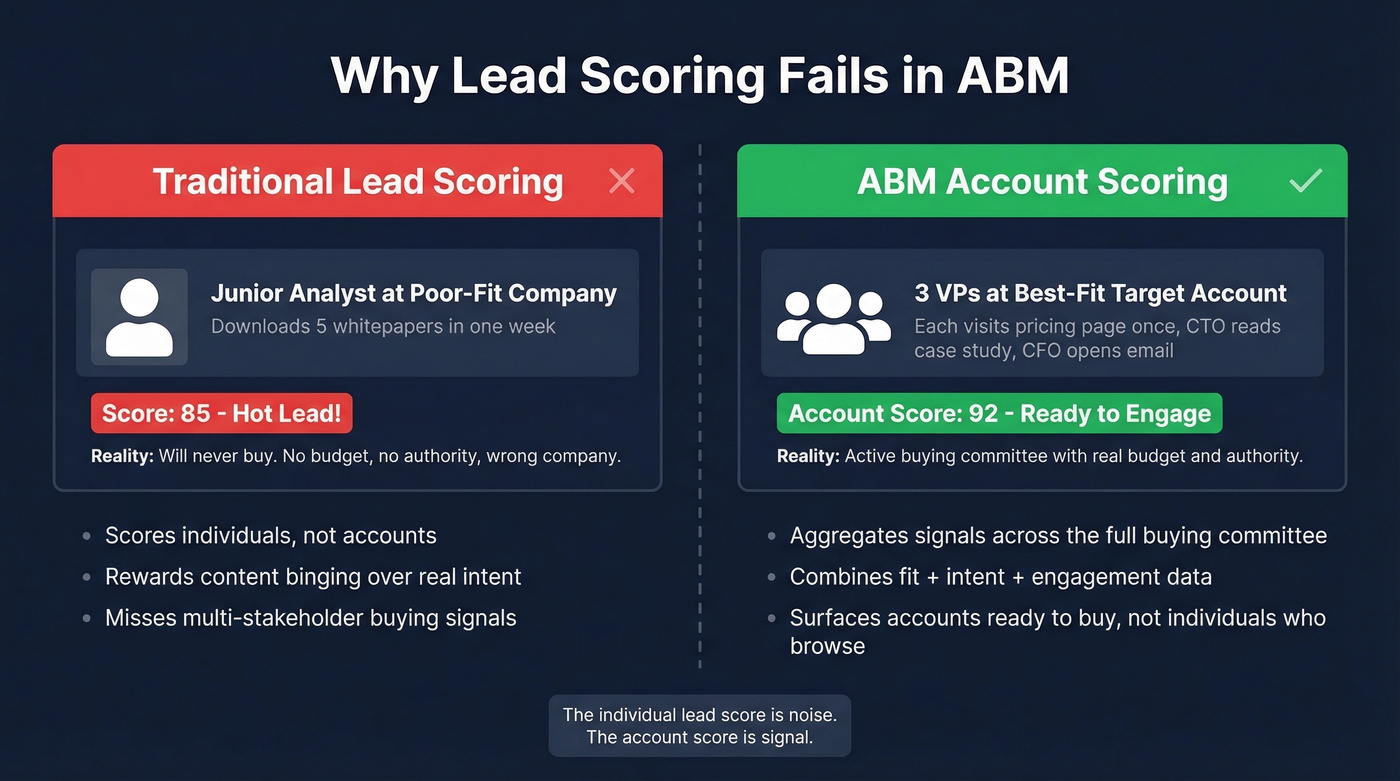
That's not a hypothetical. It's Tuesday.
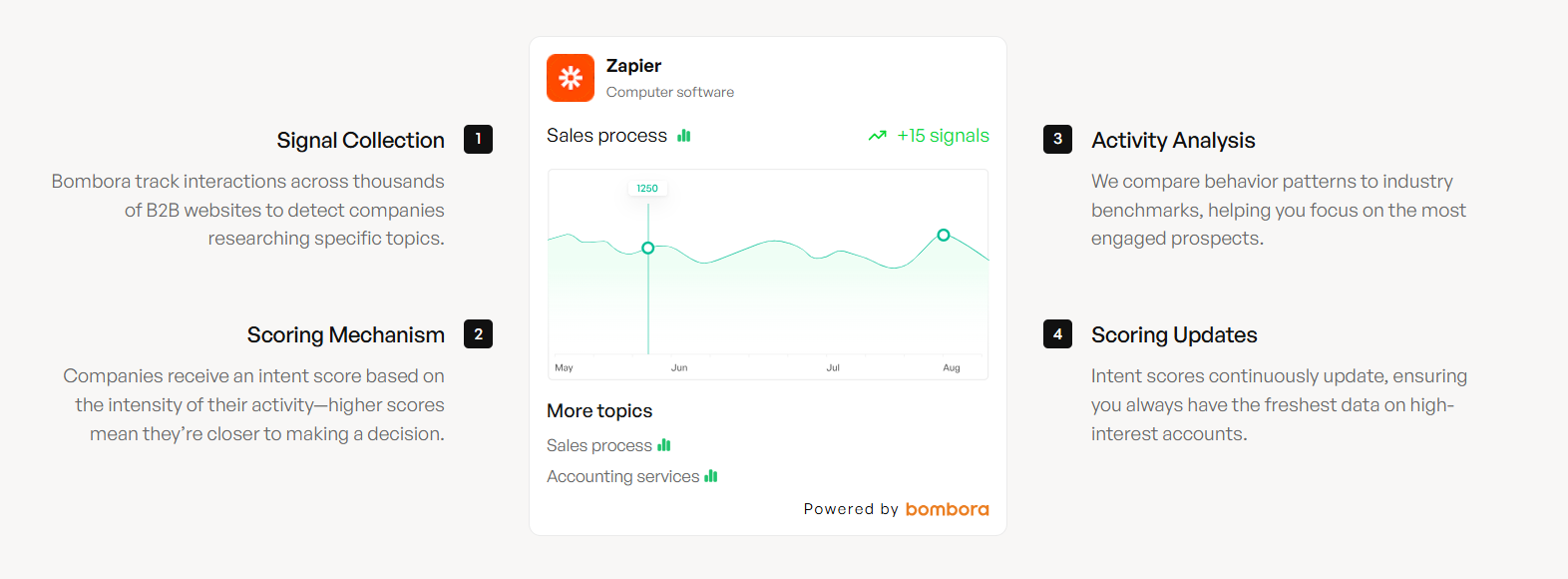
Demandbase's framework gets this right. Account scoring combines three inputs: account fit (firmographic and technographic match to your ICP), intent data (third-party research signals plus first-party website activity), and engagement data (interactions across the entire buying committee, not just one contact). When buying committees run 6-10 stakeholders deep, you need a model that aggregates signal across all of them. The individual lead score is noise. The account score is signal.

ABM lives or dies on buying committee coverage. Prospeo gives you 300M+ profiles with 98% email accuracy, 125M+ verified mobiles, and 30+ filters - including Bombora intent data and technographics - so you can map 6-12 stakeholders per account without stitching together three tools.
Stop running ABM on bad data. Get verified buying committees at $0.01/email.
Benchmarks: What Good Looks Like
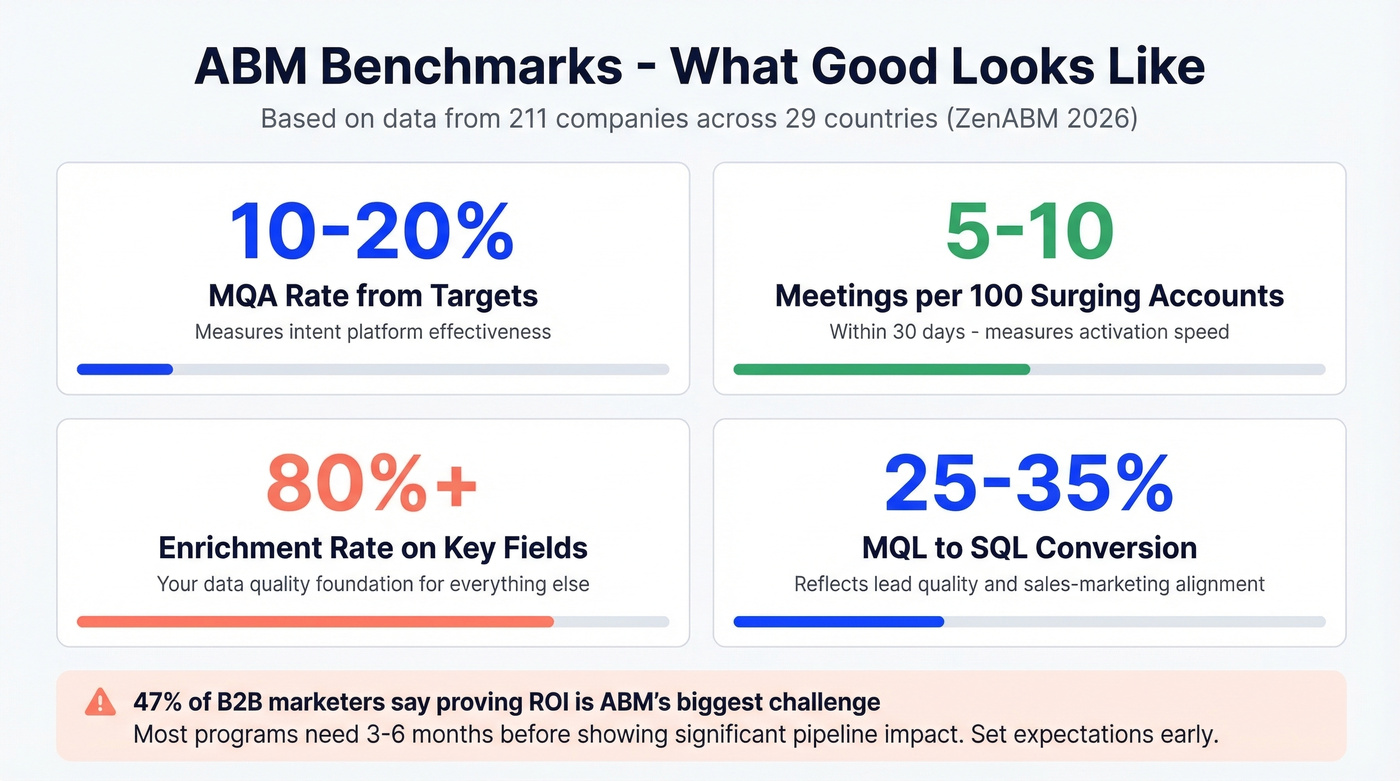
Numbers give you something to calibrate against. These benchmarks represent realistic targets for teams with functional ABM programs, and ZenABM's 2026 benchmark report - based on anonymized data from 211 companies across 29 countries - shows these ranges hold across geographies:
| Metric | Target | Why It Matters |
|---|---|---|
| MQA rate from targets | 10-20% | Intent platform effectiveness |
| Meetings per 100 surging accounts (30 days) | 5-10 | Intent activation speed |
| Enrichment rate (key fields) | 80%+ | Data quality foundation |
| MQL-to-SQL conversion | 25-35% | Lead quality + alignment |
One uncomfortable reality: 47% of B2B marketers say proving ROI is ABM's biggest challenge. That's partly a measurement problem and partly a patience problem. Most programs need 3-6 months before showing significant pipeline impact. If your leadership expects results in 30 days, set expectations before you launch - or you'll kill a working program before it has time to work.
If you're tightening measurement, it helps to standardize your funnel metrics and keep an eye on pipeline health so ABM doesn't get judged on the wrong scoreboard.
Real ABM Lead Generation Results
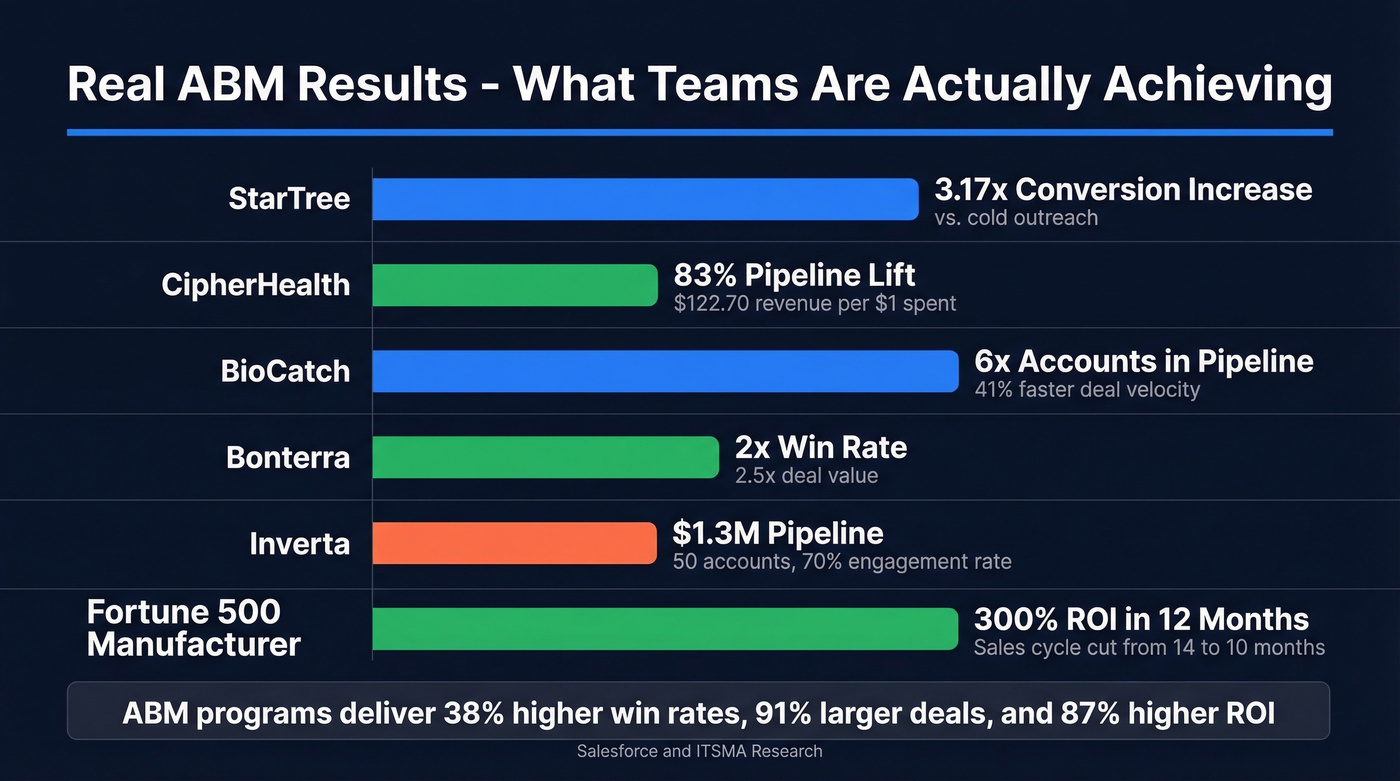
The benchmarks are useful, but case studies show what's actually achievable:
| Company | Result | Detail |
|---|---|---|
| StarTree | 3.17x conversion increase | vs. cold outreach |
| CipherHealth | 83% pipeline lift | $122.70 revenue per $1 spent |
| BioCatch | 6x accounts in pipeline | 41% faster deal velocity |
| Bonterra | 2x win rate | 2.5x deal value |
| Inverta | $1.3M pipeline | 50-account enterprise campaign, 70% engagement rate |
| Fortune 500 manufacturer | 300% ROI in 12 months | Sales cycle cut from 14 to 10 months |
Salesforce and ITSMA research shows ABM programs deliver 38% higher win rates, 91% larger deals, and 87% higher ROI compared to traditional approaches. The manufacturing case is particularly instructive - they shifted from trade shows to digital-first ABM using 6sense intent data and technical content syndication, and cut their sales cycle by four months. That's not incremental improvement. That's a structural change in how pipeline moves.
One practitioner on r/marketing reported double-digit open rates from their first ABM email campaign versus the 3% they were getting from traditional outbound - a common pattern once you're reaching the right people at the right accounts.
5 ABM Mistakes That Kill Pipeline
1. Running "fake ABM." Lightly personalized outbound sequences sent to a target account list isn't ABM. If your SDRs are running the same cadence with a company name swapped in, you're doing outbound. Real ABM coordinates marketing air cover, personalized content, and multi-threaded sales outreach against the same account simultaneously.
2. Measuring MQLs instead of account progression. ABM's unit is the account, not the individual. Track what percentage of target accounts move through funnel stages - interested, considering, selecting, closed - not how many form fills you generated.
3. Trusting contact-level attribution. This one's subtle but it compounds fast. HubSpot's attribution window is 90 days. Safari's ITP and ad blockers kill cookies. Redirect chains strip UTM parameters. The result: contact-level attribution creates a ton of false negatives, making your ABM program look like it's failing when it isn't.
4. Sending generic content across tiers. A Tier 1 account that gets the same nurture email as a Tier 3 account is a wasted opportunity. Your highest-value targets need content that speaks to their specific industry, challenges, and buying stage.
5. Skipping post-sale ABM. Most teams turn off ABM after the deal closes. That's leaving expansion revenue on the table. The same account-based approach that won the deal should drive upsells, cross-sells, and renewals.
ABM Tools: What You Actually Need
Organizations invest anywhere from $35,000 to over $1 million annually on ABM solutions. You don't need the full stack on day one.
| Category | Tools | Starting Price |
|---|---|---|
| Data Enrichment | Prospeo, ZoomInfo, Cognism | Free-$0.01/email; ~$15k+/yr; ~$15k-40k+/yr |
| Intent Data | Bombora, 6sense | ~$25k+/yr; Free plan (50 credits/mo) |
| ABM Platforms | Demandbase, Terminus, RollWorks | $25k-$250k+/yr |
| Visitor ID | Dealfront (Leadfeeder), Lead Forensics | Free-$99/mo; ~$500-1,500/mo |
| CRM/MAP | HubSpot, Salesforce, Marketo | Free tiers to enterprise contracts |
If you're still building your stack, it helps to compare free lead generation tools and the best data enrichment services before you commit to annual contracts.
Look, if you're a 500-person org with a $200k ABM budget, Demandbase or 6sense makes sense as your orchestration layer. But if you're a 20-person sales team proving ABM works before you scale it, start with your CRM, a solid enrichment tool for contact data, and 6sense's free plan for intent signals. That's a functional ABM stack without enterprise contracts. Skip the $100k platform until you've earned the budget.
Your tiered account list is only as good as the contact data behind it. Prospeo refreshes every 7 days - not 6 weeks - so your buying committee maps stay current as stakeholders change roles. Layer in intent signals across 15,000 Bombora topics to know which accounts to activate now.
Real ABM needs real-time data. Build account-ready contact lists in minutes.
FAQ
How is an ABM lead different from a regular lead?
An ABM lead is a contact within a pre-selected target account that matches your ICP - chosen before they ever engage with your brand. Regular leads come from inbound channels passively. The core difference: account-based leads are pursued proactively based on fit and intent signals, not generated through broad marketing.
Can you run ABM without an expensive platform?
Yes. A CRM, a data enrichment tool for verified buying committee contacts, and 6sense's free plan for intent signals will get you running. Add a dedicated orchestration platform like Demandbase once you've proven the model and have budget to scale.
How long before ABM produces pipeline results?
Most programs take 3-6 months to show significant pipeline impact. Intent-driven outreach can produce meetings within 30 days, but closed-won attribution for enterprise deals typically requires 6-12 months of data. Set expectations with leadership before launch - ABM is a long game.
What's the biggest ABM measurement mistake?
Using MQL count as your primary metric. ABM should be measured by percentage of target accounts progressing through funnel stages - not individual lead volume. Contact-level attribution also creates false negatives due to cookie loss and short attribution windows, making programs look worse than they actually are.