

ABM Services: Platforms, Agencies, Pricing, and How to Choose
Your VP of Marketing just told the board that ABM is the priority for next quarter. Now you're sorting through a confusing mix of account-based marketing platforms, consulting agencies, and - confusingly - ABM Industries, the facility management company. (Looking for them? Head to abm.com.)
Companies running ABM programs report 38% higher win rates, 91% larger deal sizes, and 24% faster revenue growth. Those numbers are real, but the path from "we're doing ABM" to those results is littered with six-figure platform contracts, misaligned sales teams, and bounced emails. The average ABM program delivers 137% ROI - if you build it right.
Here's how to navigate it.
What You Need (Quick Version)
You don't need a $100K platform to run ABM. You need a strategy, clean contact data, and a way to reach decision-makers. Here's the stack by budget:
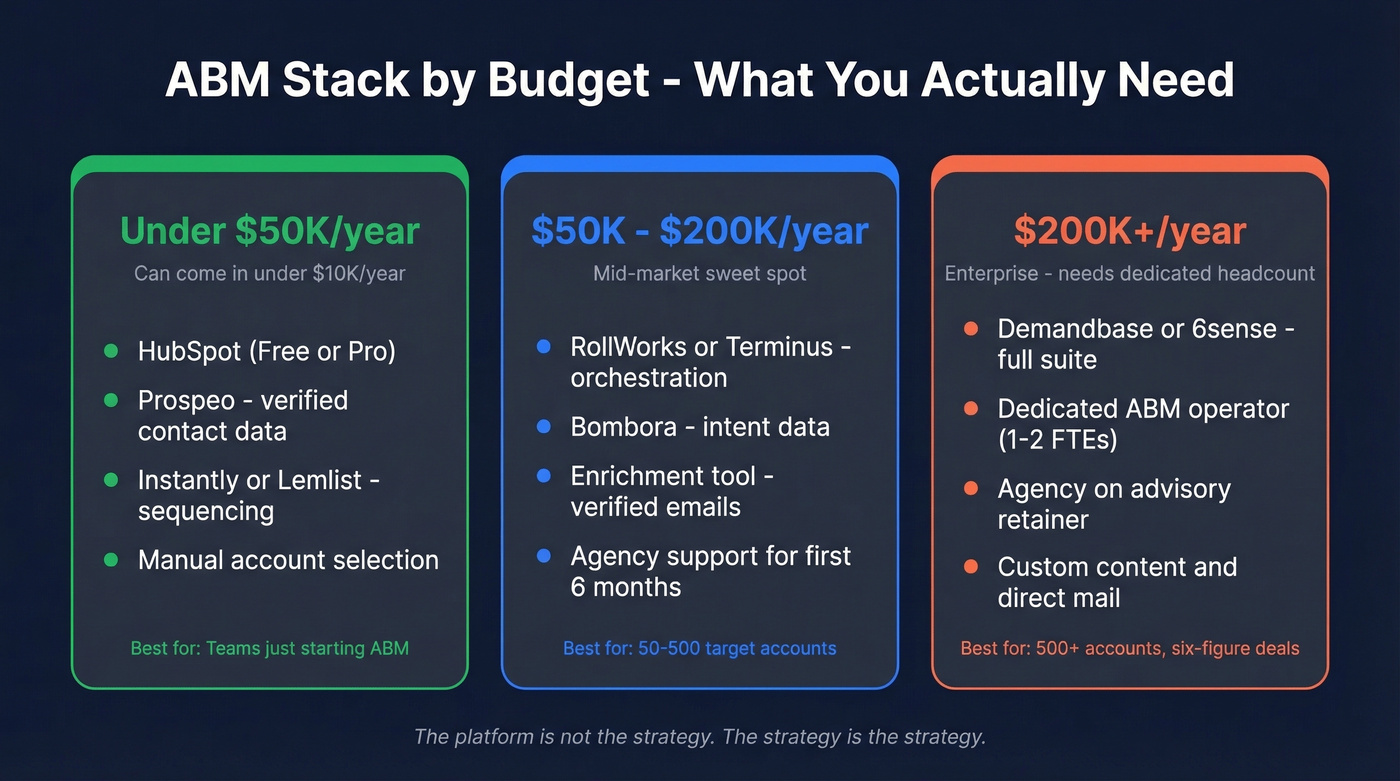
Under $50K/year: HubSpot + Prospeo for verified contact data at target accounts + a sequencing tool like Instantly or Lemlist. If you're not on HubSpot Enterprise, this stack can come in under $10K/year.
$50K-$200K/year: RollWorks or Terminus for orchestration, a dedicated enrichment tool for verified emails, and Bombora for intent data. Add an agency for the first 6 months if you've never run ABM before.
$200K+/year: Demandbase or 6sense - but only if you have dedicated headcount to operate them. These platforms are powerful and complex. Without at least one dedicated operator, you're buying a Ferrari to drive to the grocery store.
What Are Account-Based Marketing Services?
Account-based marketing services combine strategy, technology, and execution - identifying best-fit accounts, mapping decision-makers, and orchestrating personalized outreach across every channel that matters. Three categories fall under this umbrella:
ABM platforms are software tools - Demandbase, 6sense, RollWorks, Terminus - that automate account identification, intent monitoring, ad orchestration, and attribution. They're the infrastructure layer.
ABM agencies are service teams that build your strategy, create personalized content, run campaigns, and align your sales and marketing teams. They're the expertise layer.
Managed ABM services combine both. An agency runs the strategy and execution while using platform technology on your behalf. Some vendors position this as a turnkey solution, handling everything from account selection to campaign reporting so your team doesn't need to build the infrastructure from scratch.
A survey of 771 marketers found that 71.2% of organizations now implement ABM strategies, and companies dedicate an average of 37% of their marketing budgets to it. That's not a trend anymore - it's table stakes. But here's the nuance most vendors won't tell you: ABM complements lead generation. It doesn't replace it. The best programs layer account-based tactics on top of existing demand gen, focusing high-touch effort on accounts that matter most while keeping broader campaigns running.
The Three ABM Models
1:1 ABM - "Markets of One." Each account gets its own campaign. Custom content, personalized ads, tailored messaging for every stakeholder. This is the most resource-intensive model, typically costing $5,000-$30,000 per account. It works for enterprise deals where a single closed account justifies the investment.
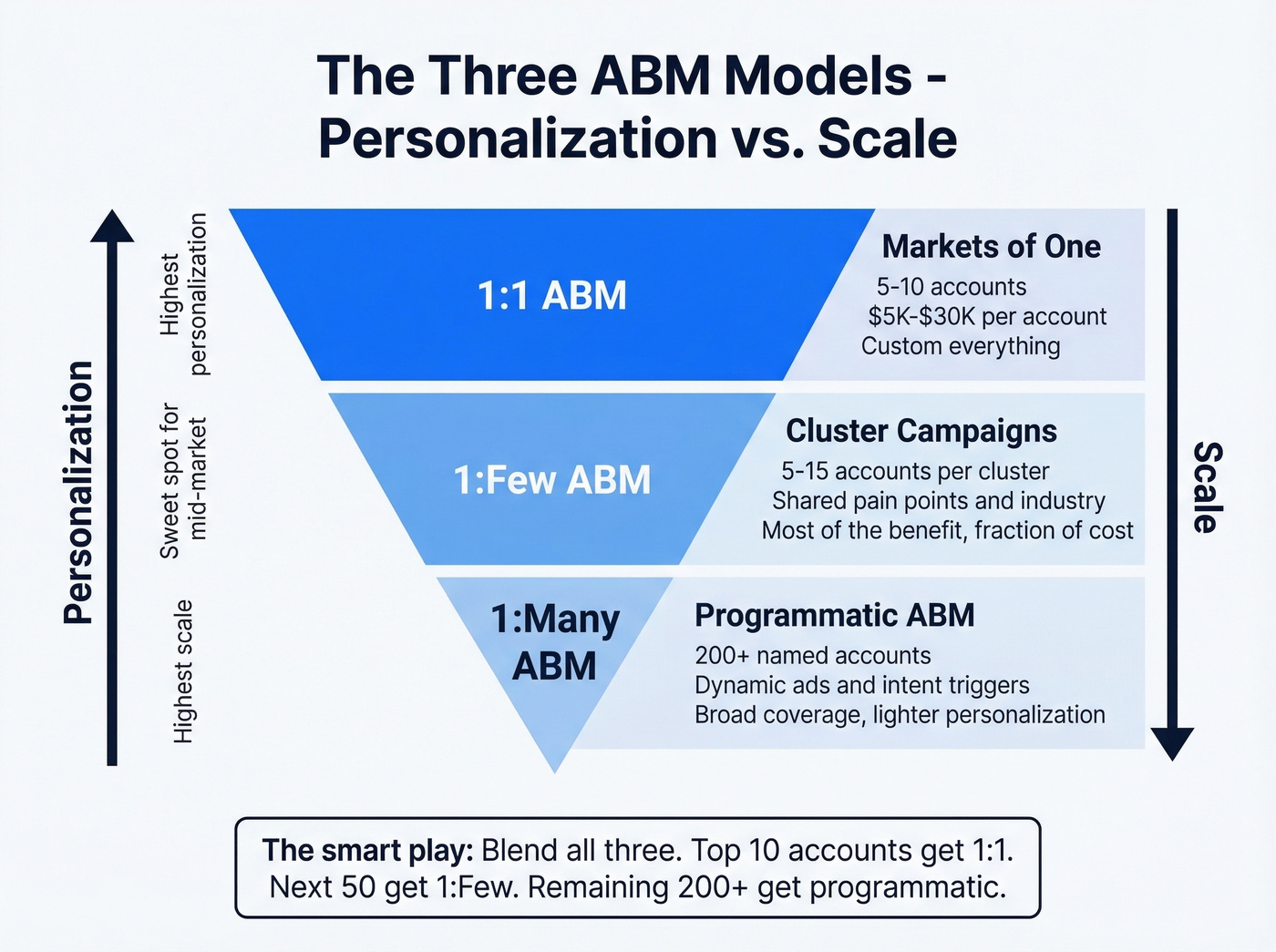
1:Few ABM - Cluster Campaigns. You group 5-15 accounts that share similar characteristics - same industry, same pain points, same tech stack - and build campaigns for the cluster. You get most of the personalization benefit at a fraction of the 1:1 cost. This is the sweet spot for most mid-market teams.
1:Many ABM - Programmatic ABM. Hundreds of named accounts targeted at scale with lighter personalization. Think dynamic ads, segmented email sequences, and intent-triggered workflows. The personalization is thinner, but the coverage is broad.
The smart play is blending all three. Your top 10 accounts get 1:1 treatment. The next 50 get clustered into 1:few campaigns. The remaining 200+ get programmatic coverage. And remember - B2B purchase decisions involve about seven decision-makers on average. You're not targeting accounts; you're targeting buying groups within accounts.
What the Deliverables Include
Whether you're buying a platform, hiring an agency, or building in-house, a complete ABM program covers these deliverables:
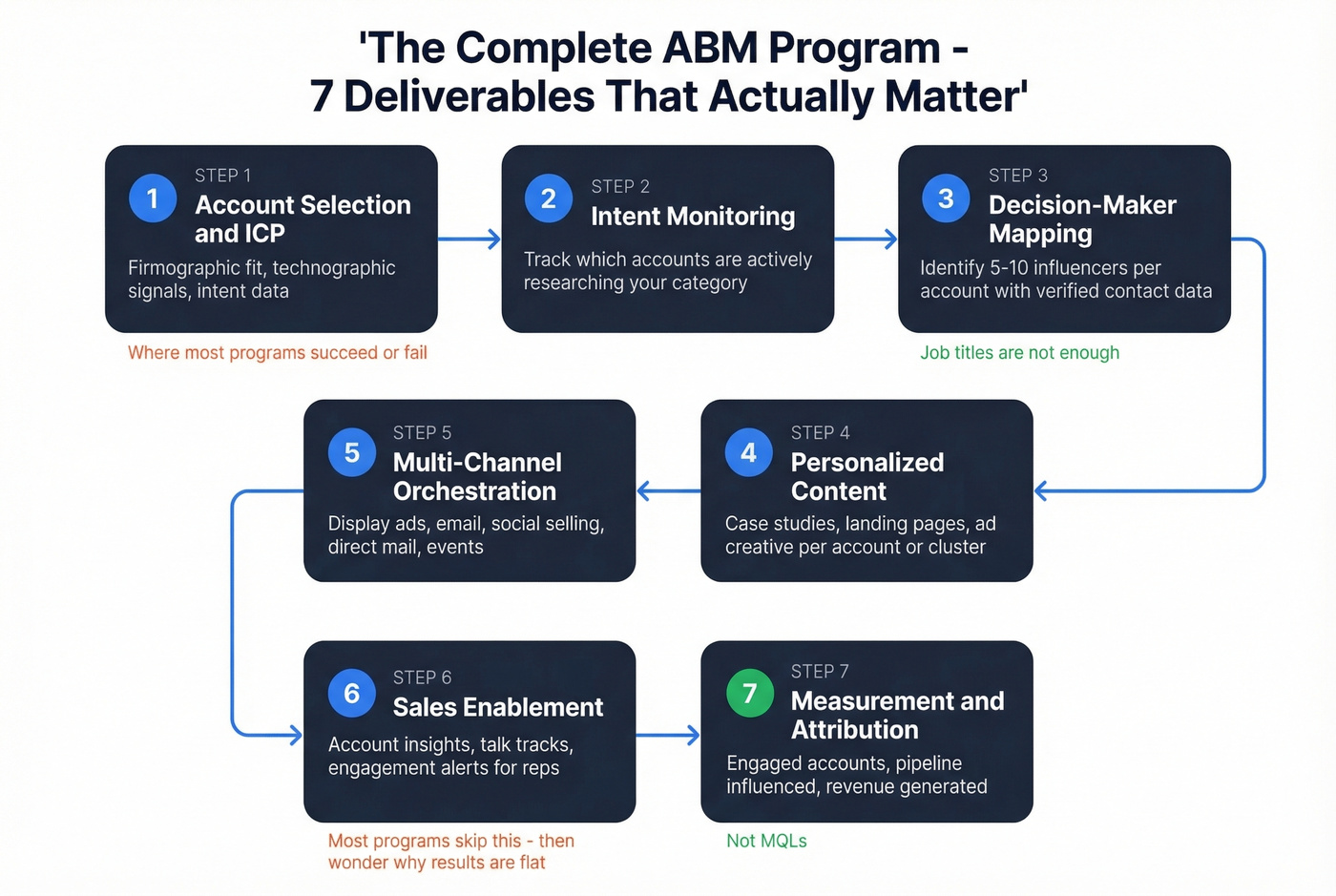
Account selection and ICP definition - identifying which accounts to target based on firmographic fit, technographic signals, and intent data. This is where most programs succeed or fail. (If you need a starting point, use an ideal customer profile template and scoring rubric.)
Intent data and signal monitoring - tracking which accounts are actively researching topics related to your solution. Bombora, 6sense, and Demandbase all offer this.
Decision-maker mapping - identifying the 5-10 people in each account who influence the purchase. Job titles aren't enough; you need verified contact data.
Personalized content creation - case studies, landing pages, and ad creative tailored to specific accounts or clusters.
Multi-channel orchestration - coordinated outreach across display ads, email sequences, social selling, direct mail, and events.
Sales enablement and alignment - giving reps account-specific insights, talk tracks, and engagement alerts. Most programs skip this piece and then wonder why results are flat.
Measurement and attribution - shifting from MQL-based metrics to account-centric KPIs like engaged accounts, pipeline influenced, and revenue generated.
A solid agency pilot should deliver a prioritized list of 50-150 accounts, decision-maker mapping, 2-3 messages per persona, 2 personalized proof assets, multi-channel orchestration, and a CRM-connected pipeline dashboard - all within 6-8 weeks.
ABM Platforms vs. Agencies
The platform-vs-agency question comes down to capability and bandwidth.
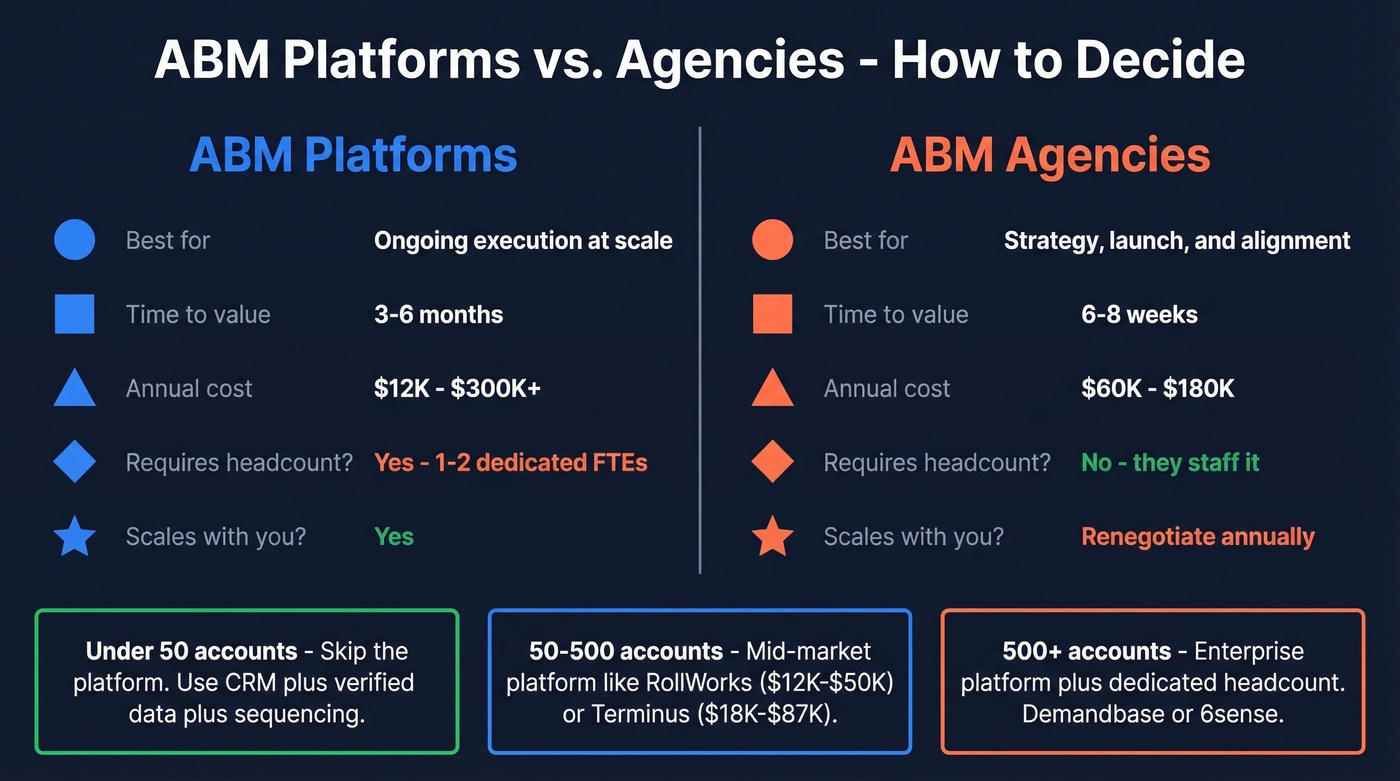
| Factor | Platform | Agency |
|---|---|---|
| Best for | Ongoing execution | Strategy + launch |
| Time to value | 3-6 months | 6-8 weeks |
| Annual cost | $12K-$300K+ | $60K-$180K |
| Requires headcount | Yes (1-2 FTEs) | No (they staff it) |
| Scales with you | Yes | Renegotiate annually |
Fewer than 50 accounts? You don't need a platform. A clean CRM, verified contact data, and a sequencing tool will get you there. The platform adds scale, not strategy.
Between 50 and 500 accounts? A mid-market platform like RollWorks ($12K-$50K/year) or Terminus ($18K-$87K/year) starts to make sense. The automation handles what a human can't do manually at that volume.
Above 500 accounts? You're in enterprise territory. Demandbase or 6sense become the logical choices - but you need dedicated headcount to operate them. We've seen teams buy 6sense, get excited about the intent data, and then realize nobody has the bandwidth to act on the signals. That's an expensive dashboard.
Agencies are worth it for the first 6 months. They bring methodology, playbooks, and the sales alignment conversations that internal teams struggle with. After that initial period, bring the execution in-house and keep the agency on a lighter advisory retainer.

Your ABM program targets buying groups - but you need verified emails to reach them. Prospeo gives you 98% accurate emails and 125M+ verified mobile numbers for decision-makers at your target accounts, refreshed every 7 days. At $0.01 per email, your entire ABM contact data layer costs less than one month of most platforms.
Stop paying platform prices for contact data that bounces.
How Much Do ABM Services Cost?
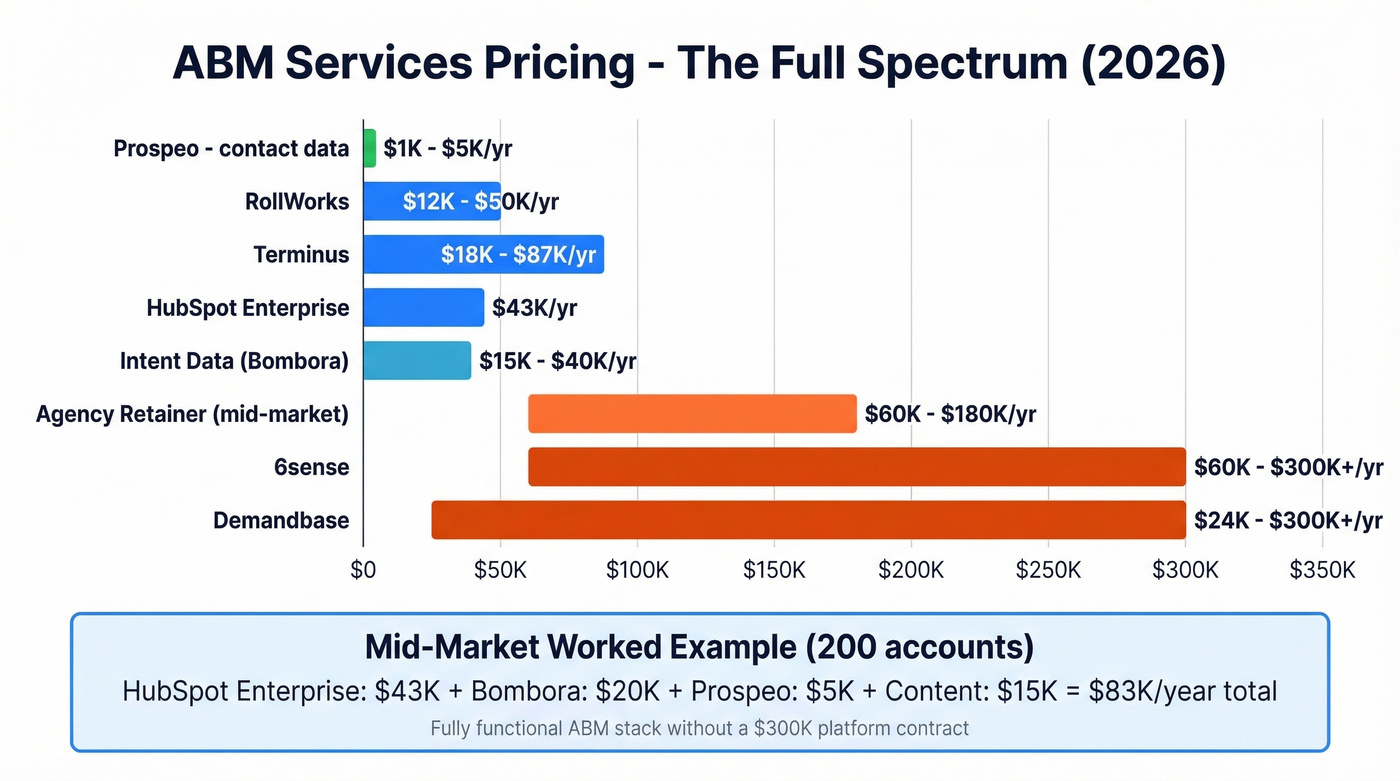
Let's talk real numbers. The fact that 6sense and Demandbase won't publish pricing is frustrating - expect three demos and two discovery calls before you see a number. Here's what the market actually looks like:
Enterprise Platforms
| Provider | Annual Cost |
|---|---|
| Demandbase | $24K-$300K+/yr |
| 6sense | $60K-$300K+/yr |
Mid-Market Platforms
| Provider | Annual Cost |
|---|---|
| Terminus | $18K-$87K/yr |
| RollWorks | $12K-$50K/yr |
| HubSpot Enterprise | $43,200/yr |
Agency and Add-On Costs
| Category | Annual Cost |
|---|---|
| Intent data (Bombora / TechTarget) | $15K-$40K/yr |
| Agency - published (WebFX) | $525-$825+/mo mgmt + $850-$5K+/mo ad spend |
| Agency - mid-market retainer | $5K-$15K/mo |
| Agency - enterprise retainer | $15K-$50K+/mo |
| Pilot (6-8 weeks) | $20K-$45K total |
| 1:1 campaign per account | $5K-$30K |
At the top end, enterprise ABM budgets can exceed $1M annually - and some organizations spend $5M+ when you include headcount, technology, and media. Forrester pegs the average ABM budget (excluding headcount) at $350K, with $200K for a pilot and $600K for a mature program. Those are enterprise numbers. Most mid-market teams can run a meaningful program for far less.
Worked example for a mid-market team (200 target accounts):
- HubSpot Marketing Hub Enterprise: $43,200/year
- Bombora intent data: ~$20,000/year
- Prospeo for verified contact data and enrichment: ~$5,000/year
- Content creation (freelance + design): ~$15,000/year
- Total: ~$83,000/year
That's a fully functional ABM stack without a $300K platform contract. A common practitioner take - one we've heard echoed across Reddit threads and Slack communities - is that expensive tools become "expensive reminders to sell to your ICP." The platform isn't the strategy. The strategy is the strategy.
Here's the thing: if your average contract value is under $25K, you probably don't need a dedicated ABM platform at all. A CRM with good contact data and disciplined outreach will get you 80% of the results at 10% of the cost. Save the six-figure platform spend for when you're closing six-figure deals.
Top Platforms and Agencies in 2026
Leading ABM Platforms
Demandbase is the enterprise leader and the platform most often compared to 6sense. It covers account identification, intent data, advertising, and sales intelligence in one suite. Pricing runs $24K-$300K+ depending on modules and account volume. If you're running ABM across 500+ accounts with a dedicated team, Demandbase is the default choice.

6sense has the best intent data engine in the category, with a 4.3/5 rating on G2 across 1,317 reviews. The "Revenue AI" positioning is compelling, but the learning curve is steep - that's the most consistent complaint from users. Budget $60K-$300K+/year. Worth it if you have the team to operate it; a waste if you don't.
Terminus (DemandScience) sits in the mid-market sweet spot at $18K-$87K/year. It's particularly strong on display advertising and account-level engagement tracking. Less overwhelming than 6sense, more capable than RollWorks. A solid middle ground.
RollWorks is the most accessible entry point at $12K-$50K/year. It started as AdRoll's B2B arm and has grown into a legitimate ABM platform. Best for teams running their first programmatic campaigns who don't want to commit to enterprise pricing.
HubSpot Marketing Hub Enterprise bundles ABM tools - target account lists, company scoring, account-level reporting - into its $43,200/year plan. With a 4.4/5 rating on G2 across 14,556 reviews, it's the most widely adopted marketing platform on this list. If you're already on HubSpot, this is the path of least resistance. The ABM features aren't as deep as Demandbase or 6sense, but the native integration with your existing CRM and marketing automation is the real selling point.
Madison Logic focuses on enterprise display advertising and content syndication, with strong intent data from its own publisher network. It's a good complement to a broader stack rather than a standalone platform. Pricing typically lands in the $30K-$100K+/year range.
Foundry (TechTarget Priority Engine) combines intent data with content syndication at scale. If your strategy leans heavily on content-driven engagement rather than outbound, Foundry is worth evaluating. Expect $25K-$75K/year depending on scope.
Choosing an ABM Agency
Directive is a strong option for B2B SaaS teams that want ABM tied to measurable pipeline impact, not just awareness.
WebFX is the only agency on this list with published pricing - $525-$825+/month for management fees plus $850-$5K+/month in ad spend. That transparency alone makes them worth a conversation if you want to test agency-led account-based marketing without committing to a $10K/month retainer. They're better suited for mid-market companies than enterprise.
MOI Global and Transmission are both well-known picks for enterprise programs.
The remaining agencies worth evaluating: The ABM Agency is a pure-play specialist with deep methodology. RevvGrowth works well for Series B-C companies launching their first ABM motion. Ironpaper is a mid-market B2B generalist with solid capabilities - less specialized but more flexible. Inverta focuses on strategy and enablement, helping you build the internal capability to run ABM yourself rather than running campaigns for you. When selecting a firm, prioritize those that can demonstrate measurable pipeline impact from previous engagements rather than just impressions or engagement scores.
Skip agencies that won't share case studies with pipeline numbers. Engagement metrics alone don't pay the bills.
The Data Quality Foundation
We've seen this play out dozens of times. You launch your first ABM campaign. Intent data looks great. Personalized ads run for three weeks. Then your SDRs report 30% of emails bounced and half the phone numbers were dead.
The industry has a dirty secret - many programs struggle because of bad contact data, not bad strategy. Poor data integration leads to 30-40% lower account match rates. You can have the best intent signals in the world, but if you can't actually reach the decision-makers at those accounts, you're running an expensive brand awareness campaign. The consensus on r/sales echoes this: data quality and sales-marketing misalignment are the two most common reasons programs stall.
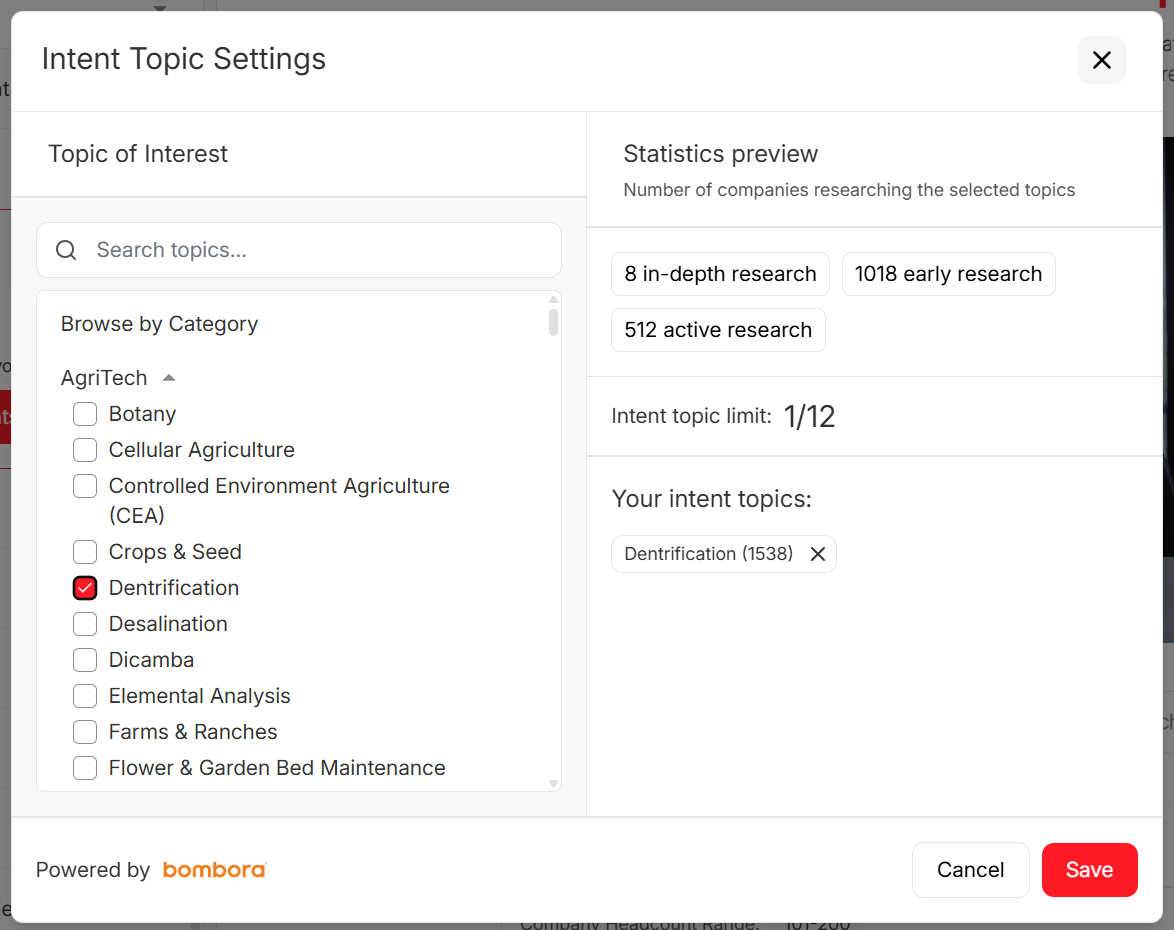
This is where contact data infrastructure matters. Prospeo's 300M+ professional profiles, 98% email accuracy, and 125M+ verified mobile numbers make it the enrichment layer that ensures campaigns actually reach people. A 7-day data refresh cycle means you're not emailing someone who changed jobs six weeks ago, and 30+ search filters - buyer intent, technographics, job changes, headcount growth - let you map entire buying groups at target accounts. Native integrations with Salesforce and HubSpot mean enriched contacts flow directly into your ABM workflows.
The Snyk case study makes the point clearly: their team of 50 AEs went from a 35-40% bounce rate to under 5%, and AE-sourced pipeline jumped 180%. At roughly $0.01 per email versus $60K+ for an enterprise platform, the ROI math on contact data is hard to argue with. (If you're evaluating vendors, compare data enrichment services and how they handle verification.)
Why ABM Programs Fail
Targeting the wrong accounts. This happens when marketing builds the target account list without sales input, or when the list balloons to 2,000 accounts because nobody wants to say no. More accounts means thinner personalization, which defeats the entire purpose. Start with 50-150 accounts that sales actually wants to work. If you need to scale list-building, learn how to automate target account lists without bloating your ICP.
Sales and marketing misalignment. Let's be honest: if your sales and marketing teams aren't meeting weekly to review account engagement and coordinate outreach, you don't have an ABM program. You have a marketing campaign that sales ignores. Alignment isn't a Slack channel - it's shared KPIs, a leadership mandate, and a sales SLA that says "respond to engaged accounts within 24-48 hours." What does alignment look like on a Tuesday morning? An SDR pinging marketing to say "this account just hit our pricing page three times - can we accelerate the direct mail piece?" (This is also where marketing enablement makes the handoff operational.)
Lead-first thinking instead of buying-group focus. If you're still measuring success by MQLs, you're doing it wrong. ABM is about engaging buying groups within accounts, not generating individual leads. Forrester data points to a 200% increase in win rates and an 800% increase in opportunity progression when teams shift from MQLs to buying groups and opportunities. That's not a marginal improvement - it's a fundamentally different outcome.
How to Run an ABM Pilot
A pilot should take 6-8 weeks and prove the model before you commit to a full program.
Deliverables:
- Prioritized list of 50-150 target accounts (sales-approved)
- Decision-maker mapping (5-10 contacts per account, verified)
- 2-3 personalized messages per persona
- 2 personalized proof assets (case studies, one-pagers)
- Multi-channel orchestration (email + ads + social minimum)
- CRM-connected pipeline dashboard
Budget breakdown:
- Media spend: $8K-$20K
- Agency fees (if using one): $8K-$15K
- Content creation: $3K-$8K
- Total pilot: $19K-$43K
Minimum stack: A clean CRM, a sequencing tool (Instantly, Lemlist, or Smartlead), an enrichment tool for verified contacts, and optionally an intent data source. That's it. You don't need a $60K platform to prove ABM works for your business. If you're building the outbound motion alongside ABM, borrow a few sales prospecting techniques that still work at scale.
Set a sales SLA from day one: engaged accounts get a response within 24-48 hours. And set expectations with leadership - 3-6 months to significant impact. For teams under 500 accounts, modular stacks are often faster and cheaper to operationalize than monolithic platforms. The pilot proves the model; the first two quarters build the pipeline.
ABM Trends in 2026
AI is reshaping execution, not strategy. A survey of 771 marketers found 78.7% now incorporate AI into their ABM programs - primarily for personalization at scale, predictive account scoring, and dynamic content generation. The tools are getting smarter, but the strategy still requires human judgment.
Budgets are going up. Nearly half (49.7%) of marketers plan to increase ABM budgets in 2026. Programs that can show pipeline influence and revenue attribution are getting funded; programs that report on impressions and engagement scores are getting cut.
Modular stacks are replacing all-in-one platforms. Mid-market teams are increasingly building CRM + enrichment + sequencing + optional intent data rather than buying $60K+ monolithic platforms. The best-of-breed approach gives you flexibility, lower switching costs, and often better data quality at each layer. In our experience, this is where the market is heading fastest.
FAQ
What's the difference between ABM platforms and ABM agencies?
Platforms are software - Demandbase, 6sense, RollWorks - that automate account targeting, intent monitoring, and ad orchestration. Agencies build your strategy, create content, run campaigns, and align sales with marketing. Most mid-market teams start with an agency to build the playbook, then layer in a platform as they scale.
How long does it take to see ROI from ABM services?
Most organizations see significant program impact within 3-6 months. Pilots typically run 6-8 weeks to prove the model. Forrester data shows ABM programs deliver 21-50% higher ROI than non-ABM approaches, but the first quarter is usually about building infrastructure and alignment rather than closing deals.
Can small teams run ABM without an expensive platform?
Yes. A clean CRM, verified contact data, and a sequencing tool like Instantly or Lemlist give you a functional stack for under $10K/year. The platform adds scale and automation - not strategy. Start with 50 accounts, prove the model, then decide if you need more technology.
What's the difference between ABM and demand gen?
Demand gen casts a wide net to generate interest across your total addressable market. ABM flips that - you start with a defined list of target accounts and focus resources on engaging the buying groups within them. The best programs run both: demand gen fills the top of funnel broadly, while ABM concentrates high-touch effort on accounts most likely to close.
How many accounts should an ABM program target?
For 1:1 programs, target 5-25 accounts with deep personalization. 1:few clusters group 5-15 similar accounts per campaign. 1:many can target hundreds with lighter-touch programmatic outreach. Most pilots start with 50-150 accounts to prove the model before scaling - anything above 200 in a pilot dilutes personalization.
Decision-maker mapping is where ABM programs succeed or fail. Prospeo's 30+ search filters - including intent data across 15,000 topics, technographics, and headcount growth - let you identify and verify the 5-10 buyers in every target account. Teams using Prospeo book 26% more meetings than ZoomInfo users.
Map every buying group member with verified contact data in minutes.