

How to Accelerate Deals Without Discounting Your Way to a Close
Your biggest deal just went dark. The champion stopped responding, the CFO pushed the decision to next quarter, and your forecast is suddenly fiction. You're not alone - 84% of sales reps are missing quota, and sales cycles have lengthened 32% since 2021. Discounting won't fix this. Understanding the specific strategies that compress timelines without torching your margins will.
The Deal Velocity Formula
Deal velocity measures how much pipeline revenue you generate per day:
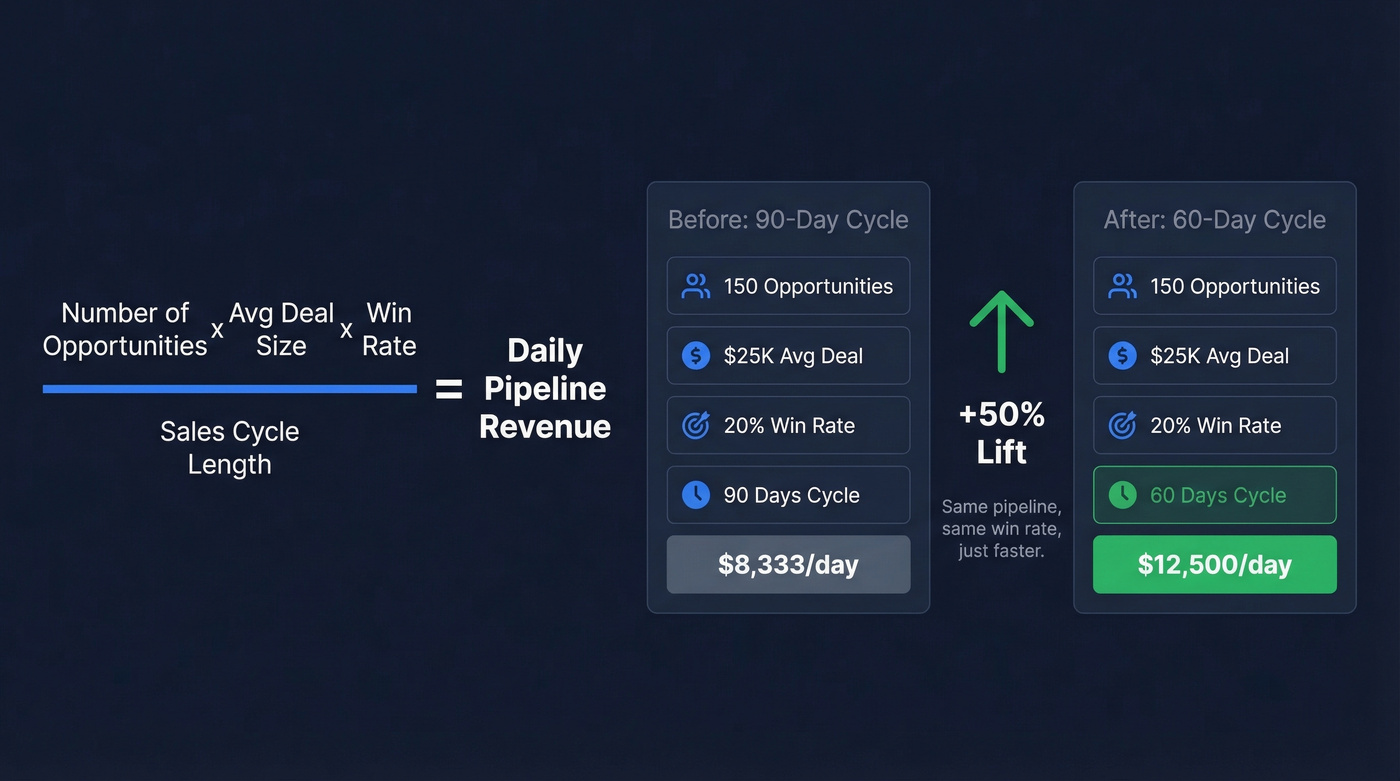
(Number of Opportunities x Average Deal Size x Win Rate) / Sales Cycle Length
A SaaS team with 150 opportunities, a $25K average deal, a 20% win rate, and a 90-day cycle generates $8,333 per day. Shorten that cycle to 60 days and you're at $12,500 - a 50% lift without closing a single extra deal. Companies running modern sales models grow 17-21% faster than competitors still using traditional playbooks.
| Segment | Avg Days to Close |
|---|---|
| B2B SaaS | 84-102 |
| Enterprise | 120-270 |
| Mid-market | 60-90 |
| Self-serve | 14-30 |
The trap is optimizing only one variable. Discounting shortens cycle length but crushes deal size. The real wins come from improving multiple levers at once.
Why Deals Stall
40-60% of B2B deals are lost to "no decision" - not to a competitor. Deals don't die in a dramatic loss. They fade out because nobody forced a decision. Five blockers show up over and over:
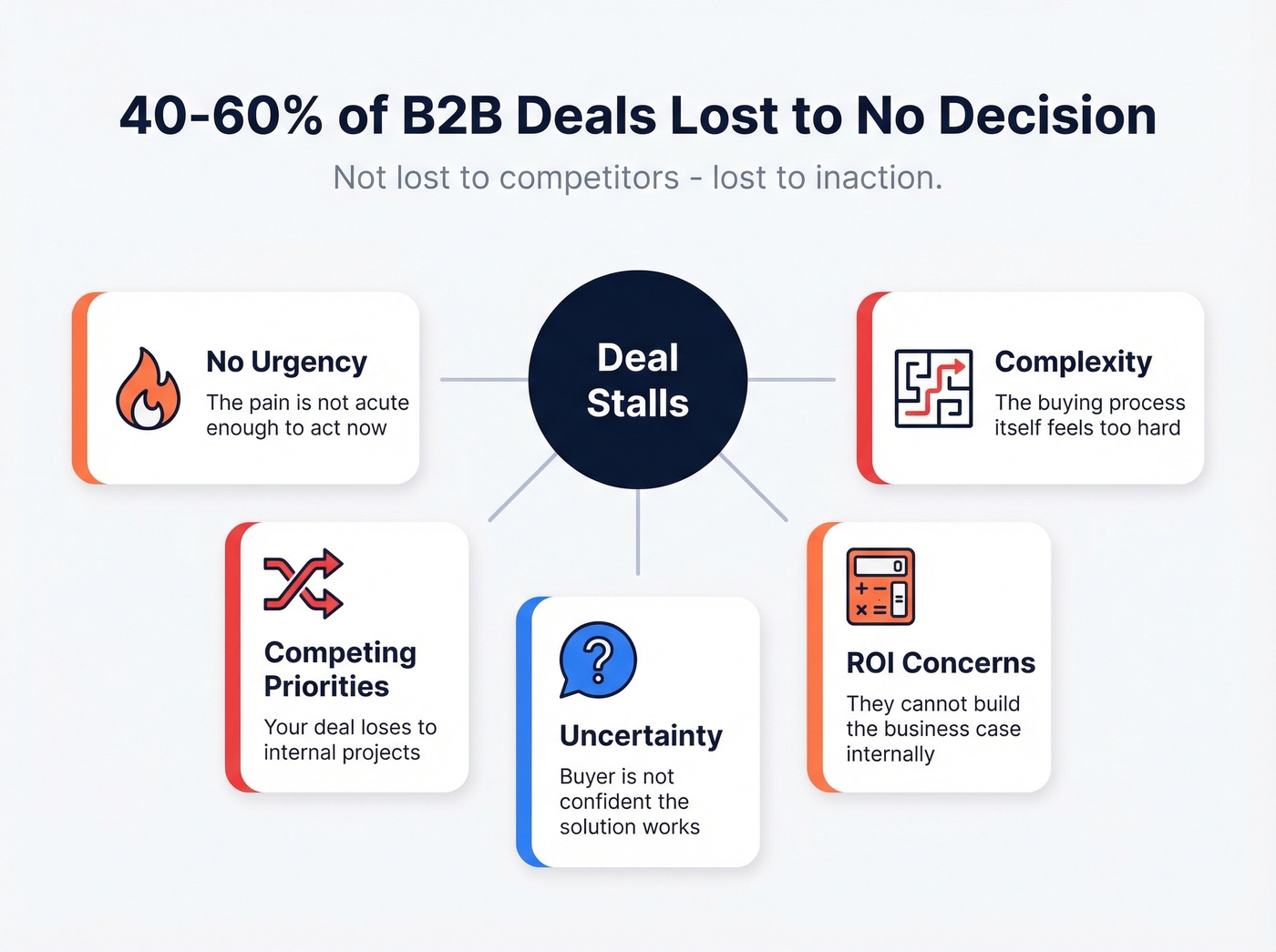
- No urgency - the pain isn't acute enough to act now
- Competing priorities - your deal loses to internal projects
- Uncertainty - the buyer isn't confident the solution will work
- ROI concerns - they can't build the business case internally
- Complexity - the buying process itself feels too hard
If you can diagnose which blocker is killing your deal, you can intervene. Most reps never bother to ask.

Multi-threading 8-13 stakeholders only works if you can actually reach them. Prospeo gives you 98% accurate emails and 125M+ verified mobile numbers - refreshed every 7 days, not every 6 weeks. Teams using Prospeo book 26% more meetings than ZoomInfo users.
Stop losing deals to stale data. Start reaching the full buying committee.
Five Levers That Actually Shorten Sales Cycles
Tighter Discovery and Qualification
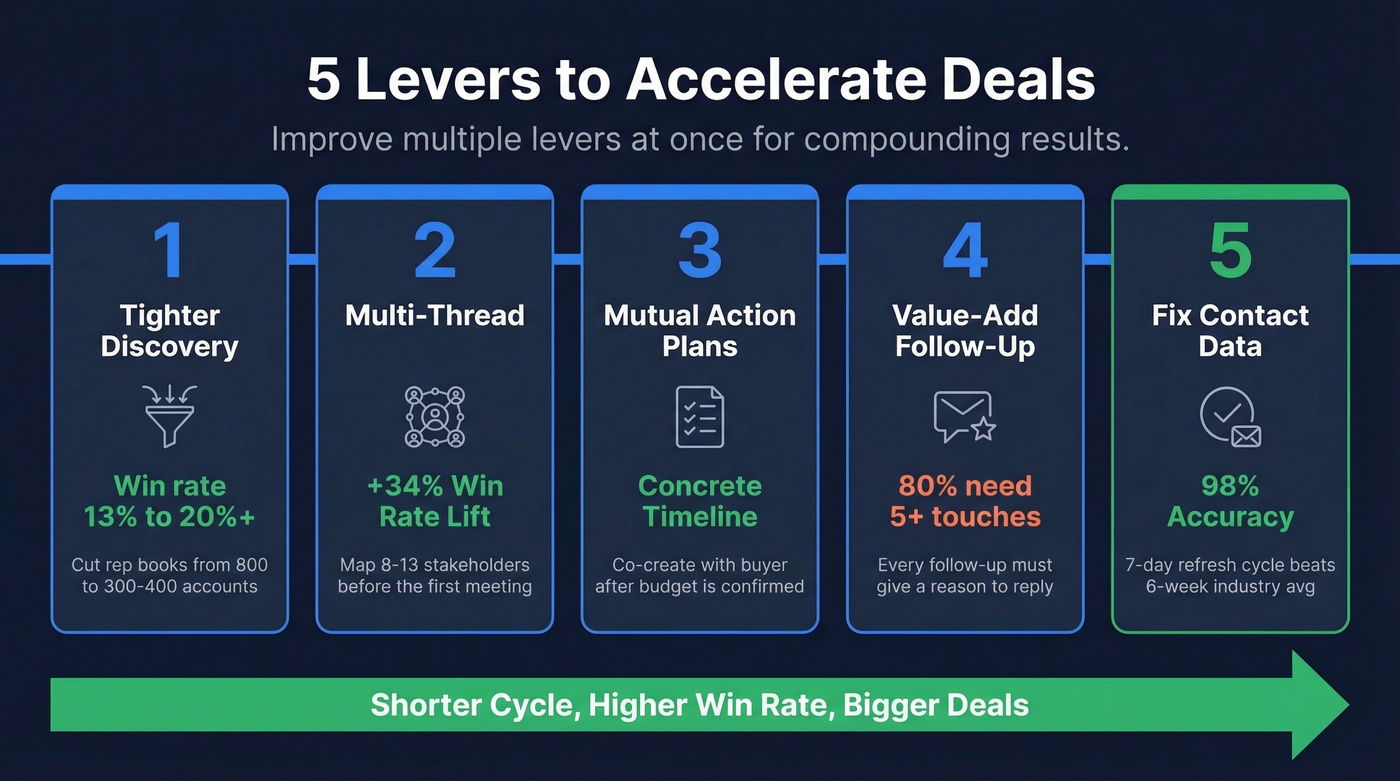
Reps spend roughly two hours per day actually selling. The rest goes to admin, internal meetings, and working accounts that were never going to close. We've seen this pattern repeatedly: trimming rep books from 800+ accounts down to 300-400 pushed win rates from 13% to over 20% in under a year. Fewer accounts means deeper discovery, which means fewer deals stalling mid-funnel.
If you want a tighter qualification framework, start with discovery that forces clarity on pain, timeline, and decision process.
This is the simplest way to speed up your pipeline - stop working the ones that were never real.
Multi-Thread Every Serious Opportunity
The average B2B deal now involves 8-13 stakeholders. Single-threading - relying on one champion to sell internally - is how deals die in committee. Ask any AE who's closed enterprise: single-threaded opportunities are where pipelines go to rot. Multi-threading lifts win rates by roughly 34%.
Here's the thing: you need to map the hierarchy of influence before your first meeting, not after your champion goes quiet. Identify who controls budget, who validates technically, and who has political veto power. Keep outreach 1:1 - no group blasts. The consensus on r/sales is pretty clear on this: the reps who multi-thread early close faster and more predictably than those who scramble to find the economic buyer at the eleventh hour.
If you're selling into complex orgs, it helps to separate the technical buyer vs economic buyer early.
Use Mutual Action Plans
A mutual action plan is a shared document mapping the path from "interested" to "signed." It's co-created with the buyer - not your internal sales process projected onto them. We've found that introducing the MAP too early, before budget is confirmed, actually slows things down. Wait until you've validated shared objectives and budget authority.
Every MAP needs five elements: deal details with a target go-live date, business objectives and success criteria, named stakeholders and decision-makers, milestones with owners and deadlines, and resources like security docs and procurement requirements. The MAP turns "we'll get back to you" into a concrete timeline with accountability on both sides. It's one of the most reliable deal acceleration workflows you can implement, and it costs nothing but discipline.
Follow Up Like You Mean It
80% of sales require at least five follow-ups, yet nearly half of reps quit after one touch.
Every follow-up should add value: a relevant case study, a stakeholder introduction, a competitive insight. "Just checking in" emails don't compress timelines - they signal that you have nothing new to offer. If your follow-up doesn't give the buyer a reason to reply, don't send it.
To make this repeatable, keep a set of follow-ups your team can personalize fast.
Fix Your Contact Data
Multi-threading requires reaching 8-13 people. If 20% of your contact data is stale - and it probably is - two or three of those stakeholders are unreachable. Your multi-threading strategy hits a wall before it starts.
Prospeo solves this at the data layer. With 98% email accuracy and a 7-day refresh cycle versus the six-week industry average, your outreach actually lands. Teams using Prospeo book 26% more meetings compared to ZoomInfo and 35% more compared to Apollo. The free tier gives you 75 verified emails plus 100 Chrome extension credits per month - enough to test whether stale contacts are your bottleneck.
If you're evaluating vendors, compare data enrichment services and how they handle refresh + verification.

Your deal velocity formula has a hidden variable: data quality. When 20% of your contacts bounce, your cycle length balloons and win rates crater. Prospeo's 7-day refresh cycle and 5-step verification eliminate the dead contacts that silently kill your pipeline - at $0.01 per email.
Fix the data layer and watch your sales cycle compress.
Mistakes That Slow Deals Down
In our experience, the deals that drag longest share the same patterns. Reps talk more than they listen - if you're over 60% talk time in discovery, you're pitching, not qualifying. They fail to disqualify early, wasting eight weeks on a deal that should've been cut in week one. They pitch the person who loves the demo instead of the person who signs the contract.
If your team needs a cleaner process, tighten your sales process before adding more tools.
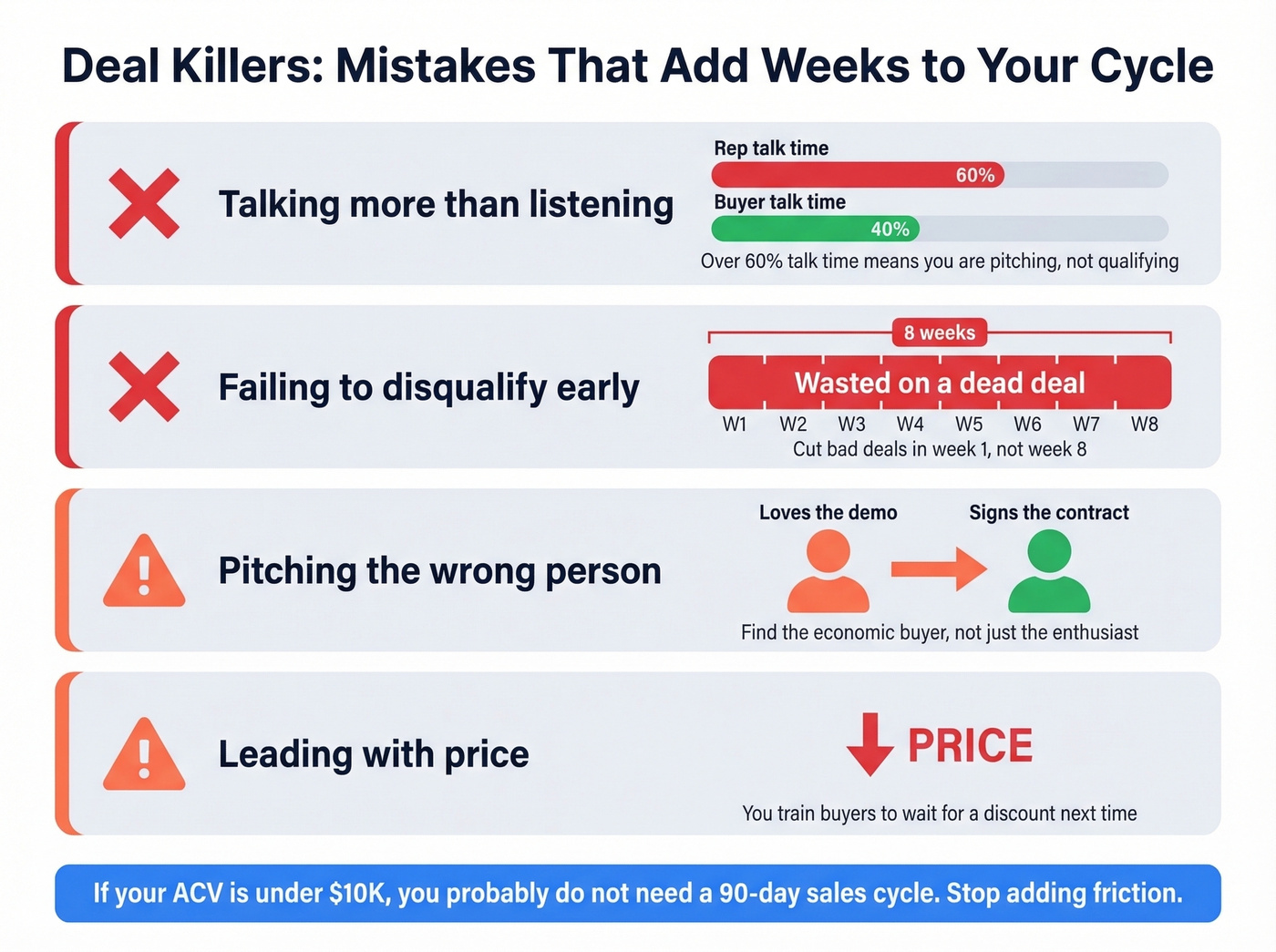
And they lead with price, training buyers to wait for a better offer next time.
Let's be honest: if your average contract value is under $10K, you probably don't need a 90-day sales cycle. The problem isn't that enterprise sales processes are slow - it's that teams apply enterprise processes to deals that should close in two calls. Skip the seven-stage pipeline for a $6K deal. You're just adding friction.
Deal Acceleration Tools Worth Considering
Pick one tool per category and use it well. That matters more than stacking a dozen platforms.
| Category | What It Does | Example | Typical Cost |
|---|---|---|---|
| CRM & Pipeline | System of record | Salesforce, HubSpot | $25-300/seat/mo |
| Sales Engagement | Sequence & follow-up | Outreach, Salesloft | $75-150/seat/mo |
| Prospecting & Data | Verified contacts | Prospeo (98% accuracy, free tier) | Free-~$0.01/email |
| Demo Automation | Buyer enablement | Consensus, Navattic | $50-200/seat/mo |
| Conversation Intel | Call analysis | Gong, Chorus | $100-200/seat/mo |
| Forecasting | Pipeline analytics | Clari, BoostUp | $80-150/seat/mo |
The sales acceleration market hit $124.4B in 2024 and there's no shortage of vendors. But the highest-leverage investment is almost always data quality - every other tool in this stack depends on reaching the right person at the right time. Some teams also run live product workshops or virtual events to compress evaluation timelines, though these work best for mid-market and enterprise segments where multiple stakeholders need to align quickly.
If you're building a modern stack, start with the SDR tools that support multi-threading and clean handoffs, then audit your pipeline health so you know where deals actually stall.
FAQ
What is deal velocity?
Deal velocity is daily pipeline revenue: (Opportunities x Deal Size x Win Rate) / Sales Cycle Length. A higher number means you generate revenue faster without necessarily closing more deals - you can improve it by shortening cycle time, raising win rates, or both.
How long is the average B2B sales cycle?
B2B SaaS deals typically close in 84-102 days. Enterprise cycles run 120-270 days, while mid-market falls in the 60-90 day range. Self-serve motions can close in 14-30 days.
What's the fastest way to accelerate deals above $25K?
Multi-thread every opportunity, co-create a mutual action plan with your buyer, and verify every contact email before outreach so follow-ups land instead of bouncing. Stale data is one of the most common - and most invisible - reasons enterprise deals stall.