

Account-Based GTM: The Execution-First Guide for 2026
A RevOps lead we know ran a 3-tool bake-off last quarter. The "best" platform created 4,000 duplicate contacts in Salesforce in five days. The cheapest one had better phone connect rates. Account-based GTM isn't about the fanciest stack - it's about rigorous execution with clean data underneath.
What It Actually Means
Account-based GTM is a company-wide operating model, not a marketing campaign. It coordinates sales, marketing, CS, product, and operations across the full customer lifecycle - acquisition through retention, expansion, and advocacy. You've probably heard "account-based go-to-market strategy" used interchangeably with ABM. The distinction matters: ABM is a subset focused on top-of-funnel engagement, while the full model encompasses the entire revenue engine.
Three things hold it together. First, precision targeting using firmographics, technographics, intent signals, and predictive scoring with dynamic reprioritization. Second, cross-functional coordination so campaigns, outreach, and CS motions reinforce the same account plan. Third, account-level measurement that tracks buying committee coverage, pipeline velocity, and expansion revenue instead of lead counts.
Product usage data can surface expansion opportunities months before CS outreach catches them. That's why this has to be a company-wide operating model, not a marketing project.
The numbers back this up. Top B2B marketers running account-based programs report 81% higher ROI across 300+ marketers surveyed by Demandbase. Gartner's Digital Markets research cites a 14% lift in pipeline conversion, a 28% increase in overall account engagement, and a 25% rise in MQL-to-SAL conversion when account-level measurement replaces lead counting.
| Dimension | Traditional ABM | Account-Based GTM |
|---|---|---|
| Ownership | Marketing-led | Cross-functional |
| Scope | Top-of-funnel engagement | Full lifecycle |
| Core metric | MQLs, engagement score | Account velocity, win rate |
| Post-sale | Ends at closed-won | Retention + expansion |
| Team model | Marketing runs campaigns | Pods share KPIs |
ABM is a tactic. The account-based go-to-market model is how you run the business. Most "ABM failures" aren't ABM failures at all - they're coordination failures where marketing ran ads and sales ignored the target list.
Why It Matters in 2026
The execution gap is widening. Forrester's CX Index fell to a new low - 1 in 4 brands declined, only 7% improved, and decliners dropped around 4 points on a 100-point scale. Meanwhile, 51% of CSOs say pipeline creation is their top lever, and buyers spend half their research time on independent third-party sources before ever talking to sales.
Corporate Visions found that when buyers and sellers align on problem definition early, win rates jump 38%. Yet 83% of sales leaders struggle to adapt to modern buying decisions. The gap between "we know what to do" and "we're actually doing it" is exactly where an account-based strategy lives.
Here's the thing: if your average deal size is under $15K and you have fewer than 200 target accounts, you probably don't need a six-figure ABM platform. You need a clean contact list, a shared Slack channel between your BDR and marketer, and the discipline to run a 4-week sprint. The tooling can come later.
The Modern ABM Framework
The classic 2016 pyramid - 1:1, 1:few, 1:many - is dead. "Programmatic ABM" kept showing up in QBRs without execution or KPIs behind it.
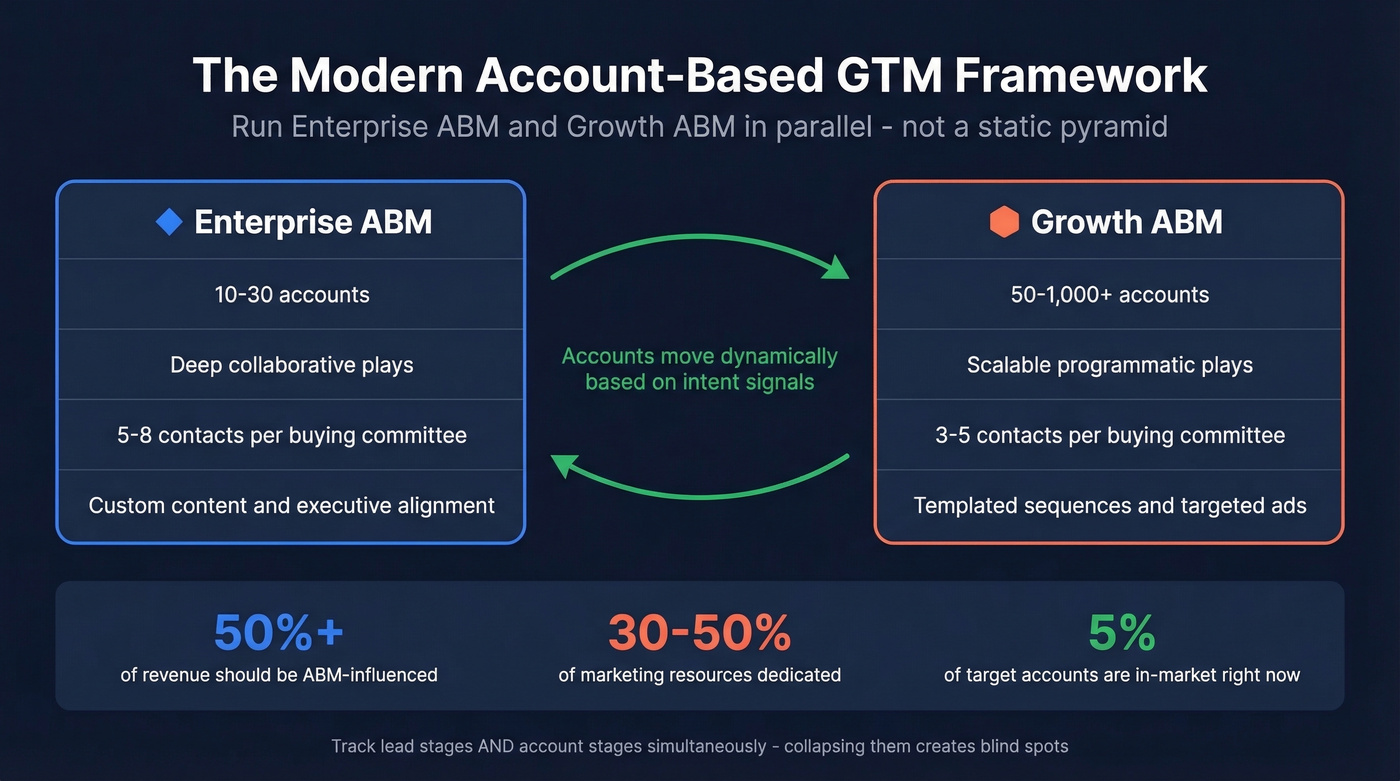
Run Enterprise ABM and Growth ABM in parallel instead. Enterprise ABM covers your highest-priority accounts with deep, collaborative plays. Growth ABM provides a scalable foundation across 50 to thousands of accounts. Accounts move dynamically between tiers based on intent signals and engagement - not static annual planning. Nrich.io's playbook recommends ABM should influence at least 50% of total revenue, with 30-50% of marketing resources dedicated to it. If you're not at those levels, you're running ABM as a side project.
One nuance most teams miss: track both lead stages and account stages simultaneously. An individual contact can be MQL-qualified while the account is still in awareness. Collapsing these into a single funnel creates blind spots. We've seen teams lose deals because CS flagged an expansion signal that sales never saw - dual tracking prevents that.
Crawl, walk, run. Start with 20-30 accounts in a 4-week pod sprint. Expand to 50-100 accounts in quarter two. Scale to full-tier coverage once your pod execution is consistent and your data hygiene is proven.

Your pods need buying committee contacts that are actually current. Prospeo refreshes 300M+ profiles every 7 days - not every 6 weeks - so your account-based plays hit real decision-makers. Intent data across 15,000 Bombora topics is built in, starting at $0.01/email.
Stop feeding your pods stale data. Start with contacts that connect.
Run It With Pods
Pods are cross-functional units - Marketing, BDR, Sales, and CS - sharing a target account list. Marketing owns ICP selection, buying group mapping, and signal monitoring. BDRs validate contacts, run multithreaded outreach, and own meeting generation. Sales confirms decision-makers and leads executive alignment. CS drives retention, expansion, and advocacy post-close.
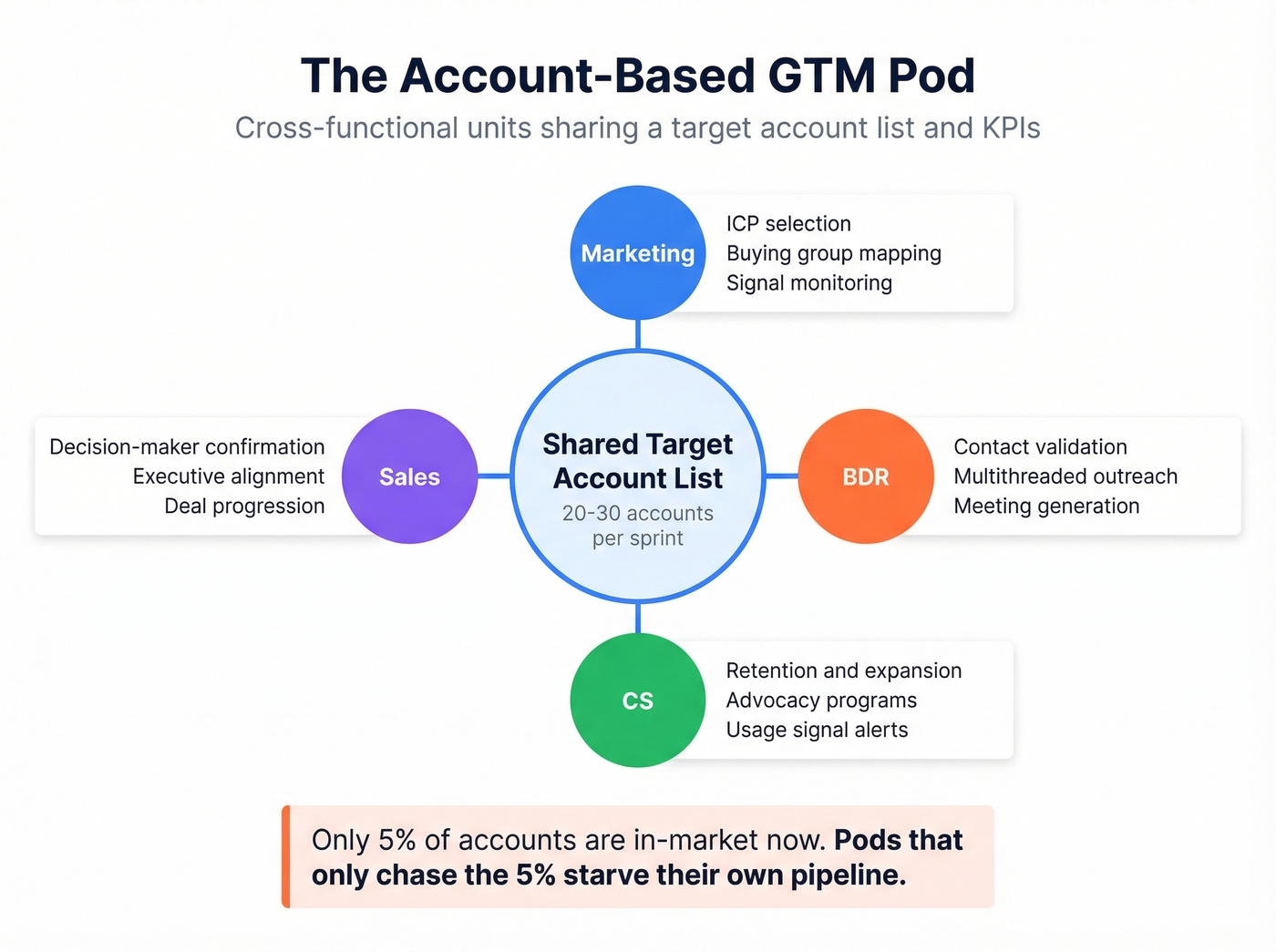
One critical heuristic: roughly 5% of your target accounts are in-market right now. For the other 95%, your job is to create demand through education and awareness. Pods that only chase the 5% starve their own pipeline.
Contact-level intent beats account-level intent. Top teams push data coverage from ~40% to 85% via waterfall enrichment - knowing which individual is researching your category matters far more than knowing the company is.
The Stack That Works
Let's be honest - the consensus on r/sales and r/b2bmarketing is that platforms like 6sense and Demandbase can feel like expensive reminders to sell to your ICP.
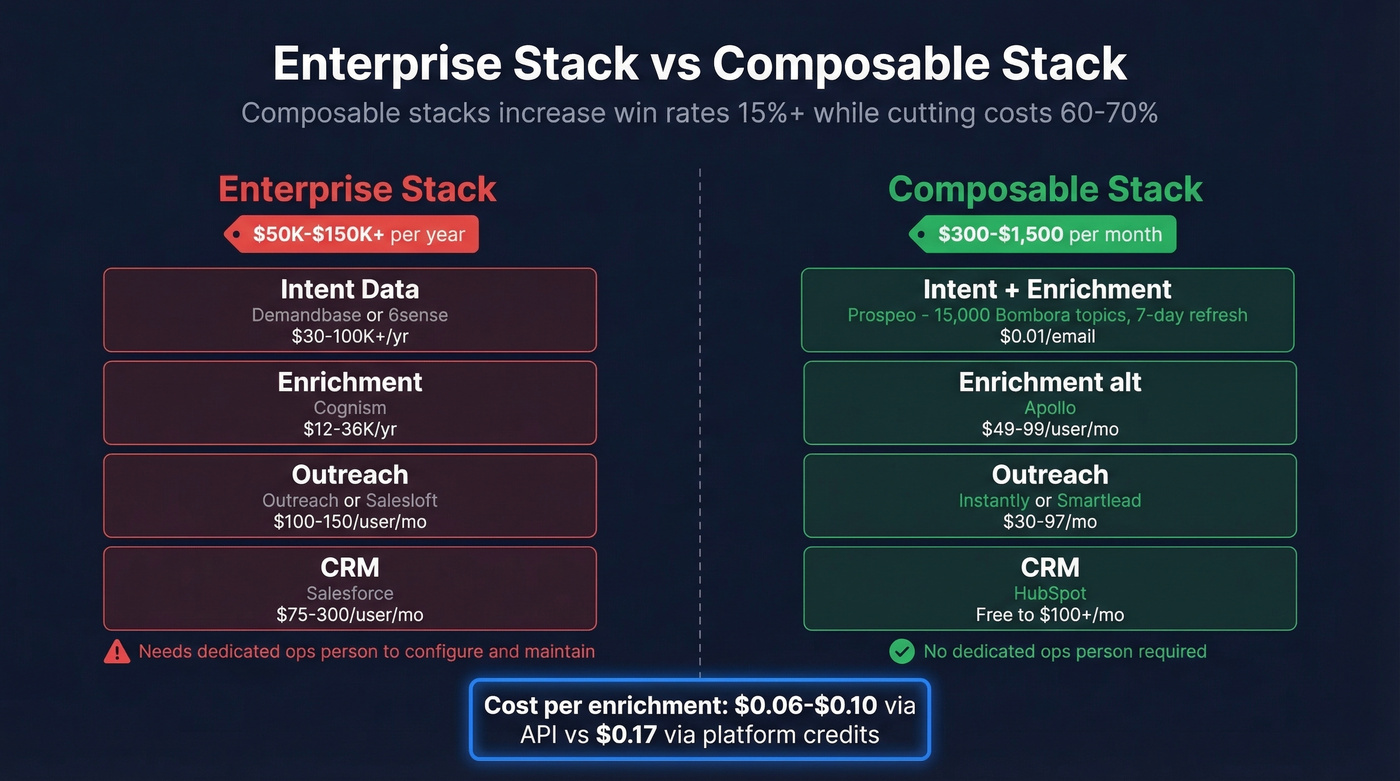
| Layer | Enterprise Pick | Enterprise Cost | Lean Pick | Lean Cost |
|---|---|---|---|---|
| Intent data | Demandbase / 6sense | $30-100K+/yr | Bombora (via enrichment tools) | Varies |
| Data + enrichment (alt) | Cognism | ~$1K-3K/mo | Apollo | ~$49-99/user/mo |
| Outreach | Outreach / Salesloft | $100-150/user/mo | Instantly / Smartlead | $30-97/mo |
| CRM | Salesforce | $75-300/user/mo | HubSpot | Free-$100+/mo |
Prospeo includes intent data across 15,000 topics powered by Bombora, so most teams won't need a separate intent vendor. Its 7-day data refresh cycle keeps buying committee contacts current versus the 4-6 week lag typical of larger platforms. Orchestration lives in your CRM workflows or a tool like Clay, not in a $100K platform.
Composable stacks increase win rates by 15%+ while cutting costs 60-70%. Cost-per-enrichment can land around $0.06-$0.10 per record via direct API versus $0.17 through platform credits. Cognism's internal ABM program drove $700K+ in pipeline using a lean stack with AI-generated landing pages that cut creation time from 3 hours to under 30 minutes.
Composable stack total for a small team: $300-$1,500/month. That covers the data layer, outreach, and CRM basics - versus $50K+ for an enterprise stack your team will use at 30% capacity. Skip the enterprise tier if you don't have a dedicated ops person to configure and maintain it; you'll spend more time fighting the platform than running plays.
Composable stacks win. Prospeo replaces your separate intent vendor and enrichment tool - 15,000 intent topics, 98% email accuracy, 125M+ verified mobiles, and a 92% API match rate. Push contact-level coverage from 40% to 85% without a $100K platform.
Build the lean ABM stack that actually outperforms enterprise tools.
What Good Looks Like
AVEVA's GSK program won Forrester's 2025 B2B Program of the Year award - and the numbers explain why: £7m active pipeline, 46 new relationships, and 2,000 visits to a personalized microsite. This is what happens when enterprise ABM gets full organizational commitment.
The results aren't enterprise-only, though. BlueBotics generated £4m+ in opportunities and £750K+ revenue with a marketing team of one. One marketer, 160 new relationships, 15 sales conversations. Acxiom built £1.5m in pipeline within 120 days entering the automotive vertical from a standing start - landing relationships with AA, McLaren, Nissan, and PSA Groupe. GoodShape engaged 80% of 337 target accounts, producing £1m+ pipeline and 500,000 impressions.
The common thread across all four: disciplined account selection, clean data, and coordinated execution. Not six-figure platforms. Whether you're running a global program across multiple regions or targeting 30 accounts in a single vertical, the fundamentals don't change.
Measuring What Matters
Ditch lead counts. Your scorecard has four metrics.
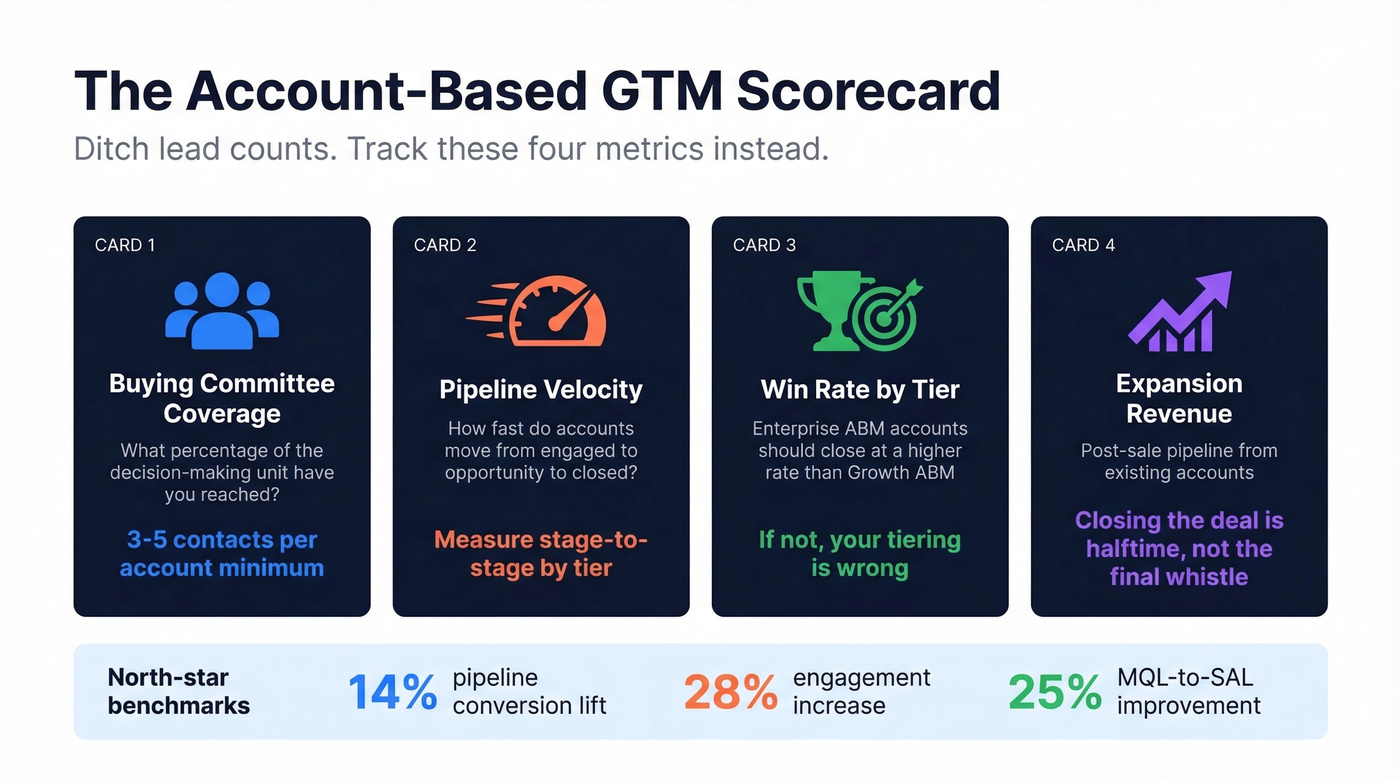
Buying committee coverage tells you what percentage of the decision-making unit you've reached - target 3-5 contacts per account minimum. Pipeline velocity tracks how fast accounts move from engaged to opportunity to closed, measured stage-to-stage by tier. Win rate by tier should show Enterprise ABM accounts closing at a meaningfully higher rate than Growth ABM; if they don't, your tiering is wrong. And expansion revenue - post-sale pipeline from existing accounts - is where the full-lifecycle model proves its value. Closing the deal is halftime, not the final whistle.
Your north-star benchmarks: 14% pipeline conversion lift, 28% engagement increase, 25% MQL-to-SAL improvement. If you're not tracking toward these within two quarters, revisit your account selection and pod execution before blaming the tools. We've found these benchmarks hold whether you're evaluating an account-based go-to-market strategy for the first time or optimizing one that's been running for years.
FAQ
Is account-based GTM just ABM rebranded?
No. ABM is a marketing-led tactic focused on top-of-funnel engagement and ad campaigns. Account-based GTM is a cross-functional operating model spanning acquisition through expansion, with shared account-level KPIs across sales, marketing, CS, and product. The distinction shows up in ownership, metrics, and post-sale involvement.
How many accounts should a pilot target?
Start with 20-30 accounts for a 4-week pod sprint, mapping 3-5 buying committee contacts per account. Most teams scale to 50-100 accounts within the first quarter based on engagement signals and pod capacity.
What tools do you need first?
Your CRM plus a verified data platform like Prospeo with 98% email accuracy and intent data included, then one outreach channel. Add dedicated intent platforms and orchestration only after you can reliably reach the buying committee and run coordinated plays. Total cost: $300-$1,500/month.
How does this differ from a traditional go-to-market strategy?
A traditional go-to-market strategy optimizes for volume - more leads, more demos, more top-of-funnel activity. An account-based approach flips the model: you start with a defined list of high-fit accounts, then coordinate every function around penetrating and expanding those accounts. The result is higher win rates, larger deal sizes, and stronger post-sale retention.