

The Ungated Account Based Marketing Plan Template You'll Actually Use
You've got exec buy-in for Account Based Marketing, a list of dream accounts, and zero documentation holding it together. The plan lives in someone's head. SDRs are freelancing their outreach. Marketing is running ads to accounts nobody agreed on. What you need isn't another strategy deck - it's an account based marketing plan template you can execute against, today.
Here's the template, a filled example, scoring model, budget math, and the SLA that keeps sales and marketing from blaming each other. No email gate, no PDF download. Copy and paste it.
Quick Checklist
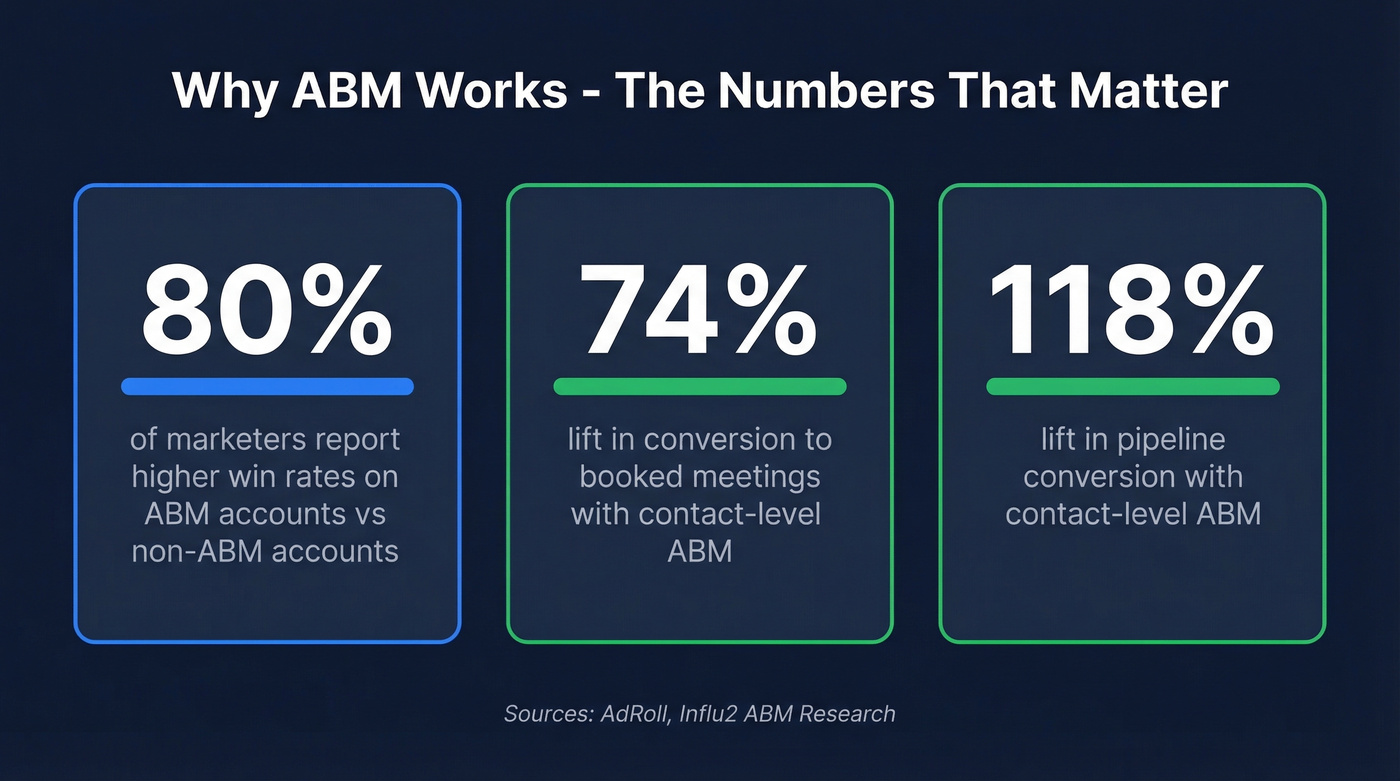
80% of marketers report higher win rates on ABM accounts versus non-ABM accounts. Contact-level ABM can lift conversion to booked meetings by up to 74% and pipeline conversion by up to 118%. But only if you plan the work.
- ☐ Define ICP + build Target Account List
- ☐ Score and tier accounts (1:1, 1:few, 1:many)
- ☐ Map buying committees (5+ stakeholders per account)
- ☐ Choose channels and build multi-touch plays
- ☐ Set budget using ACV-based heuristic
- ☐ Lock KPIs to ITSMA's 3R framework
- ☐ Sign a sales-marketing SLA with response-time commitments
- ☐ Establish weekly/monthly/quarterly operating rhythm
The ABM Plan Template
One distinction before you start: an ABM strategy template covers the whole program - ICP, tiering, budget, roles. An account plan is a single-account execution doc. This template is the strategy layer. You'll create individual account plans underneath it.
Copy these tables directly into Google Docs, Notion, or your project management tool.
Plan Snapshot
| Field | Your Entry |
|---|---|
| Goal | e.g., 12 new enterprise logos |
| Target ACV | e.g., $200K |
| Tier focus | 1:1 / 1:few / 1:many |
| Timeline | e.g., Q1-Q4 2026 |
| Owner | e.g., VP Marketing + CRO |
Account Insights
For each Tier 1 account, capture the primary pain point, trigger event (funding round, leadership change, renewal timing), current vendor or competitor, and whitespace estimate - the revenue you could displace or create.
Buying Committee Map
| Role | Contact | Channel | Status |
|---|---|---|---|
| Champion | - | - | Engaged / Cold |
| Economic buyer | - | - | - |
| Technical evaluator | - | - | - |
| Blocker | - | - | - |
| End user | - | - | - |
Plays and Channels
Map multi-touch sequences across at least 3-4 channels: paid ads, direct mail, personalized content, outbound sequences, events, and executive outreach. Each tier gets a different play intensity.
Think of it as the "Rule of 7." Prospects need repeated exposure across multiple touches and formats before they engage. One channel won't cut it, no matter how sharp your message is.
Budget, KPIs, SLA, and Rhythm
Use the ACV heuristic in the budget section below. Tie every KPI to one of the 3Rs - Reputation, Relationships, Revenue. Write an SLA with volume, quality, and response-time commitments. Set weekly pipeline syncs, monthly account reviews, and quarterly business reviews with leadership. Put these on the calendar before you launch.
Filled Example: GlobalCorp
Goal: Win GlobalCorp's analytics platform deal. ACV: $220K. Tier: 1:1.
GlobalCorp spends roughly $500K/yr on manual reporting. Their Tableau renewal hits in Q3 - that's the window. The VP of Analytics presented at a conference about "reducing dashboard sprawl," which maps directly to our positioning. That kind of public signal is gold; it tells you the pain is real and the timing is right.
Budget: 3% x $220K = $6,600 account-specific spend across ads, direct mail, an executive dinner, and custom content.
Quarterly milestones:
- Q1: Secure 3 meetings across the buying committee
- Q2: Deliver business case; run technical proof-of-concept
- Q3: Align proposal timing with Tableau renewal
- Q4: Close
KPIs: Engagement score across 6 stakeholders, pipeline stage progression, proposal-to-close velocity.
How to Score and Select Accounts
Not every account deserves ABM resources. Use a weighted 0-10 scoring model so you can rank accounts, debate tradeoffs, and draw a clear prioritization line.
| Factor | Weight | Account A | Account B |
|---|---|---|---|
| ICP Fit | 20% | 8 | 7 |
| Current Need | 25% | 7 | 6 |
| Opportunity Revenue | 15% | 5 | 4 |
| Decision-maker inclination | 25% | 6 | 7 |
| Buying history | 15% | 5 | 4 |
| Weighted Score | 100% | 6.35 | 5.60 |
Score every candidate account, rank by weighted score, and draw a line. Your top slice becomes Tier 1, the next becomes Tier 2, and the rest becomes Tier 3 or gets cut entirely.
You've scored accounts and mapped committees. Now you need verified contact data for every stakeholder - and stale data will tank the whole program before it starts. Prospeo covers 300M+ professional profiles with 98% email accuracy and 125M+ verified mobile numbers, all refreshed every 7 days. Search by company, filter by department and seniority, and export verified contacts for the entire buying committee in minutes.

You just mapped 6-10 stakeholders per account. Now you need verified emails and direct dials for every single one. Prospeo covers 300M+ profiles with 98% email accuracy and 125M+ verified mobiles - refreshed every 7 days so your buying committee data never goes stale.
Fill every row in your buying committee map with verified contacts.
Map the Buying Group
Gartner's research shows the average B2B deal involves 6-10 decision-makers, each gathering 4-5 pieces of information independently before the group ever meets. If you're only engaging one or two contacts per account, you're losing deals you don't even know about.
| Role | Name | Channel | Status |
|---|---|---|---|
| Champion | - | Email + calls | Engaged |
| Economic buyer | - | Executive dinner | Warm |
| Technical evaluator | - | Demo + docs | Cold |
| Blocker | - | Internal champion | Unknown |
| End user | - | Webinar + content | Engaged |
Update this quarterly. People leave, get promoted, or go dark. Treat it as a living document, not a launch artifact.
Bad contact data is the #1 reason ABM plays fail before the first touch. At ~$0.01/email, Prospeo lets you verify entire Tier 1 account lists for less than the cost of a single direct mail piece. Search by company, filter by seniority and department, and export the full buying group in minutes.
Your ABM budget is too strategic to waste on bounced emails.
Tiering That Actually Sticks
Tiering isn't segmentation. Segmentation groups accounts by shared attributes like industry or tech stack. Tiering ranks specific accounts by value to prioritize resources. And here's the reality: 31% of marketers lack the resources to personalize at scale, which is exactly why tiering matters. Don't attempt 1:1 for every account. You'll do all of them badly.
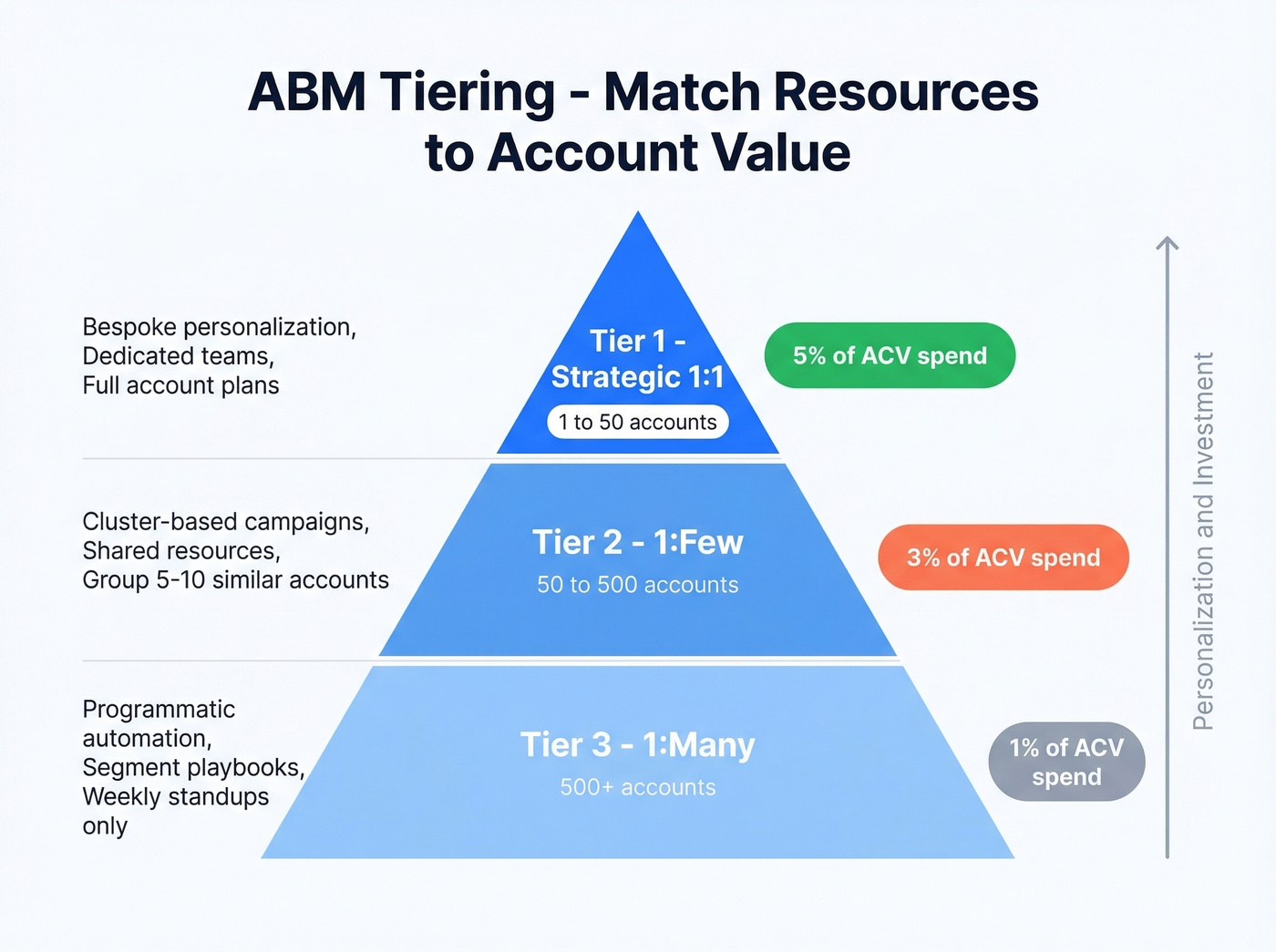
| Tier | Accounts | ABM Type | Personalization | Resources |
|---|---|---|---|---|
| Tier 1 | 1-50 | 1:1 Strategic | Bespoke | Dedicated teams |
| Tier 2 | 50-500 | 1:Few | Cluster-based | Shared campaigns |
| Tier 3 | 500+ | 1:Many | Programmatic | Automated |
Full account plans for Tier 1. Lighter cluster plans for Tier 2 - group 5-10 similar accounts and run shared campaigns against them. For Tier 3, skip individual plans entirely and use a segment playbook with weekly standups.
Budget Math
The most recent large-scale ABM budget study put the average at ~$350K excluding headcount, with pilots averaging ~$200K. That data is from 2019 - actual 2026 budgets likely trend higher, given that 72% of companies increased ABM spend and 40% raised it year-over-year.
For account-level budgeting, use the ACV heuristic:
| ACV Range | Spend as % of ACV | Example |
|---|---|---|
| $50K-$150K | 1% | $1,000 per account |
| $150K-$300K | 3% | $6,000 per account |
| $300K+ | 5% | $15,000+ per account |
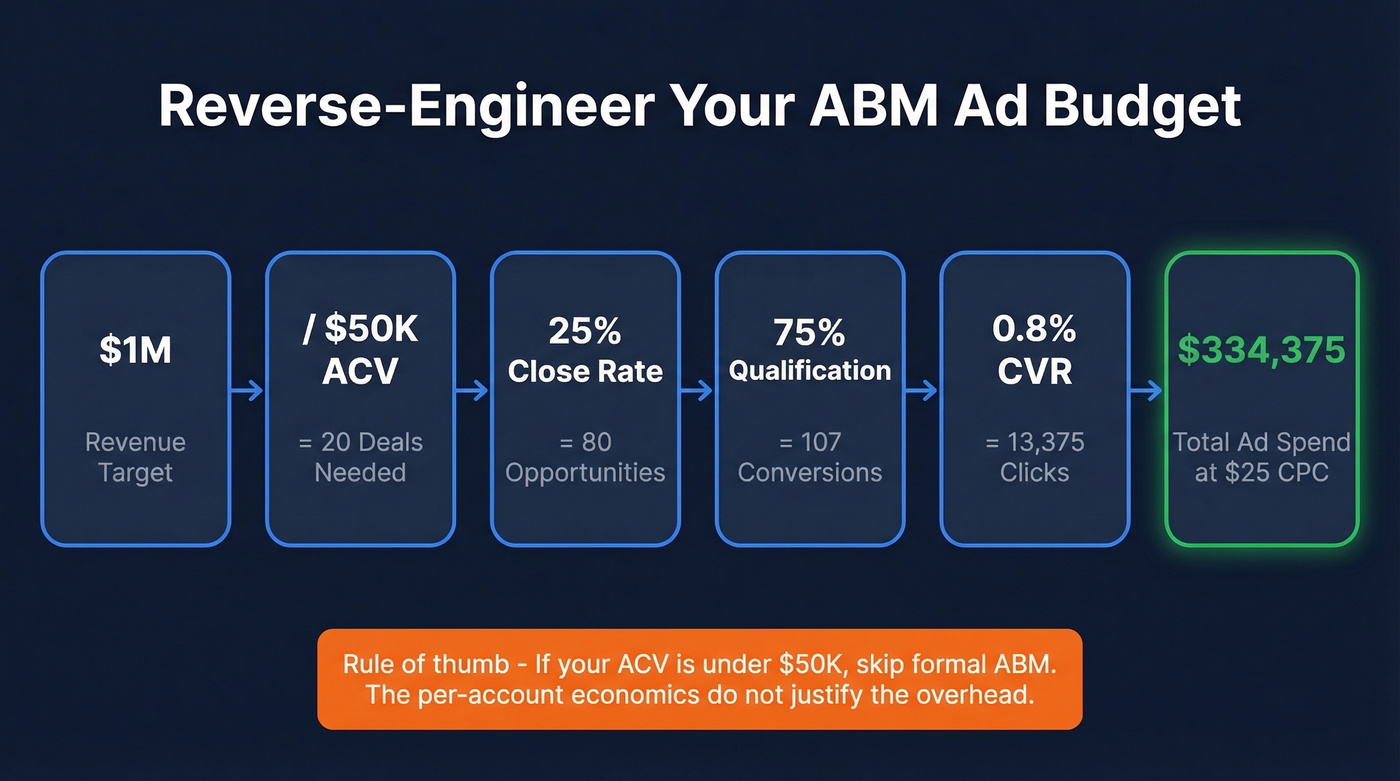
For ad-spend forecasting, work backwards from revenue. A ZenABM worked example: $1M revenue target / $50K ACV = 20 deals needed. Factor in 25% close rate and 75% qualification rate, and you need ~107 conversions. At 0.8% landing page CVR that's 13,375 clicks. At $25 CPC, you're looking at $334,375 total spend. That math keeps expectations honest.
Here's the thing: if your average deal size is under $50K, you probably don't need a formal ABM program at all. The per-account economics don't justify the overhead. Run targeted demand gen instead and save ABM for when your contracts warrant the investment.
Typical tech line items:
| Tool | Annual Cost |
|---|---|
| Demandbase | $30-100K+/yr |
| 6sense | $0-$300K+/yr |
| Bombora | $12-40K/yr |
| HubSpot Marketing Hub | From $800/mo (Pro) |
| Prospeo | Free tier; ~$0.01/email on paid plans |
| Apollo.io | From $49/user/mo |
KPIs and Attribution Traps
Use ITSMA's 3R framework:
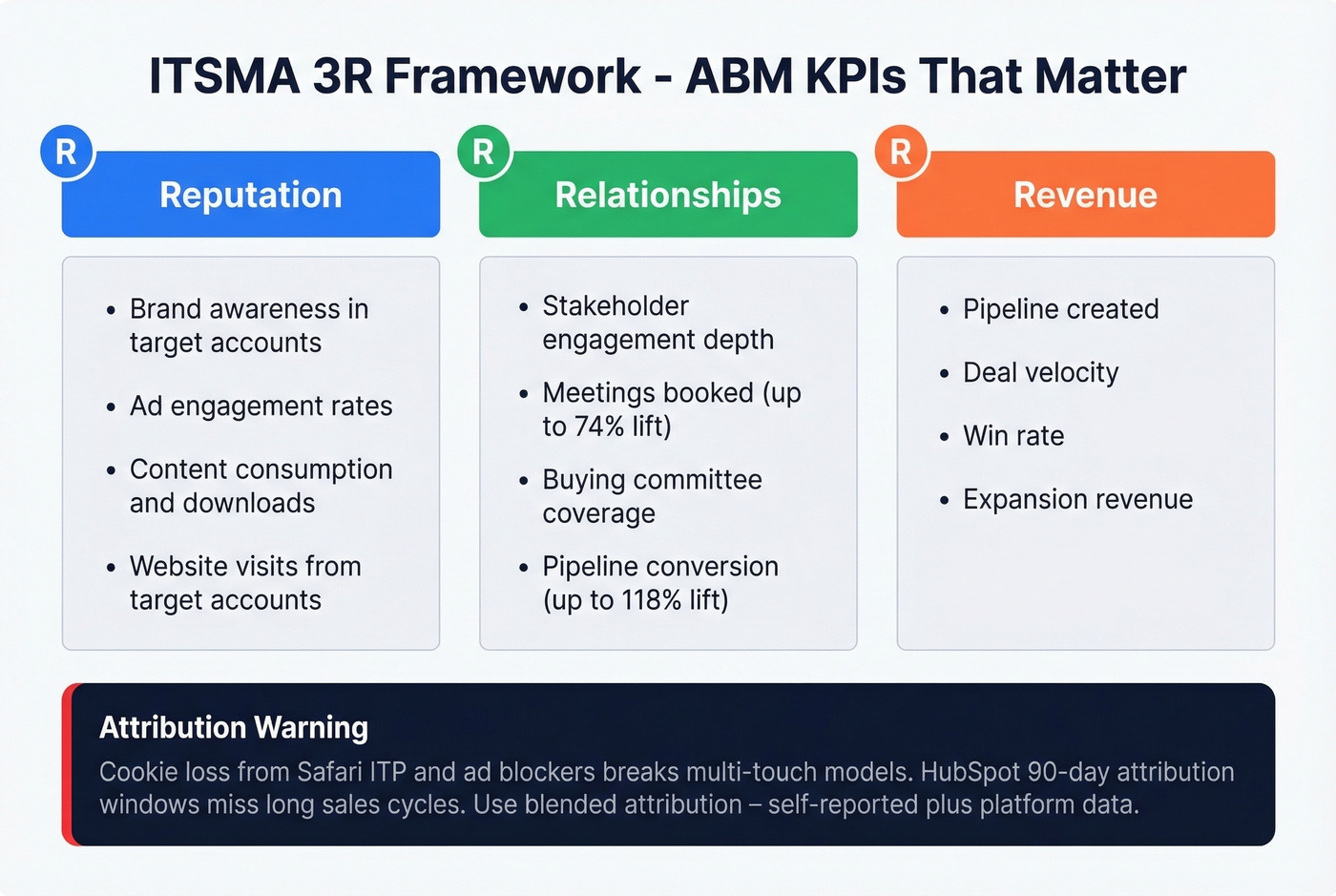
Reputation covers brand awareness within target accounts, ad engagement, and content consumption - leading indicators that prove you're getting noticed. Relationships measures stakeholder engagement depth, meetings booked, and buying committee coverage. Contact-level ABM can lift meeting conversion by up to 74% and pipeline conversion by up to 118%. Revenue tracks pipeline created, deal velocity, win rate, and expansion revenue - the metrics your CFO actually cares about.
For context, one documented ABM program generated $7.83M in qualified pipeline from 164 deals, closing $1.52M across 30 won opportunities.
Let's be honest about attribution: it's broken for ABM, and pretending otherwise will get your program killed. Cookie loss from Safari ITP and ad blockers means your multi-touch model is missing touches. HubSpot's 90-day attribution window cuts off credit for long sales cycles - if your average deal takes 9 months, you're losing half the story. Build a blended model: self-reported attribution plus platform data. Present both to leadership and explain why neither tells the full picture alone.
SLA and Operating Rhythm
Fill this in and get both VPs to sign it:
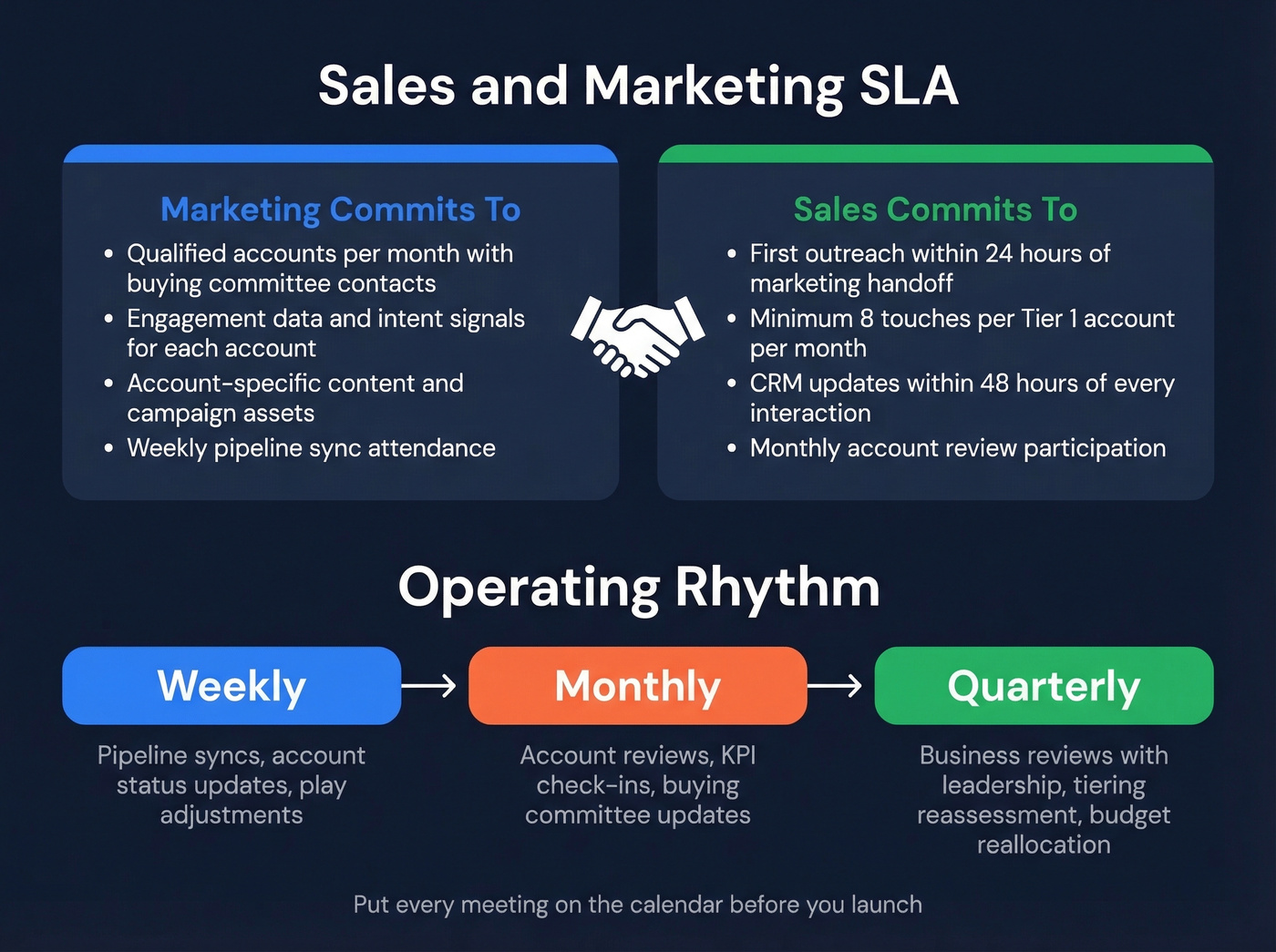
- Marketing commits to: _____ qualified accounts/month with buying committee contacts and engagement data.
- Sales commits to: First outreach within 24 hours of handoff. Minimum 3 multi-threaded touches per account in week one.
- Shared KPIs: Account-to-meeting conversion, pipeline velocity, win rate by tier.
- Cadence: Weekly pipeline reviews, monthly account strategy sessions, quarterly business reviews with leadership.
Companies with strong sales-marketing alignment see 36% higher retention and 38% higher win rates. The SLA is how you get there. Without it, ABM degrades into marketing running ads and sales ignoring them within 90 days. I've watched it happen at three different companies - the pattern is always the same: no shared accountability, no shared metrics, and eventually no shared belief that ABM works.
Mistakes That Kill ABM Programs
Measure account progression, not MQL volume. Optimizing for webinar signups is demand gen, not ABM. If your dashboard still centers on lead counts, you haven't actually switched to ABM - you've just renamed your demand gen program.
Align SDR messaging to campaign content. When BDRs freelance their own sequences that contradict your positioning, you confuse the buying committee and undermine months of air cover. In our experience, this is the single most common ABM failure mode. (If you need a baseline, start with proven sales follow-up templates.)
Keep segments large enough to learn from. Over-segmenting into groups of 12 accounts means you'll never get statistically meaningful data. You need enough accounts per tier to spot patterns and iterate.
Personalize at the company level, not the template level. Swapping persona titles in email templates isn't personalization. Research the account's actual pain points, reference their specific situation, and build content that only works for that company. If your "personalized" email could apply to any company in the same industry, it's not personalized. (More on this in our guide to personalized outreach.)
Verify your contact data before launch. High bounce rates don't just tank one campaign - they damage your domain reputation for months. If you're seeing issues, start with email bounce rate benchmarks and fixes, then tighten your email deliverability fundamentals. The consensus on r/sales and r/outbound is blunt: most "ABM programs" are just outbound with a logo swap. The template above exists to prevent exactly that.
FAQ
What should an ABM plan template include?
Every account based marketing plan template needs an ICP definition, tiering model, budget allocation, channel mix, KPIs tied to the 3R framework, a sales-marketing SLA, and an operating rhythm. The strategy template sits on top; individual account plans live underneath it for each Tier 1 target.
How many accounts belong in Tier 1?
Most teams run 10-50 accounts in Tier 1 with dedicated resources and bespoke content. Going above 50 dilutes personalization into Tier 2 territory. Start with 10-15 for your first ABM program, then expand once you've proven the motion works.
How do I build a buying committee contact list fast?
Start with your CRM to see who you already know at each target account, then fill gaps with a B2B data platform - filter by company, department, and seniority to find verified emails and direct dials for the 6-10 stakeholders you need per account. We've found that 30+ search filters and weekly data refreshes make the difference between a clean launch and a bounce-rate disaster.
What's a realistic ABM budget for a first program?
Plan $150K-$350K excluding headcount for a pilot, or use the ACV heuristic: spend 1-5% of target deal value per account depending on deal size. A $200K ACV account warrants roughly $6,000 in dedicated spend across ads, direct mail, and custom content.
When should I skip ABM entirely?
If your average contract value is below $50K, the per-account economics rarely justify formal ABM. Run targeted demand gen campaigns instead and reserve account-based plays for enterprise deals where the ROI math works - typically $100K+ ACV with 6-10 person buying committees.