

Account Management Best Practices: The Operational Playbook for 2026
79% of sales organizations have rebuilt their key account programs at least once in the past seven years. Not tweaked. Not "optimized." Rebuilt from scratch. That's not a stat about bad luck - it's a stat about structural failure.
The underlying problem isn't ambition. It's that most account management programs run on generic advice, stale data, and PowerPoint plans nobody updates after the kickoff meeting. Only 28% of sales leaders believe their channels actually meet cross-selling and growth targets. Meanwhile, a 5% increase in retention can boost profits by 25-95%, and returning customers spend 67% more than first-time buyers. The money is sitting there. Most teams just can't reach it.
This playbook covers the account management best practices - backed by research, frameworks, and benchmarks - that close that gap. Operational specifics you can implement before your next QBR, not theory.
The 90-Second Version
If you're short on time:
- Tier your accounts ruthlessly. Use the ICP scoring model in Section 5. Tier 1 gets 5-10 accounts with full plans. Tier 3 gets monitoring only. Stop spreading your team thin across 50 "strategic" accounts.
- Steal the health scoring formula. Section 6 has a signal-by-signal scoring model (usage, NPS, engagement, renewal risk) that rolls up to a single percentage. Healthy, At Risk, or Critical - no ambiguity.
Account Management vs. Customer Success vs. Sales
These three roles get conflated constantly, and the confusion creates real org-design problems.
| Account Manager | Customer Success Manager | Account Executive | |
|---|---|---|---|
| Focus | Select high-value clients | Entire customer base | Net-new prospects |
| Primary metric | Account revenue growth | Retention & adoption | New bookings |
| Touch model | High-touch, strategic | One-to-many, proactive | Deal-cycle driven |
| Revenue mandate | Renewals + upsells | Retention (indirect) | Close new logos |
The key distinction: account managers own a curated portfolio of your most valuable clients with an explicit revenue growth mandate. CSMs cover the broader base with a retention and adoption focus. AEs hunt net-new. When you blur these lines - asking AEs to "manage" their closed deals, or expecting CSMs to drive expansion revenue - nobody does either job well. 70% of CSOs now list higher returns from key accounts as a priority, which means getting these roles right has never mattered more.
What Top Account Teams Do Differently
Product quality barely matters for account growth. That sounds wrong, but the data is unambiguous.
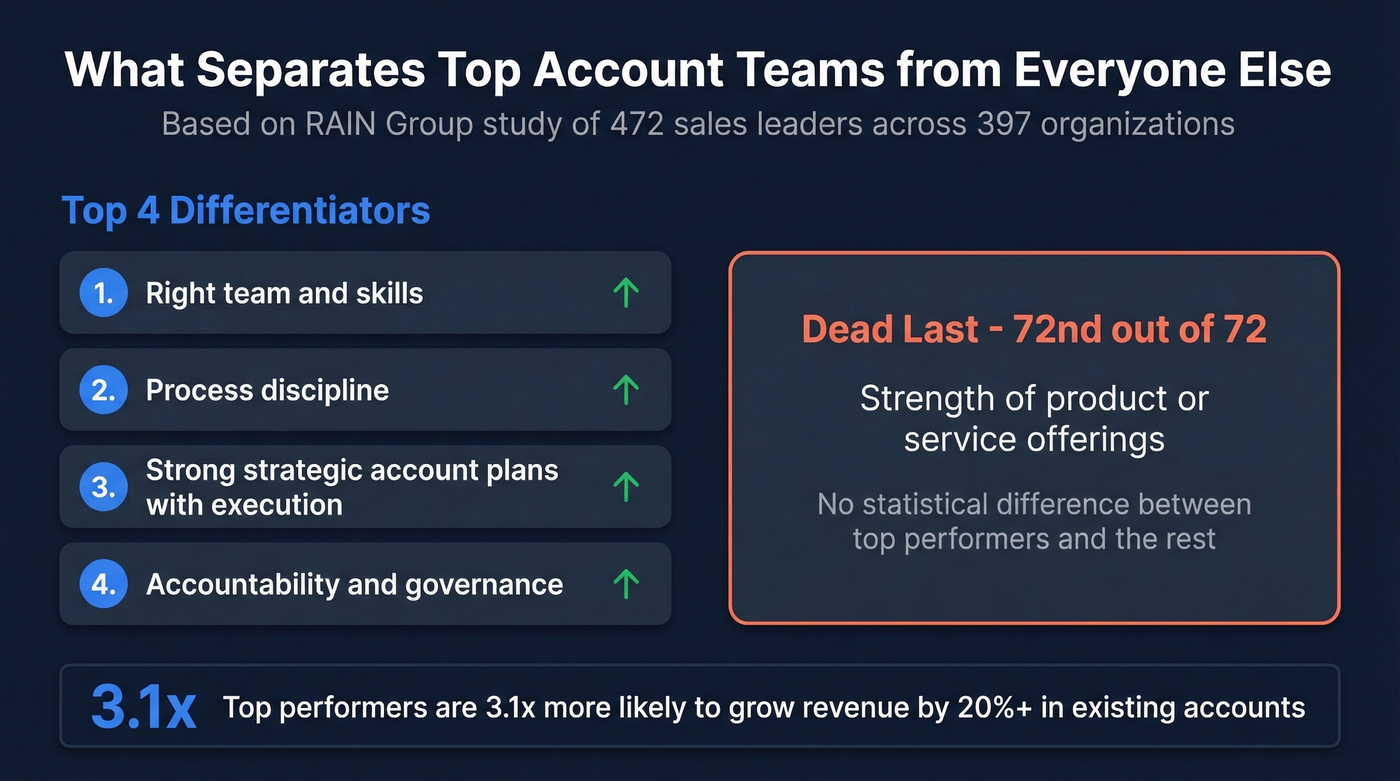
RAIN Group studied 472 sales leaders, analyzing 72 factors that separate top-performing strategic account teams from everyone else. "Strength of product/service offerings" ranked dead last - 72nd out of 72. There was no statistical difference between top performers and the rest on perceived offering growth potential.
What did separate them? Four things: the right team and skills, process discipline, strong strategic account plans with actual execution behind them, and accountability. Top performers in strategic account management are 3.1x more likely to grow revenue by 20%+ in existing accounts. That gap isn't about having a better product. It's about running a better operation.
This is good news if you're competing against vendors with deeper feature sets. Your framework - the process, the people, the plans - is the actual competitive advantage. Let's build one.
How to Tier Your Key Accounts
Not every account deserves a strategic plan. Trying to give every customer the white-glove treatment is what Cranfield School of Management flags as "boiling the ocean" - a common failure pattern in KAM rollouts.
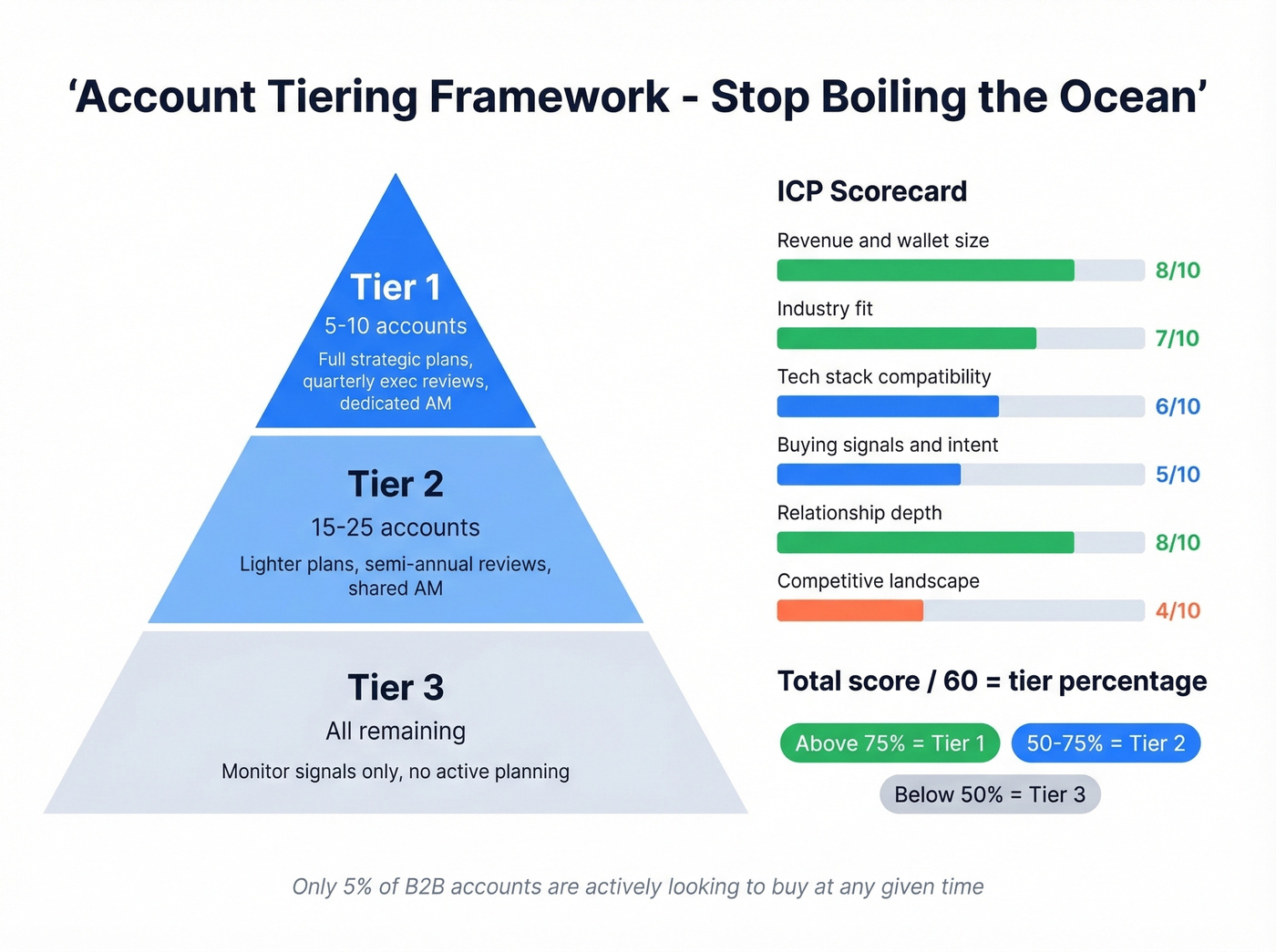
Use an Ideal Customer Profile scorecard to force-rank your accounts. Score each on a 1-10 scale across six dimensions:
| Dimension | What You're Scoring |
|---|---|
| Revenue / size | Current spend + wallet size |
| Industry fit | Alignment to your ICP |
| Tech stack | Compatibility signals |
| Buying signals | Intent, expansion cues |
| Relationship depth | Multi-threaded? Champion? |
| Competitive landscape | Locked in or at risk? |
Sum the scores and convert to a percentage. Then tier:
- Tier 1 (>75%): 5-10 accounts. Full strategic plans, quarterly executive reviews, dedicated AM resources.
- Tier 2 (50-75%): 15-25 accounts. Lighter-touch plans, semi-annual reviews, shared AM coverage.
- Tier 3 (<50%): Monitor signals only. Don't invest planning time until they show movement.
Only 5% of B2B accounts are actively looking to buy at any given time. Your job isn't to plan for every account - it's to identify the ones where timing, fit, and relationship depth create a real growth opportunity, and go deep on those.

You just built a tiering scorecard. Now you need verified contact data to fill it. Prospeo gives you 30+ filters - buyer intent, headcount growth, technographics, funding - to score and prioritize accounts with real signals, not guesswork. 300M+ profiles, 98% email accuracy, refreshed every 7 days.
Stop planning accounts with stale data. Start with contacts that actually connect.
10 Practices That Drive Account Growth
1. Build Multi-Threaded Relationships
The average B2B deal now involves 11 stakeholders. If your entire relationship runs through a single champion, you're one departure away from losing the account. We've seen it happen - a VP leaves, the new hire brings in their preferred vendor, and two years of relationship-building evaporates overnight.
Multi-threading means building genuine connections with at least 3-5 contacts across different functions and levels within each Tier 1 account. Not just "adding them on the CRM" - actually engaging them. Monthly touchpoints, shared content, invitations to events. When your champion leaves, you should have two other people who'll take your call.
2. Create Living Account Plans
Static account plans are worse than no plans at all. They create a false sense of preparedness. Organizations with frequently updated account plans are 3x more likely to build customer decision confidence - and customers with high decision confidence are 10x more likely to make a low-regret purchase.
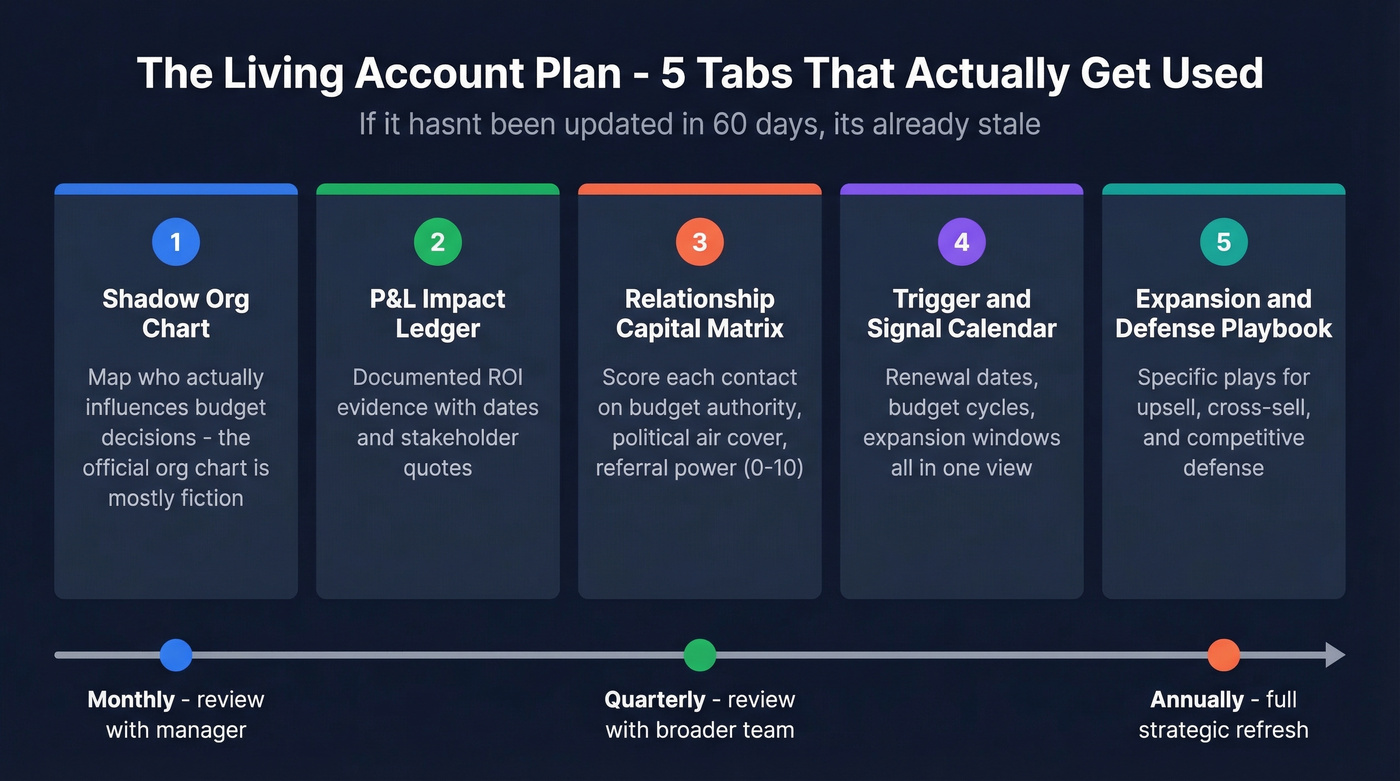
Build your plans as living documents with five tabs:
- Shadow org chart & political risk map - the official org chart is mostly fiction; map who actually influences budget decisions
- P&L impact ledger - documented ROI evidence with dates and stakeholder quotes
- Relationship capital matrix - score each contact on budget authority, political air cover, and referral power (0-10)
- Trigger & signal calendar - renewal dates, budget cycles, expansion windows
- Expansion & defense playbook - specific plays for upsell, cross-sell, and competitive defense
Review monthly with your manager. Quarterly with the broader team. Copy this framework into a Google Sheet or Notion doc - it works as-is. If the plan hasn't been updated in 60 days, it's already stale. Some teams condense their strategic account plans into a plan-on-a-page for each account: a single-sheet summary of goals, key contacts, expansion opportunities, and next actions that keeps everyone aligned without drowning in detail.
3. Run White Space Analysis
White space analysis is how you find expansion revenue you've been walking past. The method is simple: build a grid with the customer's business units on one axis and your products/services on the other. Label each cell:
- Saturated - already deployed, limited growth
- Underway - active opportunity or pilot
- Not fit - genuinely not relevant
- White space - viable but not yet pursued
Most teams skip this exercise because it feels obvious. It's not. We've run white space analyses where AMs discovered entire departments they'd never engaged - departments that were already using a competitor's product for something we could've sold them two years ago.
4. Implement Account Health Scoring
Gut feel doesn't scale. You need a scoring model that gives every account a single number - and makes "At Risk" impossible to ignore.
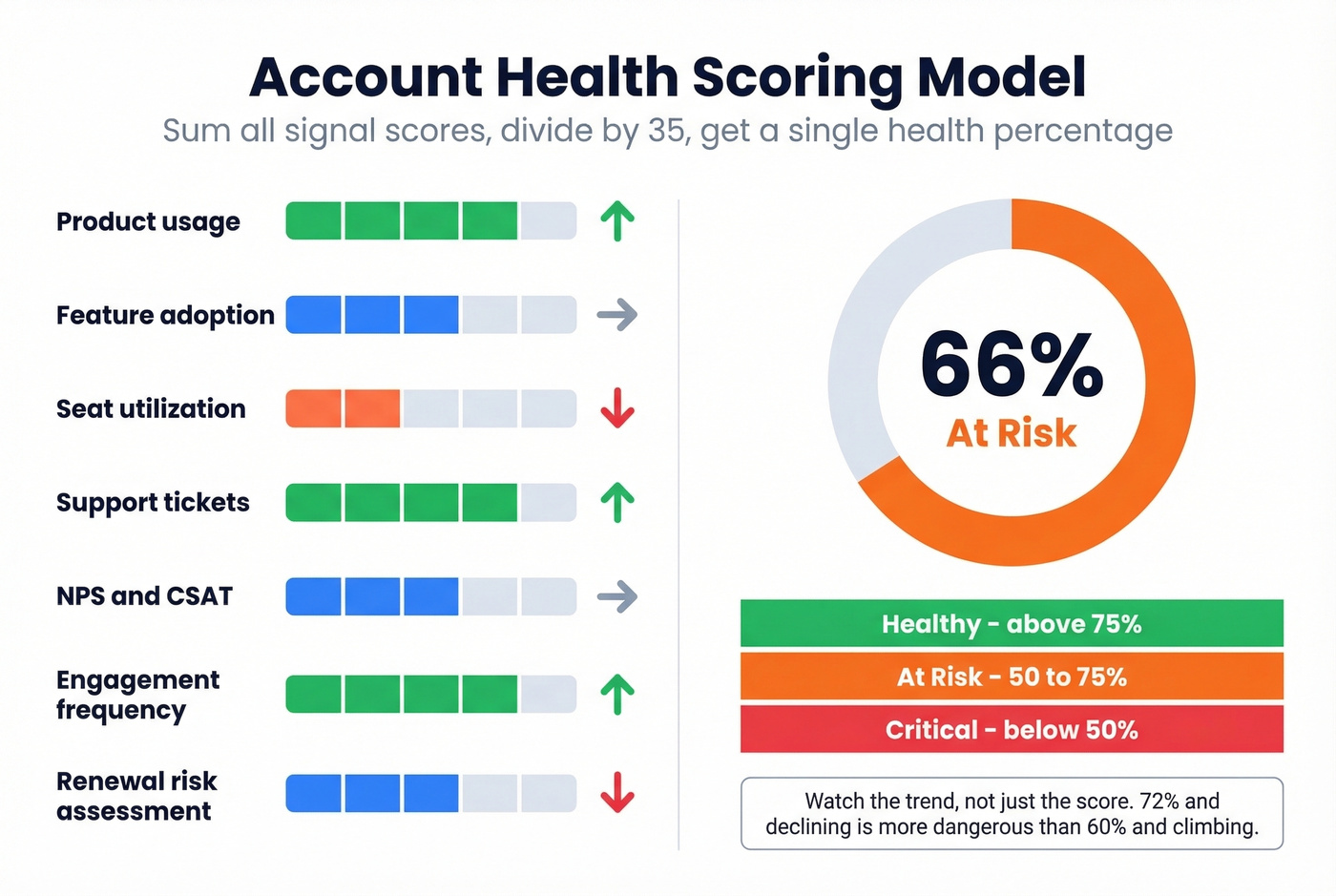
Score each signal on a 1-5 scale:
| Signal | Score (1-5) | Trend | Data Source |
|---|---|---|---|
| Product usage | ↑ ↓ → | Analytics | |
| Feature adoption | ↑ ↓ → | Product | |
| Seat utilization | ↑ ↓ → | License data | |
| Support tickets | ↑ ↓ → | Helpdesk | |
| NPS / CSAT | ↑ ↓ → | Survey | |
| Engagement freq. | ↑ ↓ → | CRM | |
| Renewal risk | ↑ ↓ → | AM assessment |
Formula: Sum all scores / 35 = health percentage. Above 75% is Healthy. 50-75% is At Risk. Below 50% is Critical.
The trend column matters as much as the score. An account at 72% and declining is more dangerous than one at 60% and climbing. Review health scores monthly and flag any account that drops a tier.
5. Establish QBR and EBR Cadence
Quarterly Business Reviews aren't optional for Tier 1 accounts. They're the forcing function that keeps plans alive and surfaces problems before they become churn events. Match the cadence to your tiering:
- Tier 1: Quarterly QBRs with the customer, plus monthly internal reviews
- Tier 2: Semi-annual reviews, with ad-hoc check-ins when health scores shift
- Tier 3: No scheduled reviews - trigger-based only
For executive business reviews, bring your leadership to their leadership once or twice a year. The goal isn't a status update - it's strategic alignment. Share roadmap, discuss their priorities, and identify where you can co-invest. EBRs that feel like sales pitches destroy trust. EBRs that feel like partnership planning build it. Define clear meeting goals before every QBR: what decisions need to be made, what data you'll present, and what commitments you're seeking from both sides.
If you need a tighter structure, use a QBR agenda that forces decisions.
6. Map Every Stakeholder
Stakeholder mapping goes beyond knowing names. For each Tier 1 account, document every contact with their role in the buying process:
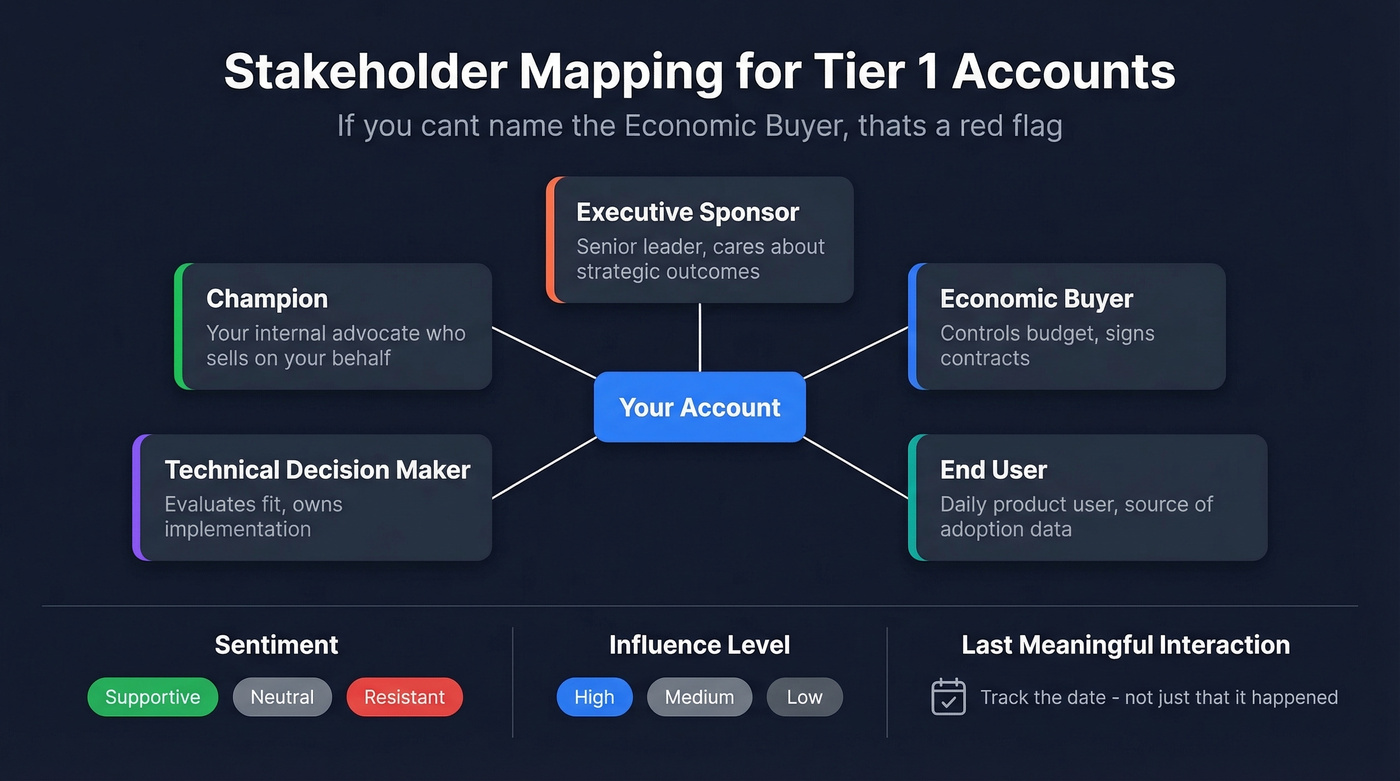
- Champion - your internal advocate who sells on your behalf
- Economic Buyer - controls budget, signs contracts
- Technical Decision Maker - evaluates fit, owns implementation
- End User - daily product user, source of adoption data
- Executive Sponsor - senior leader who cares about strategic outcomes
For each person, track their sentiment (supportive, neutral, resistant), their influence level, and the last meaningful interaction. If you can't name the Economic Buyer for a Tier 1 account, that's a red flag. You're one budget review away from a surprise.
If you want a cleaner way to think about roles, map the technical buyer vs economic buyer explicitly.
7. Align Expansion to Triggers
The best account teams don't sell on a calendar. They build a trigger-based system that surfaces upsell and cross-sell opportunities from actual signals.
Watch for these expansion triggers: usage spikes beyond current tier limits, adoption of features adjacent to premium offerings, stakeholders asking about capabilities you haven't sold them, new departments onboarding, and leadership changes that create fresh budget conversations. Beyond timing, build structural stickiness - deep integrations, multi-year agreements, and workflow dependencies that make switching painful. The accounts that churn least are the ones where your product is woven into daily operations, not sitting on the periphery.
Structure your expansion motion in five phases:
- Identify the best expansion bets
- Deepen connections through strategic business reviews
- Execute upsell/cross-sell plays tied to specific triggers
- Protect renewals by flagging at-risk signals early
- Iterate based on what's converting
If you want to operationalize this, build a system for how to track sales triggers.
8. Keep Contact Data Clean
Here's the thing: your stakeholder map is fiction if the data behind it is stale. And the data is almost certainly stale - industry benchmarks put CRM data decay at 35-40% annually. People change jobs, get promoted, switch email addresses, and your carefully mapped org chart quietly becomes useless.
Snyk, a security company with 50 AEs prospecting 4-6 hours per week, saw their bounce rate sitting at 35-40% before they fixed their data hygiene. After implementing automated enrichment with Prospeo, bounces dropped under 5% and AE-sourced pipeline jumped 180%, generating 200+ new opportunities per month. That's the difference clean data makes.
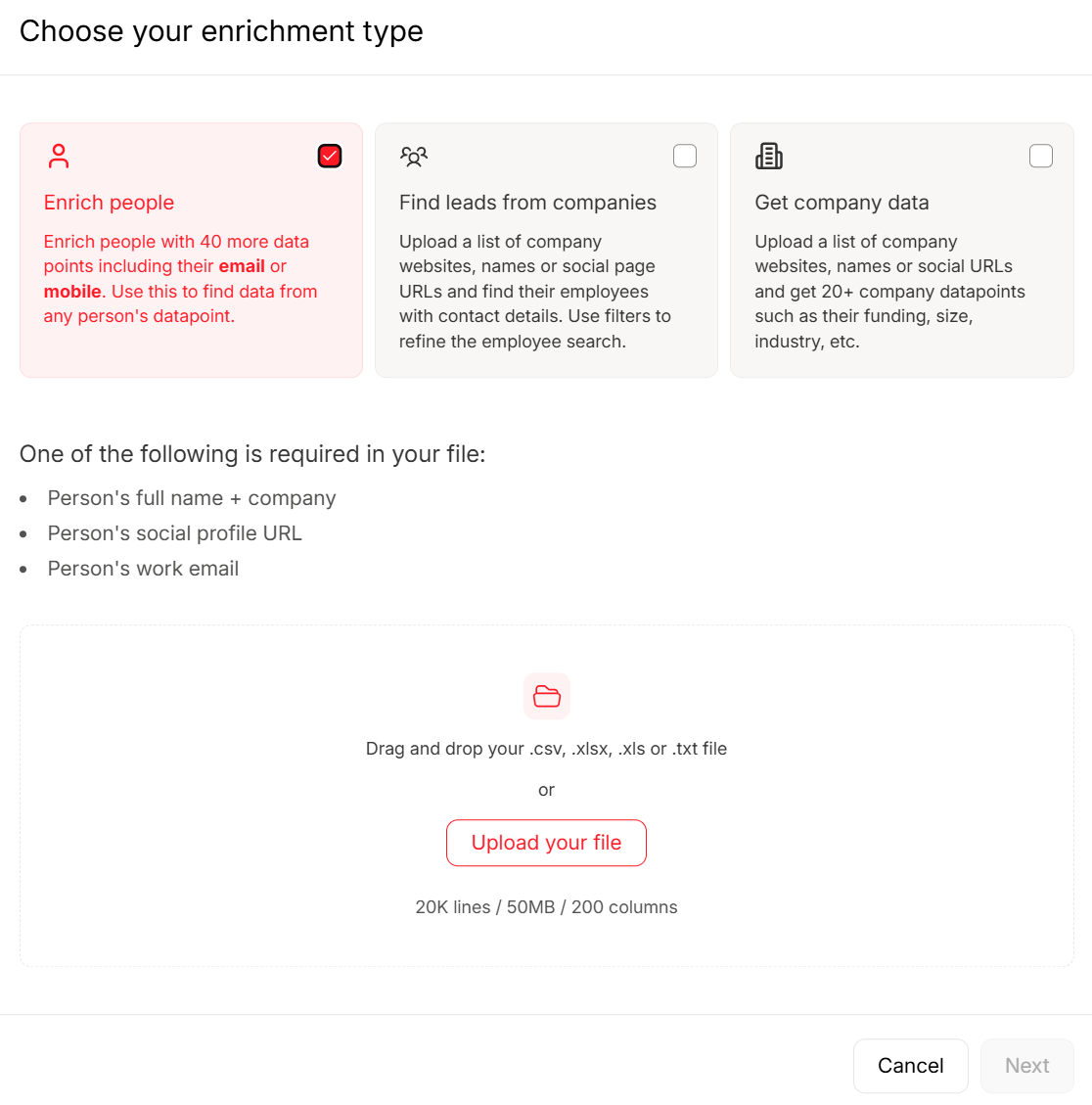
If you're evaluating vendors, compare data enrichment services before you commit.
9. Segment by Growth Potential
Most teams segment accounts by revenue, geography, or industry. That's fine for territory planning, but it's terrible for growth planning. A $2M account with zero expansion potential shouldn't get the same investment as a $500K account that could 4x.
Segment by growth trajectory instead:
- Strategic Growth - high current value, high expansion potential
- High Growth - lower current value, high expansion potential
- Stable - solid revenue, limited growth upside
- Opportunistic - low current value, uncertain potential
Transformed account management functions using this model see 25%+ increases in upsell and cross-sell revenue, plus higher retention and optimized coverage costs. Align your best AMs, your deepest playbooks, and your most aggressive incentives to the Strategic Growth and High Growth segments. Skip the Opportunistic tier until you've maxed out the first two - spreading resources there too early is how teams end up with mediocre results across the board.
10. Measure What Matters
Track five KPI buckets and you'll cover the full picture:
- Customer Lifetime Value - your anchor metric for account-level investment decisions
- CSAT / NPS - leading indicators of retention and expansion willingness
- Churn / Retention Rate - the baseline health metric; if this is moving wrong, nothing else matters
- Upsell & Cross-Sell Revenue - the growth engine; track both absolute dollars and percentage of total ARR
- Engagement Frequency - meeting cadence, response times, product usage; declining engagement predicts churn 3-6 months out
Don't drown your team in dashboards. Pick one metric from each bucket, set a target, and review monthly. Five numbers on a whiteboard beat fifty in a BI tool nobody opens.
If you need a deeper model, run a formal churn analysis alongside health scoring.
2026 Benchmarks Worth Knowing
Numbers without context are useless. Here's what top-performing SaaS companies hit in 2026 - the closest proxy for account management performance at scale:
| Metric | Median | Top Performers |
|---|---|---|
| Net Revenue Retention | ~100-105% | 120%+ (drives 2.3x valuations) |
| Expansion % of new ARR | ~40% | 50%+ (above $50M ARR) |
| CAC Payback | 15-18 months | <12 months |
| LTV:CAC | 3:1 | 4:1 to 5:1 |
| Annual Revenue Growth | 26% | 40%+ |
If your NRR is below 100%, you're shrinking inside your existing base - no amount of new logo acquisition fixes that. The 120%+ NRR benchmark is the clearest signal that your account program is working. Companies hitting that number aren't just retaining; they're growing faster inside existing accounts than most teams grow through net-new sales.
Here's my hot take: most B2B companies don't have a growth problem. They have a retention-and-expansion problem wearing a growth-problem costume. If your average deal size is under $25K and your NRR is above 110%, you're probably better off doubling down on account management than hiring another AE. The math almost always favors expansion over acquisition.
7 Mistakes That Kill Account Growth
1. Treating KAM as "a new way of selling." Key account management is a different business model, not a sales tactic you bolt onto existing processes. Cranfield School of Management identifies this as a foundational mistake - and it cascades into everything else.
2. The Captain Super-KAM syndrome. One heroic AM managing everything solo, with no team support, no cross-functional resources, and no backup plan. When they burn out or leave, the account relationship walks out the door with them.
3. Boiling the ocean. Trying to roll out strategic account management across 100 accounts simultaneously instead of proving the model with 5-10 first. Large organizations need years to absorb new ways of working. Start with a beachhead - one account showing 70% growth makes leadership buy-in hard to reject.
4. Weak senior sponsorship. If your C-suite treats account management as a sales team initiative rather than a company-wide strategy, you'll never get the cross-functional resources that Tier 1 accounts require.
5. Staying product-centric. Pitching features instead of co-creating value. The best account teams think in terms of their customer's P&L, not their own product roadmap.
6. Set-and-forget plans. Building a beautiful account plan in January and never updating it. Plans that aren't reviewed monthly become artifacts, not tools.
7. Using net-new pipeline tools for post-sale growth. Traditional CRMs are built for tracking deals through a funnel, not for managing strategic relationships over years. This leads to double entry, offline spreadsheets, and critical context living in someone's head instead of a system.
Tools Worth Evaluating
The right tool stack depends on your maturity. Early-stage teams can run account management inside their CRM with disciplined processes. Scaled teams need dedicated KAM platforms. Everyone needs clean data.
| Tool | Best For | Starting Price |
|---|---|---|
| Prospeo | Contact data + CRM enrichment | Free tier; ~$0.01/email |
| monday CRM | Lightweight pipeline + tracking | $10/user/mo |
| Zoho CRM | Budget-friendly full CRM | $14/user/mo |
| Pipedrive | Sales-focused pipeline mgmt | $14/user/mo |
| Salesforce | Enterprise CRM + ecosystem | $25/user/mo |
| Kapta | Dedicated KAM platform | Custom pricing |
| DemandFarm | Strategic account planning | Custom pricing |
| Gainsight | Customer success + health scoring | Custom pricing |
The CRM is table stakes. The differentiator is what you layer on top. Dedicated KAM tools like Kapta and DemandFarm add account planning, org charts, and health scoring that CRMs don't handle natively. Gainsight covers the customer success angle with health scoring and playbook automation. For data quality - the foundation everything else depends on - Prospeo's CRM enrichment keeps your stakeholder maps current with 98% email accuracy on a 7-day refresh cycle, starting free with no contracts.
If you're still choosing a system of record, start with a few examples of a CRM to sanity-check fit and pricing.
Multi-threading across 3-5 stakeholders per account means nothing if you can't reach them. Prospeo's 125M+ verified mobile numbers hit a 30% pickup rate - nearly 3x the industry average. Find every decision-maker, budget holder, and influencer in your Tier 1 accounts in one search.
Your champion just left. Do you have direct dials for the other four stakeholders?
FAQ
What's the difference between account management and customer success?
Account managers own a select portfolio of high-value clients with a revenue growth mandate - renewals, upsells, cross-sells. CSMs cover the broader customer base with a retention and adoption focus. AMs go deep on fewer accounts; CSMs go wide across the install base.
How many key accounts should one AM handle?
Tier 1 strategic accounts: 5-10 max per AM. Tier 2 with lighter-touch plans: 15-25. Beyond that, you're boiling the ocean. Start narrow, prove the model with measurable NRR gains, then expand coverage.
What KPIs matter most for account managers?
Five buckets: customer lifetime value, CSAT/NPS, churn rate, upsell/cross-sell revenue, and engagement frequency. Top performers hit 120%+ NRR and generate 40%+ of new ARR from expansion inside existing accounts.
How often should account plans be updated?
Monthly with your direct manager, quarterly with the cross-functional team. Frequently updated plans make organizations 3x more likely to build customer decision confidence - which makes customers 10x more likely to make a low-regret purchase.
How do I keep stakeholder data current across key accounts?
Automate it. With 35-40% of CRM contacts going stale annually, manual updates can't keep pace. A 7-day enrichment refresh cycle with 98% email accuracy keeps your stakeholder maps reliable and your multi-threading efforts pointed at the right people.