

The Account Plan Template Your VP Actually Wants (With a Filled-In Example)
It's Q4 planning season. Your VP wants account plans for the top 20 by Monday. There's a link to a Google Doc from 2022 that nobody's touched since. You open it, stare at 14 empty fields, and close the tab.
Only 28% of sales leaders believe their account management channels actually hit cross-sell and growth targets. One CSM on Reddit put it bluntly - managing a $10M book across 120 accounts with plans that rely on people actually maintaining them is a fantasy when teams don't bother sharing notes 90% of the time. The template isn't the problem. Knowing what to put in it - and keeping it alive - is.
What You Need (Quick Version)
Your plan needs five core sections: account snapshot, stakeholder map, SWOT, action plan, and review cadence. Start with a Google Sheet or Notion page - don't buy software until you've proven the habit. Tier ruthlessly: full plans for your top 5-10 accounts only.
The number-one reason plans fail isn't laziness. It's stale stakeholder data. You mapped 14 people, have emails for six, and three bounce. Fix the data before you plan the engagement.
What Is an Account Plan?
An account plan is a living document that answers five questions about a strategic account: What do we know about this company? Who makes decisions? What do they need? Where's the whitespace? And what are we doing about it - with names, dates, and milestones attached?
AEs use them to close complex deals. CSMs use them to protect and grow revenue. KAMs use them to orchestrate multi-threaded relationships across business units. You don't need one for every account. If you're managing 80-120 accounts, building full plans for all of them is a fantasy. Full plans for your top 5-10. Lighter plans for the next 15-25. Everything else gets signal monitoring only.
Why Strategic Account Planning Matters
The average B2B purchase involves roughly 11 stakeholders, and for enterprise deals that number can climb toward 20. You can't navigate that kind of buying group with tribal knowledge and a good memory.
65% of account managers' time goes to non-revenue activities - admin work, internal meetings, chasing down context that should already be documented. A structured plan doesn't just help you sell. It reclaims hours you're currently wasting.
Structured account planning yields 28% faster sales cycles and 35% higher close rates. An ABM ROI survey of 771 marketers found an average ROI of 137%, with 82% saying account-based approaches outperform traditional marketing. When you focus resources on the accounts that matter most - whether for expansion within existing customers or new product launches - the math works.
Here's the thing: most teams don't need account planning software. They need the discipline to fill in a spreadsheet for their top 10 accounts and review it monthly. Buy the tool after you've proven the habit for two quarters.
Components of a Strong Template
Most templates you'll find online are designed for the person requesting the plan, not the person filling it out. They're heavy on fields and light on guidance. Here are the eight sections that actually matter.
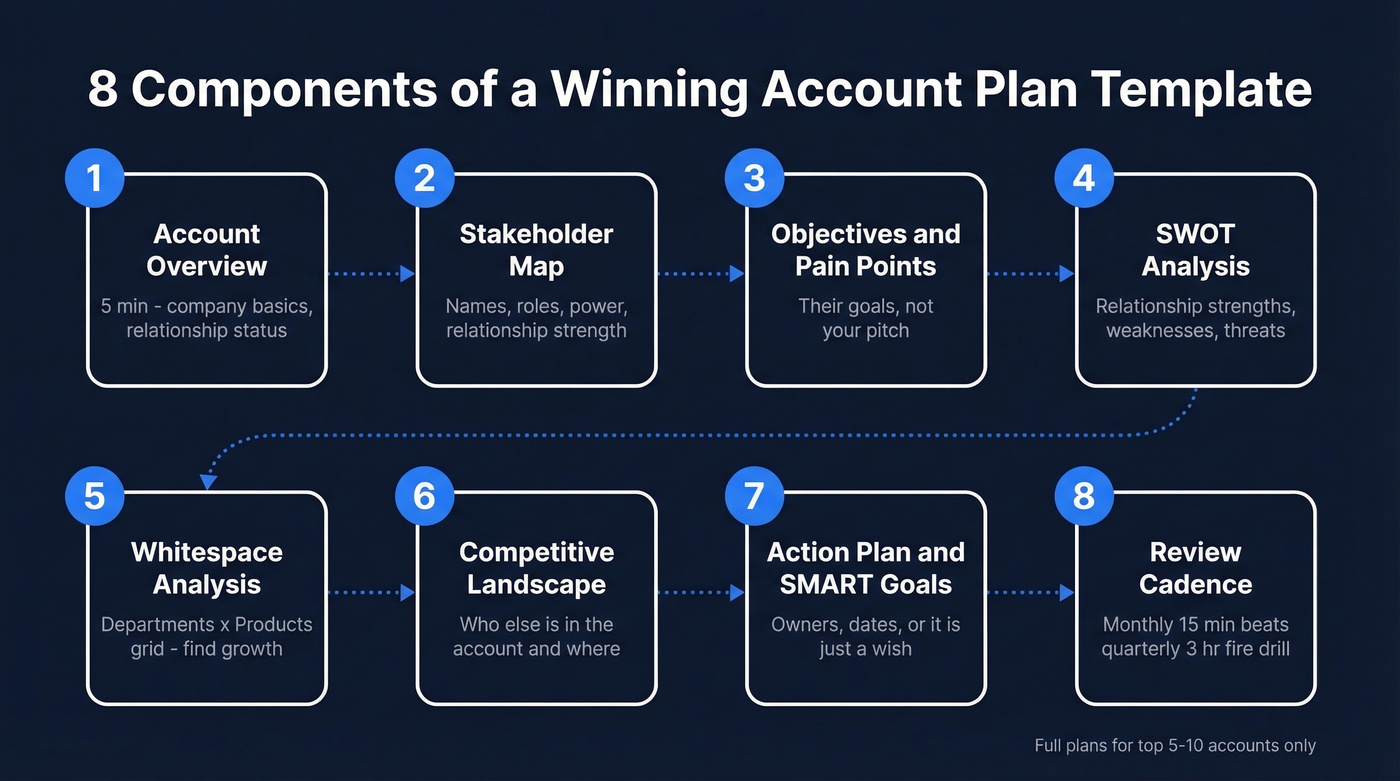
Account Overview
Company name, industry, employee count, annual revenue, fiscal year end, and your current relationship status - prospect, new customer, renewal, or expansion. Include the account owner and any secondary contacts on your side. This section should take five minutes. If it takes longer, you're overcomplicating it.
Stakeholder Map
List every person who influences the deal or the renewal. For each, capture their role, department, decision-making authority (decision-maker, influencer, gatekeeper, end user, or blocker), and your current relationship strength. Rate each as strong, developing, unknown, or adversarial. We'll cover mapping frameworks in the next section.
Objectives & Pain Points
What is this company trying to accomplish in the next 12 months? Not what you think they should care about - what they've actually told you, or what their public filings, job postings, and press releases reveal. List 2-3 customer objectives with measurable success criteria, then map your solution to each one.
SWOT Analysis
Strengths, weaknesses, opportunities, and threats - from the account relationship perspective, not the company's business overall. A strength: your champion sits in procurement. A weakness: zero relationship with the CTO's team. An opportunity: a new business unit launching in Q2. A threat: a competitor already embedded in their EMEA offices.
Whitespace Analysis
This is the section most templates skip, and it's the one that drives expansion revenue. Build a simple grid with business units or departments on one axis and your products or services on the other. Label each cell: Saturated, Underway, Not a Fit, or Whitespace. The whitespace cells are your growth targets.
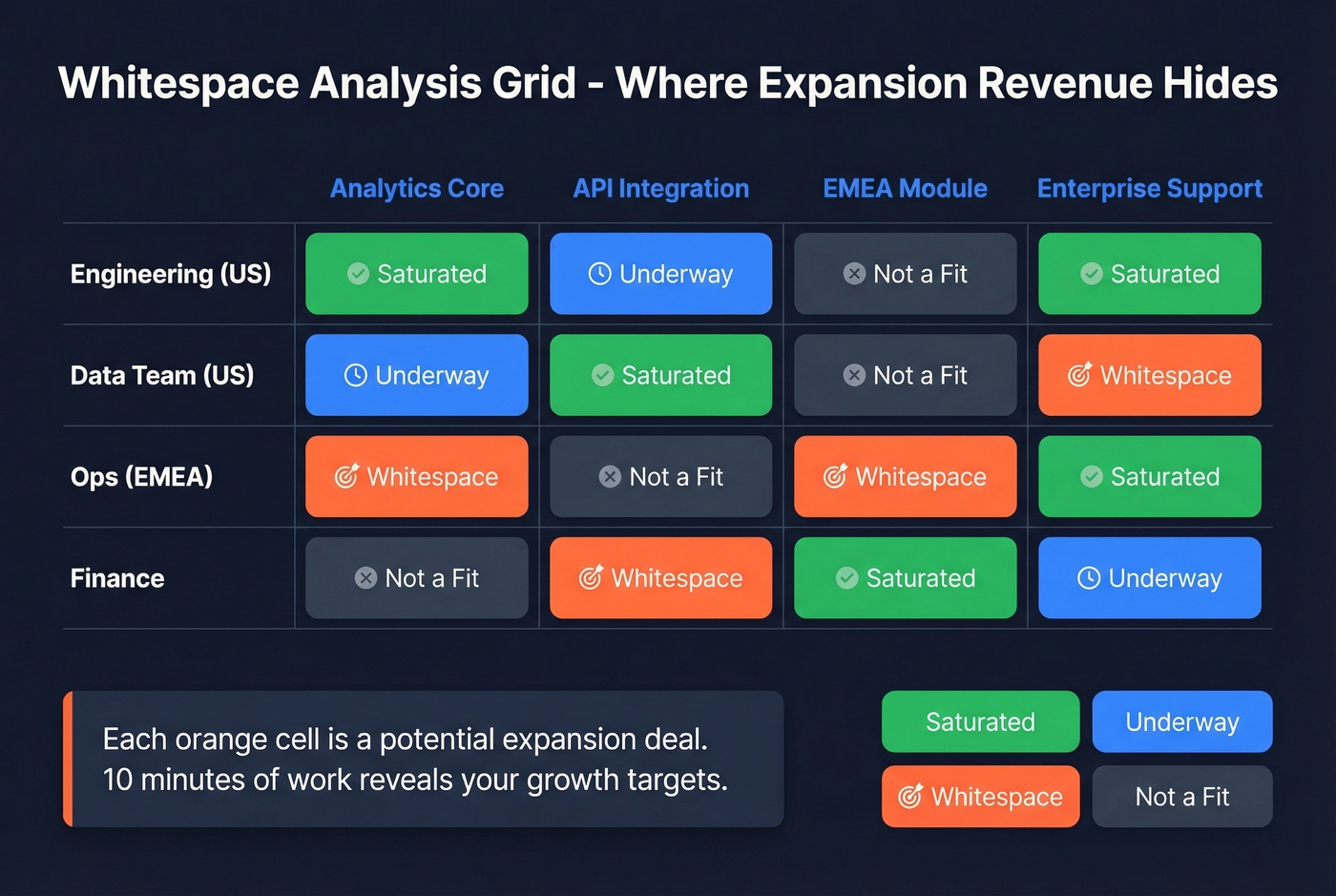
Ten minutes of work. That's where expansion revenue hides.
Competitive Landscape
Who else is in the account? What are they selling? Where are they strong, and where are they vulnerable? You don't need a full competitive analysis - just enough to know where you're fighting uphill and where you have an opening. If you want a repeatable way to track rivals, build lightweight competitive intelligence into your monthly review.
Action Plan & SMART Goals
This is where plans either become useful or die. Set 2-3 SMART Goals - specific, measurable, achievable, relevant, time-bound - with an owner and a due date for each. One addressing a client pain point, one targeting whitespace, one strengthening a relationship. Without owners and dates, goals are wishes.
Review Cadence
Monthly 15-minute reviews beat quarterly 3-hour fire drills every time. Set a monthly check-in to update stakeholder status and action items. Do a deeper strategic review quarterly. Put both on the calendar now - reviews that aren't scheduled don't happen. If your team runs QBRs, align this cadence with your QBR questions so the plan stays usable.

You just mapped 14 stakeholders. Now you need to actually reach them. Prospeo gives you verified emails (98% accuracy) and direct dials (125M+ mobiles) for every person on your account plan - refreshed every 7 days so your data never goes stale between quarterly reviews.
Stop planning around bounced emails. Start with data that connects.
Stakeholder Mapping Frameworks
Listing names and titles isn't stakeholder mapping. Real mapping means understanding who has power, who supports you, and who's going to kill your deal in a committee meeting you weren't invited to.
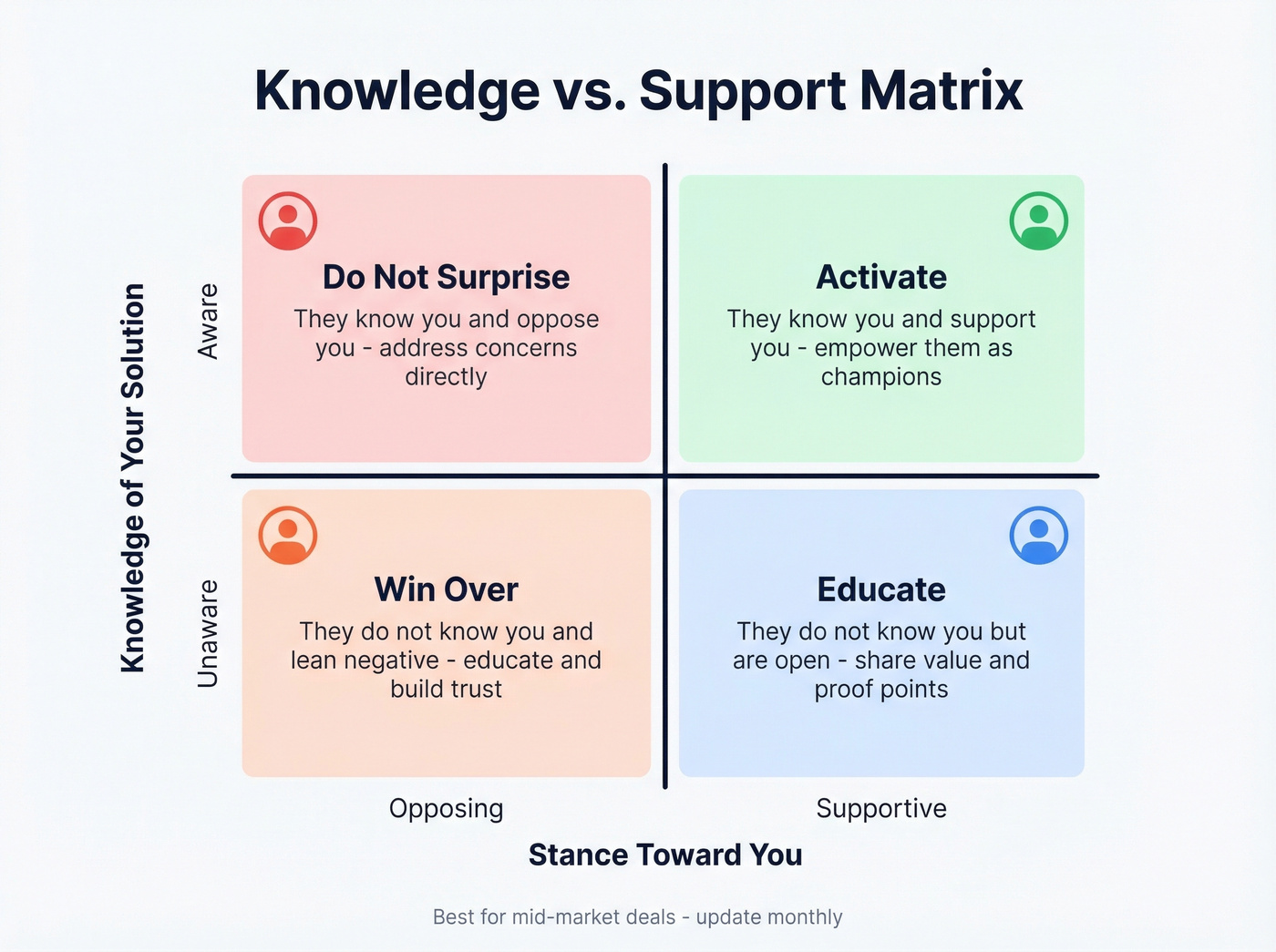
Knowledge vs. Support Matrix. Plot stakeholders on two axes: aware vs. ignorant of your solution, and supportive vs. opposing. Four quadrants - people to educate, people to win over, people to activate, and people not to surprise. This is the simplest framework and the one that works best for mid-market deals.
Salience Model. Categorize stakeholders by power, legitimacy, and urgency. Someone with all three is your definitive stakeholder - the person who can greenlight or kill the deal. This model is heavier but useful for enterprise accounts with 15+ people involved.
The practical workflow: brainstorm every name, categorize each by role, visualize the relationships, prioritize by power and interest, finalize in a shared workspace, and update monthly.
Now the part every template glosses over. You mapped 14 stakeholders. You have emails for six. Three bounce. Your plan is only as good as your ability to actually reach the people on it. In our experience, stale contact data is the silent killer of otherwise solid account plans - we've seen teams with great strategy lose deals simply because they couldn't get in front of the right person.
Prospeo fixes this. Paste a company URL or upload a CSV of names and get verified emails at 98% accuracy and direct mobile numbers, refreshed on a 7-day cycle. With 300M+ professional profiles and 125M+ verified mobiles, you're working from verified records, not guesses. If you're comparing vendors, start with a shortlist of data enrichment services and pick based on refresh rate and verification.

The whitespace analysis you just built is worthless if you can't reach the new contacts in those departments. Prospeo's 30+ search filters let you find every decision-maker by department, seniority, and company - then enrich your CRM with 50+ data points per contact at $0.01 per email.
Fill every cell in your whitespace grid with a real, reachable contact.
Filled-In Account Plan Example
Templates are abstract until you see one filled in. Here's a realistic example for a fictional mid-market account.
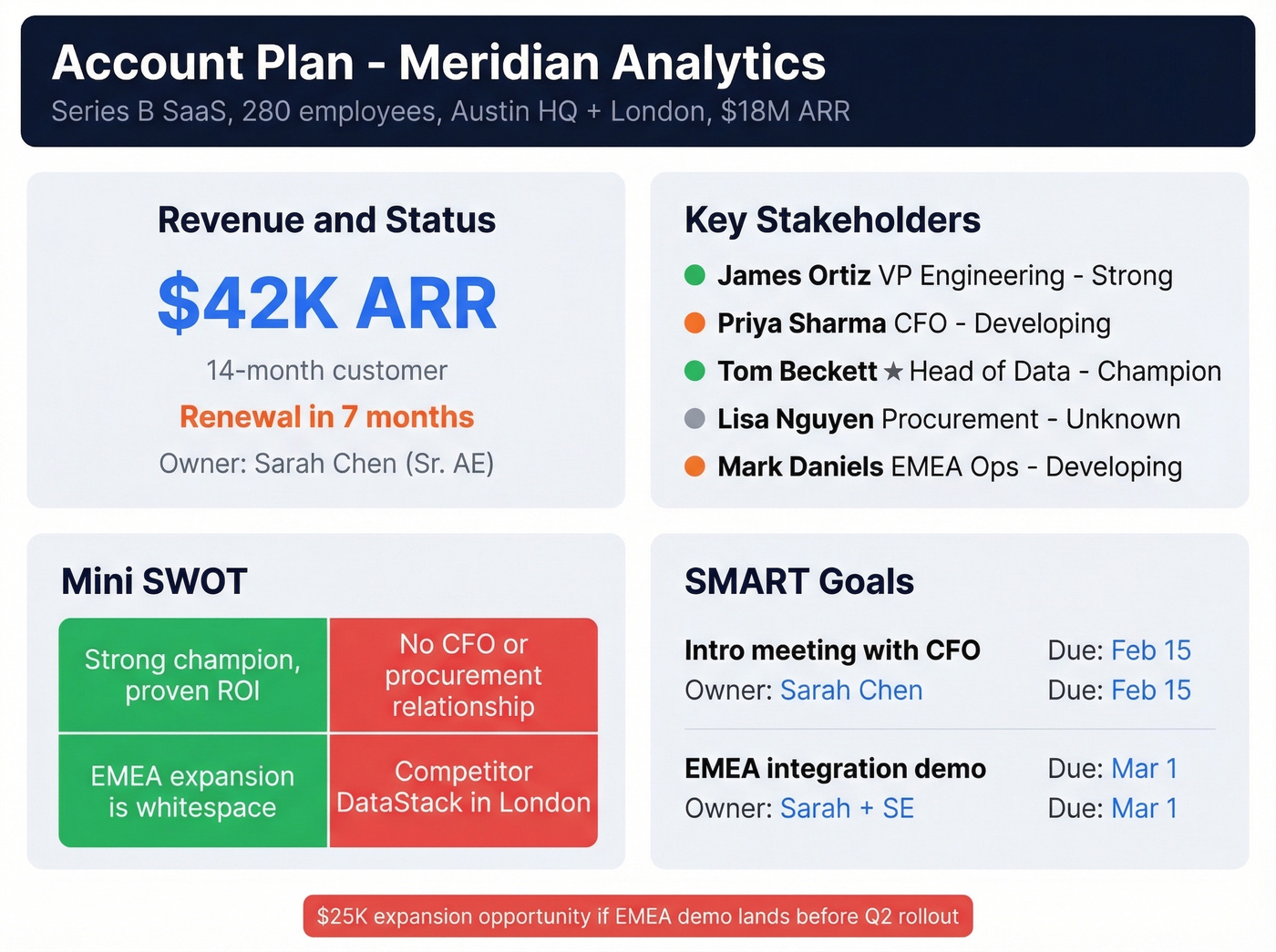
Account: Meridian Analytics - Series B SaaS, 280 employees, $18M ARR, Austin HQ with a London office. Current customer on a $42K annual contract for your analytics integration product. Renewal in 7 months. Account owner: Sarah Chen (Senior AE).
| Section | Details |
|---|---|
| Revenue | $42K ARR (current) |
| Relationship | 14-month customer, expanding |
| Fiscal Year End | December 31 |
Stakeholders:
| Name | Role | Type | Relationship |
|---|---|---|---|
| James Ortiz | VP Engineering | Decision-maker | Strong |
| Priya Sharma | CFO | Decision-maker | Developing |
| Tom Beckett | Head of Data | Champion | Strong |
| Lisa Nguyen | Procurement Lead | Gatekeeper | Unknown |
| Mark Daniels | EMEA Ops Director | End user | Developing |
Customer Objectives:
- Reduce data pipeline latency by 40% before Q3 - success metric: sub-2-second query times.
- Expand analytics capabilities to London office by Q2 - success metric: 30+ EMEA users onboarded.
- Consolidate three vendor contracts into two - success metric: $60K annual savings.
Mini SWOT:
| Positive | Negative | |
|---|---|---|
| Internal | Strong champion (Tom Beckett), proven ROI from Year 1 | No relationship with CFO or procurement |
| External | EMEA expansion = whitespace | Competitor (DataStack) already in London office |
Whitespace Opportunity: Meridian's London office runs DataStack for basic reporting. Their EMEA Ops Director has expressed frustration with DataStack's API limitations. This is a $25K expansion opportunity if you can demo your EMEA-ready integration before their Q2 rollout.
SMART Goals:
| Goal | Owner | Due Date |
|---|---|---|
| Secure intro meeting with CFO Priya Sharma | Sarah Chen | Feb 15 |
| Deliver EMEA integration demo to Mark Daniels | Sarah Chen + SE | Mar 1 |
Review Cadence: Monthly 15-minute check-in (first Tuesday). Quarterly deep dive with sales leadership (March, June, September, December).
That plan took 25 minutes to fill out because the stakeholder data was already verified and the objectives came from real conversations. One page, maybe two. That's all you need.
Common Mistakes (and Fixes)
Only 28% of sales leaders trust their account management to hit cross-sell targets. Let's break down what's going wrong.
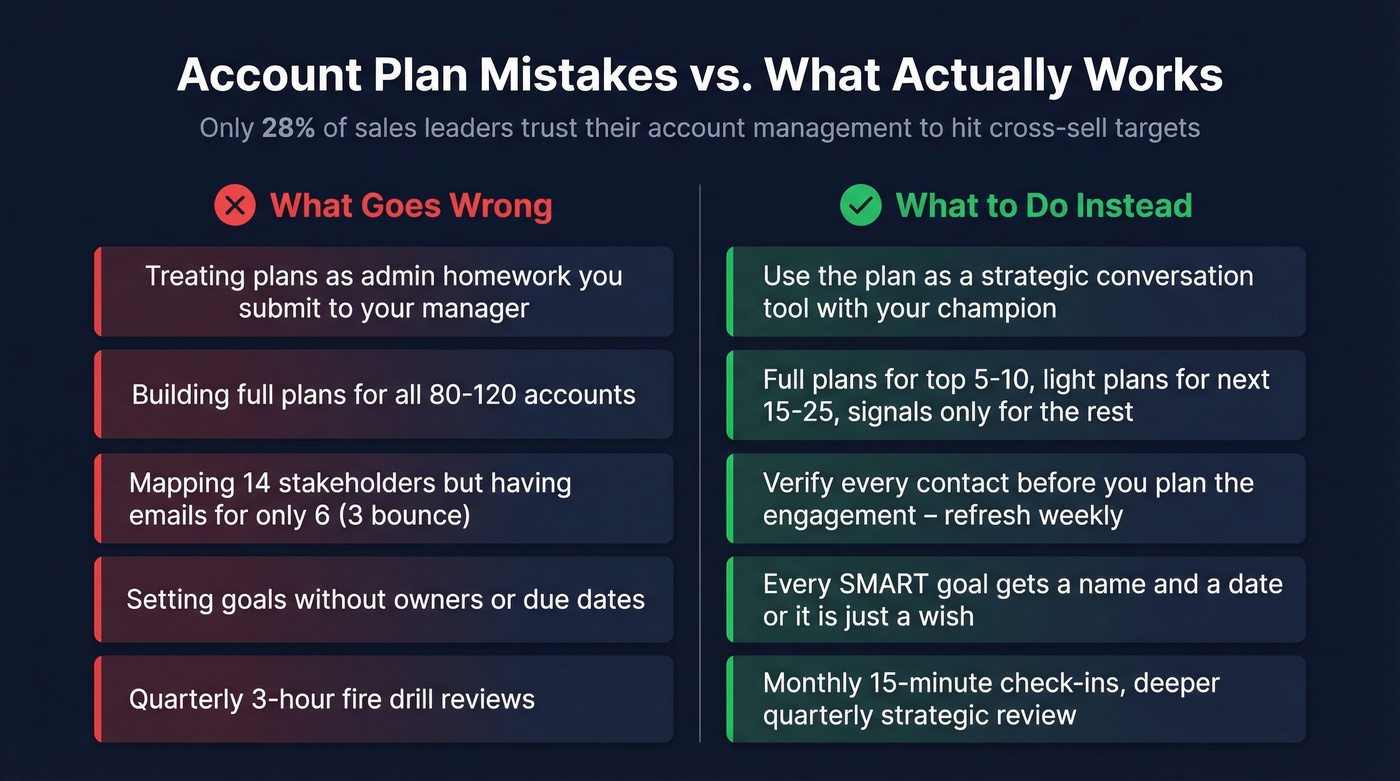
The biggest killer is treating plans as admin homework - a form to submit to your manager rather than a strategic conversation with your champion. If your plan reads like a pitch deck built from your product's feature list, start over. Start from the customer's initiatives, pains, and compelling events.
Planning every account equally is the second most common mistake. Cap full plans at 5-10 per rep. Anything more dilutes effort to the point of uselessness. The Reddit CSM managing 120 accounts had it right: you can't build detailed plans for 50+ accounts and expect any of them to get maintained.
Two more mistakes that compound each other: skipping whitespace analysis and writing vague goals. Build the business unit x product grid - it takes 10 minutes and it's where expansion revenue lives. Then make every goal specific. "Improve executive engagement" isn't a goal. "Secure meeting with CFO by March 15" is. Every goal gets a name and a date.
And the set-and-forget trap. Monthly 15-minute reviews. If you only look at the plan quarterly, it's already stale by the time you open it. Keep the plan where your team already works - Salesforce, HubSpot, Notion, wherever. A plan in a forgotten Google Doc is a plan that doesn't exist. If you're trying to operationalize this, treat it like sales execution, not documentation.
From Static Template to Living Plan
The quarterly slide deck is dead the moment a stakeholder changes roles. And stakeholders change roles constantly - your beautifully formatted PowerPoint becomes fiction within weeks.
The modern approach treats account plans as living documents fed by continuous signals: hiring alerts, leadership changes, product launches, funding rounds. When your champion gets promoted or your blocker leaves, the plan should update - not wait for the next QBR. The tool stack that makes this work is straightforward: your CRM for the plan itself, a contact data provider with weekly refresh cycles for data freshness, and a collaboration tool for cross-functional input. If you need a system for those signals, start with how to track sales triggers.
Free Templates to Download
Don't overthink the format. Pick one, start filling it in, and iterate.
Smartsheet offers the most complete free set - Excel, Word, and PowerPoint versions with sample text already filled in. The templates are free downloads, though Smartsheet has paid plans for collaboration features. HubSpot's free CRM template works well if you're already in their ecosystem. Atlassian's Confluence template is solid for cross-functional input. Notion is the lightweight option - free for personal use, $10/user/month for teams.
Skip the fancy tools if you're just starting out. A plain Google Sheet works fine for proving the habit before investing in software. If you're evaluating where the plan should live, compare a few examples of a CRM and pick the one your team actually updates.
FAQ
How long should an account plan be?
One to two pages max. If it takes more than 30 minutes to fill out, it's too complex and nobody will maintain it. Focus on the five core sections - snapshot, stakeholder map, SWOT, action plan, review cadence - and add complexity only after you've nailed the basics for two quarters.
How many accounts need a full plan?
Full plans for your top 5-10 strategic accounts per rep. Lighter one-page plans for 15-25 growth accounts. Everything else gets signal monitoring only - trying to maintain 50+ detailed plans guarantees none of them stay current.
How often should I update my plan?
Monthly 15-minute reviews for stakeholder changes and action-item progress. Deeper strategic review quarterly. Put both on the calendar the day you create the plan - reviews that aren't scheduled don't happen.
What's the fastest way to get contact data for mapped stakeholders?
Paste a company URL into Prospeo's email finder or upload a CSV of names to get verified emails (98% accuracy) and direct dials in seconds. The free tier includes 75 email credits per month - enough to fill contact gaps across several strategic accounts without spending a dollar.
How is an account plan different from a go-to-market strategy?
A go-to-market strategy targets a market or segment - it defines positioning, messaging, and channels for a broad audience. An account plan narrows that focus to a single strategic account, mapping specific stakeholders, whitespace, and SMART goals. Think of the account plan as the execution layer that turns broader strategy into concrete, account-level actions with owners and deadlines.