


Accutrend vs Cognism: A Comparison That Doesn't Make Sense (And What You Actually Need)
Your VP asked you to compare Accutrend vs Cognism, and five minutes in you realized they aren't even the same category of product. Accutrend sells government-sourced business registry data - SOS filings, UCC records, liquor licenses. Cognism sells B2B sales intelligence with verified contact details and a European focus. Comparing them is like comparing a county records office to a sales engagement platform.
The quick version:
- Need US business filings data? Accutrend - but read the contract terms first.
- Need European B2B contacts with phone-verified mobiles? Cognism, if you've got a ~$22.5K/year budget for a 5-user setup.
What Is Accutrend?
Accutrend has been around since 1989. It's a small team of roughly 15 people compiling business data from government sources - processing 500,000+ records per month across 100+ fields, pulling from 50-state Secretary of State filings, UCC records, UBO datasets, and niche registries like liquor licenses. Coverage spans the US, Canada, and Mexico, delivered via API, dashboard, or CSV.
Use this if you need government-sourced business registry data for compliance, risk, or lending use cases.
Skip this if you need a classic outbound prospecting database. Accutrend's core products are filings and registry datasets, not a self-serve system for verified outreach emails and direct dials at scale. There are zero reviews on G2 or Capterra. The only independent signal is a 2.9/5 on Glassdoor from four reviews, with employees flagging outdated data infrastructure.
What Is Cognism?
Cognism is a B2B sales intelligence platform with a strong European focus, scoring 4.5/5 on G2 from 1,318 reviews. Its flagship feature is Diamond Data - phone-verified mobile numbers that connect with 87% of your list, per Cognism's own benchmarks. They also screen data against do-not-call lists in 15 countries, which matters a lot for outbound in the UK and across the EU.
Use this if you're an enterprise team focused on EMEA outbound and need phone-verified mobiles with compliance coverage.
Skip this if you're budget-conscious. There's no free plan and typically no month-to-month self-serve option; Cognism is sold via sales-led contracts. Pricing for a 5-user Grow setup benchmarks around $22,513/year. G2 reviewers consistently flag inaccurate data and missing mobile numbers as recurring pain points - worth testing before committing. Also worth knowing: Cognism settled a class action (Kis v. Cognism) over profiles being viewable by free-trial users, with payouts ranging from $22.50 to $150.
Side-by-Side Comparison
| Data type | Business registry | B2B sales intelligence | B2B contact data |
| Primary use | SOS, UCC, UBO lookups | EMEA outbound sales | Verified emails + mobiles |
| Pricing model | Quote-based licensing | Platform + per-seat | Credit-based, self-serve |
| Annual cost | Mid-five figures (est.) | ~$22,513/yr (5 users, Grow) | ~$0.01/email, free tier |
| Contract | 5-year data lease | Annual; 10-15% renewal increases | No contract |
| Data freshness | Updated every 24 hours | Not disclosed | 7-day refresh cycle |
| Geography | US, Canada, Mexico | Europe + global | Global (300M+ profiles) |
| Reviews | None (G2/Capterra) | G2: 4.5/5 (1,318) | 15,000+ companies using |
| Compliance | CCPA/GDPR compliant | DNC in 15 countries | GDPR, DPAs available |
| Best for | Filings research | Enterprise EMEA teams | Self-serve sales teams |
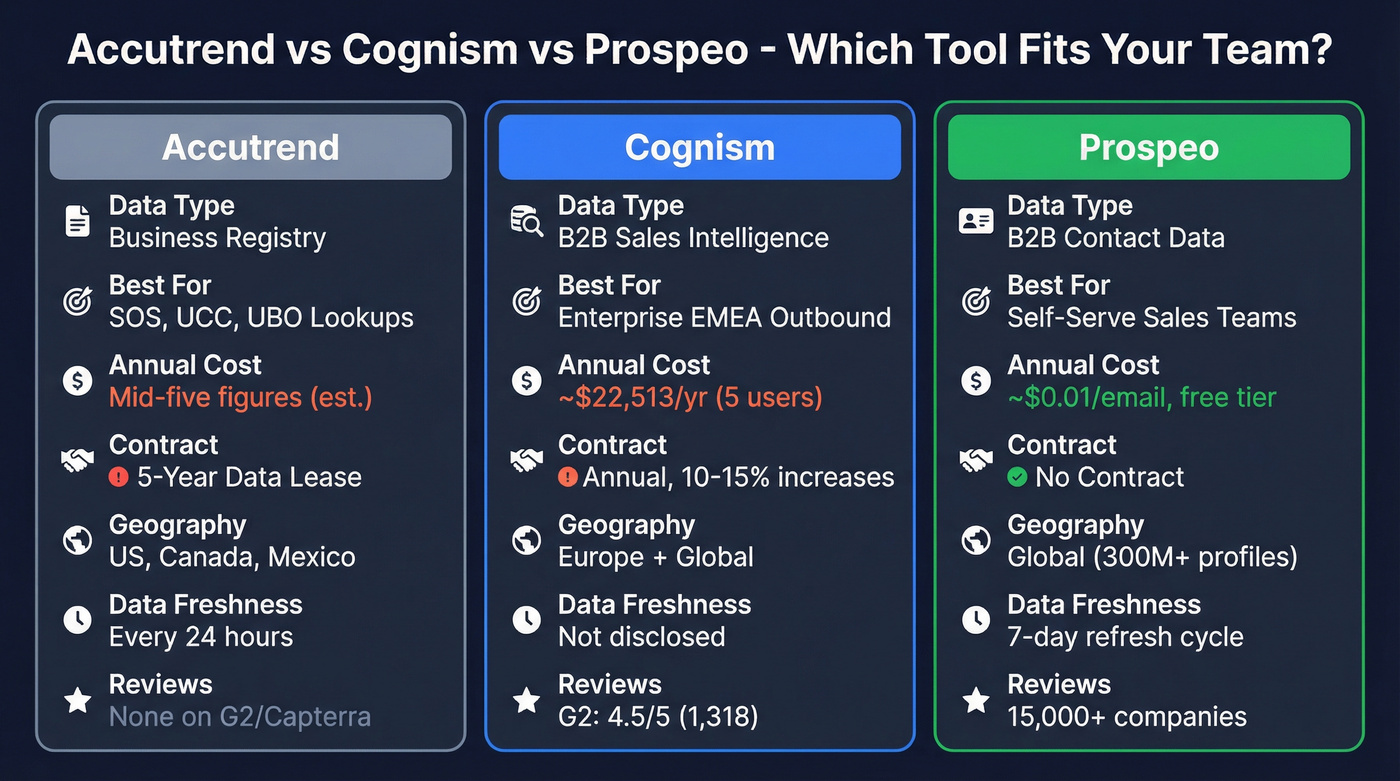
These aren't competing products. They're different tools for different jobs.

Accutrend locks you into a 5-year data lease. Cognism starts at ~$22.5K/year with fair-use caps. Prospeo gives you 300M+ profiles with 98% email accuracy and 125M+ verified mobiles - refreshed every 7 days, at $0.01/email, with zero contracts.
Get accurate B2B data today without signing your next five years away.
Pricing Breakdown
Accutrend doesn't publish pricing. The real catch is the contract: full-file data leasing runs on 5 consecutive 12-month terms with 90-day termination notice. You only get perpetual use rights after completing all five years. Terminate early, and you return all data files. Let's be honest - we've seen teams sign 5-year data leases and regret it by year two, when their needs have shifted and they're stuck paying for data they barely touch.
If you're evaluating vendors like this, it helps to understand what you're actually buying in B2B company data (registry records vs. contact-level data vs. enrichment).
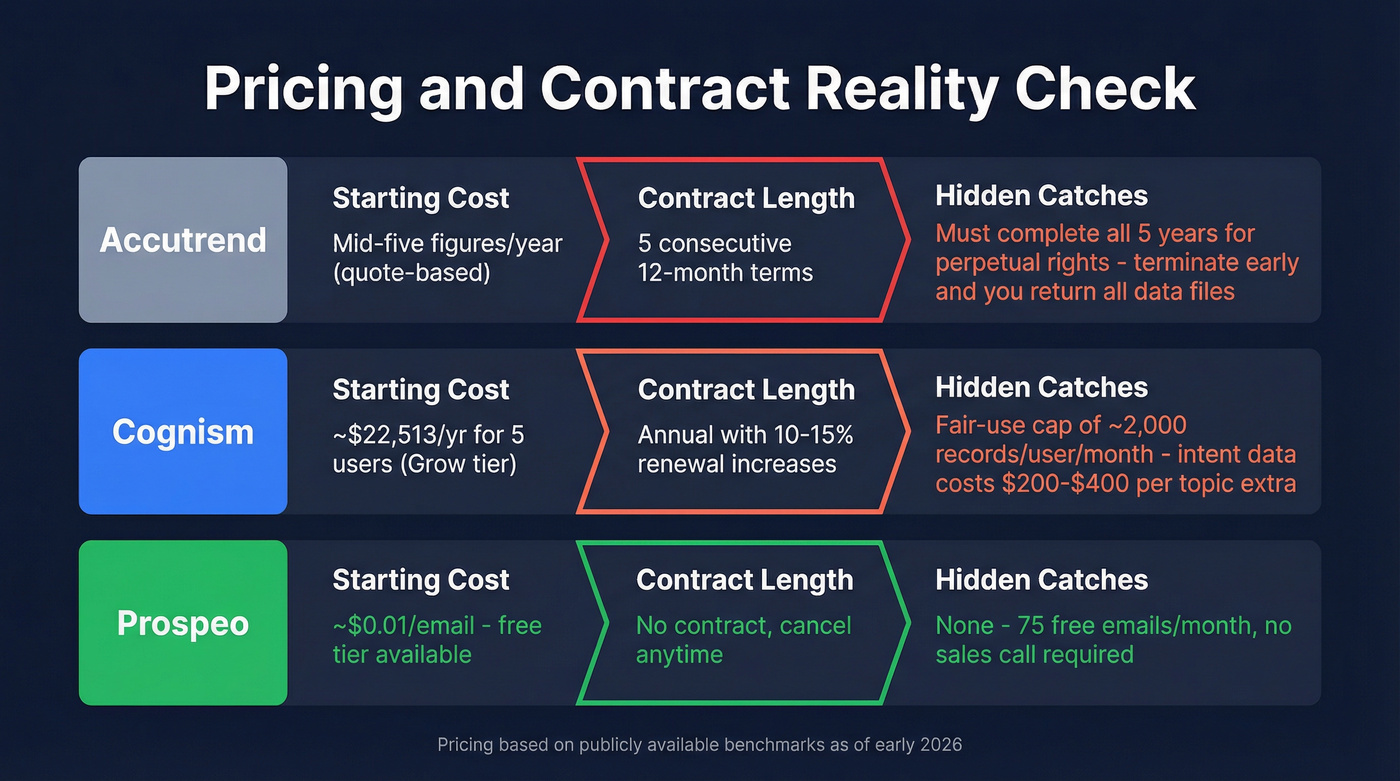
Cognism runs a platform-fee-plus-seats model. The Grow tier starts around $15,000/year in platform fees plus ~$1,500 per user. Elevate (with Diamond Data) jumps to ~$25,000 platform plus ~$2,500/user. A 5-user Grow setup benchmarks around $22,513/year. Despite "unrestricted" framing, there's a fair-use cap of roughly 2,000 records per user per month. Intent data costs extra - $200-$400 per topic, and most teams need 8-15 topics. Expect 10-15% renewal increases annually.
Prospeo costs roughly $0.01 per email. The free tier gives you 75 emails and 100 Chrome extension credits per month. No contracts, no sales calls, cancel anytime.
The Better Option for Most Teams
Here's the thing: if your deal sizes are under $50K and your team is under 20 reps, you don't need either Accutrend or Cognism. You need accurate contact data without the overhead.
Prospeo covers 300M+ professional profiles with 98% email accuracy, 143M+ verified emails, and 125M+ verified mobiles pulling a 30% pickup rate. Data refreshes every 7 days - most competitors take 6 weeks. You get 30+ search filters including buyer intent powered by Bombora, technographics, and job change signals, with native integrations into Salesforce, HubSpot, Smartlead, Instantly, Lemlist, Clay, Zapier, and Make. One of our customers, Snyk, cut their bounce rate from 35-40% to under 5% and saw AE-sourced pipeline jump 180% after switching.
If you're building a stack around outbound, pair your data source with solid sales prospecting techniques and a repeatable lead generation workflow.

We've watched teams spend months evaluating enterprise platforms when what they actually needed was accurate data without a 5-year contract or a $22K annual commitment. If deliverability is part of the pain, start with email bounce rate benchmarks and an email deliverability guide before you scale volume.
Snyk's 50 AEs dropped their bounce rate from 35-40% to under 5% and grew AE-sourced pipeline 180% with Prospeo. No enterprise contract negotiations, no per-seat platform fees - just verified emails and direct dials that actually connect.
75 free emails per month. No sales call required. See the data quality yourself.
Which One Should You Pick?
Three paths:
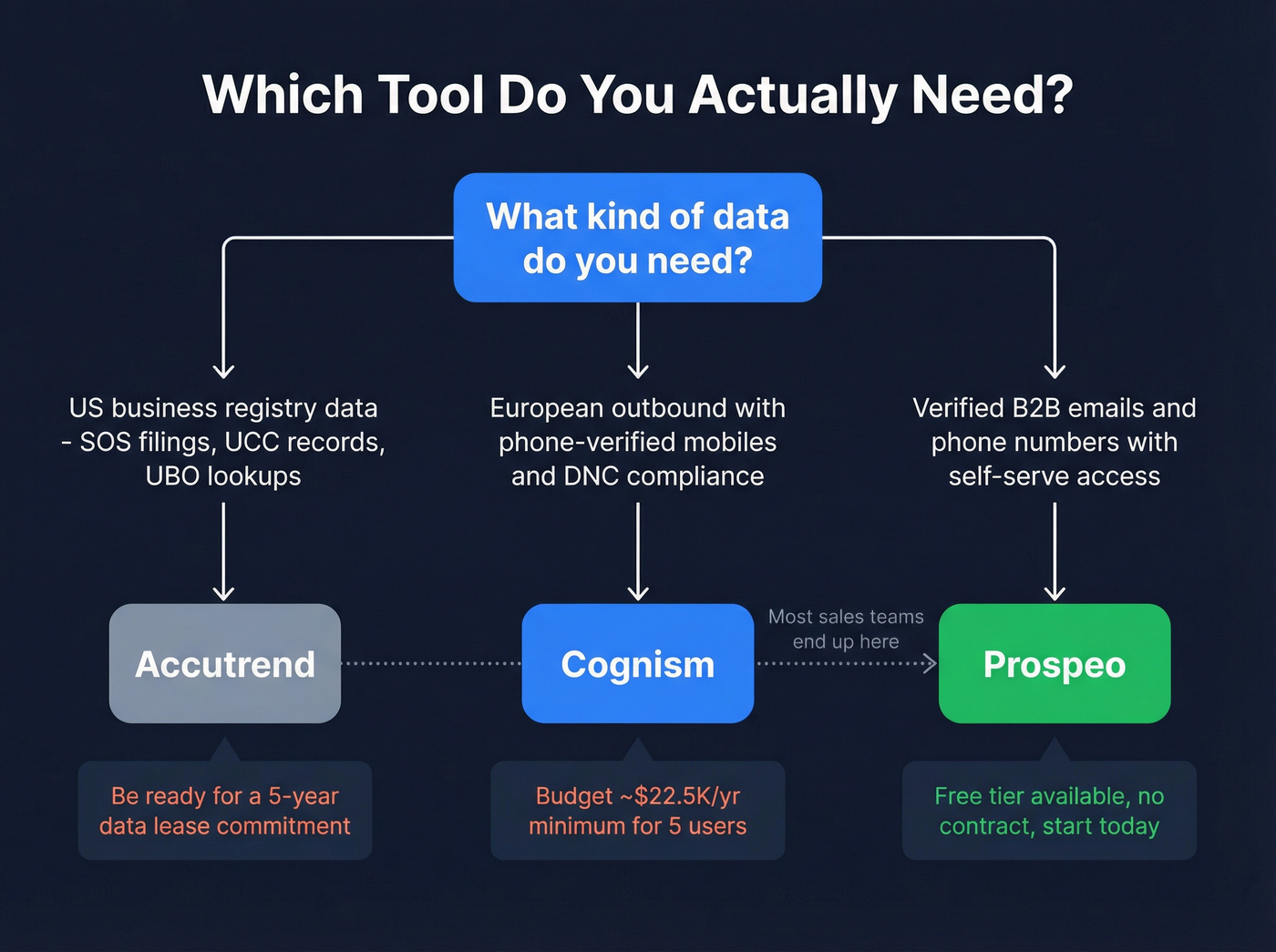
Pick Accutrend if you specifically need US business registry data - SOS filings, UCC records, UBO lookups - for compliance, risk, or lending workflows. Go in with eyes open on that 5-year data lease.
Pick Cognism if you're an enterprise team running European outbound and you've got a ~$22.5K/year budget for phone-verified mobiles with DNC compliance across 15 countries.
Pick Prospeo if you need verified B2B emails and phone numbers, want self-serve access today, and don't want to sign a multi-year contract. For most sales teams weighing Accutrend vs Cognism, that's the real answer. If you're still shopping, compare options in our guide to sales prospecting databases.
FAQ
Are Accutrend and Cognism direct competitors?
No. Accutrend provides government-sourced business registry data like SOS filings and UCC records. Cognism is a B2B sales intelligence platform for outbound prospecting. They serve entirely different use cases - registry compliance vs. contact-level outreach.
Does Cognism have a free plan?
No. Cognism is sold via sales-led contracts with platform fees plus per-seat costs. A 5-user Grow setup benchmarks around $22,513/year, and renewal increases of 10-15% annually are standard.
What's a good self-serve alternative to both?
Prospeo - 300M+ profiles, 98% email accuracy, 125M+ verified mobiles, and a free tier with 75 emails per month. It's the self-serve option most sales teams actually need when neither registry data nor enterprise EMEA contracts fit the budget.