

ActiveCampaign vs HubSpot: The Honest Comparison for 2026
ActiveCampaign is an email automation tool that added a CRM. HubSpot is a CRM that added email automation. Too many comparisons treat them as interchangeable - they solve fundamentally different problems, and the right pick depends on which problem you actually have.
30-Second Verdict
ActiveCampaign wins for: email-first marketing teams under 5 people who need deep automation at a reasonable price.
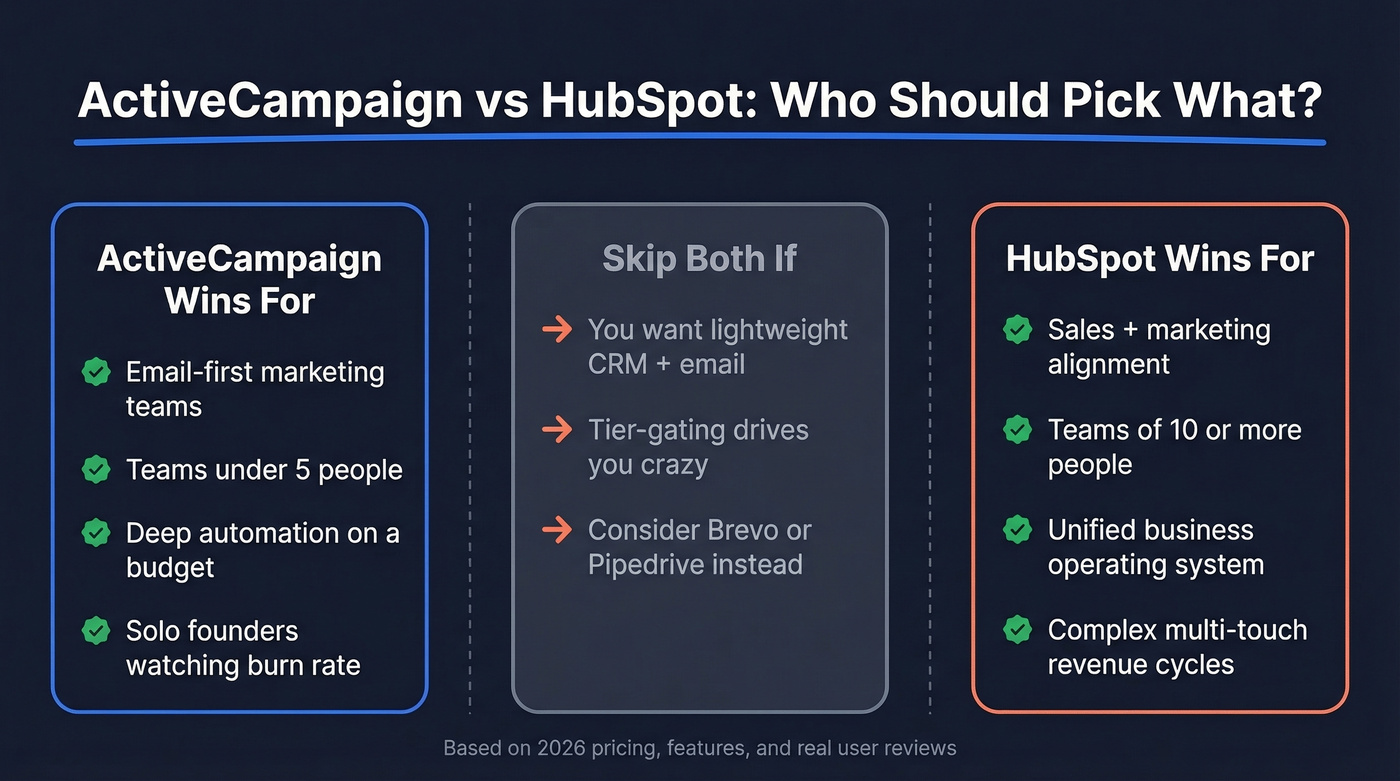
HubSpot wins for: sales + marketing alignment with 10+ people who need a unified operating system.
Skip both if you need a lightweight CRM plus a dedicated email tool without tier-gating headaches. Consider Brevo or Pipedrive paired with a standalone email platform.
What Each Platform Actually Is
ActiveCampaign is built for marketers who think in workflows. Its automation builder is the core product - everything else (CRM, landing pages, SMS) orbits around it. The user base reflects this: 91.9% of G2 reviews come from small businesses. It's a tool that does one thing exceptionally well and bolts on the rest.
HubSpot is a business operating system that happens to include email marketing. The Smart CRM sits at the center, with Marketing Hub, Sales Hub, Service Hub, and Content Hub radiating outward. Its review base is more evenly distributed across company sizes, and the platform is designed for teams that want everything in one place. HubSpot can feel overwhelming for solo users or very small teams - a point that comes up repeatedly in user feedback. Both carry identical 4.4/5 ratings across ~14,600 reviews each, which tells you nothing useful. The composition of those reviews tells you everything.
Pricing Breakdown
Here's where the conversation gets real. These two platforms don't just differ in features - they use entirely different pricing models. ActiveCampaign charges by contacts. HubSpot's Marketing Hub pricing is seat-based at Starter, then moves to a base platform price at Professional and Enterprise with a set number of seats included.
HubSpot also offers a free CRM tier that's genuinely useful for contact management and basic deal tracking. But it lacks marketing automation entirely, so don't mistake it for a real marketing platform.
Side-by-Side Pricing (2,500 Contacts / 5-Person Team)
| Tier Level | ActiveCampaign | HubSpot Marketing Hub |
|---|---|---|
| Entry | Starter: $39/mo (1 seat, 5 actions/automation) | Free CRM or Marketing Hub Starter: $9/seat/mo (annual) |
| Mid | Plus: $95/mo (1 seat, unlimited actions) | Marketing Hub Professional: $800/mo (includes 3 seats, $3K onboarding) |
| Advanced | Pro: $149/mo (3 seats, predictive sending) | Marketing Hub Enterprise: $3,600/mo (includes 5 seats, $7K onboarding) |
| Top | Enterprise: $255/mo (5 seats, custom reporting) | - |
Data per Zapier's comparison.
ActiveCampaign's Starter limitation is a dealbreaker for most real use cases. Five actions per automation sounds fine until you realize a basic welcome sequence with conditional branching needs 8-15 steps. You're effectively forced into Plus ($95/mo) for anything beyond the simplest drip campaigns.
HubSpot's jump from Starter ($9/seat/month) to Professional ($800/month plus $3,000 onboarding) is one of the most aggressive tier gaps in SaaS. You can be paying $9/seat on Starter and then hit an $800/month platform price the moment you need full marketing automation.
Year 1 Total Cost
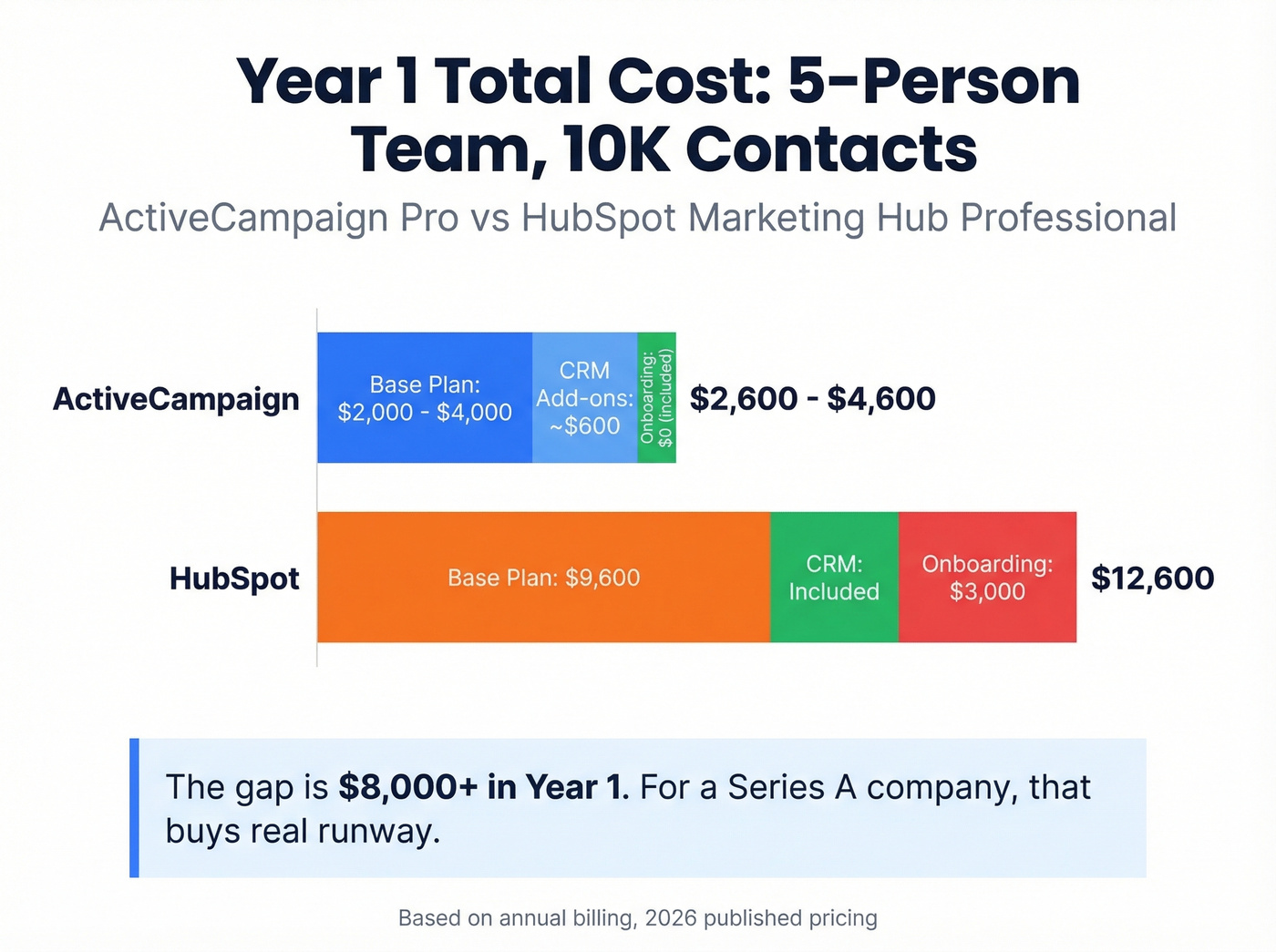
Below is a practical cost model for a 5-person team with 10K contacts. HubSpot's base pricing and onboarding fees are straightforward; ActiveCampaign's exact monthly price depends on the contact tier you select.
| Cost Item | ActiveCampaign (Pro + CRM add-ons) | HubSpot Marketing Hub Professional |
|---|---|---|
| Base plan + contacts (annual) | ~$2,000-$4,000 | $9,600 |
| Enhanced CRM add-ons (Pipelines + Sales Engagement) | ~$600+/year | Included |
| Onboarding | Included | $3,000 |
| Year 1 Total | ~$2,600-$4,600 | $12,600 |
We've modeled this cost scenario for dozens of teams - the gap is consistent. For a Series A company watching burn rate, saving $8,000+ in Year 1 buys a lot of runway. ActiveCampaign's CRM capabilities are add-ons, but even with pipelines and sales engagement bolted on, you're typically nowhere near HubSpot's price point at Professional.
Let's be honest: if your average deal size is under $15K, you almost certainly don't need HubSpot Professional. The platform pays for itself when you have complex, multi-touch revenue cycles with large deal sizes. For everyone else, you're paying for features you'll never configure.
Automation Depth
Use ActiveCampaign if you live and breathe email workflows. The visual automation builder is the core experience, and once you're on Plus or above, you get unlimited automation actions. Conditional logic, branching, wait steps, goal tracking - it's all there without hitting artificial ceilings. In our testing, ActiveCampaign's automation builder feels noticeably faster to configure than HubSpot's, especially for multi-branch sequences with 10+ decision points.
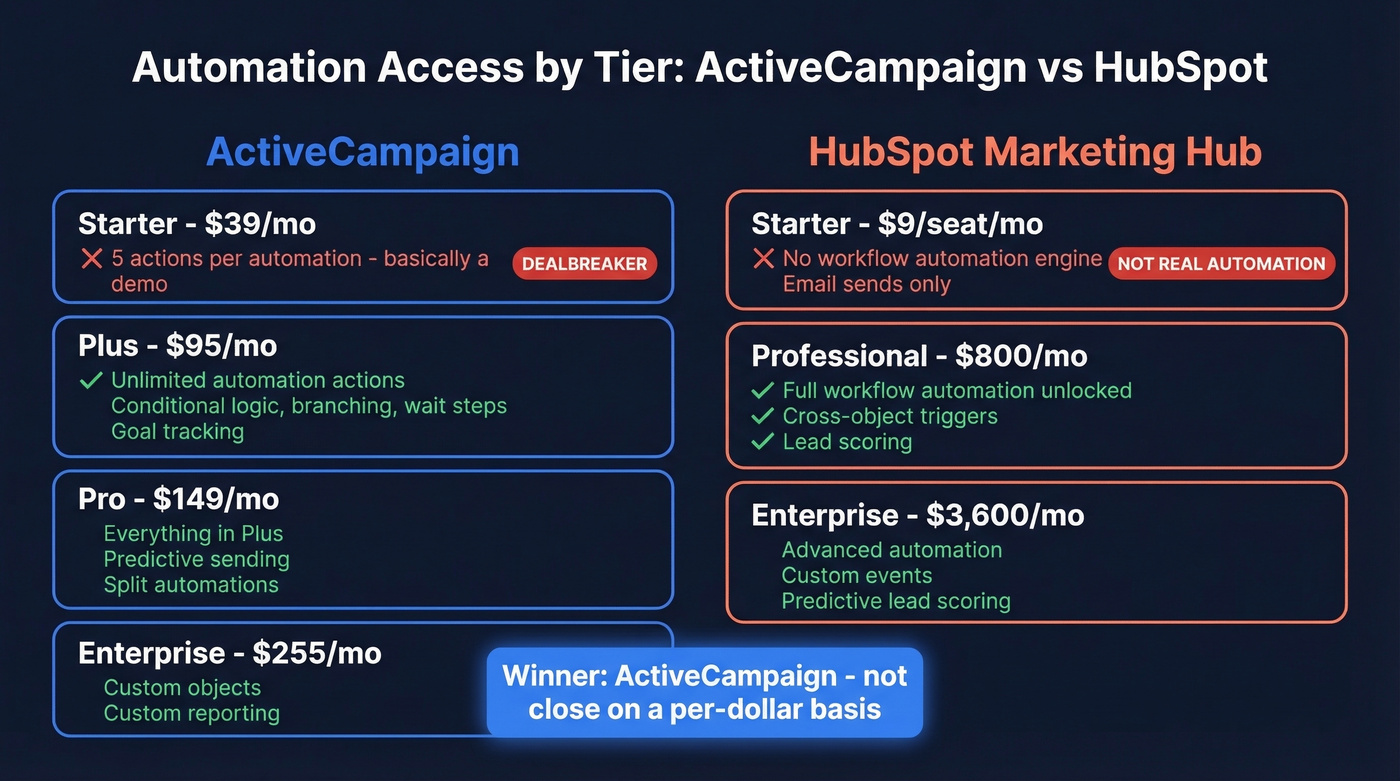
Skip ActiveCampaign's Starter if you need anything beyond a basic 5-step drip. Five actions per automation is a demo-tier limitation dressed up as a real plan.
Use HubSpot if you need automation that spans sales and marketing - auto-assigning leads, triggering sales tasks from marketing engagement, or syncing lifecycle stages across teams. But know that real marketing automation workflows start at the Professional tier ($800/month).
Skip HubSpot Starter for automation. It's a CRM with email sends. The workflow automation engine doesn't unlock until Professional.
Winner: ActiveCampaign, and it's not close on a per-dollar basis.
CRM and Sales Pipeline
HubSpot's CRM is the whole point of the platform. The native Smart CRM unifies contacts, deals, tickets, and reporting in a single data model. Built-in calling, meeting scheduler, and calendar sync make it a genuine sales operating system. Pipeline management connects directly to marketing attribution, so you can trace revenue back to the campaign that sourced it. The tradeoff is that pipeline count and feature access are tier-gated - you pay more as your needs grow.
ActiveCampaign takes a different approach. Its CRM offers unlimited pipelines at all tiers, per Zapier's testing, and simpler deal tracking that works well for email-centric sales processes. But the CRM is an add-on, not the core product, and it isn't as sales-OS-centric as HubSpot. One Reddit user documented a painful HubSpot-to-ActiveCampaign migration where automations broke, calling disappeared, and integrations kept failing. That story isn't unique - the CRM gap between these platforms is real.
Despite both platforms touting ease of use, HubSpot scores 8.6 vs ActiveCampaign's 8.2 on G2's Ease of Use metric - likely because HubSpot's UI is more polished even if its feature depth is shallower at lower tiers.
Winner: HubSpot. If CRM is a priority, this isn't a contest.

ActiveCampaign and HubSpot both depend on clean contact data to drive results. Bad emails kill automations, tank deliverability, and waste your CRM spend. Prospeo gives you 98% verified emails at $0.01 each - with a 7-day refresh cycle so your CRM never runs on stale data.
Stop feeding bad data into a good CRM. Start with Prospeo.
Email Marketing and Deliverability
Both platforms get email marketing right at a basic level. Review data shows 1,111 mentions of "Email Marketing" as a HubSpot strength. ActiveCampaign offers A/B testing from Starter and send limits that scale with your contact tier (10x at Starter/Plus, 12x at Pro, 15x at Enterprise).
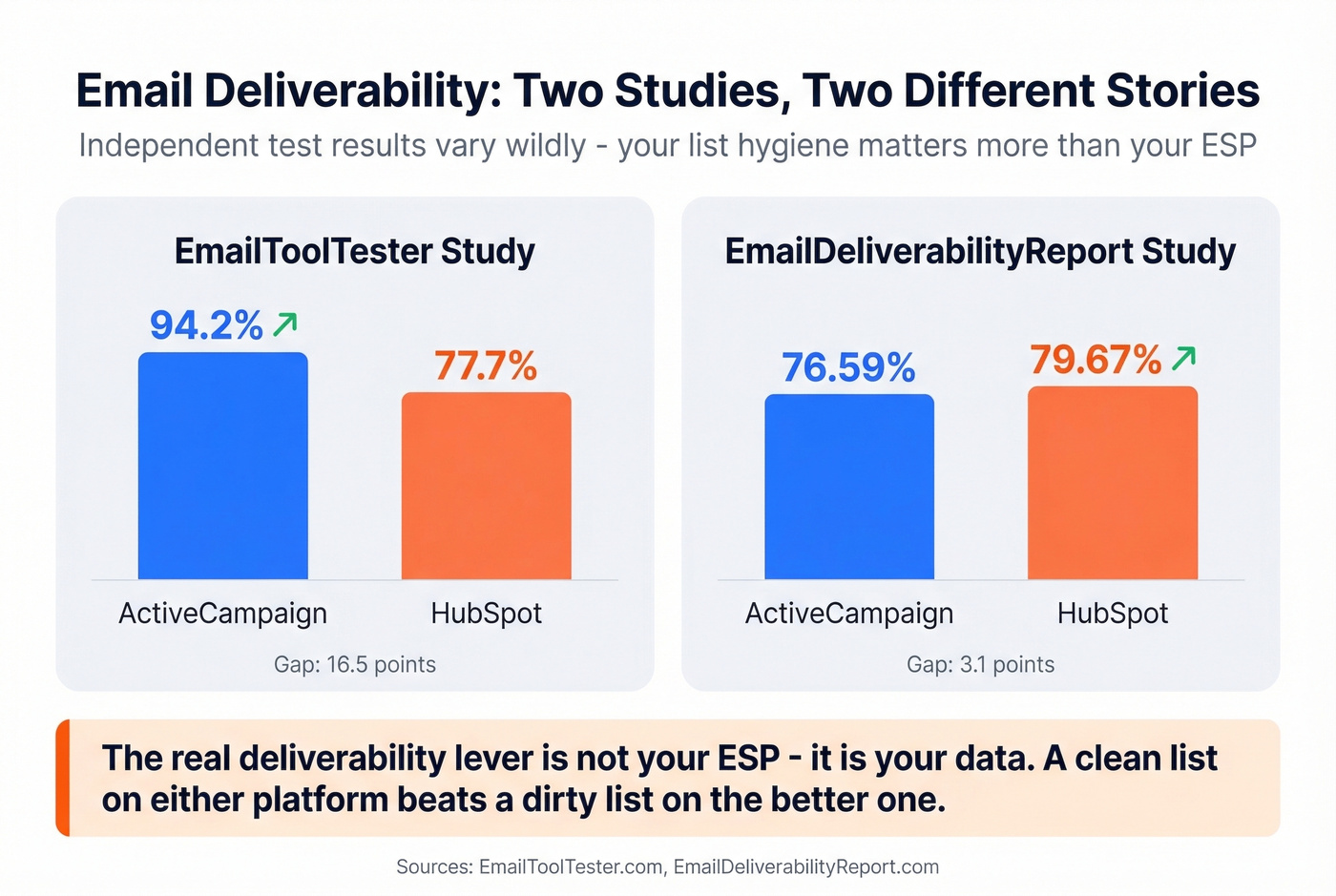
Here's where it gets interesting - and contradictory. Two independent deliverability studies tell opposite stories:
- EmailToolTester: ActiveCampaign 94.2% vs HubSpot 77.7%
- EmailDeliverabilityReport: ActiveCampaign 76.59% vs HubSpot 79.67%
The gap varies by provider - HubSpot tends to edge ahead on Gmail inbox placement while ActiveCampaign performs better on some corporate email servers. But deliverability depends on your list hygiene, authentication setup, and sending practices far more than which logo is on your email builder. A clean list on either platform will outperform a dirty list on the "better" one. We've seen teams with 95%+ inbox rates on both platforms - and teams bouncing 20%+ on both.
The real deliverability lever isn't your ESP. It's your data. Pairing either platform with a verification tool like Prospeo - 98% email accuracy on a 7-day refresh cycle - eliminates the bad-data variable entirely. (If you want the full playbook, start with our email deliverability guide.)
Winner: Tie. Anyone who tells you one platform categorically delivers better is selling you something.
Reporting, AI, and Integrations
Reporting
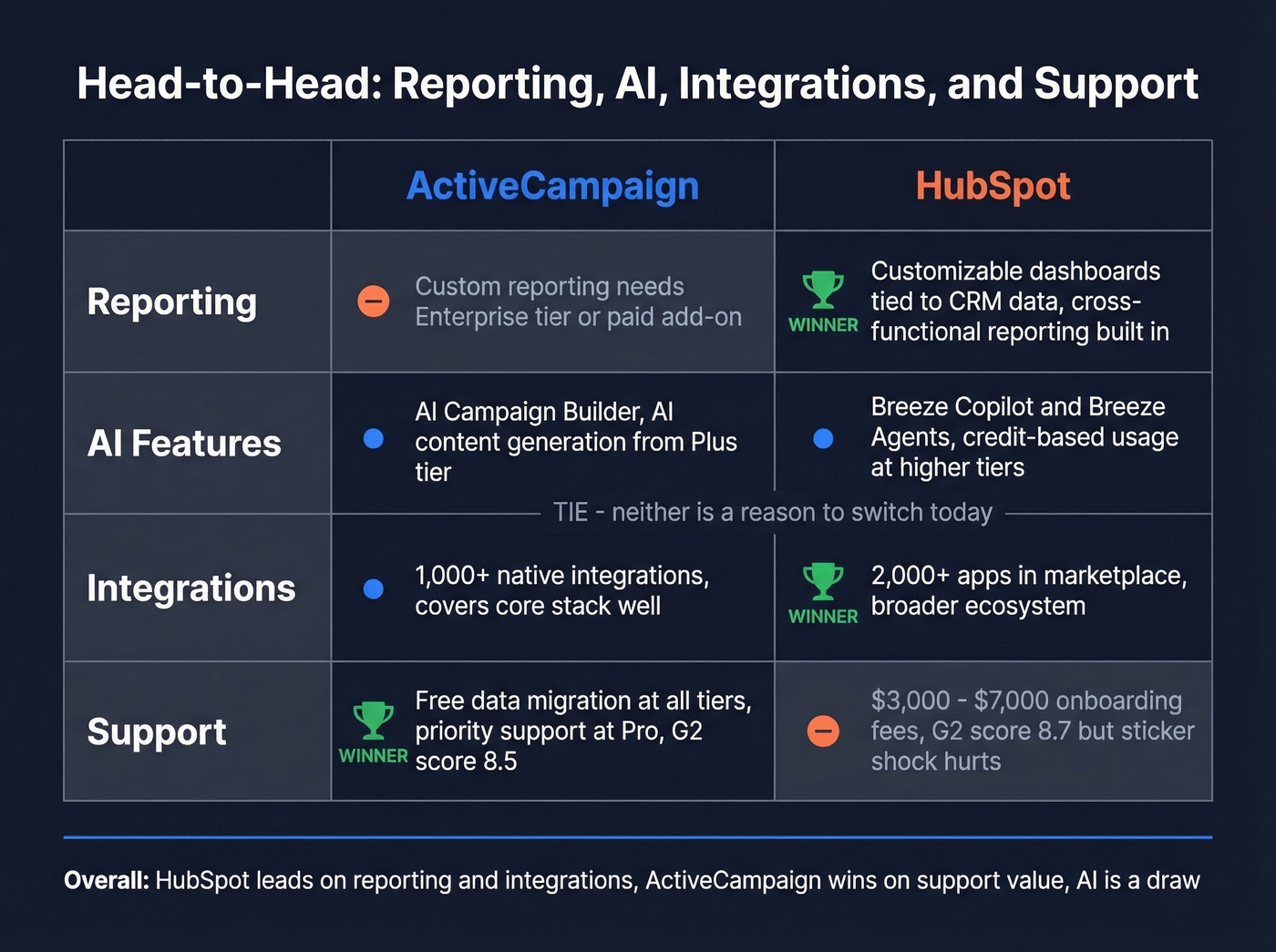
HubSpot's dashboards are more customizable and tie directly into CRM data, making cross-functional reporting straightforward. ActiveCampaign's custom reporting requires the Enterprise tier or a paid add-on. For teams that live in dashboards, HubSpot wins.
AI Features
Both platforms are pushing hard into AI, but their approaches differ. HubSpot's Breeze suite includes Breeze Copilot and Breeze Agents for in-app assistance and automation, with advanced functionality tied to higher-tier hubs and credit-based usage. ActiveCampaign includes an AI Campaign Builder, and AI content generation is available starting at Plus.
Neither platform's AI is a reason to switch today. Both are clearly investing here.
Integrations
HubSpot connects to 2,000+ apps through its marketplace. ActiveCampaign supports 1,000+ native integrations. Both work with Zapier, which closes most gaps. HubSpot's ecosystem is broader, but ActiveCampaign covers the core stack - Shopify, WooCommerce, Slack, Salesforce - without issues.
Support
ActiveCampaign includes free data migration at all pricing levels, and Pro adds priority support and advanced onboarding. HubSpot charges $3,000-$7,000 for onboarding at Professional and Enterprise. Review data shows similar satisfaction scores (ActiveCampaign 8.5 vs HubSpot 8.7 on support quality), but the cost difference matters. When you're already paying $800/month and then get hit with a $3,000 onboarding fee, the support experience starts with sticker shock.
ActiveCampaign wins on support value.
What Real Users Say
Both platforms score 4.4/5 on G2 across ~14,600 reviews each. The review composition tells a more useful story.
ActiveCampaign's top praise centers on "Easy to Use" (848 mentions) and "Automation" (787 mentions). Top complaints are "Learning Curve" (419) and "Expensive" (403). That "expensive" tag is interesting - it suggests users hitting contact-tier pricing walls as their lists grow, not that the base price is high.
HubSpot's top praise is "Ease of Use" (2,525 mentions) and "Email Marketing" (1,111). Top complaints are "Learning Curve" (808) and "Missing Features" (786). That "Missing Features" number is telling - it almost always means "missing at my tier." Features exist; they're just locked behind a higher price point.
On Reddit, HubSpot gets called a "money trap". The switching stories go both directions - people leave HubSpot for cost reasons and leave ActiveCampaign because the CRM can't keep up. Neither platform makes migration painless.
The Data Gap Neither Fills
Look, neither ActiveCampaign nor HubSpot is a dedicated B2B data platform for contact sourcing and real-time email verification. Both assume you're bringing clean data to the party. That's a dangerous assumption - bad contact data means bounced emails, broken automations, and wasted spend on sequences that never reach anyone.
Prospeo fills this gap with 300M+ professional profiles, 143M+ verified emails, and 98% email accuracy on a 7-day refresh cycle. It integrates natively with HubSpot, and you can connect it to ActiveCampaign through Zapier or Make so enriched contacts flow into your lists without manual cleanup. If you're comparing vendors, see our roundup of data enrichment services. Self-serve pricing starts free, with paid plans from ~$39/month.
Whichever platform you choose, the automation is only as good as the data feeding it. (Related: how to reduce bounce rate and protect your sender reputation.)
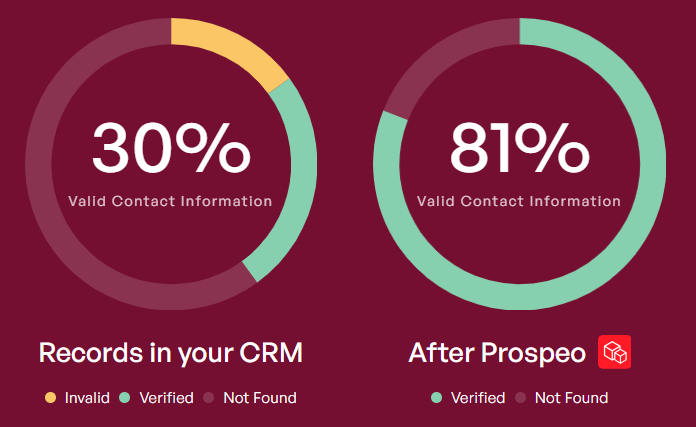
You just calculated Year 1 costs for HubSpot vs ActiveCampaign. Now consider what bad contact data costs you on top of that - bounced emails, burned domains, and missed pipeline. Prospeo enriches your CRM with 50+ data points per contact at a 92% match rate, so every dollar you spend on your CRM actually converts.
Enrich your HubSpot or ActiveCampaign CRM with data that actually connects.
Which Should You Pick?
| Scenario | Pick |
|---|---|
| Email-first team, fewer than 5 people, under 25K contacts | ActiveCampaign Plus or Pro |
| Sales + marketing alignment, 10+ people | HubSpot Professional |
| Budget-conscious, need CRM + email | Brevo or Pipedrive + dedicated email |
Here's the category scorecard:
| Category | Winner |
|---|---|
| Automation | ActiveCampaign |
| CRM | HubSpot |
| Email Marketing | Tie |
| Pricing | ActiveCampaign |
| Reporting | HubSpot |
| AI | Tie |
| Integrations | HubSpot |
| Support | ActiveCampaign |
The split is clear. ActiveCampaign wins on automation depth, price, and support value. HubSpot wins on breadth, CRM, and integrations. If you're a 3-person marketing team running email sequences on a budget, ActiveCampaign Pro at ~$149/month is hard to beat. If you're building a 15-person revenue team that needs sales, marketing, and service on one platform, HubSpot Professional's $800/month starts to make sense - even if the onboarding fee stings.
For budget-conscious teams, Brevo offers solid email marketing with a built-in CRM starting free, and Pipedrive gives you a clean sales pipeline at ~$14/seat/month. If you're building outbound alongside either CRM, borrow these sales prospecting techniques and keep a set of sales follow-up templates handy.
FAQ
Is ActiveCampaign really cheaper than HubSpot?
Yes, for most teams. ActiveCampaign Pro with CRM add-ons runs roughly $2,600-$4,600 in Year 1 for a 5-person team with 10K contacts, while HubSpot Marketing Hub Professional totals around $12,600 including its mandatory $3,000 onboarding fee. Even with extra pipeline and sales engagement add-ons, ActiveCampaign costs a fraction of HubSpot's mid-tier.
Which platform has better email deliverability?
Independent studies contradict each other - one puts ActiveCampaign at 94.2% vs HubSpot's 77.7%, while another reverses the gap. List hygiene, SPF/DKIM authentication, and sending practices matter far more than platform choice. Pair either tool with a verification service to eliminate bad-data bounces.
Can I migrate from HubSpot to ActiveCampaign?
Not always smoothly. Users report broken automations, missing CRM features like calling and calendar sync, and integration failures after switching. Budget 2-4 weeks for rebuilding workflows, and test thoroughly before cutting over.
Does HubSpot's free plan include marketing automation?
No. The free CRM handles contact management and basic deal tracking, but workflow automation requires Marketing Hub Professional at $800/month. HubSpot Starter ($9/seat/month) adds email sends but still lacks the full automation engine.
How do I keep contact data clean in either platform?
Use a dedicated data provider to verify emails and enrich records before importing. Neither platform sources or verifies B2B contact data natively. Prospeo's CRM enrichment returns 50+ data points per contact at a 92% match rate and integrates with both HubSpot (natively) and ActiveCampaign (via Zapier or Make).