

Adapt.io vs B2B Lists: Platform or Purchased Data?
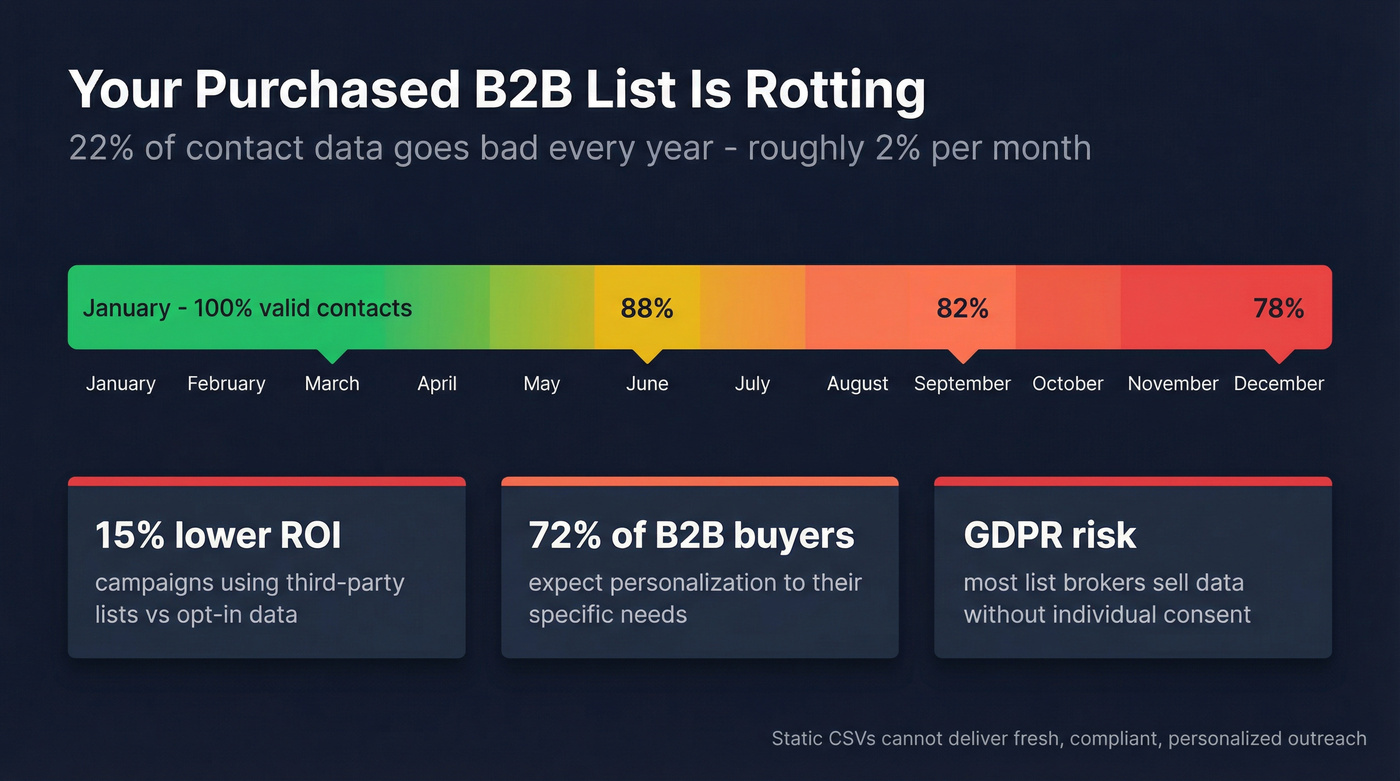
22% of B2B contact data goes bad every year. That means buying a static list in 2026 is basically buying a phone book. When you weigh Adapt.io against purchased B2B lists, the real question isn't which one to pick - it's whether you should be buying lists at all.
What "B2B Lists" Actually Means
"B2B lists" isn't a single product. It's a category that covers everything from shady scrape-and-sell operations to vendors like LakeB2B, which markets 450M+ verified business profiles with outcome-based SLAs and revenue-aligned pricing. The delivery model is fundamentally different from a self-serve platform, though. You're buying a static file. You don't pick the filters, and you don't control the freshness.
Why Purchased Lists Fail
Contact data decays at roughly 2% per month. A list you buy in January is missing nearly a quarter of its valid contacts by December, and campaigns using third-party lists see roughly 15% lower ROI than opt-in data. Meanwhile, 72% of B2B buyers now expect personalization to their specific business needs. A static CSV can't deliver that.
Compliance is the other landmine. Most list brokers sell data without individual consent, putting you on shaky ground under GDPR and CAN-SPAM. In our experience, the data is rarely as clean as the vendor promises. And the targeting problem is just as bad - you get what the vendor has, not what you need. No real-time filtering by tech stack, headcount growth, or buyer intent. Just a CSV and a prayer.
Adapt.io - What You Get
Adapt.io is a self-serve prospecting platform with 25+ search filters, a Chrome extension, CRM export options for Salesforce, HubSpot, and Pipedrive, and a 7-day free trial with no credit card required. The database size is murky - G2 cites 150M contacts while other sources put it at 250M+. The platform itself is straightforward to use, and the credit-based model is built around a shared pool of credits instead of per-seat pricing, which works well for small teams.
Pricing Breakdown
| Plan | Monthly | Credits | Daily Cap | Key Gates |
|---|---|---|---|---|
| Free | $0 | 25 email | 25/day | No CSV export |
| Starter | $49 | 500 email | 50/day | No phone numbers |
| Basic | $99 | 1,000 email + 100 phone | 100/day | No API access |
| Custom | Quote | Custom | No cap | Full feature access |
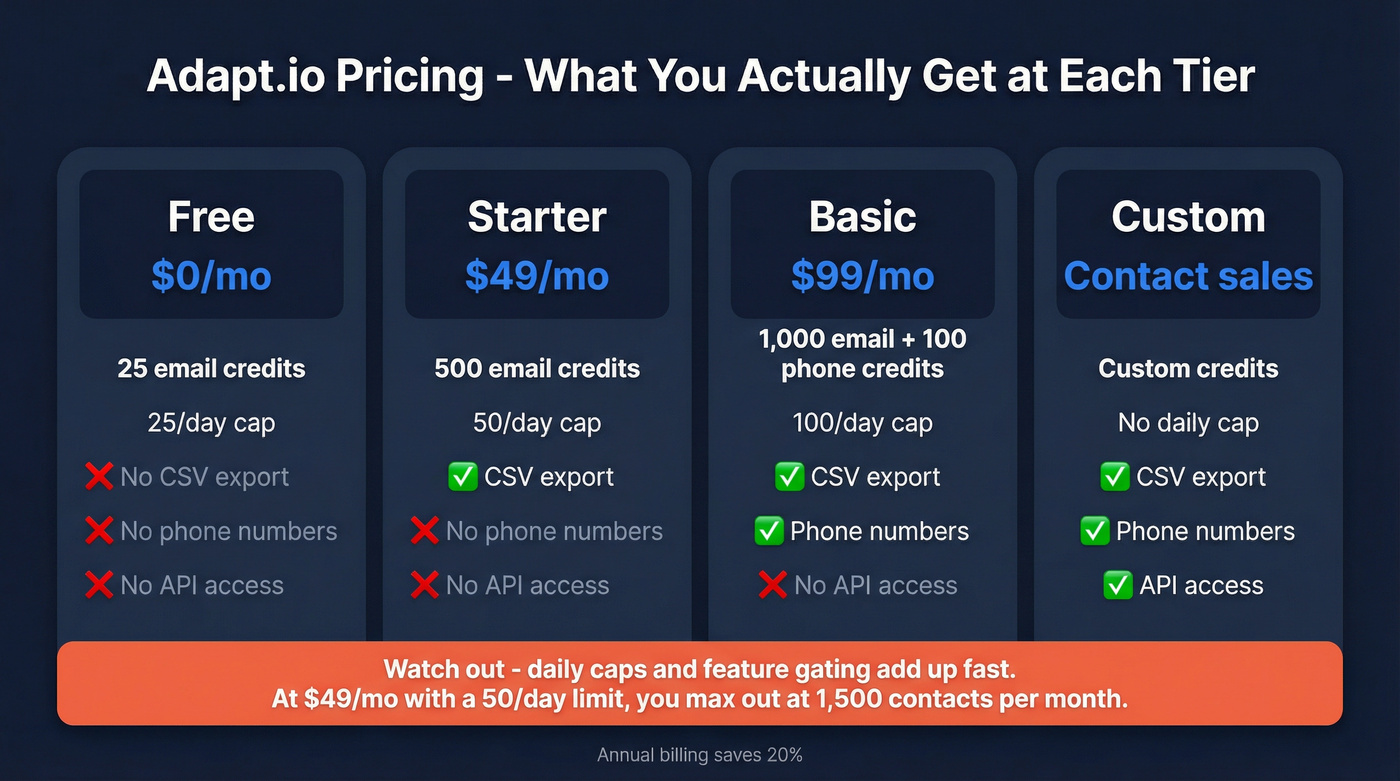
Annual billing saves 20%. CSV export requires Starter+, phone numbers require Basic+, and API access requires a Custom plan. That feature gating adds up fast.

Adapt.io's daily caps and static B2B lists both throttle your pipeline. Prospeo delivers 300M+ profiles with 98% email accuracy, a 7-day refresh cycle, and zero daily contact limits - starting at ~$0.01 per email.
Stop rationing contacts. Start building pipeline without limits.
Where Adapt.io Falls Short
Use Adapt.io if you're a solo founder just starting outbound and don't need more than 50 contacts a day.
Skip it if you're running any real volume. One of the most common complaints across 2,789 reviews on G2 is credit and contact limits. Paying $49/month and hitting a 50-contact-per-day wall is genuinely frustrating when you're trying to build pipeline. We've seen teams burn through their daily allocation before lunch.
Here's the number that should give you pause: G2's aggregated benchmarks peg Adapt.io at 4 months to implement and 16 months to see ROI. That's a long payback for a $49/month tool. Reviewer feedback also flags inconsistent email and phone data, and the database size discrepancy - 150M vs. 250M depending on where you look - doesn't inspire confidence. The 4.6/5 rating looks solid on the surface, but dig into the cons and the pattern is clear.
Let's be honest: if your team sends more than 50 emails a day, and in 2026 most outbound teams do, Adapt.io's daily caps make it a starter tool you'll outgrow in weeks.
Head-to-Head Comparison
| Data freshness | Unknown cycle | Static (decays 22%/yr) | 7-day refresh |
| Email accuracy | Inconsistent | Varies; degrades without re-verification | 98% verified |
| Database size | 150M-250M | Varies by vendor | 300M+ profiles |
| Cost model | Credits ($49-99/mo) | Per-contact ($0.10-$0.50+) | ~$0.01/email |
| Daily limits | 25-100/day | None (bulk buy) | No daily caps |
| Free tier | Yes (25/day) | No | 75 verified emails + 100 Chrome credits/month |
| GDPR compliance | Depends on workflow | Risky | Yes (opt-out enforced) |
| Targeting control | 25+ filters | Limited; typically scoped via SOW | 30+ filters + intent data |
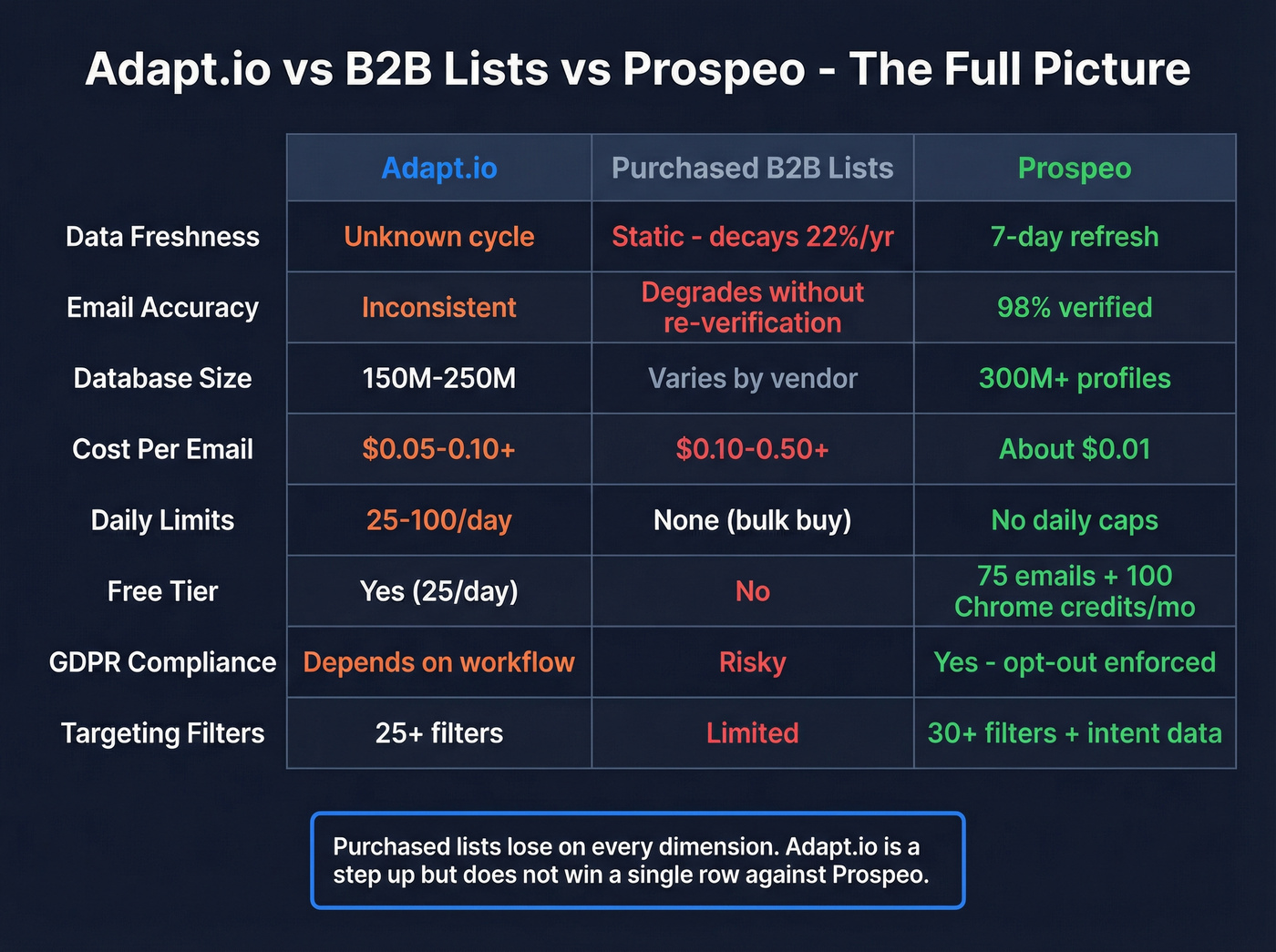
Purchased lists lose on every dimension that matters for modern outbound. Adapt.io is a real step up from list brokers, but it doesn't win a single row here.
A Stronger Alternative
For teams that outgrow Adapt.io's constraints or want better data than any purchased list delivers, Prospeo's database covers 300M+ professional profiles with 98% email accuracy and a 7-day refresh cycle. No daily contact caps, no annual contracts. Intent data tracking 15,000 topics via Bombora helps you find buyers actively researching your category. At roughly $0.01 per email, the unit economics are hard to beat - ZoomInfo typically runs $15,000-$40,000+/year for comparable data. In our testing, Adapt.io's daily caps became a bottleneck within the first week; that problem simply doesn't exist here.
If you're evaluating databases, start with a side-by-side of data enrichment services and sales prospecting databases so you're comparing refresh cycles and verification, not just list size.
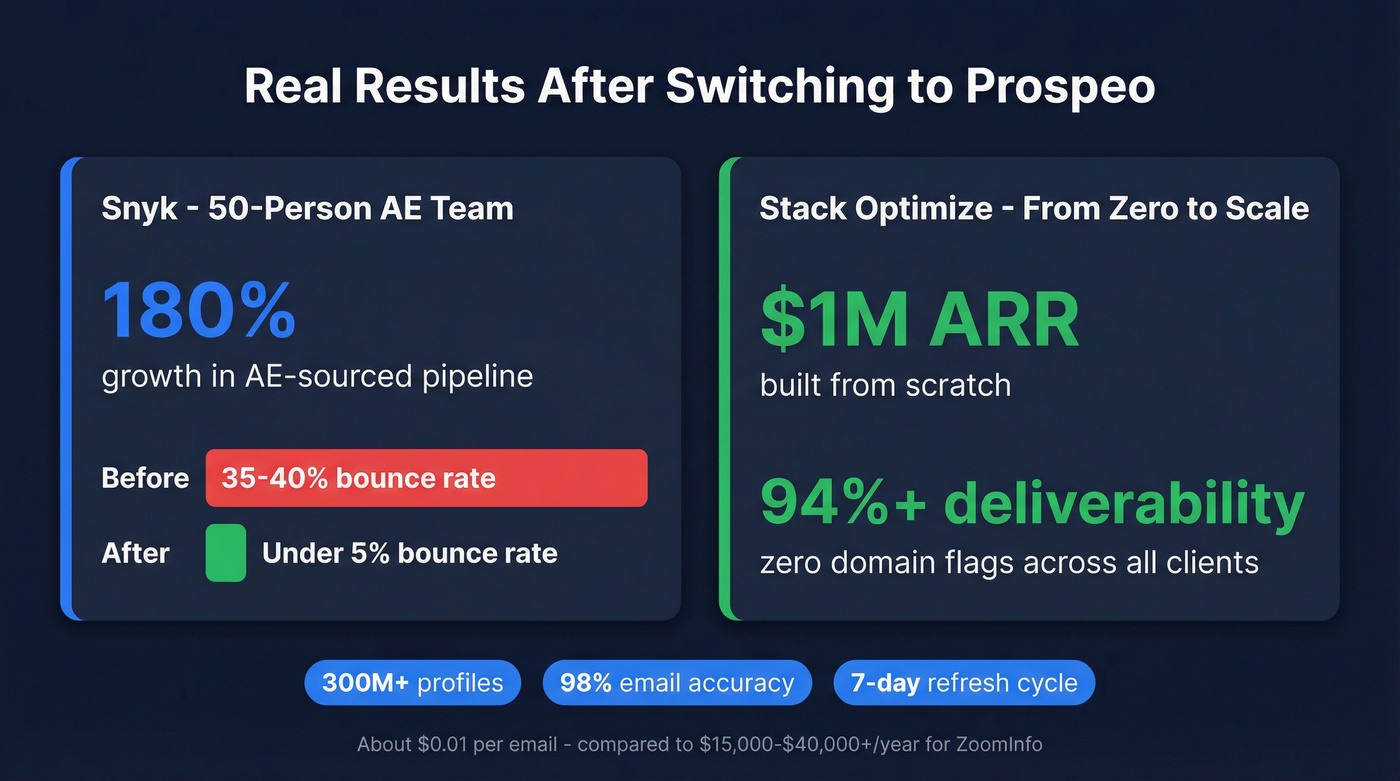
Real results back this up. Snyk's 50-person AE team cut bounce rates from 35-40% to under 5% and grew AE-sourced pipeline 180% after switching. Stack Optimize built from $0 to $1M ARR while maintaining 94%+ deliverability and zero domain flags across all clients.
Final Verdict
Comparing Adapt.io vs B2B lists is the wrong question in 2026. Buying static lists is a relic. The real comparison is between self-serve platforms, and on that playing field the choice comes down to database size, accuracy, refresh speed, daily limits, and transparent pricing. Adapt.io is fine for budget-conscious founders just getting started. But for anyone doing real outbound volume, you deserve better data at a lower cost - try a free tier and run your own comparison.
If you're building a repeatable outbound motion, pair your data source with proven sales prospecting techniques and track lead generation metrics so you can see when data quality starts dragging performance.
Static lists decay 22% per year. Adapt.io's refresh cycle is unknown. Prospeo re-verifies every record every 7 days - that's why Snyk cut bounce rates from 35% to under 5% and grew pipeline 180%.
Get data that's 7 days fresh, not 7 months stale.
FAQ
Is Adapt.io free?
Yes - 25 email credits and a 25-contact daily cap. Most teams outgrow it within a week. The Starter plan at $49/mo bumps you to 500 credits and 50 contacts per day, but the daily limit still applies. Prospeo's free tier gives you 75 verified emails plus 100 Chrome credits monthly with no daily cap.
Are purchased B2B lists GDPR compliant?
Usually not. Most list brokers sell data without individual consent, creating real compliance risk under GDPR and CAN-SPAM. Self-serve platforms with opt-out enforcement and active suppression lists are significantly safer for outbound campaigns.
What's the cheapest way to build a B2B contact list?
Prospeo's free tier gives you 75 verified emails and 100 Chrome extension credits per month with no credit card required. Adapt.io's free plan offers 25 contacts per day with more limited data. Both beat paying $0.10-$0.50 per contact from a list broker by a wide margin.
How do self-serve platforms compare to list brokers for accuracy?
Self-serve platforms with active verification pipelines dramatically outperform static lists. A 5-step verification process with a 7-day refresh cycle delivers 98% email accuracy, while purchased lists degrade roughly 2% per month and rarely include ongoing re-verification. The consensus on r/sales is that static lists aren't worth the compliance risk anymore - and the data backs that up.