

Advanced Email Verifiers: The Only Ones Worth Using in 2026
You verified your list before that last campaign. Every email came back "valid." Then you watched the bounce rate climb past 4%, and your sender reputation took a hit that took weeks to recover from. The culprit wasn't bad syntax or typos - it was catch-all domains, and your verifier shrugged at every one of them.
Most verification tools handle the easy stuff fine. They'll catch typos, flag disposable addresses, and confirm that a domain exists. But roughly 28% of B2B emails sit on catch-all domains - servers that accept mail for any address, real or fake. Global inbox placement averages around 84%, and 64.6% of businesses say deliverability issues have directly impacted revenue. Those aren't abstract numbers when your pipeline depends on cold outreach actually landing.
Here's the stat that should bother you: only 23.6% of businesses verify their lists before every campaign. The other 76.4% are gambling with their sender reputation every time they hit send. When your verifier returns "unknown" for a quarter of your list and calls it a day, you're flying blind past the 2% bounce threshold that triggers spam filters.
You don't need 15 verifiers compared. You need one that handles catch-alls and refreshes data weekly. Here are the six worth testing.
Our Picks (TL;DR)
| Pick | Best For |
|---|---|
| Prospeo | Best overall - 98% accuracy, catch-all handling, 7-day data refresh |
| ZeroBounce | Best for risky-email detection (if budget allows) |
| Clearout | Best mid-tier value |
Prospeo wins on accuracy and data freshness. ZeroBounce excels at flagging risky addresses but struggles with catch-all resolution. Clearout delivers solid results without breaking the budget.
What Separates Advanced From Basic
Not every tool that calls itself a verifier deserves the label. Here's the checklist that separates real verification from basic syntax checking:
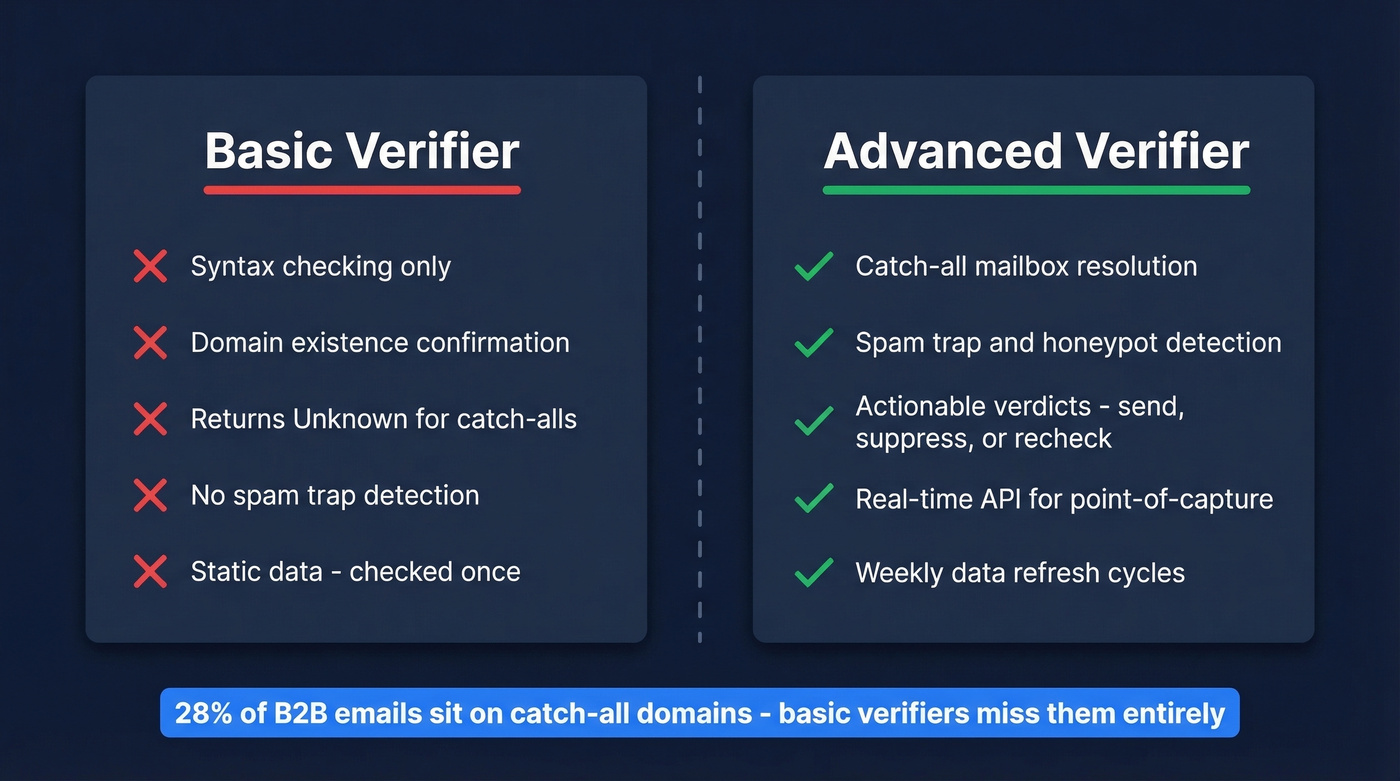
- Catch-all resolution. The verifier doesn't just label catch-all domains "unknown" - it determines whether the specific mailbox exists. This is the hardest problem in verification, and most tools punt on it entirely.
- Spam-trap and honeypot detection. Advanced tools identify addresses that exist solely to catch senders with poor list hygiene. Hitting one can blacklist your domain overnight. (If you need a cleanup playbook, see spam-trap removal.)
- Actionable verdicts, not just "unknown." A result of "unknown" is useless. You need a tool that tells you what to do - send, suppress, or recheck.
- Real-time API for point-of-capture. About 9% of emails entered on webforms are invalid. Catching them before they hit your CRM saves downstream pain. (More on point-of-capture checks: how to check if an email exists.)
- Data freshness. Email lists decay ~22.5% per year. A verifier that checked an address six months ago is giving you stale confidence. Look for weekly refresh cycles - many data providers only refresh on a ~6-week cycle. (Related: email deliverability guide.)
The Best Advanced Email Verifiers for 2026
Prospeo
Use this if you're running outbound at scale and can't afford bounces tanking your sender reputation. Prospeo's 5-step verification process covers catch-all handling, spam-trap removal, and honeypot filtering across 143M+ verified emails - all refreshed on a 7-day cycle. That 98% email accuracy isn't a marketing number; Meritt saw bounce rates drop from 35% to under 4% after switching, and their pipeline tripled from $100K to $300K per week. (If you're also building lists, pair verification with a reliable email ID finder.)
Pricing is straightforward: ~$0.01 per email, with a free tier of 75 emails per month. No contracts, no sales calls required. Native integrations with Smartlead, Instantly, Lemlist, HubSpot, and Salesforce mean verified contacts flow directly into your sequences without a CSV detour. The proprietary email-finding infrastructure doesn't rely on third-party providers, which is part of why the accuracy numbers hold up in practice - we've seen this consistently across our own campaigns and in customer results like Stack Optimize maintaining 94%+ deliverability with bounce rates under 3% across all their clients. (If bounces are your recurring issue, start with email bounce rate benchmarks and fixes.)
Skip this if you only need syntax checking for a tiny newsletter list - you'd be overpaying for firepower you don't need.
ZeroBounce
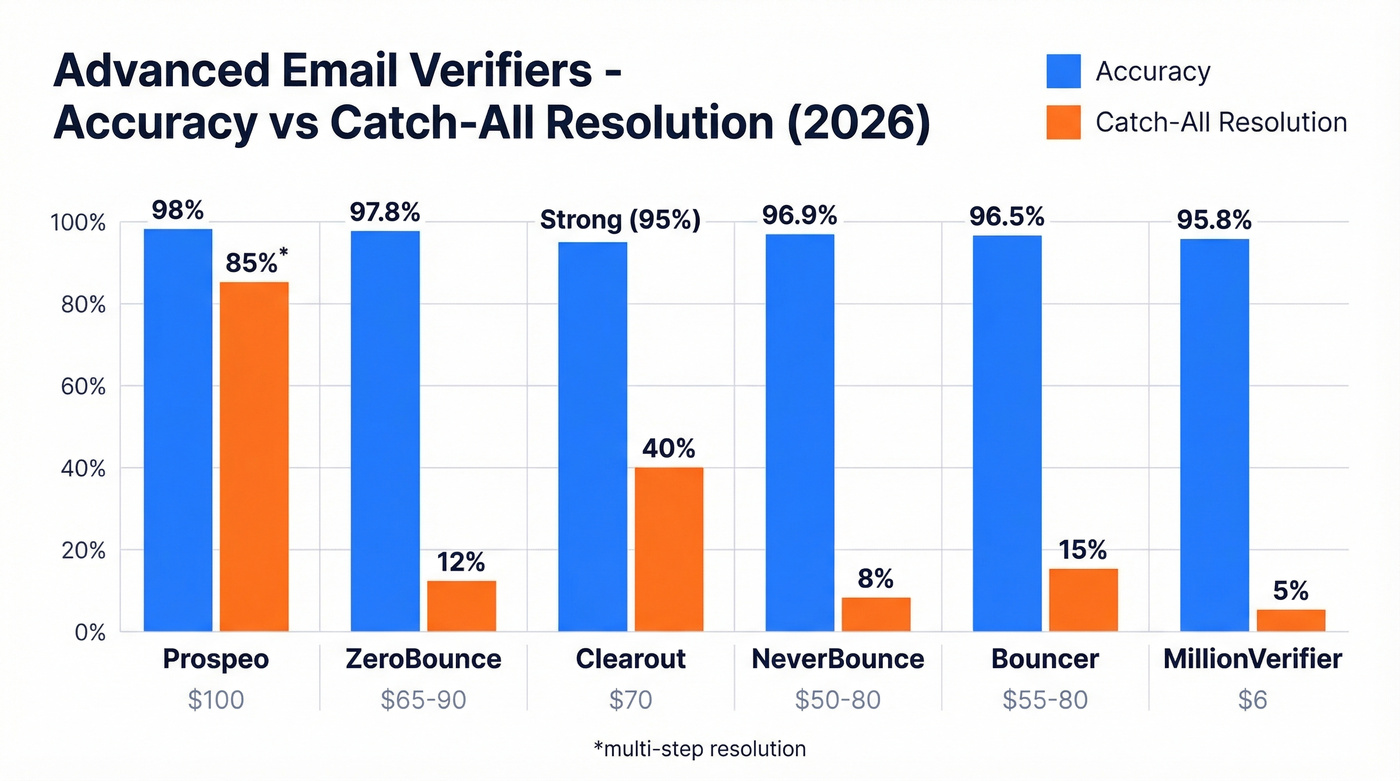
ZeroBounce's risk scoring is genuinely useful for lists heavy on role-based addresses and known complainers. It hits 97.8% accuracy in benchmark testing with a 0.9% false positive rate and 1.3% false negative rate - strong numbers that reflect its focus on flagging addresses that technically exist but are likely to cause problems.
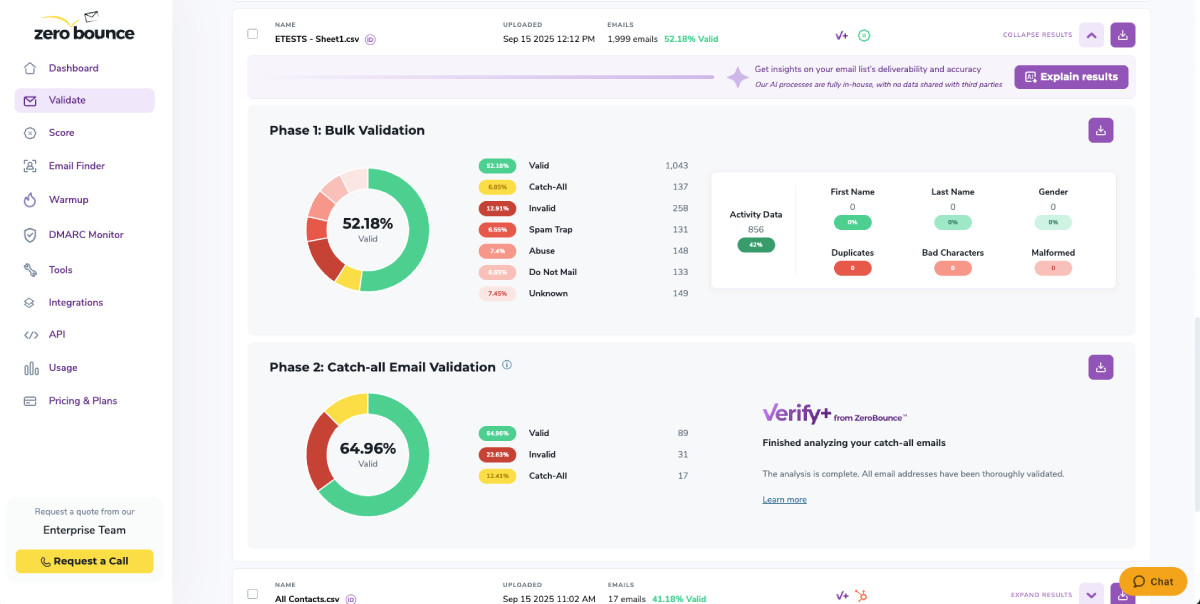
The catch-all story is weaker. ZeroBounce resolves about 12% of catch-all addresses, with the rest returning as "unknown." The consensus on r/coldemail is that accuracy is excellent but credits burn fast on large lists. Pricing runs $0.008/email pay-as-you-go, or roughly $65-90 for 10k verifications depending on plan and discounts, with 100 free per month.
Bottom line: Best-in-class risk detection, mediocre catch-all handling. Worth the premium if risky addresses are your primary headache.
Clearout
Clearout is the tool we recommend to teams that want solid verification without paying ZeroBounce prices. It runs around $70 for 10k emails with 100 free credits to test. In Hunter's benchmark, Clearout scored 68.37% - but that number deserves context. Hunter penalizes "unknown" results as incorrect, which drags down scores for any tool that's honest about catch-all ambiguity rather than guessing. (If you're comparing vendors, you may also want our Bouncer alternatives roundup.)
Skip it if you need best-in-class catch-all resolution or sub-second API response times for real-time form validation.
NeverBounce
Fast and reliable. NeverBounce processes 10k emails in about 18 minutes, and the API is rock-solid for point-of-capture workflows. Accuracy sits at 96.9% with a 1.4% false positive rate and 1.7% false negative rate. Those false positive numbers matter: they mean NeverBounce marks roughly 1 in 70 valid emails as invalid, which translates to lost opportunities at scale.
Catch-all resolution is weak at 8%, and Reddit users flag inconsistencies specifically on catch-all domains. Pricing runs ~$50-80 for 10k depending on plan type, with 10 free credits to start.
Bouncer
Bouncer hits 96.5% accuracy with 15% catch-all resolution - the second-best catch-all rate in this group. It's GDPR-focused and popular with European teams. The tradeoff is slower API response times noted across multiple benchmarks. Expect ~$55-80 for 10k. (If you're tightening compliance and deliverability together, add DMARC alignment to your checklist.)
MillionVerifier
Let's be honest: at ~$6 for 10k emails, MillionVerifier is the cheapest option by a wide margin - and that should make you nervous. If your deal sizes are above $5k, the $60 you save on verification can cost thousands in deliverability recovery when a bad batch torches your domain. Accuracy is 95.8% with only 5% catch-all resolution, and Reddit users report it misses unregistered domains and invalid TLDs that other tools catch easily. Use it as a pre-filter if you must, never as your only line of defense. (For safer sending practices, see best way to send bulk email without getting blacklisted.)

28% of your B2B list sits on catch-all domains. Most verifiers return "unknown" and move on. Prospeo's 5-step verification resolves catch-alls, removes spam traps, and filters honeypots - refreshed every 7 days, not every 6 weeks.
Drop your bounce rate under 4% like Meritt did - start with 75 free verifications.
Pricing at a Glance
| Tool | Accuracy (FP/FN) | Catch-All | ~Cost/10k | Best For |
|---|---|---|---|---|
| Prospeo | 98% | High (multi-step) | ~$100 | Accuracy + freshness |
| ZeroBounce | 97.8% (0.9%/1.3%) | 12% | ~$65-90 | Risky email detection |
| Clearout | Strong | Moderate | ~$70 | Mid-tier value |
| NeverBounce | 96.9% (1.4%/1.7%) | 8% | ~$50-80 | API speed |
| Bouncer | 96.5% | 15% | ~$55-80 | GDPR compliance |
| MillionVerifier | 95.8% | 5% | ~$6 | Budget (with caveats) |
Why not LeadMagic or Verifalia? LeadMagic's self-published benchmark claims 99.5% accuracy with 94.2% catch-all resolution - impressive numbers, but the benchmark was run by LeadMagic themselves, and pricing starts at $59.99/mo for 2,500 credits. Verifalia advertises a 30+ step verification process but lacks the independent accuracy data used above. Snov.io and GamaLogic were also considered but didn't differentiate enough on catch-all handling to earn a spot.
Why Catch-All Handling Matters Most
A catch-all server accepts mail for any address at that domain, including completely made-up ones. Your verifier pings the server, gets an "accepted" response, and marks it valid or unknown. Neither answer tells you whether a real human checks that inbox.
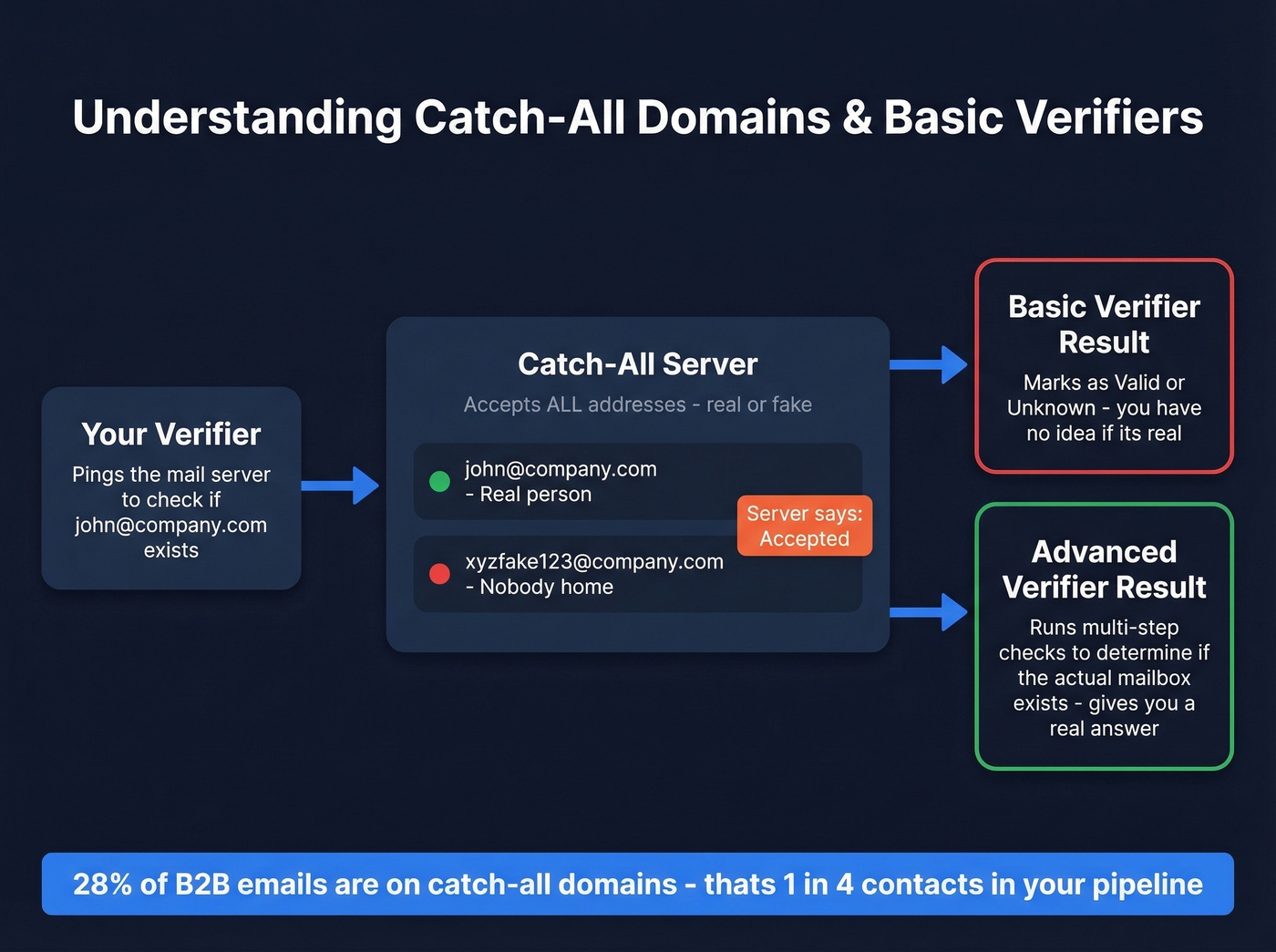
With 28% of B2B emails sitting on catch-all domains, this isn't an edge case. It's a quarter of your pipeline. And with 26.6% of marketing budgets going to email, you're risking a significant chunk of spend on unverified deliverability. (If you're scaling outbound, also watch email velocity to avoid reputation shocks.)
The resolution rates tell the story: multi-step verification processes actively resolve catch-all addresses instead of shrugging. ZeroBounce manages 12%. NeverBounce hits 8%. MillionVerifier barely cracks 5%. The gap between those numbers and a tool that actually handles catch-alls is the gap between guessing and knowing.
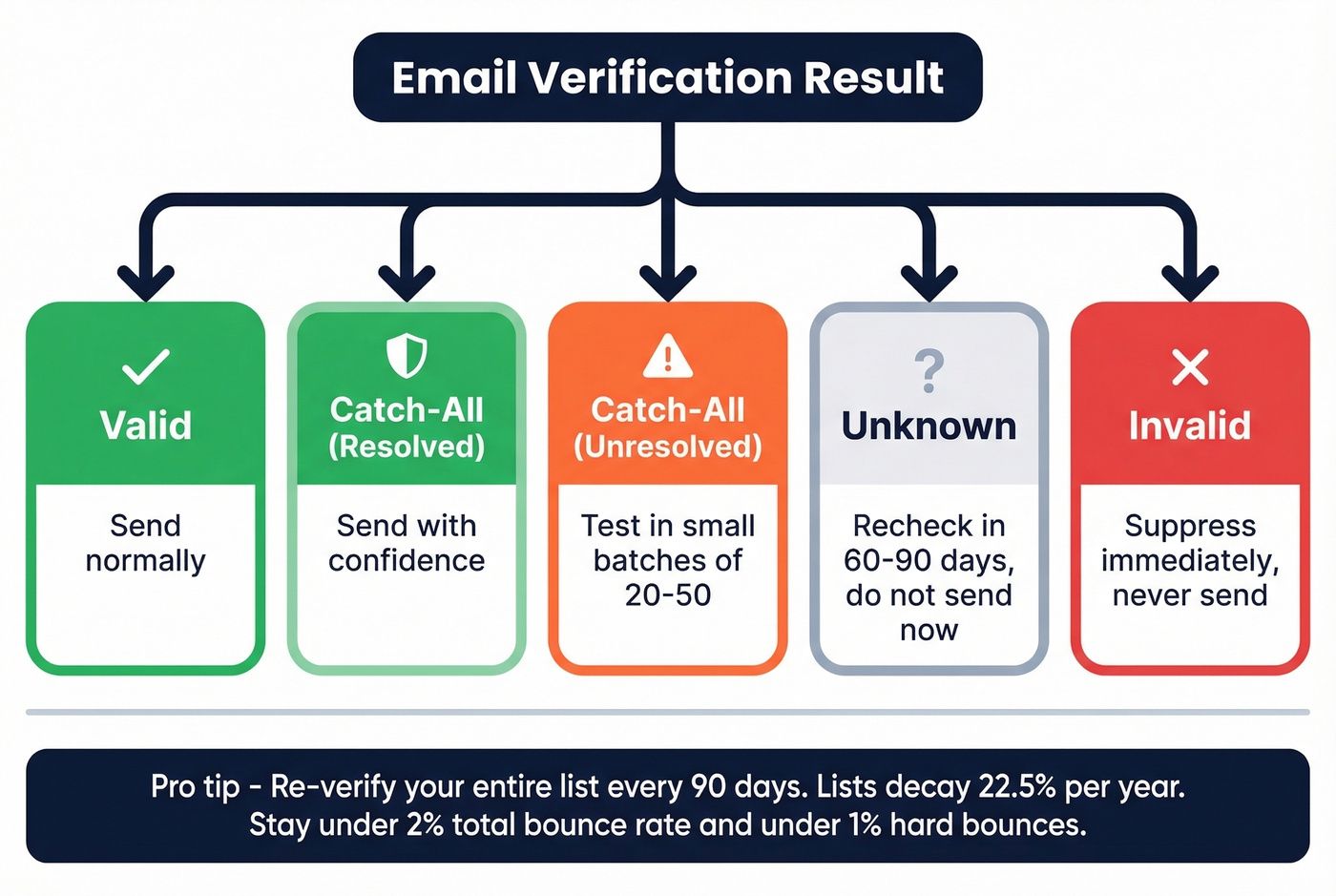
Here's how to handle each verdict:
| Verdict | Action |
|---|---|
| Valid | Send normally |
| Catch-all (resolved) | Send with confidence |
| Catch-all (unresolved) | Test lightly in small batches |
| Unknown | Recheck in 60-90 days |
| Invalid | Suppress immediately |
Verification Best Practices
Five rules that keep your bounce rate under 2% and your domain off blacklists.
Verify on a schedule. Monthly for high-volume senders, quarterly at minimum. Lists decay ~22.5% per year, which means nearly a quarter of your contacts go stale whether you notice or not. Pair this with real-time API verification on webforms to catch the 9% of entries that are invalid before they pollute your CRM.
Re-check catch-all and unknown results every 60-90 days. Server configurations change, and an address that was catch-all last quarter might resolve cleanly now. Monitor bounce rates obsessively - stay under 2% total and target hard bounces under 1%.
We've seen teams skip re-verification on an old list and blow up a warm domain in a single campaign. One agency we talked to lost three months of domain warming because they trusted a six-month-old verification result on a 40k-contact list. If the data is more than 90 days old, run it through again. No exceptions.
Your sender reputation can't survive a 35% bounce rate. Prospeo's proprietary verification infrastructure - no third-party dependencies - delivers 98% accuracy at $0.01/email. Stack Optimize runs 94%+ deliverability across every client.
Test 75 emails free and see what your current verifier is missing.
FAQ
Do I need an advanced email verifier or is a basic one enough?
Basic verifiers check syntax and confirm domains exist - fine for a small newsletter. An advanced tool adds SMTP mailbox verification, catch-all resolution, and spam-trap detection. If you're sending more than a few hundred emails per month or doing outbound prospecting, basic verification leaves too many gaps.
How often should I re-verify my email list?
Monthly for high-volume outbound, quarterly for lighter senders. Lists decay roughly 22.5% per year, so even a "clean" list from six months ago has significant rot. Tools with a 7-day refresh cycle reduce re-verification frequency since the underlying data stays current.
Why do some verifiers return "unknown" for so many emails?
Catch-all domains accept mail for any address, making mailbox existence ambiguous during SMTP checks. Basic verifiers stop there and label everything "unknown." Multi-step verification tools probe further to resolve these - but resolution rates vary widely, from 5% to high confidence depending on the tool's approach.
Is a cheap bulk verifier good enough?
Budget tools miss edge cases - unregistered domains, invalid TLDs, recycled spam traps - that damage sender reputation. For teams with deal sizes above a few thousand dollars, the $60 saved on verification can cost thousands in deliverability recovery and lost pipeline.
Which verifier handles catch-all domains best?
Among the tools we tested, Prospeo's 5-step verification includes dedicated catch-all resolution that actively determines mailbox existence rather than returning "unknown." Most competing tools in common benchmarks resolve under 15% of catch-all addresses, leaving a quarter of typical B2B lists unverified.