

AI Chatbot Lead Generation: The Practitioner's Playbook for 2026
A prospect hits your site at 11 PM, fills out a form, and waits. Your SDR sees it at 9 AM - ten hours later. By then, the prospect's already demoing a competitor.
Leads contacted within 5 minutes are 21x more likely to convert than those left waiting, yet the average B2B response time sits at 42 hours. That gap is where AI chatbot lead generation earns its keep - not as a gimmick, but as a qualification engine that works while your team sleeps.
What Separates Pipeline from a Fancy Form
Three things matter:
- A chatbot that qualifies, not just captures. If it's only collecting name and email, you've built a form with a personality.
- A qualification framework mapped to conversation logic. BANT or CHAMP questions wired into conditional branching and lead scoring (see a deeper deal qualification framework).
- A verification layer so captured emails don't bounce. Run every lead through an enrichment tool before it touches your sequences - otherwise you're torching your sender reputation (use an email verifier as the baseline).
Capture without qualification is a fancier contact form. Capture without verification is a domain reputation time bomb (here’s how to check bounce signals before they snowball).
Why AI Chatbots Win at Generating Leads
Chatbots deliver 3x higher conversion rates than static forms, and 64% of businesses using them report more qualified leads. A single interaction costs $0.50-$0.70 - cheaper than almost any other channel for initial engagement.
If you’re building a broader system around bots, it helps to anchor the motion in proven pipeline generation ideas so the chatbot isn’t your only lever.
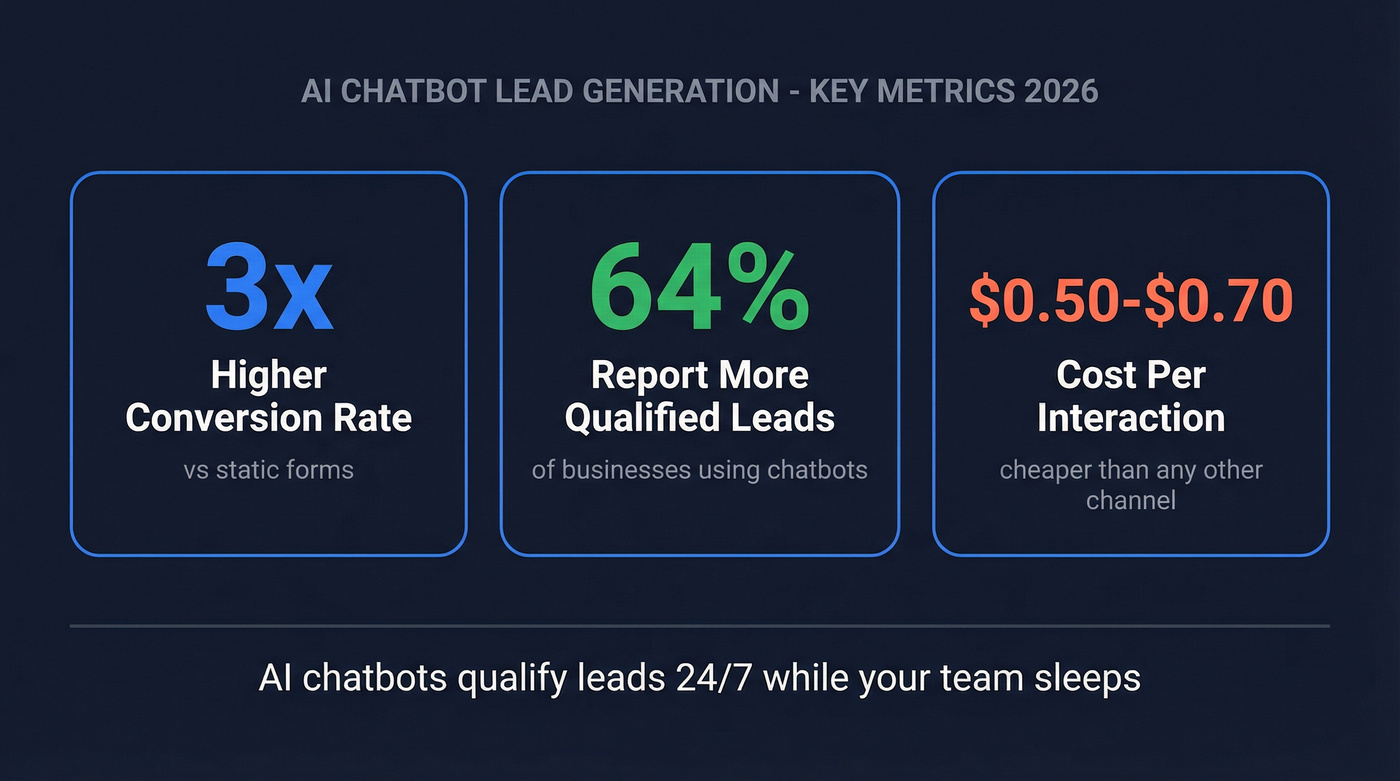
The real advantage is timing and filtering. A chatbot asks the second question, then the third, then routes the hot lead to a rep's calendar while disqualifying the tire-kicker - all at 2 AM on a Sunday. That 24/7 availability compounds fast when you're running paid traffic. It's the core reason more teams are deploying conversational bots instead of relying on static forms and delayed SDR follow-up.
The Qualification Playbook
Here's the thing: the framework matters more than the tool. We've watched teams spend months configuring enterprise bots only to realize their qualification logic was the actual problem. A $45/month chatbot with tight BANT scripting will outperform a $2,500/month bot with vague "How can I help you?" openers every single time.
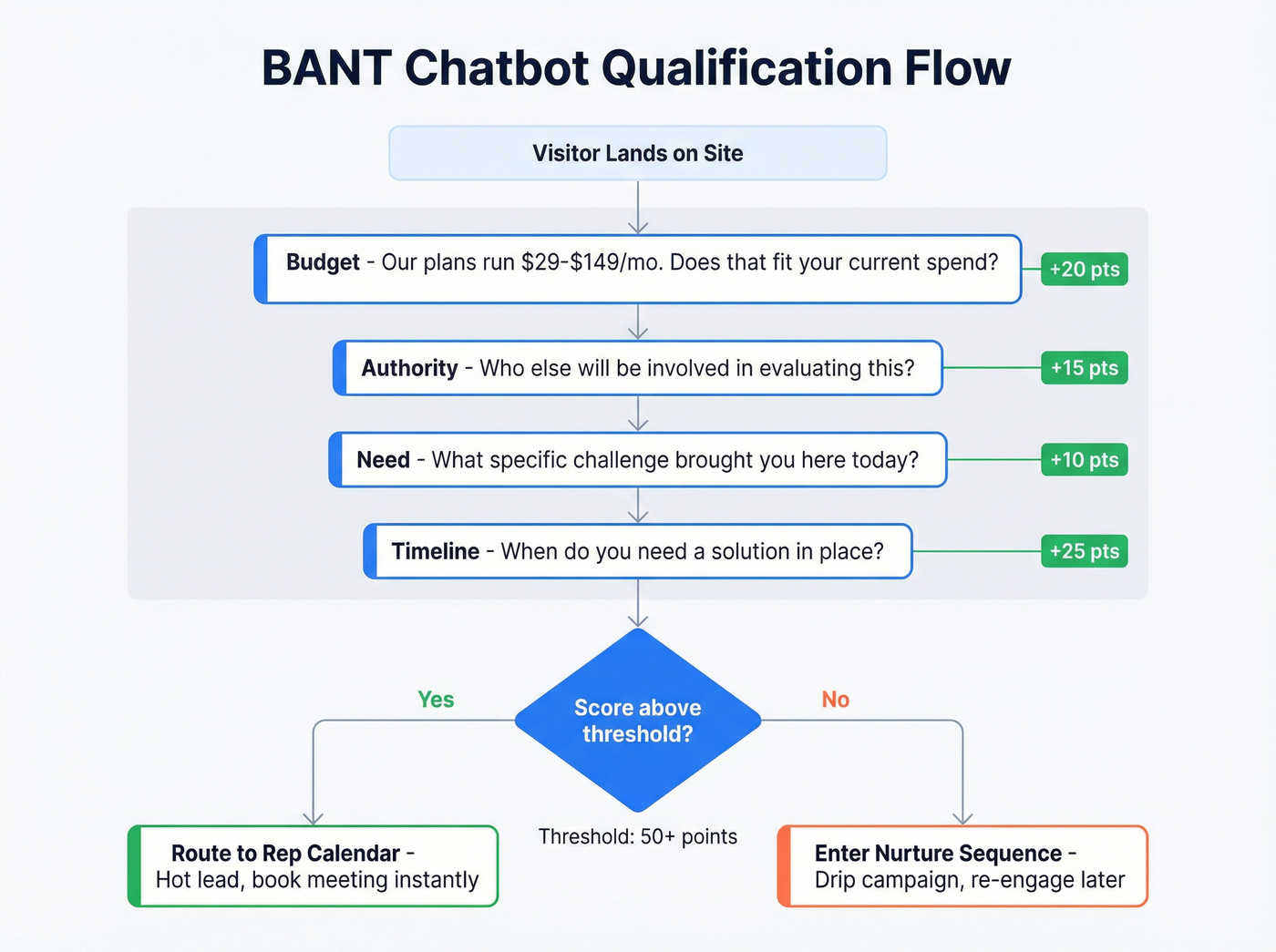
BANT for SMB and transactional sales - four questions, mapped to flow:
- Budget: Don't ask "What's your budget?" Anchor to ranges: "Our plans run $29-$149/month. Does that fit your current spend?"
- Authority: "Who else will be involved in evaluating this?" beats "Are you the decision-maker?" Less confrontational, more informative.
- Need: "What specific challenge brought you here today?"
- Timeline: "When are you looking to have a solution in place?" Under 30 days signals urgency.
Wire these into conditional logic and score accordingly: decision-maker = +15 points, timeline under 30 days = +25, budget confirmed = +20. Leads above threshold get routed to a rep. Everyone else enters a nurture sequence (pair this with lead generation vs lead nurturing so handoffs don’t break). Even well-qualified leads convert to opportunities at only about 6.2% in B2B SaaS, so the bot's job is filtering out bad fits early, not closing deals.
The line between rule-based chatbots and autonomous AI agents is blurring fast in 2026, but the qualification logic underneath still matters more than the wrapper. Ground your bot's responses in an approved knowledge base - RAG-based approaches reduce hallucination by 42-68%, which matters when your bot is making promises to prospects at 2 AM.
If your average deal size is under $5k, you almost certainly don't need an enterprise chatbot. A well-scripted Landbot flow will outperform Drift at around 1/55th the cost. (If you’re evaluating the broader stack, start with AI SDR software to see what should be automated vs kept human.)

Your chatbot qualifies 200 leads a month. But if 40% of those emails bounce, your sender reputation is toast. Prospeo's 5-step verification catches bad emails before they touch your sequences - 98% accuracy, catch-all handling, spam-trap removal. At $0.01 per email, verifying every chatbot lead costs less than a single bounced reply costs your domain.
Stop feeding unverified chatbot leads into your outbound sequences.
Tools Worth Evaluating
| Tool | Best For | Starting Price | Watch Out For |
|---|---|---|---|
| Landbot | No-code visual builder | Free / $45/mo | Mostly rule-based flows |
| Tidio | SMB / e-commerce | Free / $29/mo | AI locked behind higher tiers |
| Zapier Chatbots | Automation-first teams | Free / $19.99/mo | Knowledge base size limits |
| Lindy | Multi-channel workflows | Free / $49.99/mo | 40 free tasks/mo burns fast |
| HubSpot Breeze | Existing HubSpot users | ~$1/conversation + $1,500+ onboarding | Auto-upgrade risk if you exceed credits |
| Drift | Enterprise ABM | ~$2,500/mo (annual) | Overkill under 50 employees |
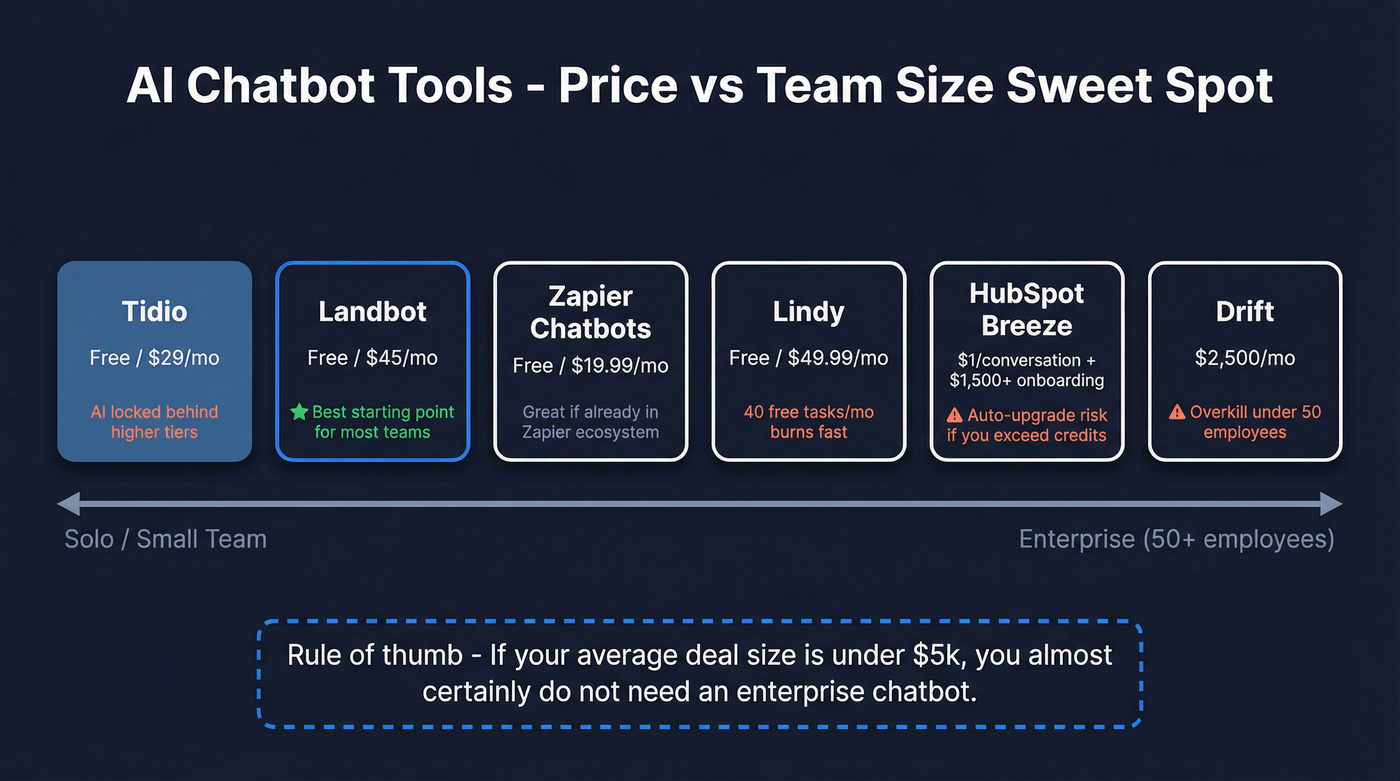
Landbot's visual flow builder makes BANT scripting dead simple - it's where we'd start for most teams. Tidio is solid for testing, but real AI features require upgrading. Zapier Chatbots make sense if you're already deep in the Zapier ecosystem, though knowledge base limits vary by plan. Some teams also experiment with a ChatGPT website chatbot for lead generation by connecting OpenAI's API to a custom widget, though you'll need to build your own qualification logic and routing on top.
Let's talk about HubSpot Breeze pricing, because it trips people up. At about $1 per conversation, it sounds cheap until you do the math: 500 conversations a month is $500 in credits alone, plus mandatory onboarding fees that typically start around $1,500+. If you exceed included credits, HubSpot can auto-upgrade you and keep you on that higher tier for the rest of the contract term. If you're under 50 employees, skip Drift entirely - the ROI math doesn't work. Chatling and Botpress are also worth a look for teams wanting more AI-native builders.
After Capture: Closing the Data Quality Gap
Your chatbot is humming. Two hundred leads a month, nicely qualified. Then you push them into outbound sequences and 40% of the emails bounce. Your sender reputation craters. Sound familiar? A common theme in r/b2bmarketing is that clean data and tighter ICP filtering move the needle far more than lead volume ever will (use an explicit ideal customer profile to keep the bot from “qualifying” the wrong people).
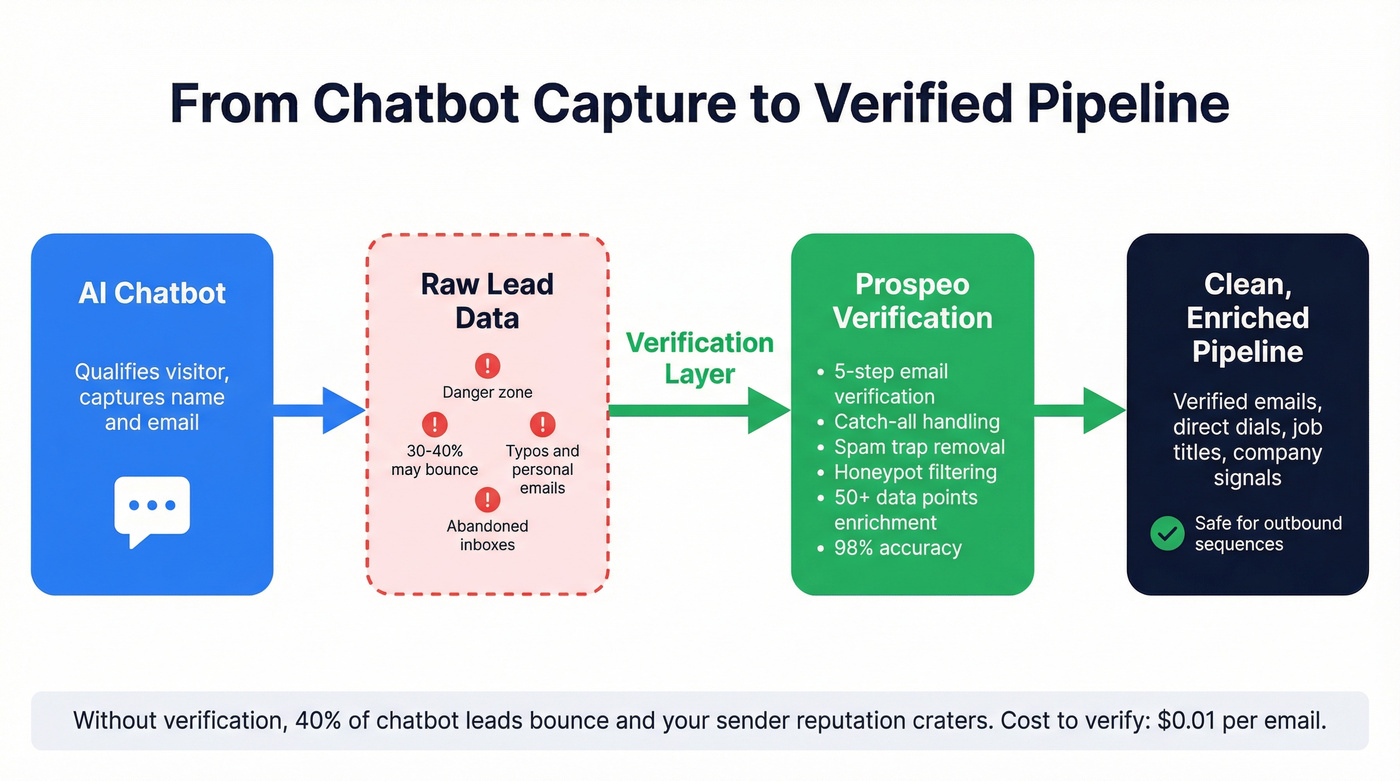
In our experience, the data quality gap kills more pipeline than bad qualification. The chatbot captures a name and email, but that email might be a personal address, a typo, or an abandoned inbox. You need a verification and enrichment layer between capture and outbound (especially if you’re running outbound email automation at scale).
Prospeo handles this cleanly - upload chatbot leads via CSV or API, and every email gets verified at 98% accuracy through a 5-step process with catch-all handling, spam-trap removal, and honeypot filtering. Each contact comes back enriched with 50+ data points, including direct dials from 125M+ verified mobiles. The free tier gives you 75 email verifications per month, enough to test the workflow before committing.

AI chatbots qualify prospects at 2 AM, but a name and email isn't enough to close a deal. Prospeo enriches every chatbot-captured lead with 50+ data points - verified direct dials from 125M+ mobiles, job titles, company signals - so your reps call the right person with the right context. 92% API match rate, 7-day data refresh, no contracts.
Turn chatbot captures into fully enriched, dial-ready prospects.
Compliance You Can't Skip
| Regulation | Model | Key Requirement | Penalty |
|---|---|---|---|
| GDPR | Opt-in | Explicit consent required | Up to EUR 20M / 4% turnover |
| FCC/TCPA | Per-seller consent | Separate PEWC per seller | $500-$1,500 per violation |
| CCPA/CPRA | Opt-out | "Do Not Sell" link required | Up to $7,500 per intentional violation |
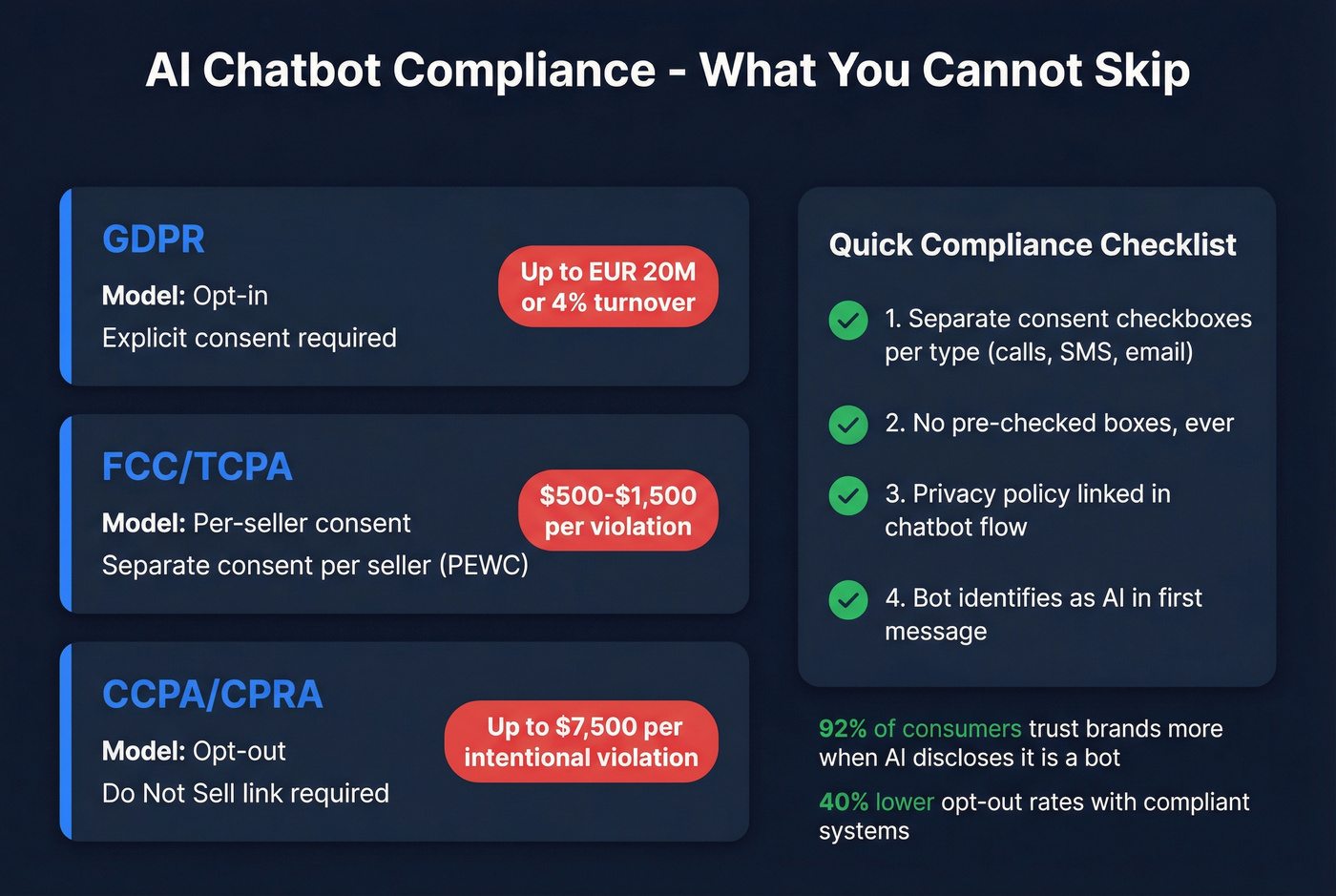
The FCC's one-to-one consent rule closed the loophole where a single consent checkbox covered multiple sellers. 92% of consumers trust brands more when AI discloses it's a bot and explains how data will be used, and compliant systems see 40% lower opt-out rates. Transparency isn't just legal protection - it's a conversion lever. (For the full landscape, align your process with B2B compliance requirements.)
Quick compliance checklist:
- Separate consent checkboxes per communication type (calls, SMS, email)
- No pre-checked boxes - ever
- Privacy policy linked directly within the chatbot flow
- Bot self-identifies as AI in the first message
FAQ
Do AI chatbots actually work for B2B lead generation?
Yes. Businesses using chatbots for qualification report up to 64% more qualified leads and roughly 3x higher conversion rates versus static forms. The key is building real qualification logic - BANT or CHAMP frameworks - not just collecting contact info.
What's a realistic chatbot lead conversion rate?
Chatbot-to-lead conversion rates typically range 15-40% depending on industry and how aggressively you qualify. Even qualified leads convert to opportunities at only ~6% in B2B SaaS. The bot's job is filtering out bad fits early, not closing deals.
How do I keep chatbot leads from bouncing?
Run captured emails through a verification tool before they enter outbound sequences. Unverified chatbot leads bounce at 30-40%, which craters sender reputation fast. A 5-step verification process that catches catch-all domains, spam traps, and honeypots is the minimum standard - test with a small batch before scaling.