

The Best AI Data Enrichment Tools in 2026, Ranked by What Actually Matters
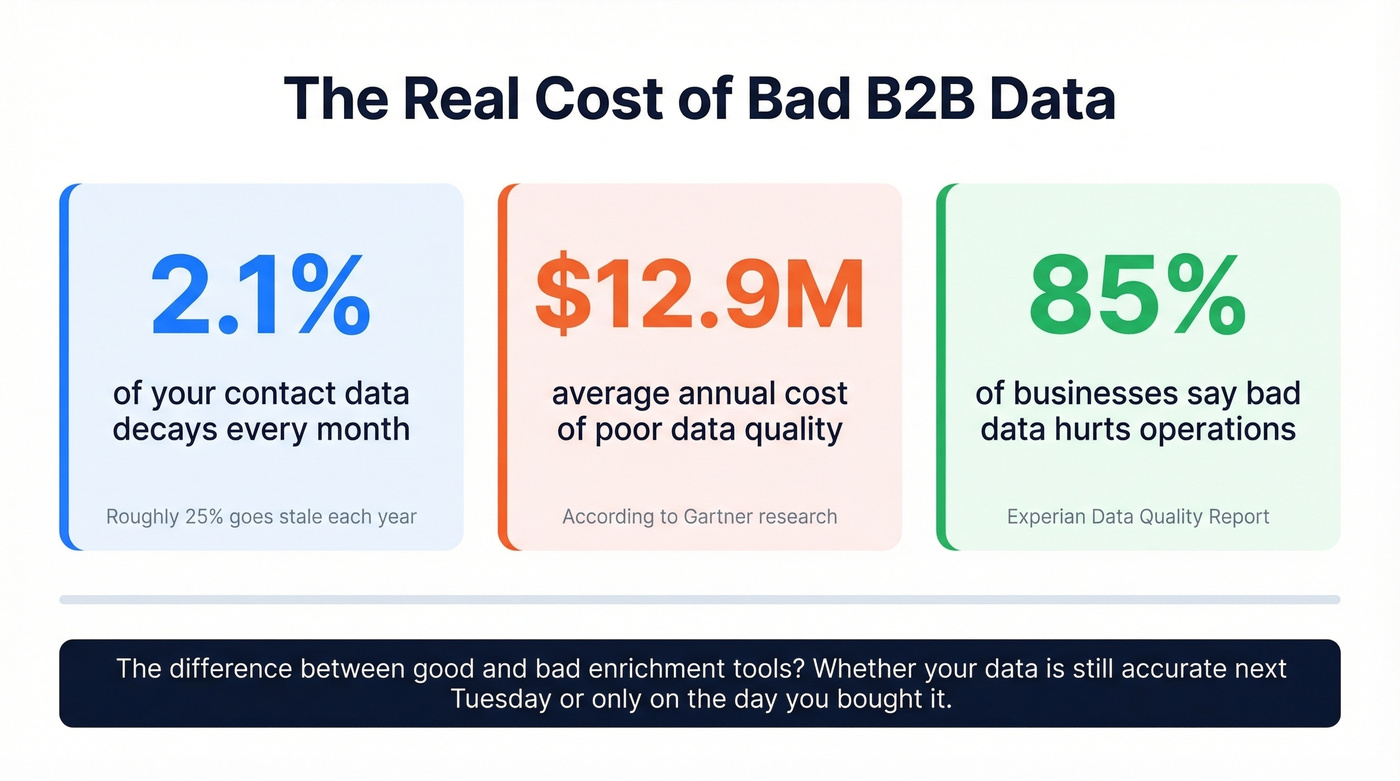
B2B contact data decays at roughly 2.1% per month - about a quarter of your database goes stale every year. Experian found that 85% of businesses say poor-quality data harms operational efficiency, and Gartner pegs the cost at $12.9M/year for the average organization. So the gap between AI data enrichment tools that actually work and ones that just slap a label on a static database comes down to one question: is your data still accurate next Tuesday, or only on the day you bought it?
We've tested most of these tools across multiple ICPs. Here's the honest takeaway: tools like Clay are AI-native for workflow and research, while Seamless.AI is built around real-time discovery. Others bolt smart features onto traditional databases. Both approaches can work. But if your average deal size sits below $10K, you almost certainly don't need a $15K/year platform to get clean contact data.
Quick decision framework: Pick by accuracy need, then compliance requirement, then budget, then stack integration.
Our Top Picks
- Prospeo - Best for email accuracy and self-serve enrichment. 98% email accuracy, 7-day refresh cycle, ~$0.01/lead.
- Clay - Best for waterfall enrichment workflows. 150+ data providers, AI research agent, $185/mo entry point.
- Cognism - Best for European compliance and direct dials. GDPR-first architecture, Diamond Data phone verification.
Side-by-Side Comparison
| Tool | Starting Price | Data Quality (typical) | Refresh / Update Model | Best For |
|---|---|---|---|---|
| Clay | $185/mo | Varies by provider | On-demand / workflow-driven | Waterfall workflows |
| ZoomInfo | ~$15K/yr | ~87% email accuracy | ~6 weeks | US database depth |
| Cognism | ~$1K-3K/mo | 98% match rate | Ongoing | EMEA + direct dials |
| Apollo | Free; $49/mo+ | ~79-85% email accuracy | ~6 weeks | All-in-one prospecting |
| Seamless.AI | Free tier; ~$50-150/mo | Varies by lookup | Real-time | Real-time discovery |
| Breeze Intelligence | ~$10/1K credits | Varies by segment | Varies | HubSpot-native |
| Lusha | Free; $49.90/mo | ~85% | ~6 weeks | Quick lookups |
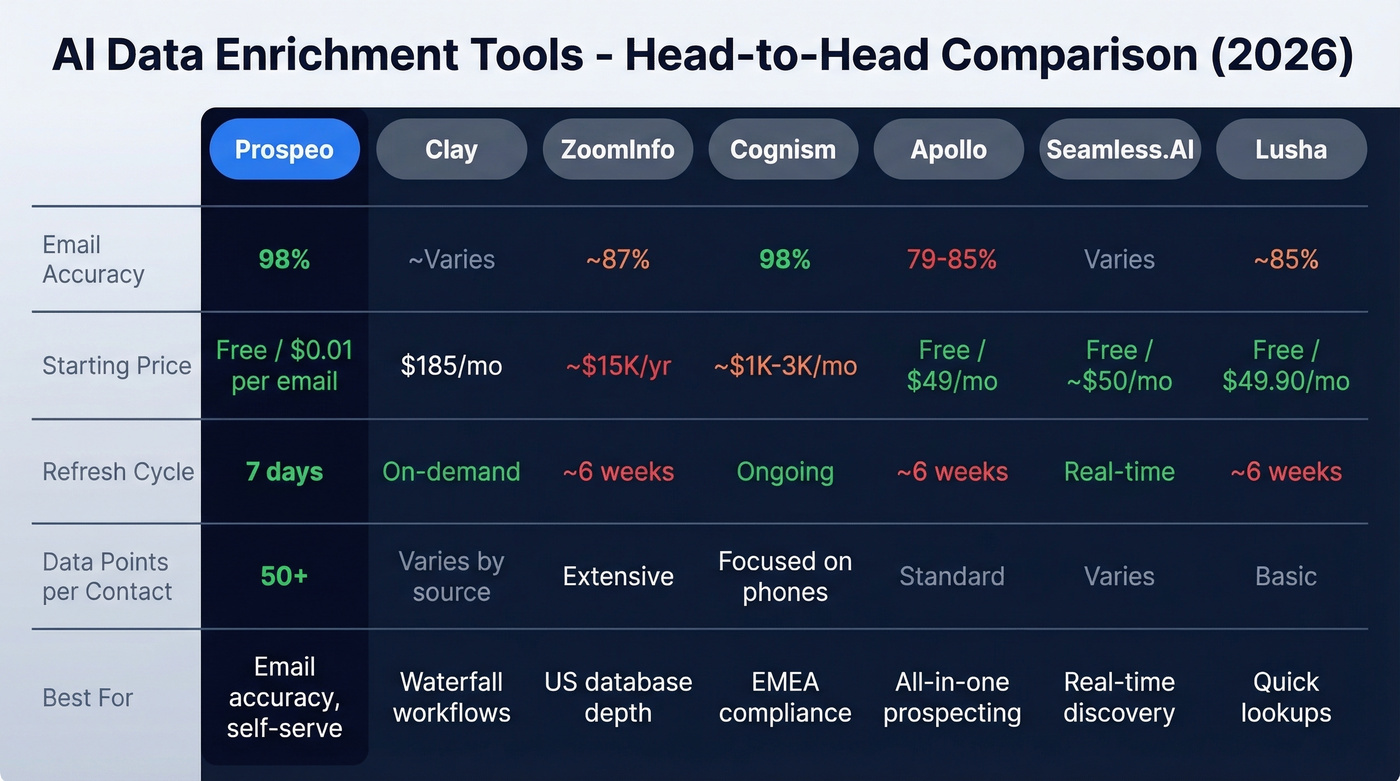

You just read that B2B data decays at 2.1% per month. Most AI enrichment tools refresh every 6 weeks - by the time reps touch those records, they're already stale. Prospeo's 7-day refresh cycle, 98% email accuracy, and 92% API match rate mean your enriched data actually stays enriched.
Stop paying for data that's decaying faster than you can use it.
Best AI-Powered Enrichment Platforms
Prospeo
Prospeo's database covers 300M+ professional profiles with 143M+ verified emails hitting 98% accuracy. That number holds up because of a proprietary 5-step verification process with catch-all handling, spam-trap removal, and honeypot filtering - no reliance on third-party email providers.
If you're comparing providers, start with a B2B database that matches your ICP and geography.
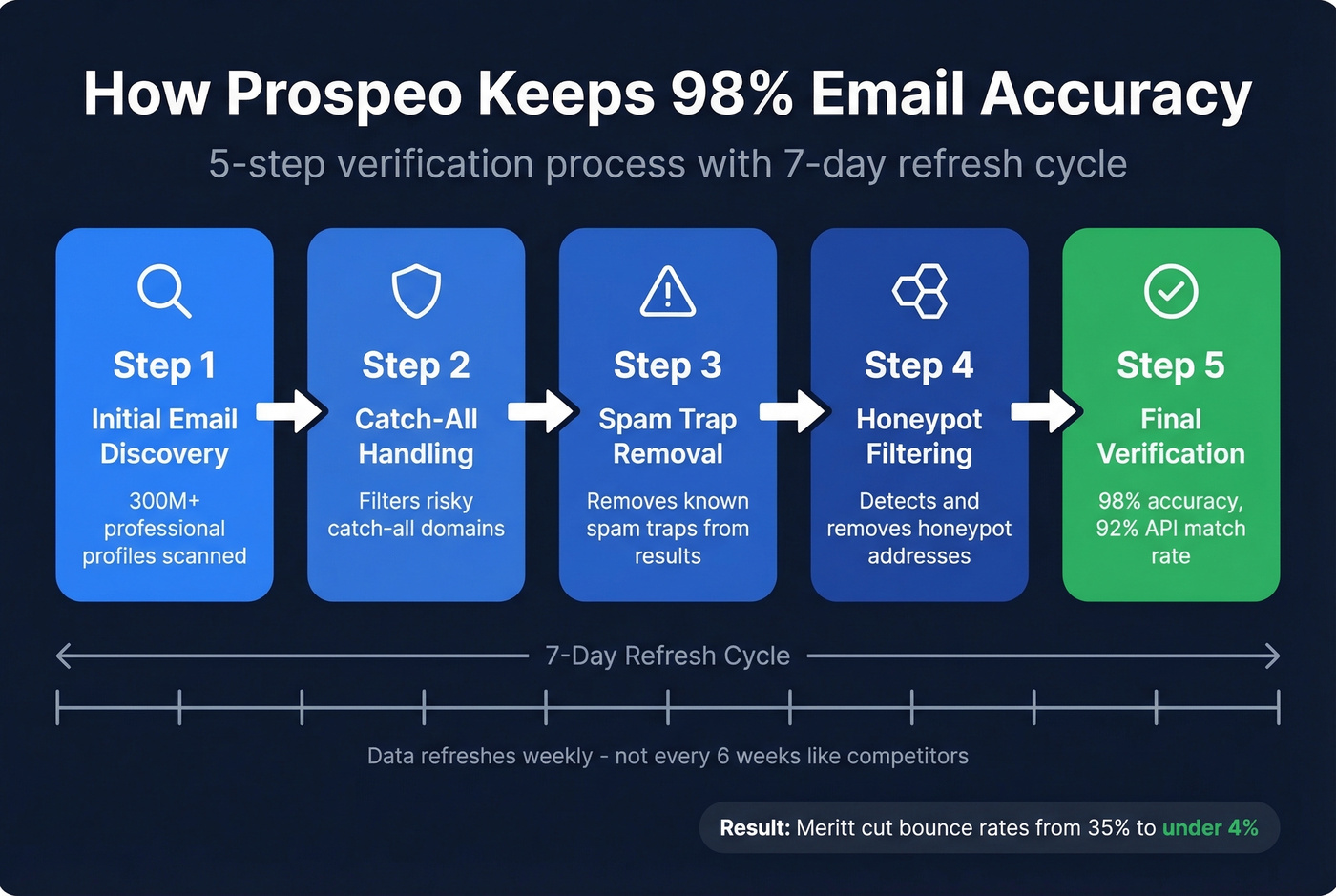
The 7-day data refresh cycle is the standout feature. Industry average sits around 6 weeks, which means most "enriched" records are already decaying by the time reps touch them. Weekly refresh keeps records usable without manual re-verification.
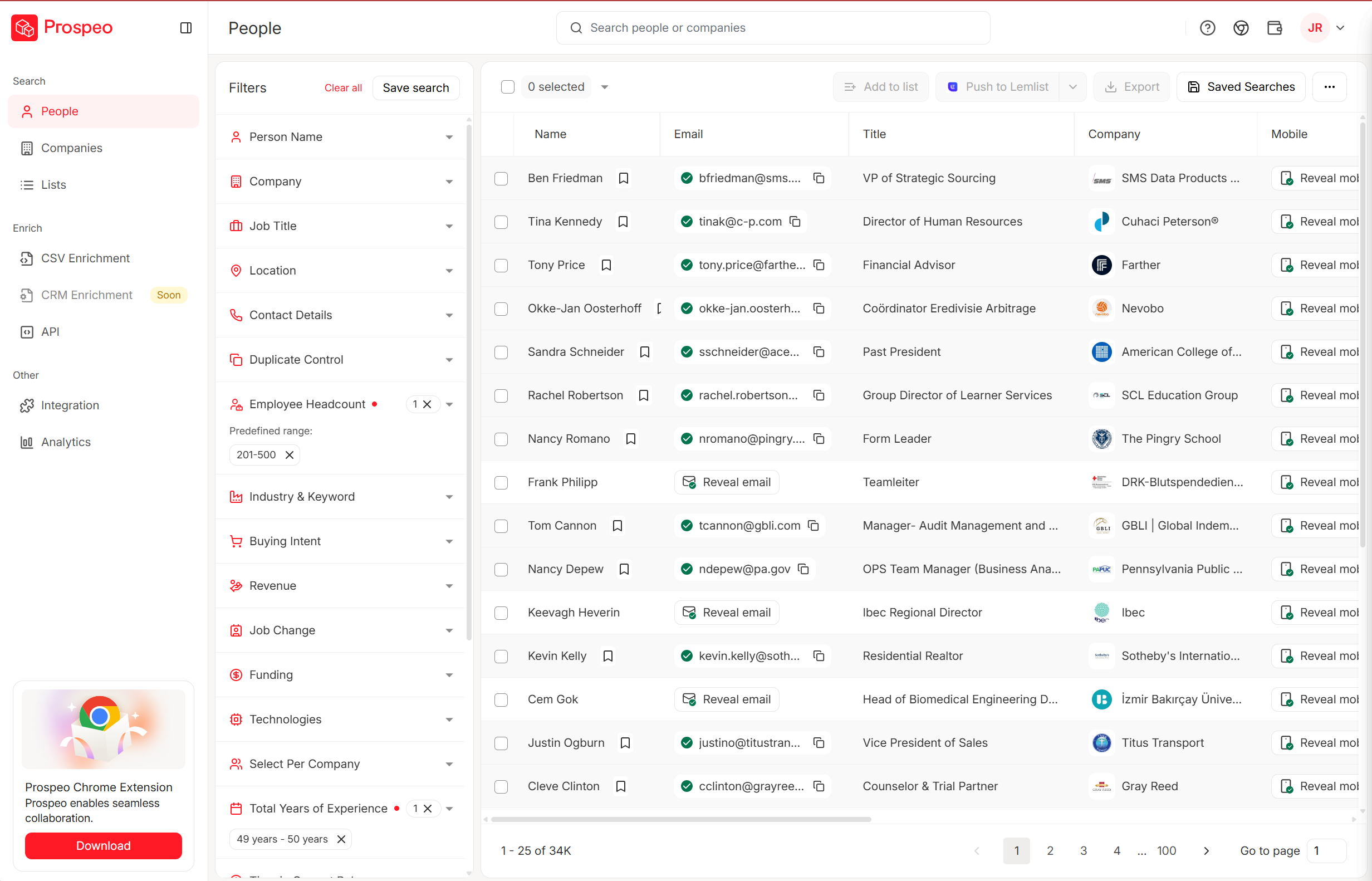
The enrichment API returns 50+ data points per contact with a 92% API match rate, and enrichment workflows bring back contact data for 83% of leads. You also get 30+ search filters covering buyer intent, technographics, job changes, and funding signals. Native integrations with Salesforce, HubSpot, Clay, Smartlead, Instantly, Lemlist, Zapier, and Make keep your stack connected. Intent data covers 15,000 topics via Bombora for layering buyer signals on top of contact data.
The proof point that matters most: Meritt tripled pipeline from $100K to $300K/week after switching, with bounce rates dropping from 35% to under 4%. Pricing starts free with 75 emails and 100 Chrome extension credits per month, scales at roughly $0.01/email, and requires zero contracts or sales calls.
Clay
Use this if you're running complex, multi-source enrichment workflows and want an AI research agent pulling from 150+ data providers in a single waterfall sequence. Clay's March 2026 pricing overhaul brought new tiers: Launch at $185/mo with 2,500 Data Credits and 15,000 Actions, Growth at $495/mo with 6,000 Data Credits and 40,000 Actions. The old $800/mo Pro plan is gone - CRM integrations now live at the $495 tier. Legacy plan customers have until April 10, 2026 to switch between old tiers before changes lock.
If you're building multi-provider waterfalls, this is basically data enrichment orchestration at scale.
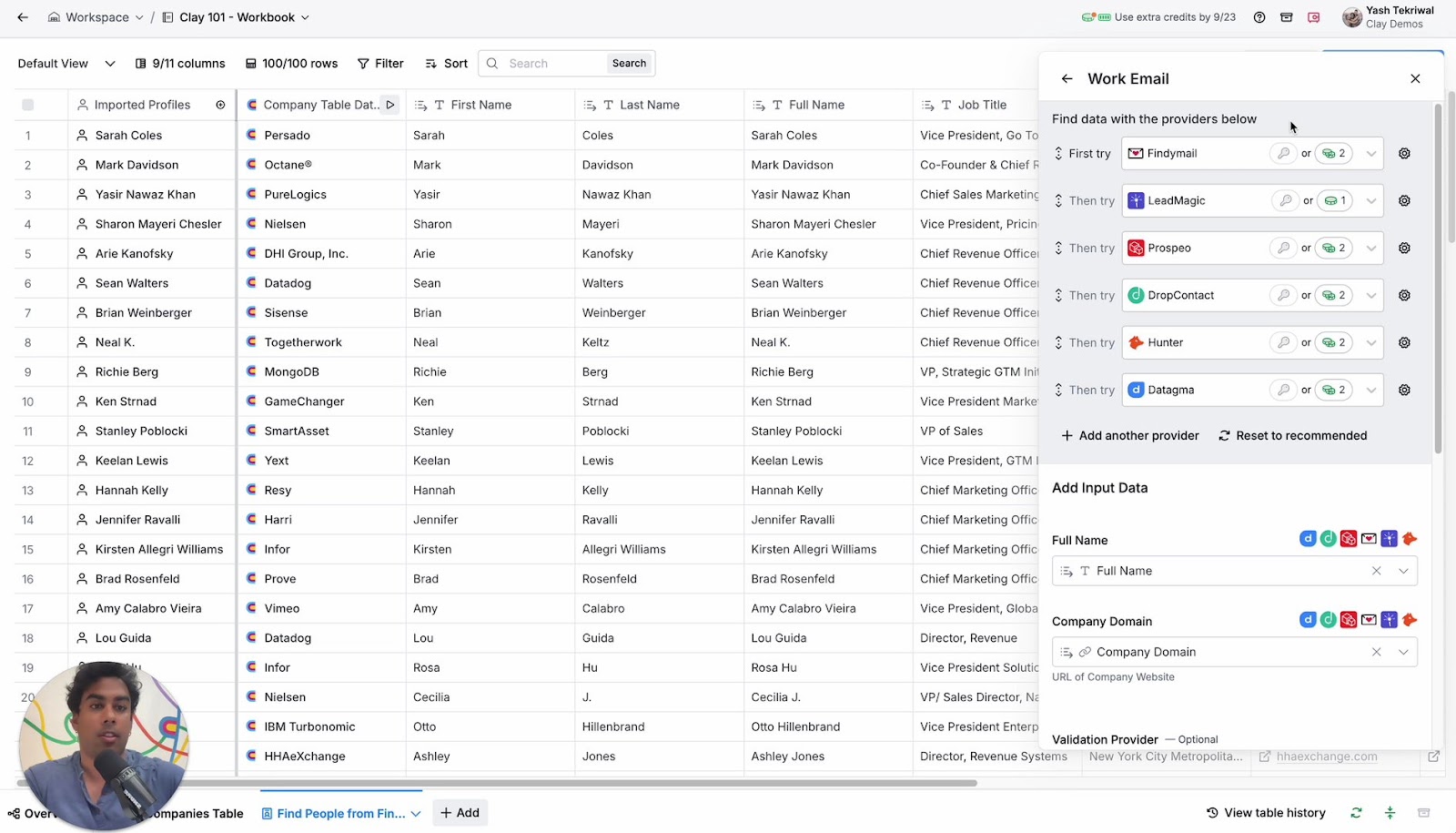
The new two-currency model splits Data Credits (for buying third-party data) from Actions (for platform orchestration). No charge for failed lookups, which matters when 20-30% of lookups return nothing. Clay says 90% of customers won't hit Actions limits and 85% of AI users will spend less under the new model. Under the hood, Clay uses LLMs for enrichment tasks like summarizing company descriptions, classifying industries, and extracting key details from unstructured web pages - a genuine differentiator over tools that rely on static field matching alone.
Skip this if you want plug-and-play simplicity. Reddit users on r/sales consistently report a week-long learning curve and real monthly spend of $500-$2,000 depending on volume. Clay also doesn't send emails - you'll need a separate outreach tool (see outbound email automation).
ZoomInfo
The deepest US B2B database on the market. Intent data, org charts, technographics, and workflow automation all under one roof. If you're a 200+ person sales org running outbound, ABM, and intent from a single platform, ZoomInfo's breadth is hard to match.
But the pricing is the elephant in every room. Typical contracts run $15K-$45K+/year depending on tier, with additional users at ~$2,500 each. Add-ons like Global Data at $9,995 and bulk credits at $0.20-$0.60/credit pile on top. Discounts of 30-65% are common if you negotiate hard, but renewal uplifts of 10-20% are equally common if you don't. Annual contracts only. The #1 complaint on Reddit and in every procurement thread we've read is paying for modules you never activate.
Cognism's head-to-head benchmarking showed a 72% match rate for ZoomInfo versus 98% for Cognism. That's a vendor benchmark, so discount it somewhat, but the directional gap in European markets matches what we've seen in bake-offs. ZoomInfo's refresh cycle is around 6 weeks, meaning enriched records start decaying almost immediately.
Cognism
Pick Cognism if you're selling into EMEA and compliance isn't optional. GDPR-first architecture with Diamond Data phone verification - they human-verify mobile numbers before delivering them. Published benchmarks show a 98% match rate versus ZoomInfo's 72%, and a 22% call connect rate versus 14%.
If compliance is a gating factor, align your process with a GDPR compliant database checklist before you buy.
Where ZoomInfo still wins: US database depth and workflow breadth. Cognism's strength is narrower but deeper on compliance and mobile accuracy. Custom pricing typically lands at ~$1,000-$3,000/mo for small teams.
Apollo
Apollo gets you from signup to running outbound sequences fast. Free tier for testing, paid plans at $49-$119/user/month on annual billing. Search, export, and sequence in one platform.
Skip this if you're in competitive niches where data freshness matters. The persistent complaint on r/coldemail is that Apollo's "verified" emails still bounce at unacceptable rates, and the data feels picked over in saturated verticals. Credit constraints also bite at scale - you'll hit limits faster than you expect.
If bounces are your bottleneck, pair enrichment with an email verifier before sending.
Seamless.AI
Seamless.AI isn't limited to a static database. Its real-time data engine searches for and verifies contact information on the fly, which means fresher results for individual lookups. Free tier available for light testing, with paid plans running roughly $50-$150/mo.
The trade-off is speed: real-time search is slower for bulk enrichment than pre-built databases. Best suited for teams that prioritize accuracy on targeted searches over raw volume.
Breeze Intelligence
Clearbit is dead as a standalone product. HubSpot acquired it in December 2024 and rebranded everything as Breeze Intelligence. If you're on HubSpot, the enrichment is now native - 250+ data sources, 100+ attributes, credit-based pricing starting around $10 per 1,000 credits/month.
Not on HubSpot? Cross it off your list entirely. There's a 300 exports/day limit, no free tier, and credits reset monthly. It works well inside HubSpot, but the walled-garden approach means zero flexibility outside that ecosystem.
If you're trying to reduce manual ops work, consider how this fits into CRM automation before committing.
Lusha
Simple, fast, affordable for individual lookups. Free plan available, paid from $49.90/mo for 3 users. Best for reps who need a quick phone number or email - not for teams running bulk enrichment workflows.
What AI Enrichment Actually Costs
Here's what most comparison articles skip: the real cost per usable lead. In our experience, a tool that's cheap per seat but delivers 15% bounce rates is more expensive than one that costs more but actually works. Let's break this down.
This is also why the benefits of data enrichment show up most clearly in deliverability and conversion, not just “more fields.”
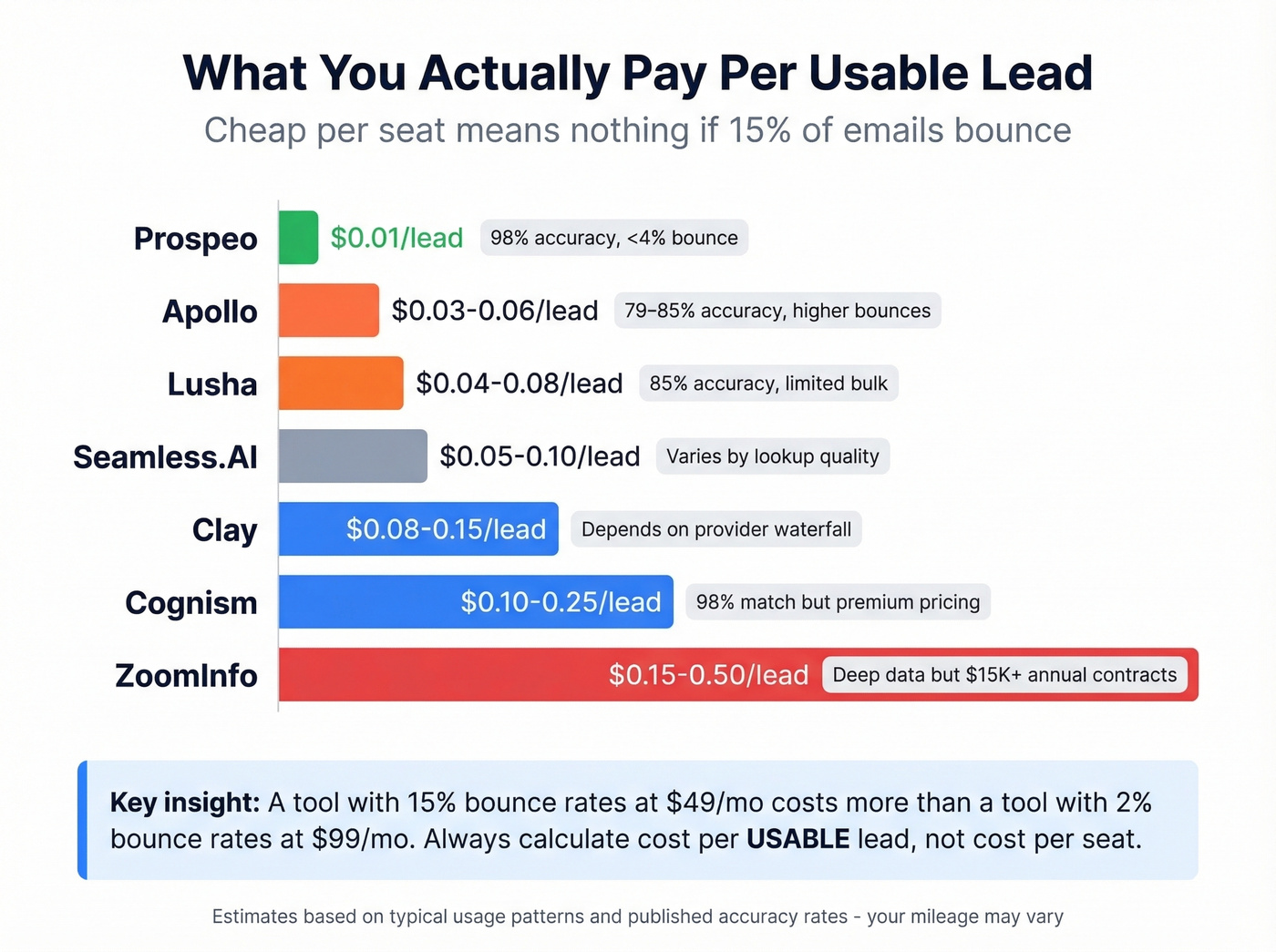
| Tool | Starting Price | Credit/Seat Model | Hidden Costs |
|---|---|---|---|
| Clay | $185/mo | Data Credits + Actions | Credit burn on bad workflows |
| ZoomInfo | ~$15K/yr | Annual + bulk credits | Renewal uplifts, overages |
| Cognism | ~$1K-3K/mo | Custom packages | Enterprise add-ons |
| Apollo | Free; $49/mo+ | Per-user + credits | Credit caps at scale |
| Seamless.AI | Free; ~$50-150/mo | Per-seat | Opaque scaling costs |
| Breeze Intel | ~$10/1K credits | Credit-based, HubSpot-only | Platform lock-in |
| Lusha | Free; $49.90/mo | Per-seat (3 users) | Limited bulk capability |
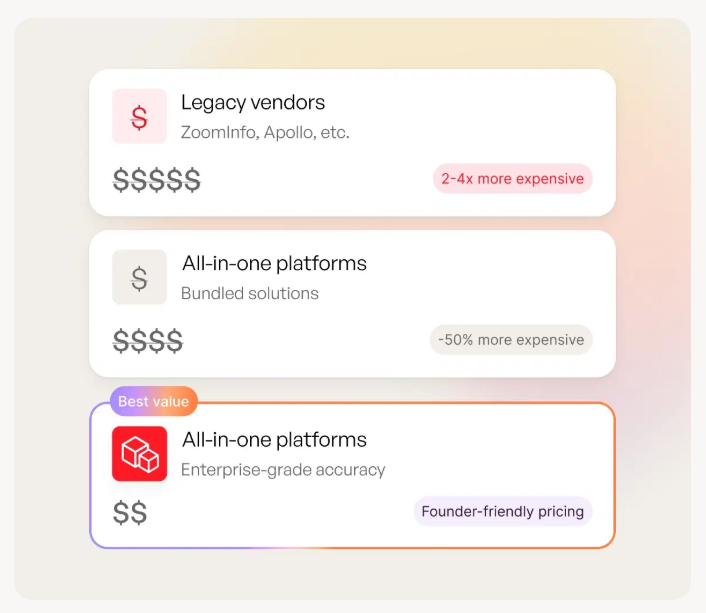
Meritt tripled pipeline from $100K to $300K/week and cut bounce rates from 35% to under 4% - with the same team. Prospeo returns 50+ data points per contact at $0.01/email, no contracts required. That's what AI enrichment looks like when accuracy isn't an afterthought.
Enrich your first 75 contacts free and see the difference in deliverability.
Enrichment Mistakes That Burn Budget
Over-enriching everything. Paying for 50 data points on a lead that hasn't opened your first email is waste. Use tiered enrichment: basic firmographics at capture, full contact data at SQL stage, real-time enrichment at opportunity.
If you need a tighter handoff, map enrichment to your MQL to SQL handoff rules.
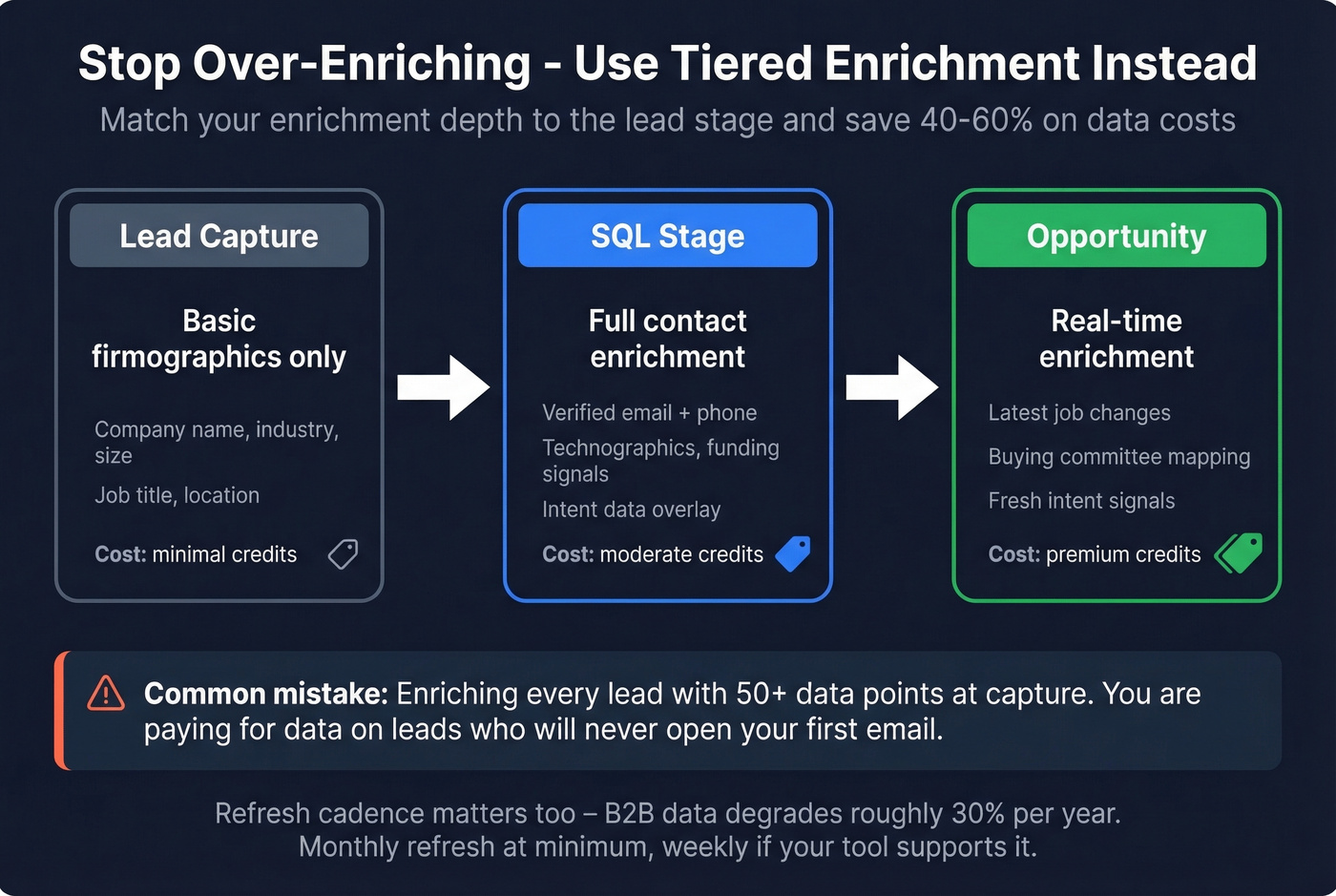
Set-and-forget syndrome. B2B data degrades ~30% annually. If you enriched your database in January and haven't refreshed since, a third of it is already wrong. Build a refresh cadence - monthly at minimum. Enrichment automation can handle these cycles so records stay current without manual intervention.
Enriching at the wrong stage. Don't burn credits enriching top-of-funnel leads that haven't been qualified. Save the expensive enrichment for leads showing buying behavior. This one mistake alone accounts for more wasted spend than picking the wrong tool does.
Skipping verification. Look, enrichment and verification aren't the same thing. Most platforms return data without confirming deliverability - that's why bounce rates vary so wildly across tools. If your provider doesn't verify on delivery, you need a separate verification step before you send a single email.
If you're scaling outbound, build this into your business cold email infrastructure so deliverability doesn’t collapse.
FAQ
How do AI data enrichment tools differ from traditional enrichment?
AI-native platforms like Clay pull from multiple sources dynamically, using machine learning to classify, deduplicate, and normalize records on the fly. AI-enhanced tools add smart features to pre-built databases. AI-native produces fresher results; AI-enhanced offers broader coverage and faster bulk processing.
Is AI-powered enrichment GDPR compliant?
It depends entirely on the provider's data sources and architecture. Look for providers with DPAs, opt-out enforcement, and vetted data partners. Cognism has the strongest GDPR-first design; Prospeo enforces opt-outs globally with a zero-trust data partner policy.
Can I use multiple enrichment tools together?
Yes - waterfall enrichment is increasingly standard. You run data through multiple providers sequentially, filling gaps each tool misses. Clay orchestrates this natively with 150+ providers, and Prospeo integrates directly into Clay workflows as one of those sources.
What's a good email accuracy rate for enrichment?
Industry average hovers around 85-90%. Top-tier tools hit 95%+, with Prospeo benchmarking at 98%. Always test with your own domain and ICP before committing - accuracy varies by industry, seniority level, and geography.
The tools above cover every budget and use case. Whether you need a full AI data enrichment stack or a single high-accuracy provider, start with the comparison table and filter by what matters most to your team.