

AI Email Warmup in 2026: What Works, What Doesn't, and What Matters More
Your warmup dashboard says 95% deliverability. Your actual campaign just bounced 8%. That gap defines the problem with AI email warmup right now - tools grade themselves against their own seed networks, not real inboxes. Gmail's November 2025 enforcement shift changed the rules, and most warmup tools haven't caught up.
The Short Version
- Most "AI warmup" tools use rule-based automation, not real AI. Only a few adapt to bounce signals dynamically.
- Warmup alone won't save your deliverability. Clean data and authentication matter more.
- Best starting stack: Instantly (starts around $37/mo) for warmup + Prospeo for verified contact data + Google Postmaster Tools for monitoring.
What "AI" Actually Means in Email Warmup
When warmup vendors say "AI," they almost always mean adaptive rule-based logic - not machine learning, not LLMs, not anything resembling what most people picture when they hear the term.
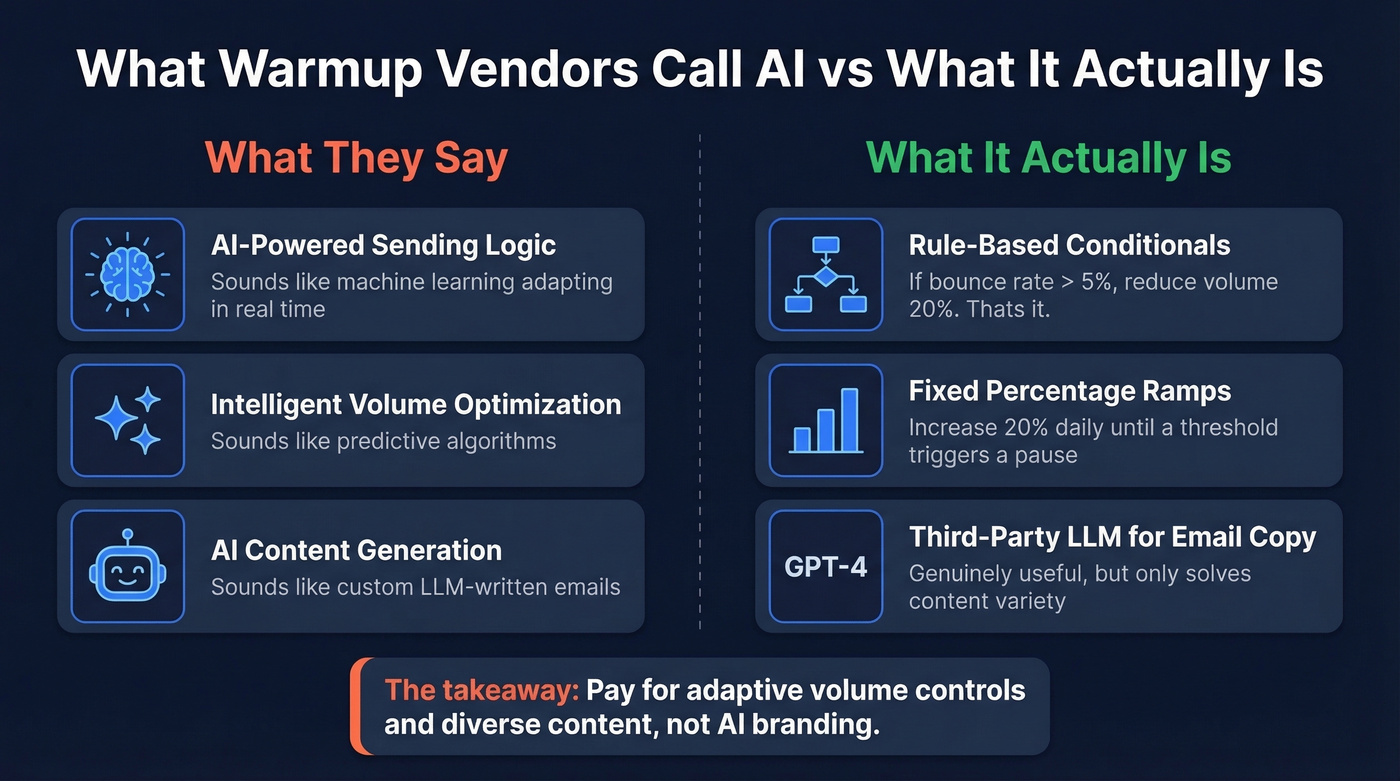
6sense's warmup system makes the formula transparent: bounce rate below 3%, daily volume increases 20%. Between 3-5%, volume holds. At 5% or higher, it drops 20%. That's a conditional rule responding to a single metric. It works, but calling it "AI powered" is generous.
Warmbox takes a different approach, using GPT-4 to generate varied warmup email content so messages look less templated. Genuinely useful, but it solves the content problem, not the sending logic problem. Vendors blur this line constantly.
Don't pay a premium for "AI" branding. Pay for adaptive volume controls and diverse warmup content. Those are the features that actually move the needle.
Why Most Warmup Tools Underperform
Three mechanisms are killing warmup effectiveness in 2026.

Cloud automation detection. Many warmup tools simulate engagement through automated systems hosted on cloud infrastructure. Providers can identify non-human interaction patterns and discount those signals. Your dashboard shows opens; Gmail sees bots. If you want a more reliable baseline, track your sender reputation outside the warmup tool.
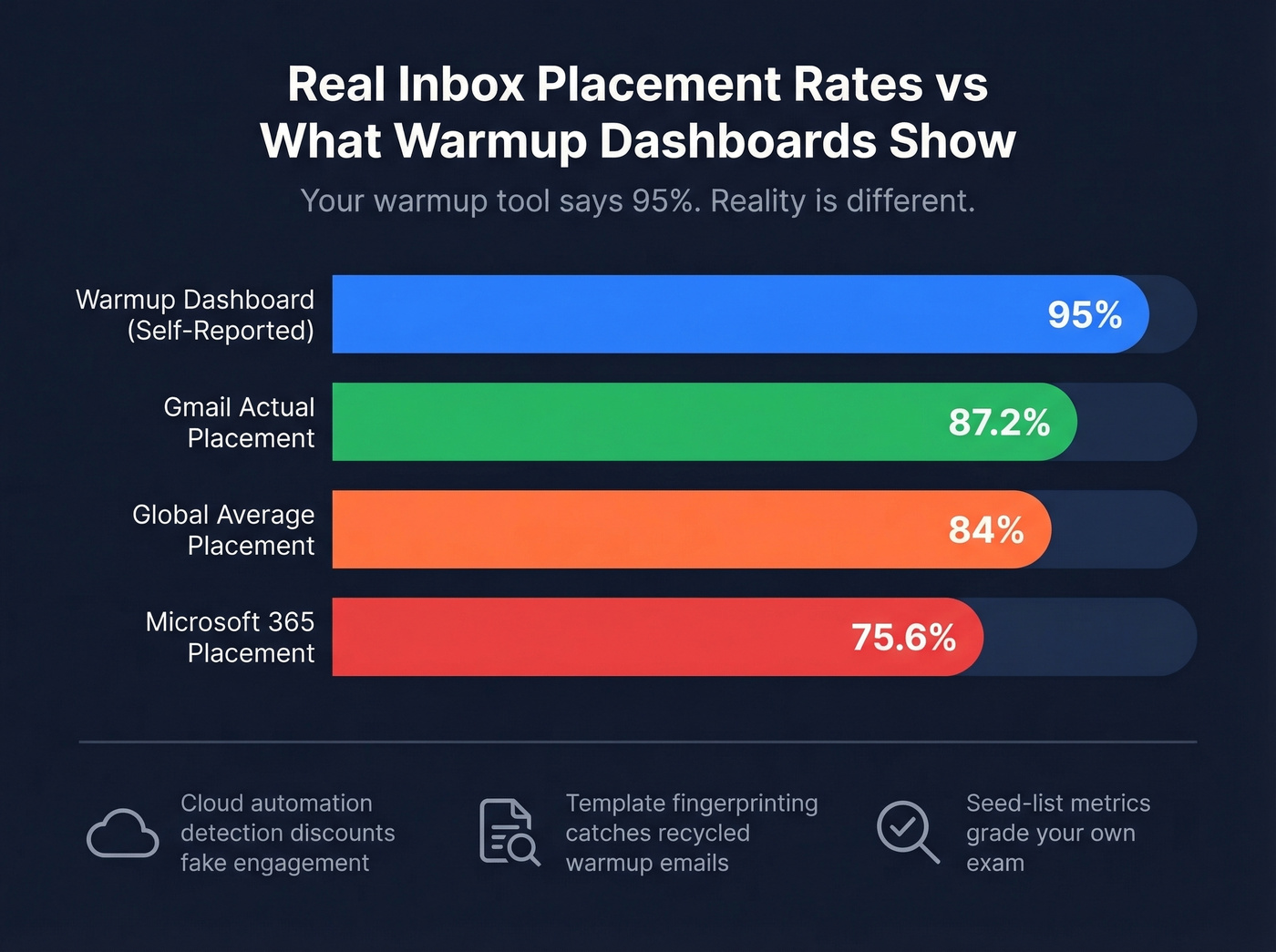
Template fingerprinting. Warmup networks send millions of messages using recycled templates. Even with variation, patterns are detectable at scale. Postbox Services tested nearly all major warmup tools and found none demonstrated meaningful deliverability improvements.
Biased seed-list metrics. Warmup tools measure deliverability against controlled mailboxes inside their own networks. That's grading your own exam. Global inbox placement averages just 84% - Gmail sits at 87.2%, but Microsoft drops to 75.6%. If you need a deeper breakdown, see our email deliverability guide.
Gmail's November 2025 enforcement added real consequences: non-compliant bulk email can be temporarily or permanently rejected at the SMTP level, bounced outright rather than just foldered to spam. Apollo dropped warmup entirely in 2024, replacing it with volume pacing - a sign that even major platforms doubt traditional warmup's value. On r/coldemail, operators report domains tanking after three weeks even with inbox warmup running continuously.
Here's the thing: warmup tools aren't useless, but they've become a security blanket. Most teams would get better results spending that $37/month on verified data and proper authentication than on artificial engagement signals that Gmail increasingly ignores. If you're scaling outbound, it also helps to understand email velocity so you don't ramp too fast.

Your warmup tool reports 95% deliverability. Your campaign bounces 8%. The gap isn't your warmup - it's your data. Prospeo's 5-step verification delivers 98% email accuracy with a 7-day refresh cycle, so every address you send to actually exists. Stack Optimize built a $1M agency on Prospeo data with bounce rates under 3% across every client.
Fix the data first. Warmup only works on clean lists.
Fix the Data Before You Warm Up
If your bounce rate exceeds 5%, no warmup tool - AI-driven or otherwise - will save you. The average cold email bounce rate runs 7-8%, and the goal is under 5%. Warmup builds reputation through engagement signals. Bad data destroys it through bounces. The math doesn't work if you're feeding invalid emails into your sequences. For benchmarks and bounce-code context, use this email bounce rate reference.
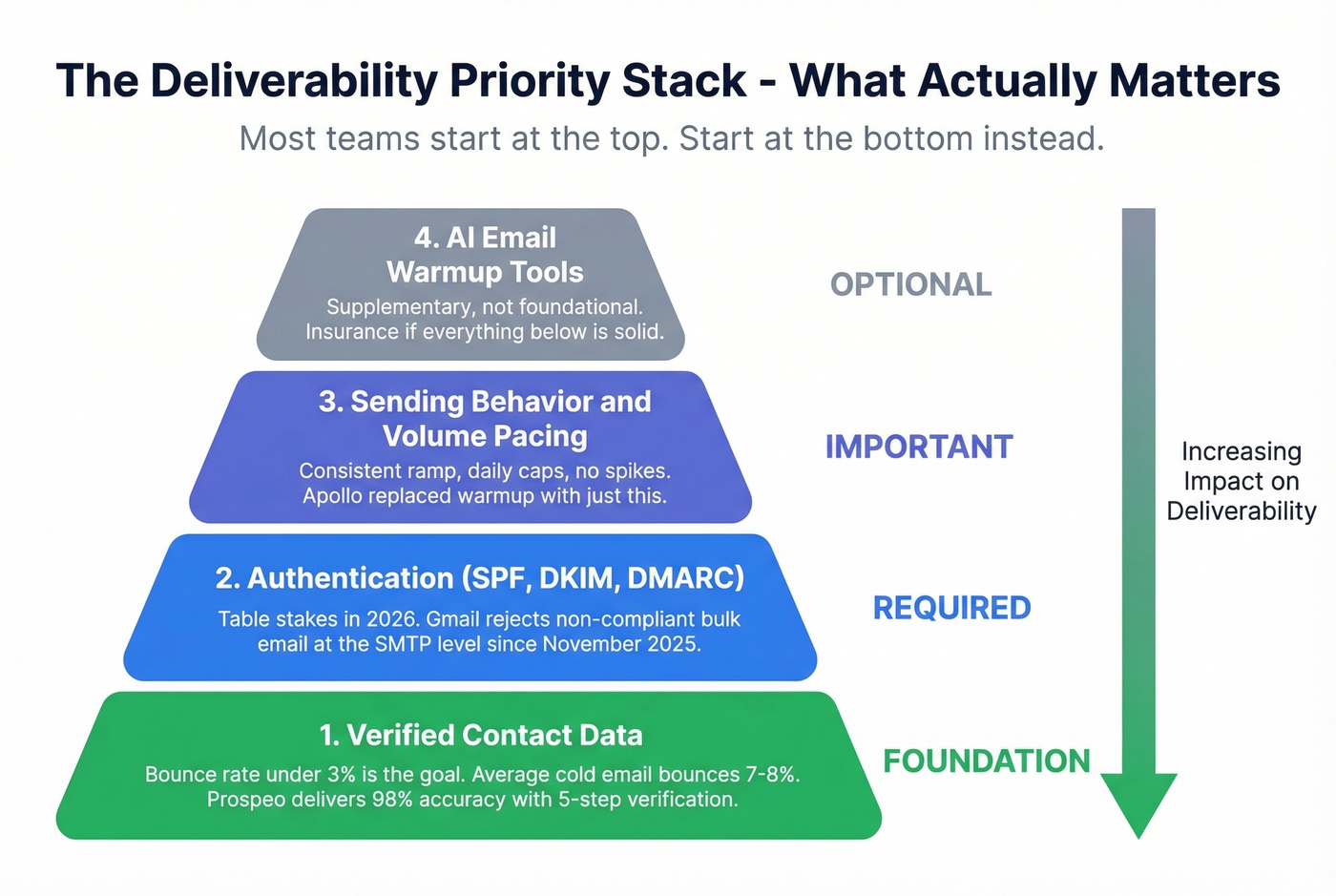
Before spending a dollar on warmup software, verify your list. Prospeo's 5-step verification - catch-all handling, spam-trap removal, honeypot filtering - delivers 98% email accuracy with data refreshed every 7 days. Stack Optimize runs Prospeo across all client campaigns and maintains 94%+ deliverability with bounce rates under 3%. If you want to pressure-test your process, compare it to an email spam checker workflow.
SPF, DKIM, and DMARC are table stakes, not optional. Gmail wants spam complaint rates below 0.1%. Authentication plus clean data gets you there. Warmup without those foundations is wasted spend. If you're troubleshooting policy failures, start with DMARC alignment and then confirm your setup with how to verify DKIM is working.
How to Warm Up Properly
If you're going to use an AI email warmup tool, here's the ramp that actually works:
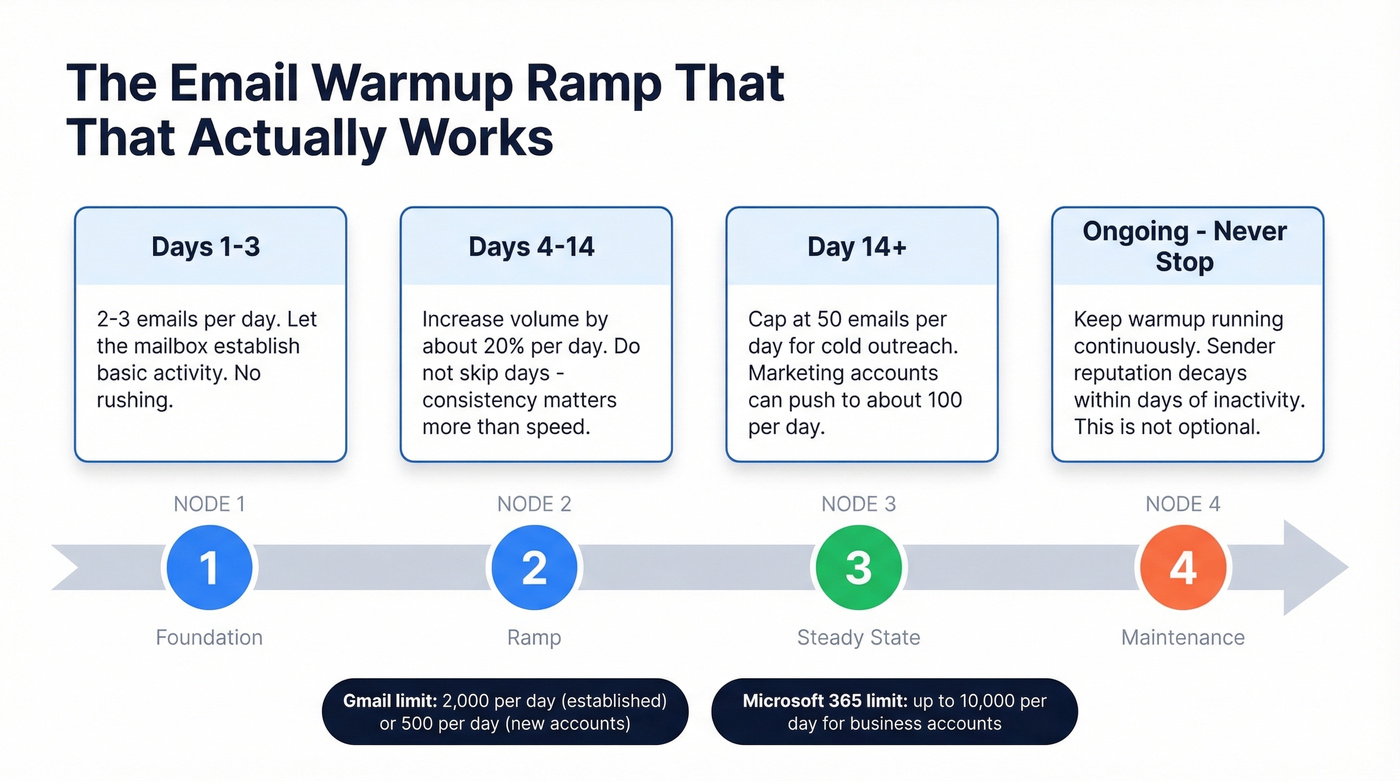
- Days 1-3: 2-3 emails per day. Let the mailbox establish basic activity.
- Days 4-14: Increase volume by ~20% per day. Don't skip days.
- Cap: 50 emails/day per account for cold outreach. Marketing accounts can push to ~100/day.
- Never stop: Warmup should run continuously. Turning it off after two weeks is a common mistake - sender reputation decays within days of inactivity.
Know your ESP limits. Gmail caps at 2,000/day for established accounts, but new or flagged accounts hit 500/day. Microsoft 365 allows up to 10,000/day for business accounts. If you're building a full outbound motion, pair this with a solid B2B cold email sequence.
If you don't trust warmup tools at all, there's a manual path: set up Google Workspace, send a few real emails per day, increase by about 50% daily until you hit 40-50/day. We've tested this approach and it works. It's just slower.
Top Warmup Tools Compared
| Tool | Starting Price | Network Size | Notable Feature |
|---|---|---|---|
| Instantly | $37/mo | 1M+ inboxes | Scale + ease of use |
| Warmbox | $19/mo | 35K+ inboxes | GPT-4 content generation |
| Lemwarm | $29/mo | Not public | Lemlist ecosystem integration |
| MailReach | ~$19.50/mo | Not public | Monitoring and diagnostics |
| TrulyInbox | $22-$39/mo | Not public | High-volume scaling |
| Warmy | $279/mo per mailbox | Not public | AI engine "Adeline" |
| Mails.ai | Free (warmup) | Not public | Free warmup; paid outreach |
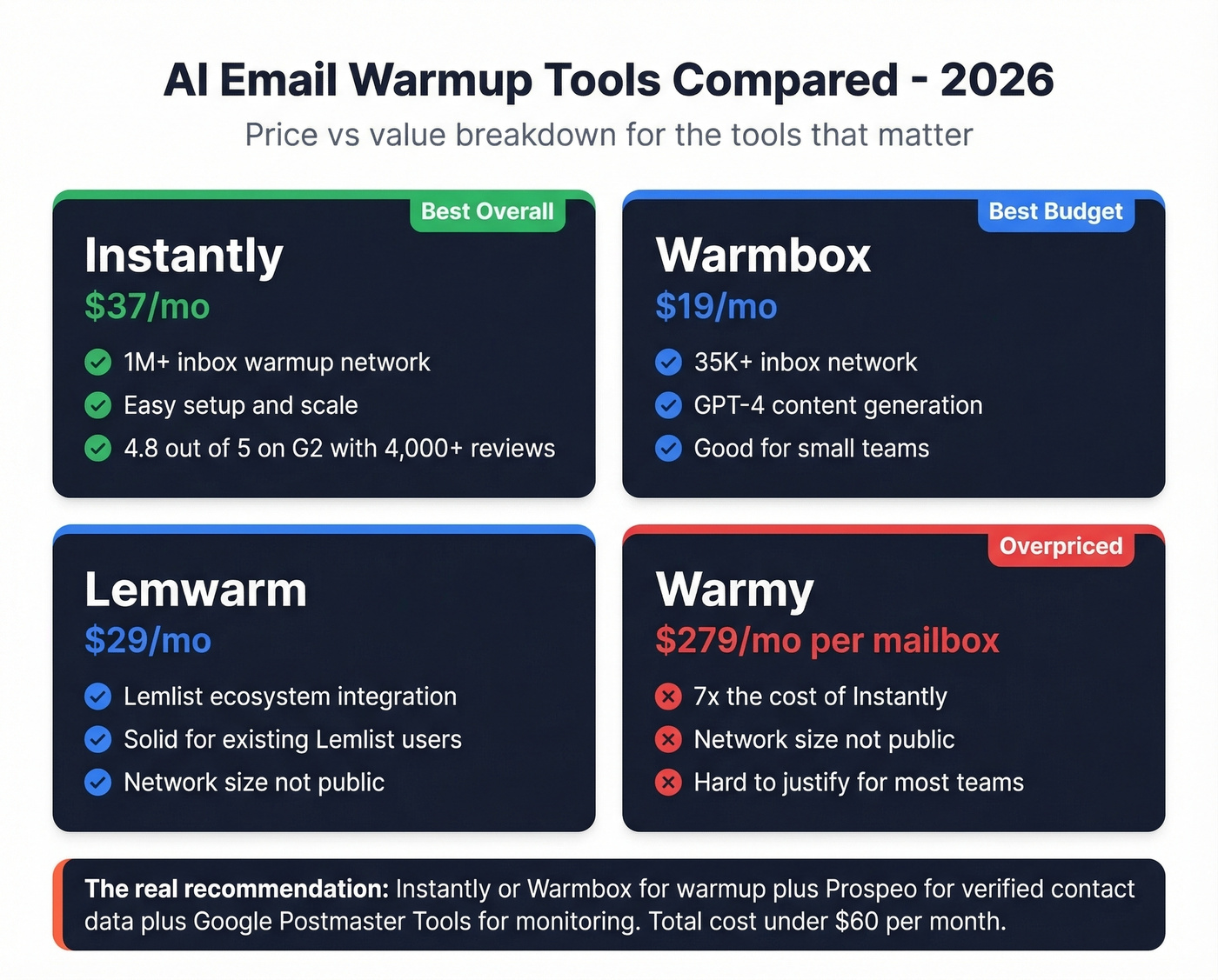
Instantly is the default recommendation - large network, reasonable price, and 4.8/5 across 4,000+ G2 reviews. Some vendors advertise unlimited warmup across all mailboxes, but check the fine print; caps often apply to network interactions or daily send volume. If you're evaluating options, our roundup of unlimited warmup tools can help.
Warmy at $279/mo for a single mailbox is hard to justify when Instantly costs a seventh of that. Expensive doesn't mean better. What matters more than price is whether the tool uses standard SMTP/IMAP access versus inbox manipulation via provider APIs. Google's late-2022/early-2023 crackdowns targeted warmup approaches that relied on Gmail API behavior, not normal sending and receiving.
Skip Warmy unless you're running a large agency with a specific need for its reporting suite. For most teams, Instantly or Warmbox paired with verified data will outperform a $279/mo tool running on dirty lists. If you're also choosing an outreach platform, compare against our picks for an AI bulk email sender.
You're spending $37/mo on warmup to build sender reputation, then destroying it with 7-8% bounce rates from unverified lists. Prospeo gives you 143M+ verified emails at $0.01 each - catch-all handling, spam-trap removal, honeypot filtering included. Teams using Prospeo book 35% more meetings than Apollo users because the emails actually land.
Stop warming up dead addresses. Start with data that connects.
FAQ
Is email warmup legal?
Yes - there's no law against it. The real risk is ESP terms-of-service violations. Google's crackdowns in late 2022 and early 2023 targeted warmup tools manipulating inbox behavior via Gmail APIs, not users building reputation through standard SMTP/IMAP activity.
How long does AI email warmup take?
Initial ramp takes 2-4 weeks at 20% daily volume increases, but warmup should run continuously. Turning it off after the ramp period is one of the most common mistakes we see - sender reputation decays within days of inactivity.
Can warmup fix a burned domain?
Rarely. A fresh domain with proper authentication and clean, verified contact data is faster than rehabilitation. Most teams attempting domain recovery give up within 30 days. A new $6/mo Google Workspace account plus verified contacts gets you restarted faster than months of reputation repair.
Does warmup matter if my data is already clean?
It helps, but less than vendors claim. Teams running verified lists under 3% bounce report 94%+ deliverability with minimal warmup. Clean data and authentication do the heavy lifting. Warmup is supplementary, not foundational. Let's be honest - if your bounce rate is already under 3% and your authentication is solid, warmup is insurance, not a requirement.