

AI for ABM: Why Most Programs Fail (and How to Fix Yours)
78.7% of marketers now use AI for ABM. Sounds impressive - until you learn that nearly 70% find AI's current effectiveness limited. That's a lot of money spent on "intelligence" that isn't delivering.
The gap isn't the technology. It's the foundation underneath it.
Here's the short version: build a scoring framework first (Fit 40% / Intent 35% / Relationship 25%) before you buy any platform. Enterprise suites like Demandbase and 6sense only make sense with dedicated ABM ops and a mid-five-figure to six-figure budget. For everyone else, verified contact data with intent signals plus a sequencing tool gets you 80% of the way for around $500/month.
Predictive vs. Generative AI in ABM
Predictive AI scores accounts, identifies buying stages, and prioritizes where reps spend time. It answers one question: who should we target right now?
Generative AI creates personalized content and scales messaging across buying committees. It answers a different one: what do we say to them? Organizations using generative AI in account-based marketing have seen a 50% increase in sales-qualified leads. The most effective programs layer both - predictive to prioritize, generative to engage - and the teams that treat them as separate capabilities rather than one magic button consistently outperform those chasing a single all-in-one solution.
How Intent Signals Actually Work
Intent data tells you which accounts are actively researching topics relevant to your solution. There are three layers, and they aren't equal.
- First-party intent - behavior on your own properties: website visits, email engagement, product usage. Clearest signal, most actionable.
- Second-party intent - a partner's first-party data: publishers, review sites like G2, sponsored content platforms.
- Third-party intent - aggregated web behavior from external providers. Broadest reach, noisiest signal.
Only 21% of marketers use intent data at all. That's a massive competitive advantage sitting on the table for anyone willing to operationalize it. Start with first-party, layer in third-party for coverage, and don't skip verification - intent signals pointing at stale contacts are worthless.
A Practical ABM Scoring Framework
Teams that succeed follow a resource allocation model: 70% on proven demand gen, 20% on ABM implementation, 10% on experiments. This 70/20/10 approach correlates with 34% faster program maturity compared to going all-in overnight.
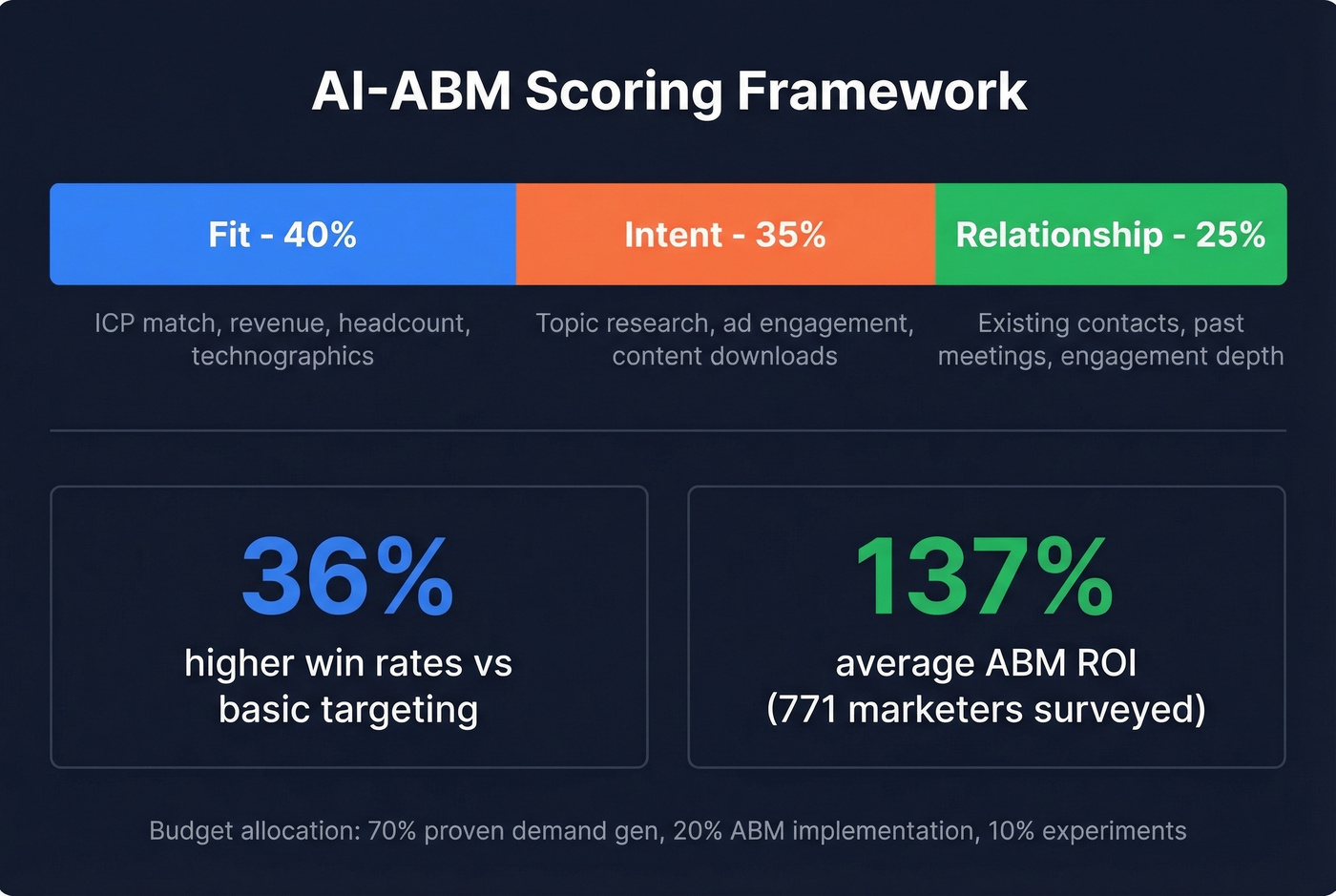
Every account gets scored across three dimensions:
| Signal Layer | Weight | Example Inputs |
|---|---|---|
| Fit | 40% | ICP match, revenue, headcount, technographics |
| Intent | 35% | Topic research, ad engagement, content downloads |
| Relationship | 25% | Existing contacts, past meetings, engagement depth |
We've seen teams using this kind of multi-signal scoring hit 36% higher win rates versus basic demographic targeting. A survey of 771 marketers found average ABM ROI hits 137% - but that average masks a brutal distribution. The winners win big. The losers waste a year. With 49.7% of teams planning to increase ABM budgets in 2026, the gap between disciplined programs and sloppy ones will only widen.

Your ABM scoring framework needs verified contacts underneath it. Prospeo layers Bombora intent data across 15,000 topics with 300M+ profiles, 98% email accuracy, and a 7-day refresh cycle - so your Fit + Intent + Relationship scores actually connect reps to real buyers, not bounced emails.
Stop feeding your ABM engine stale data. Start with contacts that convert.
Why Most AI-Driven ABM Programs Fail
67% of ABM programs fail to deliver in their first year. We've watched it happen repeatedly, and the failure modes are predictable.
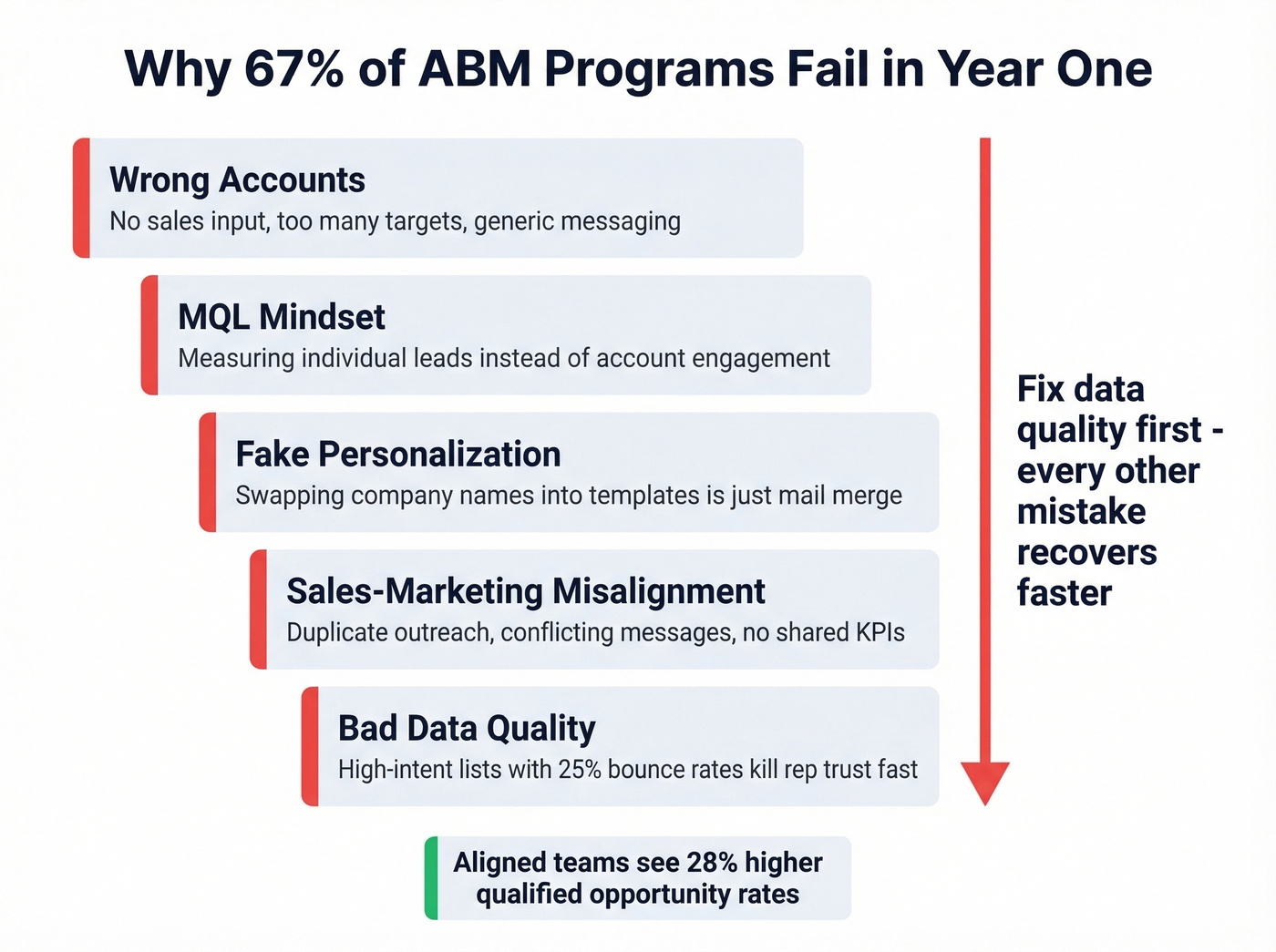
Wrong accounts. No sales input on target lists, too many accounts, messaging so generic it could've been a blast email. One B2B SaaS marketer on Reddit described the classic version: ads driving clicks but zero demos, while Google brought signups from completely off-target accounts.
MQL mindset. Measuring individual leads instead of account-level engagement. ABM isn't lead gen with a fancier name.
Generic "personalization." Swapping a company name into a template isn't personalization. It's mail merge.
Sales-marketing misalignment. Duplicate outreach, conflicting messaging, no shared KPIs. Teams with strong alignment see 28% higher qualified opportunity rates - misalignment kills programs faster than bad data.
Vanity metrics. Tracking opens and clicks instead of pipeline influence and deal velocity.
And then there's the failure mode that doesn't make most lists: data quality. Your AI scoring model is only as good as the contact data it acts on. If your "high-intent" account list produces 25% email bounces, reps lose trust in the program within weeks. In our experience, the teams that fix data quality first recover from every other mistake faster. (If you're seeing this, start with email bounce rate and email deliverability.)
The AI-ABM Tool Stack
Enterprise Orchestration
Demandbase and 6sense are the heavyweights. Demandbase leans media-heavy with a native B2B DSP and daily audience sync including LinkedIn. 6sense leads on predictive analytics and buying-stage scoring, with display, video, and CTV activation through The Trade Desk. Both typically land in the mid-five figures to six figures per year on custom contracts and often take a few months to implement fully. Intent-scored accounts are typically 2x more likely to become opportunities - but only if you have the team to operationalize them.
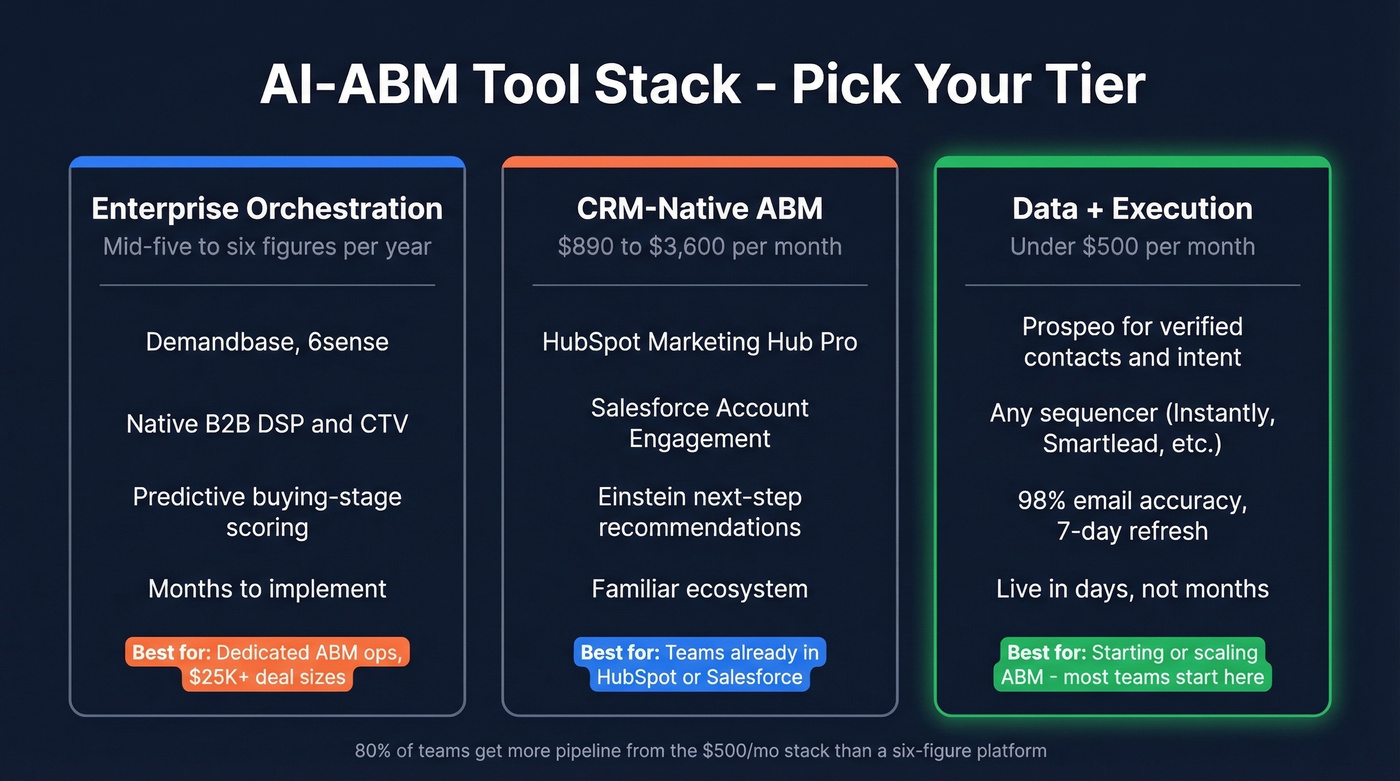
Let's be honest: most teams buying an enterprise ABM platform are overspending. If your average deal size is under $25K or you don't have a dedicated ABM ops person, you'll get more pipeline from a $500/month data-and-sequencer stack than from a six-figure platform collecting dust after a rough implementation. Skip this tier unless you've got the headcount and deal sizes to justify it.
CRM-Native ABM
HubSpot Marketing Hub Professional runs $890/month plus roughly $3K onboarding. Salesforce Account Engagement starts at $1,250/month, with Einstein providing next-step recommendations from CRM notes and engagement history. Best for teams already deep in those ecosystems who don't want another platform to manage. Not the best for teams that need intent data or predictive scoring beyond what's baked in.
The Data + Execution Layer
This is where most teams should actually start. AI can tell you which accounts to target - but you still need verified emails and direct dials to reach the humans inside those accounts.
| Tier | Best For | Tools | Budget |
|---|---|---|---|
| Enterprise orchestration | Dedicated ABM ops | Demandbase, 6sense | Mid-five figures to six figures/yr |
| CRM-native ABM | HubSpot/Salesforce teams | HubSpot, Salesforce | $890-$3,600/mo |
| Data + execution | Starting or scaling ABM | Prospeo + sequencer | Under $500/mo |
Stop Tracking MQLs
If your ABM dashboard still reports MQLs, you're measuring the wrong thing.
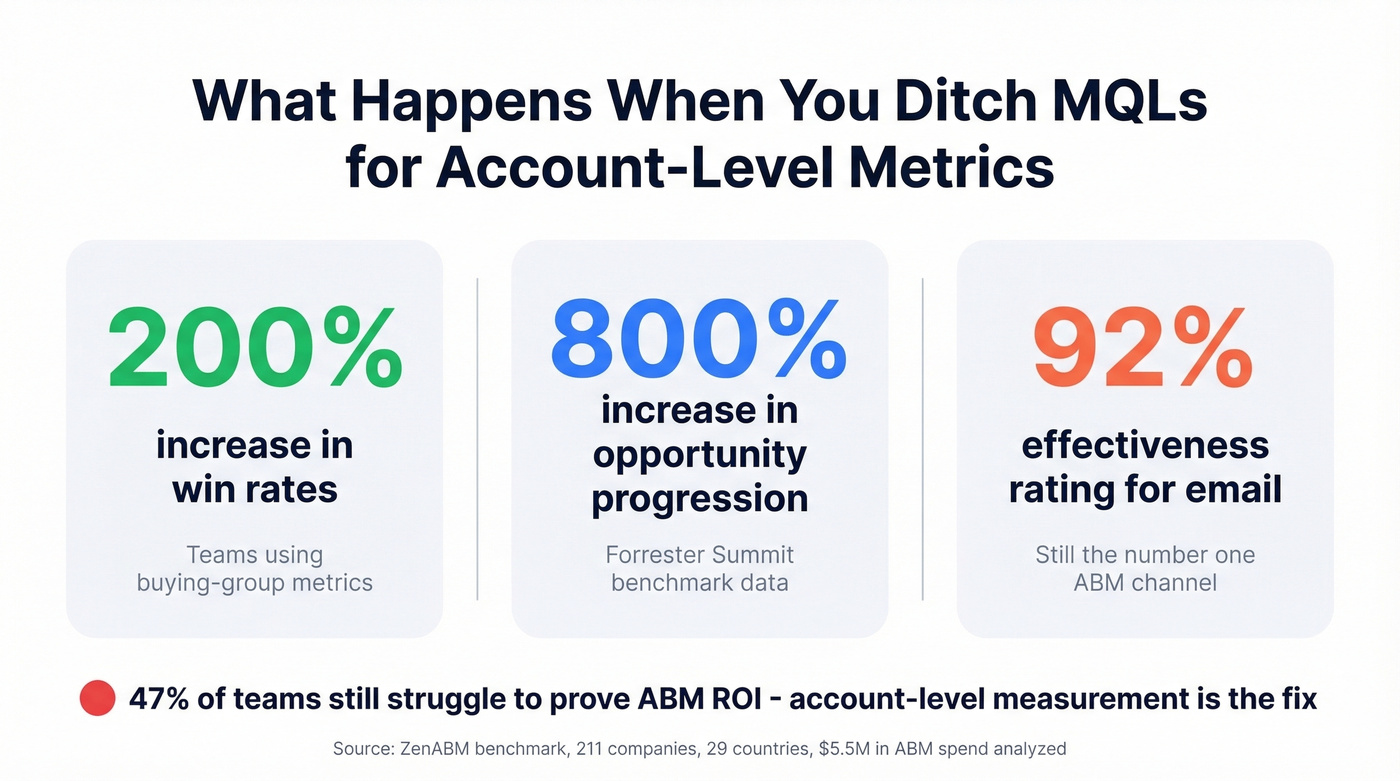
A Forrester Summit keynote cited a 200% increase in win rates and 800% increase in opportunity progression when teams moved to buying-group metrics. ZenABM's benchmark study across 211 companies in 29 countries - analyzing $5.5M in ABM spend and 161K ads - reinforces that account-level measurement is the dividing line between programs that scale and programs that stall. The top challenge remains proving ROI, with 47% of teams struggling with it, but email at 92% effectiveness is still the #1 ABM channel. Get the data right, measure at the account level, and the ROI case builds itself.
Using AI for ABM works - but only when the scoring framework, data hygiene, and account-level metrics are in place before you layer on automation. Start with the foundation, pick the tool tier that matches your budget and team size, and let the intelligence compound. If you need a tighter outbound motion to activate those accounts, borrow proven sales prospecting techniques and keep your sales activities consistent.
The article's math is clear: a $500/month data-and-sequencer stack outperforms six-figure platforms for most teams. Prospeo gives you intent-filtered account lists, verified emails at $0.01 each, 125M+ direct dials, and native integrations with HubSpot, Salesforce, and every major sequencer - no contracts, no sales calls.
Get enterprise ABM data at 90% less than enterprise pricing.
FAQ
What's the difference between predictive and generative AI in ABM?
Predictive AI scores accounts and identifies buying signals to tell you who to target. Generative AI creates personalized content at scale to tell you what to say. The best programs layer both - predictive for prioritization, generative for engagement - and teams doing so report 50% more sales-qualified leads.
How much does an AI-ABM platform cost?
Enterprise platforms like Demandbase and 6sense typically land in the mid-five to six figures per year. CRM-native tools cost $890-$3,600/month. A self-serve data platform paired with a sequencer runs under $500/month - the best starting point for teams without dedicated ABM ops.
Why do most ABM programs fail in the first year?
67% fail to deliver in year one, primarily from targeting too many accounts without sales input, measuring MQLs instead of account engagement, and feeding AI models stale contact data that tanks deliverability. Investing in a platform won't fix these problems if the underlying scoring framework and data hygiene aren't in place first.