

AI in Sales: What Actually Works, What Fails, and What to Do About It
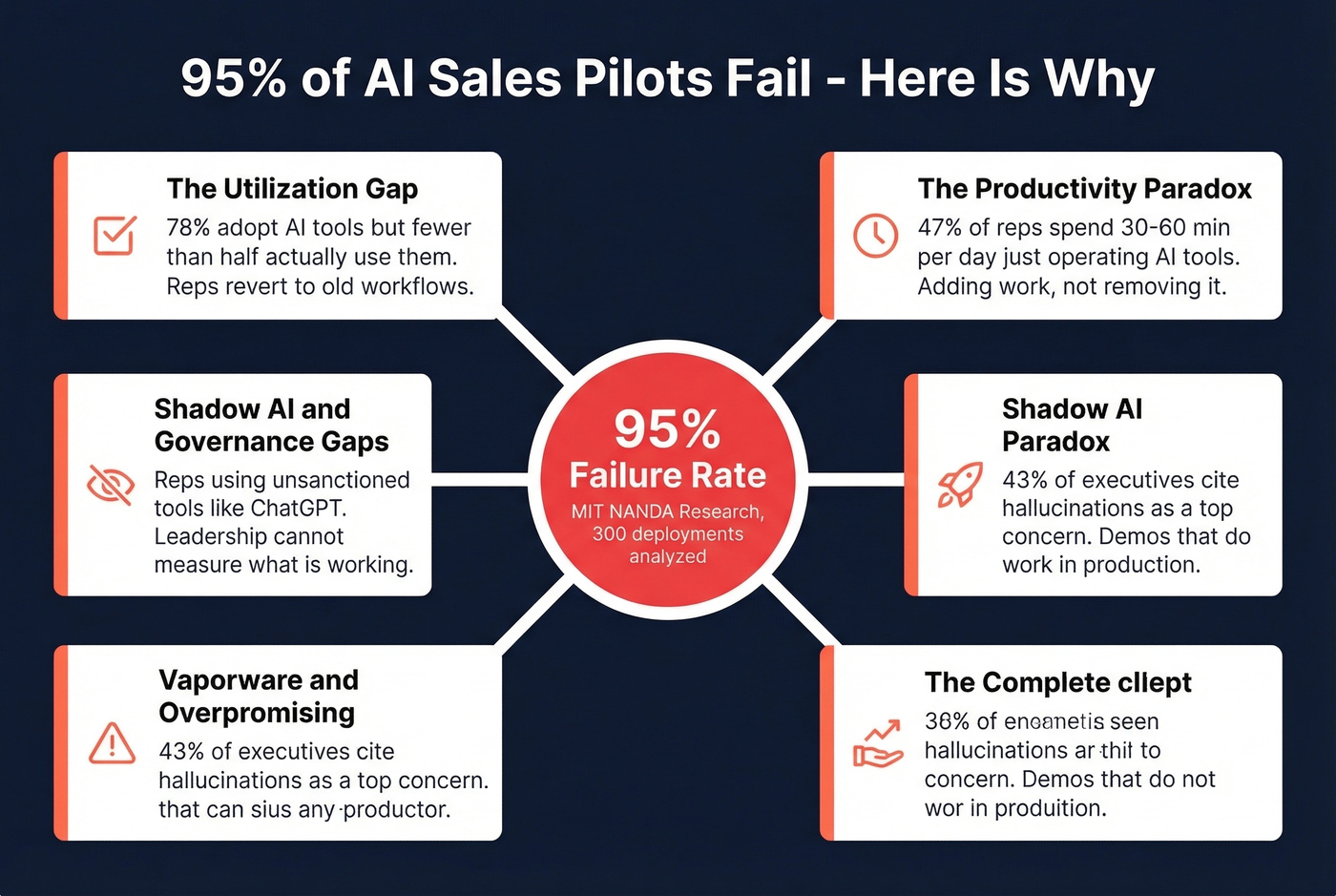
Ninety-five percent of AI sales pilots fail. Not "underperform." Not "need more time." Fail - as in, they never produce the revenue acceleration they promised. That's the finding from MIT's NANDA research group, which analyzed 300 public AI deployments, interviewed 150 practitioners, and surveyed 350 employees to reach that number. Meanwhile, 47% of sales reps now spend 30-60 minutes a day just operating their AI tools - roughly the same time they spend on CRM. Teams are adding AI and getting busier, not better.
So what separates the 5% that actually work? It's not the model. It's not the vendor. It's the implementation - and specifically, the data underneath it.
The Short Version
- Fix your data first. AI models trained on stale contacts produce stale outputs. Start with a verified data layer before you plug in anything else.
- Pick one use case. Not five. One narrow workflow - personalized first-touch emails, call prep summaries, lead scoring - and get it right.
- Train for 6+ weeks, then QA daily for 90 days. AI SDR tools often take 200+ iterations to reach top-rep performance.
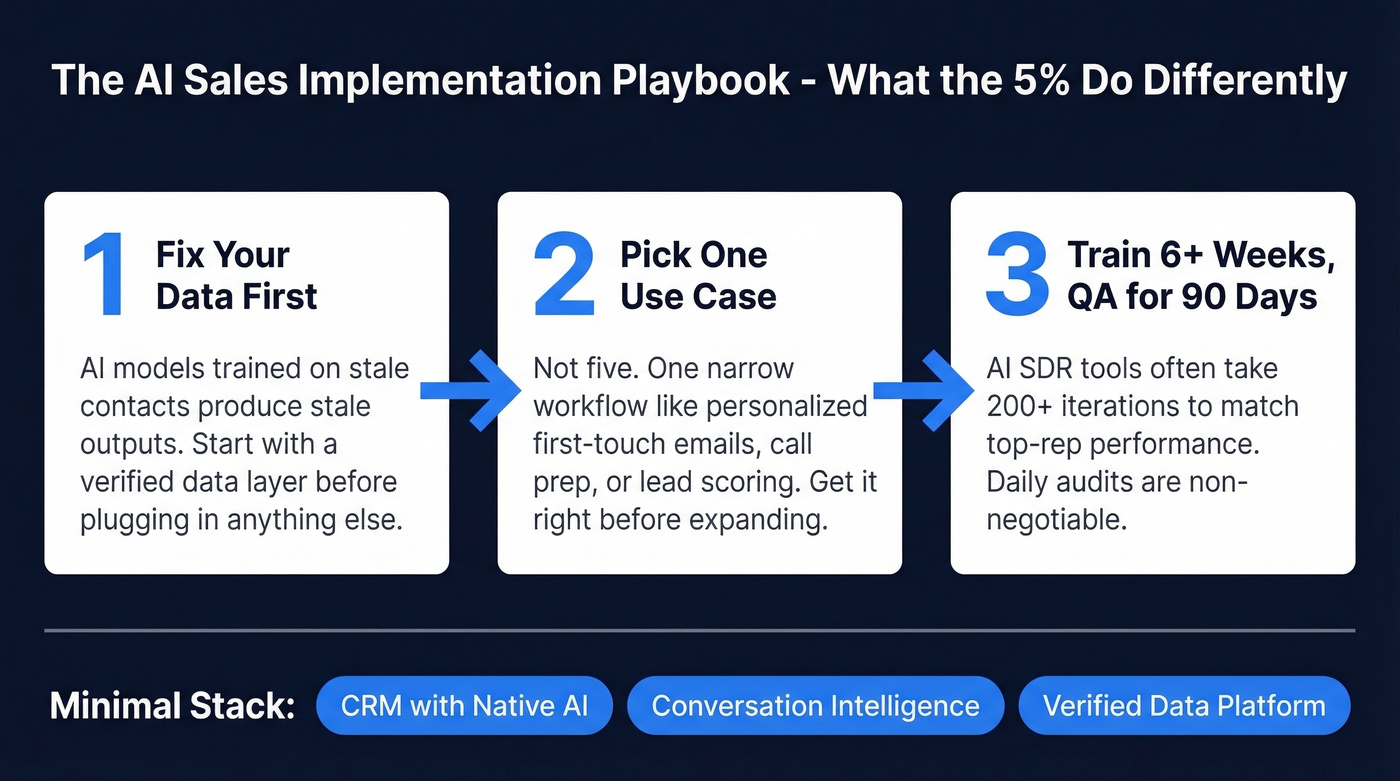
Minimal stack: CRM with native AI (Salesforce or HubSpot) + conversation intelligence (Gong) + verified data platform. That's it. Everything else is phase two.
How AI Is Changing Sales in 2026
The market is massive and accelerating. AI sales tools hit roughly $3B in market size in 2025, and the broader AI agent market is projected to grow from $7.84B to $52.62B by 2030 - a 46.3% CAGR that reflects how much enterprise money is flowing into autonomous workflows.
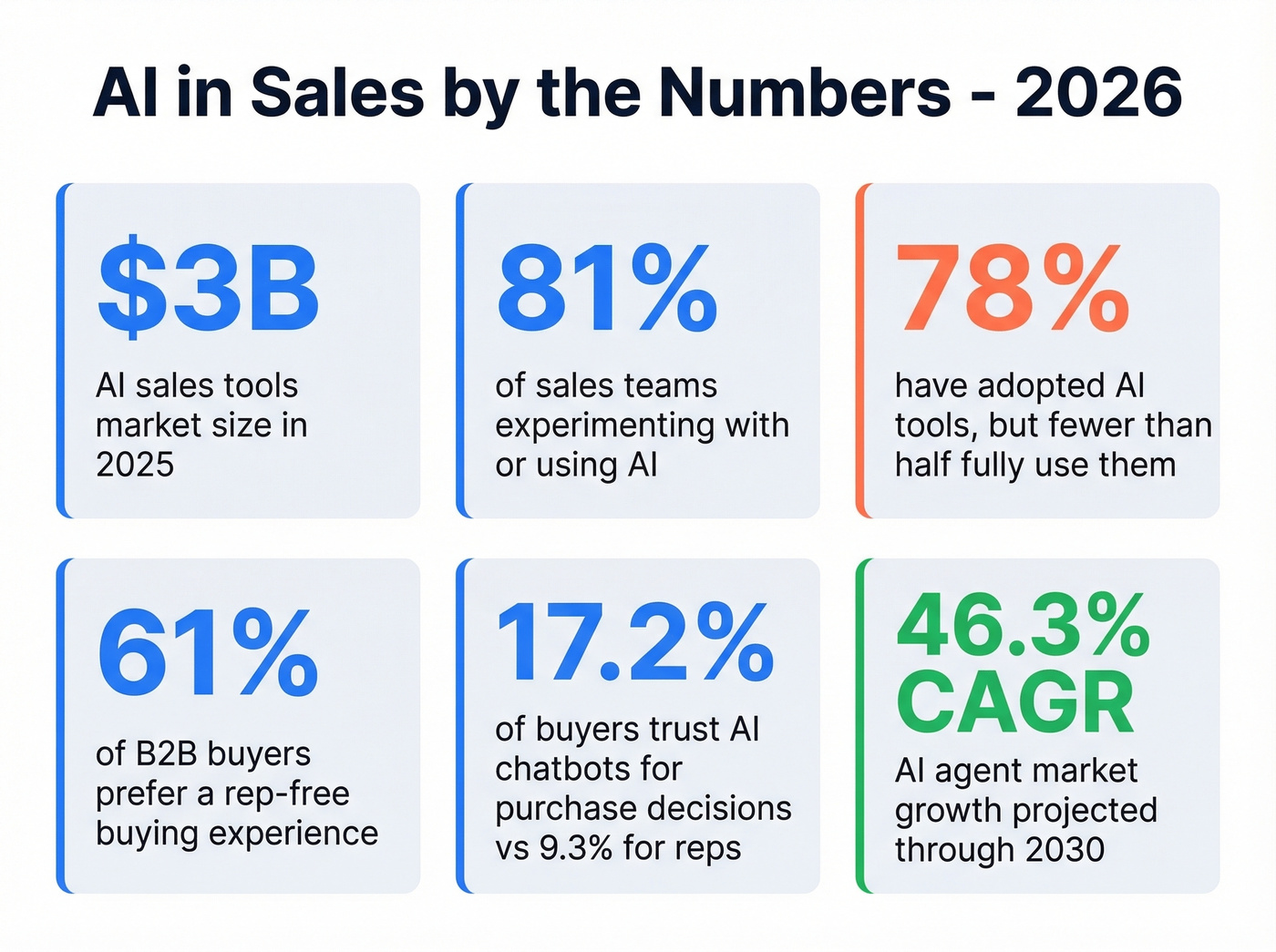
Adoption is near-universal but barely utilized. Per Salesforce's State of Sales report, 81% of sales teams are experimenting with or have fully implemented AI. Highspot's enablement research tells the other side: 78% have adopted AI tools, yet fewer than half fully utilize them. That's a lot of shelfware.
Buyer behavior is shifting just as fast. Gartner reports that 61% of B2B buyers now prefer a rep-free buying experience, and G2 buyer behavior data shows gen AI chatbots are trusted by 17.2% of buyers for final purchase decisions, compared to 9.3% for vendor salespeople. Buyers are researching on their own, asking ChatGPT for vendor shortlists, and arriving at sales conversations already opinionated. The teams that win aren't the ones with the most tools - they're the ones whose technology surfaces the right buyer at the right moment.
The hype correction is real, and it's healthy. It's forcing teams to focus on what actually moves pipeline instead of chasing features.
How Sales Teams Use AI Today
AI in the sales process isn't one thing. It's seven or eight different workflows, each with different maturity levels and ROI profiles. Let's break down the ones that matter most.
Lead Scoring & Prioritization
AI scoring models analyze firmographic, behavioral, and intent signals to rank leads by likelihood to close. Sellers who effectively partner with AI are 3.7x more likely to meet quota. Salesforce Einstein and HubSpot's predictive scoring are the most common entry points - they're already in your CRM. A medical device company scoring by hospital system size and regulatory timeline will outperform one using generic firmographics every time. The more specific your scoring model, the better it performs.
Prospecting & Outbound
This is where adoption is highest and where we've seen the most dramatic results. 54% of teams now use AI for personalized outbound emails, and 45% use it for account research. Apollo and Outreach lead in sequencing, but the real differentiator is signal-based targeting - using buyer intent data and job-change alerts to time outreach, not just personalize it.
The numbers back this up: signal-personalized outreach achieves 15-25% reply rates versus 3-5% for generic cold email. That's a 5x difference from the same tool, just with better input data.
Sales Forecasting
AI forecasting pulls pipeline data, rep activity, and historical close rates to predict quarter-end numbers. The value isn't the prediction itself - it's catching deals that are slipping before your weekly commit call. Clari and Gong both offer strong forecasting layers on top of conversation data.
Conversation Intelligence
Gong's internal data shows a 2,200% increase in sales conversations about AI since November 2022. The category is exploding. These tools record, transcribe, and analyze calls to surface coaching moments, competitive mentions, and deal risk signals. If your team hasn't started here, this is where we'd point you first - it's one of the most proven categories with the clearest ROI.
Email Personalization
Generic sequences are dead. Outreach's historic data shows personalization yields 10% higher open rates and double the reply rates compared to templated blasts. AI tools now draft first-touch emails using prospect research, company news, and technographic signals - but they still need human review. The best reps use AI as a first draft, not a send button. (If you want a deeper breakdown, see our guide to AI email personalization.)
Deal Coaching
AI deal coaching surfaces risk signals mid-cycle: single-threaded deals, stalled next steps, missing economic buyers. Using Gong's "Ask Anything" in a deal is associated with 26% higher win rates. Still maturing, but the early data is compelling.
Does AI Actually Deliver ROI?
Yes - when implemented correctly.
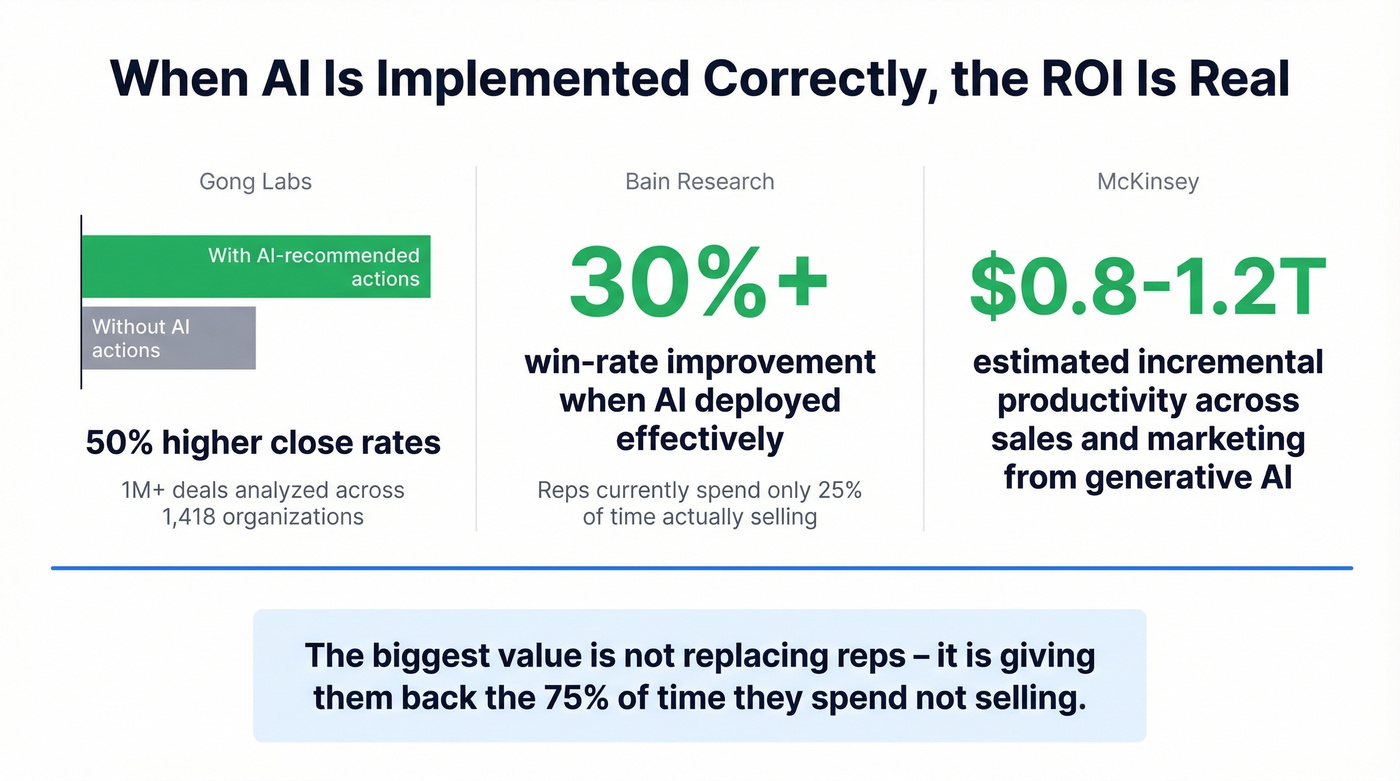
Gong Labs analyzed 1M+ deals across 1,418 organizations and found that deals where reps followed AI-recommended actions closed at 50% higher rates. That's not a marginal lift. Bain's research points to 30%+ win-rate improvements when AI is deployed effectively, noting that sellers currently spend only about 25% of their time actually selling. The biggest value isn't replacing reps - it's giving them back the other 75%.
A large European telco built a gen-AI dashboard for call center managers and sellers that delivered 20-30% improvement in customer satisfaction scores - proof that the ROI extends beyond pipeline into retention and expansion.
McKinsey estimates generative AI will unlock $0.8-1.2 trillion in incremental productivity across sales and marketing. The gap between AI-enabled teams and everyone else is widening fast.
Why 95% of Pilots Fail
MIT's NANDA research didn't just find that 95% of pilots fail - they identified why. The problem isn't the technology. It's four recurring failure modes.
The Utilization Gap
Highspot's data captures this perfectly: 78% of B2B organizations have adopted AI for sales, but fewer than half fully utilize those tools. Teams buy the license, run a pilot, and then nothing changes. Reps revert to old workflows because the tool wasn't integrated into their daily process. Adoption without utilization is just an expense.
The Productivity Paradox
47% of sales professionals spend 30-60 minutes per day operating AI tools. That's time they used to spend prospecting or prepping for calls. When AI adds a workflow step instead of removing one, you've created a net negative. Bain calls this the "micro-productivity trap" - piecemeal usage that produces tiny gains that never compound into real revenue impact. We've seen this pattern repeatedly across teams we talk to.
Vaporware and Overpromising
Here's the thing: some demos showcase capabilities that don't work reliably in production. The training data is thin, the automation requires constant babysitting, and 43% of executives cite hallucinations as a top concern. The fact that so many vendors demo features that barely function in production is one of the more infuriating dynamics in this market right now.
Shadow AI and Governance Gaps
MIT's research flagged shadow AI - reps using unsanctioned tools like ChatGPT to draft emails, research accounts, or summarize calls without organizational oversight. The risk isn't just data leakage. It's that leadership can't measure what's working because half the usage is invisible. Without governance, you can't optimize.

This article makes it clear: AI sales tools are only as good as the data feeding them. Prospeo refreshes 300M+ profiles every 7 days - not every 6 weeks - so your AI models, lead scoring, and personalized outreach run on contacts that actually exist. 98% email accuracy means your AI-generated sequences land in inboxes, not bounce logs.
Fix the data layer first. Everything else compounds from there.
How to Implement AI for Sales the Right Way
The 5% that succeed follow a remarkably consistent playbook. And here's the hot take most vendors won't tell you: if your average deal size is under $10K, you probably don't need an AI SDR platform at all. A CRM with native intelligence, clean data, and a well-trained human rep will outperform a $30K/year tool that nobody maintains.
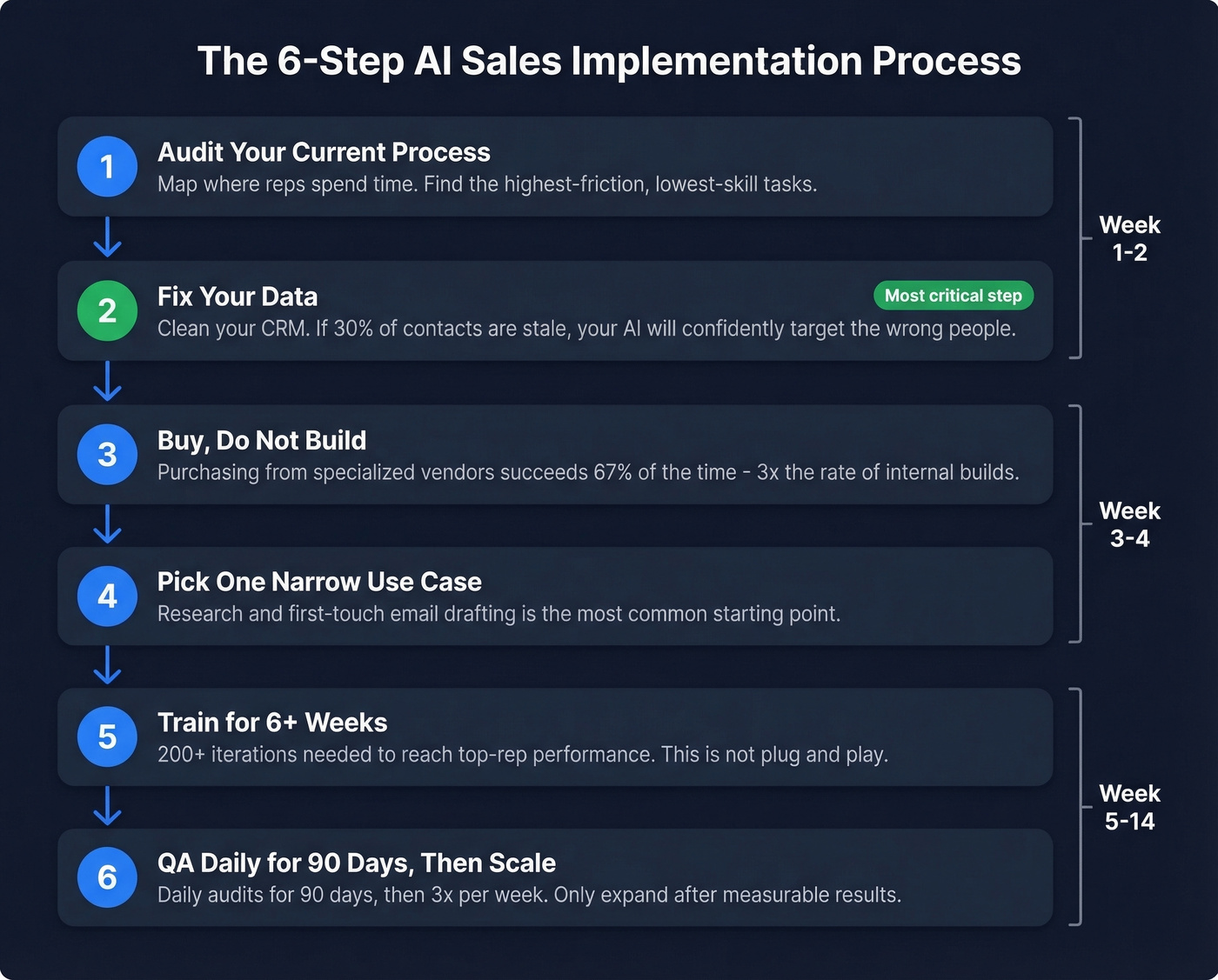
For everyone else, here's the playbook.
Step 1: Audit your current process. Map where reps spend time. Identify the highest-friction, lowest-skill tasks. That's your starting point - not the sexiest use case, but the one with the clearest ROI.
Step 2: Fix your data. AI models are only as good as their inputs. If your CRM has 30% stale contacts, your system will confidently target the wrong people. Clean your database before you train anything on it. (This is also where data enrichment and data validation automation pay off fast.)
Step 3: Buy, don't build. MIT's research found that purchasing tools from specialized vendors succeeds 67% of the time - roughly triple the success rate of internal builds. Unless you have a dedicated ML team, use proven tools.
Step 4: Pick one narrow use case. Research and first-touch email drafting is the most common starting point. Don't try to automate the entire sales cycle on day one.
Step 5: Train for 6+ weeks. SaaStr's experience was clear - their AI SDR needed 6 weeks of daily training and 200+ iterations to reach top-rep performance. This isn't plug-and-play.
Step 6: QA daily for 90 days, then scale. Daily audits for the first 90 days, then at least 3x per week ongoing. Only after one use case delivers measurable results should you expand to the next. Over-scoping is the #1 killer of these initiatives.
The Data Problem Nobody Talks About
Every article about AI sales tools focuses on the model, the prompt, the workflow. Almost none talk about what happens when the data underneath is wrong.
Here's what actually happens: your AI SDR sends a beautifully personalized email to someone who left the company four months ago. The email bounces. Your domain reputation takes a hit. After a few hundred bounces, your deliverability craters - and now even your human reps' emails land in spam.
Snyk's sales team lived this. Their bounce rate was running 35-40% before they switched their data layer. After moving to Prospeo, bounces dropped to under 5%, and AE-sourced pipeline jumped 180% - over 200 new opportunities per month. The AI didn't change. The sequencing didn't change. The data changed. A 7-day refresh cycle and 98% email accuracy meant the models were finally targeting real people at real companies, instead of ghosts from a database that refreshes every six weeks.
Your AI tools are only as smart as the contacts they're targeting. Bad data doesn't just waste credits - it actively damages your ability to sell. If you're seeing bounce issues, start with check bounce and then work backward into email reputation.
Signal-based outreach hits 15-25% reply rates vs 3-5% for generic cold email. Prospeo combines buyer intent data across 15,000 topics, job-change alerts, and technographic filters - the exact signals this article says separate the 5% that succeed. At $0.01 per email, you get enterprise-grade targeting without enterprise pricing.
Stop feeding your AI tools stale data. Start with signals that convert.
AI Sales Tools by Category
Rather than reviewing 30 tools, here are the categories that matter and the best starting point in each.
| Category | Tool | Starting Price | Best For |
|---|---|---|---|
| CRM + AI | Salesforce Sales Cloud (Einstein) | $25/user/mo | Enterprise CRM + native AI |
| CRM + AI | HubSpot Sales Hub | $20/seat/mo | Mid-market, fast setup |
| Conversation Intel | Gong | ~$100-150/user/mo | Win-rate coaching |
| Prospecting & Data | Prospeo | Free; ~$0.01/email | Verified emails & mobiles |
| Prospecting & Data | Apollo | $49/user/mo | All-in-one prospecting |
| Sequencing | Outreach | ~$100/user/mo | Enterprise outbound |
| AI Copilot | MS Copilot for Sales | ~$50/user/mo | Microsoft 365 teams |
| AI SDR | Regie.ai | ~$30K+/yr | Automated first-touch |
| AI Dialer | Nooks AI | ~$100/user/mo | Parallel dialing + AI |
| CRM (Budget) | Freshsales | $9/user/mo | Startups |
Most mid-market teams spend $50-150/user/month across 2-3 tools. Enterprise stacks with intent data, conversation intelligence, and sequencing run $200+/user/month. If you're evaluating vendors, start with a shortlist from the best AI sales tools and sanity-check your data source against the best B2B database options.
Can AI Fully Automate Sales?
Partially, and it's already happening. Emergence Capital's data across 400+ B2B companies shows 36% decreased SDR/BDR headcount last year - the highest reduction of any sales function. Outreach's survey found 22% of teams have fully replaced SDRs with AI.
But full replacement isn't the dominant pattern. SaaStr deployed an AI inbound agent that generated $1M in revenue in its first 90 days - impressive, but it worked alongside human reps who handled complex deals. The 45% of teams running hybrid models (AI + human SDRs) are outperforming both fully automated and fully manual approaches.
The SDR role isn't disappearing. It's shrinking, specializing, and moving upmarket toward conversations machines can't handle yet. Skip the "replace all your reps" pitch from vendors - for teams with deal sizes above $25K, the hybrid model is where the strongest results are.
What's Next - 2028 and Beyond
Gartner predicts that by 2028, 15% of day-to-day work decisions will be made autonomously by AI agents - up from virtually zero in 2024. They also project 60% of B2B sales tasks will run through conversational interfaces by that same year.
The key distinction going forward is agentic versus generative AI. Generative AI produces outputs - drafts, summaries, research. Agentic AI plans, executes, and optimizes entire workflows with minimal human input. A LangChain survey of 1,300+ companies found 63% of mid-market organizations already have agents in production, and the consensus on Reddit's r/sales and r/somebodymakethis threads is that agentic workflows are moving from experiment to expectation faster than most leaders realize.
The next wave isn't "AI that helps reps write emails." It's AI that runs the first three touches, qualifies the lead, and books the meeting - with a human stepping in only when the deal gets complex. Understanding how these autonomous agents reshape selling will separate teams that lead their markets from those scrambling to catch up.
FAQ
Is AI replacing salespeople?
Not entirely. 36% of companies reduced SDR headcount last year, but hybrid models (AI for first-touch, humans for complex deals) still outperform full automation. The role is shrinking and specializing, not vanishing.
How long before AI sales tools show ROI?
Expect 6-12 weeks minimum. AI SDR tools need at least 6 weeks of training and 200+ iterations to match top-rep performance. Daily QA for the first 90 days is non-negotiable before you can trust the outputs.
What's the best AI tool for sales in 2026?
It depends on the use case. Salesforce Sales Cloud for CRM-native AI, Gong for conversation intelligence, and Prospeo for verified prospecting data at ~$0.01/email. Start with one category and expand after proving ROI.
Why do most AI sales implementations fail?
MIT research identified four root causes: bad data, over-scoping, undertraining, and lack of daily QA. Fix your data first, start with one narrow use case, and audit outputs relentlessly for 90 days.
How much do AI sales tools cost?
From free to $350+/user/month. Most mid-market teams spend $50-150/user/month across 2-3 tools (CRM + conversation intelligence + data). Enterprise stacks with intent data and sequencing typically run $200+/user/month.