

AI Outbound Agents: Real Costs, What Breaks, and Whether You Need One in 2026
Your VP of Sales just forwarded you a post about an AI outbound agent that "books 50 meetings a week on autopilot." The comments are split between people calling it the future and people calling it vaporware. Both camps are partially right, and the difference comes down to execution details nobody's writing about.
60% of BDRs already use AI tools in some capacity. But the gap between "using AI" and "deploying an autonomous outbound agent" is enormous. Before you invest, you need to understand what actually works, what breaks, and what it really costs.
The Short Version
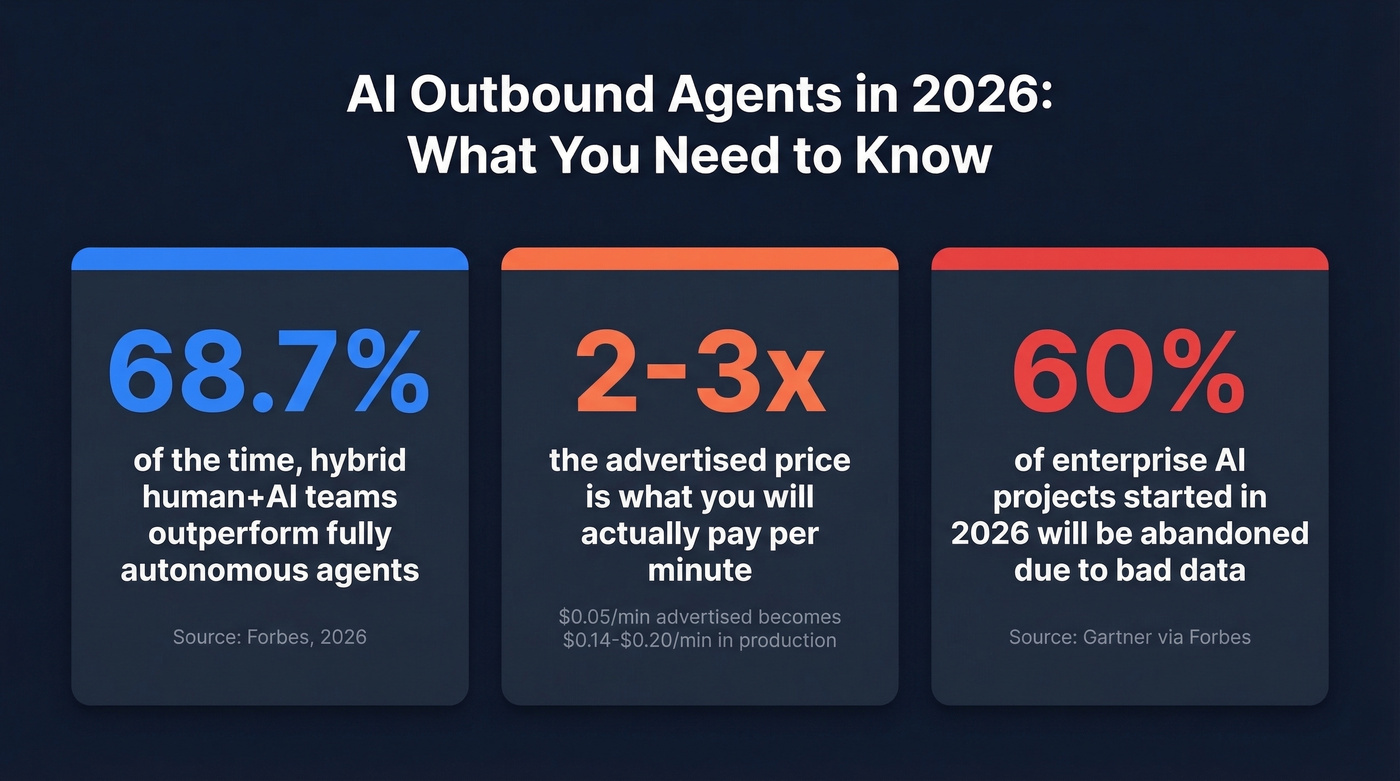
- Hybrid beats autonomous. Human+AI teams outperform fully autonomous agents 68.7% of the time. Plan for handoffs, not replacement.
- Budget 2-3x the sticker price. A "$0.05/min" platform becomes $0.14-$0.20/min once you add LLM tokens, TTS, and telephony.
- Fix your data first. If your contact list is garbage, the AI just burns money faster. (Start with a verified contact database.)
What These Agents Actually Do
An AI outbound agent autonomously initiates contact with prospects - via voice calls, email sequences, or SMS - then qualifies them and routes warm leads to a human rep. Think of it as AI-powered outbound sales at its most structured: speed-to-lead response, appointment setting, payment follow-ups, event promotion, and reactivation campaigns.
The key word is "qualification," not "closing." These agents filter who's reachable and interested so your reps spend time on conversations that matter. A human BDR typically makes around 21 attempts per contact over 53 days - roughly 8 calls, 8 emails, and 5 social touches. An agentic system compresses that timeline dramatically, but only for the structured portions. Complex objection handling, creative deal-making, and relationship building still need a human (and strong phone sales skills).
Where AI Outbound Agents Fail
Here's the thing: Gartner projects 60% of enterprise AI projects started in 2026 will be abandoned because the underlying data isn't AI-ready. Outbound agents are no exception. The failure modes are specific and predictable.
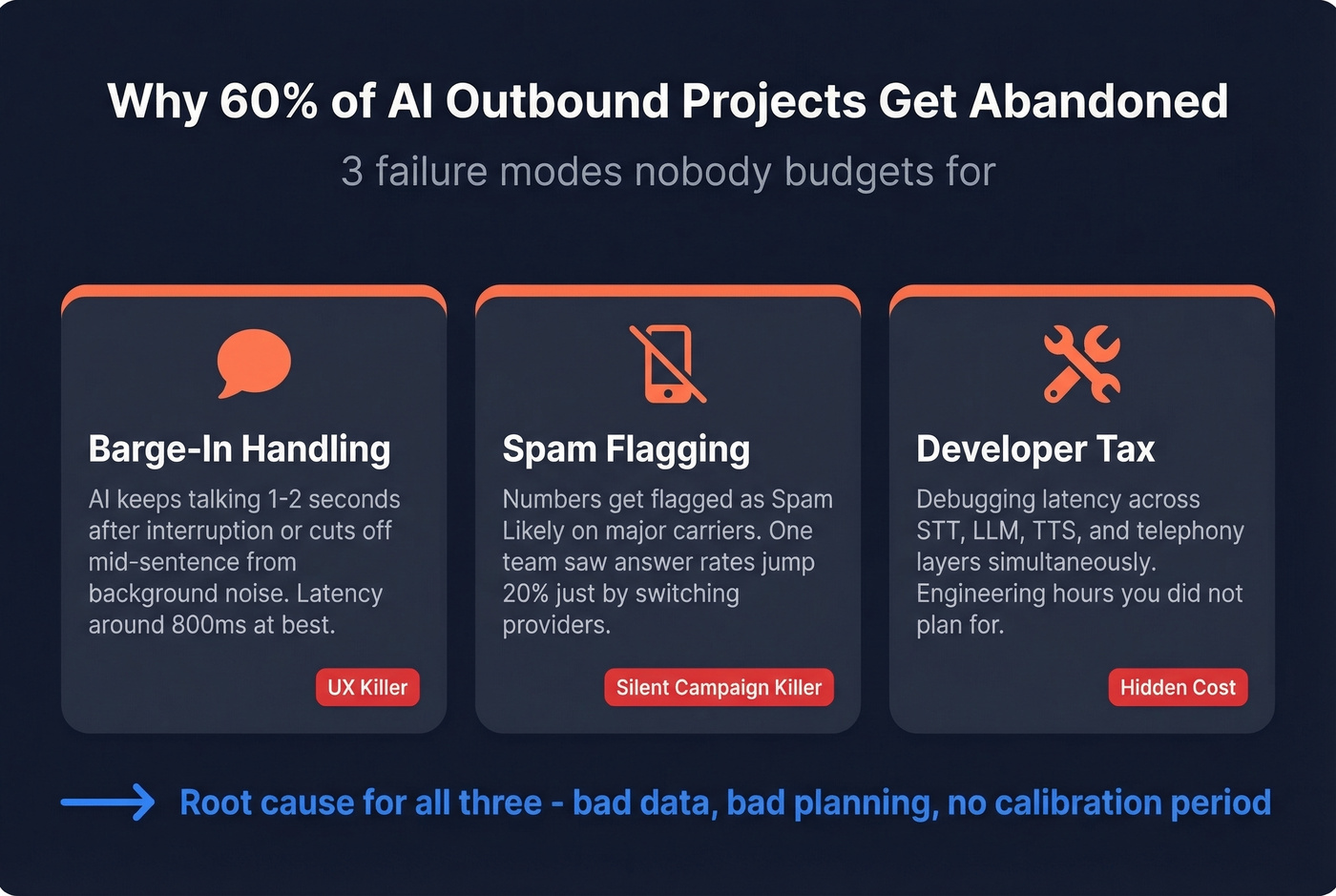
Barge-in handling is still rough. Bland AI keeps talking 1-2 seconds after a prospect interrupts. Vapi swings the other direction - it's hyper-sensitive to background noise and cuts itself off mid-sentence. Retell's turn-taking felt more natural in a month-long production test, with latency around 800ms in that setup. None of them are great yet.
Spam flagging kills answer rates. A practitioner on r/ProductivityApps running ~5k minutes/week reported Bland's numbers getting flagged "Spam Likely" on T-Mobile. Switching providers improved answer rates by about 20%. Carrier reputation is the silent campaign killer nobody budgets for.
The "developer tax" is real. With modular platforms like Vapi, you're debugging latency spikes across STT, LLM, TTS, and telephony layers simultaneously. That's engineering time you didn't plan for, and it adds up fast. (If you're building a broader stack, map it to your RevOps tech stack early.)

Bad data is the #1 reason AI outbound agents fail. Every stale number burns credits, tanks carrier reputation, and triggers spam flags. Prospeo's 300M+ profiles refresh every 7 days - not every 6 weeks - so your agent dials real people at current numbers with 98% email accuracy and a 30% mobile pickup rate.
Stop optimizing the AI while feeding it garbage contacts.
What It Actually Costs
The advertised range for AI voice agents runs $0.05-$0.99/min. That range is almost useless because the base platform fee is just one component.
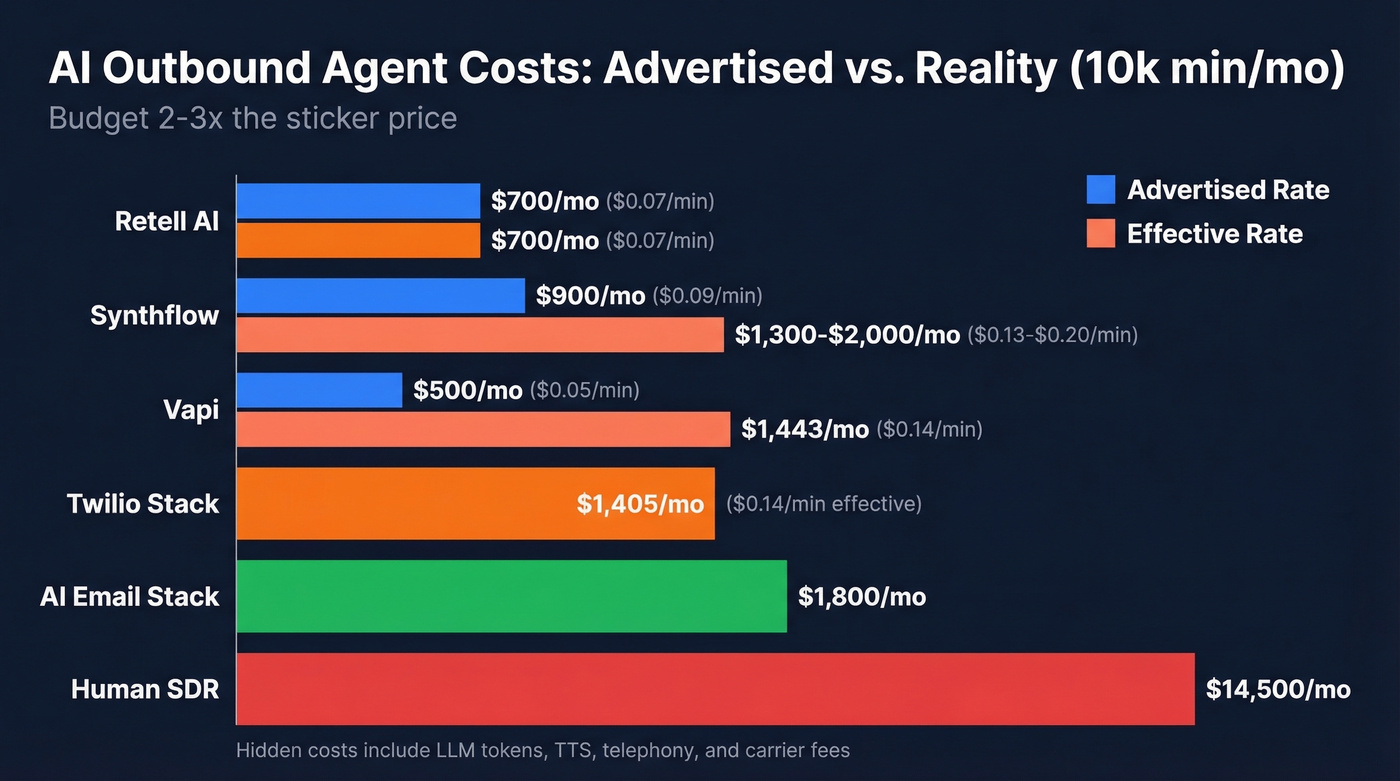
| Platform | Advertised Rate | Effective Rate | Monthly Cost (10k min) |
|---|---|---|---|
| Retell AI | $0.07/min | ~$0.07/min (lean config) | ~$700 |
| Synthflow | $0.09/min | ~$0.13-$0.20/min | ~$1,300-$2,000 |
| Vapi | $0.05/min | ~$0.14/min | ~$1,443 |
| Twilio Voice (assembled stack) | Varies | ~$0.14/min | ~$1,405 |
| Human SDR | - | - | ~$14,500 |
| AI email stack | - | - | ~$1,800 |
We've seen teams budget $0.05-$0.09/min and end up paying $0.14-$0.20/min once the full stack is assembled. Retell can stay close to $0.07/min in a lean configuration, but the total climbs with different model, voice, and telephony choices. An AI email stack - sequencer, enrichment, warmup, inbox management - runs roughly $1,800/mo and can touch ~20k prospects (see outbound email automation options). One practitioner reported 14 meetings and 3 closed customers per month from that setup, roughly $130/meeting and $600/customer acquired.
A loaded human SDR costs ~$14,500/mo. The math favors agentic outbound at scale, but only if you account for the real costs upfront.
Let's be honest: if your average deal size is under $5k, you almost certainly don't need a voice AI agent. An email-first stack at $1,800/mo will outperform on ROI because the unit economics of voice don't justify the complexity. Save voice AI for high-ACV outbound where a live conversation actually moves the needle (and align it to your B2B SaaS sales model).
TCPA Compliance
This is the section that can cost you millions.
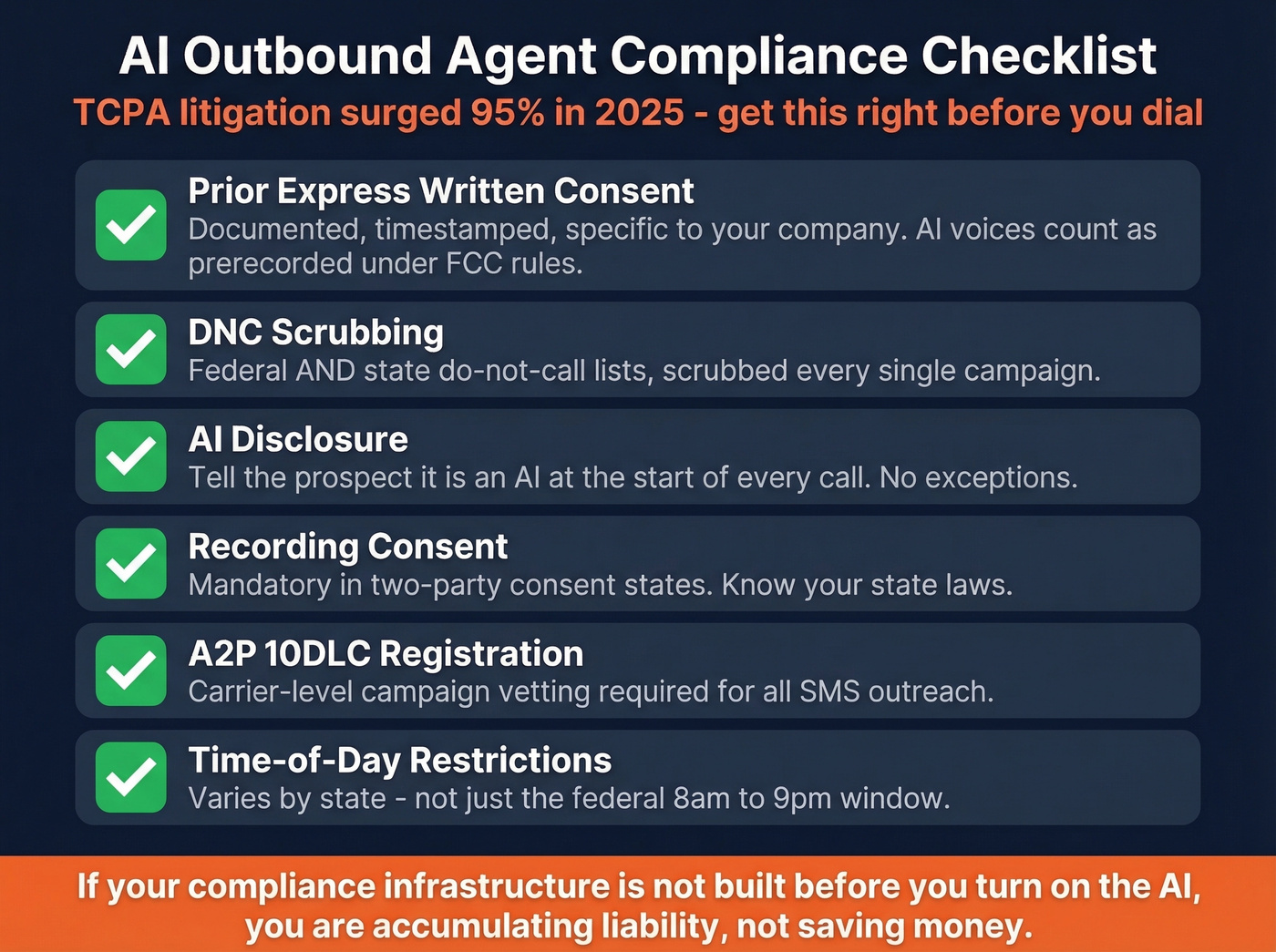
The FCC ruled in February 2024 that AI-generated voices qualify as "artificial or prerecorded" under the TCPA - prior express written consent is required before your agent dials anyone. TCPA litigation surged nearly 95% year-over-year as of late 2025, and the Supreme Court's McLaughlin v. McKesson decision (June 2025) means district courts aren't bound by FCC interpretations in civil TCPA cases, increasing litigation variability. State-level laws are tightening fast - Texas SB 140 expanded solicitation definitions to include texts with treble damages, and Virginia SB 1339 requires honoring text opt-outs for 10 years.
Your operational checklist before deploying any AI outbound agent:
- Prior express written consent - documented, timestamped, specific to your company
- DNC scrubbing - federal and state lists, every campaign
- AI disclosure - tell the prospect it's an AI at the start of the call
- Recording consent - mandatory in two-party consent states
- A2P 10DLC registration - carrier-level campaign vetting for SMS
- Time-of-day restrictions - varies by state, not just the federal 8am-9pm window
If your compliance infrastructure isn't built before you turn on the AI, you're not saving money. You're accumulating liability. (If you need a broader framework, start with B2B compliance.)
The Upstream Problem: Your Data
AI outbound agents fail because of bad data more than bad AI. Every wasted dial, every bounced email, every "Spam Likely" flag traces back to the same root cause: you're reaching out to the wrong number, the wrong email, or a contact who left the company six months ago. We've watched teams spend weeks tuning their AI agent's voice and personality while feeding it a contact list that's 30% stale. That's like optimizing the paint job on a car with no engine.
Fixing this requires verified data before you dial. Prospeo's 300M+ professional profiles, 98% email accuracy, and 125M+ verified mobile numbers with a 30% pickup rate run on a 7-day refresh cycle - compared to the 6-week industry average. At roughly $0.01 per email, you're spending pennies to avoid burning dollars on dead contacts. (If you're cleaning lists at scale, use data validation automation and the right data enrichment tools.)
You just read that AI voice agents cost $0.14-$0.20/min in production. Every wasted dial on a wrong number or departed contact compounds that cost. Prospeo's 125M+ verified mobile numbers and 7-day refresh cycle mean your agent connects with real buyers - not voicemails at numbers that churned months ago.
Cut wasted dials before you tune a single AI prompt.
Deployment Strategy by Volume
Not every team needs the same setup. Match the tier to your prospect value and volume.
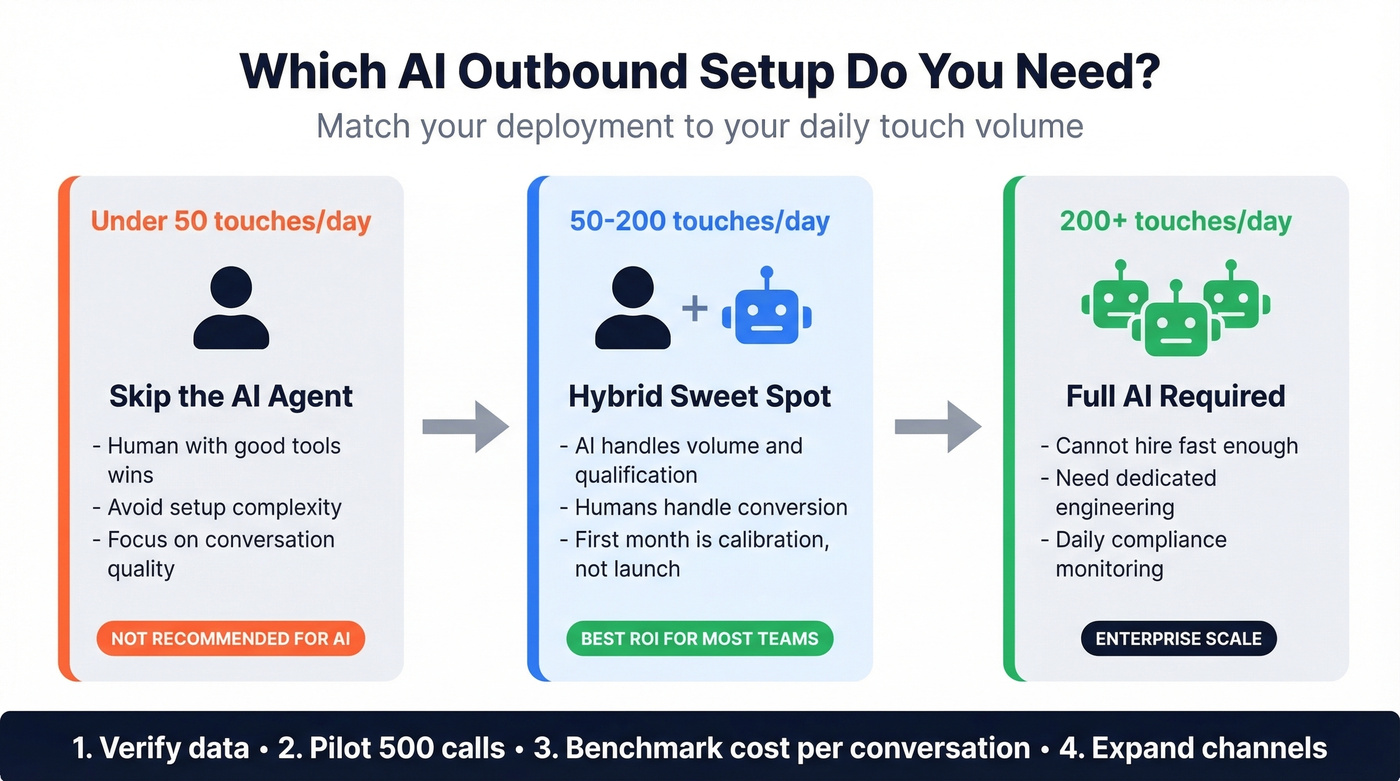
Under 50 touches/day - skip the autonomous agent. A human with good tools will outperform, and you'll avoid the setup complexity entirely.
50-200 touches/day - this is the sweet spot for agentic outbound. AI handles volume and qualification; humans handle conversion. Use AI-first for cold lists, AI-assisted for warm leads, and human-led for enterprise accounts. Most teams we talk to land here, and the ones that succeed treat the first month as a calibration period, not a launch. (This is also where a solid sales outreach strategy matters more than the model.)
200+ touches/day - AI agents are the only realistic option. You can't hire fast enough, and the economics of human SDRs at this volume don't work. But you'll need dedicated engineering support and a compliance team that's paying attention daily.
Follow this deployment order: First, verify your contact data and build compliance infrastructure. Second, pilot 500 calls with a single use case - speed-to-lead or appointment setting works best. Third, expand to additional channels and segments only after you've benchmarked cost per conversation. (If you're still defining who to target, tighten your Ideal Customer Profile first.)
Readiness checklist before you sign anything:
- Clean, verified contact data
- Defined ICP with clear qualification criteria
- TCPA compliance infrastructure in place
- Human handoff plan with hot transfer support
- Realistic budget at 2-3x the advertised per-minute rate
If you can't check all five boxes, you're not ready. Fix the foundation first.
FAQ
Can an AI outbound agent replace my SDR team?
Not yet. Hybrid human+AI teams outperform fully autonomous agents 68.7% of the time. Use AI for volume qualification and appointment setting; keep humans for closing and complex objections. The strongest results come from treating these agents as a force multiplier, not a headcount replacement.
What's the real cost per minute for AI voice agents?
Expect $0.13-$0.20/min after adding LLM tokens, TTS, and telephony - budget 2-3x the advertised rate. A 10,000-minute month on Retell's lean configuration runs ~$700; the same volume on Vapi lands around $1,400.
How do I avoid getting my numbers flagged as spam?
Use carrier-registered numbers with A2P 10DLC registration for SMS. Rotate caller IDs, start with low volume to build reputation, and verify contact data before dialing. Disconnected lines tank your caller reputation fast. A 7-day data refresh cycle and verified mobile numbers help prevent dead-number dials that damage sender and caller scores.
When should I deploy agentic outbound instead of manual prospecting?
Deploy when you consistently exceed 50 outbound touches per day, have clean verified data, and your TCPA compliance infrastructure is in place. Below that threshold, a well-equipped human rep delivers better results per conversation. The decision hinges on volume and data readiness, not whether the technology works in theory.