

AI Pipeline Inspection: How It Works in 2026
The US lost $7.7 billion between 2005 and 2020 to pipeline leaks alone. A single day of unplanned downtime can cost $1 million. AI pipeline inspection isn't a future technology - it's the only way utilities and operators are going to close the gap between aging infrastructure and shrinking budgets.
The Short Version
What it does: AI analyzes CCTV and in-line inspection footage to automatically detect, classify, and score pipeline defects - cutting manual video review from weeks to days, and often hours for initial triage.
Three tools to evaluate first: SewerAI AutoCode for high-throughput sewer coding, ITpipes AiDetect for QA-forward workflows, and AECOM PipeInsights for enterprise-grade utility programs.
The one thing most buyers get wrong: Overcoding inflates rehab budgets. If your vendor can't show you their QA process and overcoding rates, you're buying a black box.
What Is AI Pipeline Inspection?
This approach uses computer vision and machine learning to analyze video or sensor data from inside pipelines, automatically identifying defects like cracks, corrosion, root intrusion, and joint failures. It spans sewer, oil & gas, and potable water systems.
The core workflow looks like this: a CCTV crawler or in-line inspection tool captures footage, AI models detect and classify defects against standards like NASSCO's PACP/MACP codes, and the output feeds into risk scoring and capital planning. For oil & gas, the modalities shift to electromagnetic methods like MFL and ECT, acoustic, optical, and robotic inspection - but the AI layer serves the same purpose. It turns raw sensor data into prioritized action.
The Cost of Doing Nothing
Corrosion causes 15-25% of pipeline incidents in the US, costing roughly $1.4 billion annually. For municipalities, manual CCTV review takes weeks per project. Backlogs compound. What starts as a $50,000 repair becomes a $2 million emergency when you defer it long enough.
The pipe inspection robot market hit $5.5 billion in 2025 and is projected to reach $23.6 billion by 2035 - growth driven by operators who've done the math on what inaction costs.
How AI Defect Detection Actually Works
AI accelerates the middle stages of the inspection-to-capital-planning pipeline. CCTV crawlers or ILI tools capture raw footage. AI models process that footage frame-by-frame, detecting defects and classifying them - a crack gets a PACP code, a joint offset gets scored by severity. The system then assigns risk scores based on defect density, pipe material, age, and location, and those scores feed capital planning tools that prioritize which segments need rehabilitation first.
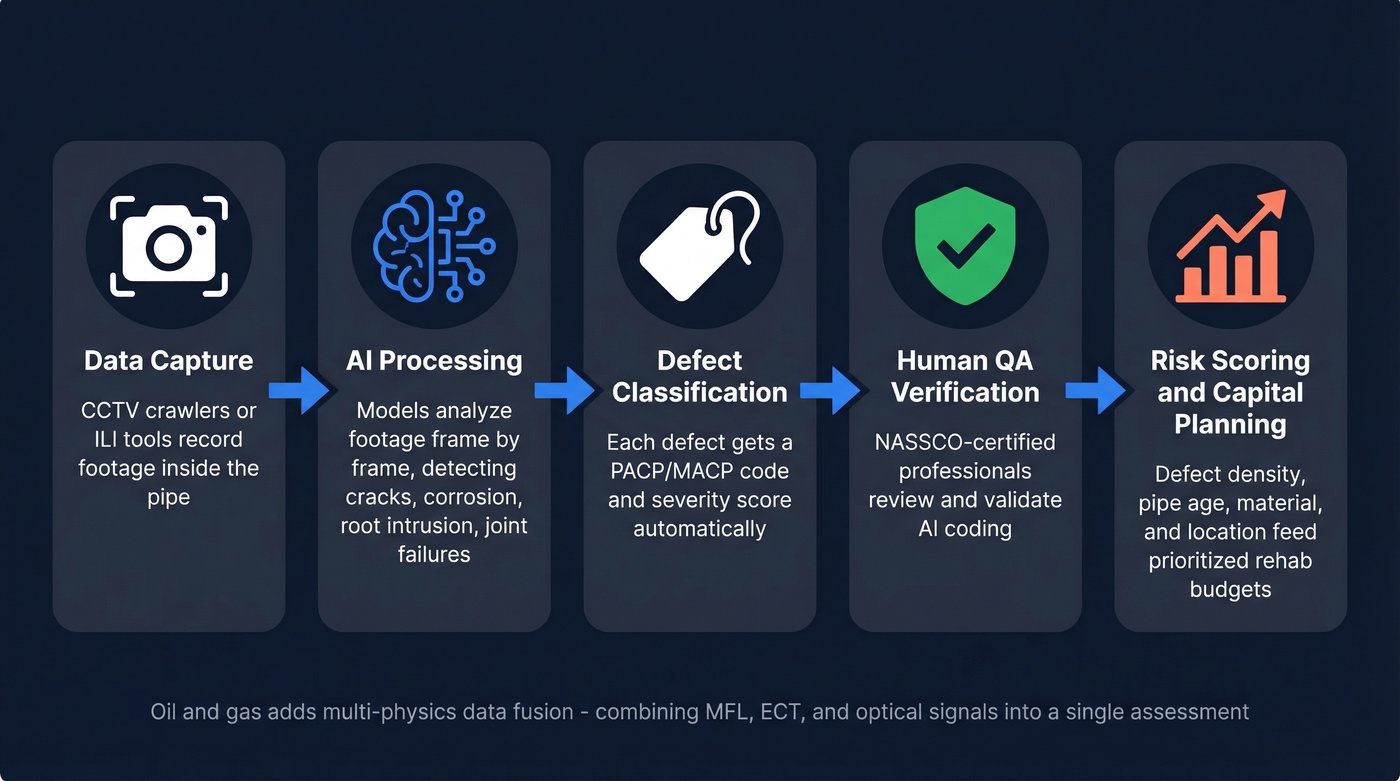
For oil & gas, a 2026 academic review frames four major ILI technology families - electromagnetic, acoustic, optical, and robotic - each with trade-offs between detection accuracy, adaptability, and cost. AI's role here is multi-physics data fusion: combining MFL, ECT, and optical signals into a single defect assessment.
Here's the procurement reality: if you want defensible coding, require human verification by NASSCO-certified professionals. AI can do the first pass fast. Certified reviewers make it auditable.

Evaluating AI pipeline inspection vendors is one thing. Reaching the utility directors, asset managers, and infrastructure decision-makers who buy them is another. Prospeo gives you 300M+ profiles with 30+ filters - including technographics and buyer intent - so you can target operators actively investing in pipeline modernization. 98% email accuracy means your outreach lands.
Stop guessing who's buying pipeline AI. Find them with verified data.
Tools Worth Evaluating
| Tool | Primary Use | AI Approach | Pricing Model | Est. Cost |
|---|---|---|---|---|
| SewerAI AutoCode | Sewer coding | PACP CV | Usage-based | $500-$2K/mo |
| ITpipes AiDetect | Sewer QA/QC | Human-verified AI | Add-on license | $3K-$10K/yr |
| AECOM PipeInsights | Enterprise utility | AI defect/rehab | Custom | $10K-$50K+/yr |
| EdgeAI Pipe Dream | Robotic inspect | Hardware + AI SW | Subscription | $2K-$5K/mo |
| ClearObject ClearVision | Consulting + AI | Custom deploy | Project-based | $25K-$100K+ |
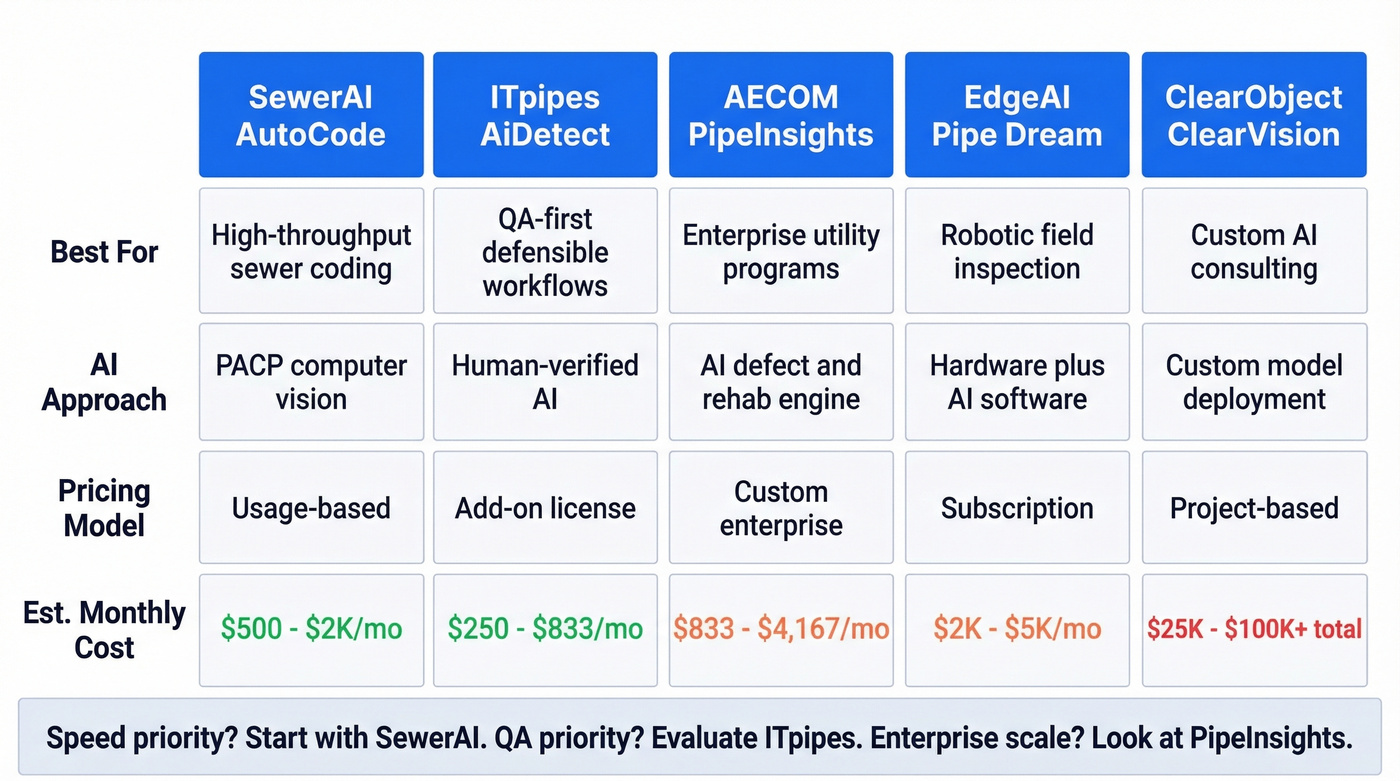
Quick decision framework: Start with SewerAI if you want high-throughput coding. If your priority is QA defensibility and workflow transparency, evaluate ITpipes. For large utilities managing massive inspection volume that need engineered decision support tied to capital planning, look at PipeInsights or consulting-led options like ClearObject.
SewerAI AutoCode
The speed play. AutoCode is positioned around "6x faster review" and "99% accuracy," with partner materials describing throughput in the tens of thousands of linear feet per hour. SewerAI's packaging is clearly defined with three offerings: PIONEER (annual, seat-based, NASSCO PACP/MACP certified), AUTOCODE (usage-based AI-assisted defect coding), and RISK & REHAB (mileage-based capital planning with GIS-integrated network maps).
Expect $500-$2,000/month for a small municipal program. They'll also run a $0 preliminary rehab plan on your top 10-20 highest-risk assets - a smart way to test before committing. We've found that kind of free pilot offer is the single best indicator a vendor trusts their own product.
ITpipes AiDetect
Where SewerAI optimizes for throughput, ITpipes optimizes for defensibility. AiDetect is built directly into the ITpipes platform and emphasizes experienced professional verification at every step. ITpipes also publishes a practical vendor-evaluation framework that's one of the most transparent you'll find in this niche.
Expect $3,000-$10,000/year for municipal licenses. Use this if you care more about defensible QA than raw speed. Skip it if you need standalone AI coding without committing to the ITpipes ecosystem.
AECOM PipeInsights
Miami Beach used PipeInsights to compress contractor video review from six weeks to days, eliminating the iterative back-and-forth that stalled payment cycles. That's the pitch: enterprise-grade AI defect recognition with built-in rehab recommendations for mid-to-large utilities processing thousands of inspection hours annually. Pricing runs $10,000-$50,000+ - this isn't self-serve SaaS, it's a platform engagement with implementation support.
EdgeAI Pipe Dream
Forget software for a moment. Pipe Dream is a portable, modular inspection robot for 6-48"+ pipelines, pairing hardware with AI-powered analysis. RFID-enabled positional accuracy and Kevlar-reinforced tethering make it field-ready for harsh environments. It's available on Texas BuyBoard, which simplifies municipal procurement. Expect $2,000-$5,000/month for hardware plus software.
ClearObject ClearVision
Consulting-led AI deployment. Their SAWS engagement cut assessment time by half while standardizing scoring across the wastewater network. Budget $25,000-$100,000+ for initial deployment. This is the right path when you need a custom model trained on your specific pipe materials and defect patterns, but it's overkill for a 50-mile sewer system.
Real-World Results
A municipal program documented by OxMaint surveyed 340 miles of infrastructure, identified 2,847 defects, and prioritized $12 million in capital improvements. The city cleared a 4.5-year inspection backlog in 8 months, saving $2.4 million in scaffolding and rigging alone - with inspection cycles running 85% faster.
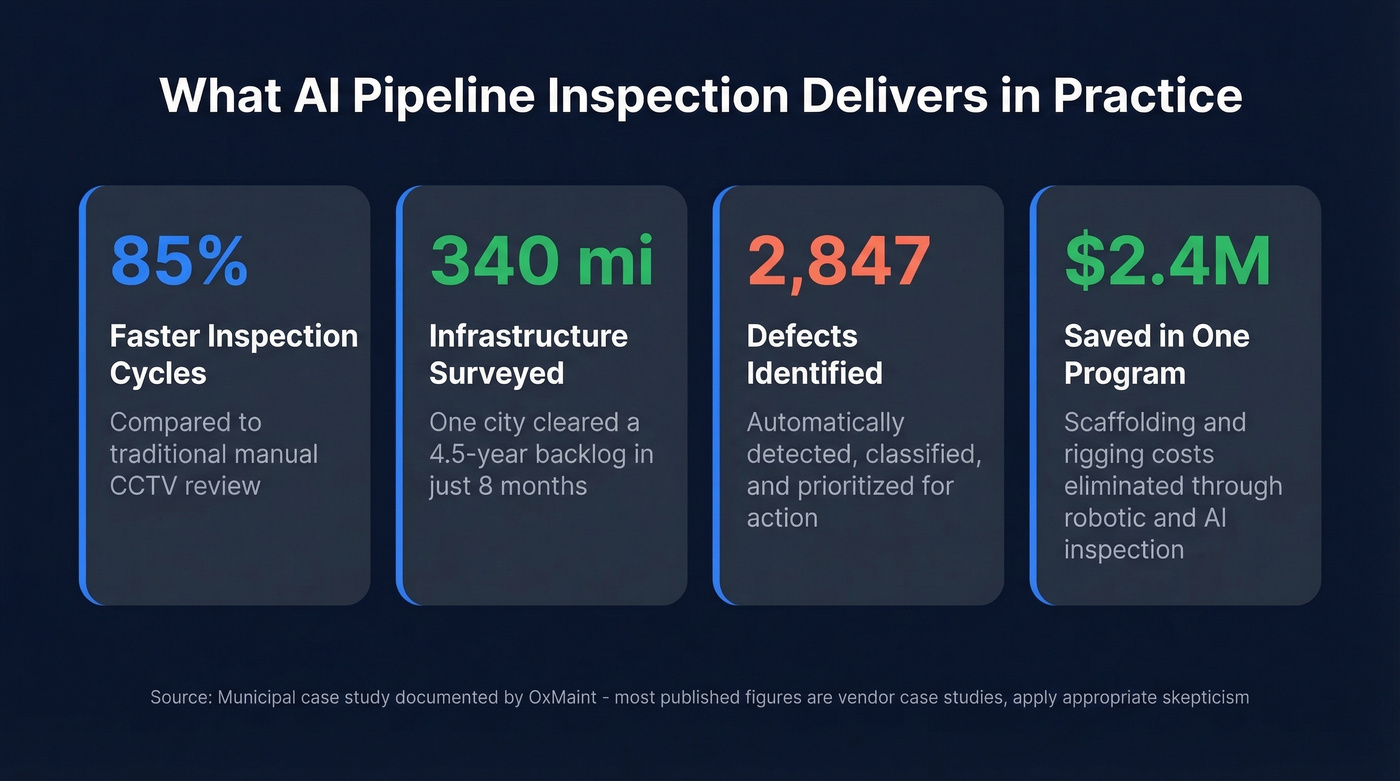
The pattern across deployments is consistent: 50-85% time reduction, with the biggest gains coming from backlog clearance rather than per-inspection speed. Independent benchmarks remain scarce - most published figures are vendor case studies, so take the exact numbers with appropriate skepticism.
Let's be honest about what matters here: most utilities don't need the fanciest AI model. They need any AI model that clears their backlog before the next sinkhole opens. The difference between 97% and 99% accuracy matters far less than the difference between "inspected" and "still in the queue."
Pitfalls to Avoid
We've seen enough AI-driven inspection deployments go sideways to flag these. In our experience, the vendors who resist sharing overcoding metrics are the ones with the worst numbers.
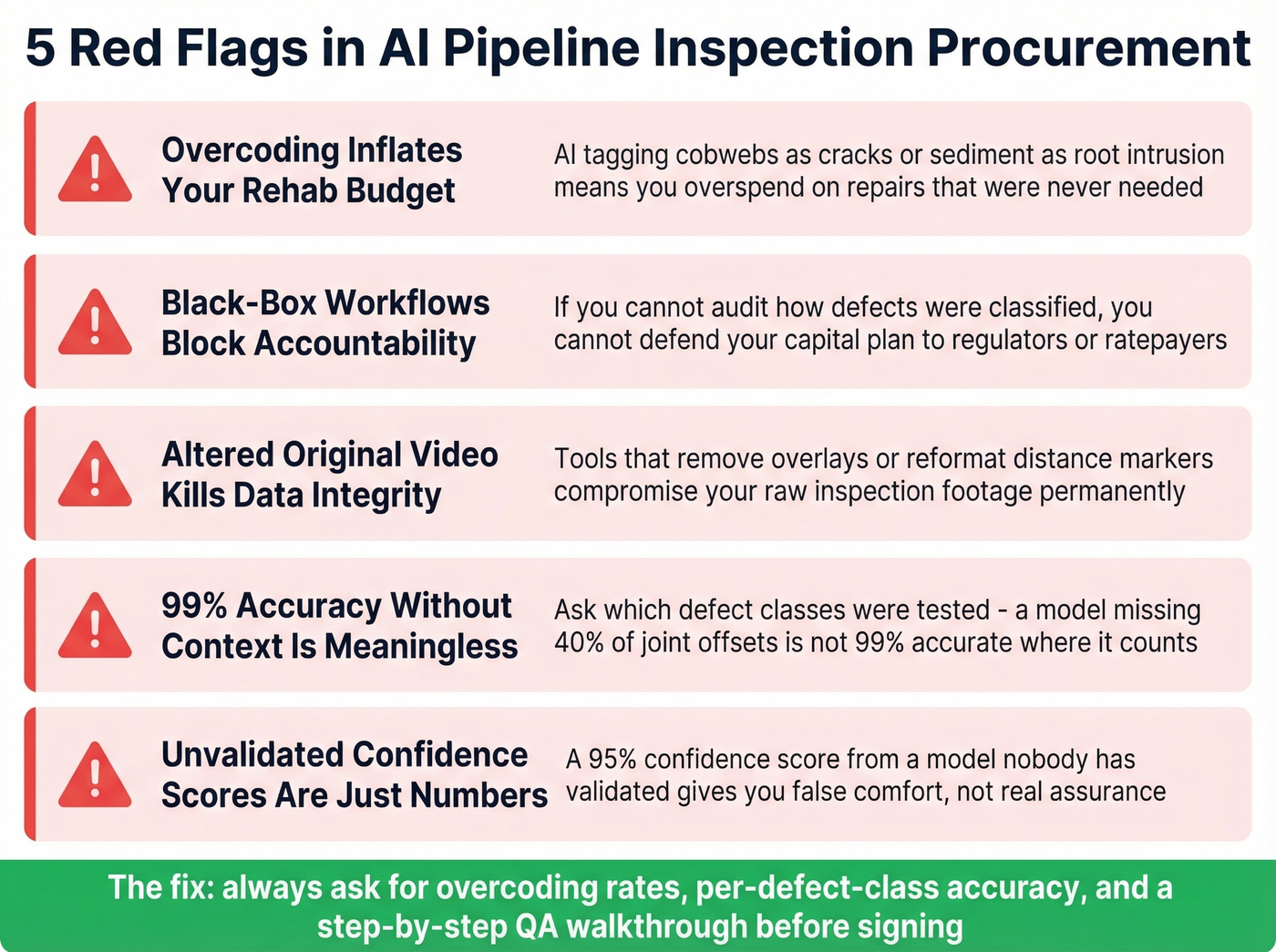
Overcoding is the silent budget killer. AI models that tag cobwebs as cracks or sediment as root intrusion inflate rehab budgets and erode trust with city councils and boards. Always ask for overcoding rates before signing anything.
Black-box workflows are a red flag. If you can't audit how defects were classified, you can't defend your capital plan in front of regulators or ratepayers.
Tools that alter original inspection videos - removing overlays, reformatting distance markers - compromise data integrity. Your raw footage should remain untouched.
"99% accuracy" without context is meaningless. Which defect classes were tested? A model that's 99% accurate on large cracks but misses 40% of joint offsets isn't 99% accurate in any way that matters to your rehab budget.
Confidence scores without validation give false comfort. A 95% confidence score from an unvalidated model is just a number on a screen.
How to Evaluate Vendors
Independent user reviews on G2 and Reddit are virtually nonexistent for sewer AI tools - the market is too niche and too new. Your best due diligence is reference calls with existing municipal customers. Beyond that, this checklist - adapted from ITpipes' five-question framework - covers the essentials:
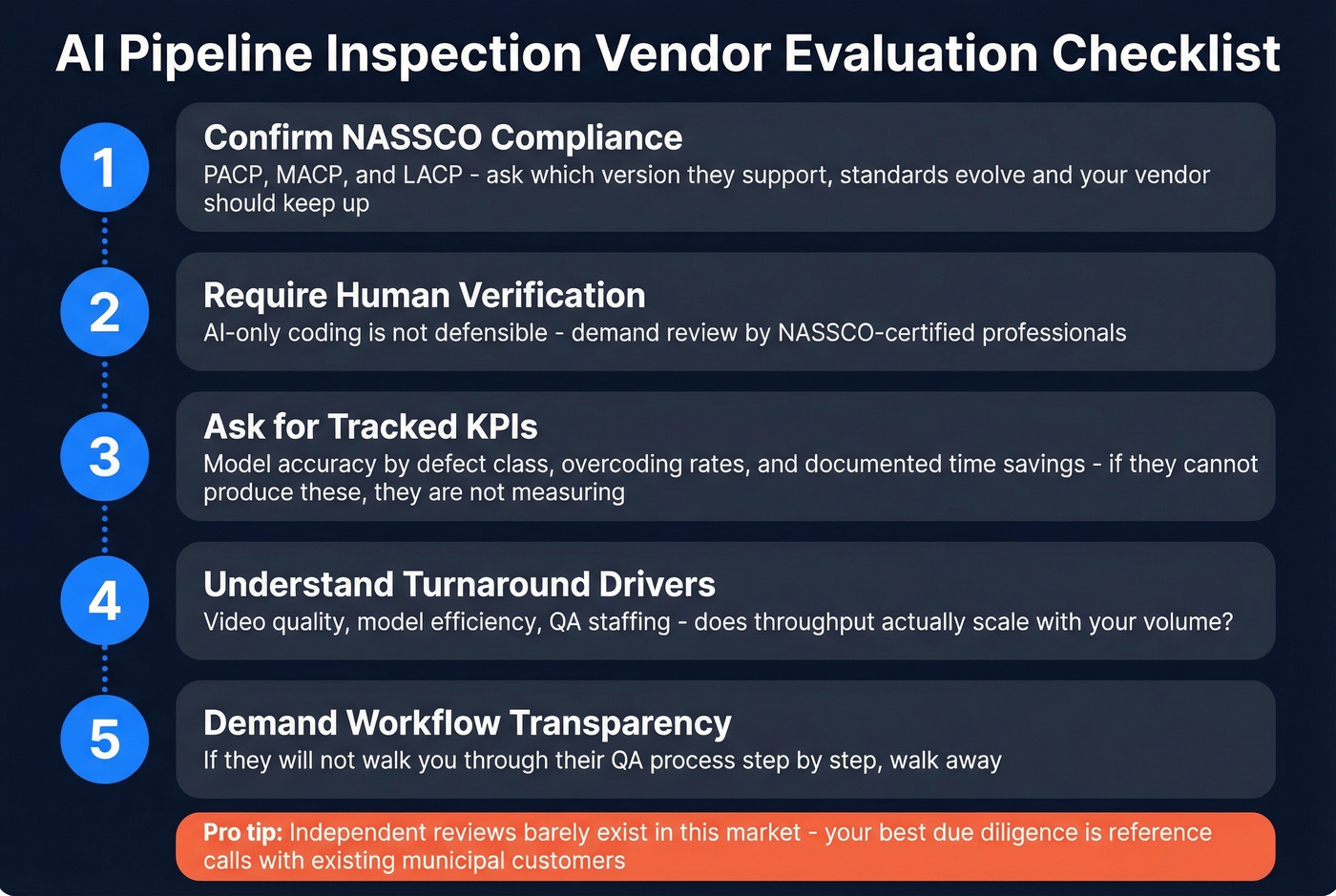
- Confirm NASSCO PACP/MACP/LACP compliance and ask which version they support. Standards evolve; your vendor should keep up.
- Require human verification by NASSCO-certified professionals. AI-only coding isn't defensible.
- Ask for tracked KPIs: model accuracy by defect class, overcoding rates, and documented time savings. If they can't produce these, they aren't measuring.
- Understand turnaround time drivers - video quality, model efficiency, QA staffing - and whether throughput scales with volume.
- Demand workflow transparency. If they won't walk you through their QA process step by step, walk away.
FAQ
How accurate is AI pipeline inspection?
Vendor claims range from 97-99%, but accuracy varies significantly by defect class and video quality. A model scoring 99% on large fractures may miss 40% of joint offsets. Always request per-defect-class metrics and require human QA by NASSCO-certified professionals before trusting results in capital plans.
Does AI replace human inspectors?
No. AI accelerates defect coding but doesn't eliminate the need for certified reviewers. Human verification is what makes results defensible for regulatory compliance and capital planning. The value is speed and standardization, not headcount reduction.
How much does AI-powered inspection cost?
SaaS tools like SewerAI AutoCode run $500-$2,000/month for small municipal programs. Enterprise platforms like AECOM PipeInsights range from $10,000-$50,000+/year. Robotic hardware bundles from EdgeAI add $2,000-$5,000/month. Consulting-led deployments start at $25,000.
What standards should AI inspection tools comply with?
Look for NASSCO PACP, MACP, and LACP compliance - these are the industry-standard coding systems for sewer condition assessment in the US. Confirm which version the vendor supports, since standards are updated periodically. Non-compliant tools produce data that's difficult to defend in regulatory or capital planning contexts.
If you sell AI inspection solutions and need to reach utility decision-makers, Prospeo's B2B database covers 300M+ professional profiles with 98% email accuracy - including public works and infrastructure roles. Filter by department, job title, and buyer intent across 15,000 topics to find in-market prospects.
If you're building outbound to these operators, treat it like a go-to-market strategy: define your ICP, map buying roles, and sequence outreach.
You can also tighten targeting with technographics and intent signals, then operationalize it with a repeatable lead generation workflow.
Once you have the list, protect deliverability with email verification and monitor bounce rates so your domain doesn't get burned.
Pipeline inspection companies scaling outbound need data that won't wreck their sender reputation. Prospeo's 5-step email verification and 7-day refresh cycle keep bounce rates under 4% - the same standard you'd expect from your inspection AI's defect accuracy. At $0.01 per verified email, reaching thousands of municipal and oil & gas contacts costs less than a single day of manual prospecting.
Your pipeline data refreshes weekly. Your prospect data should too.