

The Alternative Close: A Practitioner's Guide to Killing Indecision
It's Thursday afternoon. You've run three demos this week, and every single one ended with "let me think about it." That phrase isn't a buying signal - it's a deal dying in slow motion. 40-60% of B2B deals are lost not to competitors but to "no decision." The alternative close exists to kill that indecision before it metastasizes.
What You Need (Quick Version)
- The alternative close replaces "yes or no?" with "Option A or Option B?" - shifting the buyer's decision from whether to which.
- Use it after you've qualified the prospect and confirmed they have authority to buy, typically in the late-discovery or proposal stage.
- The #1 rule: both options must move the deal forward. Never offer "buy" vs. "don't buy" dressed up as a choice.
What Is the Alternative Close?
This technique reframes the buying decision. Instead of asking a prospect to say yes or no - a binary that invites hesitation - you present two options that both result in forward motion. The prospect picks a path, not an exit.
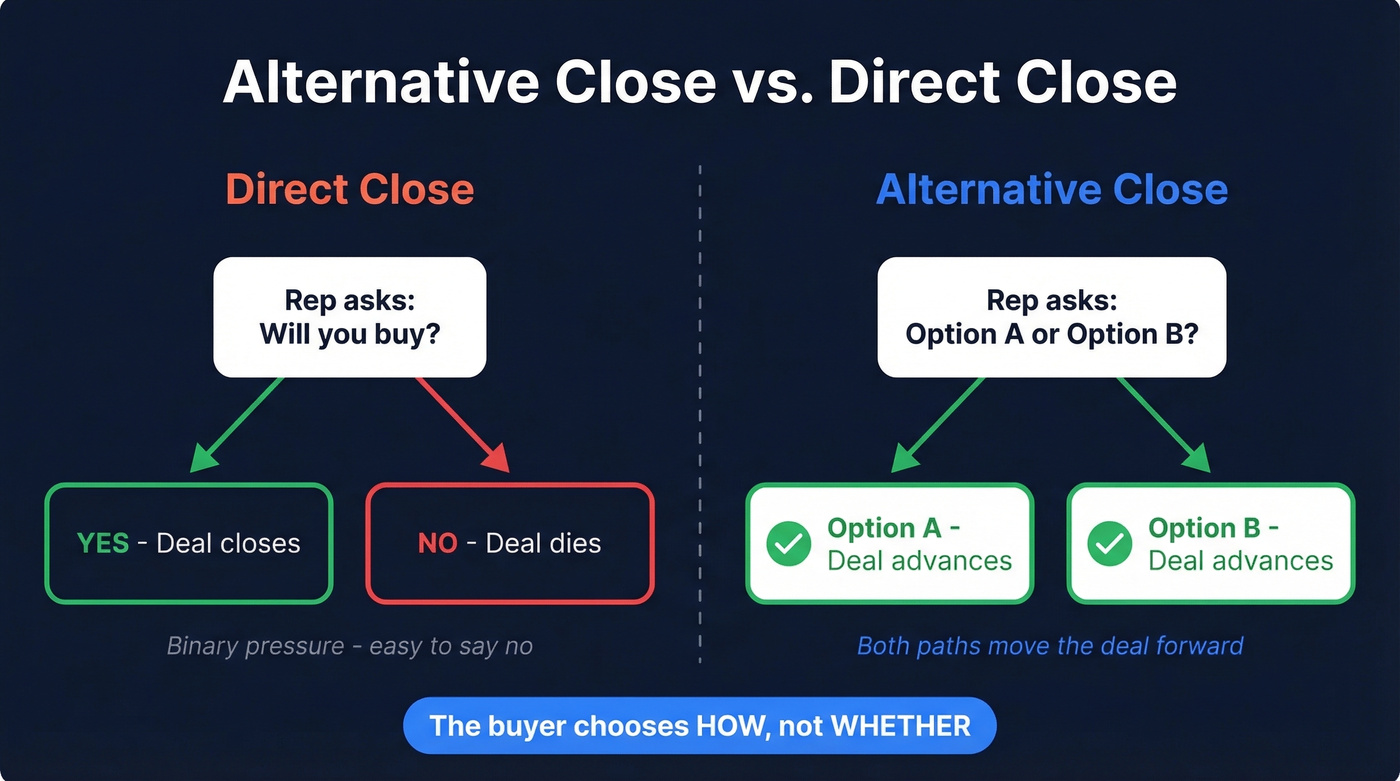
Compare this to a direct close, where you simply ask for the sale outright. A direct close is a straightforward "Will you buy?" - effective with highly motivated buyers, but risky when indecision is the real enemy. Here's what the alternative close sounds like in practice: "Would you prefer to start with the 10-seat pilot in Q2, or roll out the full 50-seat deployment in Q3?" Neither answer is "no." Both answers advance the deal.
A straight yes/no close puts all the pressure on a single moment of commitment. The alternative choice close distributes that pressure across two acceptable outcomes, so the buyer feels like they're choosing rather than being cornered. It works because it removes the easiest escape hatch - the word "no."
The Psychology Behind It
This technique works because of a concept behavioral scientists call choice architecture - the deliberate design of how options are presented to influence decisions. As Richard Thaler put it: "The first misconception is that it is possible to avoid influencing people's choices." Every time you present a proposal, you're already shaping the decision environment. The alternative close just does it on purpose.
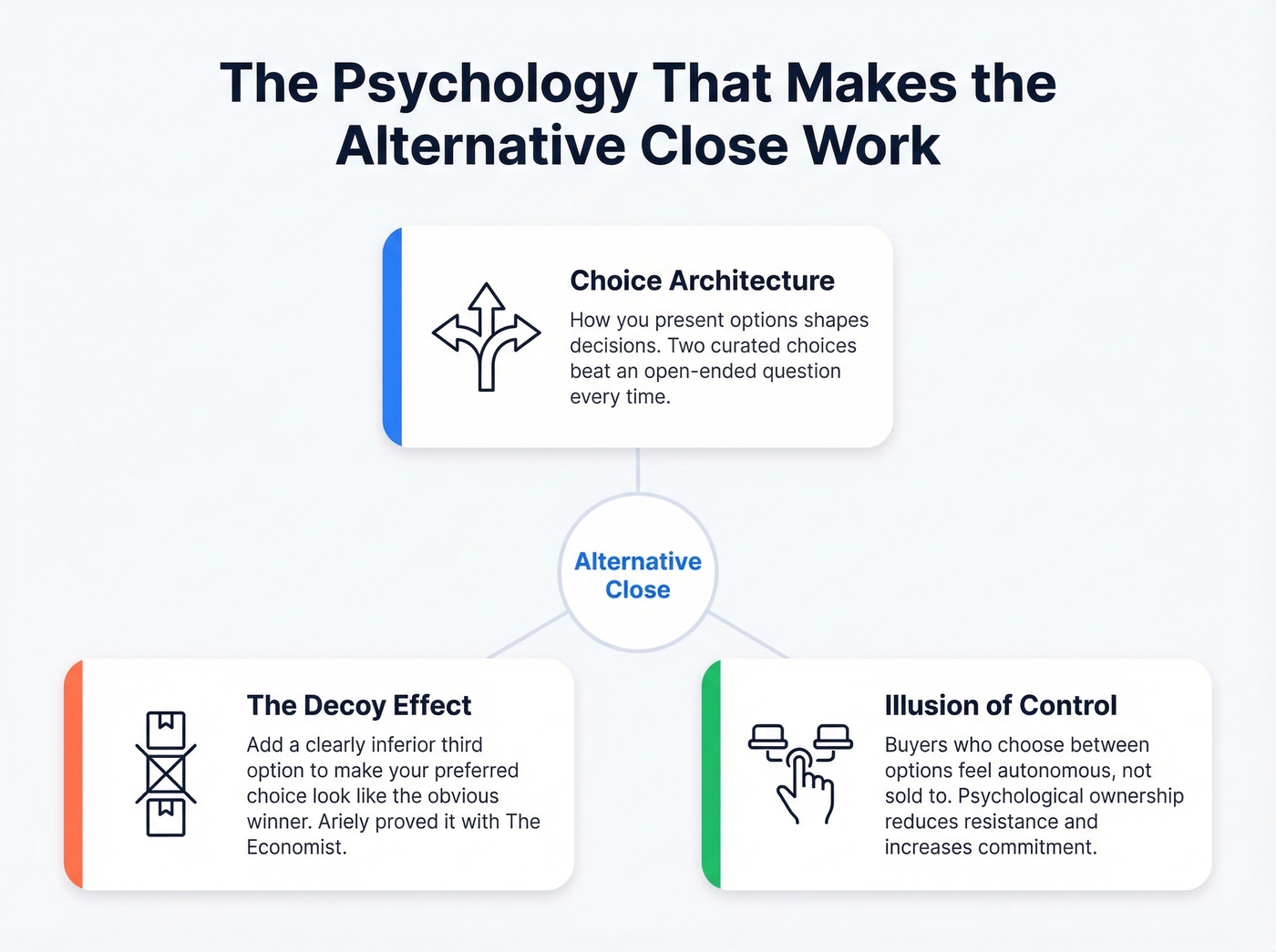
This connects to nudge theory. Thaler and Sunstein's framework argues that small changes in how choices are structured can dramatically shift behavior without restricting freedom. Offering two options instead of an open-ended "what do you think?" is a textbook nudge.
Then there's the decoy effect, famously documented by Dan Ariely in Predictably Irrational. When The Economist offered online-only ($59), print-only ($125), and print+online ($125), the print-only option existed solely to make print+online look like a steal. Nobody picked print-only - but its presence shifted buyers toward the more expensive combo. In B2B, you can use the same principle by designing your two options so the one you want the buyer to pick looks obviously better by comparison.
The deeper mechanism is the illusion of control. When buyers choose between two options, they feel autonomous - they're making a decision, not being sold to. That psychological ownership reduces resistance and increases commitment to the outcome they selected. You can also layer in an opportunity cost frame here, spelling out what the buyer stands to lose by delaying, so each option feels more urgent than doing nothing.
How It Stacks Up Against Other Techniques
Not every close works the same way, and the alternative close occupies a specific niche. Per Lepaya's analysis, it's a subset of the assumptive close - it assumes the sale is happening and only asks how. HBR's three-part taxonomy of closing approaches categorizes techniques as foreground suggestions (medium pressure), commands (high pressure), and background suggestions (low pressure). The alternative choice close, done right, sits in that background-suggestion zone - a distinction most sales blogs completely miss.
| Technique | How It Works | Pressure Level | Best For |
|---|---|---|---|
| Alternative close | Two options, both advance | Low | Late-stage decisions |
| Assumptive close | Acts as if buyer said yes | Medium | Warm prospects |
| Trial close | Tests readiness mid-convo | Low | Discovery/mid-funnel |
| Summary close | Recaps value, asks for deal | Medium | Complex multi-benefit |
| Urgency close | Deadline or scarcity lever | High | End-of-quarter pushes |
| Puppy close | Let the prospect try before buying | Low | Product-led or trial-based sales |
Here's the key distinction: trial closes gauge temperature, summary closes reinforce value, and urgency closes manufacture pressure. The puppy close lets the product sell itself during a trial period, banking on the endowment effect - once someone uses something, they don't want to give it up. The alternative choice technique does none of those. It redirects the decision so both options advance your deal.
How to Use It in 5 Steps
We've watched reps butcher this technique dozens of times. The difference between a close that converts and one that falls flat usually comes down to these five steps.
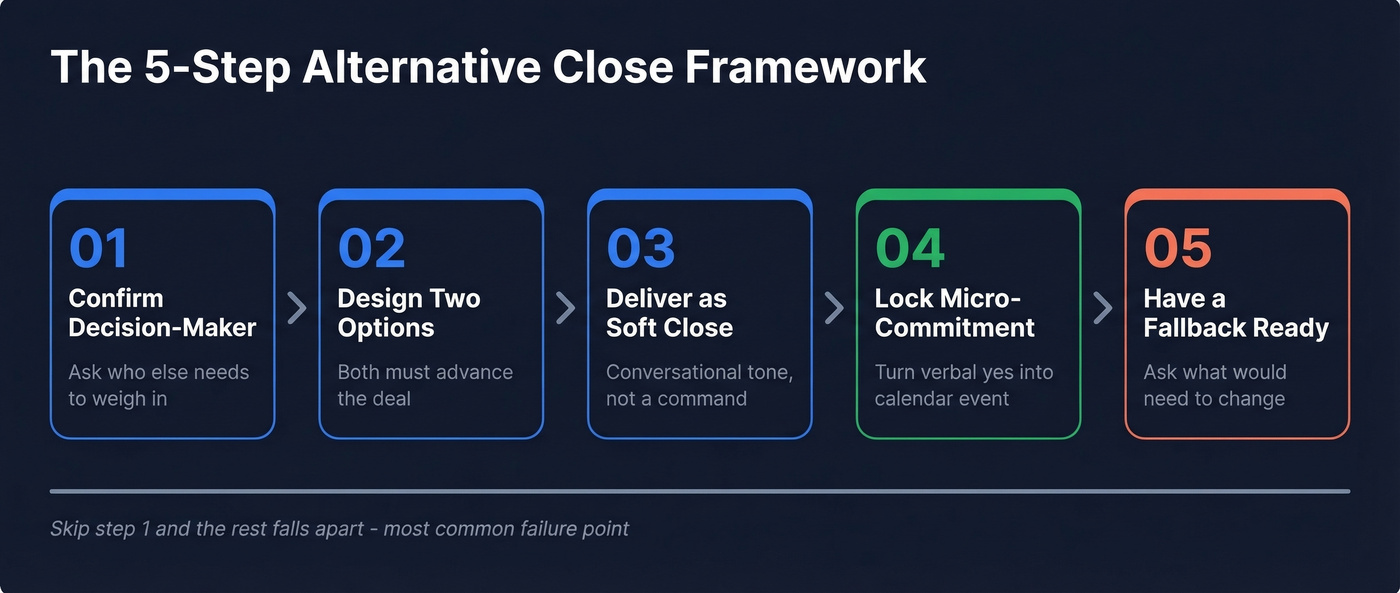
1. Confirm the Decision-Maker
The most elegant close in the world is worthless if you're presenting it to someone who needs to "run it by their boss." Before you design your two options, ask directly: "Who else needs to weigh in on this decision?" or "What does your approval process look like?" If you're not talking to someone with authority, your close becomes a game of telephone. This is the single most common reason the technique fails, and it has nothing to do with the technique itself.
2. Design Your Two Options
This is where the craft lives. Both options should be genuinely valuable - not a real option and a throwaway. I've seen reps blow this by pairing a serious proposal with an obviously inferior one, and buyers see through it instantly.
Use anchoring: make Option A the higher-commitment path (full deployment, annual contract) and Option B the lower-commitment path (pilot, quarterly). If you want to get sophisticated, add a decoy - a third option that's clearly inferior to your preferred choice, making it look like the obvious winner.
3. Deliver as a Soft Close
Tone matters more than words. If you deliver "Would you prefer the annual plan or the quarterly?" like you're reading a hostage demand, you've turned a background suggestion into a command. Keep your voice conversational. Frame it as a natural next step: "Based on what you've told me, I think either of these would work - which feels like a better fit for your team?"
4. Lock the Micro-Commitment
Once they pick an option, don't celebrate - confirm. "Great, let's get the pilot paperwork over to you this afternoon. I'll send the SOW by 3 PM - does that work?" The micro-commitment turns a verbal preference into a calendar event or a document in motion.
5. Have a Fallback Ready
Sometimes both options get rejected. That's fine - HBR recommends building fallback positions into every close. Your fallback isn't a discount. It's a question: "What would need to change about either of these for it to work?" This resets the conversation without surrendering your position.

Step 1 of your alternative close framework is confirming the decision-maker. Prospeo's 300M+ profile database with 30+ filters - including job title, seniority, and department - lets you identify and reach the person with buying authority before you ever pitch. 98% email accuracy means your close lands in the right inbox.
Stop closing the wrong person. Start with verified decision-maker data.
Scripts That Actually Work
Scripts aren't meant to be read verbatim - they're flexible guides you adapt to the conversation. With reps averaging 40 calls a day, having a framework beats improvising every time.
SaaS Demo Follow-Up
"I know your team's evaluating both tiers. Would it be more helpful if I sent over a one-page summary of Standard, or a side-by-side comparison of Standard and Premium so you can walk your CFO through the differences?"
Both options keep the deal moving. One is lower effort for you; the other signals higher intent from them. Either way, you've got a next step.
Cold Call Opener
Cold calling averages a 2.3% success rate - top teams hit 5-8% with structured approaches, and a pattern-interrupt question can drive 6.6x higher success rates. A choice-framing opener puts that principle to work:
"I've got two things that might be relevant to your team - a 30-second version and a 2-minute version. Which works better for your schedule right now?"
This "choose-your-own-adventure" approach gives the prospect agency immediately, which reduces the instinct to hang up.
Pricing Negotiation
"We can do the 25-seat annual at $18k, or the 15-seat quarterly at $6k per quarter. Both include onboarding. Which aligns better with your budget cycle?"
Notice both options are profitable. You're not offering a discount - you're offering scope flexibility. If you want to go deeper on anchoring, see our guide to anchoring.
Email Follow-Up
"Would Tuesday at 2 PM or Thursday at 10 AM work better for a 20-minute walkthrough? I'll have the ROI model ready for whichever slot you pick."
Vague emails like "let me know your thoughts" are the opposite of a two-option close. Give them two concrete options and a reason to pick one. If you need ready-to-send copy, use these follow-up templates.
Mistakes That Kill Your Close
Not Asking "How Do They Decide?"
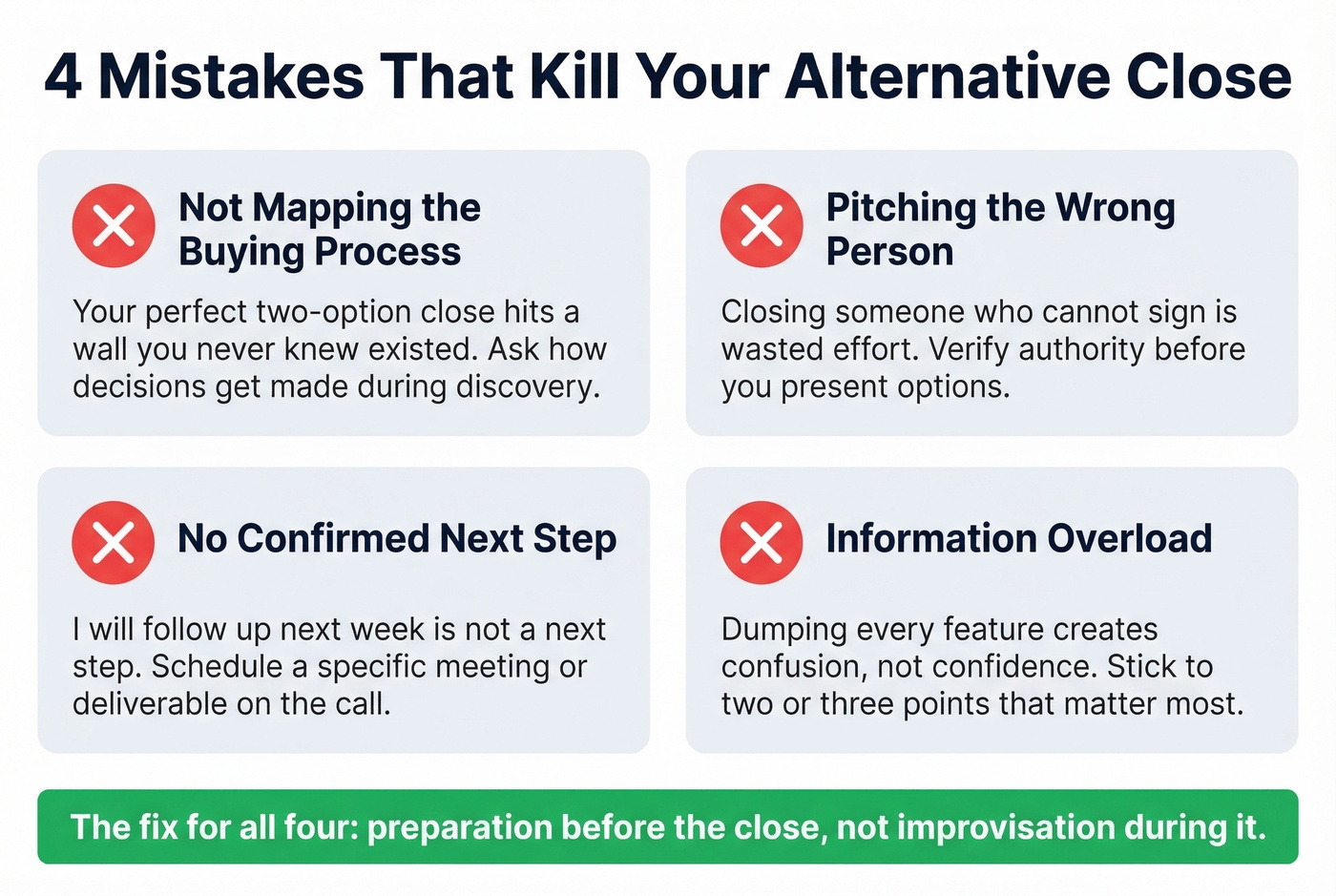
Every organization has an internal buying process - stakeholders, compliance reviews, procurement gates. If you don't ask about it, your beautifully crafted two-option close runs into a wall you didn't know existed. The fix: ask "Walk me through how decisions like this typically get made here" early in discovery. (More discovery prompts: discovery questions.)
Pitching the Wrong Person
Look, you can nail the alternative close and still lose because you're presenting options to someone who can't sign. Before you craft the perfect two-option close, make sure you're reaching a decision-maker. Prospeo gives you access to 300M+ professional profiles with 98% email accuracy and 125M+ verified mobile numbers - so your close lands with someone who can actually say yes. If you're tightening qualification, MEDDIC helps - start with authority to buy.
No Confirmed Next Step
"I'll follow up next week" isn't a next step. It's a prayer. The fix: schedule the next meeting or deliverable while you're still on the call. "I'll send the SOW by Thursday at noon - can we block 15 minutes Friday to review it together?" The "always be closing" mindset isn't about pressuring every conversation into a signature. It's about ensuring every interaction has a defined next action that keeps the deal moving forward. For more, see the full steps to close a sale.
Information Overload
Dumping every feature and use case on a prospect doesn't build confidence - it creates confusion. Stick to two or three high-impact use cases tied directly to their pain points. The technique only works when the options are clear, not buried in a 40-slide deck. If your demos are bloated, use a tighter product demo checklist.
Misreading Silence
Silence after a proposal doesn't mean "no." It often means "I'm processing" or "I need to loop in someone else." Send a relevant case study or ROI calculation - something that gives them new information to process, not just a reminder that you exist. Reset the timeline if needed, but don't disappear.
When NOT to Use It
Here's the thing: the alternative close is the single best technique for one-on-one deal conversations. But it's not universal, and using it in the wrong context will actively hurt you.
Skip it when you're dealing with committee-driven procurement processes where six stakeholders need to align. Presenting two options to one person won't move a 12-person buying committee. RFP processes have their own structure, and trying to reframe the decision will come across as tone-deaf.
Don't use it in early-stage discovery either. If you haven't fully understood the prospect's problem, presenting options feels premature and pushy. And when a buyer explicitly needs time for legal or compliance review, respect that - forcing a choice in that moment erodes trust faster than any technique can build it.
For inbound-driven deals where the prospect came to you through content or a demo request, jumping straight to a two-option frame before understanding their self-identified pain can feel jarring. Let them tell you what they need before you frame the options. If you're building a more consistent pipeline, start with proven sales prospecting techniques.
Close Rate Benchmarks
Here's where your close rate likely sits, based on industry data from GetAccept:
| Industry | Close Rate |
|---|---|
| Finance | 19% |
| Business/Industrial | 27% |
| Computer Software | 22% |
| Computers/Electronics | 23% |
| Proposal-Stage Win Rate | 47% |
Timing matters too. Tuesday is the best day to contact leads, with ~20% higher success than average. Calling between 9-10 AM yields 45% higher success rates. Reps close 3x as many deals at end of month, but those deals are 34.5% smaller on average - so the urgency close has a real cost.
One underused lever for improving these numbers: warm introductions from existing customers. Referrals shorten sales cycles and boost close rates because trust is pre-built before you ever present your two options. To track whether your funnel is improving, monitor core funnel metrics.
The "Alternative Closes" Misconception
If you've Googled "alternative closes" (plural), you've probably landed on Tom Hopkins-era lists featuring techniques like the Wish-Ida close, the Law-of-Ten close, and the Lost-Sale close. These are a grab-bag of rhetorical closing scripts - persuasion monologues, not the two-option framing technique we've been discussing.
The alternative choice close (singular concept) is a specific behavioral technique. "Alternative closes" (plural) is just a category label for "other ways to close." Don't confuse the two.
You just designed the perfect two-option close. But 40-60% of deals die to no decision - often because reps waste cycles on prospects who were never reachable. Prospeo's 125M+ verified mobile numbers with a 30% pickup rate give you a direct line to buyers, so your alternative close actually gets delivered live.
Get direct dials to the prospects worth closing - at $0.01 per lead.
FAQ
Is the alternative close manipulative?
No - it's a background suggestion that preserves buyer agency. The key is offering genuinely valuable options, not engineering a trap. If both options serve the buyer's interests, you're helping them decide, not cornering them. Ethical selling means both paths deliver real value.
How many options should I offer?
Two. Three maximum if you're deliberately using a decoy to steer preference. More than three triggers choice paralysis - the exact problem this technique solves. Sheena Iyengar's jam study showed conversions dropped 90% when shoppers faced 24 options versus six.
What if the prospect rejects both options?
Ask what's missing and reset the timeline. "What would need to change about either option?" turns rejection into new discovery. Never panic-discount - that signals your options weren't real. Treat it as fresh information, not a dead end.
Does this technique work over email?
Yes - offer two specific next steps like meeting times or scope options. Vague emails like "let me know your thoughts" kill momentum. For cold outreach, start with verified contact data so your message reaches the right inbox instead of bouncing.