

Always Be Prospecting: From Sales Platitude to Pipeline System
You crushed Q1. President's Club felt inevitable. Then Q2 opened and your pipeline looked like a parking lot at midnight - empty, quiet, and a little depressing. You'd ignored the cardinal rule - always be prospecting - and now you're scrambling.
The feast-or-famine cycle is the single biggest reason reps miss quota. Not bad closing skills, not weak demos. Just an empty top of funnel. Understanding that difference is what separates reliable performers from reps riding an unpredictable revenue rollercoaster.
Here's the thing: ABP isn't a motivational poster. It's a system. Protect a daily time block of 60-90 minutes for outbound before anything else. Run a multi-channel cadence of 7-10 touches across email, phone, and social over three weeks. And start with clean data - verified emails and verified mobile numbers, not a stale CSV from six months ago.
What ABP Really Means
The phrase is a deliberate riff on "Always Be Closing" - the Alec Baldwin line from Glengarry Glen Ross that became shorthand for aggressive, transactional selling. ABP flips the emphasis from the bottom of the funnel to the top. You can't close what you haven't opened.
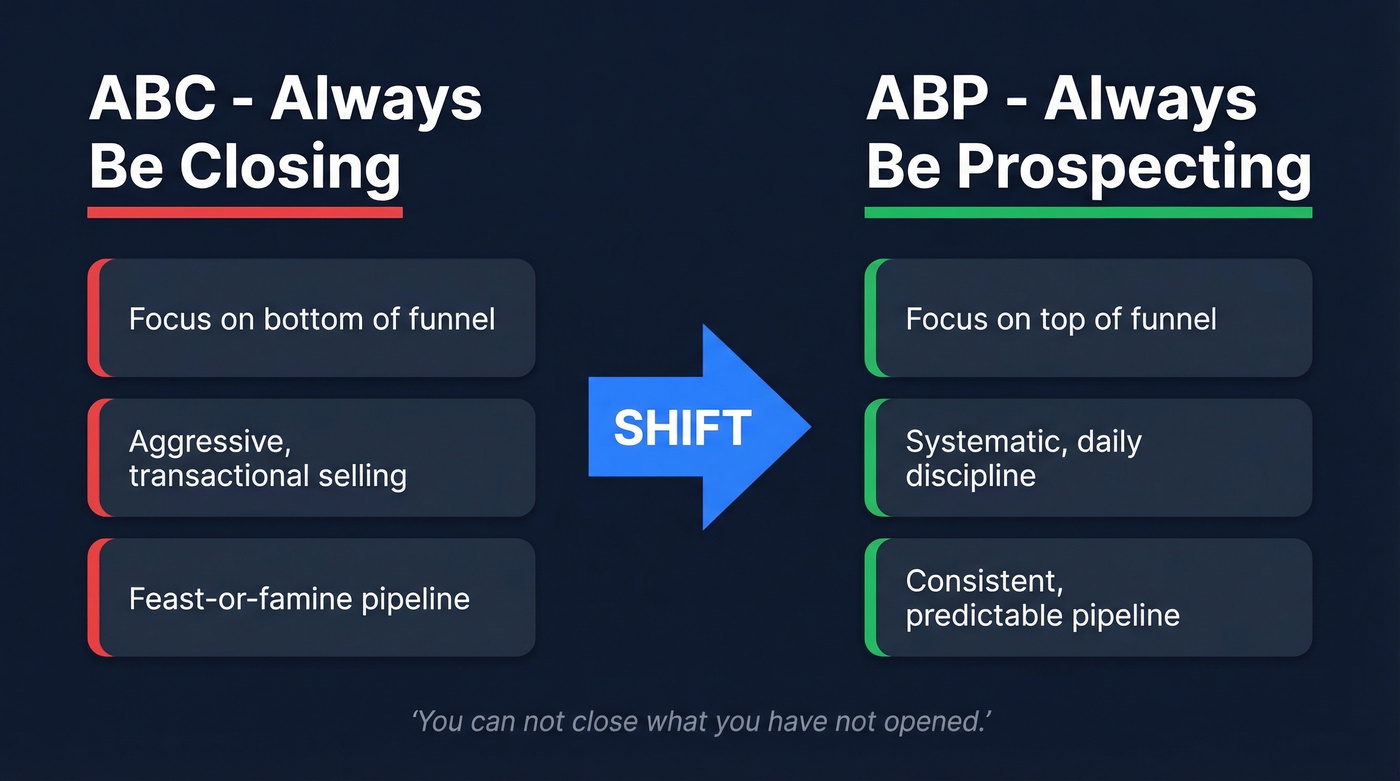
Jeb Blount nails this in Fanatical Prospecting: the number one cause of slumps, failure, and unhappiness in sales is an empty pipeline, and the root cause is the failure to prospect. That's not motivational fluff - it's a diagnostic. The fix isn't working harder during a drought. It's building a system that prevents the drought from happening in the first place, moving from reactive panic to proactive discipline.
Why ABP Matters More in 2026
The way buyers buy has changed fundamentally. 80% of B2B interactions now happen in digital channels. Buyers use roughly 10 channels during a purchase cycle, spend only 17% of their buying time meeting suppliers, and 96% research before they'll talk to a rep. They aren't coming to you.
Outbound is getting harder too. Cold email senders report declining performance year over year, and speed matters more than ever - deals closed within 50 days show a 47% win rate versus 20% for deals that drag past that mark. 50% of sales go to the first vendor that responds. The window to engage is shrinking fast. If reps aren't consistently in the conversation when buyers are ready, they lose by default.
B2B cycles are longer, involve more stakeholders, and demand higher-quality data at every touchpoint. Pipeline gaps here are costlier and harder to recover from, which is exactly why a daily system beats sporadic bursts of activity.
The ABP Daily System
ABP doesn't work as a vibe. It works as a calendar event.
The Morning Power Hour
Block 60-90 minutes at the start of your day for dedicated outbound - before email, before Slack, before your first meeting. We've seen it over and over: reps who protect their morning block consistently outperform those who "find time later." The average rep spends less than 30% of their day on revenue-generating activities, and a protected block is the only reliable way to fight that drift. No exceptions, no rescheduling. Treat it like a meeting with your biggest prospect.
The Multi-Channel Cadence
Before you touch a single channel, define your ICP using win/loss data from your last two quarters - firmographics, tech stack, and buying triggers. Then aim for 7-10 touches over three weeks across at least three channels:
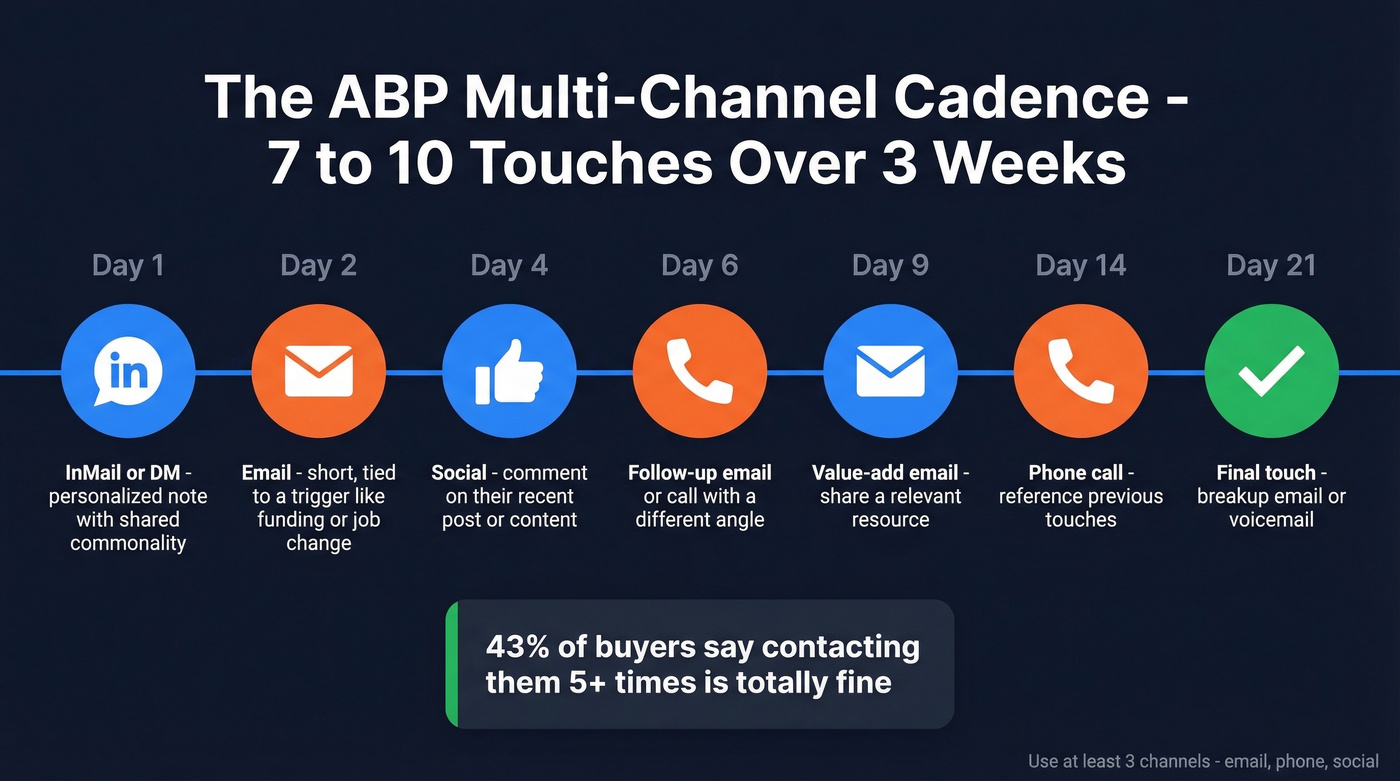
- Day 1: InMail or DM with a personalized note referencing a shared commonality - this alone lifts acceptance rates by 46%
- Day 2: Email - short, relevant, tied to a trigger like a job change, funding round, or tech adoption
- Day 4: Comment on their recent post or content
- Day 6: Follow-up email or call with a different angle
Don't feel guilty about persistence. 43% of buyers say it's fine for sellers to contact them five or more times before getting through.
Pipeline Math
Work backwards. $500K target / $25K average deal = 20 deals. At a 25% close rate, that's 80 opportunities needed. At 20% meeting-to-opportunity conversion, you need 400 meetings. Maintain 3-5x pipeline coverage at all times. Know your numbers, and the daily activity targets write themselves.
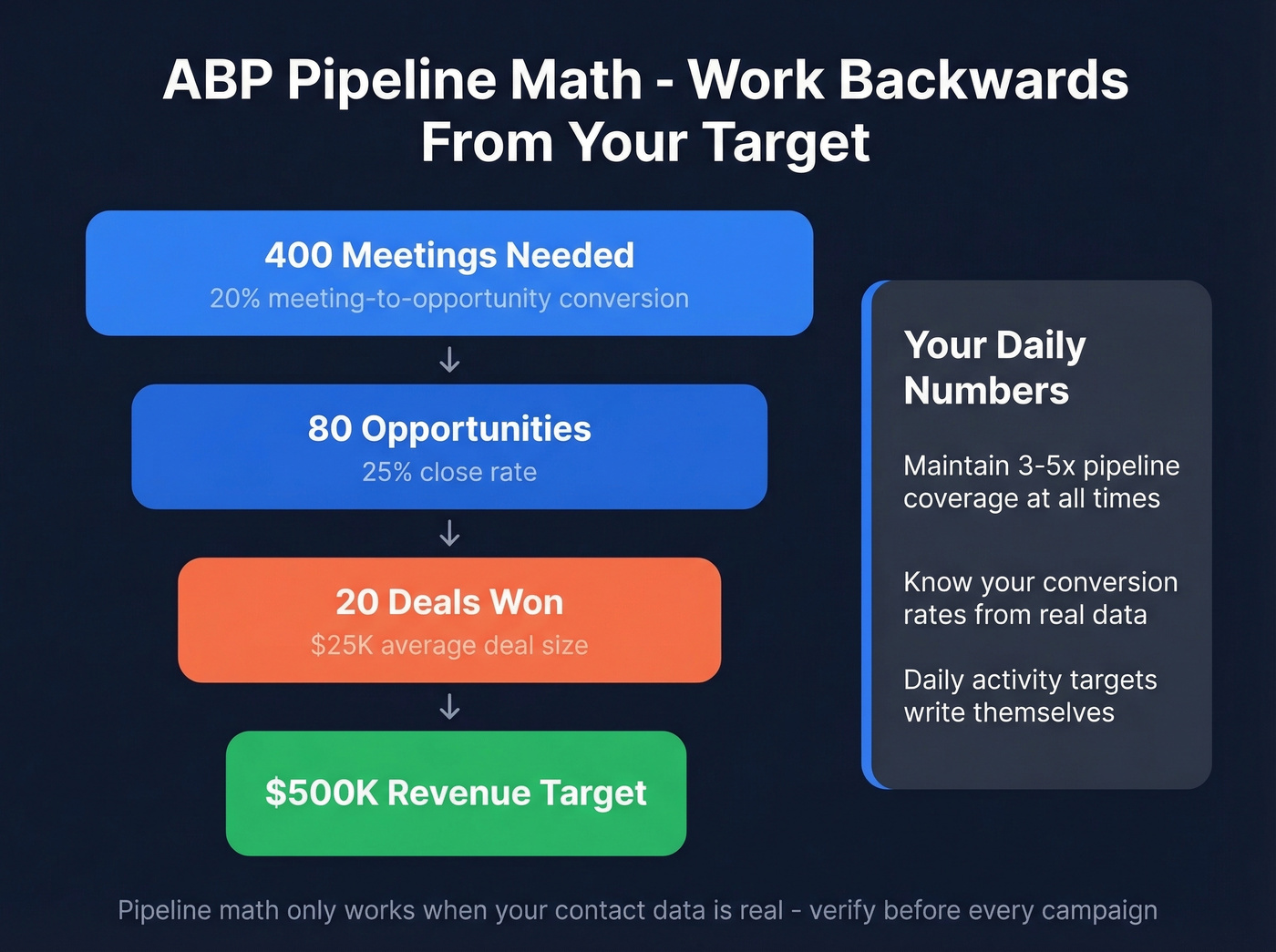
Before you start any sequence, make sure your contact data is actually good. Bad data at the top means wasted effort at every step downstream.

Your multi-channel cadence burns time and domain reputation when it runs on stale data. Prospeo's 5-step verification delivers 98% email accuracy across 143M+ contacts, refreshed every 7 days - not every 6 weeks. Start free with 75 verified emails/month.
Stop prospecting into the void. Start with data that connects.
The 5 P's of Prospecting
To prospect like a pro, you need more than hustle. You need a repeatable framework. The 5 P's give you one:
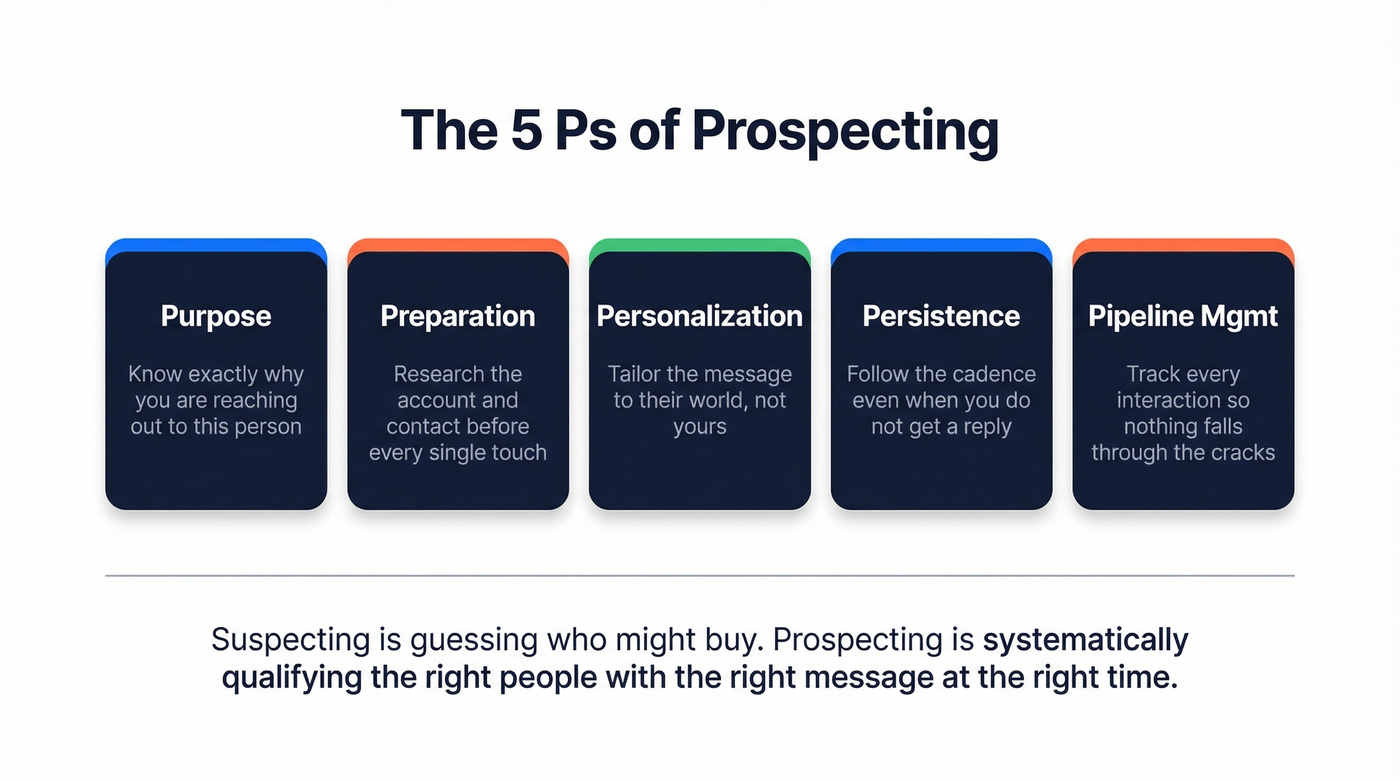
Purpose - know why you're reaching out. Preparation - research the account and contact before every touch. Personalization - tailor the message to their world, not yours. Persistence - follow the cadence even when you don't get a reply. Pipeline management - track every interaction so nothing falls through the cracks.
Teams that internalize these five pillars consistently outperform teams that rely on volume alone. The difference between suspecting and prospecting comes down to this: suspecting is guessing who might buy; prospecting is systematically qualifying and engaging the right people with the right message at the right time.
The Data Layer Most Reps Ignore
Most prospecting advice focuses on messaging, cadence, and mindset. Almost none of it talks about the boring thing that makes all of it work: data quality.
Let's be honest - this is where most ABP systems quietly fall apart. Cold email senders regularly report bounce rates between 2-5%, and 15% exceed 6%. That's enough to tank your domain reputation. Industry thresholds are clear: keep bounce rates under 2% and spam complaint rates below 0.01%. Exceed those, and even your good emails stop landing.
Take Snyk as an example. They had 50 AEs prospecting 4-6 hours a week with bounce rates running 35-40%. After switching to Prospeo for their data layer, bounces dropped under 5%, AE-sourced pipeline jumped 180%, and they were generating 200+ new opportunities per month. That's not a messaging fix. That's a data fix.
Prospeo's 5-step verification process delivers 98% email accuracy across 143M+ verified emails, with a 7-day data refresh cycle - the industry average is six weeks. It also layers in intent data tracking 15,000 topics via Bombora, so you can prioritize prospects who are actively in-market. The free tier gives you 75 emails plus 100 Chrome extension credits per month to test the workflow.
If you're comparing providers, start with a shortlist of data enrichment services and validate accuracy before you scale.
Pipeline math only works when your contact data is real. Snyk's 50 AEs cut bounce rates from 35% to under 5% and added 200+ opportunities per month with Prospeo. At $0.01 per email, your daily power hour finally pays off.
Always be prospecting - never be bouncing.
ABP Mistakes That Kill Pipeline
Mass impersonal emails. Emails sent to large untargeted lists get 67% fewer replies than smaller, targeted groups. Even basic segment-level personalization beats spray-and-pray. If you need a starting point, use proven sales follow-up templates and adapt them to each segment.
Single-channel outreach. Buyers are spread across 10 channels, and you need to be on at least three. If you're only emailing, you're invisible to the people who prefer phone and the people who prefer social. A tighter set of sales prospecting techniques helps you balance channels without adding busywork.
Ignoring compliance. GDPR fines run up to EUR 20M or 4% of global annual revenue. If you're prospecting into the EU without proper consent mechanisms, you're risking the business. Skip this if you're only selling domestically in the US, but the moment you touch European prospects, get your compliance house in order.
Prospecting only when pipeline is thin. This is the original sin. The whole point of ABP is that you prospect when things are good, not just when they're desperate.
Real talk: if your average deal size is under $15K, you don't need a complex tech stack. You need a time block, a phone, a verified email list, and the discipline to show up every morning. The system beats the software every time.
ABP in the AI Era
AI isn't replacing prospecting - it's compressing the prep work. Among teams using AI SDR tools, roughly 40% save 4-7 hours per week on prospecting activities, and 45% of high-performing teams now run hybrid human-AI models where AI handles research and first-touch personalization while humans handle relationship-building and qualification.
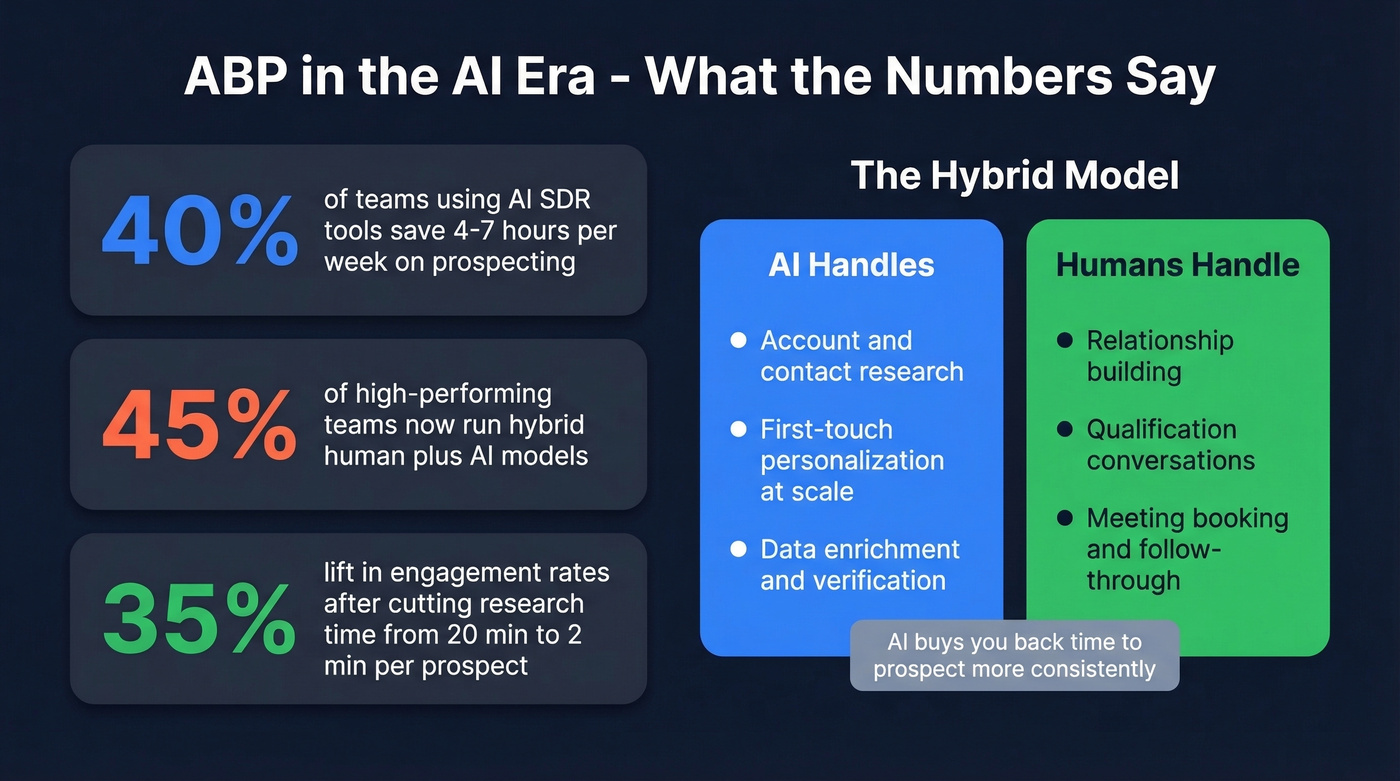
One team we've studied cut research time from 20 minutes per prospect to 2 minutes and saw a 35% lift in engagement rates. The lesson isn't that AI does the prospecting for you. It's that AI buys you back the time to prospect more consistently - which is the entire ABP premise. The consensus on r/sales echoes this: AI tools are great for research and personalization at scale, but the human follow-through is still what books meetings.
Always be prospecting isn't complicated. It's a time block, a cadence, and clean data - repeated daily until pipeline stops being a problem. If you want to operationalize it, map your lead generation workflow and track pipeline health weekly.
FAQ
What does "always be prospecting" mean in sales?
ABP means treating prospecting as a non-negotiable daily discipline, not something you do only when pipeline is thin. Block 60-90 minutes each morning, run a multi-channel cadence of 7-10 touches, and never let a strong quarter trick you into stopping. It's the system that turns sporadic effort into consistent pipeline.
How much time should I spend prospecting each day?
Block 60-90 minutes each morning for dedicated outbound before meetings or email. A protected Morning Power Hour is the single most impactful habit for consistent pipeline generation - reps who do this consistently outperform peers by a wide margin.
Why does my prospecting feel like it isn't working?
Usually it's a data problem, not an effort problem. If your bounce rate exceeds 2%, you're burning time on dead contacts and damaging your sender reputation. Verify your list before every campaign - even a small test batch will tell you whether your data is the bottleneck.
What's the difference between BDR and SDR prospecting?
BDRs typically work outbound lists while SDRs qualify inbound leads. Regardless of title, the ABP system applies equally - both roles need a protected time block, a multi-channel cadence, and clean data to generate consistent pipeline.