

Ampliz vs Power Almanac: They're Not Really Competitors
Comparing Ampliz to Power Almanac is like comparing a fishing rod to a garden hose - both are tools, but they solve completely different problems. One is a hyper-niche US local government database. The other is a global B2B data platform with an APAC specialty. If you're weighing both, you're probably unclear on what you actually need.
There isn't much public discussion comparing them head-to-head. They're both niche enough that most SDRs never run into them, let alone pit them against each other.
30-Second Verdict
Power Almanac wins if you sell exclusively to US local governments and need phone-verified decision-maker contacts organized by role.
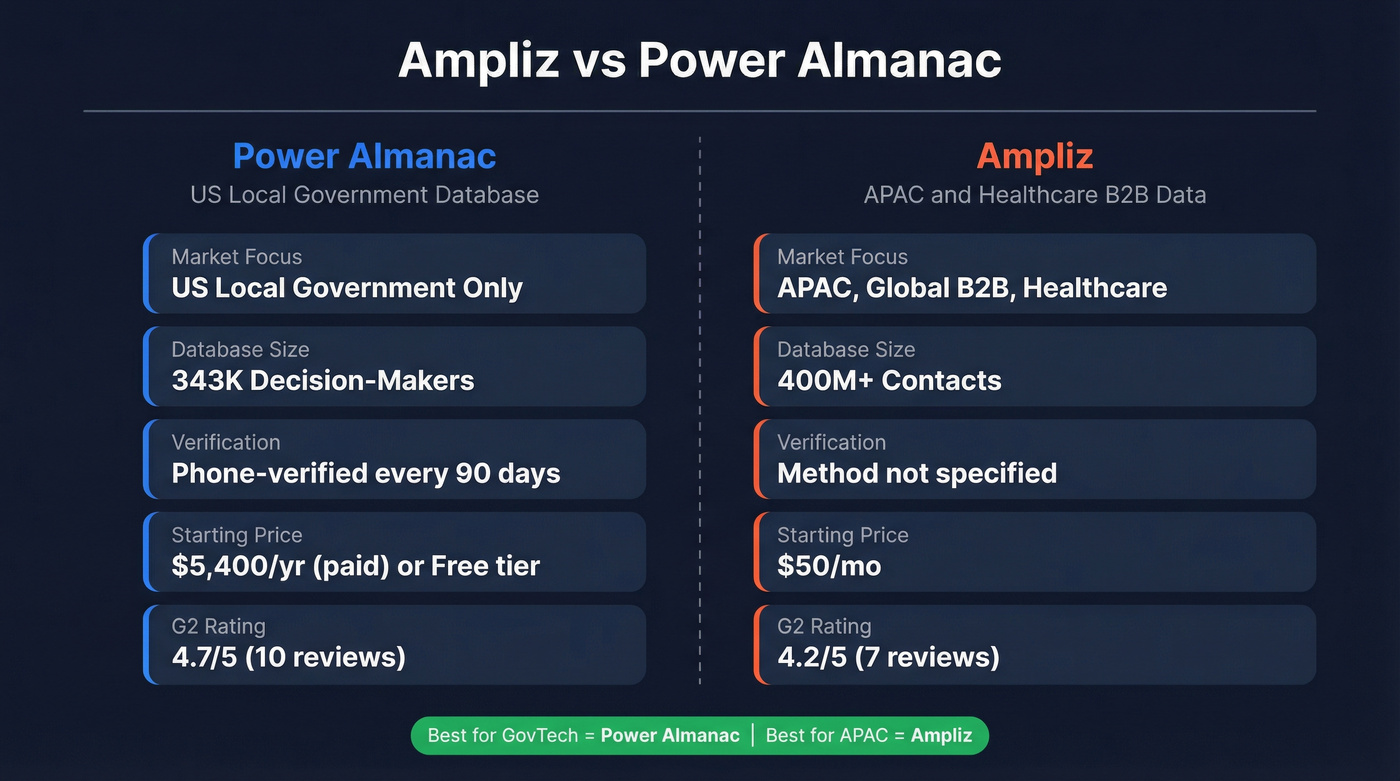
Ampliz wins if you're prospecting into APAC markets or healthcare verticals and need verified emails at scale.
Skip both if you need general B2B data across industries and geographies. Both tools are excellent within their lanes, but those lanes are narrow.
What Is Power Almanac?
Power Almanac is a local government contacts database. That's it. It covers 22,000 US local governments and roughly 343,000 decision-maker records - city managers, public works directors, finance officers, and governing board members. The database organizes contacts by 22 defined roles rather than job titles, which is smart given how inconsistent government titling can be across municipalities. That includes 101,000+ governing board members, 22,000+ top elected officials, and 16,000+ heads of public works.

Beyond contact data, Power Almanac includes entity-level intelligence: population figures, spending and employment data, fiscal year end dates, and election months. You can filter across 10 dimensions including government type, location, and headcount - useful for targeting municipalities of a specific size or budget. It also notifies you when someone changes roles, so your CRM doesn't fill up with stale contacts.
If you're building a broader outbound motion, it helps to map this kind of niche dataset into your overall sales prospecting techniques so reps don't waste cycles in the wrong market.
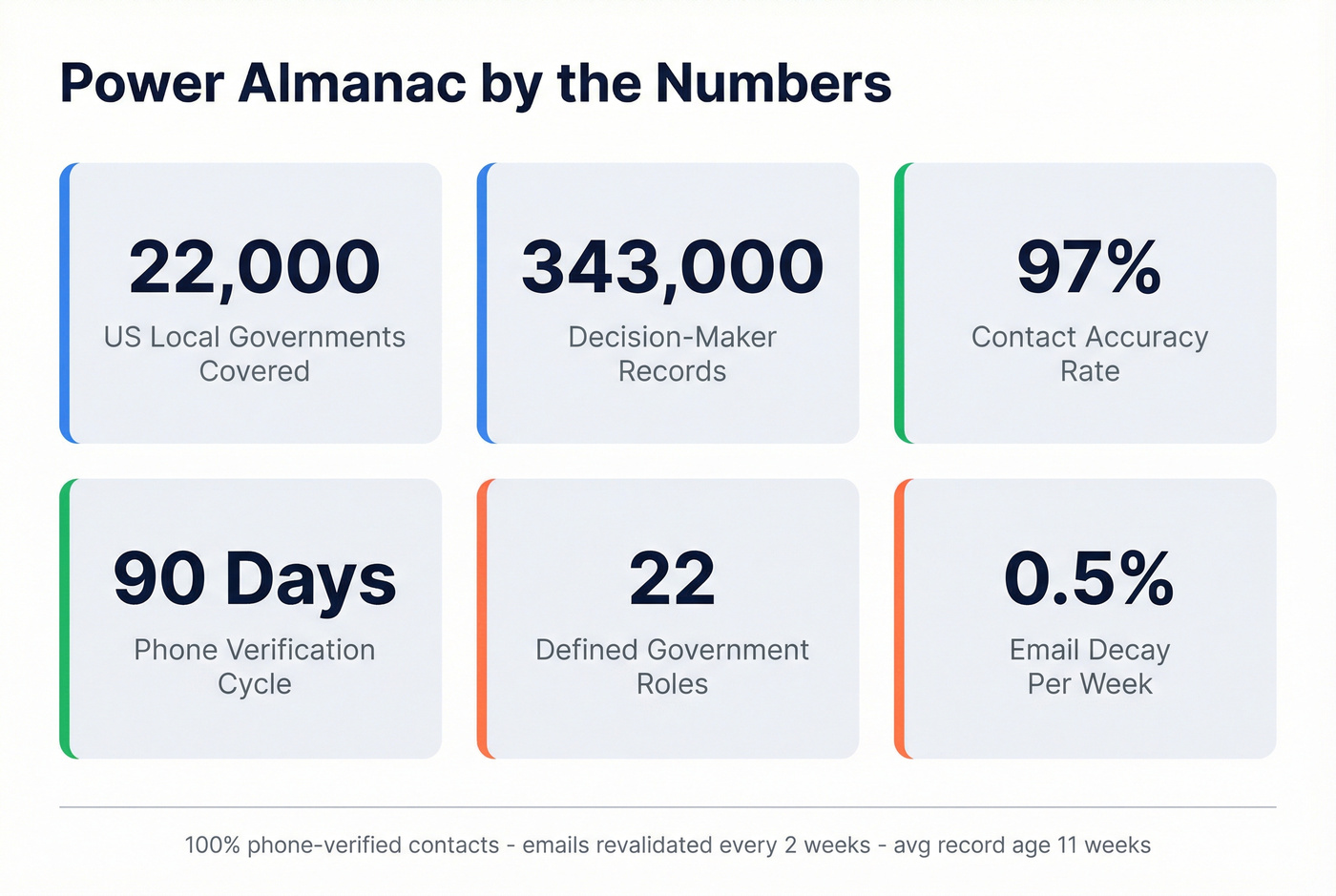
Verification is where Power Almanac earns its keep. The team calls all 22,000 governments every 90 days and revalidates emails every two weeks. They report an average record age of 11 weeks and email decay of roughly 0.5% per week, with 100% phone-verified contacts at 97% accuracy. That's credible given the narrow scope and manual approach. GovExec, which acquired Power Almanac in 2022, reaches 3.3M government influencers monthly - giving it a broader public-sector ecosystem play.
On G2, it sits at 4.7/5 with 10 reviews. Users praise the simple UI and accurate data. The main complaint: they want more roles and deeper org-chart coverage within each entity.
What Is Ampliz?
Ampliz positions itself as a global B2B data platform, but its real strength is APAC coverage. The database includes 400M+ B2B contacts across 16 APAC countries and 9M+ companies. There's also a dedicated healthcare intelligence vertical with physician directories, hospital data, and provider contacts - a useful niche if you're selling into health systems.
If you're evaluating it as a general data source, it’s worth comparing against broader sales prospecting databases before you commit.
On G2, Ampliz scores 4.2/5 with 7 reviews. A recent review highlights strong data quality for the DACH region, verified emails leading to fewer bounces, and useful bulk CRM enrichment. The downsides matter, though: coverage gaps for smaller companies, outdated job titles in some regions, and a UI that feels clunky compared to modern sales intelligence tools. We've seen teams try Ampliz for European mid-market prospecting and find the data thinner than expected outside its APAC core.
If your main pain is bounce risk, pairing any data source with dedicated data enrichment services can help keep records usable over time.

Ampliz covers APAC. Power Almanac covers US local gov. Neither gives you broad B2B coverage with verified data you can trust. Prospeo's 300M+ profiles span every industry and geography, with 98% email accuracy, 125M+ verified mobiles, and a 7-day refresh cycle - not 90 days, not unspecified.
Stop stitching together niche tools. Get one platform that covers everything.
Feature Comparison
| Dimension | Power Almanac | Ampliz |
|---|---|---|
| Market focus | US local government | APAC / global B2B |
| Database size | 343K decision-makers | 400M+ contacts |
| Data types | Name, role, email, phone, mailing address, gov entity data | Email, direct dial, company firmographics, technographics |
| Verification | Phone every 90 days | Method unspecified |
| Refresh cadence | Emails every 2 weeks | Not specified |
| G2 rating | 4.7/5 (10 reviews) | 4.2/5 (7 reviews) |
| API | No | Yes |
| CRM integrations | None | Yes |
| Starting price | Free; paid from $5,400/yr | $50/mo |
Power Almanac's 343,000 records sound tiny next to Ampliz's 400M+, but that comparison is meaningless. Power Almanac covers about 99% of local governments serving populations of 1,000+ in the US. If you're selling permitting software to city managers, those 343K records are worth more than 400M random B2B contacts.
Data freshness is the other gap worth noting. Power Almanac publishes its verification cadence in detail - 90-day phone calls, biweekly email checks. Ampliz doesn't specify its refresh methodology, which makes it harder to trust the data over time. If you're trying to reduce bounces, a dedicated email bounce rate playbook matters as much as the data vendor.
Pricing
| Plan | Power Almanac | Ampliz |
|---|---|---|
| Free tier | Power Entry (free) | Free plan (10 credits) |
| Small buy | $350 (1,000 contacts) | $50/mo |
| Entry paid | $5,400/yr (15K credits) | $50/mo |
| Mid tier | $12,000/yr (75K credits) | ~$150-200/mo (est.) |
| Top tier | $16,000/yr (Power Max) | ~$300+/mo (est.) |
Power Almanac is expensive on a per-seat basis, but its paid plans include unlimited users - a meaningful advantage for larger teams. The per-record floor sits around $0.06. You can also access Power Almanac data through Data Axle's list rental channel at a $125/M base rate, which is worth exploring if you only need a one-time pull (note: Data Axle lists a semiannual update cycle for that channel).
Ampliz starts cheaper at $50/month, but costs scale with credits and seats. Expect $50-$300+/month depending on volume. These pricing structures reflect completely different buying motions: Power Almanac is an annual commitment for a specialized dataset, while Ampliz is a monthly tool you can spin up and test in a week.
If you're building a repeatable outbound engine, aligning pricing with your lead generation workflow prevents tool sprawl.
Who Should Pick Which
Use Power Almanac if you're a GovTech startup selling to city managers, county administrators, or public works directors. The role-based targeting and phone verification make it the only serious option for US local government prospecting. In our experience, role-based targeting beats title-based search for government contacts every time - government titles are wildly inconsistent across municipalities. And given that 4.1% of government contact records change each month (40.5% annually), Power Almanac's 90-day phone verification cycle is the difference between reaching the current city manager and leaving a voicemail for someone who retired in March.
If you're operationalizing this, a clean cold calling system helps you take advantage of phone-verified records.
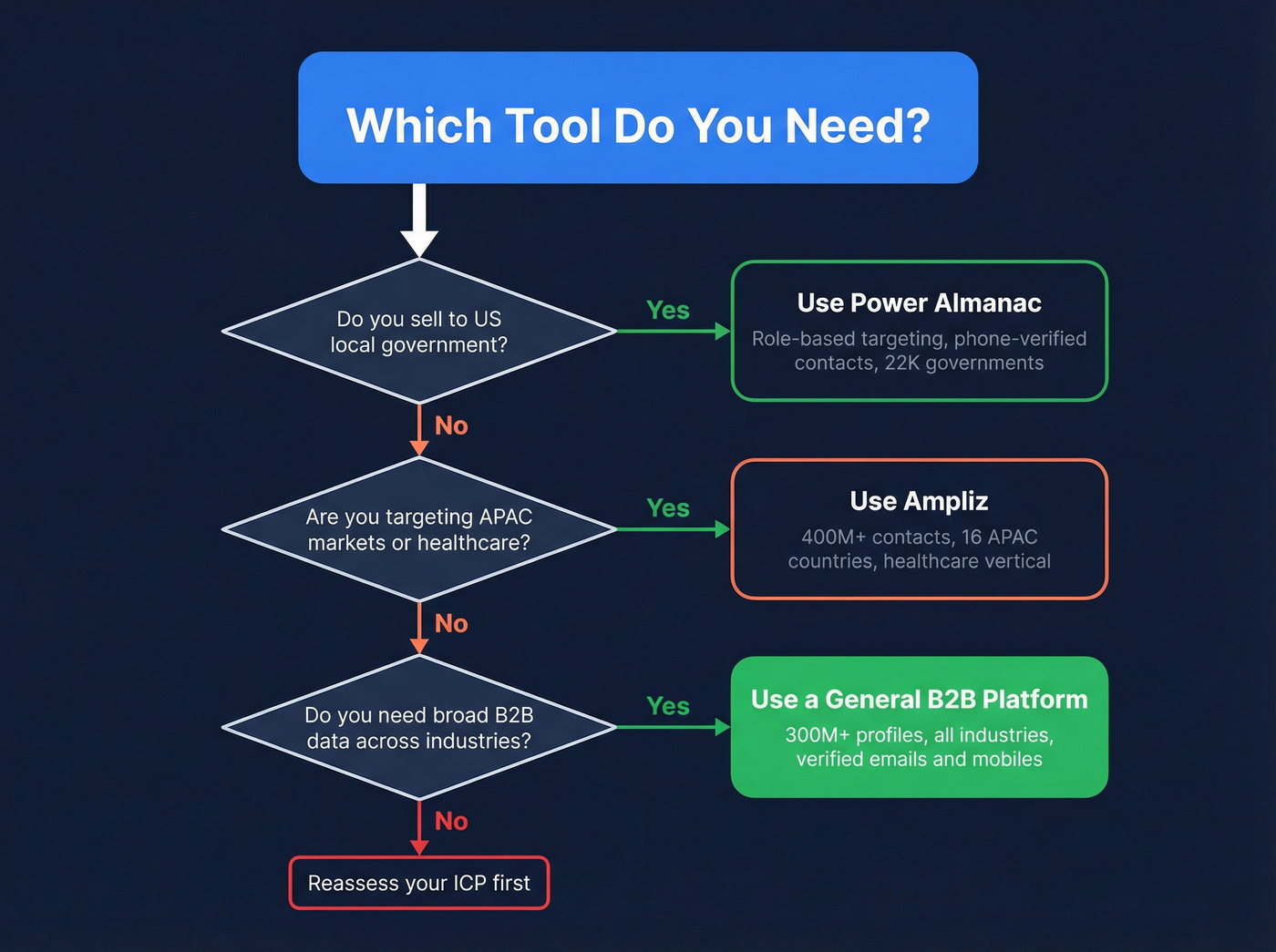
If you sell to the private sector, Power Almanac won't help you.
Use Ampliz if your SDR team is expanding into Southeast Asia, India, or the broader APAC region and needs verified emails at scale. The healthcare vertical is also worth a look if you're selling to hospitals or physician groups. Skip it if you need deep US or European coverage - dedicated tools handle that better.
Here's the thing: most teams evaluating these two tools don't actually need either one. They need general B2B data and stumbled into this comparison because a colleague mentioned one of them. If that sounds like you, stop here and pick a broad-coverage platform instead.
When Neither Tool Fits
If you sell SaaS to mid-market companies across the US and Europe, neither Power Almanac nor Ampliz is the answer. Both are built for narrow verticals, and stretching them beyond those verticals means you're paying for data that doesn't match your ICP. If you haven't formalized that ICP, start with an ideal customer profile template.
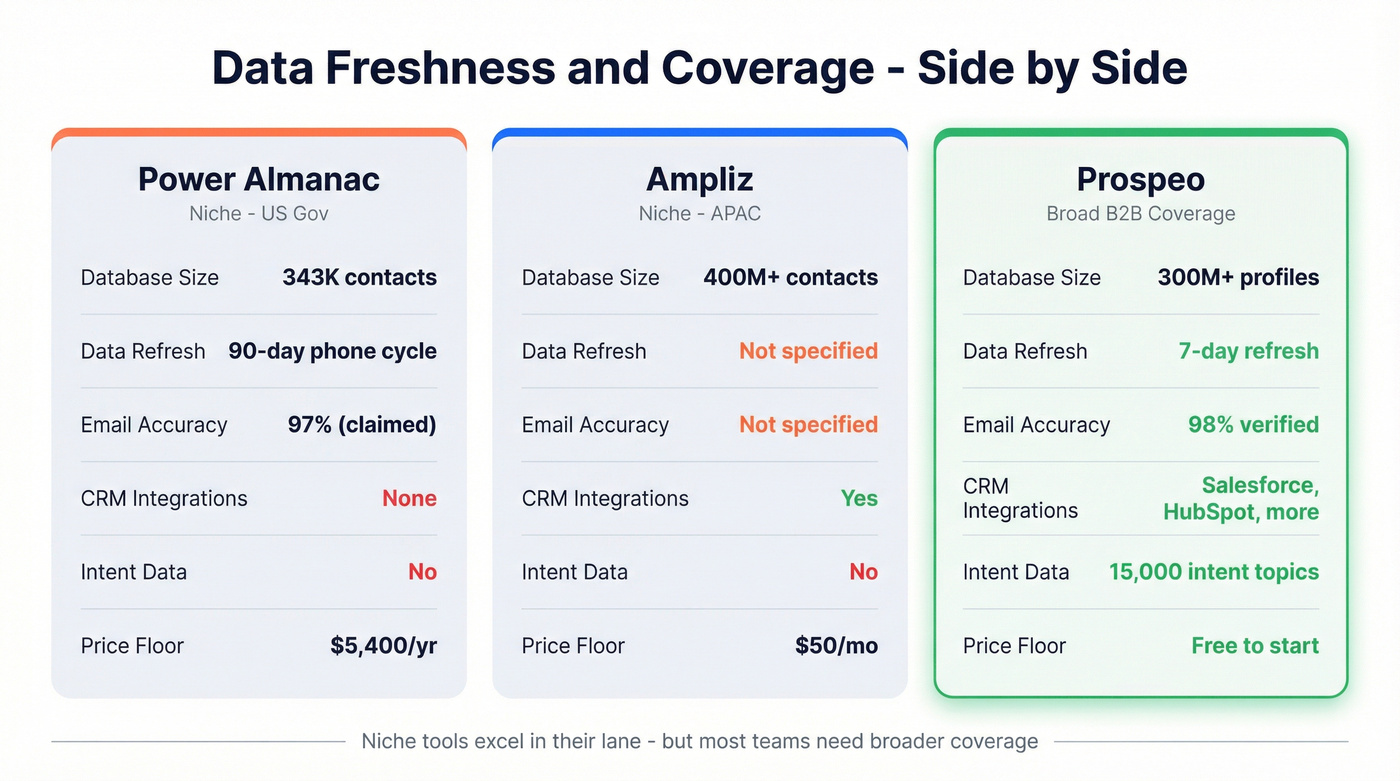
Prospeo covers 300M+ professional profiles across all industries and geographies with 98% email accuracy and 125M+ verified mobile numbers. Its 7-day data refresh cycle is dramatically faster than Power Almanac's 90-day phone verification or Ampliz's unspecified cadence. It's self-serve, starts free with 75 verified emails per month, and integrates natively with Salesforce, HubSpot, and most outbound tools - a sharp contrast to Power Almanac's zero integrations. With 30+ search filters including buyer intent data across 15,000 topics, you can target by technographics, headcount growth, funding, and job changes - the kind of signal-based prospecting that neither niche tool supports.
If you're evaluating alternatives, you can also benchmark against other B2B company data providers to sanity-check coverage and refresh claims.
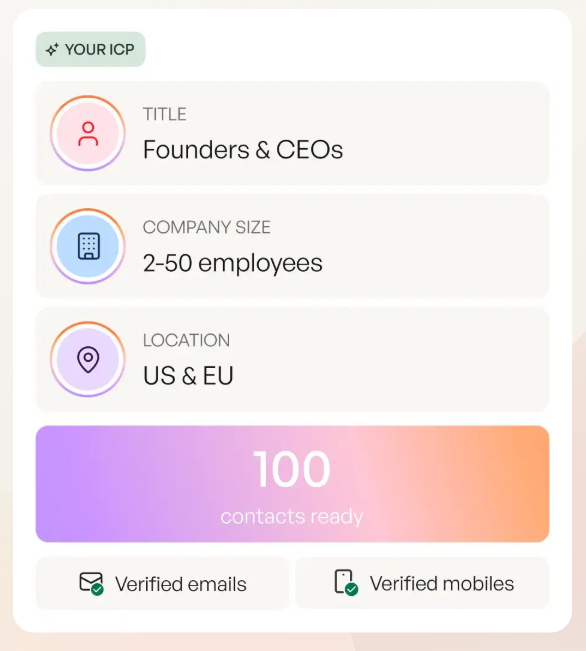
If you landed here looking for general B2B data, you don't need either tool. Prospeo gives you 30+ search filters - buyer intent, technographics, headcount growth, funding - across 300M+ contacts at roughly $0.01 per email. No annual contracts. No sales calls. Teams using Prospeo book 35% more meetings than Apollo users.
Find verified emails and direct dials for any industry in seconds.
FAQ
Is Power Almanac only for local government?
Yes. Power Almanac covers 22,000 US local governments and roughly 343,000 decision-makers organized by 22 defined roles. It has no private-sector data. If you need B2B contacts outside US local government, you'll need a general-purpose platform instead.
Does Ampliz cover the US market well?
Ampliz has some US data, but it specializes in APAC markets across 16 countries. US coverage is thinner and less differentiated than what you'd get from dedicated US-focused platforms. For reliable US prospecting, tools with weekly data refresh cycles and deeper domestic coverage are a better fit.
Which tool is better for healthcare prospecting?
Ampliz has a dedicated healthcare intelligence vertical with physician directories and hospital data - Power Almanac isn't built for healthcare at all. If you're selling to health systems or provider groups, Ampliz is the clear pick between these two.
What's a good alternative when neither niche tool fits?
For teams that need broad B2B coverage across industries, a platform with 300M+ profiles, verified emails, and CRM integrations will serve you far better than either niche tool. Look for weekly data refresh, intent signals, and self-serve pricing so you can test before committing to an annual contract.