

Apollo Contact Database: How Accurate Is It Really?
The Apollo contact database covers 275M+ contacts across 60M companies. That's a genuinely massive pool, and the filters are some of the best in the business. But size and accuracy aren't the same thing. The gap between them is where outbound teams lose money, burn domains, and waste rep hours chasing people who left their jobs six months ago.
The 30-second verdict: Tests and reviews put Apollo's email accuracy around 79-93% depending on segment and region. US-focused SaaS prospecting? You'll do fine. EMEA targeting or anything requiring sub-5% bounce rates? You'll struggle. For all-in-one prospecting on a budget, Apollo still works - just don't trust the data blindly.
What's Inside Apollo's B2B Database
Apollo pulls from four distinct sources: a contributor network of 2M+ users, engagement signals from its own outreach suite (replies, bounces, opens), public web crawling at scale, and third-party data providers processing 200M+ records monthly. That combination gives it breadth few competitors match at this price point, which is why budget-conscious SDR teams keep coming back.
The search experience is where Apollo genuinely shines. You get 200+ filters - buyer intent, technographics, funding, job change, headcount growth, phone status confidence, and more. The "Talk to Data" AI feature lets you describe your ICP in natural language instead of clicking through filter menus. It's genuinely useful for reps who don't want to learn Boolean logic.
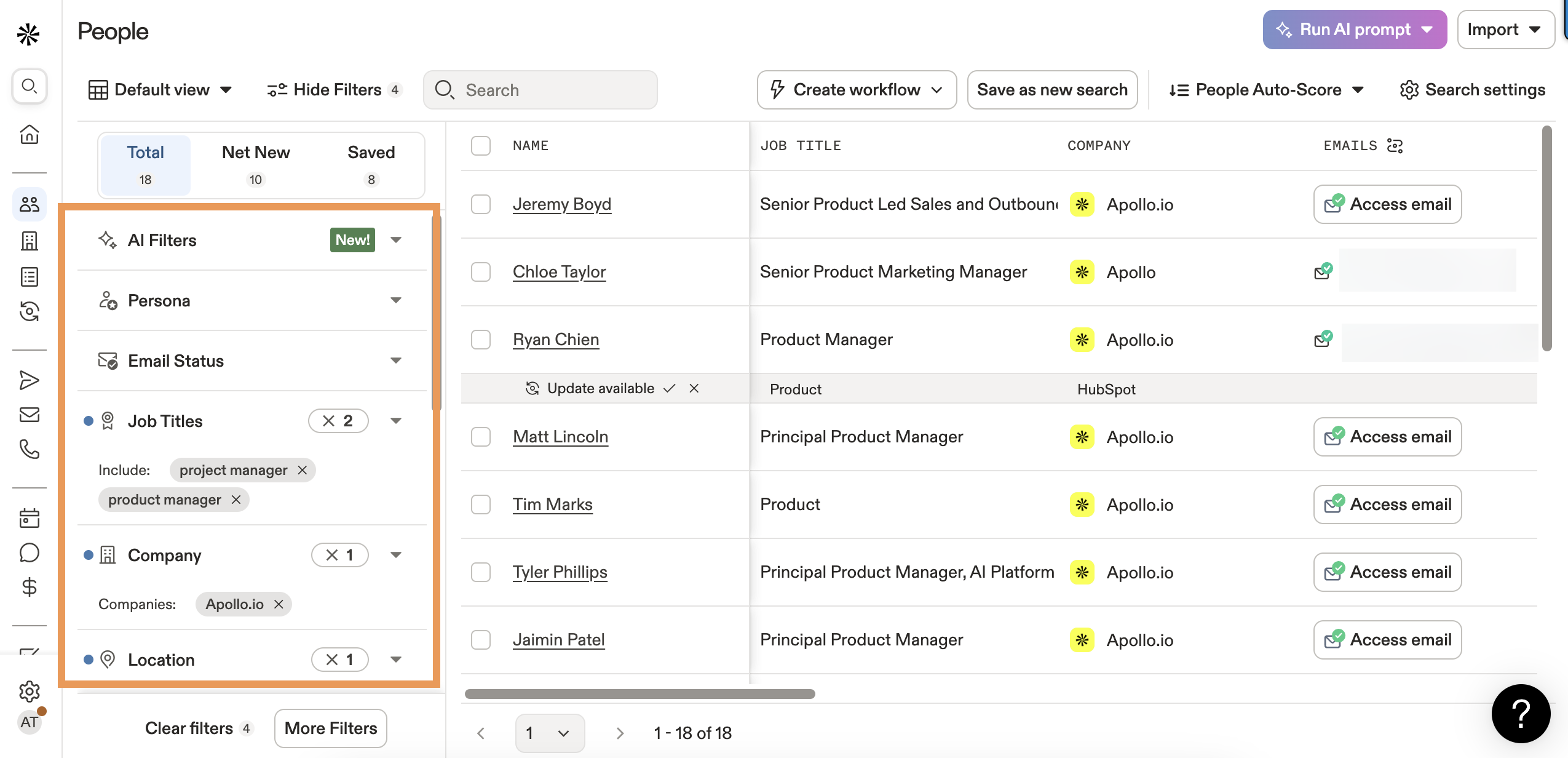
One practical limitation: search results cap at 100 pages. If your query returns more than that, you'll need to narrow your filters. That's actually good discipline for list building, but it catches people off guard.
Accuracy - What Tests Actually Show
Here's where it gets complicated.
Apollo runs a 7-step email verification process, triggers real-time refresh when it detects signals like job changes, and performs monthly checks on the database. On paper, that sounds thorough. In practice, the numbers tell a messier story.
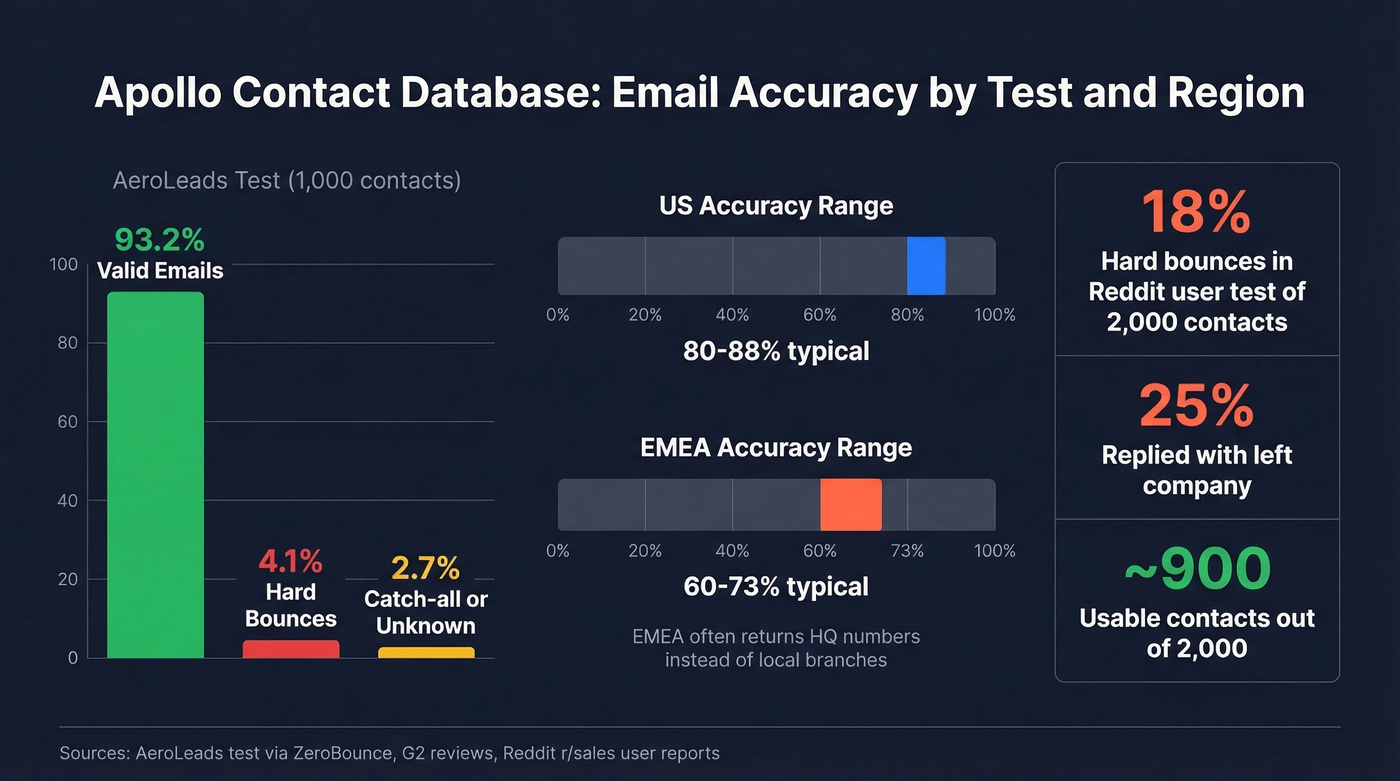
An AeroLeads test of 1,000 contacts - VPs of Sales, US SaaS, 50-200 employees - verified through ZeroBounce found 93.2% valid emails, 4.1% invalid/hard bounces, and 2.7% catch-all unknowns. Decent. But "valid" just means the mailbox exists. It doesn't mean the person still works there or holds that title. Other reviews peg overall accuracy as low as 65%, suggesting results vary dramatically by targeting precision and how stale the segment is.
G2 reviews paint a broader picture. Apollo holds a strong 4.7/5 from 9,510 reviews, but dig into the tags: 503 reviews flag "Inaccurate Data" and 458 flag "Data Inaccuracy." That's not a rounding error.
Reddit's even blunter. One user tested 2,000 contacts and reported 18% hard bounces with another 25% replying "left company" - leaving just 900 usable contacts out of 2,000. Another thread reported 80-90% of Apollo-sourced profiles looked abandoned or had no profile picture. The regional split matters too: US accuracy tends to land around 80-88%, but outside the US it can drop to 60-73%. EMEA is particularly weak, with reviews commonly noting Apollo returns headquarters numbers instead of local branch numbers for European contacts, making the data functionally useless for regional outreach.
Phone Data Isn't Much Better
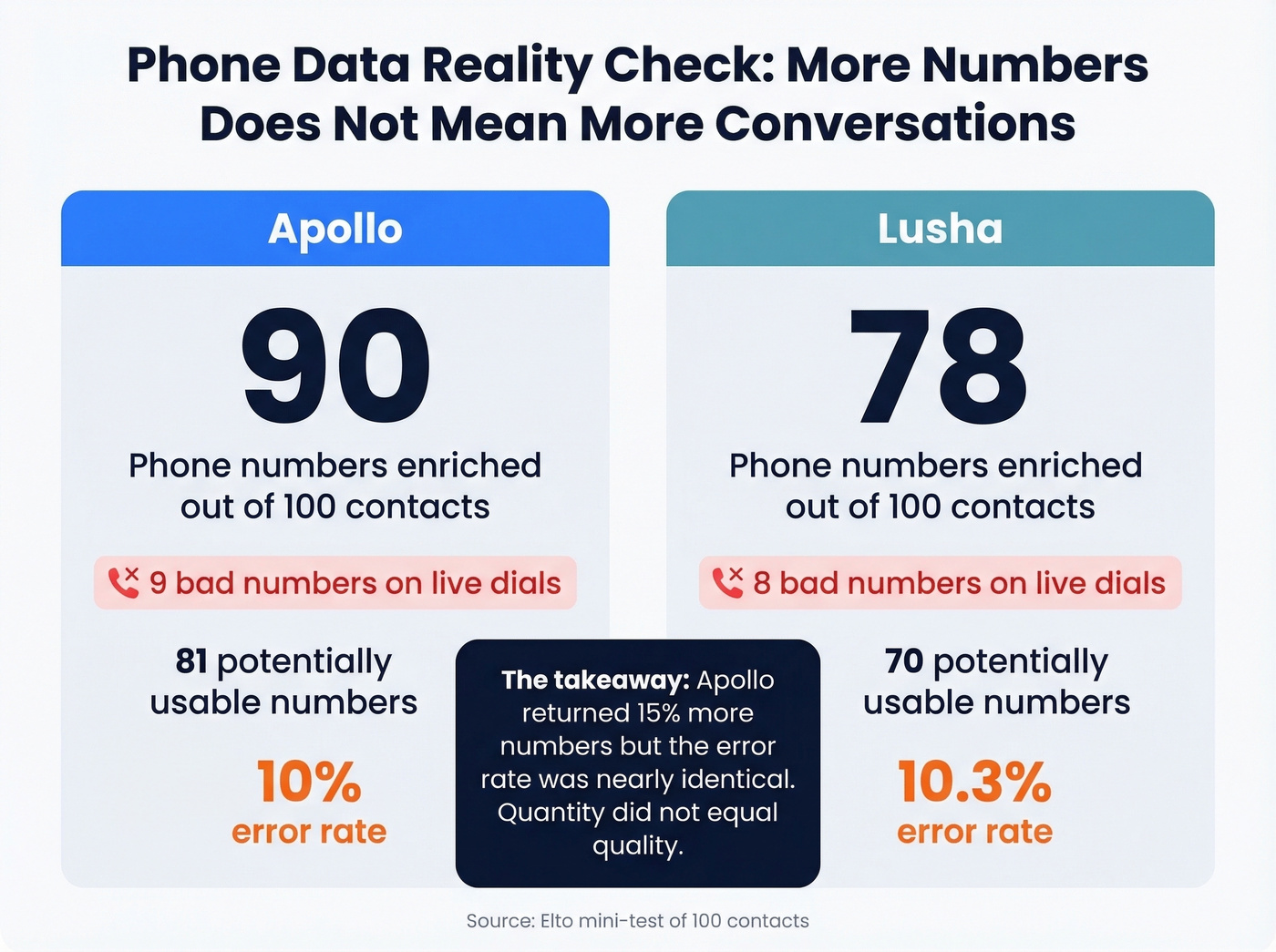
An Elto mini-test of 100 contacts found Apollo enriched 90 phone numbers versus Lusha's 78. Sounds like Apollo wins - until you actually cold-call those numbers. Nine of Apollo's 90 were bad data on live dials, roughly matching Lusha's error rate of 8 bad numbers out of 78. More numbers doesn't mean more conversations.
If you're trying to make those dials count, the gap is usually less about volume and more about phone sales skills and list hygiene.
Then there's the burned database problem. Because Apollo's free tier is so generous, the same contacts get hammered by thousands of users running identical searches. Response rates crater not because the data's wrong, but because the prospect got their fifteenth cold email this week from an Apollo list. The consensus on r/sales is pretty clear: Apollo data is "good enough to start, not good enough to scale."

Here's the thing: Apollo is still the best free prospecting tool on the market. But "best free tool" and "best tool" are very different claims. We've seen teams cut their bounce rates in half just by adding a verification step after Apollo export - which tells you everything about where the data actually stands. (If you want a deeper breakdown of tools, see our best B2B databases ranking.)

Tired of cleaning Apollo exports just to hit sub-5% bounce rates? Prospeo's 5-step verification delivers 98% email accuracy out of the box - no post-export scrubbing needed. 300M+ profiles refreshed every 7 days, not monthly.
Stop paying for contacts that bounce. Start with 75 free verified emails.
Pricing and Credit Gotchas
Apollo's pricing looks straightforward until you hit the credit system.
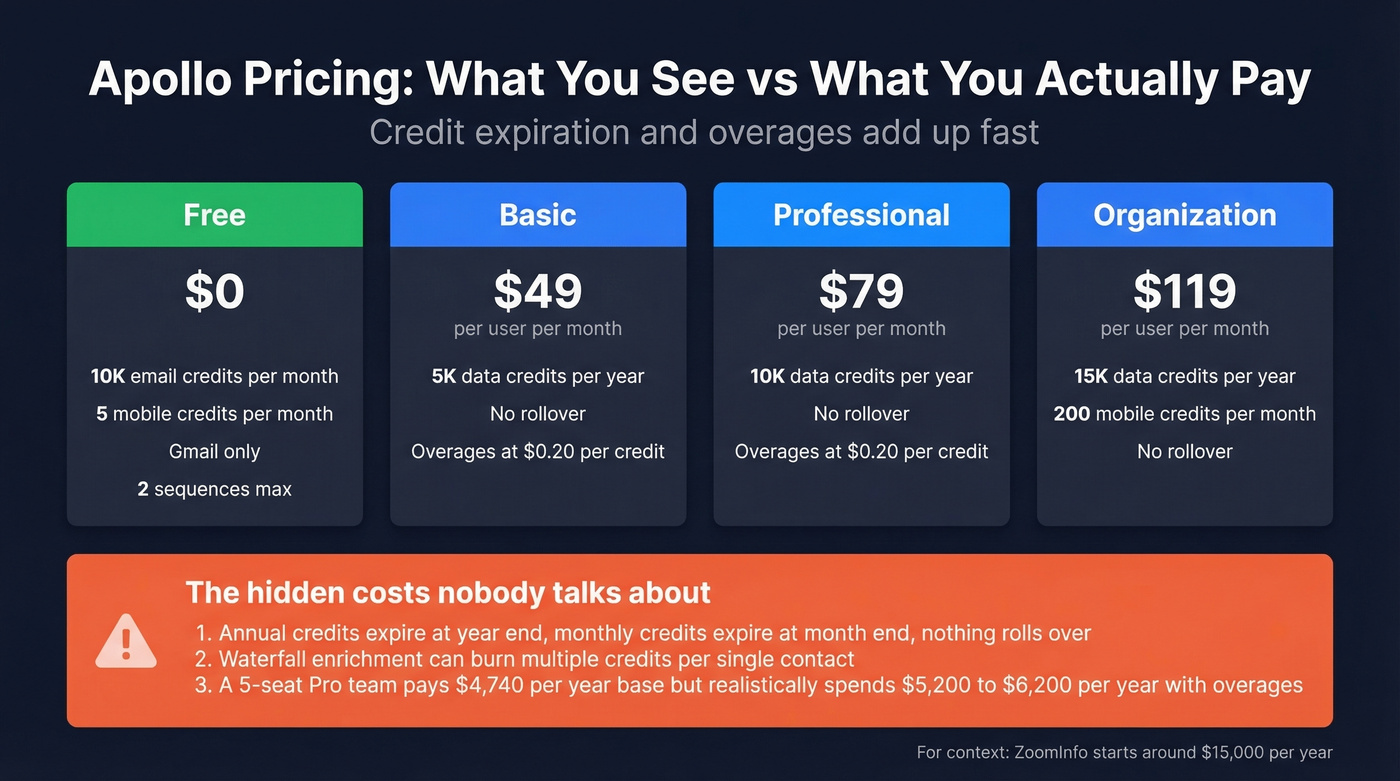
| Plan | Price (annual) | Key Credits | Notes |
|---|---|---|---|
| Free | $0 | 10K email/mo, 5 mobile/mo | Gmail only, 2 sequences |
| Basic | $49/user/mo | 5K data credits/yr | No rollover |
| Professional | $79/user/mo | 10K data credits/yr | No rollover |
| Organization | $119/user/mo | 15K data credits/yr, 200 mobile/mo | No rollover |
The gotcha is credit expiration. Annual credits expire at year-end, monthly credits at month-end - nothing rolls over. Overages cost $0.20/credit with a 250-credit minimum purchase. Credit consumption also varies by action: enrichment, exports, and AI features all burn credits at different rates, and waterfall enrichment can consume multiple credits per contact if the first source fails.
A 5-seat Professional team pays roughly $4,740/year base, but once you factor in overage packs for mobile reveals and extra exports, realistic spend lands at $5,200-6,200/year. Apollo consolidated its credit system in late 2025, and legacy accounts may see different limits than new signups.
For comparison, ZoomInfo typically starts around $15,000/year for entry packages. Apollo is dramatically cheaper. But "cheaper than ZoomInfo" is a low bar - and neither solves the accuracy problem on its own.
When Apollo Falls Short - and What to Use Instead
In our testing, Apollo's US data held up reasonably well for email-only outreach, but EMEA lists needed heavy cleaning and mobile numbers were a coin flip. If deliverability matters more than workflow convenience, the accuracy gap becomes a real problem. (This is also where data enrichment and verification workflows matter most.)
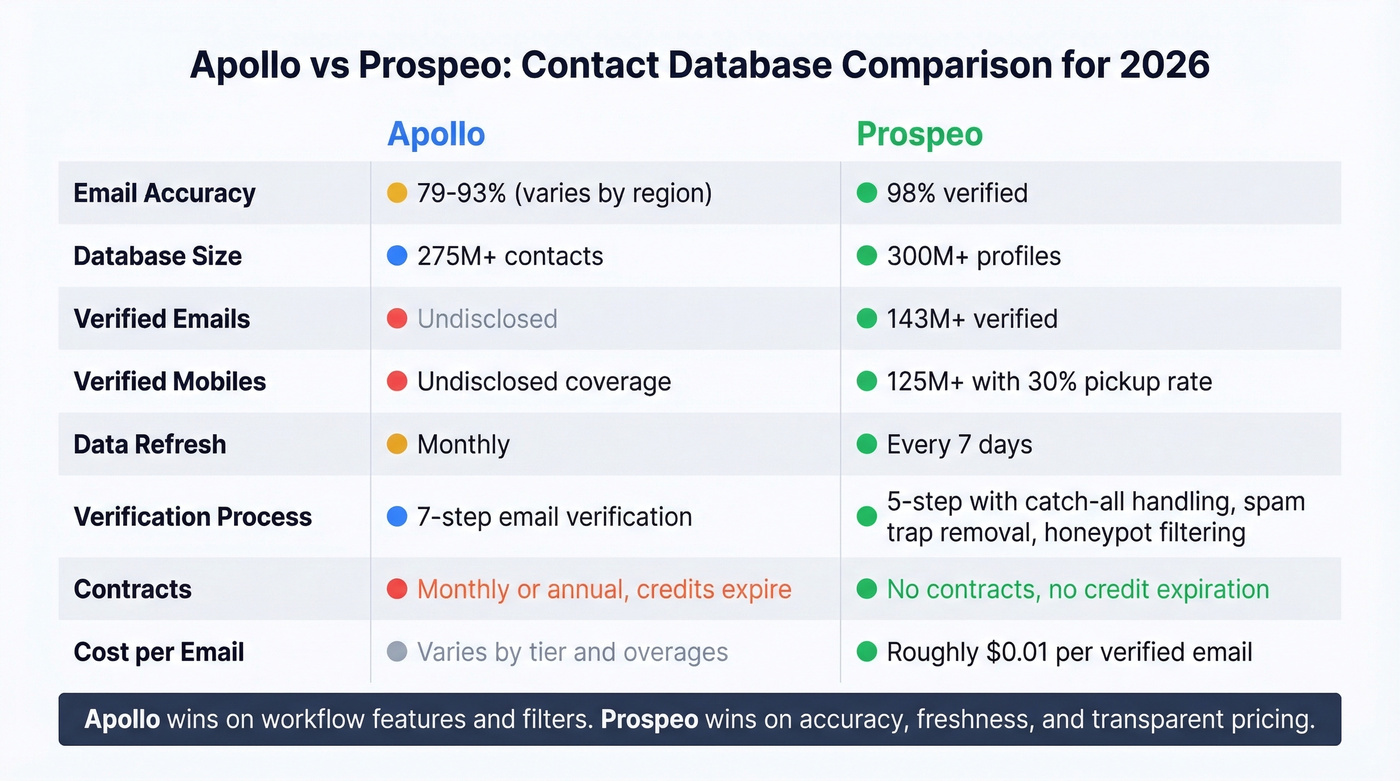
Prospeo addresses the two biggest complaints about the Apollo contact database - accuracy gaps and the burned-list problem - by building verification and freshness into the infrastructure rather than bolting it on after export. It covers 300M+ professional profiles with 98% email accuracy, backed by a proprietary 5-step verification process that includes catch-all handling, spam-trap removal, and honeypot filtering. The platform includes 143M+ verified emails and 125M+ verified mobile numbers with a 30% pickup rate, which dwarfs Apollo's undisclosed mobile coverage.
| Data refresh | Monthly | Every 7 days | Prospeo |
| Free tier | 10K emails/mo, 5 mobile | 75 emails + 100 Chrome extension credits/mo | Apollo |
| Contracts | Monthly/annual | No contracts | Prospeo |
| Intent data | Basic signals | 15K topics (Bombora) | Prospeo |
| Filters and workflow | 200+ filters, sequences, dialer | 30+ filters, Chrome extension | Apollo |
Pricing starts at roughly $0.01 per email with no annual contracts and no credit expiration games. The free tier gives you 75 emails and 100 Chrome extension credits per month - enough to test before committing anything.
Skip Apollo's higher tiers if your main pain point is data quality rather than sequencing. You'll spend less and bounce less. If you're building lists at scale, use a repeatable cold email lead list building process and track check bounce rates by segment.
Apollo's mobile numbers are a coin flip. Prospeo gives you 125M+ verified mobiles with a 30% pickup rate - nearly 3x what competitors deliver. No credit expiration, no annual contracts, roughly $0.01 per email.
Replace Apollo's guesswork with data that actually connects you to buyers.
FAQ
How big is Apollo's contact database?
Apollo covers 275M+ contacts across 60M companies, sourced from a 2M+ contributor network, public web crawling, and third-party providers processing 200M+ records monthly. Size is impressive, but independent tests show email accuracy ranges from 79-93% depending on region and segment.
Does the free plan access the full database?
Yes. Free users search the full 275M+ contact pool with 10,000 email credits and 5 mobile credits per month. Filters, sequence limits, and integrations are restricted compared to paid tiers, but the underlying data is identical.
What's a more accurate alternative to Apollo for contact data?
Prospeo offers 98% email accuracy with a 7-day refresh cycle across 300M+ profiles - no contracts, starting at roughly $0.01 per verified email. It's the strongest option for teams where deliverability and data freshness outweigh all-in-one workflow features. The free tier includes 75 emails and 100 Chrome extension credits monthly.