

Apollo Email Finder Extension: What 900K Users Won't Tell You
You pulled 200 contacts from Apollo last Tuesday, loaded them into your sequence, and woke up to a 23% bounce rate. Your domain reputation just took a hit. Now you're wondering if the Apollo email finder extension that 900K people installed is actually any good - or just popular.
Apollo's Chrome extension surfaces email addresses and phone numbers while you browse. Hover over a prospect on a company website, a professional profile, or inside your CRM, and it pulls contact data from Apollo's 270M+ contact database. It works in Gmail too, adding tracking and enrichment to your inbox. The install base is massive - north of 900K users in the Chrome Web Store.
That popularity is also its biggest problem.
What You Need (Quick Version)
Just want to install it? Head to the Chrome Web Store, search "Apollo.io," click Add to Chrome. Takes 30 seconds.
Want to know if it's worth relying on? Keep reading. The accuracy gaps, credit games, and the LinkedIn situation matter more than the feature list.
How to Install It
- Open the Chrome Web Store and search "Apollo.io"
- Click Add to Chrome then Add Extension
- Pin it to your toolbar by clicking the puzzle icon and pinning Apollo
- Log in with your Apollo account or create one - the free tier works
- Start browsing - the extension icon lights up when it detects contact data
It works on Microsoft Edge too, since Edge runs Chromium under the hood.
Sign up with your corporate email address, not a personal Gmail. Apollo gates free-tier credits based on whether you're using a verified company domain. That difference can mean 100x more credits.
What "Free" Really Means
Apollo markets "unlimited email credits" on the free plan. That's technically true and practically misleading.
If you're comparing other freemium options, start with these free lead generation tools before you commit to a workflow.
| Plan | Price | Email Credits | Mobile Credits | Export Credits |
|---|---|---|---|---|
| Free | $0 | "Unlimited" (capped*) | 5/mo | 10/mo |
| Basic | $59/mo - $49 annual | Unlimited | 75/mo | 1,000/mo |
| Professional | $99/mo - $79 annual | Unlimited | 125/mo | 2,000/mo |
| Organization | $149/mo - $119 annual | Unlimited | 200/mo | 4,000/mo |
*That asterisk is doing a lot of work.
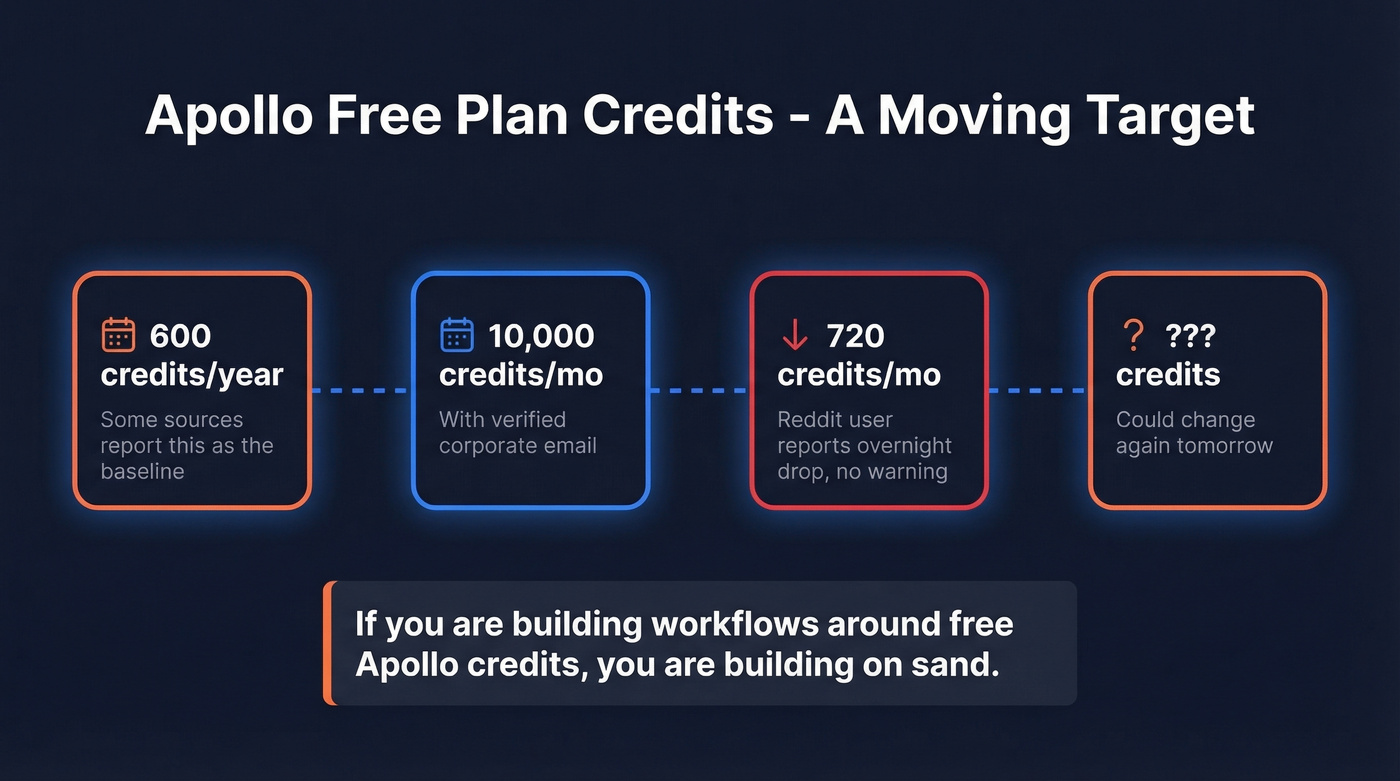
With a verified corporate email, the free plan caps you at roughly 10,000 email credits per month. Without one, you're looking at 100. That's the difference between a useful prospecting tool and a toy.
And those numbers aren't stable. One Reddit user on r/LeadGeneration reported their monthly allotment dropping from 10,000 to 720 credits overnight - no warning, no explanation. Other sources list the free plan at 600 email credits per year. Still others say 10,000/month with a corporate email.
Why do the numbers conflict? Because Apollo changes them. The free tier is a moving target, and the company doesn't publish a clear, stable credit policy. If you're building a workflow around free Apollo credits, you're building on sand.
For paid plans, Basic at $49/user/month (annual) gets you unlimited email credits with 75 mobile credits. Reasonable for a single SDR. But once you need mobile numbers at scale, you're looking at Professional or Organization - and the annual cost for a small team starts competing with tools that deliver better data.
If you're evaluating vendors beyond Apollo, this roundup of data enrichment services can help you benchmark what “good” looks like.
How Accurate Is Apollo's Data?
Here's the thing: "unlimited email credits" doesn't matter if 20-30% of those emails bounce.
If you want the benchmarks and fixes behind that number, see our guide on email bounce rate.
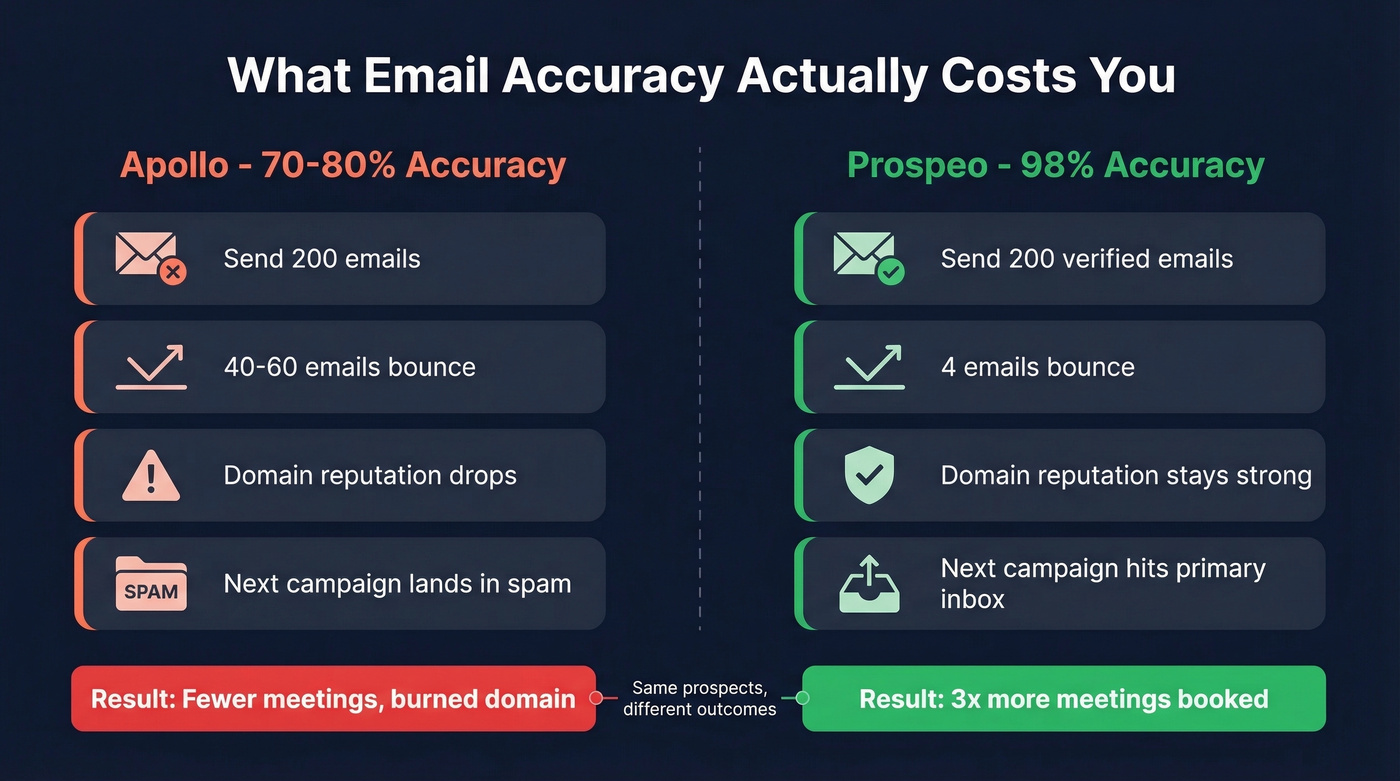
Across practitioner write-ups and Reddit threads, Apollo's real-world email accuracy lands around 70-80%. Even emails marked "verified" can still bounce. That label doesn't guarantee real-time deliverability testing, which is why serious outbound teams run Apollo exports through a dedicated AI email checker before sending.
Apollo sequences can pause emails flagged "Likely to Bounce." But that's not the same as verifying deliverability before you ever export and send. By the time you've exported 200 contacts and loaded them into Instantly or Smartlead, the damage is baked in. You send, they bounce, your domain reputation drops, and your next campaign performs worse even with clean data.

We've seen this pattern play out dozens of times with teams that come to us after burning a domain. The gap between 70% and 98% accuracy isn't a rounding error - it's the difference between a campaign that books meetings and one that lands in spam.
If you’re trying to fix deliverability at the root, use this email deliverability guide to tighten the whole system.

You just read that Apollo's real-world accuracy sits around 70-80%. Prospeo's 5-step verification delivers 98% email accuracy - with catch-all handling, spam-trap removal, and honeypot filtering built in. No more running exports through a separate verification tool. Every email you pull is already verified.
Stop paying for bounces. Pay $0.01 per verified email instead.
The LinkedIn Situation
On March 6, 2025, Apollo.io and Seamless.ai disappeared from LinkedIn. Their company pages were removed - not hidden, not restricted, removed. LinkedIn's Terms of Service prohibit third-party scraping tools, and the platform finally enforced it.
Apollo CEO Tim Zheng responded publicly, stating the company was "actively working with LinkedIn" to resolve the situation. By late April 2025, Apollo had redesigned its website and quietly removed all messaging about LinkedIn prospecting. As of mid-2025, Apollo no longer appeared in LinkedIn search results.
The extension still functions. But the relationship is clearly strained, and further restrictions aren't off the table.
The Burned Database Problem
Here's a problem nobody at Apollo wants to talk about: 900K+ extension users are pulling from the same contact pool.
If you’re shopping around, compare options in our guide to the best sales prospecting databases.
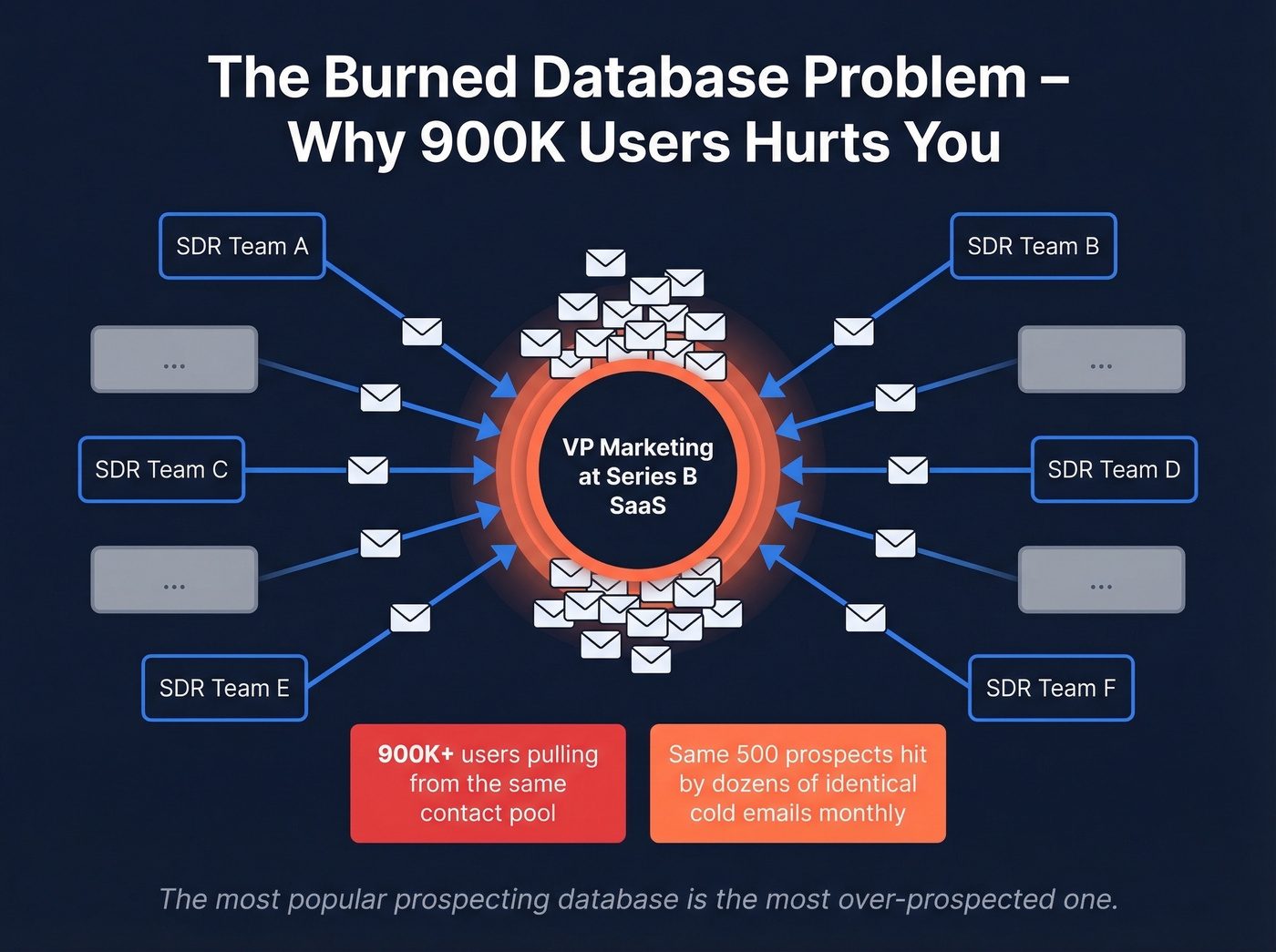
Your SDR team builds an ICP list of VP-level marketing leaders at Series B SaaS companies. So does every other team running outbound in your space. The same 500 prospects get hit by dozens of nearly identical cold emails every month, response rates crater, and prospects stop opening anything that smells like a sequence. The consensus on r/coldemail is blunt: Apollo's database is "burned."
That's not a data quality problem - it's a market saturation problem. And it matters more than any feature comparison. The most popular prospecting database is, by definition, the most over-prospected one. If everyone fishes the same pond, the fish stop biting.
Extension Not Working? Fix It
When Apollo's extension breaks, it's usually one of four things: your Chrome environment, website code changes, Apollo's servers, or a CRM API issue.
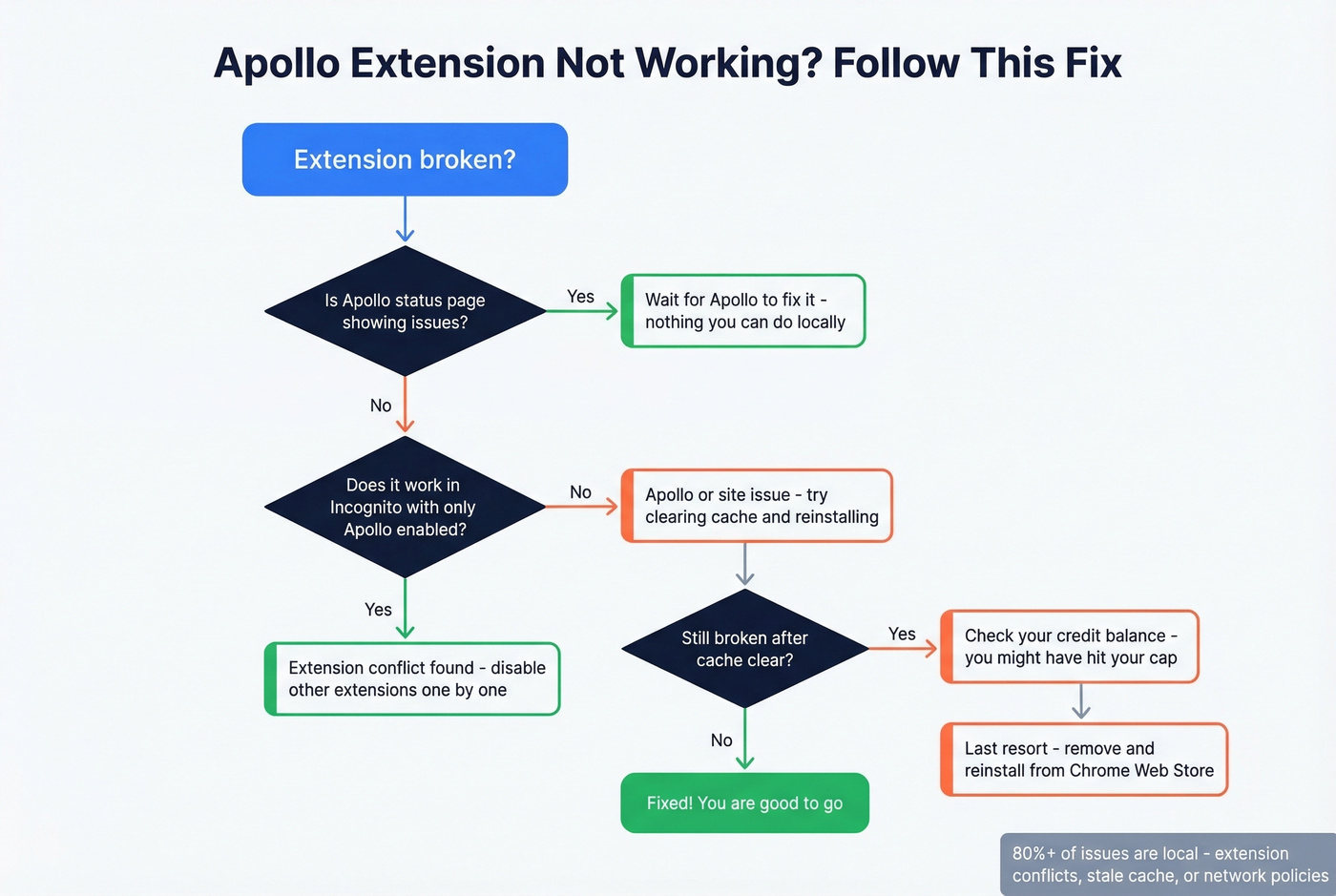
Check Apollo's status page first. If their servers are down, nothing you do locally will help.
Run the incognito isolation test. Open an incognito window, enable only the Apollo extension, and try again. If it works there but not in your normal browser, you've got an extension conflict. Disable other extensions one by one until you find the culprit.
Clear cache and update. Chrome caches extension data aggressively. Clear your browser cache, then check for updates at chrome://extensions by toggling Developer Mode and clicking Update.
Check your credit balance. Sometimes the extension appears broken when you've actually just hit your credit cap. The UI doesn't always make this obvious.
Reinstall as a last resort. Remove the extension completely and reinstall from the Chrome Web Store.
Over 80% of persistent individual issues stem from local environmental factors - extension conflicts, stale caches, or corporate network policies blocking Apollo's API calls.
Best Alternatives to Apollo's Extension
If Apollo's accuracy or the burned database problem is costing you meetings, here's what's worth testing.
If you want a broader shortlist, see our ranked list of SDR tools for 2026.
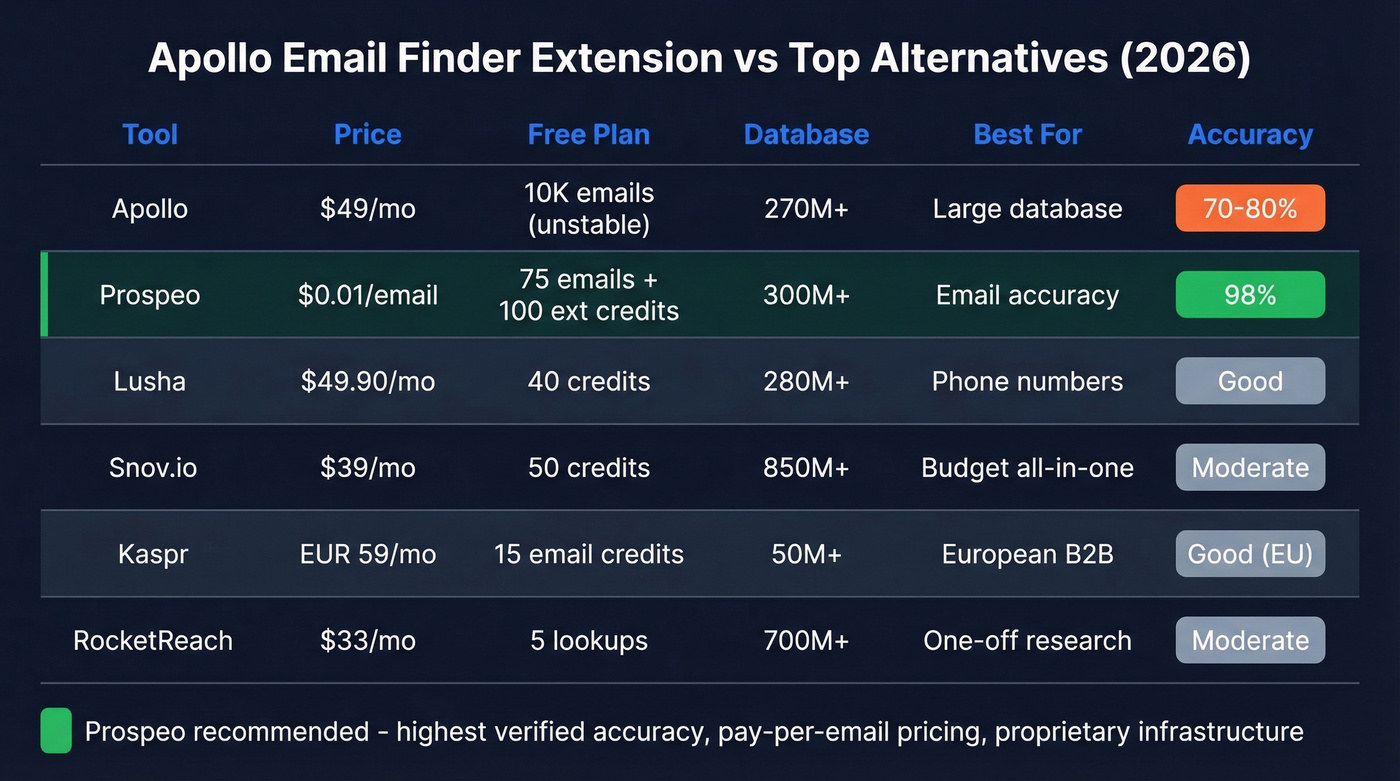
| Tool | Starting Price | Free Plan | Database Size | Best For |
|---|---|---|---|---|
| Prospeo | ~$0.01/email | 75 emails + 100 ext. credits/mo | 300M+ profiles | Email accuracy |
| Lusha | $49.90/mo | 40 credits/mo | 280M+ contacts | Phone numbers |
| Snov.io | $39/mo | 50 credits/mo | 850M+ emails | Budget all-in-one |
| Kaspr | EUR 59/mo | 15 email credits/mo | 50M+ profiles | European B2B data |
| RocketReach | $33/mo | 5 lookups/mo | 700M+ profiles | One-off lookups |
Prospeo - Best for Email Accuracy
We've run side-by-side campaigns with Apollo and Prospeo data. The difference isn't subtle. One of our customers, Meritt, saw bounce rates drop from 35% to under 4% and their connect rate triple to 20-25% after switching. That kind of improvement comes from Prospeo's proprietary 5-step verification process running on a 7-day refresh cycle - compared to the 6-week industry average.

The Chrome extension (40K+ users) surfaces 50+ data points per contact in one click. The free tier gives you 75 verified emails plus 100 Chrome extension credits per month. Paid plans start at roughly $0.01 per email - no contracts, no sales calls required. And because Prospeo uses proprietary email-finding infrastructure rather than relying on third-party providers, you're not pulling from the same burned pool everyone else uses.
If you’re building repeatable outbound, pair clean data with a strong B2B cold email sequence.
Lusha - Best for Quick Phone Numbers
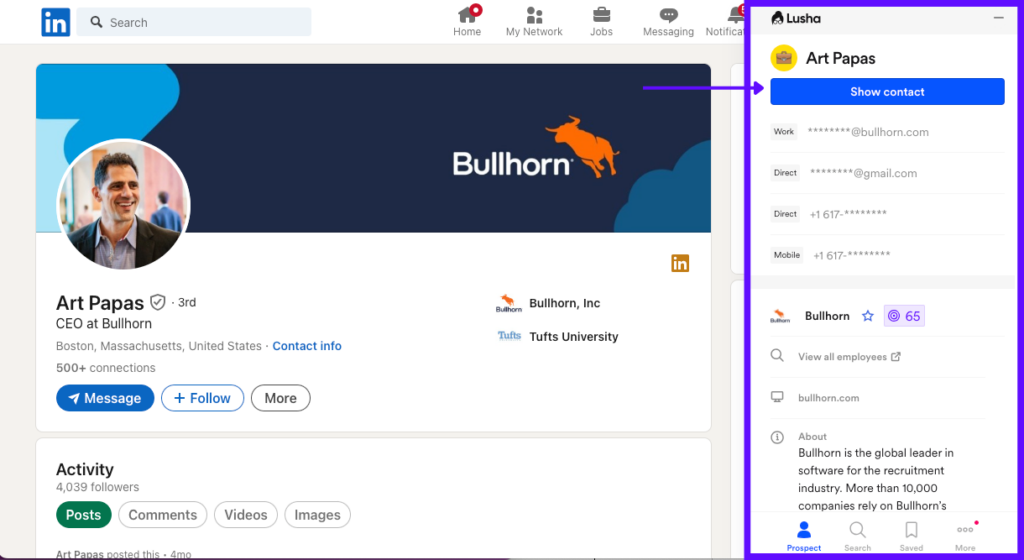
Picture this: your rep has 30 minutes before a prospect's calendar opens up, and they need a direct dial now. That's Lusha's sweet spot. The 280M+ contact database skews heavily toward North America and Europe, and the phone data quality is genuinely strong. Free plan gives you 40 credits per month; paid starts at $49.90/month.
Snov.io - Best Budget All-in-One
For solo founders who want one tool for finding emails, warming up a domain, and running drip campaigns, Snov.io is a solid answer. Starting at $39/month with 850M+ emails in the database, it punches above its weight on features. The tradeoff is email accuracy - I'd use Snov.io for discovery and run the results through a dedicated verification tool before sending at scale.
Kaspr - Best for European B2B Data
Skip this if you're selling into North America. Kaspr's 50M+ profile database is smaller than the competition, but European B2B data quality is high and GDPR compliance is baked in. Starts at EUR 59/month. The free plan at 15 email credits per month barely lets you test it, but for teams selling exclusively into EMEA, it's worth a look.
RocketReach - One-Off Research Only
Large database at 700M+ profiles and the cheapest entry at $33/month. The free plan is nearly useless at 5 lookups per month. Good for when you need a specific person's contact info and don't mind paying per lookup. Not built for bulk prospecting - the credit economics don't scale.
For enterprise teams with $15K+ budgets who need intent data bundled with contacts, ZoomInfo is the legacy option.
Should You Use Apollo's Extension?
Use Apollo if you're already deep in Apollo's ecosystem - running sequences, managing deals in their CRM, and doing casual lookups where a 20-30% bounce rate won't kill you. The extension is convenient, the free tier is functional, and the platform integration is tight.
If you’re scaling outreach, it helps to standardize sales prospecting techniques so reps don’t default to the same lists.
Switch if email accuracy and deliverability aren't negotiable. That means outbound at scale, agency work across multiple client domains, or any situation where bounces directly damage your sender reputation. The Apollo email finder extension works fine for casual research, but it's not built for high-volume campaigns where every bounce compounds.
Go enterprise if you need intent data, org charts, and workflow automation bundled into one contract and have the budget to match. ZoomInfo starts at ~$15K/year. But let's be honest - check the math on newer alternatives before signing that deal. The market has shifted.
900K users pulling from the same burned database means your prospects have seen it all before. Prospeo's 300M+ profiles refresh every 7 days - not every 6 weeks - so you reach real buyers with fresh data your competitors haven't already hammered. Teams using Prospeo book 35% more meetings than Apollo users.
Fish a different pond. One where the data is fresh and the prospects still answer.
FAQ
Is the Apollo Chrome extension free?
Yes, but "unlimited email credits" caps at roughly 10,000/month with a corporate email and just 100 without one. These limits change without notice - one user reported a drop from 10,000 to 720 overnight. Don't build a workflow around free-tier stability.
Does Apollo's extension still work on LinkedIn?
The extension still functions, but Apollo's company page was removed from LinkedIn in March 2025. The relationship is strained, and further restrictions are possible. Monitor Apollo's changelog for updates.
Why are my Apollo emails bouncing?
Apollo's real-world accuracy sits around 70-80%. Even "verified" contacts can bounce because the label doesn't guarantee real-time deliverability testing. Always run exports through a dedicated verification tool before they hit your sequence.
What's the most accurate alternative to Apollo's email finder?
Prospeo delivers 98% accuracy with a proprietary 5-step verification process and a 7-day data refresh cycle. The free tier includes 75 verified emails plus 100 Chrome extension credits per month - enough to run a real test before committing.
Can I use Apollo's extension on Microsoft Edge?
Yes. Edge supports Chrome extensions natively through its Chromium base. Install directly from the Chrome Web Store - the process is identical to Chrome, no separate download needed.