

Apollo Sales Intelligence Review: Data, Pricing & Limits (2026)
You send your first sequence to 1,000 "verified" contacts and 40 emails bounce before lunch. Your domain reputation tanks, and you haven't booked a single meeting.
That's what happens when you trust Apollo sales intelligence without understanding its actual data quality. We ran the numbers so you don't have to learn the hard way.
30-Second Verdict
Apollo is the best all-in-one value play for startups spending under $5K/year on data. Its 275M+ contact database, built-in sequences, and dialer make it genuinely useful out of the box. Independent testing shows 93.2% email accuracy - solid, but not great. Credits expire every billing cycle, regional data outside the US is weaker, and you'll need external verification for high-stakes campaigns.
What Apollo Actually Offers
Apollo positions itself as an all-in-one GTM platform, not just a database. The core is a 275M+ contact database spanning 70M+ companies, searchable through 65+ data points covering industry, headcount, tech stack, and funding stage. But the real draw for lean teams is everything bolted around that database: email sequences, a dialer, task management, and native CRM integrations with Salesforce and HubSpot.
For a startup SDR who'd otherwise stitch together four separate tools, Apollo collapses the stack into one login. That explains why Apollo skews heavily toward the small-business segment on G2 - 6,307 of its 9,477 reviews come from small businesses, with another 2,657 from mid-market. Enterprise teams tend to outgrow it fast.
Data Quality: Independent Tests
Email Accuracy (1,000-Contact Test)
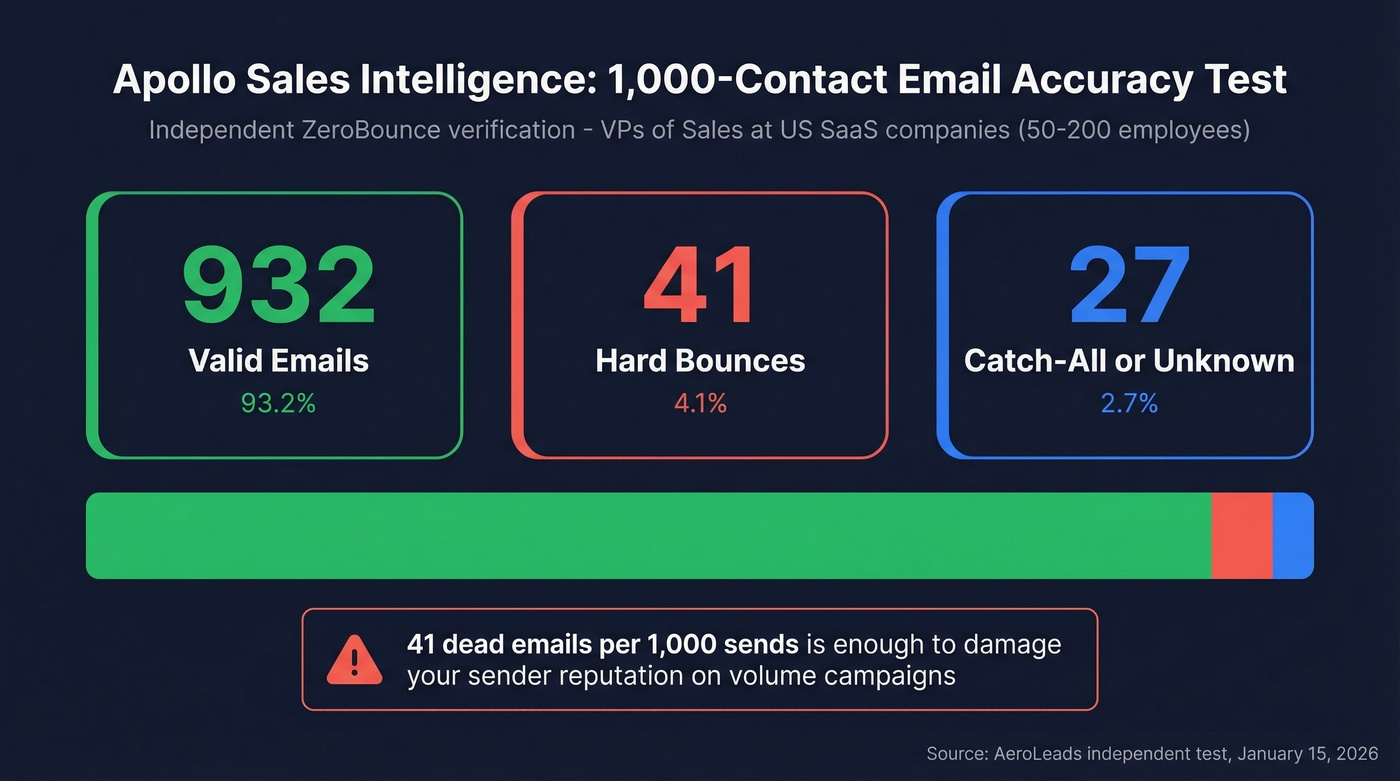
An independent test pulled 1,000 contacts on January 15, 2026 - VPs of Sales at US SaaS companies with 50-200 employees - and ran every email through ZeroBounce. Results: 932 valid (93.2%), 41 hard bounces (4.1%), 27 catch-all/unknown (2.7%). Respectable at this price point, but 41 dead emails per thousand is enough to damage sender reputation on volume campaigns.
Phone Coverage and Data Freshness
A separate 100-contact test found Apollo enriched 90 of 100 phone numbers versus Lusha's 78 (starting at $49/user/month). After cold-calling, 9 of Apollo's 90 were bad - Lusha had 8 bad numbers out of 78, a similar error rate percentage-wise.
The deeper problem is decay. Work emails have a useful half-life of 24-36 months, direct phones 18-24 months, and job titles just 12-18 months before someone's moved on. One Reddit user reported reaching contacts who'd already left their roles - a classic stale-data signal. Apollo doesn't publish its refresh cycle, which makes it impossible to know how current any given record is.
Pricing & Credit System
Apollo runs a hybrid model: per-user subscription plus usage-based credits that expire every billing cycle.
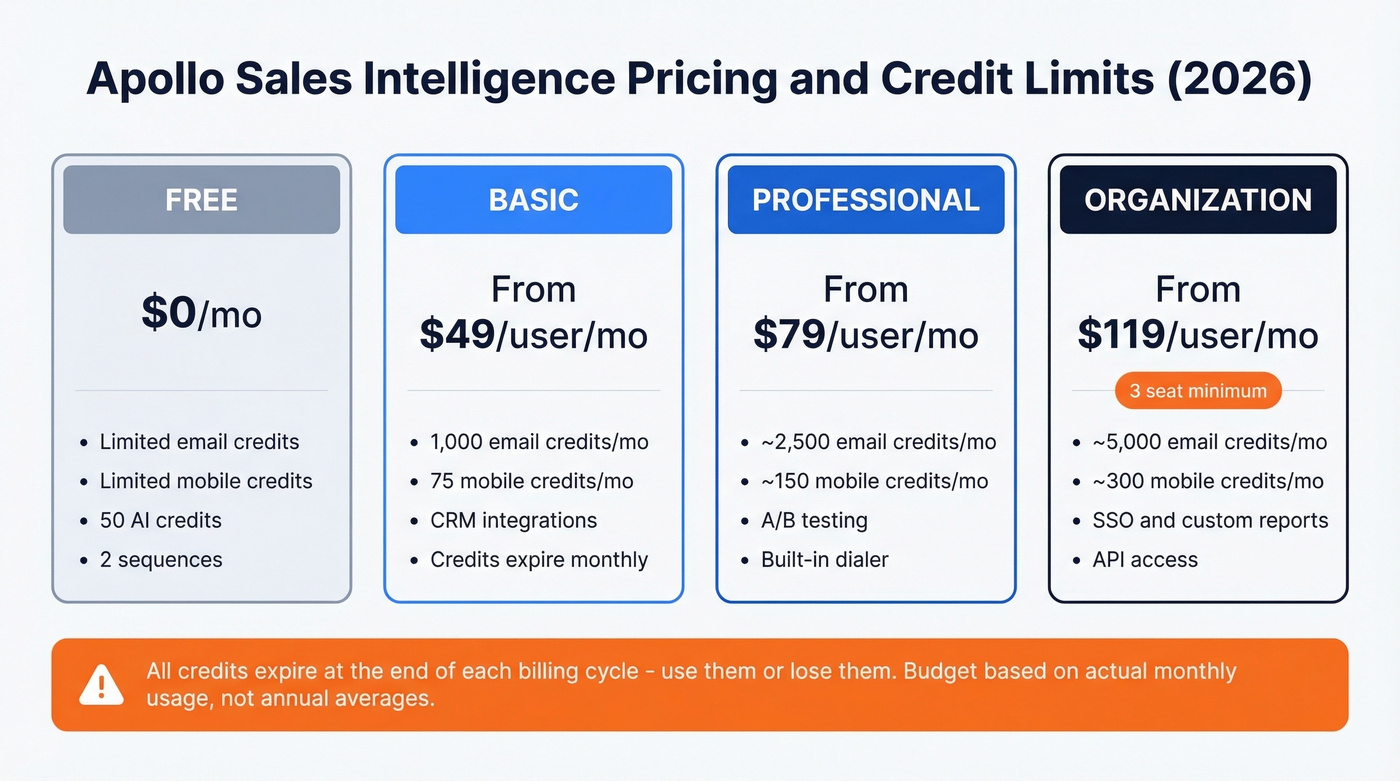
| Plan | Price/mo | Email Credits | Mobile Credits | Key Features |
|---|---|---|---|---|
| Free | $0 | Limited | Limited | 50 AI credits, 2 sequences |
| Basic | from $49/user | 1,000 | 75 | CRM integrations |
| Professional | from $79/user | ~2,500 | ~150 | A/B testing, dialer |
| Organization | from $119/user (min 3) | ~5,000 | ~300 | SSO, custom reports, API |
Need credits a la carte? Apollo's lowest-volume pack runs about 50 credits for $10.
Here's the thing about the credit expiry model: it's designed to create urgency, not value. You either use them or lose them, which pushes reps to burn credits on marginal leads just to avoid waste. We've seen teams where two reps targeting different ICPs burn credits at wildly different rates through Apollo's waterfall enrichment - makes budgeting a nightmare.

Apollo's credit-expiry model pushes you to burn credits on marginal leads. Prospeo charges ~$0.01/email with 98% accuracy, refreshes data every 7 days (not on an undisclosed cycle), and never expires your credits. Teams using Prospeo book 35% more meetings than Apollo users.
Stop losing credits and domain reputation to stale data.
What 9,477 Reviews Reveal
Apollo carries a 4.7/5 rating across 9,477 G2 reviews, with 87% giving five stars. Impressive on the surface. But the complaint themes tell a more nuanced story: 961 reviews flag data accuracy across two related categories, making it the single largest complaint. Another 597 mention missing features, 474 cite a learning curve, and 454 flag limited functionality.
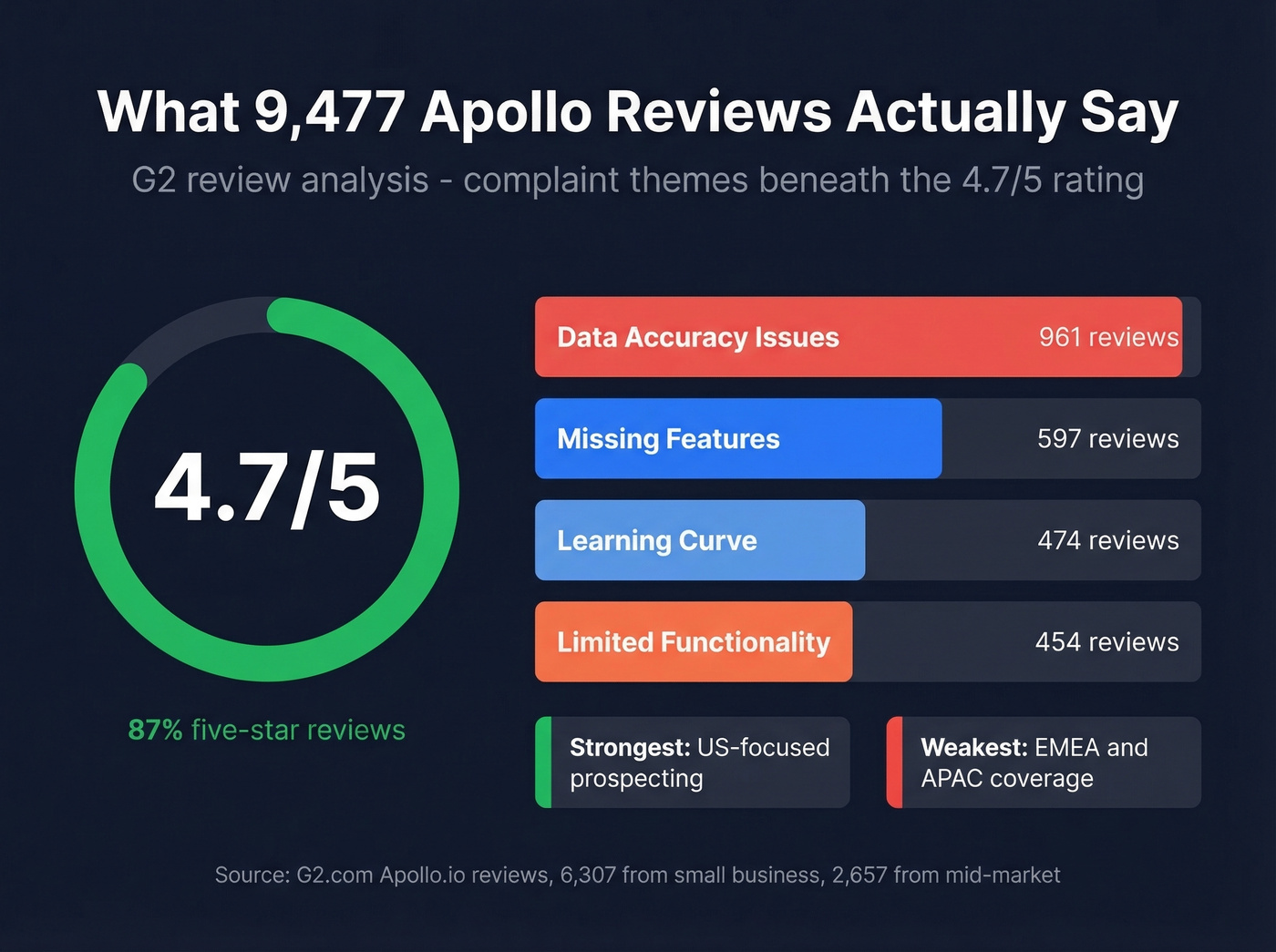
Apollo's own review summary acknowledges accuracy "can vary, especially for certain regions." US-focused prospecting is where it's strongest; coverage thins out noticeably in EMEA and APAC.
Where Apollo Falls Short
Let's be honest: Apollo is a workflow platform with a database bolted on. That's fine - most teams running deals under $15K don't need ZoomInfo-level data. But you should know exactly where the bolts are loose.
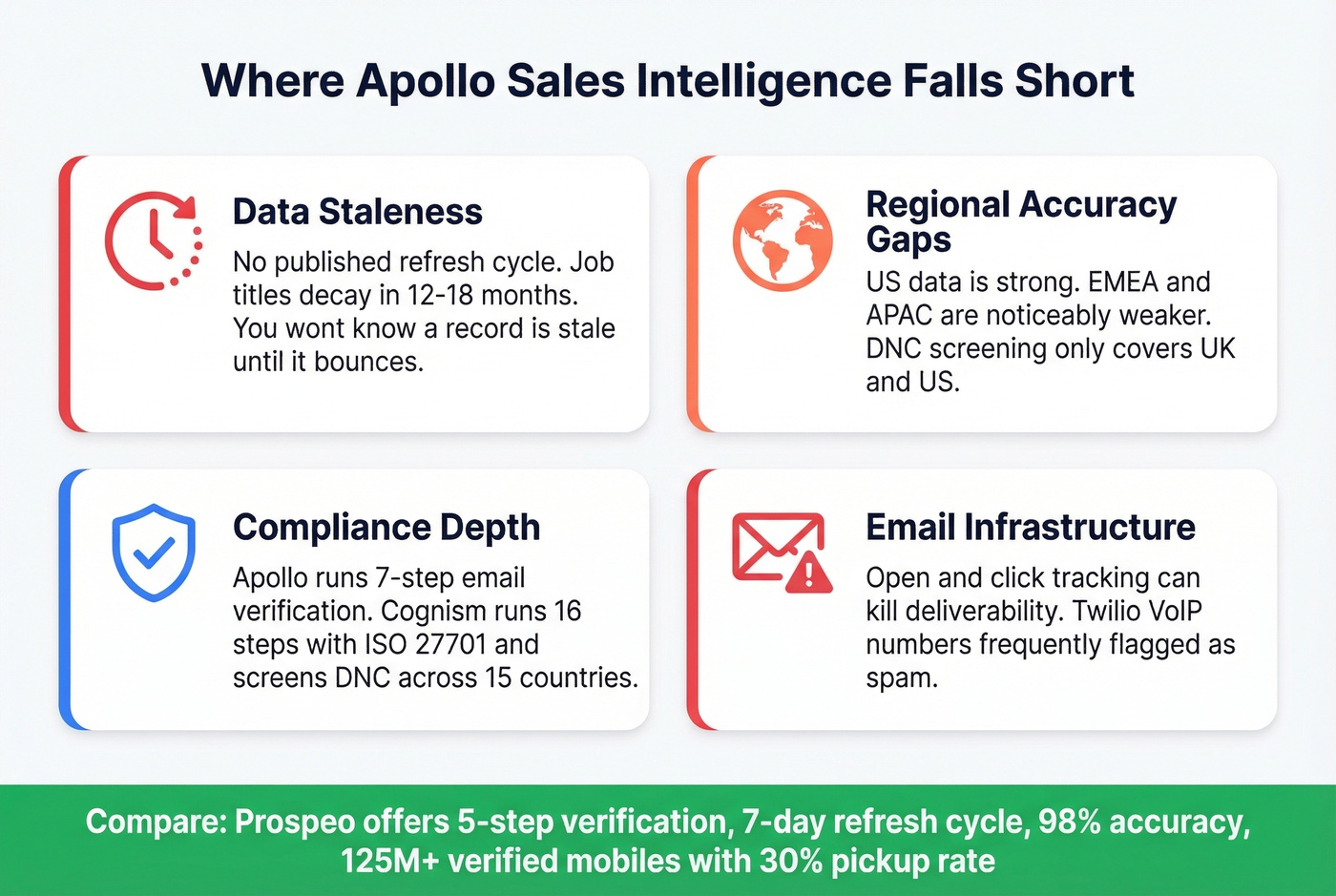
Data staleness. No published refresh cycle means you're prospecting into yesterday's org charts against 12-18 month title decay. You won't know a record is stale until it bounces or a confused stranger picks up the phone.
Regional accuracy. US data is strong. EMEA and APAC are noticeably weaker, and DNC screening only covers the UK and US.
Compliance depth. Apollo runs a 7-step email verification process. Cognism (typically $15K-$30K/year for mid-market teams) runs 16 steps, holds ISO 27701, and screens DNC lists across 15 countries. If you sell into regulated European markets, that gap matters. (If you need a framework for regulated outreach, see B2B compliance and GDPR compliant database.)
Email infrastructure. A practitioner on r/sales called Apollo "terrible with its email infrastructure" and advised disabling open/click tracking entirely because it "will kill your deliverability." Apollo's dialer also uses Twilio VoIP numbers that frequently get flagged as spam.
Getting More From Apollo
The Practitioner Workflow
The smartest Apollo users don't treat it as a single source of truth. They treat it as a list-building engine. Use Apollo's filters to build a tight ICP list of around 1,000 contacts, export the data, verify externally, then sequence from a dedicated sending platform like Instantly or Smartlead. Some teams layer Clay on top for additional enrichment before verification.
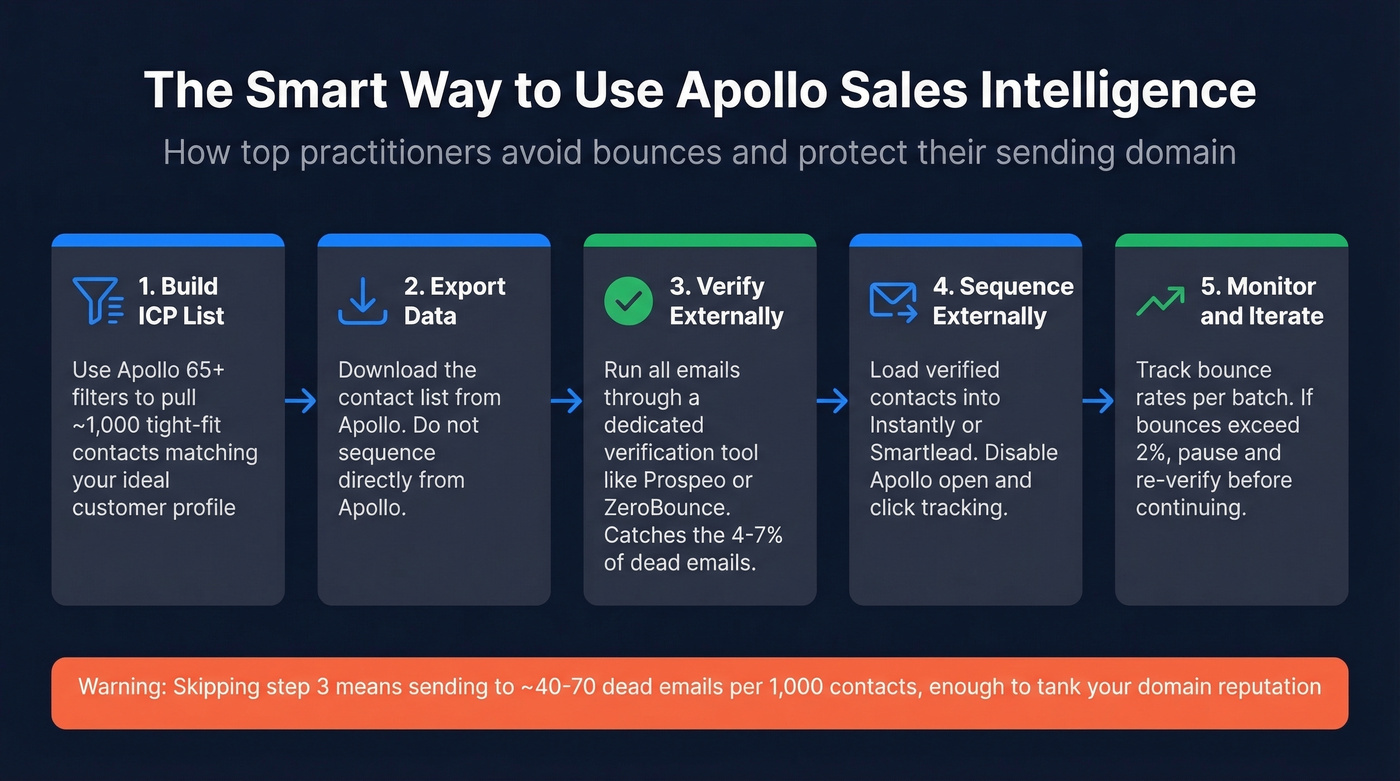
In our experience, this two-step approach - Apollo for discovery, a dedicated verification tool for accuracy - catches the 4-7% of dead emails that would otherwise torch your sending domain. (If you’re building lists at scale, use a repeatable cold email lead list building process and a dedicated email verifier.)
When Accuracy Is the Priority
Skip Apollo's data layer entirely if you're an outbound agency scaling client campaigns. One bad domain flag across a client's infrastructure costs more than a year of better data, and Prospeo's 125M+ verified mobile numbers with a 30% pickup rate give your reps a real shot at live conversations - compared to Apollo's 11%. (For dialing performance benchmarks and coaching, see B2B cold calling success rates and phone sales skills.)
For enterprise teams that need deep ABM workflows and org-chart mapping, ZoomInfo remains the heavyweight at $14K-$25K+/year.
The Verdict
Apollo is the right choice if you're a startup that needs prospecting, sequencing, and dialing in one platform for under $100/mo per rep. The best results come from treating it as a list-building and workflow tool, then verifying everything externally before a single email goes out. If data accuracy and freshness are non-negotiable - especially outside the US - pair Apollo with a dedicated verification layer, or replace the data side entirely. (If you’re comparing providers, start with the best B2B database roundup.)
FAQ
Is Apollo.io data accurate enough for cold outreach?
Independent testing shows 93.2% email accuracy for US SaaS contacts - expect roughly 40-70 bounces per 1,000 sends. That's workable for low-volume campaigns but risky at scale. Verify exports through a dedicated tool before sequencing to protect your domain reputation.
How much does Apollo.io cost per user?
Apollo's paid plans start at $49/user/month (Basic) and scale to $119/user/month (Organization, 3-seat minimum). All plans include expiring credits - unused credits reset each billing cycle, so budget based on actual monthly usage, not annual averages.
What's a good alternative to Apollo for email accuracy?
Prospeo is the strongest option for teams prioritizing deliverability: 98% email accuracy, 7-day data refresh, and ~$0.01/email with no contracts. For enterprise needs with intent data and ABM, ZoomInfo ($14K-$25K+/year) is the incumbent. Cognism is the compliance-first choice for European markets.
Does Apollo.io have intent data?
Apollo doesn't offer native buyer-intent signals as of 2026. If identifying in-market accounts is critical to your workflow, you'll need a separate provider. ZoomInfo and Cognism both bundle proprietary intent data into their enterprise tiers, and Prospeo tracks 15,000 intent topics via Bombora at a fraction of the cost.
The article's best advice: use Apollo for discovery, then verify externally. Prospeo eliminates that two-step workaround entirely - 300M+ profiles with 5-step verification, 125M+ mobile numbers with a 30% pickup rate vs Apollo's 11%, and a 7-day refresh cycle so you never prospect into yesterday's org chart.
One platform. No verification workaround. No bounced emails.