

Average Cold Email Open Rate: 2026 Data Breakdown
The average cold email open rate sits around 28% in 2026. That sounds useful until you realize published benchmarks range from 21% to 60% depending on who's measuring, what they count as an "open," and whether the dataset is truly cold outreach or warm marketing blasts.
For properly authenticated campaigns with verified lists, expect 21-39% opens. But here's the thing: open rate is the most misleading metric in cold email right now. Apple Mail Privacy Protection can nearly double your tracked opens by preloading pixels through proxy servers, registering "opens" that never happened. Track reply rate instead - 3.43% average, 5.5%+ for top-quartile campaigns per Instantly's 2026 benchmark. If your open rate is below 20%, you've got a deliverability problem, not a subject line problem.
What Open Rate Benchmarks Hide
The spread across major sources is wild:
| Source | Methodology | Avg Open Rate | Year |
|---|---|---|---|
| SendIQ | Platform data | 21.3% | 2025 |
| Martal | Compilation | 27.7% | 2024-2026 |
| Mailchimp | Billions of emails delivered (warm); campaigns with 1,000+ subscribers | 35.63% | Updated Dec 2023 |
| Focus Digital | Platform data | ~39% | 2025 |
| Belkins | 5.5M emails | 35% (non-personalized) / 46% (personalized) | Jan-Dec 2024 |
| Instantly | Billions of interactions | N/A (reply-focused) | 2026 |
Instantly doesn't even report open rate anymore - which tells you everything about where the industry is heading.
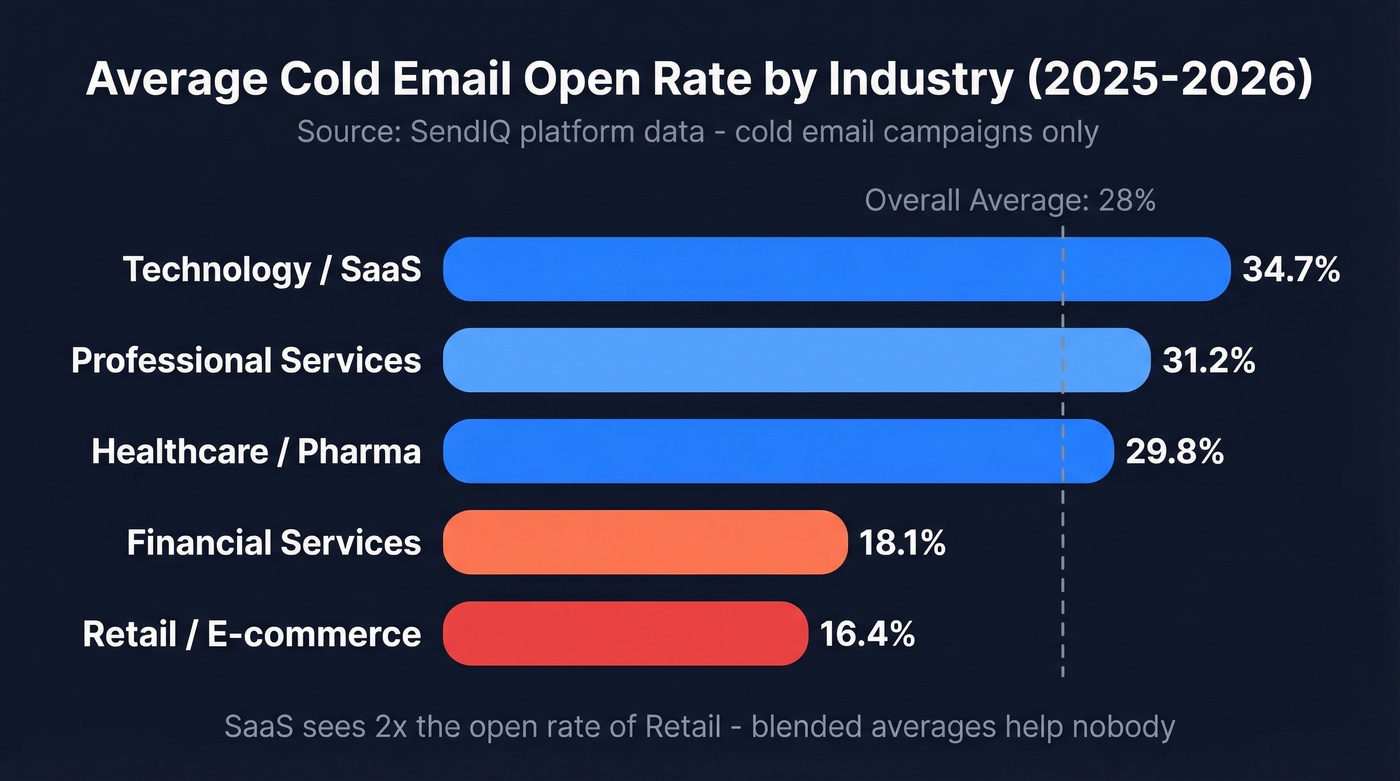
Martal's trend data shows open rates dropped from ~36% in 2023 to 27.7% by 2024, then flatlined. That decline tracks with Apple MPP adoption and tighter inbox filtering. And roughly 17% of cold emails never reach the inbox at all. Industry matters enormously. SendIQ's breakdown for cold email:
| Industry | Open Rate |
|---|---|
| Technology/SaaS | 34.7% |
| Professional Services | 31.2% |
| Healthcare/Pharma | 29.8% |
| Financial Services | 18.1% |
| Retail/E-commerce | 16.4% |
SaaS at 34.7% versus retail at 16.4% is a 2x gap. The "average" is whatever you want it to be.
Why Benchmarks Contradict Each Other
Apple MPP fakes your opens. Apple Mail preloads tracking pixels through proxy servers, registering an "open" even when nobody reads the email. Apple devices accounted for roughly 52% of all email opens as of 2021 - likely higher now. Omeda saw unique open rates nearly double within six months of MPP rolling out. Apple's Link Tracking Protection also strips UTM parameters, weakening click attribution alongside open tracking.
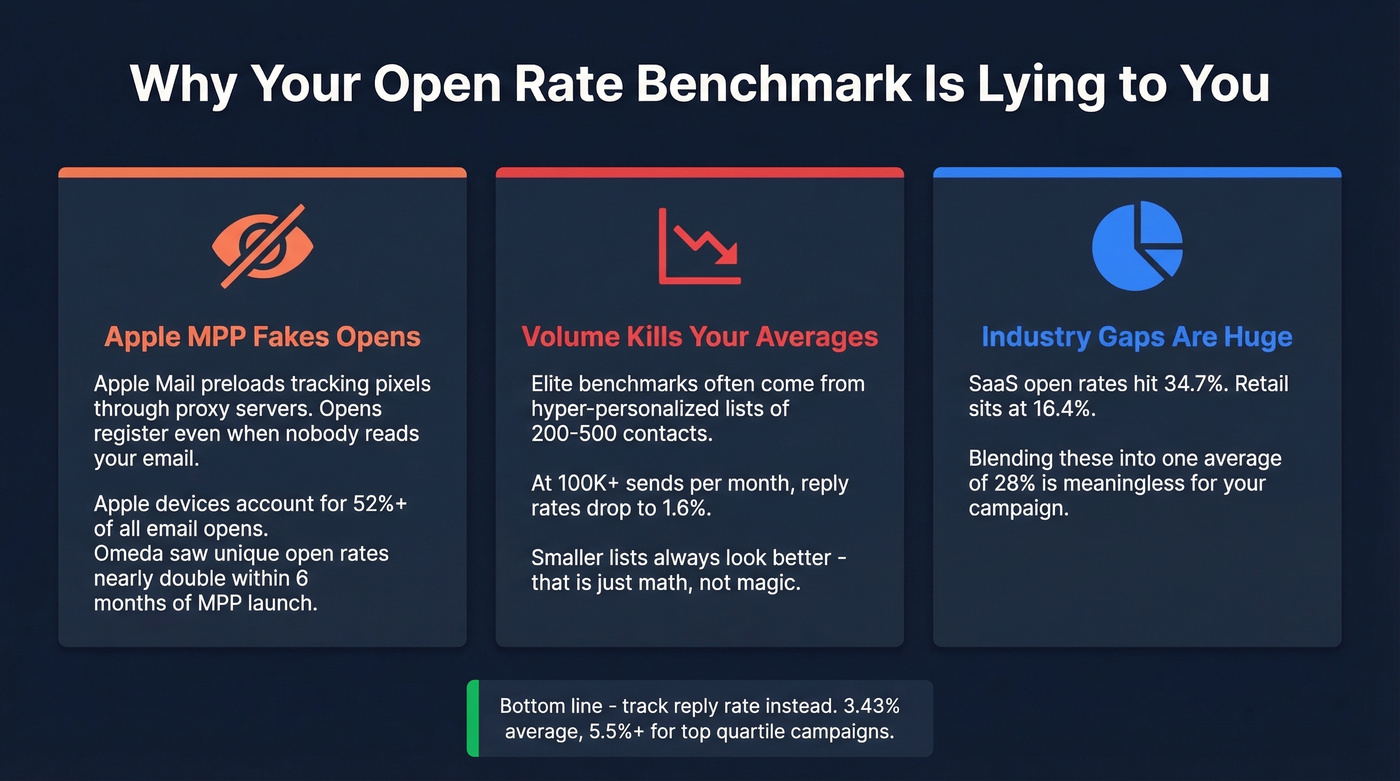
Think of it like a retail store with an automatic door counter that registers every person who walks past - delivery drivers, people ducking in from the rain, kids chasing a ball. Your "foot traffic" looks great. Sales don't move.
Volume destroys your averages. A practitioner on r/coldemail running 100K+ sends per month reported a 1.6% reply rate at scale and pointed out that "elite" benchmark rates often come from hyper-personalized lists of 200-500 contacts. We've seen this pattern repeatedly: the smaller and more targeted the list, the higher every metric looks. That's not a trick - it's just math.
Industry variation is massive. Blending SaaS and retail into one "average" helps nobody.

Bad data inflates your open rates and destroys your sender reputation. Prospeo's 5-step verification - catch-all handling, spam-trap removal, honeypot filtering - keeps bounce rates under 2% at 98% accuracy. Snyk cut bounces from 35-40% to under 5% and added 200+ new opportunities per month.
Fix your deliverability before you A/B test another subject line.
What Actually Drives Opens
The hierarchy that matters, ranked by impact:
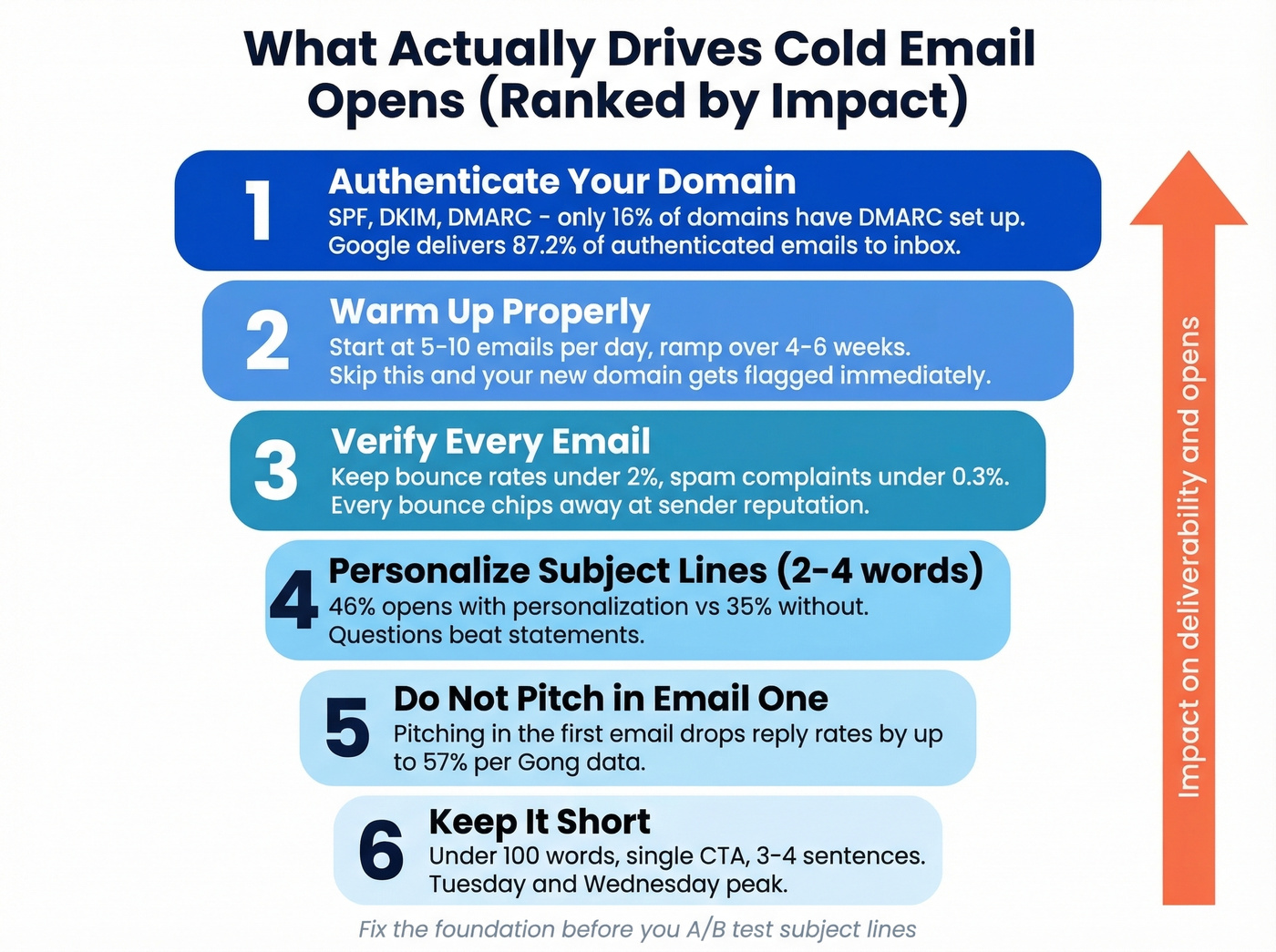
- Authenticate your domain. Google and Yahoo enforce SPF, DKIM, and DMARC for bulk senders. Microsoft followed in May 2025. Google delivers 87.2% of authenticated emails to inbox versus Microsoft's 75.6%. Only 16% of domains have DMARC implemented - if yours doesn't, fix that before anything else. (If you need a deeper walkthrough, start with this email deliverability guide.)
- Warm up properly. Start at 5-10 emails/day and ramp over 4-6 weeks. Skip this and your brand-new domain gets flagged immediately. Use a safe ramp based on email velocity limits.
- Verify every email. Keep bounce rates under 2% and spam complaints under 0.3%. Every bounced email chips away at sender reputation. Prospeo's 5-step verification - catch-all handling, spam-trap removal, honeypot filtering - keeps bounce rates under 2% at 98% accuracy. Snyk cut bounce rates from 35-40% to under 5% after switching. (More on diagnosing issues in email bounce rate.)
- Personalize subject lines (2-4 words). Belkins found personalized subject lines hit 46% opens versus 35% without. Questions outperformed statements. If you want a swipe file, use these cold email subject lines.
- Don't pitch in email one. Gong's analysis of 28M+ cold emails found that pitching in the first email drops reply rates by up to 57%. This is the single most counterintuitive finding in cold email data - and the one most teams ignore. For structure, build a B2B cold email sequence that earns the right to pitch.
- Keep it short. Under 100 words, single CTA, 3-4 sentences. Tuesday and Wednesday see peak reply rates. (Timing details: best time to send cold emails.)
Let's be honest: if your deal sizes are under five figures, obsessing over open rate is a waste of your time. Fix authentication, verify your list, and write emails worth replying to. The teams booking the most meetings aren't A/B testing subject lines endlessly - they're sending fewer, better emails to the right people. If you're rebuilding your outbound motion, start with proven sales prospecting techniques.
Metrics That Matter More
Open rate is a vanity metric in cold email post-MPP. In our experience, teams that shift focus from opens to replies see faster improvement across every downstream metric. The numbers back this up.
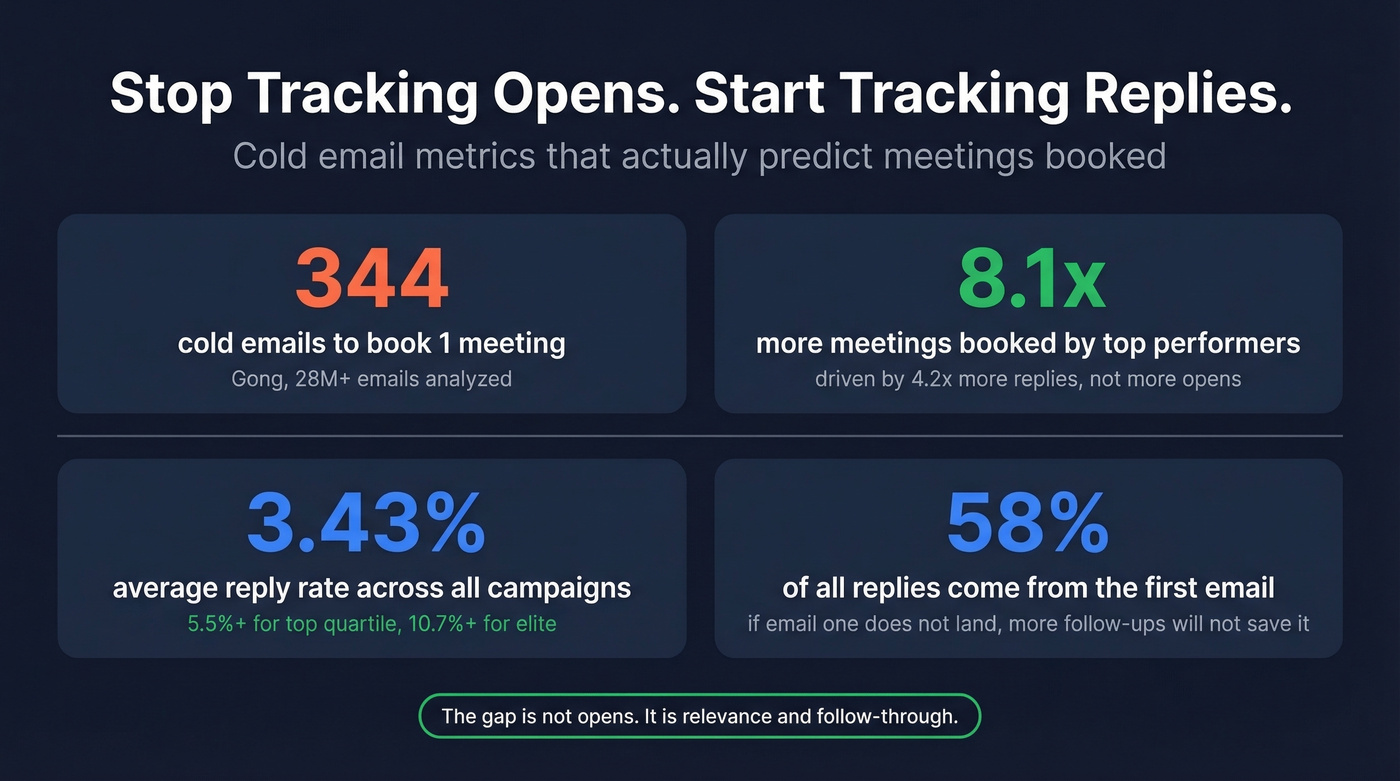
Gong's dataset shows the average rep sends 344 cold emails to land one meeting. That's a brutal ratio. Top performers book 8.1x more meetings than average - and they get 4.2x more replies. The gap isn't opens. It's relevance and follow-through.
Instantly's 2026 benchmarks put the average reply rate at 3.43%, with top-quartile campaigns hitting 5.5%+ and elite performers clearing 10.7%. And 58% of all replies come from the first email - if email one doesn't land, more follow-ups won't save a bad campaign. Open rate tells you whether your emails are reaching inboxes. Reply rate tells you whether they're reaching people. If you're only tracking one number, make it replies. To improve follow-through, use these cold email follow-up templates.
Reply rate beats open rate - but replies require reaching real inboxes. Prospeo refreshes 300M+ profiles every 7 days (not the 6-week industry average), so you're never sending to stale data. At ~$0.01/email, cleaning your list costs less than a single bounced send costs your domain.
Send fewer emails to verified contacts and book more meetings.
Cold Email Open Rate FAQ
What's a good cold email open rate?
For authenticated domains with verified lists, 30-45% on lists under 1,000 contacts is strong. At 10K+ monthly sends, 20-30% is realistic. Below 20% signals a deliverability problem - check SPF, DKIM, and DMARC before touching subject lines.
Why did my open rate suddenly drop?
Microsoft began enforcing DMARC for bulk senders in May 2025, routing unauthenticated emails to spam. Check your domain authentication first, then review bounce rates and spam complaint ratios. A spike in bounces from bad data can tank sender reputation overnight.
How do open rates vary by industry?
Technology and SaaS campaigns average around 34.7%, while retail and e-commerce hover near 16.4%. Professional services and healthcare fall in between at 29-31%. Always benchmark against your own vertical rather than a blended average cold email open rate across all industries.