

Average Email Conversion Rate: 2026 Benchmarks That Actually Make Sense
The average email conversion rate is 2-5%. You've seen that number a dozen times already. It's technically correct and practically useless - because Mailchimp's "2-5%" is usually talking about click performance, Klaviyo's "0.16%" measures purchases, and Instantly's "3.43%" measures cold email replies. They're all right. They're all measuring completely different things.
Let's fix that.
What "Conversion Rate" Actually Means
The formula is simple: (Conversions / Delivered Emails) x 100. The problem isn't the math. It's that "conversion" means something different depending on who you ask, and comparing a marketing click rate against an ecommerce purchase rate is like comparing scores across different sports: a 2 in golf is great, a 2 in basketball is terrible.
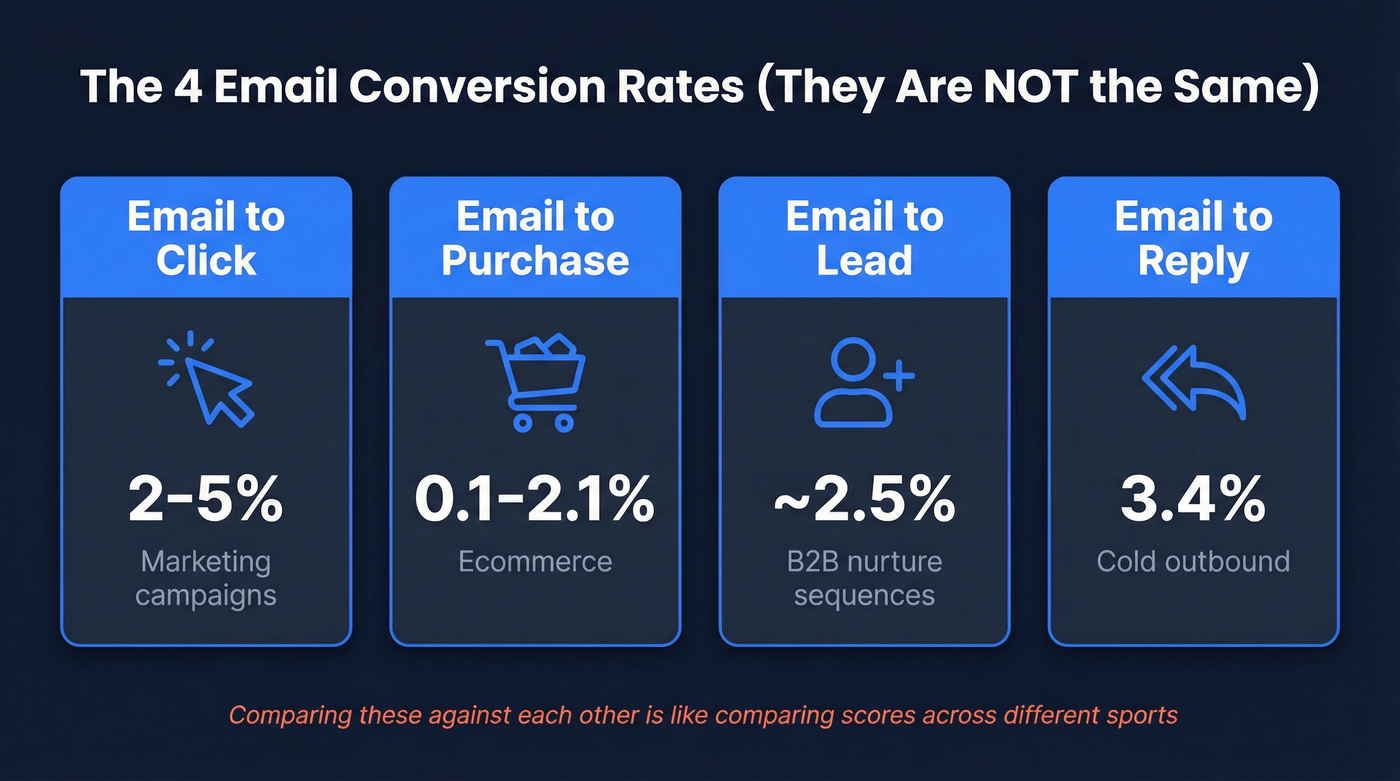
One more wrinkle worth knowing: "click rate" (clicks / delivered) and "click-through rate" (clicks / opened) aren't the same metric. HubSpot draws a clean line between the two, while Mailchimp's terminology is often used interchangeably and also highlights "clicks per unique opens" as a separate way to look at engagement. That's why benchmarks never match across platforms.
| Conversion Type | Typical Rate | Context |
|---|---|---|
| Email-to-click | 2-5% | Marketing campaigns |
| Email-to-purchase | 0.1-2.1% | Ecommerce |
| Email-to-lead | ~2.5% | B2B nurture sequences |
| Email-to-reply | 3.4% | Cold outbound |
Decide which of these four you're measuring before you benchmark anything.
Marketing Email Benchmarks for 2026
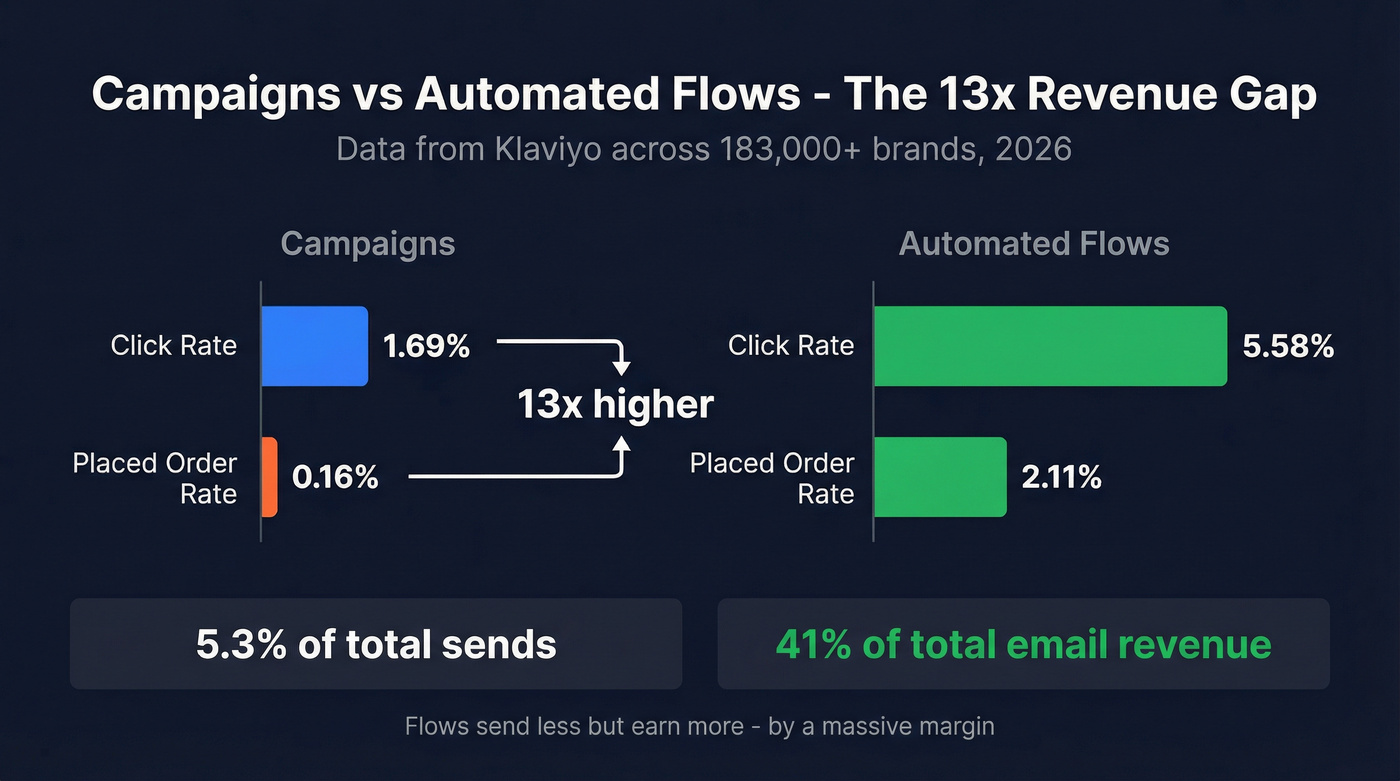
Here's the thing most marketers miss: the biggest gap isn't between industries. It's between campaigns and automated flows. Klaviyo's 2026 benchmarks across 183,000+ brands tell the story clearly:
| Metric | Campaigns | Automated Flows |
|---|---|---|
| Click rate | 1.69% | 5.58% |
| Placed order rate | 0.16% | 2.11% |
That's a 13x gap on placed orders. Flows account for just 5.3% of total sends but generate roughly 41% of total email revenue. If you're still batch-and-blasting your entire list, automated flows are the single biggest lever you have.
Industry rates vary dramatically too. Klaviyo's campaign placed order rates range from 0.26% for food and beverage down to 0.08% for jewellery. Bloomreach's data, which measures email-to-purchase across a different dataset, shows even wider spread:
| Industry | Email-to-Purchase Rate |
|---|---|
| Grocery | 7.9% |
| Fintech | 5.8% |
| Fashion | 1.4% |
Bloomreach also confirms the automation advantage: abandoned cart sequences recover 10-15% of lost purchases, welcome series convert around 3%, and post-purchase follow-ups hit roughly 6.8%.
Most teams obsess over campaign conversion rates when the real money is in flows they haven't built yet. A mediocre abandoned cart sequence will outperform your best-crafted newsletter every time. We've seen this pattern repeatedly across the B2B and DTC teams we work with.

Automated flows convert 13x better than campaigns - but only if emails reach the inbox. Meritt cut their bounce rate from 35% to under 4% with Prospeo's 5-step verification and tripled pipeline to $300K/week. Your conversion rate starts with deliverability.
Verify your list at $0.01/email and uncap your conversion rate.
Cold Email Benchmarks
Cold email operates on a completely different scale. Instantly's 2026 benchmark report puts the average reply rate at 3.43%. Top quartile senders hit 5.5%+. The top 10% clear 10.7%.
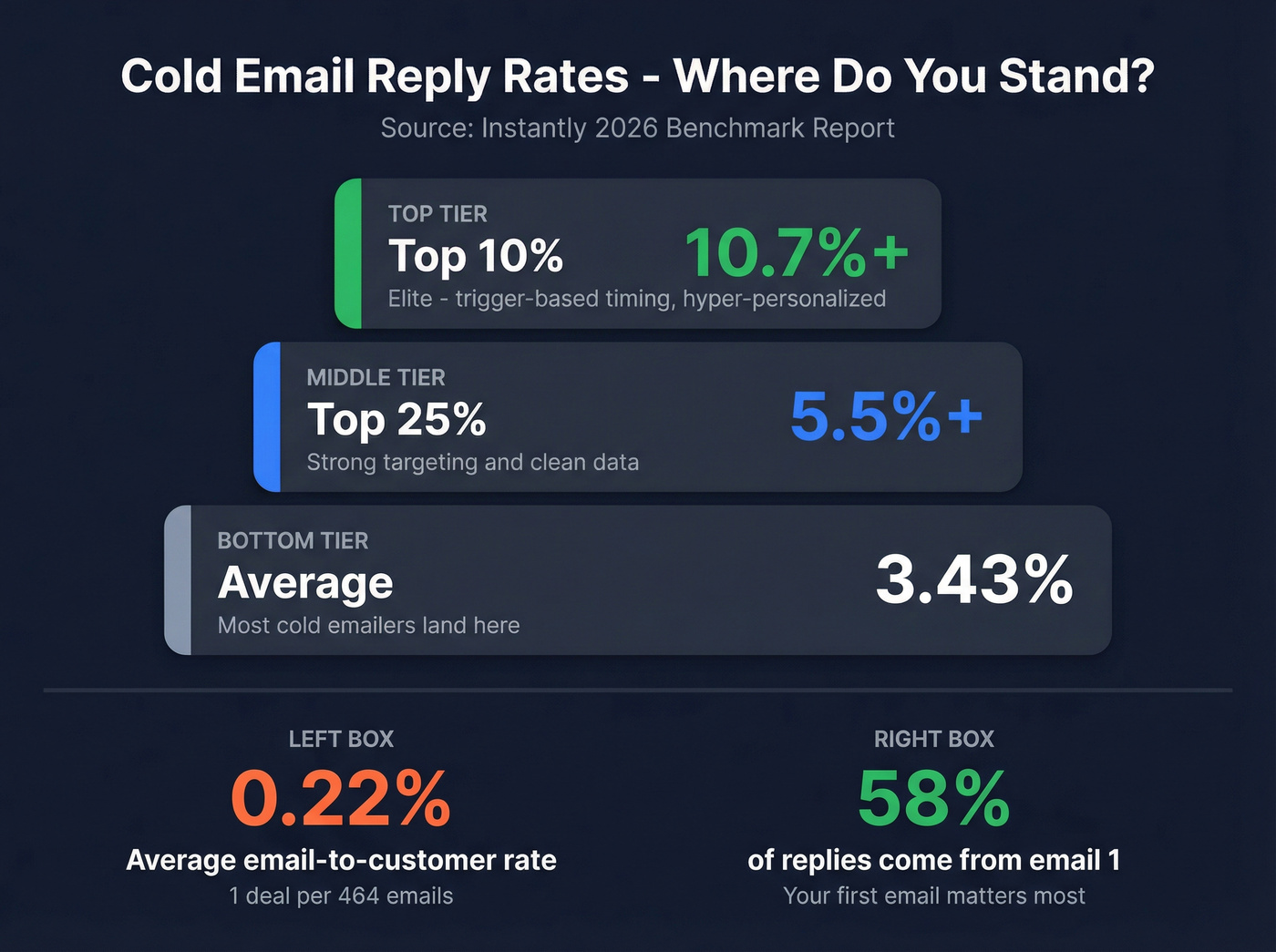
But reply rate isn't deal conversion. The average cold email-to-customer rate sits around 0.22%, roughly 1 deal per 464 emails. At higher volumes, results compress: one dataset shows 5,000+ cold emails averaging about 0.10%, or 1 deal per 1,042 emails. A practitioner who sent 147K cold emails reported a 1.2% positive reply rate.
On the other end of the spectrum, a Reddit user shared a much tighter funnel: 908 emails, 112 meetings, 28 deals - a 3.1% email-to-close rate driven by trigger-based timing and emails under 50 words. That's not typical, but it shows what's possible when targeting and timing are dialed in.
58% of replies come from step 1 of a sequence. If your first email doesn't land, follow-ups are fighting uphill.
The Deliverability Problem Nobody Talks About
Your conversion rate has a ceiling most people ignore entirely. Average inbox placement sits at 84%. That means 10.5% land in spam, and 16.9% never reach the inbox at all. Your "2% conversion rate" is calculated against delivered emails, but if a big chunk of your sends never make it past spam filters, your funnel is capped before copywriting even matters.
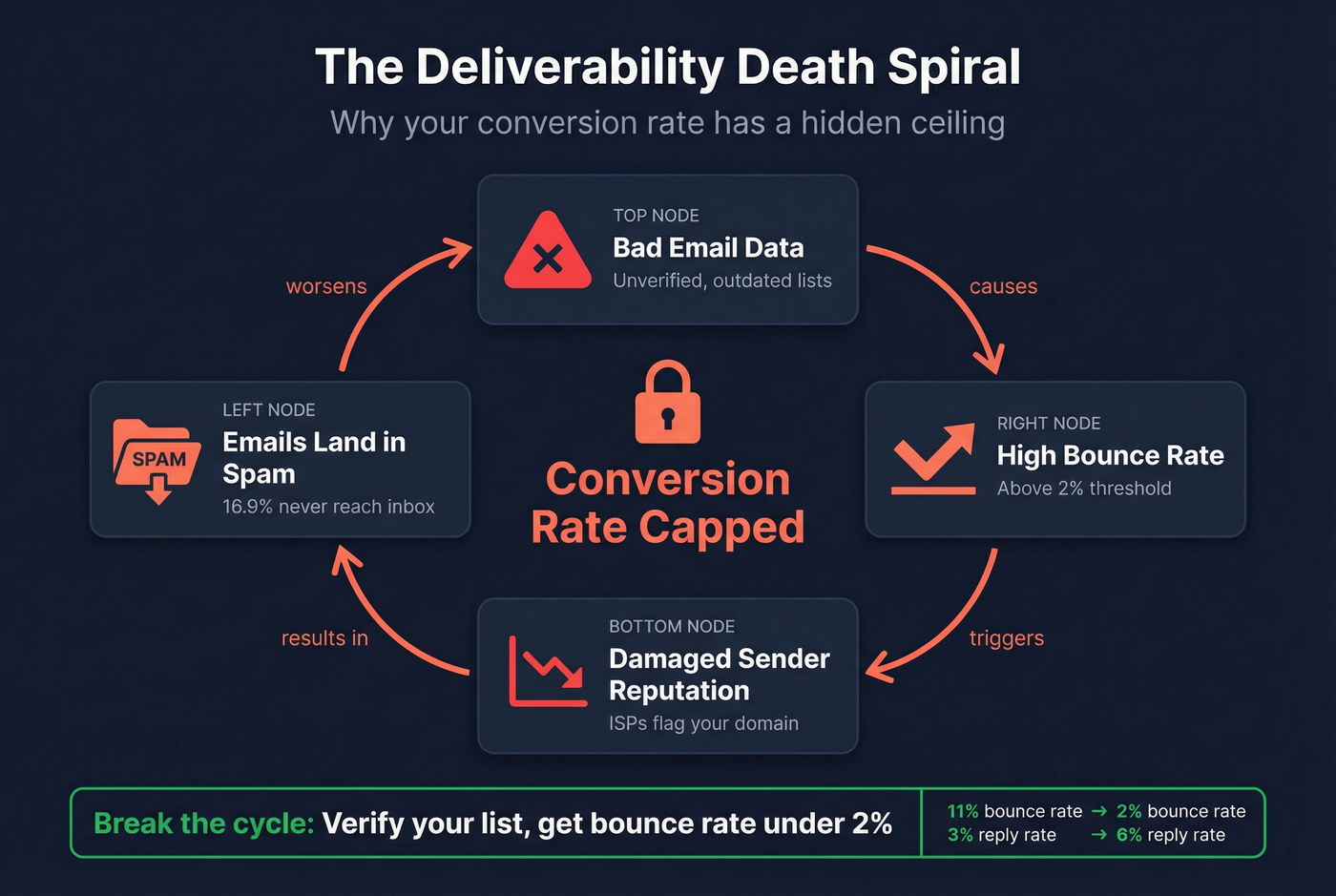
One Reddit practitioner cut their bounce rate from 11% to under 2% and watched their reply rate double from 3% to 6%. High bounce rates degrade sender reputation, which pushes more emails to spam, which tanks conversion rates across the board - a vicious cycle that starts with bad data. Prospeo's 5-step email verification delivers 98% accuracy, and one customer, Meritt, went from a 35% bounce rate to under 4% after switching, tripling their pipeline from $100K to $300K per week.
Skip the copy optimization if your bounce rate is above 2%. Fix the data first.

How to Improve Your Conversion Rate
Priority order matters. Don't start with subject lines.
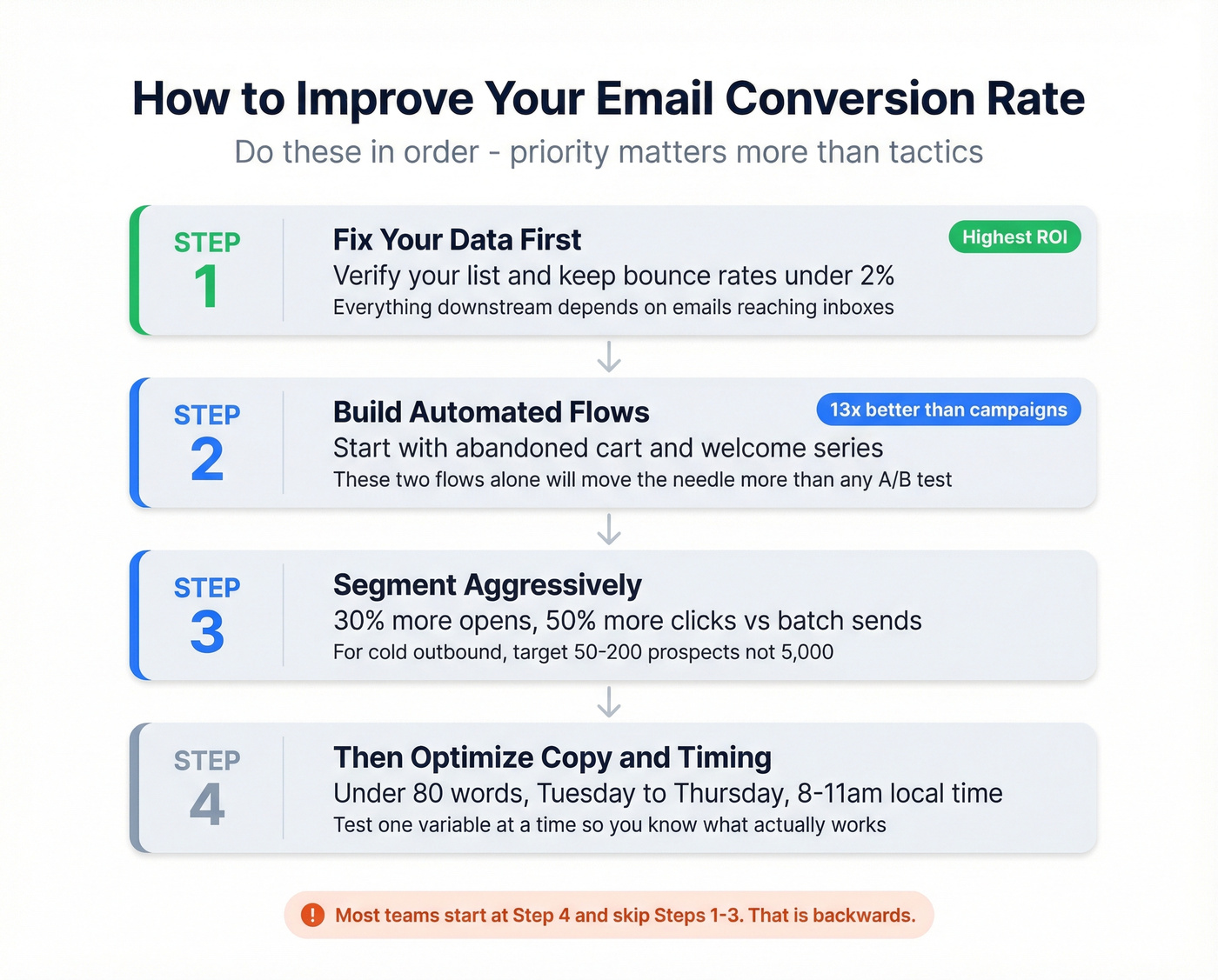
Fix your data first. Verify your list and keep bounce rates under 2%. Everything downstream depends on emails actually reaching inboxes. This isn't glamorous work, but it's the highest-ROI thing you can do. (If you want a deeper breakdown, start with email deliverability and email bounce rate.)
Build automated flows. They convert at 13x the rate of campaigns. Start with abandoned cart and welcome series - those two alone will move the needle more than any amount of A/B testing on campaign subject lines.
Segment aggressively. Segmented campaigns deliver up to 30% more opens and 50% more clicks versus batch sends. For cold outbound, the consensus on r/coldemail is that hyper-targeted lists of 50-200 prospects outperform spray-and-pray lists of 5,000 every time. If you're building outbound lists, sales prospecting techniques and a tight ideal customer profile make segmentation much easier.
Then optimize copy and timing. Keep cold emails under 80 words. Send Tuesday through Thursday, 8-11am in the recipient's timezone. Test one variable at a time so you know what's actually working. For practical swipe files, use email subject lines and cold email follow-up templates. If you're pressure-testing send volume, email velocity helps you avoid deliverability cliffs.
Cold email converts at 3.43% on average - but that number assumes your emails actually land. With 84% average inbox placement industry-wide, bad data silently kills your funnel before copy even matters. Prospeo delivers 98% email accuracy on 143M+ verified addresses, refreshed every 7 days.
Stop optimizing subject lines on a broken list. Fix the data first.
FAQ
What's a good email conversion rate?
For marketing clicks, 2-5% is solid. For ecommerce purchases, expect 0.16% on campaigns and 2.11% on automated flows. Cold email reply rates average 3.43%, with 5.5%+ considered strong. Always compare the same conversion type against the same benchmark source - mixing metrics across platforms will give you a distorted picture.
How do you calculate email conversion rate?
Divide conversions by delivered emails, then multiply by 100. Define "conversion" first: clicks, purchases, replies, and lead submissions each carry different benchmark ranges. Using delivered rather than sent as the denominator accounts for bounces and gives you a more accurate number.
Why is my email conversion rate dropping?
Check deliverability before anything else. If your bounce rate exceeds 2%, sender reputation is degrading and fewer emails are reaching inboxes. Bad data is the most common culprit we see - not weak copy, not bad timing. Verify your list, clean out inactive addresses, and monitor your domain reputation. Then worry about subject lines.