

The B2B ABM Strategy Playbook for Teams That Want Pipeline, Not Impressions
You've got a list of 500 "target accounts," a sales team that ignores it, and a marketing team running the same case study as display ads to all of them. That's not ABM. That's demand gen with a fancy label.
The teams actually generating pipeline from a B2B ABM strategy treat it as an operating system - shared definitions, signal-based triggers, closed feedback loops - not a series of loosely connected campaigns. Demandbase's benchmark report found top B2B marketers achieve 81% higher ROI with ABM. The ABM market hit $1.07B in 2023 and is forecast to reach around $2B by 2032, which means more teams are trying this. Most are doing it badly. Here's how to not be most teams.
What Account-Based Marketing Actually Requires
Three things separate ABM programs that generate pipeline from ones that generate slide decks:
- A scoring model before a platform. Fit, intent, engagement, relationship - weighted and tiered. Exact weights below. (If you need a starting rubric, use an Ideal Customer Profile template.)
- 3+ verified contacts per target account. One email per company isn't ABM. It's a cold email list.
- Account-level metrics, not MQLs. Measure penetration and pipeline health velocity. Keep your target account list between 50 and 200 accounts - anything bigger dilutes focus, anything smaller limits pipeline math.
Score and Tier Your Accounts
The biggest mistake we see in ABM programs is sales picking "priority accounts" based on gut feel. One practitioner on r/b2bmarketing described rebuilding their entire ABM pilot after this exact failure - three months of work, wasted because the list was built on vibes instead of data. The fix is a scoring model that removes opinion from the equation.
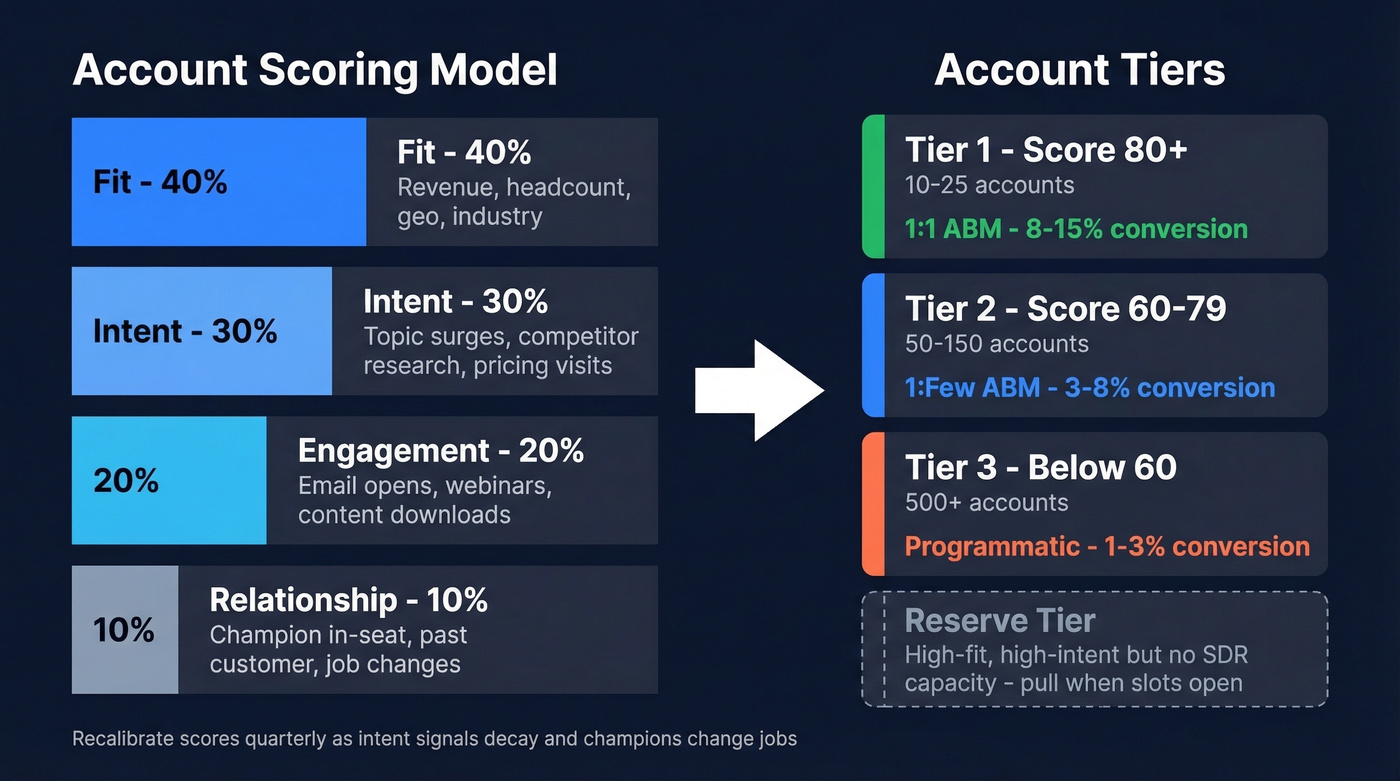
| Category | Weight | What It Measures | Example Signals |
|---|---|---|---|
| Fit | 40% | ICP match | Revenue, headcount, geo, industry |
| Intent | 30% | Buying signals | Topic surges, competitor research, pricing page visits |
| Engagement | 20% | Interaction depth | Email opens, webinar attendance, content downloads |
| Relationship | 10% | Existing connections | Champion in-seat, past customer, job-change signal |
Score each account out of 100, then tier them into three groups:
Tier 1 (80+): 10-25 accounts. True 1:1 ABM. Expect 8-15% outreach-to-meeting conversion. Tier 2 (60-79): 50-150 accounts. 1:few campaigns by industry or use case. Expect 3-8% conversion. Tier 3 (below 60): 500+ accounts. Programmatic ads and automated sequences. Expect 1-3% conversion.
One concept most teams skip: the Reserve tier. These are high-fit, high-intent accounts you can't work right now because your SDR team is at capacity. Park them, pull from Reserve when a slot opens - it prevents the "we missed that account while it was hot" problem that kills pipeline momentum. Recalibrate scores quarterly. Intent signals decay, champions change jobs, and companies that were a perfect fit six months ago may have shifted strategy entirely.
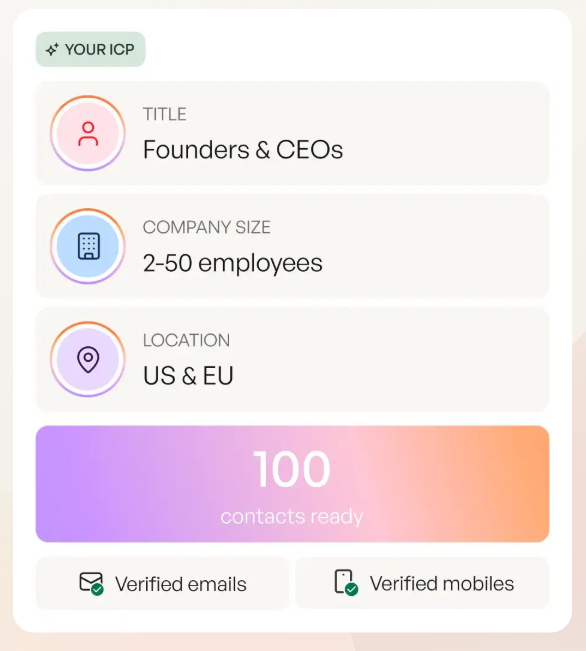
Build Your Target Account List
Your scoring model is only as good as the data underneath it. If half your contacts have outdated emails or you've only got one person mapped per account, your account-based marketing strategy is dead on arrival.
The Contact Coverage Rate formula is simple: accounts with 3+ contacts divided by total accounts. You need at least three contacts per target account - ideally across different roles in the buying committee. One contact means one job change away from zero coverage. That's not a risk worth taking on a Tier 1 account you've spent weeks personalizing for.
Build your unified list from multiple sources: CRM data, intent platforms, historical sales notes. The team behind one of the most detailed ABM rebuilds on r/b2bmarketing combined Salesforce, 6sense, and HG Insights data into a single target list and hit 100% account reach in 90 days. That kind of unified list requires clean data underneath it - often via data enrichment. We use Prospeo's B2B database to close the gap - 300M+ professional profiles with 98% email accuracy and a 7-day refresh cycle versus the six-week industry average. Layer in intent data tracking 15,000 topics via Bombora to validate which accounts are actually in-market before you spend a dollar on personalization, then export verified contacts directly into your CRM.

Execute Multi-Channel ABM by Tier
Each tier gets a different playbook. Trying to run 1:1 tactics across 500 accounts will burn your team out in a month.
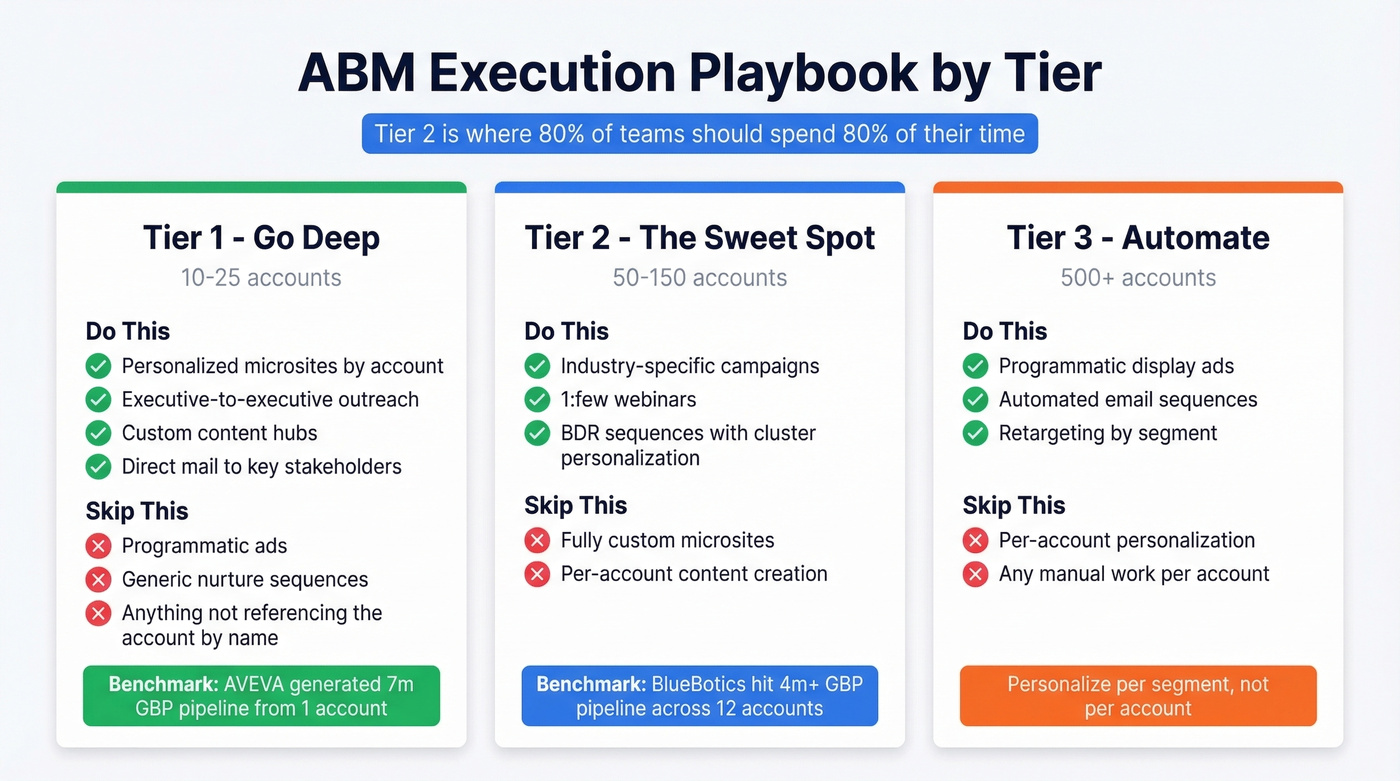
Here's my strong opinion: Tier 2 is where 80% of teams should spend 80% of their time. The ROI-to-effort ratio is unmatched.
Tier 1 - Go Deep
Personalized microsites by account (Mutiny is solid here), executive-to-executive outreach, custom content hubs, direct mail to key stakeholders. AVEVA ran 1:1 ABM against GSK and generated £7m in active pipeline with 46 new decision-maker relationships. That's the ceiling for Tier 1 done right.
Skip this at Tier 1: programmatic ads, generic nurture sequences, anything that doesn't reference the account by name.
Tier 2 - The Sweet Spot
Industry-specific campaigns, 1:few webinars, BDR sequences with cluster-level personalization. (If your sequences are underperforming, steal a few sales follow-up templates.) BlueBotics - a marketing team of one - ran 1:few ABM across 12 accounts and generated £4m+ in opportunities. The Reddit ABM rebuild team saw 56% of target accounts show engagement signals and a 63% meeting-to-opportunity conversion rate using this approach.
Skip this at Tier 2: fully custom microsites. The ROI math doesn't work when you're covering 50-150 accounts.
Tier 3 - Automate and Monitor
Programmatic display, automated email sequences, retargeting. Don't personalize per account here - personalize per segment. Skip anything requiring manual work per account.

Your ABM tiers are only as strong as the contact data underneath them. Prospeo gives you 300M+ profiles with 98% verified emails, 125M+ direct dials, and intent data across 15,000 Bombora topics - so you can score, tier, and reach every buying committee member without stale data killing your Tier 1 campaigns.
Stop running ABM on bad data. Get 3+ verified contacts per target account.
Measure What Actually Matters
If you're still reporting MQLs to your board as the primary ABM metric, you're measuring the wrong thing. Let's be honest - MQLs tell you about individual lead activity, not whether you're penetrating the accounts that actually matter. Any serious account-based marketing program requires measurement at the account level.
The engagement scoring model:
| Activity | Points | Signal Strength |
|---|---|---|
| Website visit | 1 | Low |
| Email click | 3 | Medium |
| Content download | 5 | Medium |
| Pricing page visit | 10 | High |
| Event attendance | 15 | High |
| Demo request | 25 | Very high |
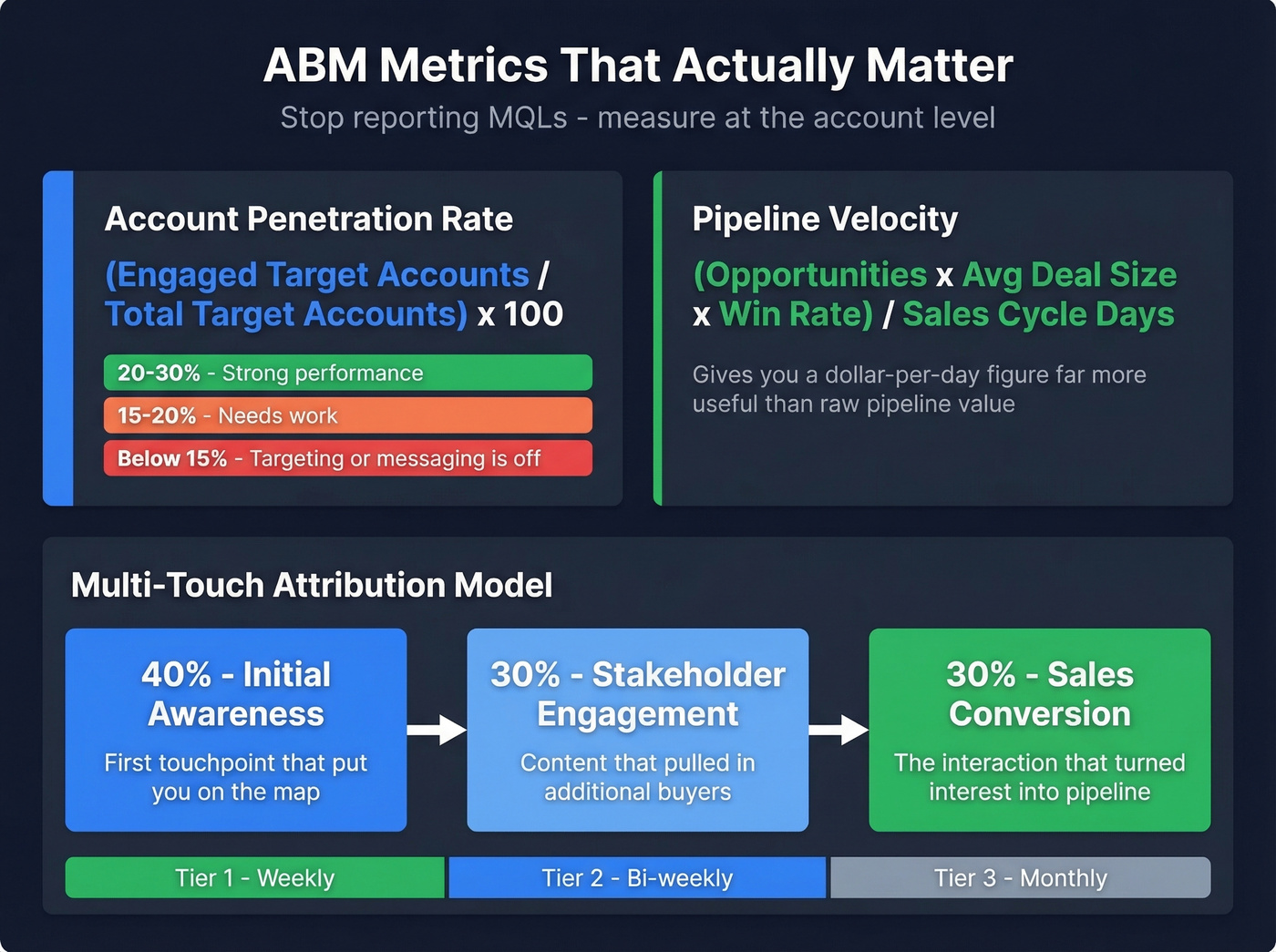
Two formulas belong on your dashboard.
Account Penetration Rate = (Engaged target accounts / Total target accounts) x 100. A 20-30% penetration rate is strong performance for enterprise ABM. Below 15% means your messaging or targeting is off.
Pipeline Velocity = (Opportunities x Avg deal size x Win rate) / Sales cycle length in days. This gives you a $/day figure far more useful than raw pipeline value, because it accounts for how fast deals actually move, not just how big the number looks in a board deck. (More on pipeline velocity.)
For attribution, use a multi-touch model at the account level: 40% to the initial awareness touchpoint, 30% to the content that engaged additional stakeholders, 30% to the sales interaction that converted. It's not perfect, but it's directionally honest and keeps both teams invested. Review Tier 1 accounts weekly, Tier 2 bi-weekly, Tier 3 monthly.
Your ABM Tech Stack in 2026
You don't need a $100K platform to start. In our experience, most teams buy 6sense or Demandbase before they've proven ABM works manually - and then spend three months configuring software instead of running plays. Skip the platform until you've earned the complexity.
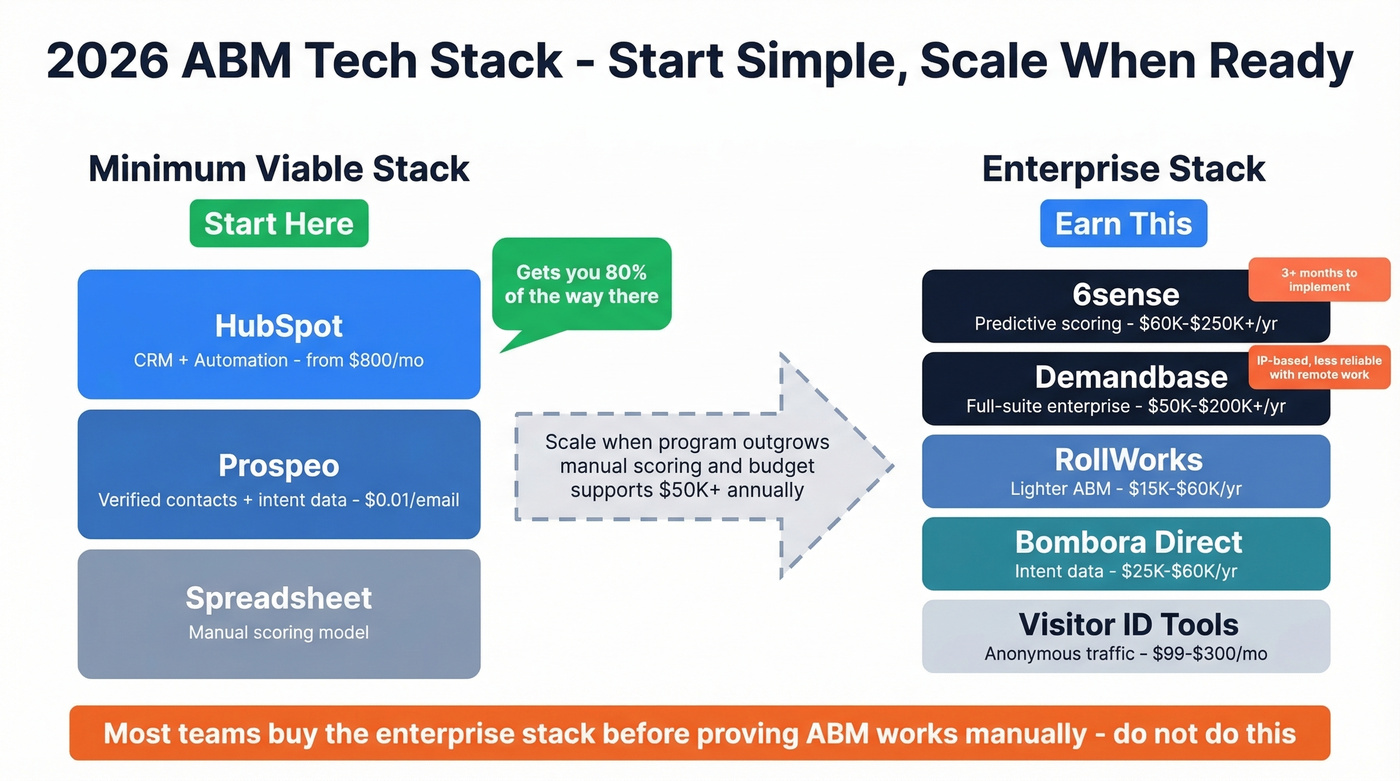
| Tool | Best For | Price Range | Reality Check |
|---|---|---|---|
| 6sense | Predictive scoring | ~$60K-$250K+/yr | 3+ months to implement |
| Demandbase | Full-suite enterprise | ~$50K-$200K+/yr | Complex config, IP-based |
| RollWorks | Lighter ABM | ~$15K-$60K/yr | Manual data stitching |
| Bombora (direct) | Intent data | ~$25K-$60K/yr | Data only, no execution |
| HubSpot | CRM + automation | From ~$800/mo | ABM features improving |
| Visitor ID tools | Anonymous traffic | ~$99-$300/mo | Supplemental signal |
6sense is widely known for a 3+ month implementation timeline, and Demandbase's IP-based identification can be less reliable with remote and hybrid traffic. Both are powerful once configured - but configuration is the bottleneck.
We've tested the minimum viable stack: HubSpot + Prospeo + a spreadsheet for scoring. That gets you 80% of the way there. Add a dedicated ABM platform when your program outgrows manual scoring and your budget supports $50K+ annual spend. (If you're evaluating vendors, start with a shortlist of SDR tools and sales prospecting databases.)
ABM Mistakes That Kill Programs
Treating ABM as campaigns. It's an operating system, not a flight. Build shared definitions, signal-based triggers, and quarterly review loops instead of launching "ABM campaigns" that end after six weeks.
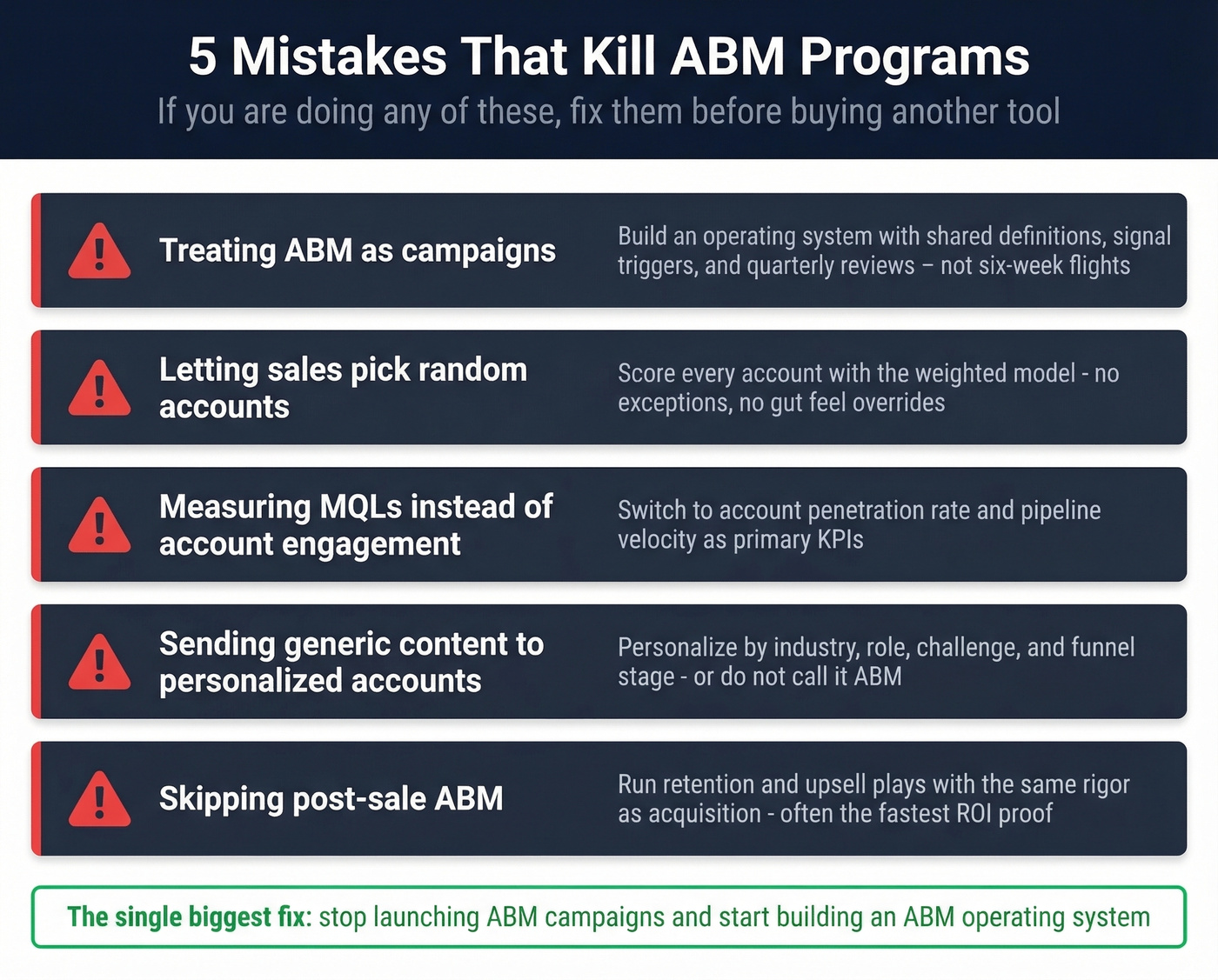
Letting sales pick random accounts. Score every account with the weighted model above. No exceptions, no "gut feel" overrides. We've watched teams waste entire quarters on accounts that scored below 40 because a VP had a "feeling" about them.
Measuring MQLs instead of account engagement. Switch to account penetration rate and pipeline velocity as primary KPIs. This one change reframes every conversation between sales and marketing.
Sending generic content to "personalized" accounts. Personalize by industry, role, challenge, and funnel stage - or don't call it ABM. (If you need a framework, map it to your B2B sales funnel.)
Skipping post-sale ABM. Your best expansion pipeline is existing customers. Run retention and upsell plays with the same rigor as acquisition. For teams that already have strong customer relationships, this is often the fastest path to proving ABM ROI internally.
The ABM teams hitting 8-15% meeting rates on Tier 1 accounts aren't guessing which companies are in-market. They're layering intent signals with verified contact data refreshed every 7 days - not the 6-week-old records most providers sell. Prospeo combines both at $0.01 per email.
Map entire buying committees with verified emails and direct dials in minutes.
ABM Strategy FAQ
How many accounts should be on a target list?
Between 50 and 200 for a focused program. Tier 1 maxes at 10-25 accounts, Tier 2 runs 50-150, and Tier 3 scales to 500+. Going wider than 200 for your core list dilutes personalization and stretches SDR capacity too thin.
What's the difference between ABM and demand gen?
Demand gen casts a wide net and measures individual leads. Account-based marketing targets specific companies and measures penetration, pipeline velocity, and multi-threaded engagement. The biggest practical difference: ABM requires sales and marketing to agree on the same account list before anything launches.
How long does ABM take to show results?
Expect 90 days for early engagement signals - meetings booked, multi-threaded conversations started. Pipeline and revenue impact typically show at six to nine months. Teams expecting results in 30 days are treating it like a campaign, not a durable operating system.
What's the minimum viable ABM tech stack?
A CRM, a data provider for verified contacts, and a spreadsheet for account scoring. Prospeo's free tier plus HubSpot covers most early-stage programs. Add platforms like 6sense or Demandbase once your budget supports $50K+ annual platform spend.
How do you measure ABM ROI?
Track account penetration rate, pipeline velocity, and influenced pipeline value using multi-touch attribution at the account level. High-performing programs consistently report 20-30% larger deal sizes and 15-25% shorter sales cycles as the clearest ROI indicators.