

B2B Average Email Open Rate: Why Every Source Gives You a Different Number
Your Q1 email report says 38% open rate. The CEO is thrilled. But half those "opens" are Apple Mail preloading tracking pixels on devices nobody's reading. The B2B average email open rate is 15-25% for genuine human opens, and around 40% if you're looking at raw metrics inflated by Apple Mail Privacy Protection. That gap is the single biggest source of confusion in email benchmarking right now.
One practitioner on r/coldemail watched their open rates drop from 25% to 15% over a few months - classic deliverability decay from bad list data. VIB Tech's benchmark roundup claims only 8% of B2B marketers rated email effective for lead gen in 2024, partly because they're measuring the wrong things. If your numbers look great but pipeline doesn't follow, your own dashboard is lying to you.
Why Open Rate Benchmarks Contradict Each Other
Before Apple rolled out Mail Privacy Protection in September 2021, open tracking worked the way everyone assumed: a tiny pixel loaded when a human opened the email. Post-MPP, Apple Mail preloads that pixel automatically. MPP is enabled on ~97% of Apple iPhone devices, and those users register as "opens" whether they read your email or not.
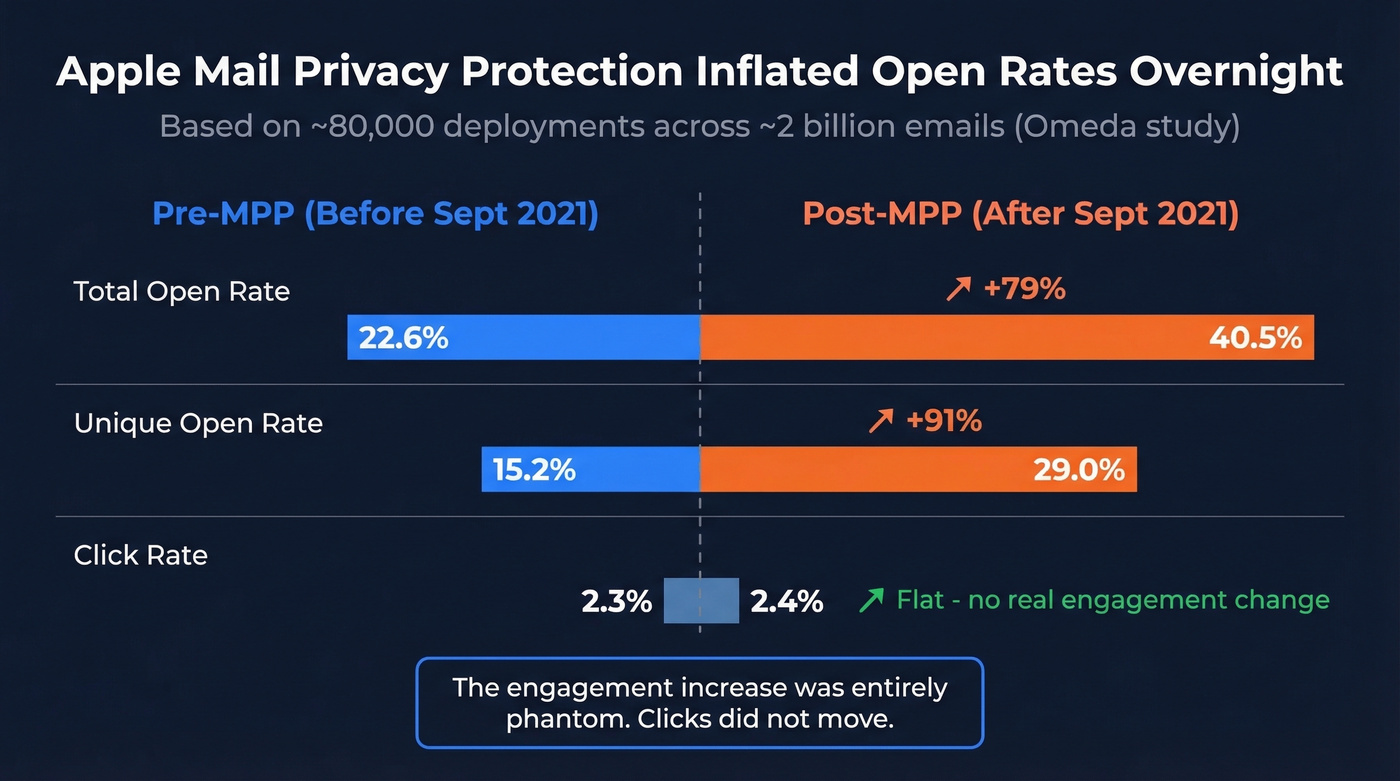
Omeda ran the most rigorous before/after analysis we've seen - ~80,000 deployments across roughly 2 billion emails. Total open rates jumped from 22.6% to 40.5%. Unique open rates went from 15.2% to 29.0%. Click rates? Flat at ~2.3-2.4%. The "engagement" increase was entirely phantom.
Meanwhile, Mailchimp's benchmark page was last updated December 2023 and warns that open-rate accuracy may be impacted by MPP. Campaign Monitor still references a 15.1% figure from the 2018 DMA report. HubSpot puts the cross-industry average at 42.35%. They're all measuring different things in different eras with different methodologies. Any benchmark that doesn't disclose its MPP stance is useless.
Open Rates by Campaign Type
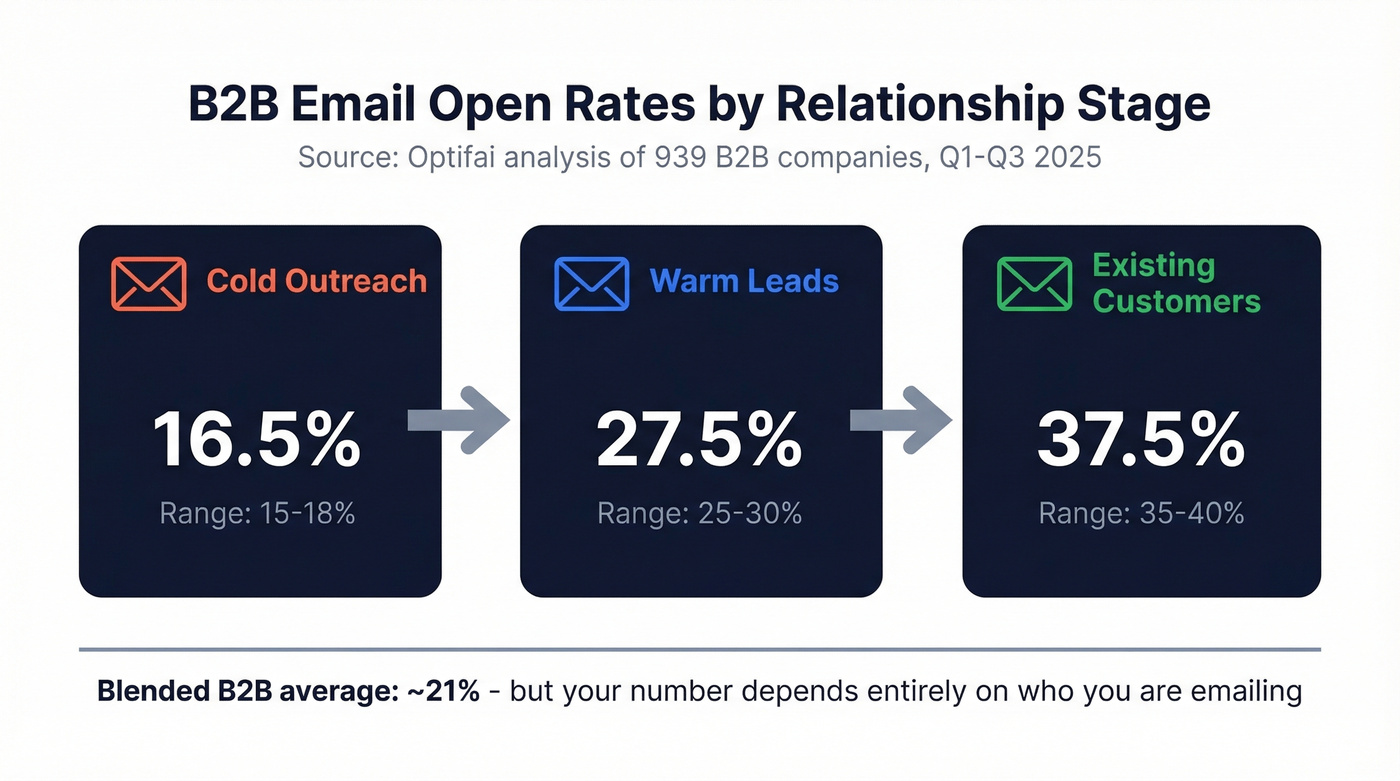
Optifai's analysis of 939 B2B companies (Q1-Q3 2025; updated Feb 16, 2026) breaks it down by relationship stage:
| Email Type | Avg Open Rate | Typical Range |
|---|---|---|
| Cold outreach | 16.5% | 15-18% |
| Warm leads | 27.5% | 25-30% |
| Existing customers | 37.5% | 35-40% |
The VIB Tech 2026 benchmark pegs the overall B2B marketing email open rate at 20.8%, which aligns with Optifai's blended sales-email figure of 21.3%. One practitioner on r/b2b_sales reported a 32% open rate on a cold campaign - strong, but their bounce rate was 7-8%, well above the recommended 5% ceiling. Small, optimized lists aren't benchmarks.
If you're building sequences, a solid starting point is a proven B2B cold email sequence structure.

Cold outreach open rates live or die on list quality. Every bounce above 5% tells ISPs you're sending to garbage data, dragging inbox placement down across your entire domain. Prospeo's 5-step verification - spam-trap removal, honeypot filtering, catch-all handling - delivers 98% email accuracy at $0.01/email.
Fix the upstream problem before you A/B test another subject line.
Open Rates by Industry
The "Sales Email" column reflects Optifai's B2B sales data. The "Marketing Email" column uses MailerLite industry benchmarks republished by ClickDimensions, which include opted-in lists and carry significant MPP inflation.
| Industry | Sales Email Open Rate | Marketing Email (MPP-inflated) |
|---|---|---|
| SaaS / Software | 23% | 38.14% |
| Manufacturing | 19% | 32.65% |
| Consulting | 21% | 45.74% |
A 23% sales email open rate for SaaS and a 38.14% marketing email open rate for the same vertical aren't contradictions - they're different email types measured with different levels of MPP contamination. When you're evaluating the average open rate for B2B email in your vertical, always check whether the source separates sales from marketing sends.
What Actually Moves the Needle
Open rate is a directional signal, not a performance metric. If you're reporting open rates to your VP of Sales without context, you're misleading them.
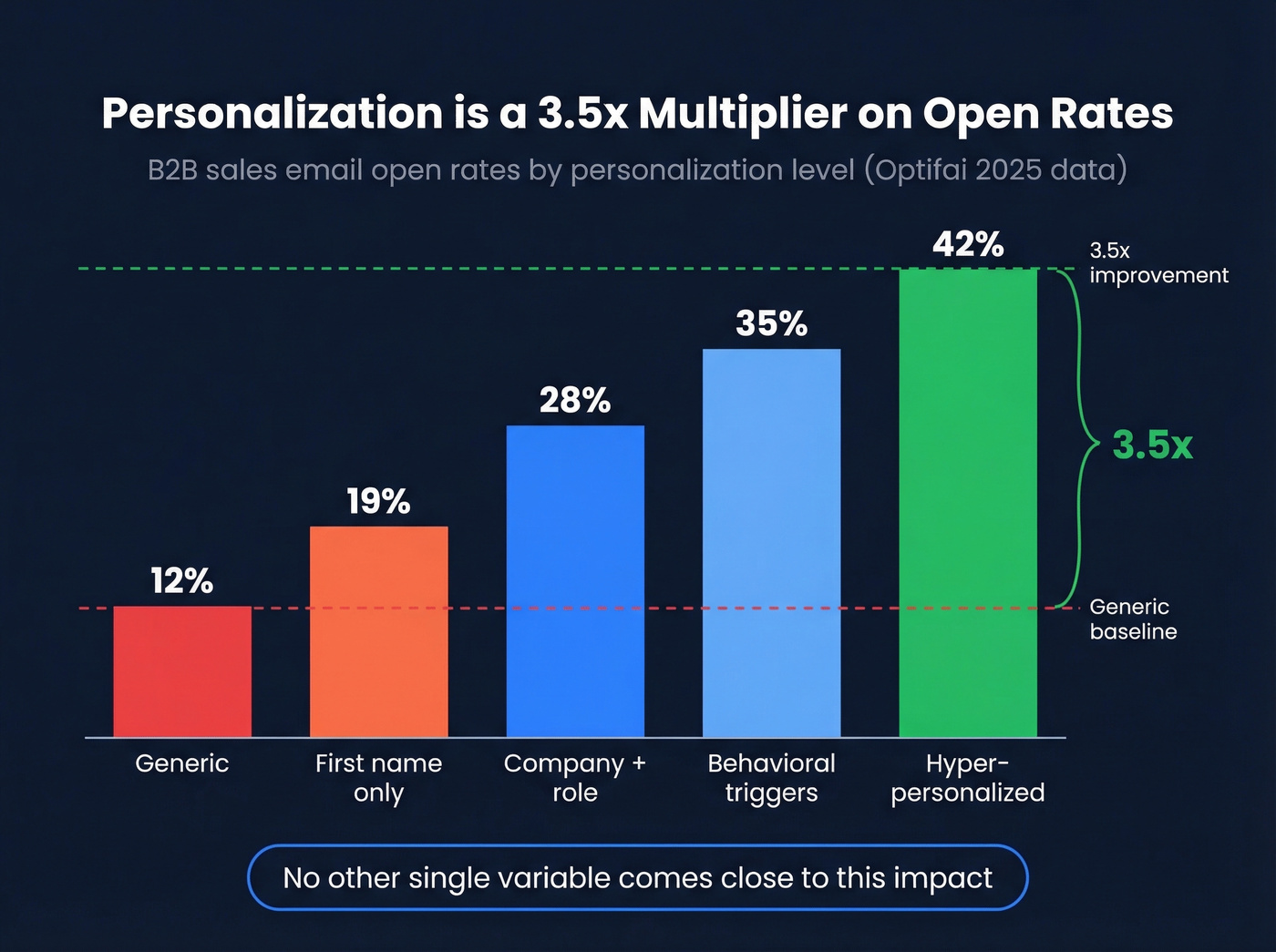
Optifai's data shows a wide spread across personalization levels:
| Personalization Level | Open Rate |
|---|---|
| Generic | 12% |
| First-name only | 19% |
| Company + role | 28% |
| Behavioral triggers | 35% |
| Hyper-personalized | 42% |
That's a 3.5x multiplier from generic to hyper-personalized. No other single variable comes close.
Tuesday at 8-9 AM produces a 26% open rate - 22% higher than the overall average in Optifai's dataset. For inbound leads, responding within 5 minutes yields a 51% open rate on your follow-up. Wait 24 hours and that drops to 12%. We've seen this pattern hold across dozens of campaigns: speed-to-lead is the most underrated factor in email performance, and it's the one most teams ignore because it requires operational changes, not just better copy.
If you want a data-backed send-time baseline, see best time to send cold emails.
List quality is the upstream variable nobody wants to talk about. Bounce rates above 5% signal to ISPs that you're sending to bad data, which tanks inbox placement across your entire domain. Make sure SPF, DKIM, and DMARC are properly configured - without authentication, ISPs are more likely to route you to spam. Prospeo's 5-step email verification catches invalid addresses, spam traps, and honeypots before they damage your sender reputation, with 98% accuracy across 143M+ verified emails.
If you're troubleshooting bounces specifically, start with email bounce rate. For inbox placement, use an email deliverability guide. And if you're tightening authentication, SPF and DMARC alignment are the usual culprits.

What to Track Instead of Open Rate
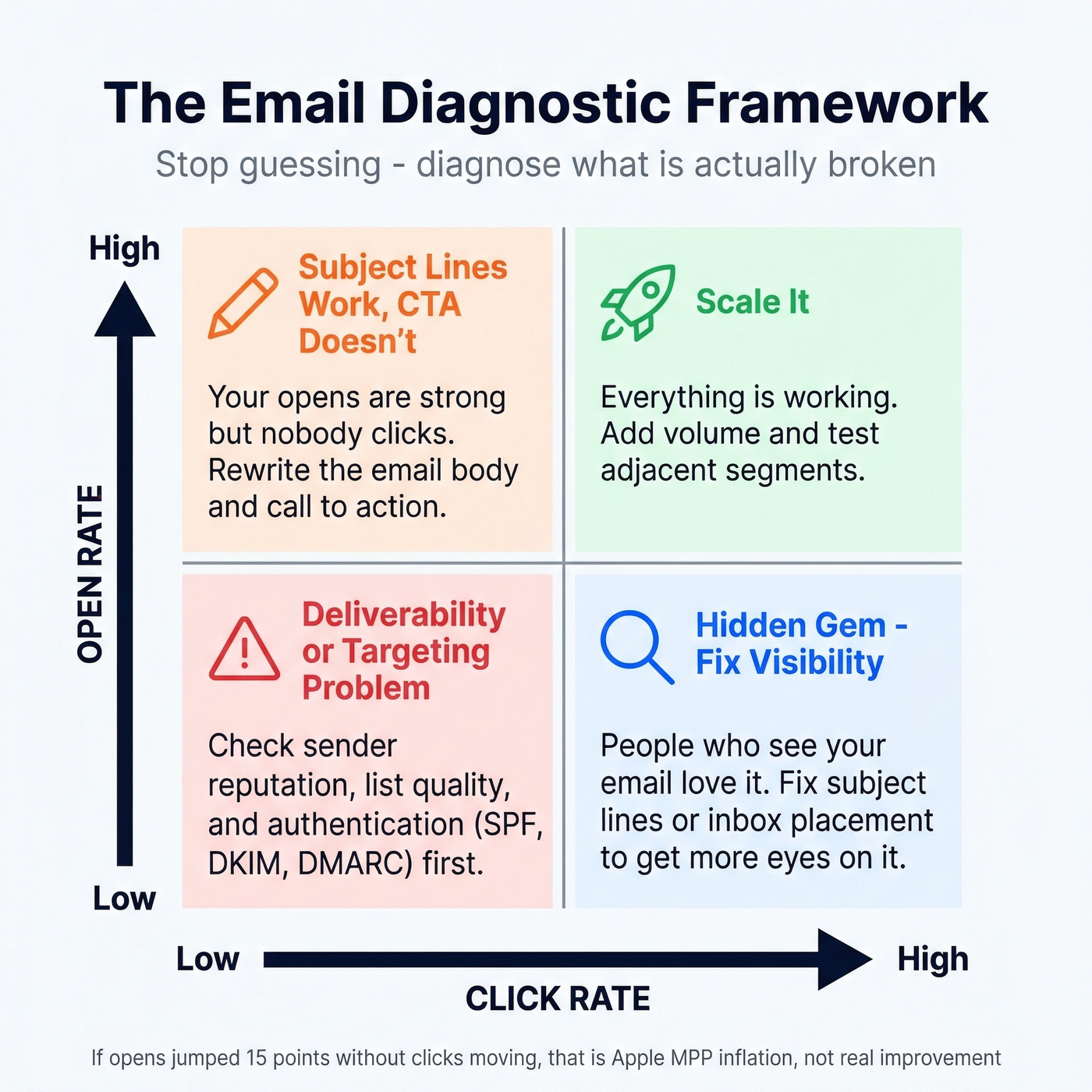
Let's be honest: most teams obsess over open rates because they're the easiest number to screenshot for a Slack update. Here's the diagnostic framework that actually tells you what's broken.
Click-to-open rate (CTOR) survived MPP. The formula: (Unique Clicks / Unique Opens) x 100. HubSpot's cross-industry CTOR average is 5.3% - if you're above that, your message resonates with the people who see it. Reply rate is the gold standard for outbound. The average sits around 5-6%; 10%+ means your targeting and messaging are genuinely working.
If you want to standardize how you report clicks, use a consistent click rate formula.
The four-quadrant diagnostic we use internally:
- Low opens + low clicks - Deliverability or targeting problem. Check sender reputation and list quality first.
- High opens + low clicks - Subject lines work, CTA doesn't. Rewrite the body.
- Low opens + high CTOR - People who see your email love it, but not enough see it. Subject line or inbox placement issue.
- High opens + high clicks - Scale it. Add volume, test adjacent segments.
Here's the thing: if your open rate jumped 15 points without a corresponding click-rate increase, you didn't get better at email. Apple got better at preloading pixels.
Most B2B teams would improve pipeline faster by cutting their list in half and verifying every address than by A/B testing subject lines for another quarter. Data quality is unsexy, but it's the highest-leverage fix in outbound email. Skip the subject-line optimization rabbit hole if your bounce rate is above 3% - fix the foundation first.
If you do test subject lines, pull from a vetted set of email subject line examples instead of guessing.
The article proves it: hyper-personalized emails hit 42% open rates vs 12% for generic blasts. Prospeo returns 50+ data points per contact - job title, company size, tech stack, intent signals - so every email reads like you did the research. 143M+ verified emails, refreshed every 7 days.
Stop sending generic cold emails to unverified addresses.
FAQ
What's a good B2B email open rate?
For cold outreach, anything above 25% is solid; above 35% means your targeting and personalization are dialed in. For marketing emails to opted-in lists, 20-25% adjusted for MPP is healthy. Raw dashboard numbers around 40% typically include phantom opens from Apple Mail.
Why did my open rate suddenly jump?
Apple Mail Privacy Protection preloads tracking pixels and registers every Apple Mail recipient as an "open," regardless of whether they read the message. If clicks didn't rise proportionally, MPP inflation is the cause. Check CTOR and reply rates instead.
How does list quality affect open rates?
Bad addresses cause bounces above 5%, which damage your sender reputation with ISPs and reduce inbox placement domain-wide. A 5-step verification process that catches spam traps and honeypots keeps bounce rates under control and protects your sending domain long-term.
What's a realistic B2B cold email open rate in 2026?
Expect 15-18% on cold outreach to net-new prospects, based on Optifai's analysis of 939 B2B companies. With strong personalization and verified data, top performers consistently hit 25-30%. Anything above 40% on cold sends likely reflects MPP inflation, not genuine engagement.