

Best B2B Blogs to Follow in 2026 (and How to Run One That Drives Pipeline)
58% of marketers say search traffic is down. Gartner projected traditional search volume would drop 25% by 2026, and the data is bearing that out. Yet the best B2B blogs winning right now aren't shutting down - they're rebuilding around pipeline instead of pageviews. The blog isn't dead. The blog that chases traffic for traffic's sake is.
If You Just Want Three Subscriptions
- Reforge - Deep-dive frameworks on growth, retention, and monetization from operators who've actually scaled companies. No fluff.
- Ahrefs Blog - The gold standard for SEO and content marketing education. Most posts are backed by their own crawl data, which makes them genuinely useful instead of theoretical.
- Lenny's Newsletter - Product and growth strategy from a former Airbnb PM. The subscriber base is massive for a reason: original research and practitioner interviews you can't get elsewhere.
Below: the full list, plus a framework for running a B2B blog that connects to pipeline - not just pageviews.
Is B2B Blogging Still Worth It?
Let's talk numbers. The average B2B website conversion rate is 1.8% A healthy target is 3-5%, and top landing pages push past 10%. Most company blogs sit well below that 3% floor, which means the problem isn't blogging as a format. It's how most teams execute it.
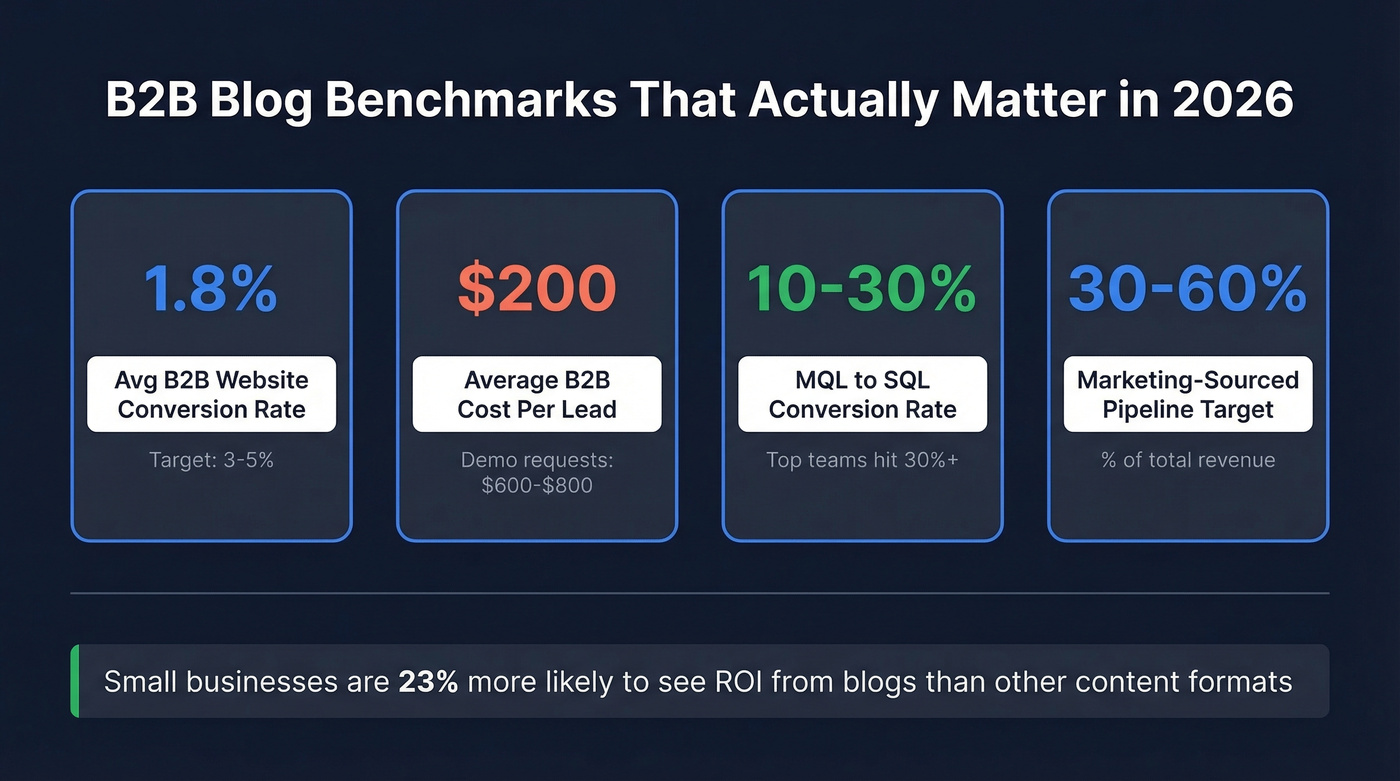
Marketing-sourced pipeline should contribute 30-60% of total revenue targets. With average B2B CPL at $200 and demo-request CPLs reaching $600-$800, a blog that converts at even 2% is one of the cheapest pipeline sources available. The MQL-to-SQL conversion benchmark sits at 10-30%, with top teams clustering toward the upper end. That gap between "someone read our blog" and "someone entered the pipeline" is where most content strategies fall apart.
The recurring debate - whether to kill the blog entirely and redirect effort to LinkedIn or a single resource page - misses the point. Small businesses are 23% more likely to see ROI from blogs than from other content formats. The channel works. The measurement framework most teams use doesn't.
The Biggest Mistake Most Teams Make
Most B2B blogs optimize for the wrong KPI. They chase pageviews, time-on-page, and subscriber counts - and end up building the best-read magazine in their industry that's still the least effective sales tool in the stack.
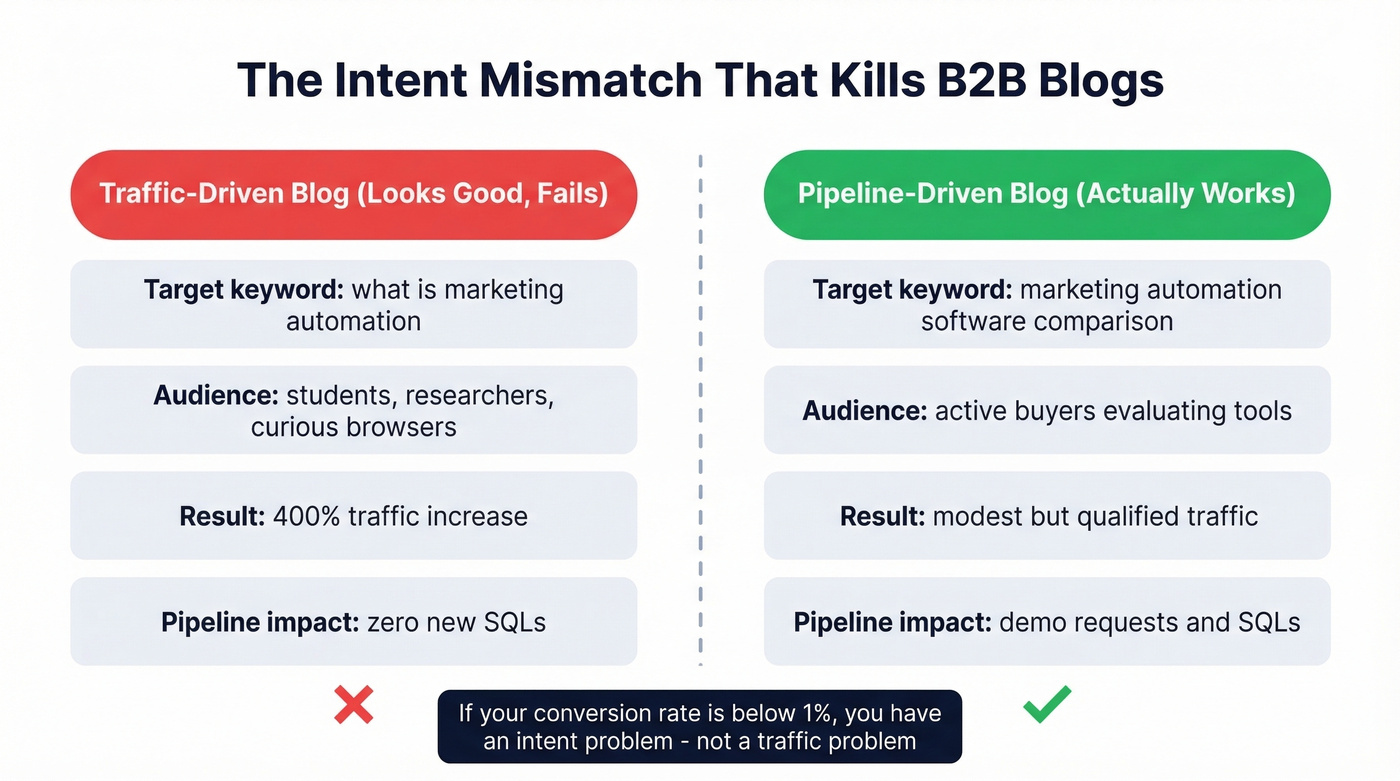
The root cause is an intent mismatch. A post targeting "what is marketing automation" attracts researchers and students. A post targeting "marketing automation software comparison" attracts buyers. Both generate traffic. Only one generates pipeline. We've seen teams celebrate a 400% traffic increase from informational content while their SQL numbers stayed flat. The blog was working as a publication. It was failing as a lead generation engine.
If your conversion rate is below 1%, you don't have a traffic problem. You have an intent problem. Fix the query targeting before you fix the content calendar.
Best B2B Blogs and Newsletters
We picked these based on three criteria: data-backed analysis, practitioner-led perspectives (not ghostwritten corporate content), and a track record of publishing original insight rather than repackaged conventional wisdom.
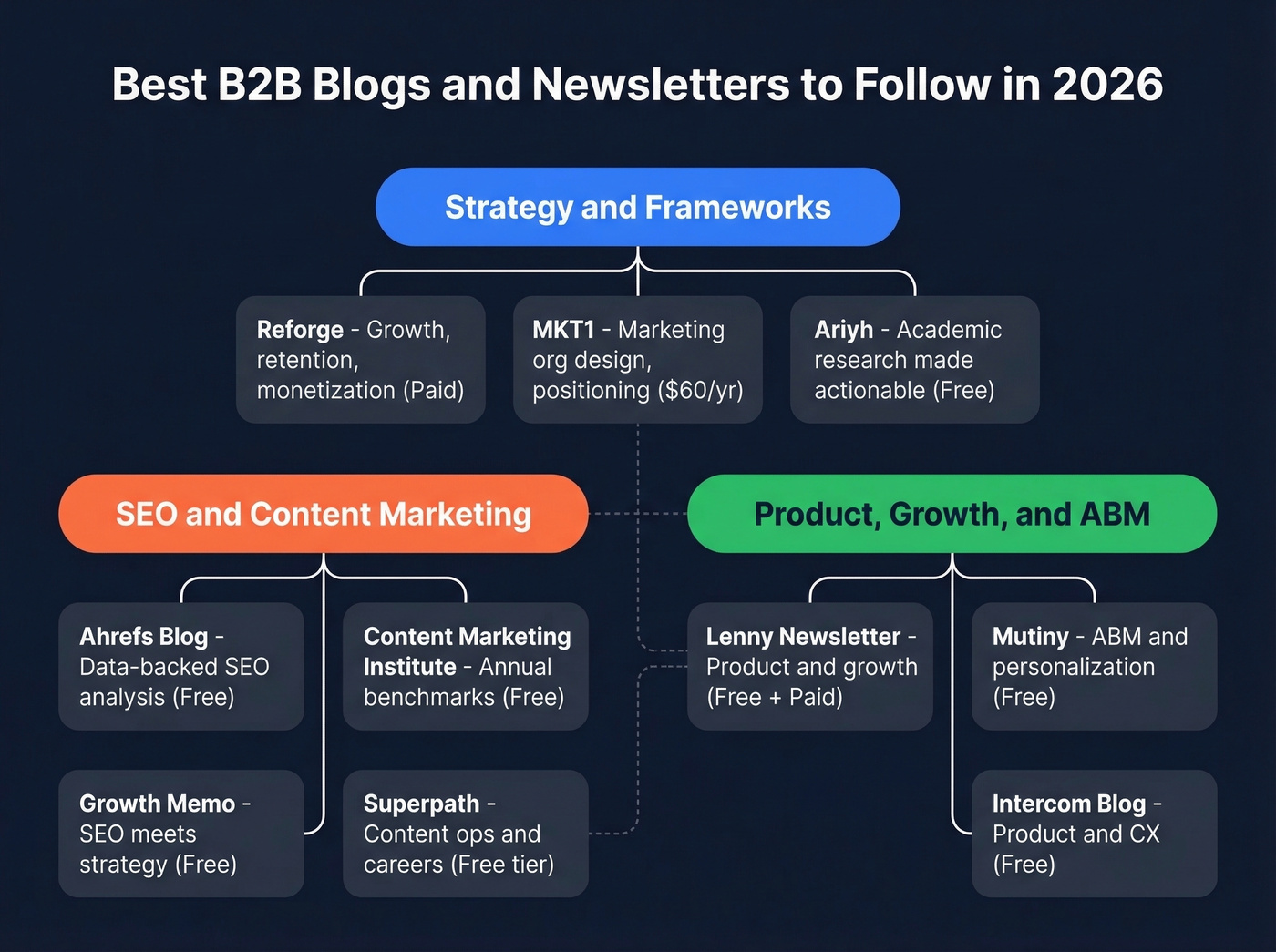
| Blog/Newsletter | Focus Area | Format | Free or Paid |
|---|---|---|---|
| Reforge | Growth strategy | Essays | Paid |
| MKT1 | Marketing strategy | Newsletter | $60/yr |
| Growth Memo | SEO + growth | Newsletter | Free |
| Ahrefs Blog | SEO + content | Blog posts + data | Free |
| Content Marketing Institute | Content strategy | Blog + research | Free |
| Superpath | Content careers | Newsletter + community | Free tier |
| Lenny's Newsletter | Product + growth | Newsletter | Free + paid |
| Mutiny | ABM + personalization | Blog | Free |
| Ariyh | Research-backed marketing | Newsletter | Free |
| Intercom Blog | Product + CX | Blog | Free |
Strategy and Frameworks
Reforge remains the most rigorous source for growth frameworks. Their essays on retention curves, monetization models, and growth loops are the kind of content that changes how you think about your funnel, not just how you write about it. If you can expense it, do.
MKT1 is Emily Kramer's newsletter, and at $60/year it's absurdly underpriced. Over 10,000 marketers subscribe. Her breakdowns of marketing org design and positioning are the most practical B2B content marketing strategy material in the space - we've shared her positioning frameworks internally more than once.
SEO and Content Marketing
Ahrefs Blog is the most consistently data-backed SEO blog publishing today. They regularly use their own crawl data to support analysis, which means you're getting evidence, not opinion. If you only follow one SEO blog, this is it.
How does it compare to the alternatives? Content Marketing Institute publishes their annual B2B content marketing research - essential for benchmarking your program, but less tactical day-to-day. Superpath and Animalz serve content practitioners with hands-on advice about writing, editing, and content ops. Growth Memo from Kevin Indig bridges SEO and strategy, covering how search is evolving in ways most pure-SEO publications don't touch.
Product, Growth, and ABM
Lenny's Newsletter has become default reading for product managers and growth leaders. His subscriber interviews and original survey data make it genuinely differentiated - it's the rare newsletter where every issue teaches something you didn't know.
Mutiny publishes strong ABM + personalization content, making it one of the best resources if you're exploring account-based strategies to resonate with target buying committees. Intercom Blog combines product storytelling with design quality that most company publications can't match.
On the research side, Forrester, Gartner, and McKinsey shape boardroom conversations. Most of their work sits behind paywalls, but free summaries are still worth tracking. Ariyh takes academic marketing research and translates it into actionable takeaways - a genuinely unique angle that no one else occupies. The consensus on r/marketing tends to agree: Ariyh is one of the few newsletters people actually read instead of archiving.

You're reading about blogs that drive pipeline - but content alone doesn't close deals. When a prospect reads your blog, you need their verified email to follow up. Prospeo gives you 143M+ verified emails at 98% accuracy for ~$0.01 each, so every blog visitor becomes a reachable lead.
Stop publishing into the void. Turn readers into pipeline.
B2B Blog Examples That Work
Knowing what good looks like matters more than following a template. These blogs execute differently, but they all connect content to business outcomes.
New Relic
New Relic publishes daily - an aggressive cadence that works because they maintain clear headlines, strong category navigation, and non-jargon writing even when covering observability and infrastructure monitoring. Most teams shouldn't try to match this pace, but the structural discipline is worth studying.
Amphenol Advanced Sensors
Proof that "boring" industries can blog well. Amphenol sells industrial sensors, and their blog uses analogies to explain complex technical topics in scannable formats. Mid-page CTAs and downloadable resources are placed naturally. If you're in manufacturing or hardware and think blogging doesn't apply to you, study this one.
Fathom
Dense finance topics made scannable. Fathom mixes webinar recaps, how-to guides, and long-form analysis - the format variety keeps readers engaged across different learning preferences. B2B finance content doesn't have to read like a compliance document.
HubSpot
Love them or not, HubSpot's approach to content defined how most B2B teams think about blogging strategy. Their pillar-and-cluster model still works. The execution just requires more original insight than it did five years ago.
Salesforce
Salesforce has published about three posts per week since 2007. That kind of longevity is a benchmark in itself - it demonstrates that consistent publishing compounds authority over years, not months.
How AI Changes B2B Blogging
The AI-era shift isn't about using ChatGPT to write faster. It's about restructuring your content so it survives in a world where AI summarizes everything.
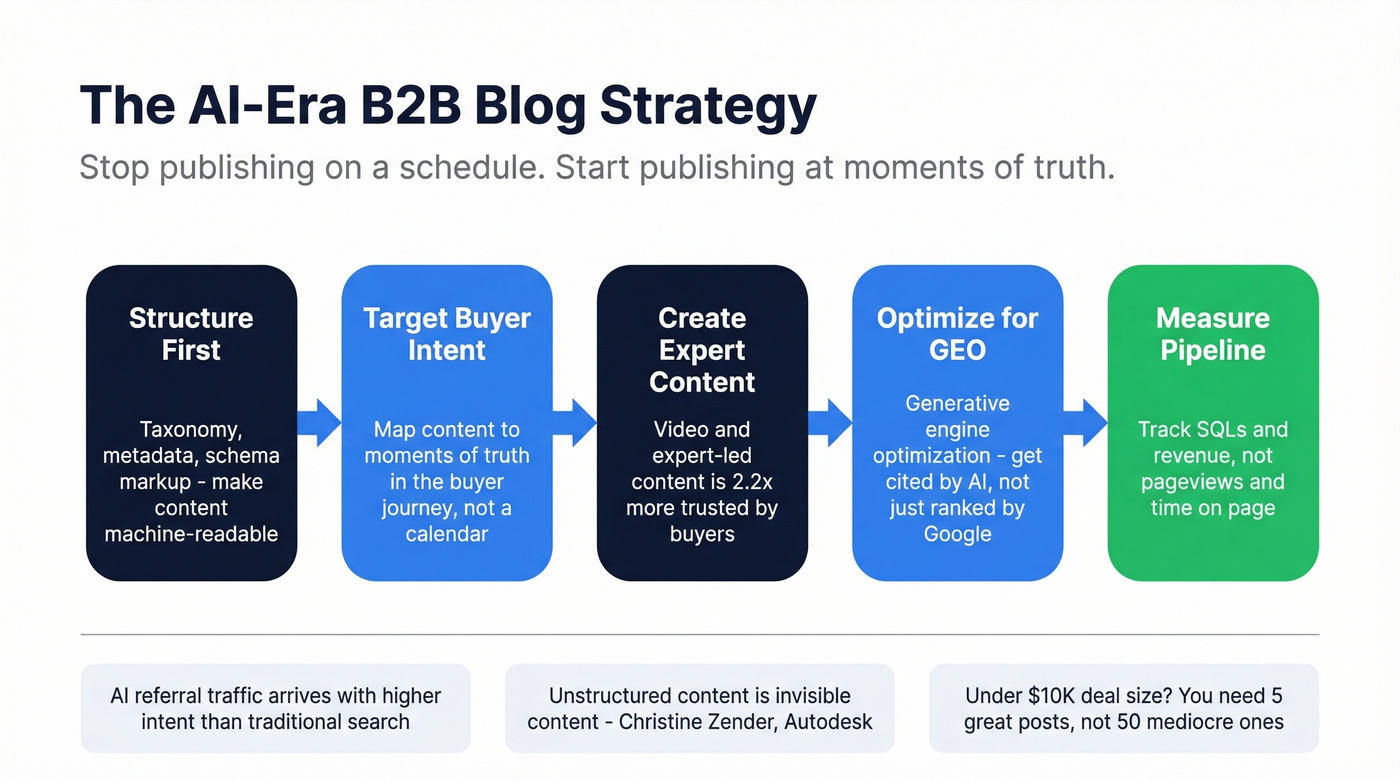
Christine Zender at Autodesk put it bluntly: "Unstructured content is invisible content." Taxonomy, metadata, and structured publishing practices are becoming make-or-break for whether your content gets reused, summarized, and surfaced by generative engines. This is generative engine optimization (GEO), and it's the SEO discipline that matters most right now.
Katie Ryan O'Connor at Asana argues teams should stop following fixed publishing schedules and instead design content around customer "moments of truth" - the specific points in a buyer's journey where the right piece of content changes a decision. That's a fundamental reframe from "publish twice a week" to "publish when it matters."
The upside: AI referral traffic tends to arrive with higher intent than traditional search traffic. Your blog doesn't need to win the traffic game anymore. It needs to win the trust game. Brands that invest in video and expert-led content are 2.2x more likely to be trusted by buyers.
Here's the thing: if your average deal size is under $10K, you don't need a 50-post blog. You need five deeply useful pieces that rank for buyer-intent keywords and one email sequence that nurtures everyone who reads them. Most B2B teams would get better results from publishing less and promoting more.
Your Blog Is a Hub, Not a Channel
Only 6% of B2B marketers rely on just one or two channels. The other 94% diversified their channel mix last year. Your blog should be the hub that feeds everything else - not a standalone channel competing with LinkedIn, YouTube, and podcasts.
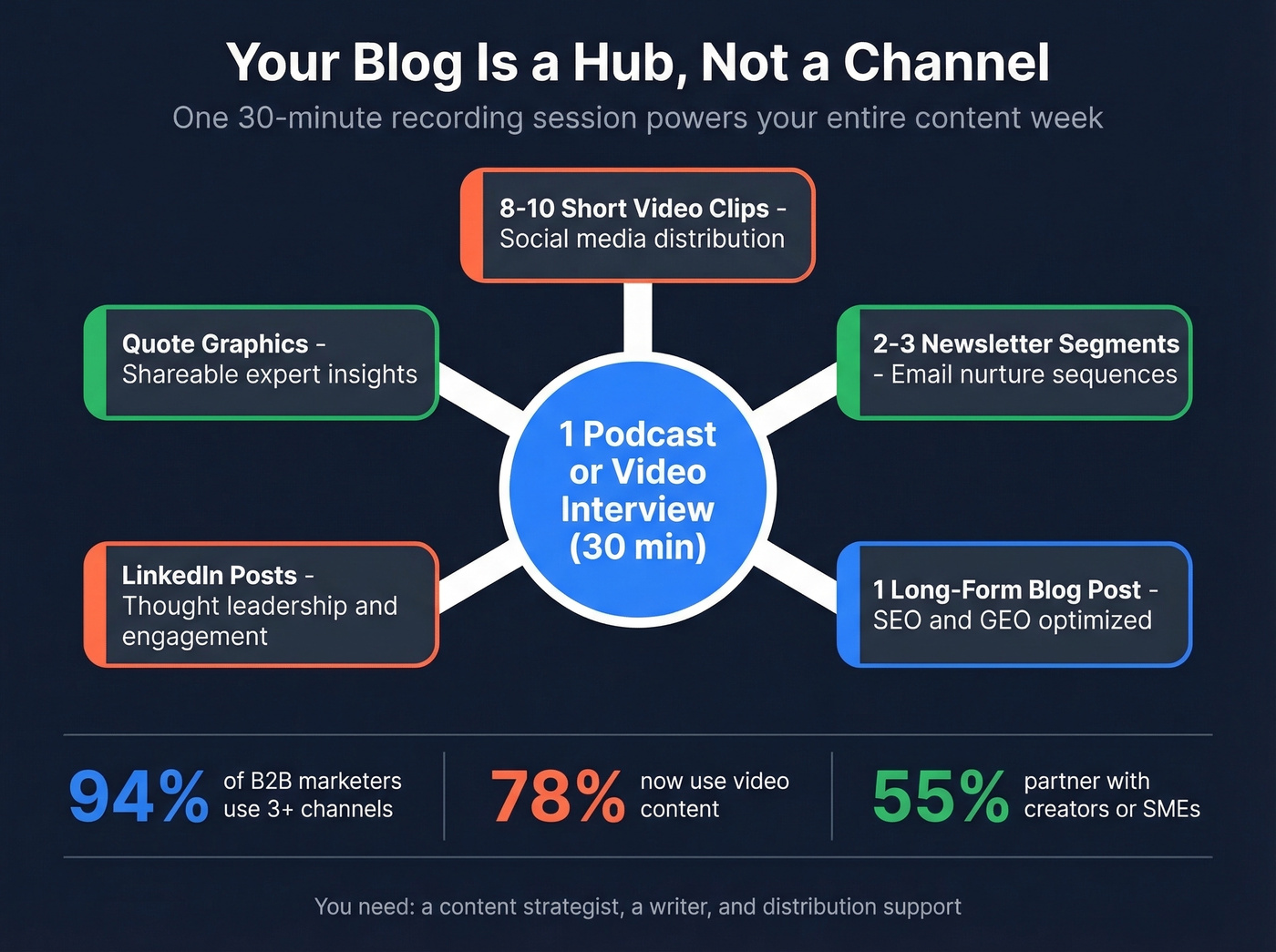
One 30-minute podcast or video interview generates 8-10 short clips for social, 2-3 newsletter segments, and one long-form blog post. That's an entire week of content from a single recording session. 78% of B2B marketers now use video, and 55% partner with creators or subject matter experts to produce it.
Running this model requires at minimum a content strategist, a writer, and distribution support - whether in-house, freelance, or agency. Many teams underestimate the operational side: someone needs to own repurposing, someone needs to manage the publishing calendar, and someone needs to handle outreach for guest contributors and podcast guests. Prospeo's Chrome extension cuts the research time for finding those contributors - it pulls verified contact data from any professional profile or company website in one click, which is a real time-saver when you're booking 4-5 guest spots per month.
The blog post becomes the long-form anchor. The clips drive awareness. The newsletter nurtures. And the blog's SEO value compounds over time while social content decays within days.
How to Measure Your B2B Blog
Stop measuring pageviews. Start measuring pipeline contribution.
The target: marketing-sourced pipeline should contribute 30-60% of revenue. If your blog feeds that number - through direct conversions, assisted touches, or branded search lift - it's working. If it doesn't, no amount of traffic growth matters.
The metrics that actually tell you something: pipeline influenced by content touches, branded search volume over time, direct traffic trends, and the qualitative signal that's hardest to track but most valuable - prospects telling your sales team "I feel like I already know you" before the first call. Branded search lift is an underrated proxy metric. If your blog is building real authority, more people search for your company name over time. That's a signal no vanity metric can fake.
One practical gap between "someone visited our blog" and "someone entered the pipeline" is contact data. When a target account engages with your content, tools like Prospeo's B2B database let you find verified emails for the right decision-maker instead of waiting for a form fill. The free tier gives you 75 verified emails per month - enough to test the workflow before committing budget.
If you want to systematize the handoff from content engagement to outbound, build a simple lead generation workflow and track lead generation metrics alongside pipeline health.

The best B2B blogs convert at 3-5%. The other 95% of visitors leave without a trace. Prospeo's CRM enrichment matches 83% of leads with 50+ data points - emails, direct dials, intent signals - so you can retarget and reach the readers who never filled out your form.
Your blog already attracts buyers. Now identify them.
FAQ
How often should a B2B blog publish?
One to two high-quality posts per week beats daily filler every time. Design your publishing rhythm around buyer moments - the points where your audience actually needs answers - not around an arbitrary content calendar. New Relic publishes daily, but most teams see better ROI from fewer, deeper pieces.
What's the difference between B2B and B2C blogging?
B2B targets buying committees of 6-10+ stakeholders across longer sales cycles, focusing on commercial intent and ROI justification. B2C targets individuals with emotional or transactional intent. The writing style, funnel design, and measurement frameworks are fundamentally different.
Are B2B blogs still worth it with AI search?
Yes, but lazy ones die. Original data, named experts, and genuine point of view can't be summarized away by AI. Blogs with strong taxonomy and structured content get surfaced more by generative engines, and AI referral traffic tends to arrive with higher intent than traditional organic.
What's a good conversion rate for a B2B blog?
The average B2B conversion rate is 1.8%, and a healthy target is 3-5%. If you're below 1%, you likely have an intent mismatch - you're attracting researchers instead of buyers - not a traffic problem.
How do I turn blog readers into sales pipeline?
Track which target accounts visit your content, then find verified contact data for decision-makers at those companies. Proactive outreach to engaged accounts closes the gap between content consumption and pipeline creation far faster than waiting for form fills. Skip this approach if your traffic is mostly top-of-funnel informational - fix the intent targeting first.