

B2B Brand Awareness: How to Build & Measure It (2026)
Your SDR sends 200 cold emails. Forty-three bounce. The rest land in inboxes where nobody recognizes your company name, so they get deleted alongside the Nigerian prince offers. That's not a demand gen problem - it's a brand awareness problem, and it's costing you pipeline every single day.
The Ehrenberg-Bass Institute's 95-5 rule explains why: only about 5% of your buyers are in-market at any given time. The other 95% don't know you exist. When they do enter a buying cycle, 78-86% of enterprise buyers only consider brands they already recognize before research even begins. If you're not already in that consideration set, you never get evaluated - no matter how good your product is.
The Short Version
- The real B2B budget split is 46% brand / 54% activation - not the 60/40 rule everyone quotes from consumer data.
- Track proxy signals, not vanity impressions. Branded search volume, direct sessions, AI citations, and share of voice actually move. Impressions alone tell you nothing.
- AI search is the biggest blind spot. Only 16% of brands track AI search performance, yet roughly half of Google searches already surface AI summaries.
- Brand recognition drives sales efficiency. Teams that invest in it see shorter cycles and higher win rates because reps aren't starting every conversation from zero.
Why Brand Recognition Matters More Than You Think
B2B buying committees now average 9-12 people. That's 9-12 individuals who need to feel comfortable putting your name on an internal recommendation, and 61% of the purchase journey happens before anyone talks to sales.
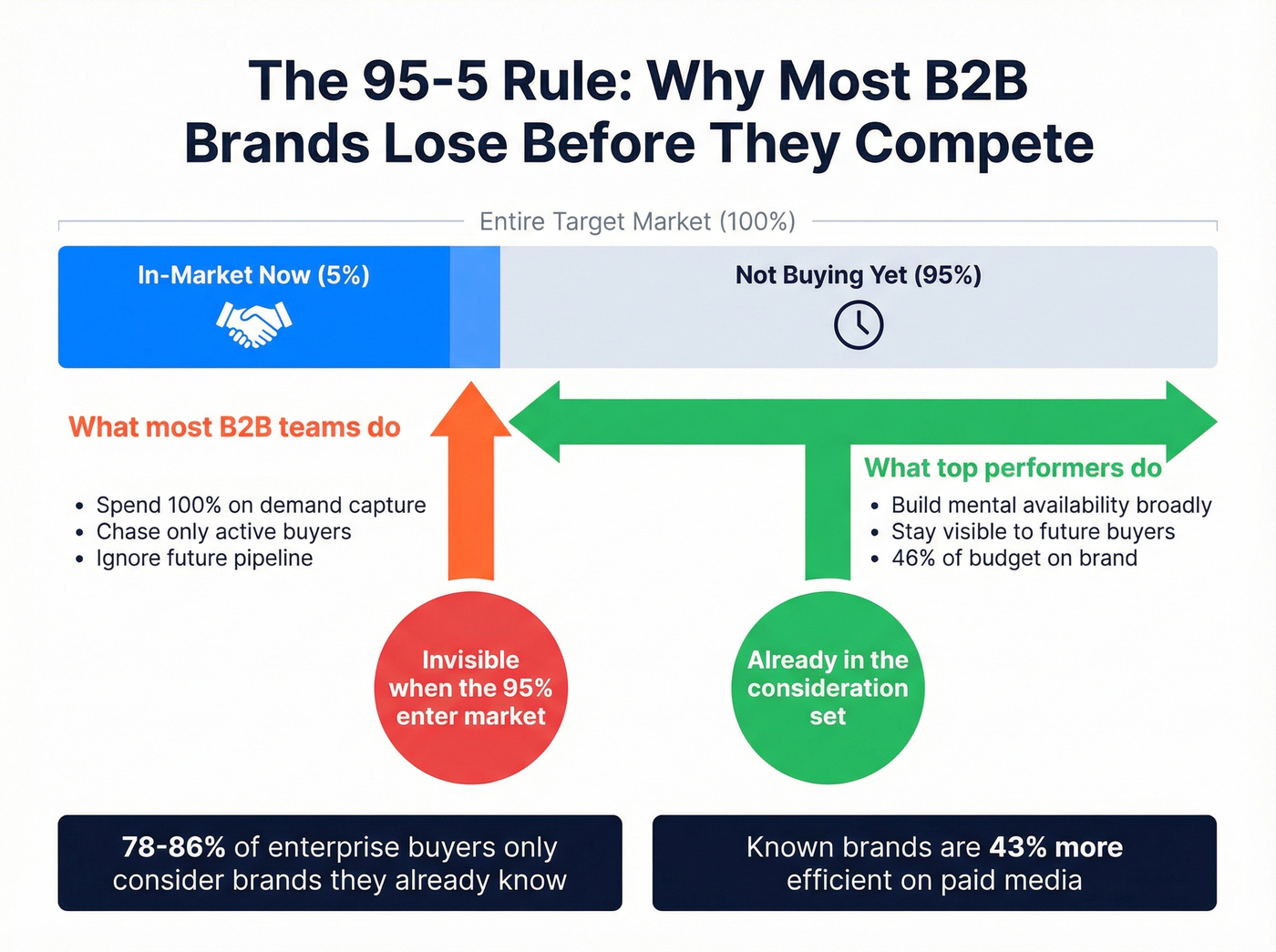
The 95-5 rule isn't just a catchy stat - it's a resource allocation framework. If you're spending everything chasing the 5% who are actively buying, you're ignoring the 95% who'll buy next quarter or next year. The first exposure to your brand carries the most weight: broad reach among future buyers compounds into pipeline faster than frequency against a small audience. This is what the Ehrenberg-Bass Institute calls building mental availability - making your brand the one that comes to mind when buyers hit a category entry point like "we need a better solution for X."
Here's the thing. A brand known by 4 out of 10 people in a target market is 43% more efficient on paid media than one known by 3 out of 10. The link between brand recognition and sales performance isn't theoretical. It shows up in cost-per-opportunity and win-rate data consistently.
The Budget Reality
Everyone cites Binet & Field's 60/40 brand-to-activation split. The problem? That number comes from consumer data. When LinkedIn commissioned Binet & Field to run a B2B-specific cut of the IPA Databank, the optimal split came back at 46% brand / 54% activation.
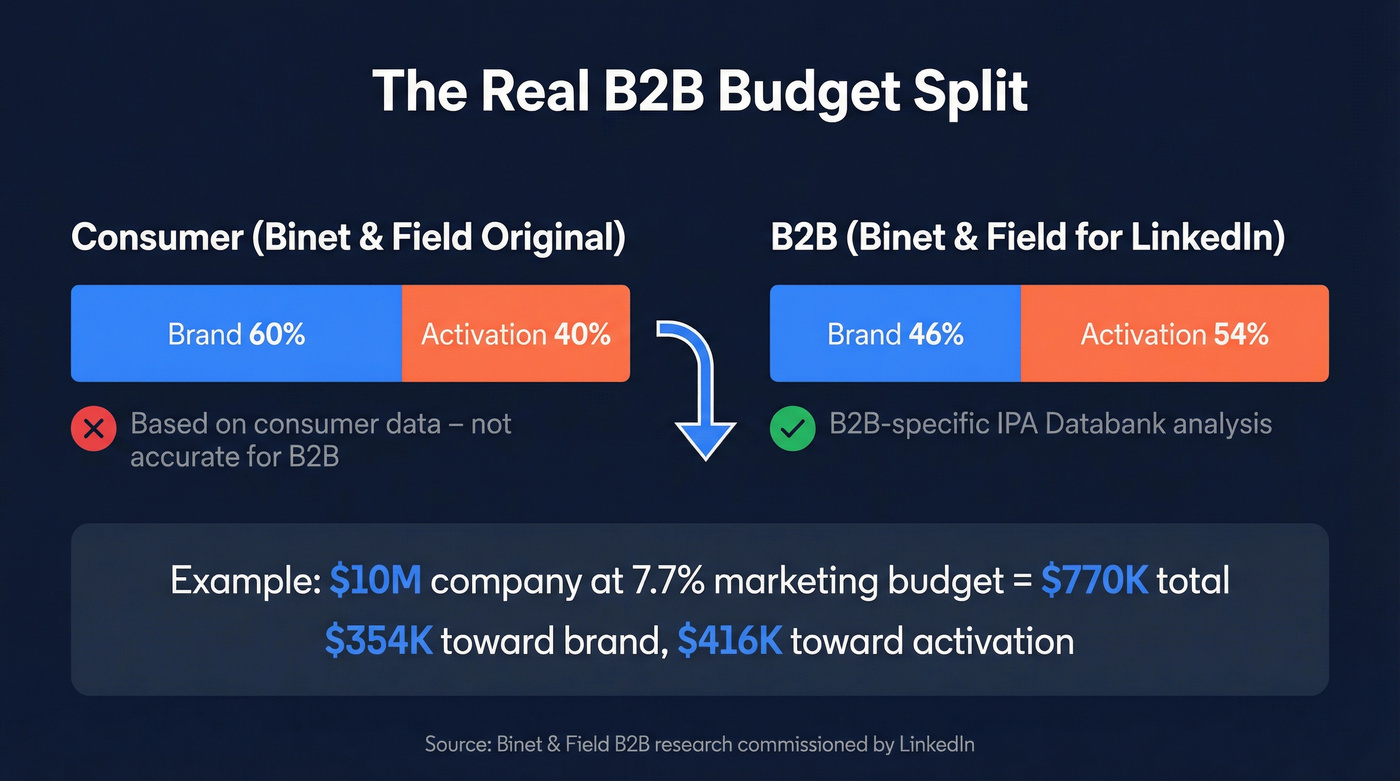
Benchmarkit's latest data puts the median B2B marketing budget at 10% of revenue. Gartner pegs CMO budgets at 7.7% of company revenue. For a $10M company, that's roughly $770K-$1M total, with around $354K-$460K toward brand. Not enough to waste on tactics that don't build memory. The B2B companies that sustain brand spend through downturns consistently outperform those that cut it when budgets tighten - treat it as a long-term investment, not a discretionary line item.

You're spending 46% of your budget building brand awareness. Don't let stale contact data undo it. Every bounced cold email tells mail servers your company can't be trusted - and ISPs remember. Prospeo's 98% email accuracy and 7-day data refresh mean your outreach reinforces brand recognition instead of destroying it.
Stop burning brand equity with bad data. Start for free.
How to Build B2B Brand Awareness
Thought Leadership
The Edelman-LinkedIn 2024 report found that 75%+ of management-level professionals researched a product they weren't previously considering after encountering strong thought leadership. Nine in ten said they're more receptive to sales outreach from companies producing quality thought leadership. And 86% are more likely to invite those companies into RFP processes.
We've seen this play out firsthand. Teams that publish consistently on industry channels - not just their own blog - build recognition as a byproduct of being genuinely useful. The key is specificity: a generic "state of the industry" post does nothing, but a detailed breakdown of how you solved a real problem earns memory and trust.
If you want a deeper playbook beyond publishing cadence, see thought leadership from the sales side too.
AI Search Optimization
Most B2B marketers are sleepwalking through this channel. McKinsey reports roughly 50% of Google searches include AI summaries, and brands are seeing 20-50% declines in traffic from traditional search as a result. Bain estimates [60% of searches now end without a click](https://www.bain.com/about/media-center/press-releases/20252/consumer-reliance-on-ai-search-results-signals-new-era-of-marketing - bain - company-about-80-of-search-users-rely-on-ai-summaries-at-least-40-of-the-time-on-traditional-search-engines-about-60-of-searches-now-end-without-the-user-progressing-to-a/).
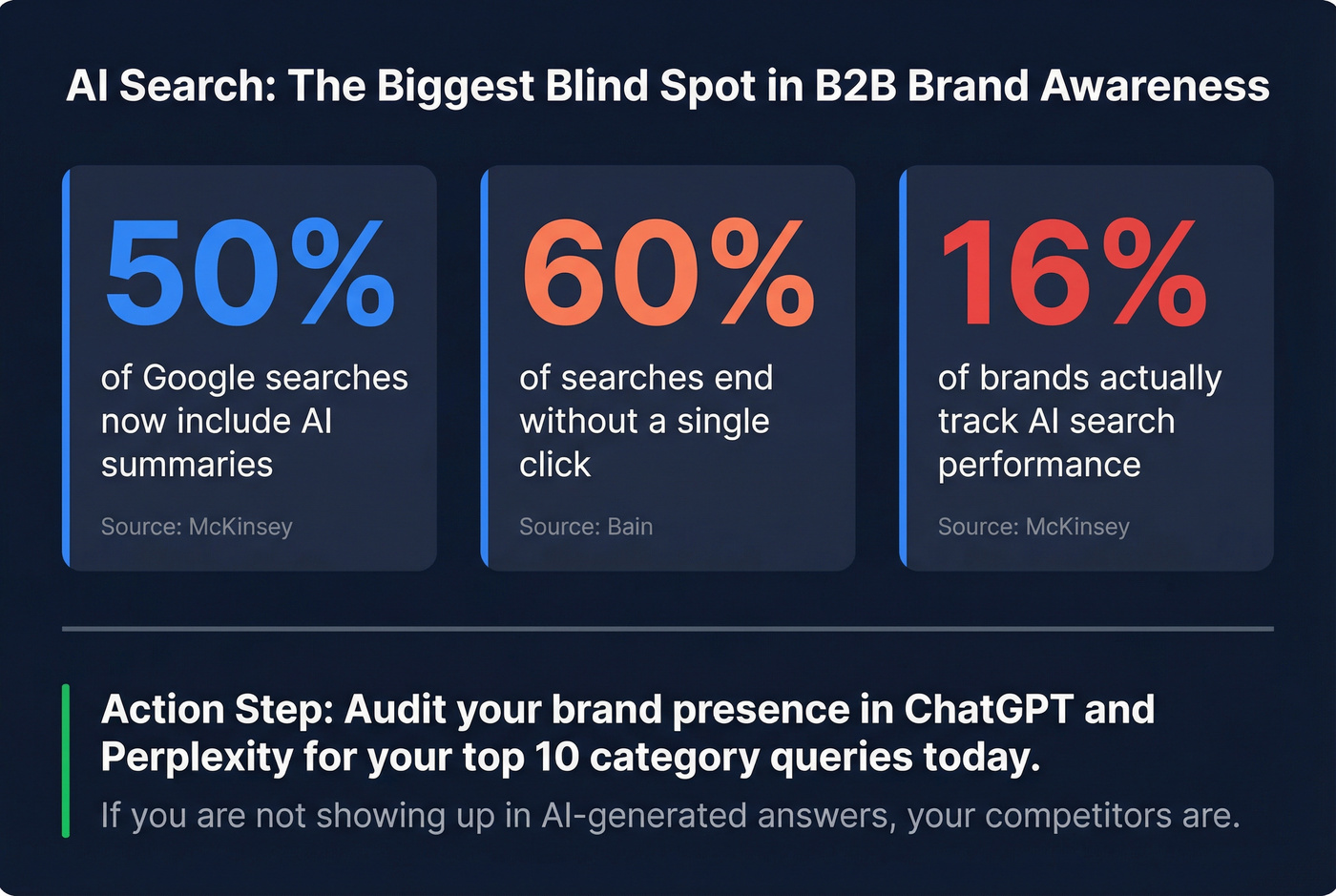
Your brand needs to show up inside the AI-generated answer. Start by auditing your presence in ChatGPT and Perplexity responses for your top 10 category queries. If you're not there, competitors are. This is the new battleground for B2B brand awareness, and only 16% of brands are even tracking it.
Running a Memorable Campaign
SOFTSWISS, a B2B gaming software company, targeted Malta - where 10% of the world's online gaming companies are registered - with OOH ads, radio, airport placements, and an experiential activation where they served branded spicy ice cream to 800 people near the offices of 29 target accounts. The result? A 33% lift in leads.
The lesson isn't "buy ice cream." It's that B2B buyers are humans who respond to creative, memorable brand experiences timed around industry moments. The best awareness campaigns combine geographic precision with a distinctive creative hook that earns memory. If your campaign looks like every other SaaS company's campaign, it won't stick.
For a repeatable structure, map this into a B2B marketing campaign framework.
Outbound as a Brand Channel
Every cold email your team sends is a brand impression. An email that bounces tells the recipient's mail server your data hygiene is poor - and ISPs remember. We've watched teams burn six figures on awareness campaigns, then undermine all of it with bounced outreach from stale contact lists. Prospeo's 98% email accuracy and 7-day data refresh cycle mean your outreach actually lands where it should, reinforcing the brand you've invested in rather than destroying it.
If you’re rebuilding the motion, start with a BDR playbook and a modern B2B outreach strategy.
Mistakes That Kill Your Brand
Do this - Invest in broad reach among future buyers, even when you can't attribute it to pipeline this quarter.
Not that - Obsess over pipeline metrics so hard that you starve the brand campaigns feeding next quarter's pipeline.
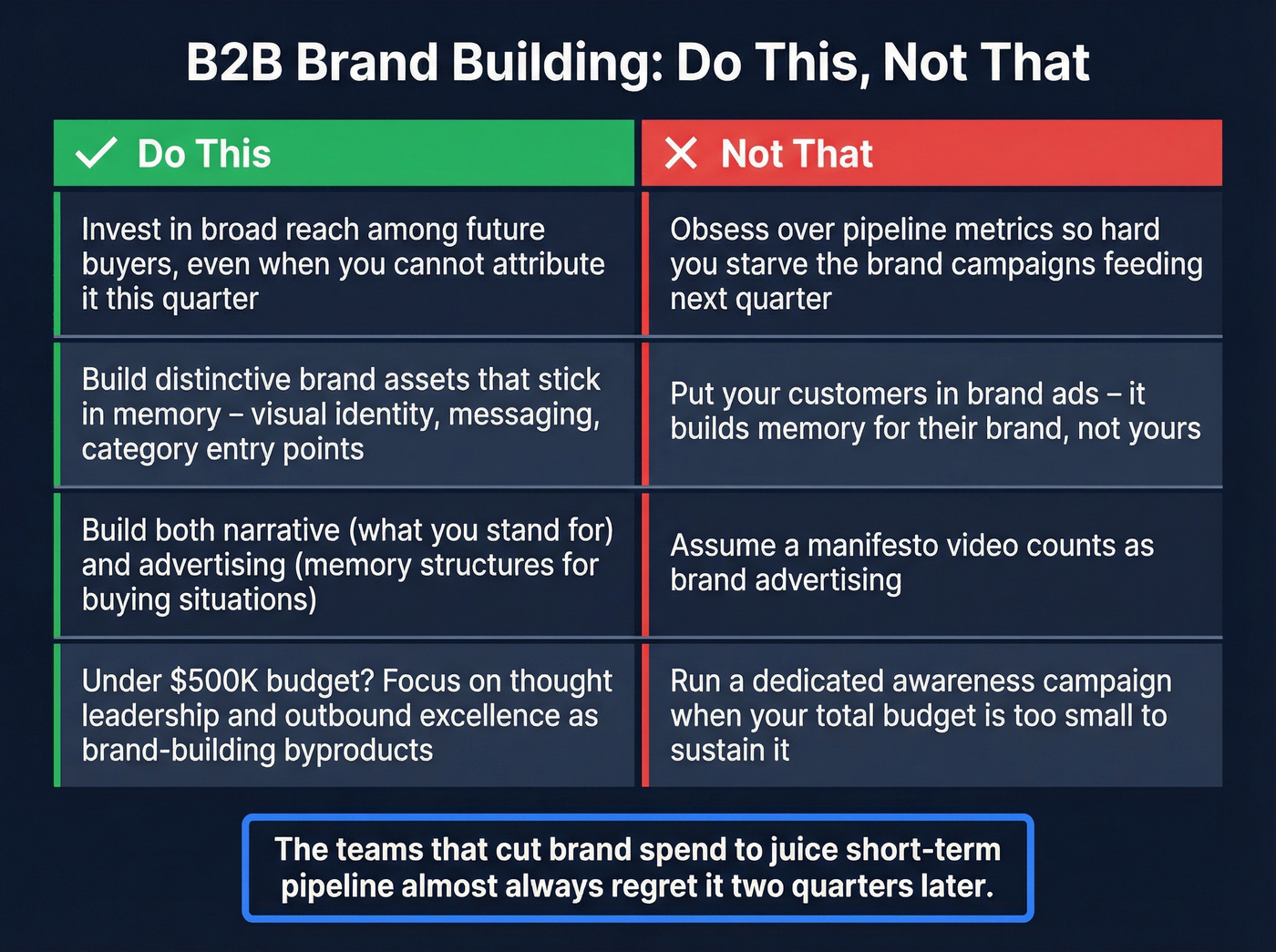
Do this - Build distinctive brand assets that stick in memory: visual identity, messaging frameworks, category entry points.
Not that - Put your customers in brand ads. It builds memory for their brand, not yours.
Do this - Build both narrative (what you stand for) and advertising (memory structures linked to buying situations).
Not that - Assume a manifesto video counts as brand advertising.
Let's be honest: if your total marketing budget is under $500K, skip the dedicated awareness campaign entirely. Instead, invest in thought leadership and outbound excellence - they build recognition as a byproduct while also generating pipeline. Dedicated brand campaigns are a luxury that only pays off at scale.
If you’re deciding where to place bets, align it to your broader B2B marketing strategy and go-to-market strategy.
How to Measure B2B Brand Awareness
Forget trying to find a single "brand awareness number." It doesn't exist. Build a proxy-signal dashboard and watch trends over 6-12 months.
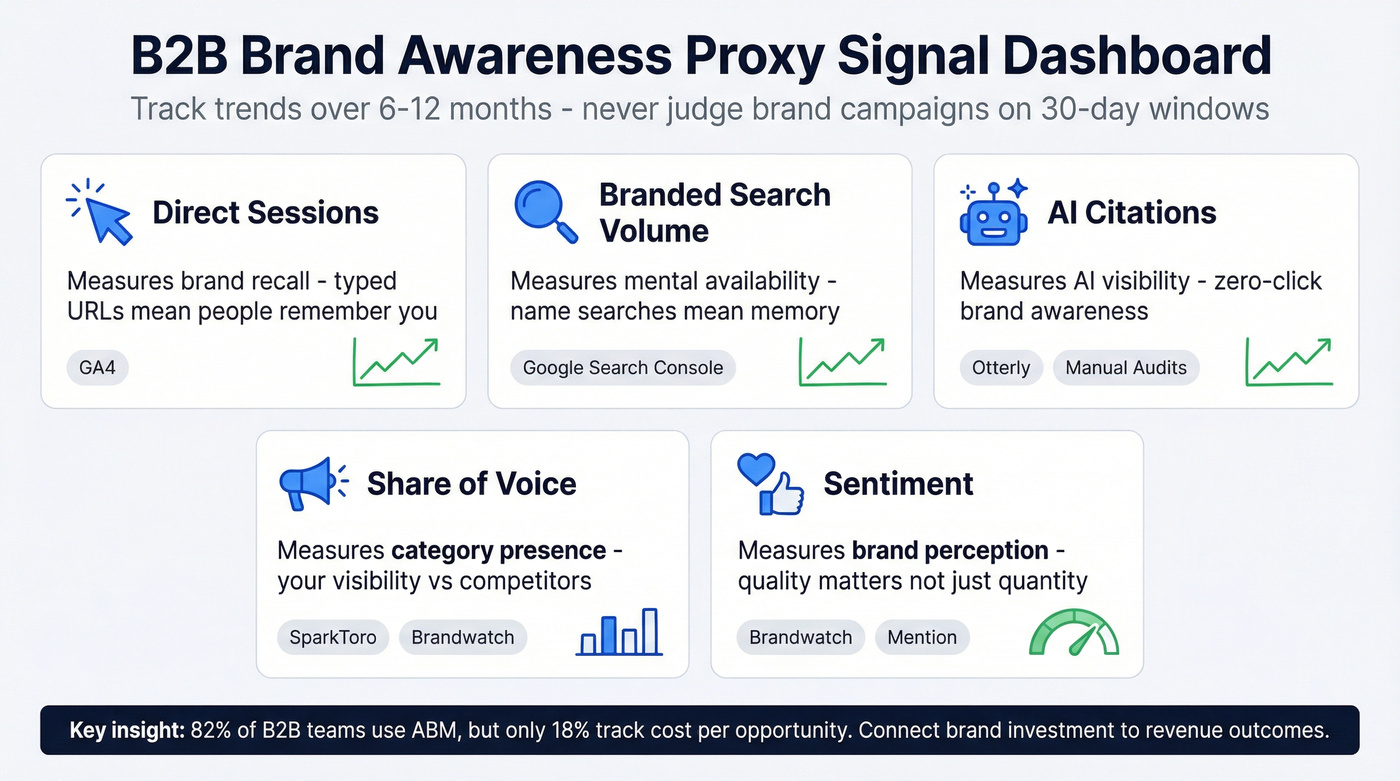
| KPI | What It Measures | Tool to Track | Why It Matters |
|---|---|---|---|
| Direct sessions | Brand recall | GA4 | Typed URLs = recognition |
| Branded search | Mental availability | Google Search Console | Name searches = memory |
| AI citations | AI visibility | Manual + Otterly | Zero-click awareness |
| Share of voice | Category presence | SparkToro, Brandwatch | Relative visibility |
| Sentiment | Brand perception | Brandwatch, Mention | Quality of awareness |
6sense's 2025 benchmarks show 82% ABM adoption, with 57% of marketers using both sourced and influenced attribution. But only 18% prioritize cost per opportunity as a top metric - meaning most teams still can't connect brand investment to revenue outcomes. Track the proxies above monthly, look for 6-12 month trend lines, and resist judging brand campaigns on 30-day windows. Brand building compounds. Give it time.
If you need a measurement system that ties these signals back to revenue, use a dedicated B2B marketing measurement framework and clean up your pipeline attribution model.
On r/b2bmarketing, the brand-vs-demand tradeoff under budget pressure comes up constantly. The consensus? Teams that cut brand spend to juice short-term pipeline numbers almost always regret it two quarters later when their funnel dries up and nobody in the market recognizes their name.
Brand awareness gets you into the consideration set. Accurate outbound data gets you into the conversation. With 300M+ profiles, 30+ filters including buyer intent and technographics, and emails verified at 98% accuracy, Prospeo connects your brand campaigns to real pipeline - at $0.01 per email.
Reach the 95% of future buyers before competitors do.
FAQ
How long does it take to see results from brand building?
Expect 6-12 months for measurable proxy signal shifts. Branded search and direct sessions move first; pipeline impact lags further. Brand building compounds - early results understate long-term returns, which is why treating it as a sustained investment matters more than optimizing for quarterly attribution.
What's the difference between brand awareness and demand generation?
Brand awareness builds recognition among the 95% not actively shopping. Demand gen captures the 5% who are. The optimal B2B split is roughly 46% brand / 54% activation per Binet & Field's B2B-specific research. When measured properly through shorter cycles and higher win rates, the two functions reinforce each other rather than compete.
What tools help measure brand recognition in B2B?
GA4 and Google Search Console handle branded search and direct traffic. SparkToro and Brandwatch track share of voice. For AI citation monitoring, Otterly plus manual audits of ChatGPT and Perplexity responses cover the emerging zero-click search space. On the outbound side, data quality is a hidden brand signal - bounced emails damage sender reputation and, by extension, brand perception.