

BDR Playbook: The 5-Layer System That Books Meetings (2026)
The average BDR playbook sells for $1,200-$1,300 and gets shelved within a month. The problem isn't the content - it's that playbooks are built like textbooks when they should be built like operating systems. Here's the five-layer framework that actually sticks.
Why Most Playbooks Fail
The typical BDR playbook is a 50-page PDF that reads great in a leadership meeting and never gets opened again. BDRs spend 60-70% of their time researching, not prospecting, and a bloated document just adds to the overhead. If a new rep can't explain your playbook in two minutes, it's too complicated.
The goal is to set reps up with clear, actionable processes - not to impress a VP with page count.
The Five Layers
- ICP & Segmentation - who you're going after
- Data Quality - verified contacts, refreshed regularly
- Signal-Based Timing - when to reach out
- Multi-Channel Cadence - how to reach out
- Cold Calls, Objections & Handoff - what to say and how to pass the baton
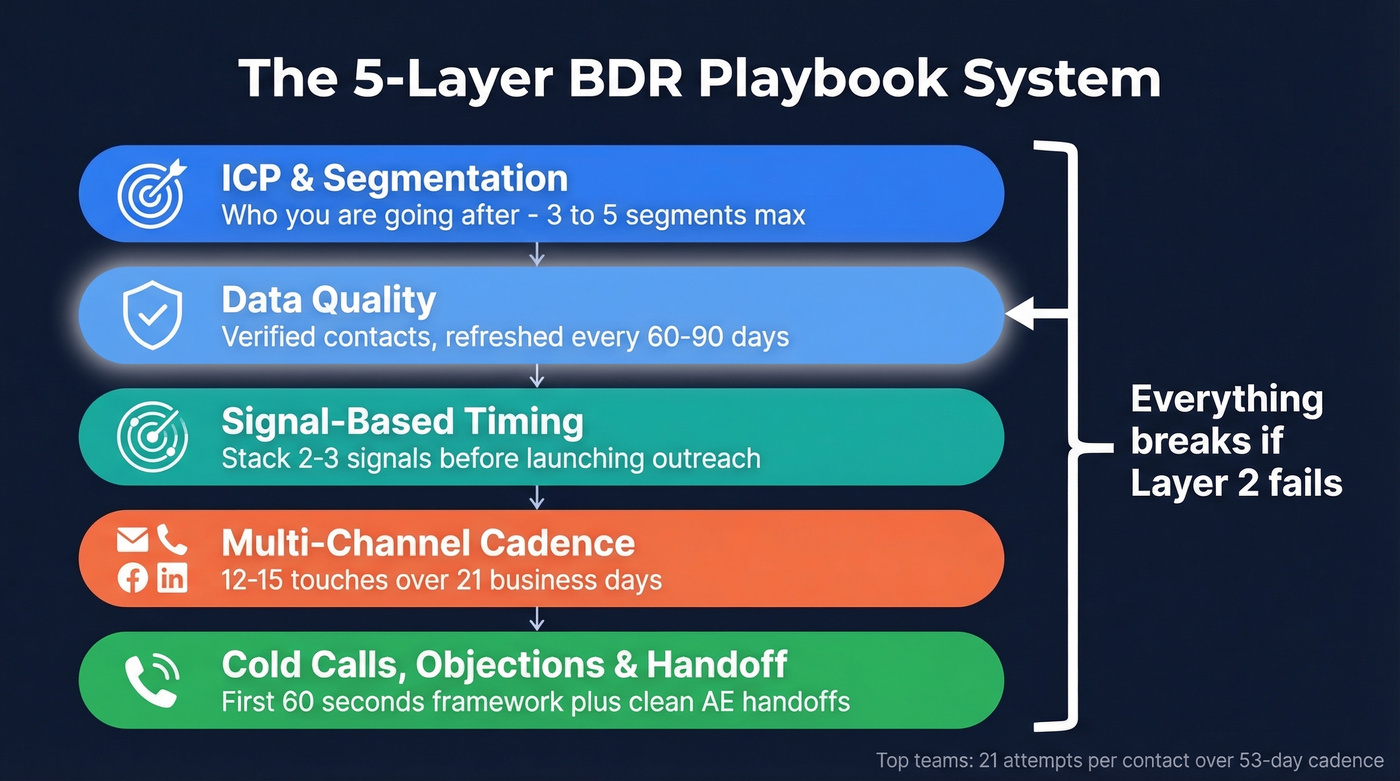
The single most important benchmark: top BDR teams average 21 attempts per contact over a 53-day cadence. And the one thing most playbooks get wrong? Data quality. Everything downstream - deliverability, connect rates, pipeline - breaks when your contacts are stale.
The 5-Layer Framework in Detail
Layer 1: ICP & Segmentation
Start with 3-5 segments. Not 47 micro-segments that look impressive on a slide but paralyze reps when it's time to build a list. Each segment needs three dimensions: firmographics (industry, headcount, revenue), technographics (what tools they use), and behavioral markers like hiring patterns, funding events, and tech adoption signals.
30% of B2B contact data goes stale every year. Your ICP definition isn't a one-time exercise - it's a living filter that determines whether your reps are calling real people or ghosts.
Layer 2: Data Quality as a System
Most teams treat data like a procurement problem. Buy a list, load it into the CRM, move on. That's how you end up with a 35-40% bounce rate on your first sequence.
Here's the thing: data quality isn't a checkbox. It's infrastructure.
The fix is a waterfall enrichment approach - run contacts through 3-4 sources, cross-reference, and validate every 60-90 days. Practitioners on r/salesdevelopment are clear on this: run your lists through two verifiers minimum before any outreach touches them. We've seen this firsthand with our own outbound - the difference between a verified list and an unverified one isn't incremental, it's night and day.

When Snyk rolled out Prospeo's verification across 50 AEs, their bounce rate dropped from 35-40% to under 5%, and AE-sourced pipeline jumped 180%. That's not a marginal improvement - it's what happens when you pair a 98% email accuracy rate with a 7-day data refresh cycle instead of the 6-week industry average.
Layer 3: Signal-Based Timing
Activity volume without signal timing is spam. Full stop.
Wait for 2-3 stacked signals before launching outreach - a funding round paired with an exec hire, a tech change alongside a headcount spike, or an intent surge combined with a job posting in your buyer's department. Tools like 6sense, Bombora, and Wappalyzer make these signals detectable. The goal is reaching prospects when they're already thinking about the problem you solve. Relevance beats volume every single time, and stacking two or three signals together is what separates a thoughtful outreach motion from a spray-and-pray one that burns your domain reputation.
Layer 4: The Multi-Channel Cadence
A 12-15 touch sequence over 21 business days is the sweet spot. Here's the cadence we recommend:
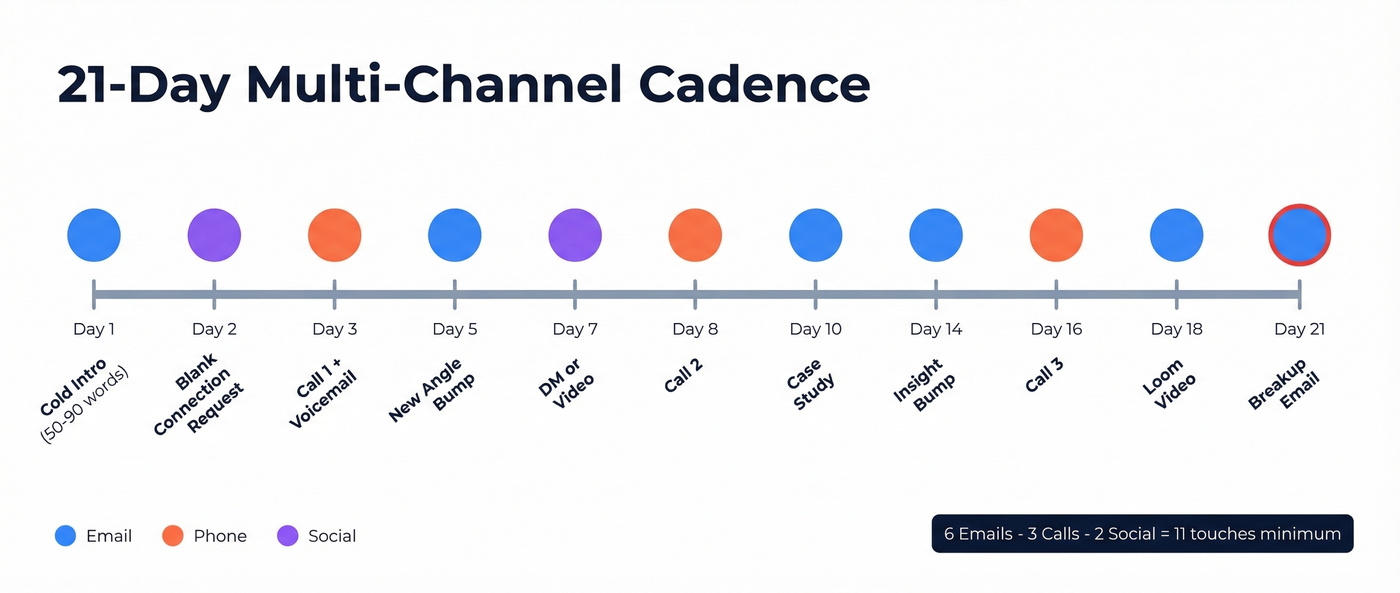
| Day | Channel | Action |
|---|---|---|
| 1 | Cold intro (50-90 words) | |
| 2 | Social | Blank connection request (higher acceptance than personalized notes) |
| 3 | Phone | Call 1 + voicemail |
| 5 | Bump with a new angle | |
| 7 | Social | Direct message or video |
| 8 | Phone | Call 2 |
| 10 | Case study or proof point | |
| 14 | Insight bump | |
| 16 | Phone | Call 3 |
| 18 | Video message via Loom | |
| 21 | Breakup |
Three messaging rules that matter more than templates. Keep emails to 50-90 words - offer-led, not pitch-led. Use a "calendar-first" booking approach where you propose two specific times and include an inline scheduler. And measure meetings held, not opens or clicks.
Speed-to-lead matters more than sequence design. Only 7% of companies respond to inbound leads within 5 minutes, and the average response time is 42 hours. 55% don't respond within 5 business days. You can have the best cadence in the world - if your response SLA is measured in days, you're losing to the competitor who calls back in minutes.
On deliverability: use a dedicated sending domain, warm it up for 6-8 weeks starting at 30-50 emails/day, and cap at 150 emails per 24 hours per domain. These aren't suggestions. They're the floor for keeping your domain out of spam. (If you want to go deeper, see email velocity and sender reputation.)
Layer 5: Cold Calls, Objections & Handoff
Only 28% of cold calls get answered, and roughly 2% convert to a meeting. That makes the first 60 seconds everything.
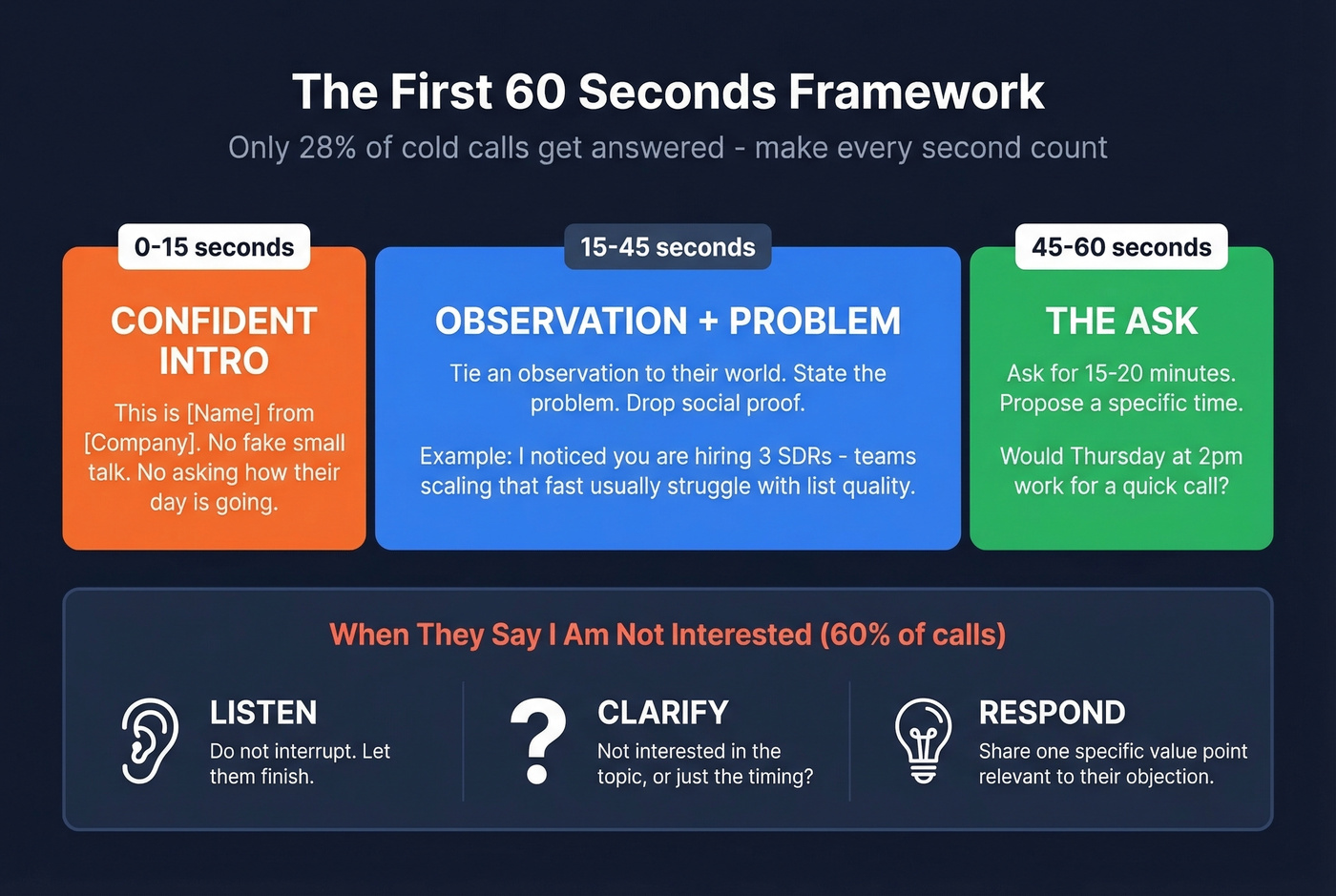
The first-60-seconds framework:
- 0-15s: Confident intro. "This is [Name] from [Company]." No fake small talk.
- 15-45s: An observation tied to their world, then a problem statement with social proof.
- 45-60s: Ask for 15-20 minutes. Propose a specific time.
Let's be honest - 60% of cold calls hit "I'm not interested." Use a Listen, Clarify, Respond framework: listen without interrupting, clarify what they mean ("Not interested in the topic, or just the timing?"), then respond with a specific value point. Other teams swear by LAER or Feel-Felt-Found. Pick one framework and drill it until it's muscle memory. (More on handling pushback: cold call rejection.)
Clean handoffs close the loop. Every qualified meeting needs account context, conversation notes, and the specific pain point that earned the meeting. Without this, AEs walk into calls cold and your conversion rate tanks. I've watched reps book 15 meetings in a month and lose half of them because the handoff doc was a one-line Slack message. Don't let that be your team.

Layer 2 of your playbook breaks everything if the data is wrong. Prospeo's 5-step verification delivers 98% email accuracy with a 7-day refresh cycle - not the 6-week industry average. Snyk's 50 AEs dropped bounce rates from 35-40% to under 5% and grew AE-sourced pipeline 180%.
Stop building cadences on stale data. Start at $0.01 per verified email.
BDR Benchmarks: What Good Looks Like
The 6sense BDR Benchmark report (n=262) is the best data set out there. Here's what top teams look like:
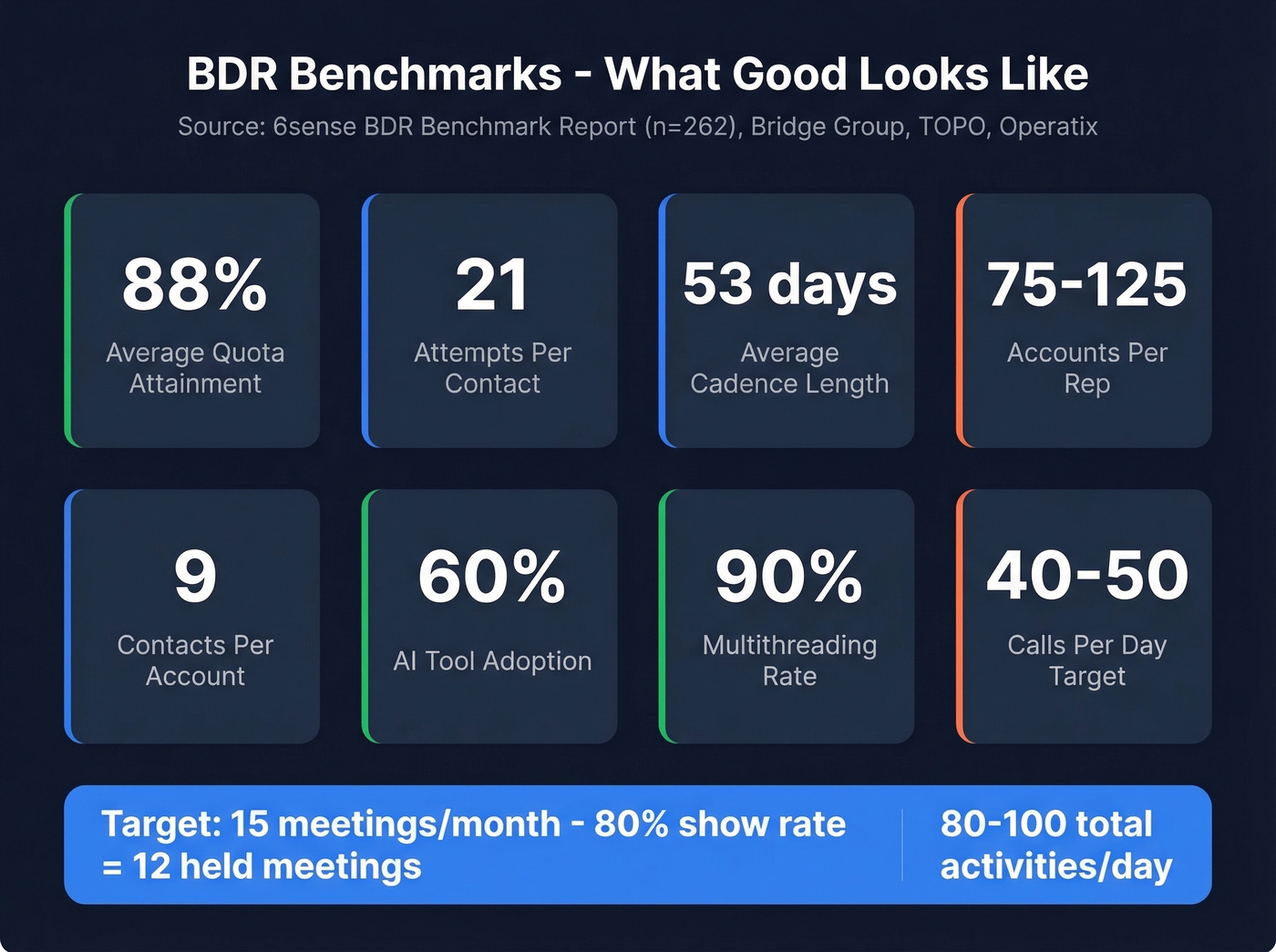
| Metric | Benchmark |
|---|---|
| Quota attainment | ~88% average |
| Attempts per contact | ~21 attempts per contact |
| Cadence length | 53 days |
| Accounts per rep | 75-125 |
| Contacts per account | ~9 |
| AI tool adoption | 60% |
| Multithreading rate | 90% |
| Supported vs unsupported | 95% vs 80% quota |
For daily activity, Gradient Works compiled benchmarks from Bridge Group, TOPO, and Operatix: 40-50 calls/day, 10-40 emails/day, 80-100 total activities/day. In our experience, teams that consistently hit 80+ activities/day outperform regardless of which tools they're using. Outbound reps should target 15 meetings/month with an 80% show rate - that's 12 held meetings feeding your pipeline.
The 30/60/90 Onboarding Ramp
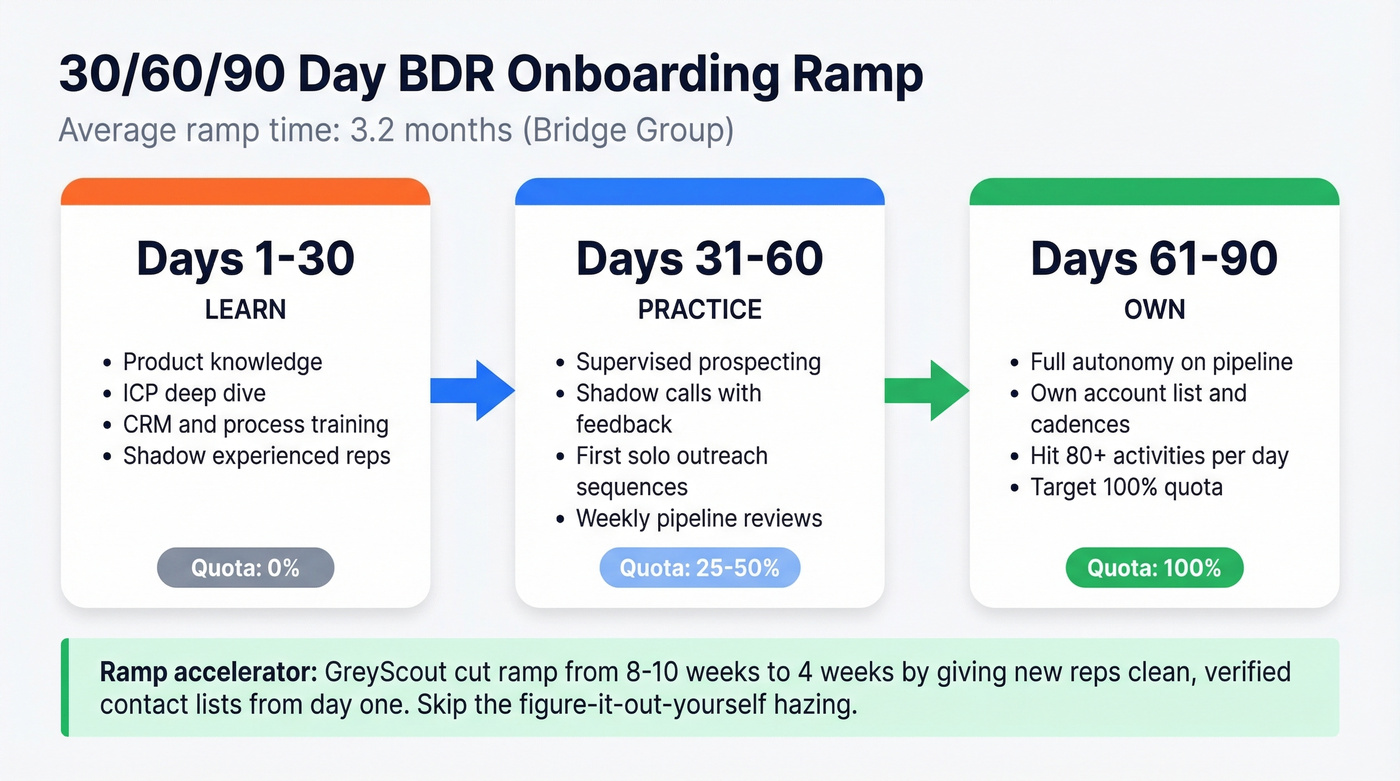
Average sales ramp time is 3.2 months per Bridge Group data, but the distribution tells a more useful story: 19% ramp in 1-3 months, 39% in 3-5 months, 23% in 5-7 months, and 18% take 7+ months.
| Phase | Focus | Quota Target |
|---|---|---|
| Days 1-30 | Product, ICP, CRM, process | 0% (learning) |
| Days 31-60 | Supervised prospecting, shadow calls | 25-50% |
| Days 61-90 | Full autonomy, own pipeline | 100% |
The biggest ramp accelerator isn't training - it's data quality. GreyScout cut rep ramp time from 8-10 weeks to 4 weeks by giving new reps clean, verified contact lists from day one. When reps aren't spending their first month debugging bad phone numbers, they start booking meetings faster. Skip the "figure out your own list" hazing ritual and hand new hires a verified, segmented list on their first Monday. (If you need a structured ramp doc, use a 30/60/90 plan.)
The BDR Tech Stack
According to McKinsey, B2B companies that adopt advanced sales technology grow revenue 2-3x faster than those that don't. But more tools isn't better - start with three, add as you scale. The consensus on r/salesdevelopment is consistent: keep your stack tight and invest in data quality over flashy features.
| Tool | Best For | Price Range |
|---|---|---|
| Prospeo | Verified emails, mobiles & data freshness | Free tier; ~$0.01/email on paid plans |
| Apollo | All-in-one prospecting + sequencing | $49-99/mo |
| ZoomInfo | Enterprise data + intent | $15-40K/yr |
| Outreach | Sequencing at scale | ~$100-130/user/mo |
| Salesloft | Sequencing + coaching | ~$75-125/user/mo |
| Orum | AI-powered parallel dialing | ~$250-350/user/mo |
| Aircall | Cloud calling for SMBs | ~$30-50/user/mo |
| 6sense | Intent data + ABM | $30-60K+/yr |
| Bombora | Intent data (standalone) | $25-50K+/yr |
If your budget is tight, start with a verified data source, a sequencer, and a dialer. Everything else is a nice-to-have until you're consistently hitting 80+ activities/day and need to optimize further. (More options: SDR tools and BDR software.)
Your reps are making 40-50 calls a day. Make sure they're calling real numbers. Prospeo gives you 125M+ verified mobile numbers with a 30% pickup rate - plus buyer intent signals across 15,000 topics to stack the timing signals Layer 3 demands.
Give your BDRs direct dials and intent data that actually connect.
FAQ
What's the difference between a BDR and an SDR?
Functionally, they're the same role at most companies. The distinction is that BDR typically implies outbound prospecting while SDR can include inbound lead qualification. Everything in this playbook applies to both. Titles vary by org, but the daily workflow is identical.
How long should a BDR cadence be?
12-15 touches over 21 business days for most B2B outbound. 6sense data shows top teams average 53-day cadences with 21 attempts per contact across email, phone, and social. Returns diminish sharply after about 14 touches - if they haven't engaged by then, recycle them later.
What's the fastest way to improve cold call conversion?
Focus on the first 60 seconds - that's where most calls are won or lost. Use the Listen, Clarify, Respond framework for objections, and stack at least two intent signals before dialing so you have something relevant to open with. Reps who prepare a specific observation about the prospect's company convert at significantly higher rates than those running a generic script.
How do I keep my BDR playbook from becoming shelfware?
Keep it modular - five layers, not fifty pages. Review quarterly and update the pieces that changed: new ICP segments, refreshed cadence templates, updated benchmarks. Tie every layer to a metric so reps can self-assess. Most importantly, keep your contact data fresh. Stale numbers are the fastest way to kill rep trust in any system you build.