

The B2B GTM Playbook With Actual Numbers, Not Just Frameworks
You're four months in. You've sent cold emails, worked a trade fair, followed up on every conversation, posted on social - and the pipeline is basically empty. A founder on r/b2bmarketing described this exact scenario: multiple product categories, multiple channels, almost no responses. The problem isn't effort. It's that most B2B GTM advice gives you frameworks without numbers, and strategy without sequencing.
This is the version with actual numbers.
The Short Version
Pick one go-to-market motion based on your average deal size. Focus on four channels max - not ten. Target 3-5x pipeline coverage against quota. And fix your data layer before you scale outbound, because bounced emails and dead phone numbers will kill your domain reputation faster than bad messaging will.
Three things matter most: choosing your motion, building a 90-day plan with real conversion targets, and knowing the 2026 benchmarks so you can tell whether you're winning or losing.
What B2B GTM Actually Means
A go-to-market strategy isn't a marketing plan. It's not a product launch checklist. GTM is the cross-functional system that connects your product, pricing, positioning, sales motion, and customer success into a single engine that acquires and retains revenue. Marketing is one layer within it. So is sales enablement. So is pricing.
This distinction matters because 61% of B2B buyer research happens before a vendor is ever contacted, and 95% of winning vendors appear on the buyer's day-one shortlist. If your go-to-market strategy is just "run ads and send emails," you're invisible during the phase where decisions actually get made. The dark funnel - peer conversations, community threads, review sites, word of mouth - is where your buyers build that shortlist. Your GTM has to account for it.
What Changed in 2026
The fundamentals haven't changed. ICP clarity, positioning, proof, and consistency still win. But the economics have shifted, and the channels are noisier.
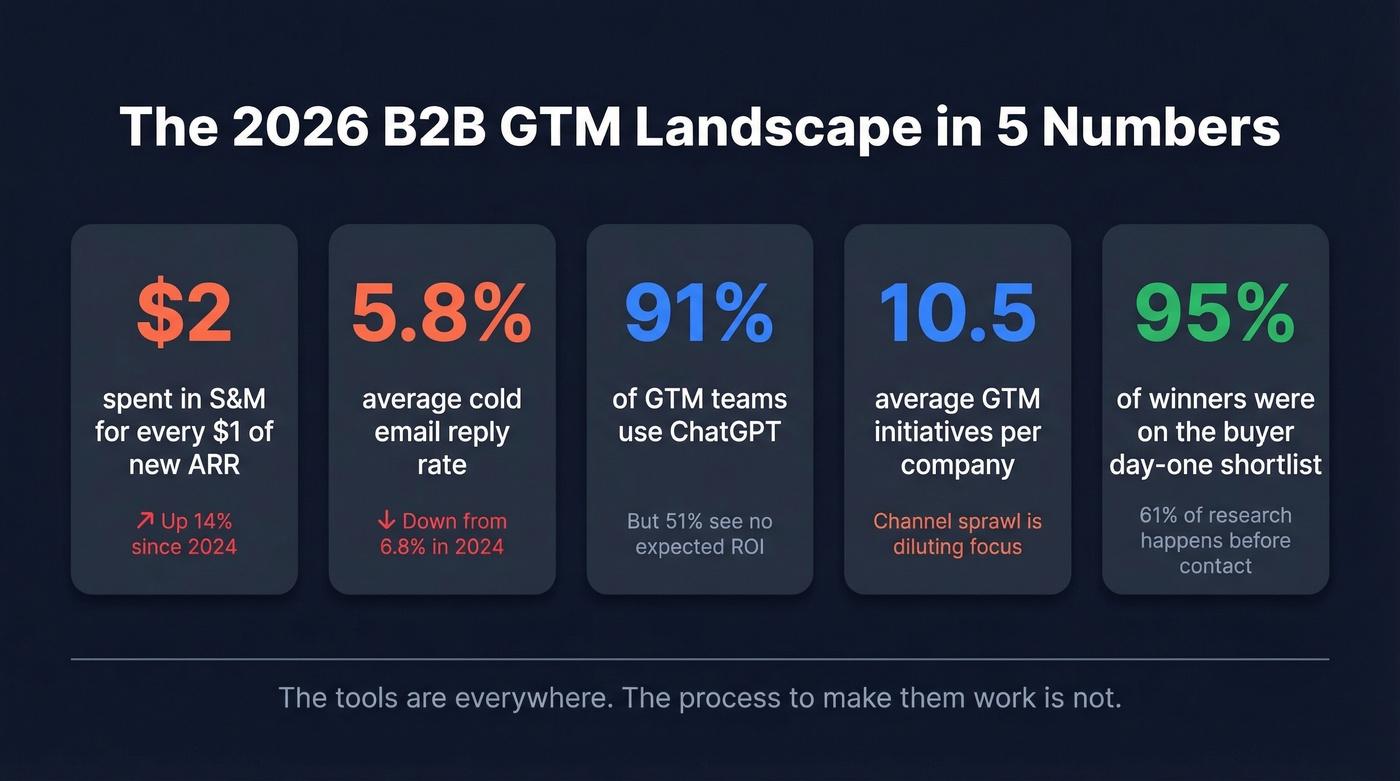
Cold email average reply rates dropped from 6.8% in 2024 to 5.8% in 2025, and nothing in the 2026 landscape suggests a reversal. The average company now runs 10.5 GTM initiatives - five core channels plus five-and-a-half experiments. That's channel sprawl, and it's diluting focus everywhere.
AI adoption is near-universal - 91% of GTM teams use ChatGPT - but 51% of B2B organizations implement AI without achieving expected outcomes. Everyone has the tools. Almost nobody has the process to make them work.
Here's the number that should scare you: companies now spend $2 in sales and marketing for every $1 of new ARR, up 14% since 2024. If your go-to-market motion doesn't match your deal economics, you're burning cash at an accelerating rate.
Choosing Your GTM Motion
This is the decision that shapes everything downstream. Get it wrong and no amount of execution fixes it.
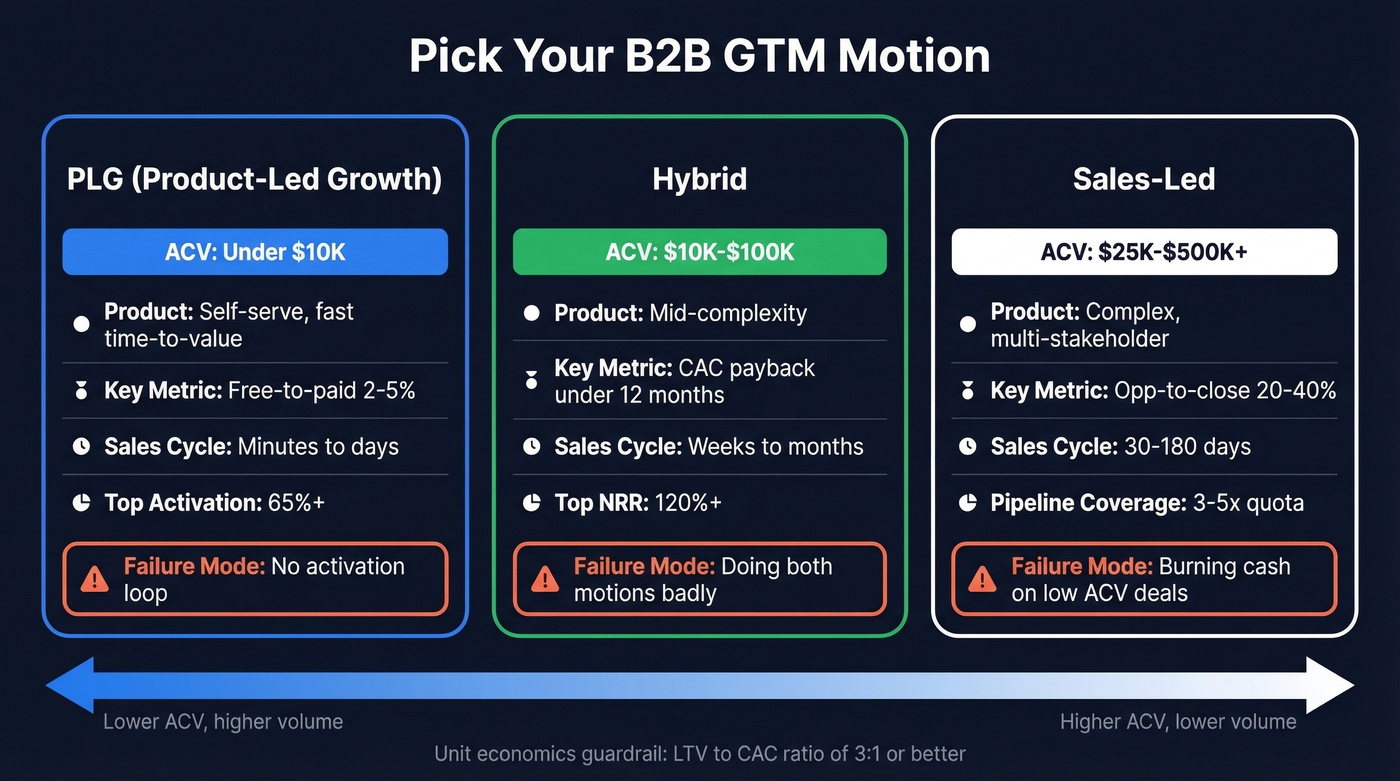
| PLG | Sales-Led | Hybrid | |
|---|---|---|---|
| ACV range | Under $10K | $25K-$500K+ | $10K-$100K |
| Ideal product | Self-serve, fast value | Complex, multi-stakeholder | Mid-complexity |
| Key metric | Free-to-paid 2-5% | Opp-to-close 20-40% | CAC payback <12mo |
| Sales cycle | Minutes to days | 30-180 days | Weeks to months |
| Failure mode | No activation loop | Burning cash on low ACV | Doing both badly |
If you're selling a product with sub-$10K deals through a pure sales-led motion with SDRs, AEs, and demos, you're burning money. The math doesn't work. PLG or a lightweight hybrid is the only way to make those unit economics pencil out.
Let's be honest: most teams under $5M ARR don't need a "GTM platform." They need one clear motion, one clean data source, and the discipline to run it for 90 days without pivoting. The companies buying six-figure tooling before they have ten happy customers are optimizing a process that doesn't exist yet.
Target these baseline conversion benchmarks: MQL-to-SQL at 25-35%, SQL-to-Opp at 50%+, and win rates above 20%. For PLG, top 10% performers hit 65%+ activation rates versus a 33% average. Best-in-class PLG companies run NRR above 120%.
Regardless of motion, the unit economics guardrails are the same: LTV:CAC of at least 3:1 and CAC payback under 12 months. If you're outside those ranges, the motion is wrong or the execution is broken.
What about buying-group orchestration? Adobe and Demandbase are pushing account-based, buying-group orchestration hard right now. It matters for enterprise deals with 6+ stakeholders and $100K+ ACVs. But it's a layer on top of your core motion - not a replacement for it. Nail the fundamentals first. Add buying-group orchestration when your average deal involves a procurement committee, not before.
Hybrid doesn't mean "do everything." It means a self-serve entry point feeding a sales-assisted expansion path. The worst version of hybrid is two half-built motions competing for resources.

You read it above: bounced emails and dead numbers kill domain reputation faster than bad messaging. Prospeo's 5-step verification delivers 98% email accuracy and 125M+ verified mobiles - refreshed every 7 days, not every 6 weeks. At $0.01 per email, your GTM unit economics actually work.
Build your prospect list on data that won't torch your domain.
Building Your 90-Day Execution Plan
A go-to-market strategy without a sequenced execution plan is just a slide deck.
Days 1-30: Foundation
Lock your ICP to one segment. Not three, not "SMB and mid-market." One. Build your TAM/SAM model - SOM is typically 1-5% in mature markets. Define your positioning: what you are, what you aren't, and why that matters to your ICP (use an ideal customer profile scoring rubric if you need one).
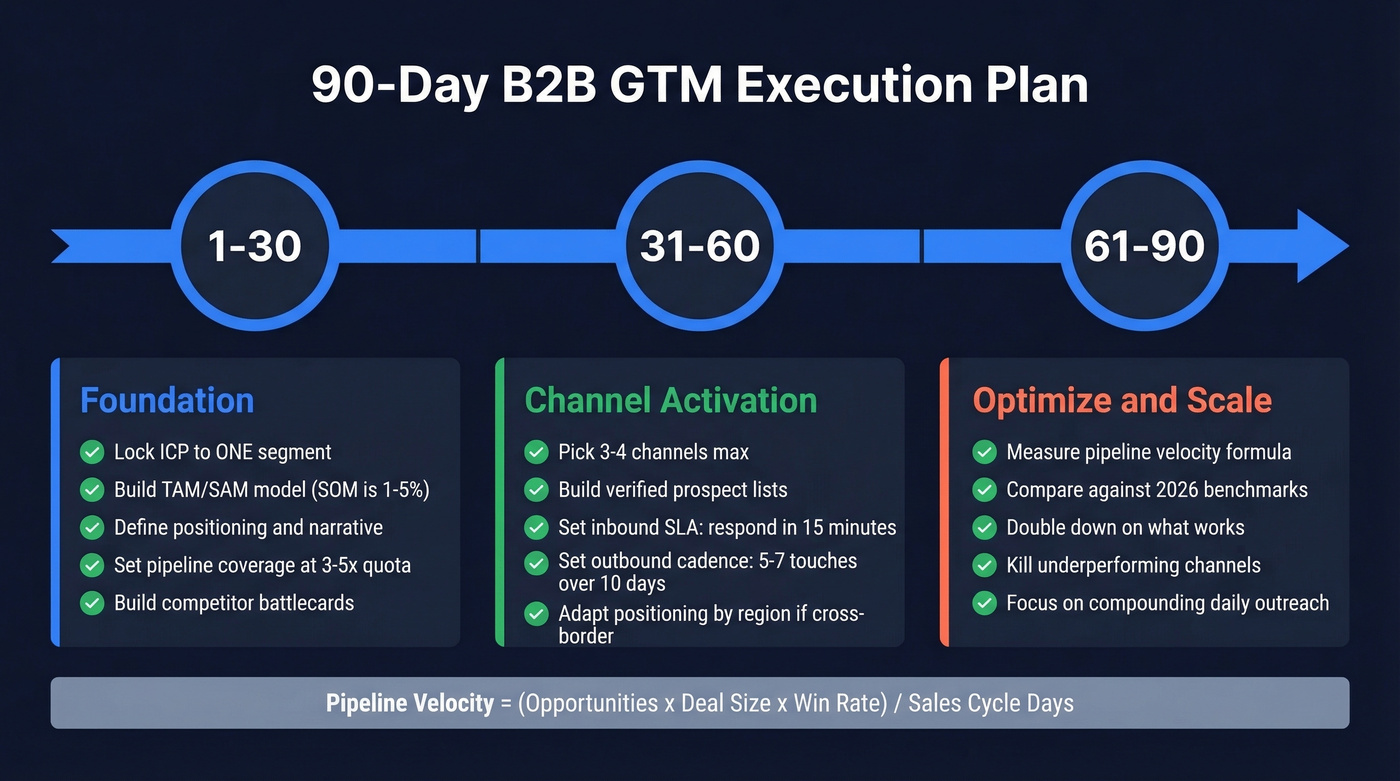
Set your pipeline coverage target at 3-5x quota. Build a competitor analysis scorecard - rate each competitor 1-10 on product, pricing, market position, and strategy to create sales battlecards. Align sales and marketing on a single narrative. Practitioners consistently say one unified story across teams is non-negotiable.
Days 31-60: Channel Activation
Pick three to four channels max. 70% of marketing-sourced pipeline comes from just four categories: SEO, events, social media, and paid search. You don't need fifteen. Build your prospect list with verified data - paste a URL or upload a CSV, get verified emails and direct dials in seconds with a tool like Prospeo. Set SLAs: inbound demo requests contacted within 15 minutes during business hours, outbound follow-up 5-7 times over 10 days (use these sales follow-up templates if you need a starting point).
If you're selling cross-border, your positioning, pricing sensitivity, and sales motion will need to adapt by region. What works in the US often fails in DACH or APAC.
Days 61-90: Optimize and Scale
Measure pipeline velocity: (Number of Opportunities x Average Deal Size x Win Rate) / Sales Cycle in days. This single formula tells you whether your engine is accelerating or stalling. Compare your conversion rates against the benchmarks in the next section. Double down on what's working. Kill what isn't.
The operators who consistently build pipeline share a common trait: they do the boring compounding work - talking to prospects daily, sending targeted messages instead of mass blasts, and following up relentlessly. The second and third touch often triggers the reply, not the first.
2026 Benchmarks Worth Tracking
Stop guessing whether your numbers are good.
| Category | Metric | Benchmark |
|---|---|---|
| Conversion | MQL-to-SQL | 25-35% |
| Conversion | SQL-to-Opp | 50%+ |
| Conversion | Win rate | 20%+ |
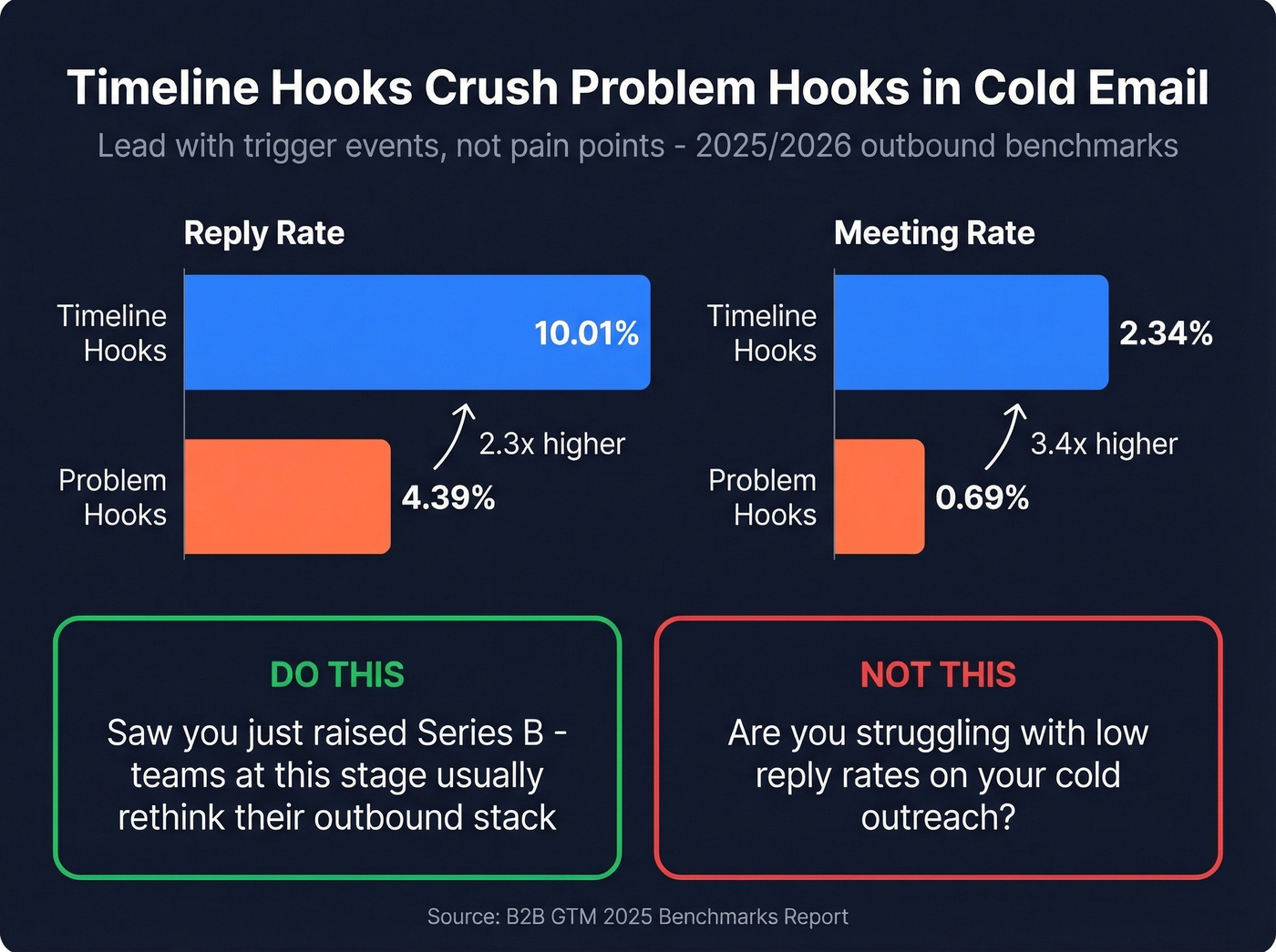
| Outbound | Timeline hooks reply rate | 10.01% |
| Outbound | Problem hooks reply rate | 4.39% |
| PLG | Activation (top 10%) | 65%+ |
| PLG | Activation (average) | 33% |
| Retention | NRR (best-in-class) | >120% |
| Retention | Logo retention (healthy) | >90% annually |
| Pipeline | Coverage target | 3-5x quota |
| Content | Teams lacking case studies | 72% |
Two numbers jump out. First, timeline-based cold email hooks outperform problem hooks by more than 2x on both reply rate and meeting rate (2.34% vs 0.69%). If your outbound sequences lead with "Are you struggling with X?" you're leaving meetings on the table. Lead with a relevant trigger event instead.
Second, 72% of marketing teams say they don't have enough case studies. Case studies and first-party research are the top-performing content types for pipeline generation, and almost nobody has enough of them. That's a gap you can exploit starting this week.
Mistakes That Kill Growth
We've seen these seven patterns destroy pipeline at companies of every size.
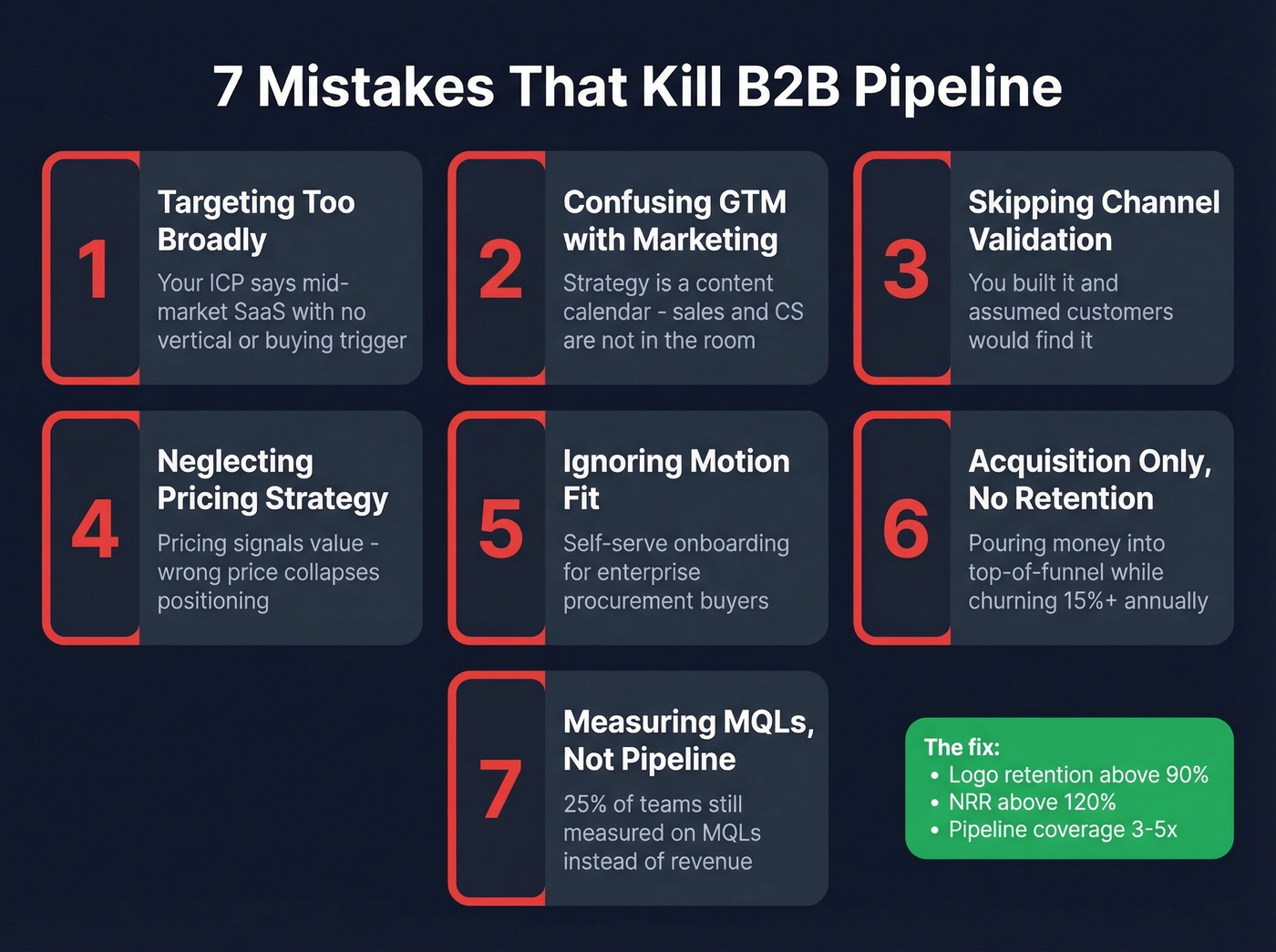
Targeting too broadly. Your ICP slide says "mid-market SaaS companies" with no vertical, no company size range, no buying trigger. You're selling to everyone, which means you're resonating with no one.
Confusing GTM with marketing. The "strategy" is a content calendar and a paid media budget. Sales, product, and CS aren't in the room.
Skipping distribution channel validation. You built the product, launched it, and assumed customers would find it. They didn't.
Neglecting pricing strategy. You picked a price based on competitors without testing willingness to pay. Pricing signals value - get it wrong and positioning collapses.
Ignoring motion fit. You built a self-serve onboarding flow for a product that requires enterprise procurement and security reviews. The motion doesn't match the buyer.
Focusing only on acquisition. You're pouring money into top-of-funnel while existing customers churn at 15%+ annually. The bucket leaks. Best-in-class companies target logo retention above 90% and NRR above 120% - if you're not tracking both, you're flying blind on half your revenue engine (track it with a real churn analysis process).
Measuring MQLs instead of pipeline. 25% of marketing teams are still measured on MQLs. Stop. Measure pipeline creation and revenue contribution. MQLs are a vanity metric that incentivizes the wrong behavior.
The Data Layer Nobody Talks About
Every go-to-market guide talks about positioning, channels, and conversion rates. Almost none talk about the data layer underneath - and it's the silent killer of outbound execution.
Bad data costs you in three ways: bounced emails destroy your sender reputation, dead phone numbers waste rep time, and stale contacts mean your carefully crafted sequences land in the void. We've watched teams build beautiful outbound playbooks that fail because 30%+ of their contact data was garbage on day one. It's the most frustrating failure mode in B2B because everything else looks right on paper.

Prospeo solves this at the infrastructure level. The database covers 300M+ professional profiles with 98% email accuracy and a 7-day refresh cycle - the industry average is six weeks. The 125M+ verified mobile numbers hit a 30% pickup rate, roughly 2.5x what legacy providers deliver. You can search with 30+ filters including buyer intent, technographics, job changes, and headcount growth, then push verified contacts straight into HubSpot, Salesforce, Instantly, or Lemlist. One customer, Meritt, tripled pipeline from $100K to $300K per week and dropped bounce rates from 35% to under 4% after switching.
Skip this section if your team already has a data provider with sub-5% bounce rates and weekly refresh cycles. But if you're running outbound on data that's more than a month old, you're sabotaging your own sequences (see email bounce rate benchmarks and fixes).
Your 90-day GTM plan needs a clean data layer from day one. Prospeo gives you 300M+ profiles with 30+ filters - buyer intent, technographics, headcount growth, funding - so you can lock your ICP to one segment and actually reach them. 92% API match rate. No contracts.
Stop spending $2 to acquire $1 in ARR with garbage data.
AI in Go-to-Market - What's Actually Working
91% of GTM teams now use ChatGPT, and the most impactful tools cited in a 195-company survey were ChatGPT, HubSpot, and Clay. Investment priorities for 2026 center on AEO - answer engine optimization, cited by 51% of respondents - and intent-based outbound at 45%.
The numbers tell a more nuanced story than the hype. While 87% of B2B teams now use AI in demand generation, only 65% report a positive impact for at least one tactic. AI is a multiplier, not a foundation. If your ICP is fuzzy, your positioning is generic, and your data is stale, AI will just help you do the wrong things faster. The teams getting results fixed their process first and then used AI to accelerate it - not the other way around. (If you want a practical workflow, start with AI cold email outreach and iterate from there.)
One stat worth planning around: Forrester predicts 61% of B2B stakeholders will use private genAI engines for purchasing decisions in 2026. That means your content needs to be structured for AI consumption, not just human reading. FAQ schema, clear data tables, and unambiguous product positioning all matter more now than they did a year ago.
FAQ
What's the difference between a GTM strategy and a marketing plan?
A GTM strategy spans product, sales, marketing, customer success, and pricing - it's the full system for acquiring and retaining revenue. A marketing plan is one channel layer within that system. You can have a great marketing plan inside a broken go-to-market strategy, and you'll still lose.
How long does a B2B GTM strategy take to show results?
PLG motions can show activation data within weeks. Sales-led approaches typically need 90-180 days to generate meaningful pipeline signal. Benchmark against pipeline coverage and conversion rates rather than closed revenue - revenue is a lagging indicator that'll mislead you in the early months.
What's the best GTM tool stack for startups?
CRM (HubSpot free tier), prospecting data (Prospeo - free tier or from ~$39/mo), outreach (Instantly ~$30/mo or Smartlead ~$39/mo), and enrichment (Clay ~$149/mo). Total cost under $300/month. You can build a fully functional go-to-market engine without an enterprise contract or a six-figure data budget.
What's the biggest mistake in B2B go-to-market execution?
Scaling outbound on dirty data. Teams invest in messaging, sequencing, and tooling - then feed it contact lists with 30%+ bounce rates. One bad data source can tank your domain reputation in weeks. Use a provider with verified emails at 98%+ accuracy and a weekly refresh cycle before you send a single sequence.