

The B2B Marketing Strategy Playbook for 2026
Every B2B marketing strategy article says the same thing: "use AI," "invest in content," "align with sales." That's not a strategy - it's a motivational poster. The playbooks that defined last year are already showing cracks, and the teams still running them are watching pipeline stall while their competitors pull ahead. What actually moves pipeline now is channel selection backed by ROI data, budget allocation that reflects how buyers behave today, and a data foundation that doesn't sabotage execution before you send a single email.
The Buyer Shifted - Fast
The buying cycle compressed from 11.3 months to 10.1 months over the past year. First contact now happens at 61% of the journey instead of 69%, meaning buyers reach out roughly 6-7 weeks earlier than before.
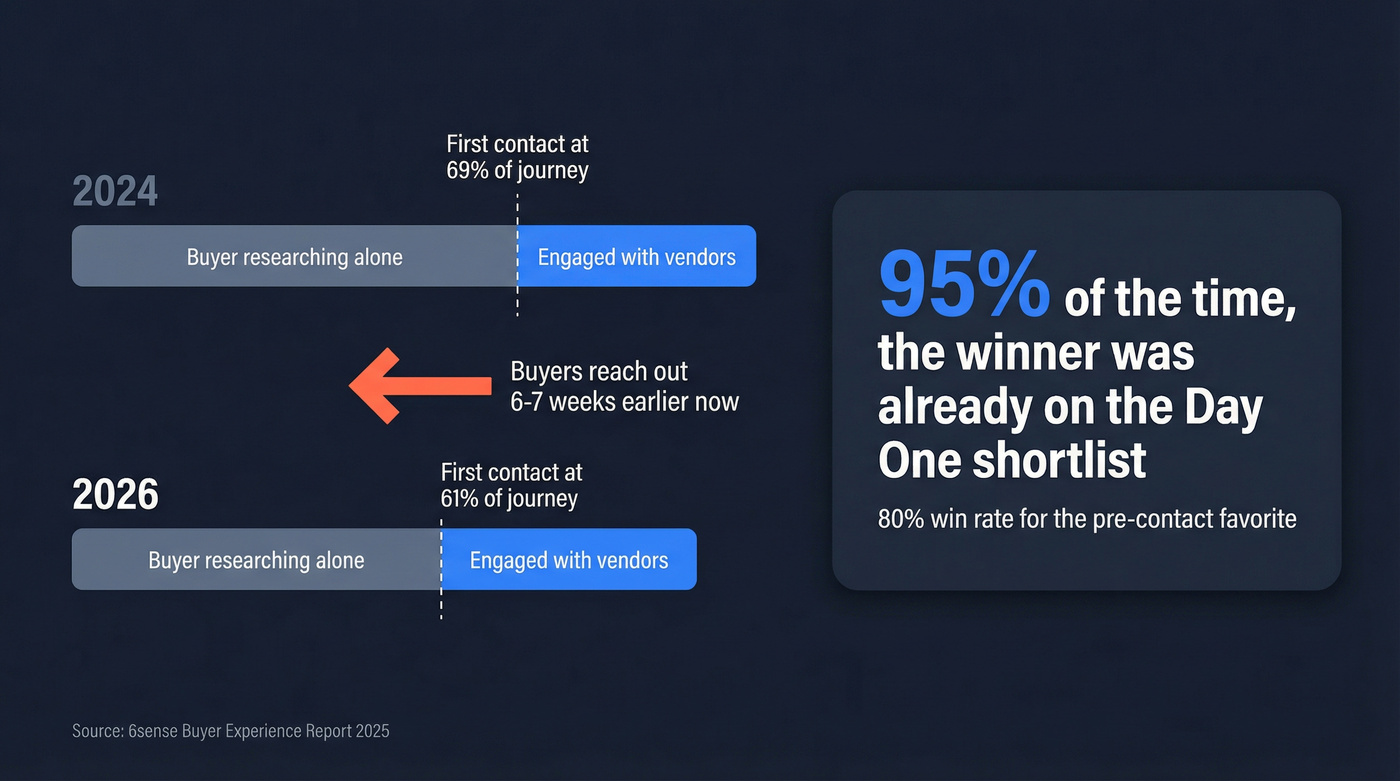
But here's the number that should keep you up at night: 95% of the time, the winning vendor was already on the buyer's Day One shortlist. The pre-contact favorite wins about 80% of deals. Your brand either exists in that mental shortlist before the cycle starts, or you're fighting for scraps.
Meanwhile, 72% of B2B buyers now encounter AI Overviews during research, and 90% click through to cited sources. That makes AI visibility a genuine top-of-funnel priority, not a nice-to-have experiment.
Budget Reality in 2026
Gartner benchmarks B2B marketing spend at 8.4% of revenue. Forrester found 87% of marketing leaders planned a budget increase, but 6sense data shows only 52.3% actually got one. That gap explains why "do more with less" remains the operational reality for most teams.
| Category | Share of Budget |
|---|---|
| Programs (campaigns, events, content) | 42% |
| Personnel (headcount, agencies) | 35% |
| Technology (martech, data tools) | 23% |
Here's the counterintuitive part. Deloitte Digital's research across 1,395 marketing leaders found that organizations investing more in martech than working media see 18% greater sales lift and 7% higher revenue growth. The stack isn't overhead - it's the multiplier. If you're still treating martech as a cost center, you're leaving measurable revenue on the table.
Channel ROI: What Actually Performs
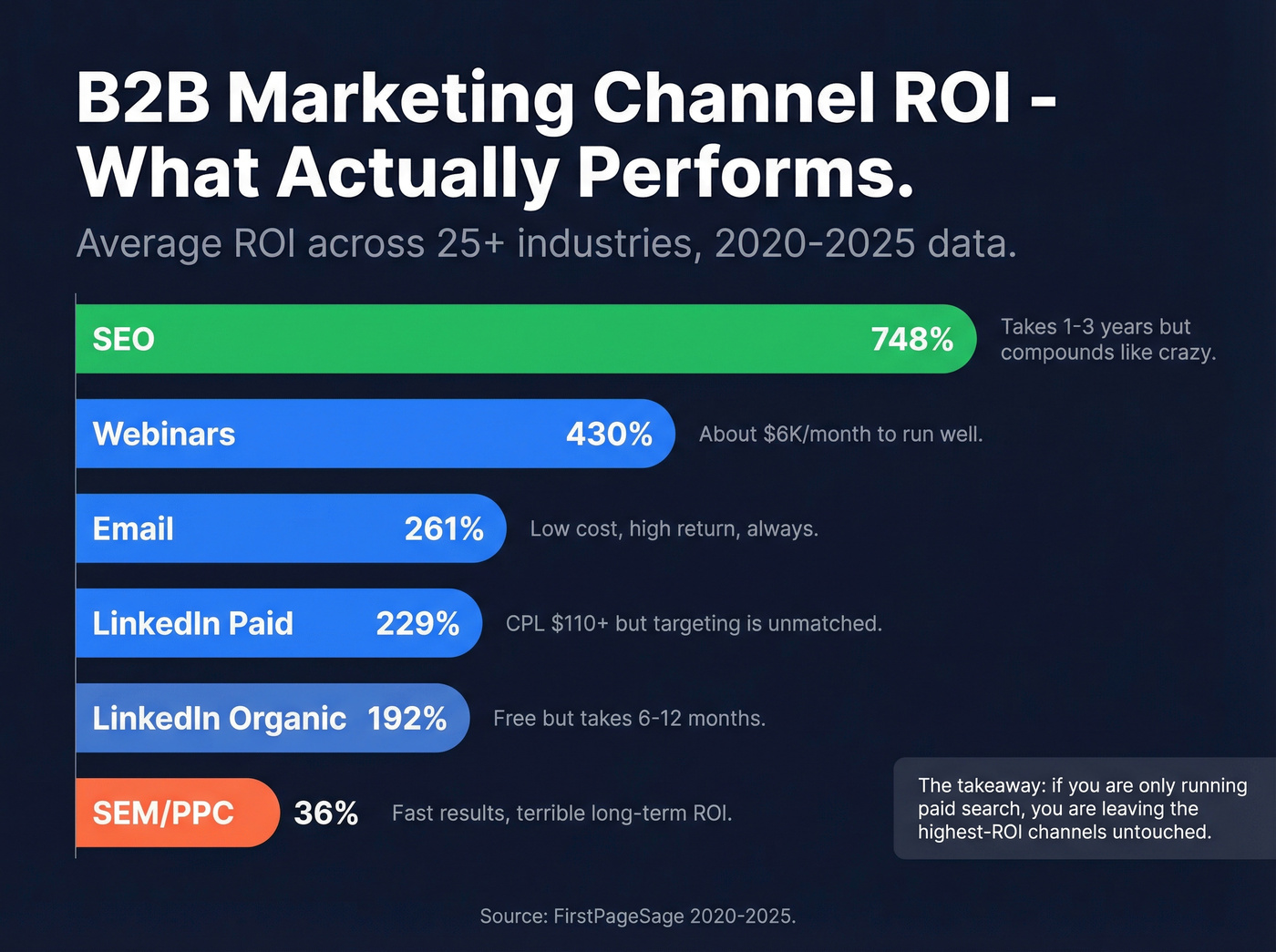
FirstPageSage tracked ROI across 25+ industries from 2020 through 2025:
| Channel | Avg ROI | Monthly Cost | Time to Return |
|---|---|---|---|
| SEO | 748% | $2-15K | 1-3 years |
| Webinars | 430% | ~$6K | ~1 year |
| 261% | - | - | |
| LinkedIn Paid | 229% | $5-20K | 3-9 months |
| LinkedIn Organic | 192% | Internal time | 6-12 months |
| SEM/PPC | 36% | $3-30K | 2-5 weeks |
SEO compounds like crazy but requires patience. PPC gives you speed at terrible long-term ROI. LinkedIn is expensive - CPL averages $110+ versus $70 for Google Ads - but the targeting precision makes it worth the premium for most B2B teams.
Let's be honest: if you're only running paid search and calling it a strategy, you're leaving the highest-ROI channels untouched. We've seen teams shift even 20% of PPC budget toward SEO and get compounding returns within 18 months.

Your 2026 strategy needs channels that compound - but every channel collapses if your data is bad. Prospeo's 7-day refresh cycle and 98% email accuracy keep bounce rates under 4%, so your outbound, ABM, and demand capture actually reach real buyers.
Stop letting stale data sabotage your best campaigns.
Five Strategies That Move Pipeline
Build Brand Before the Cycle Starts
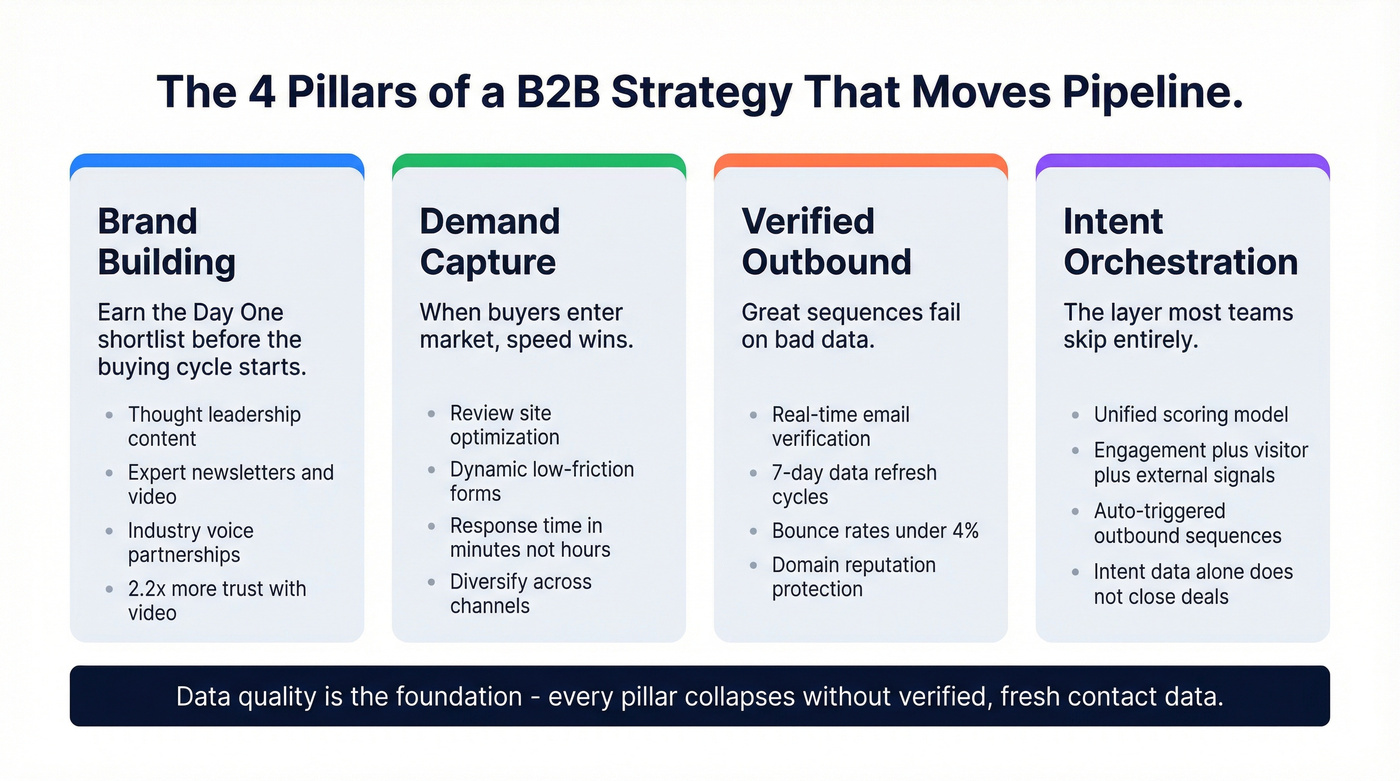
The Day One shortlist data makes this non-negotiable. Thought leadership, expert newsletters, and video content aimed at passive buyers - people who aren't in-market yet - are how you earn that spot. Brands combining video with industry voices are 2.2x more likely to be trusted. Skip this if you're a brand-new startup with zero budget; focus on demand capture first and layer brand in once you've got revenue.
If you need a framework, start with brand and tighten your B2B brand positioning before you scale distribution.
Capture Active Demand Fast
When buyers enter the market, speed wins. Optimize review-site profiles, deploy dynamic forms that cut friction, and measure response time in minutes, not hours. 94% of marketers diversified their channel mix last year. If you haven't, you're structurally behind the teams you're competing against for the same accounts.
Run Outbound With Verified Data
58% of B2B professionals identify data quality as the top factor for automation success. Teams invest in sequencing tools, write great copy, nail their ICP - then bounce 35% of their emails and torch their domain reputation in a week. We've watched it happen over and over.
This is where data freshness matters more than database size. Prospeo's 7-day refresh cycle and 5-step verification process keep bounce rates under 4%, which is the difference between a healthy sending domain and one that's blacklisted by Tuesday. Meritt tripled their pipeline from $100K to $300K/week after switching - their bounce rate dropped from 35% to under 4%.
If you're diagnosing deliverability, start with bounce rates and a full email deliverability audit.
Optimize for AI Discovery
ChatGPT has 300M+ weekly users. Your content needs to be citable by these systems, not just rankable on Google. Structure answers in 40-60 word blocks - that's the sweet spot for AI citations. Implement FAQ and How-To schema. Pitch the publications AI already cites in your category.
Layer Intent on Everything
A solid B2B strategy breaks into four pillars: brand, demand capture, outbound, and intent orchestration. That last pillar is where most teams fall short. Don't treat intent data as a standalone product. Combine engagement signals, visitor data, and external intent sources into a unified scoring model that triggers outbound automatically when target accounts start researching your category. The consensus on r/sales is that intent data alone doesn't close deals - it's the orchestration layer on top that makes it work.
To operationalize this, build a real lead scoring model and use intent based segmentation to route accounts into the right plays.
AI - Beyond Content Drafts
A Wynter survey of 100 B2B SaaS leaders at $50M+ companies found that 68% use AI for content creation, but only 16% have integrated it into marketing automation workflows. 38% are still exclusively using LLMs with no stack integration. Daily AI users report 64% higher productivity per the Slack Workforce Index, and one leader replaced five freelance writers, saving $80K annually.
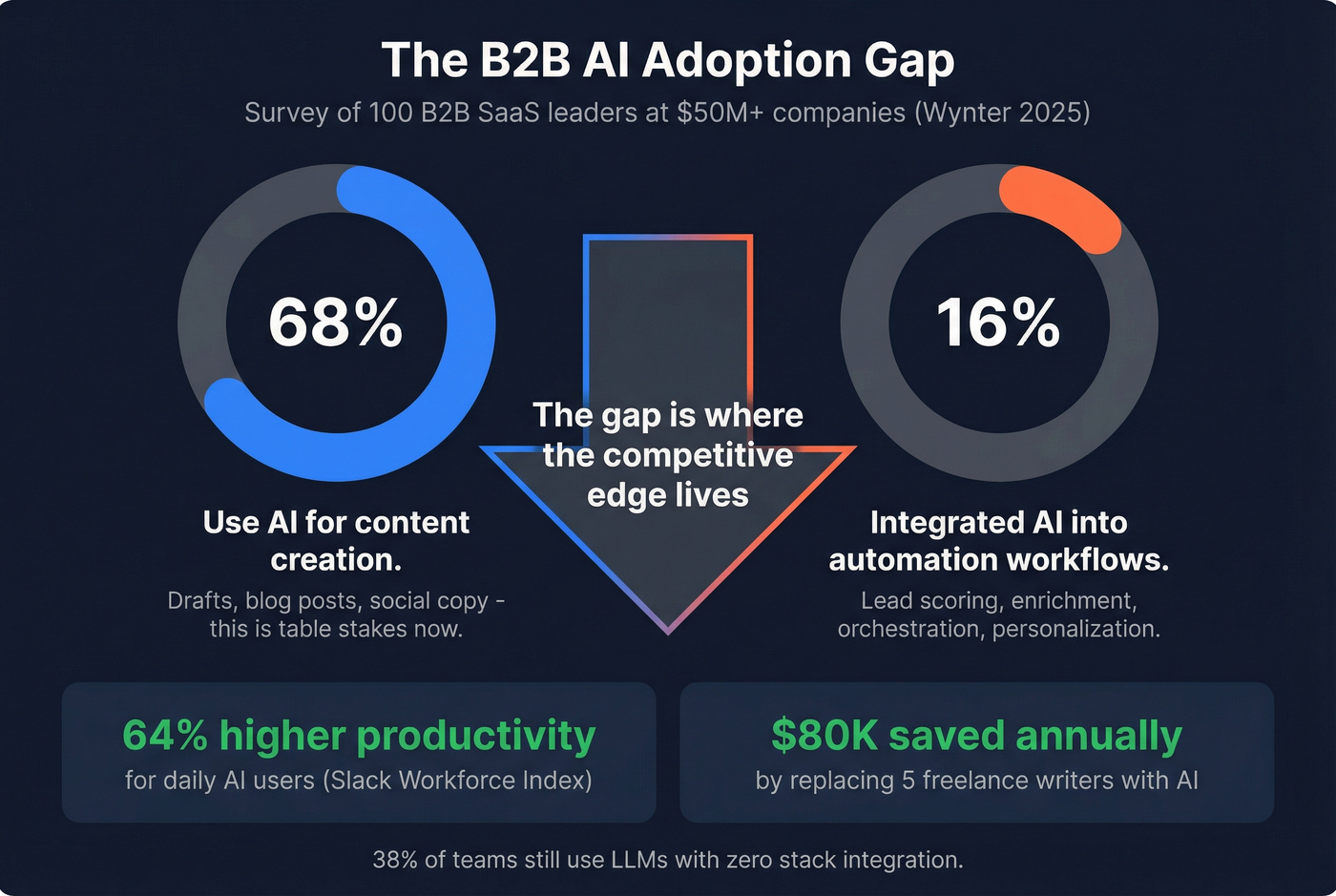
Look - everyone's using AI for drafts. That's table stakes now. The teams pulling ahead are the ones who've embedded AI into workflows beyond content: lead scoring, data enrichment, campaign orchestration, even real-time personalization at scale. If your AI strategy starts and ends with ChatGPT drafts, you're already behind the curve and the gap is widening every quarter.
Mistakes That Kill Strategies
Stale data. If your CRM is full of 6-month-old contacts, every downstream workflow is compromised. This is the single most common reason outbound campaigns fail - not bad copy, not wrong ICP, just dead email addresses.
If you're fixing this at the source, start with data enrichment services and lock in an ideal customer profile before you scale list building.
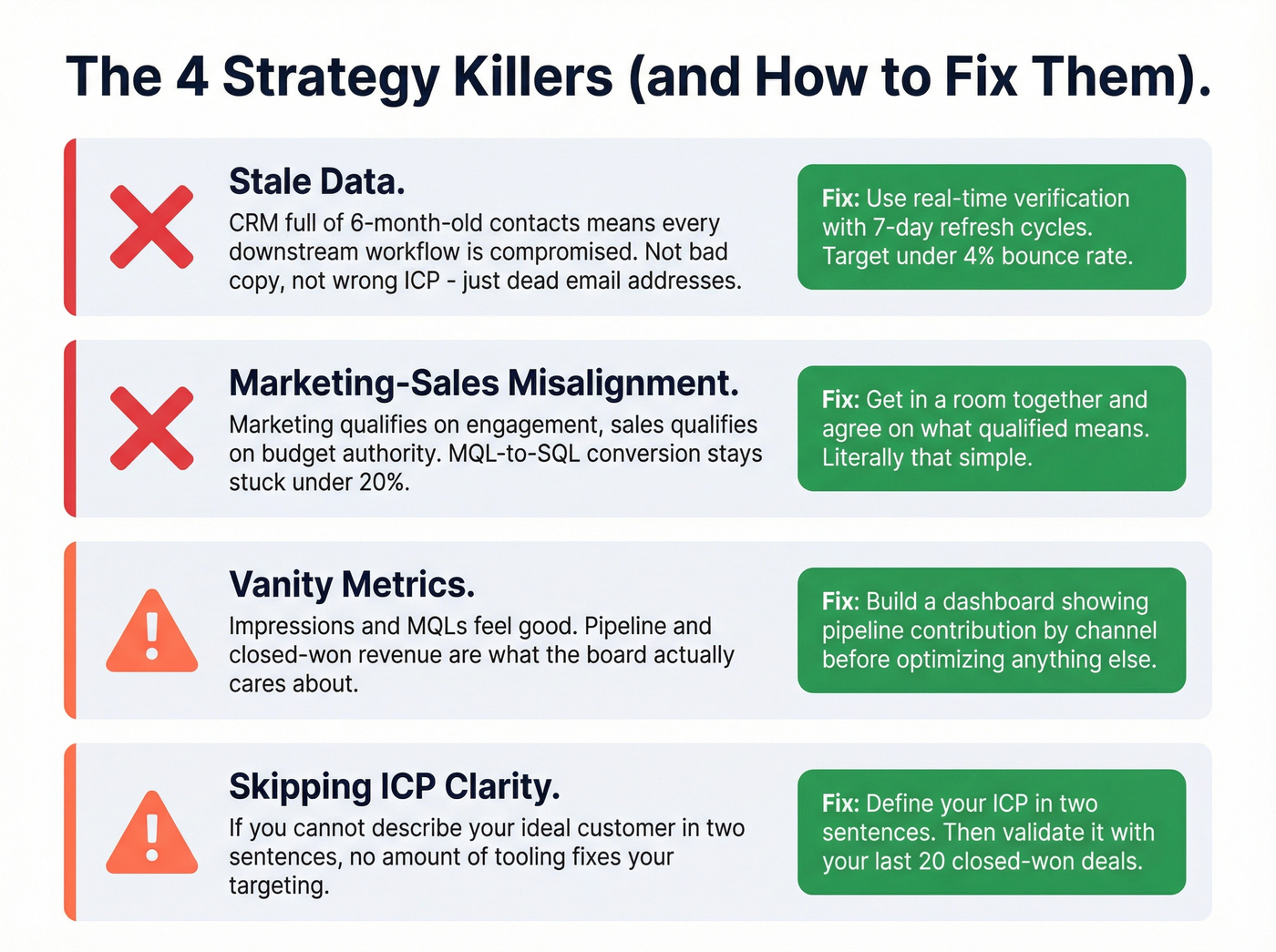
Marketing-sales misalignment. When marketing qualifies on engagement and sales qualifies on budget authority, your MQL-to-SQL conversion stays stuck under 20%. Get in a room together and agree on what "qualified" means. It sounds basic because it is.
Vanity metrics. Impressions and MQLs feel good. Pipeline and closed-won revenue are what the board cares about. If your dashboard doesn't show pipeline contribution by channel, fix that before you optimize anything else.
Skipping ICP clarity. If you can't describe your ideal customer in two sentences, no amount of tooling fixes your targeting. We've seen teams spend $50K on intent data platforms and still miss because they never nailed who they were actually going after.
Intent data, AI workflows, brand building - none of it matters if your emails bounce and your calls hit dead numbers. Prospeo gives you 300M+ profiles with 125M+ verified mobiles and 143M+ verified emails at $0.01 each. Meritt tripled their pipeline to $300K/week after switching.
Execute your 2026 strategy on data that actually connects.
FAQ
What's the highest-ROI B2B marketing channel?
SEO delivers 748% ROI based on FirstPageSage data across 25+ industries. The payback period is one to three years, but compounding returns are unmatched. Webinars (430%) and email (261%) round out the top three.
How much should a B2B company spend on marketing?
Gartner benchmarks B2B marketing budgets at 8.4% of total revenue, split roughly 42% programs, 35% personnel, and 23% technology. Companies investing more in martech than working media see 18% greater sales lift.
Is AI actually changing B2B marketing?
Yes, but narrowly. 68% of leaders use AI for content creation; only 16% have integrated it into automation workflows like lead scoring or enrichment. The competitive edge belongs to teams embedding AI across their entire stack, not just drafting blog posts.
How do I fix bad contact data for outbound?
Use a platform with real-time verification and frequent refresh cycles. Prospeo's 5-step verification and 7-day refresh eliminate the stale data problem - teams like Meritt cut bounce rates from 35% to under 4% and tripled pipeline to $300K/week after switching.
How has B2B marketing strategy evolved since 2023?
The biggest shift is channel maturity. In 2023, most teams experimented with AI tools and doubled down on gated content. By 2026, winners have moved to ungated thought leadership, AI-optimized content structures, and intent-layered outbound - a fundamentally different operating model.