

B2B Buyer Journey Statistics You Can Actually Cite in a Board Deck
Your CMO just asked for buyer journey data to back up the pipeline strategy in next week's board deck. You pull up three posts, and they all recycle the same Forrester number from 2013 without a sample size, field date, or methodology in sight. That's not data - that's decoration.
We spent two weeks pulling the primary sources behind the stats that get passed around in B2B marketing, checking sample sizes, field dates, and methodology notes so you don't have to. Here's what actually holds up.
The Three That Matter Most
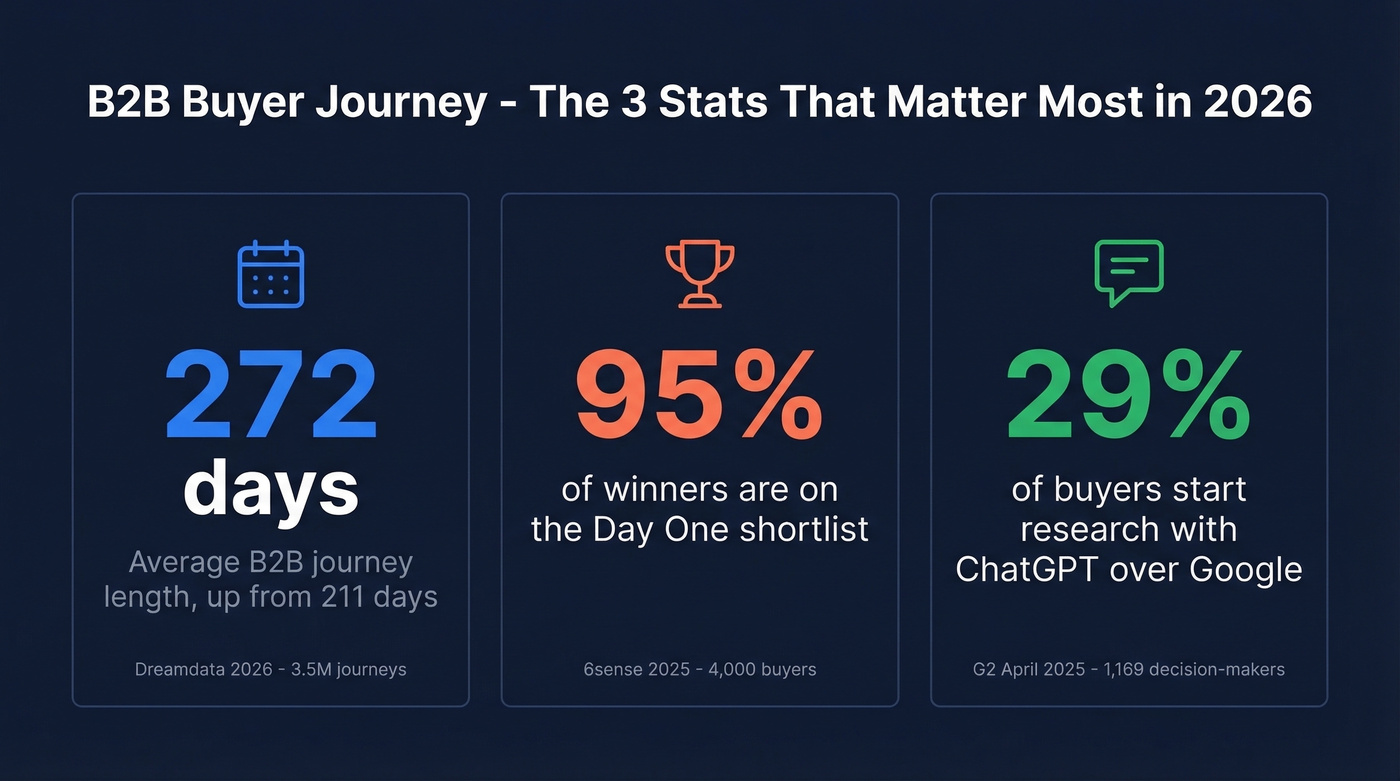
- 272-day average B2B journey - up from 211 days in Dreamdata's prior benchmark (2026 report, 3.5M journeys analyzed)
- 95% of winners are on the buyer's Day One shortlist - miss the consideration set early and you almost never win (6sense 2025 Buyer Experience Report, ~4,000 buyers)
- 29% of buyers now start research with ChatGPT over Google - the channel mix is shifting fast (G2, April 2025, 1,169 decision-makers)
How Long the Journey Takes
The headline number depends on who you ask. 6sense's 2025 Buyer Experience Report puts the average cycle at 10.1 months, down from 11.3 months in 2024. That sounds like good news until you read the fine print: part of that drop comes from mix shift, with more physical goods purchases (shorter cycles) in the 2025 sample versus the prior year.
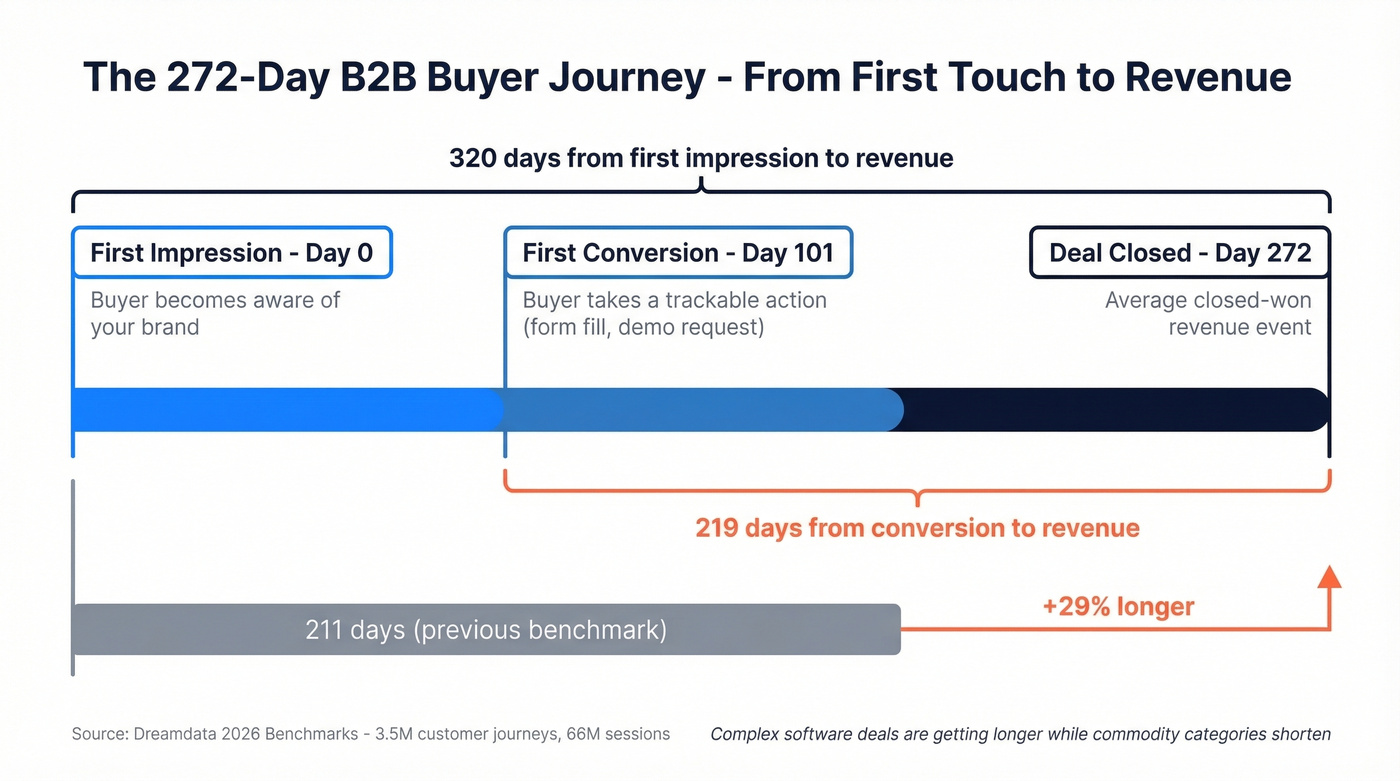
Dreamdata's 2026 benchmarks tell a different story. Across 3.5M customer journeys and 66M sessions, the average B2B journey now takes 272 days - up from 211 days previously. From first impression to closed revenue is 320 days; from first conversion to revenue is 219 days.
Here's the directional truth: cycles are shortening for commodity categories, but for complex software deals, they're getting longer. Plan accordingly.
When Buyers Contact Sales
Buyers still form strong preferences before they ever pick up the phone. 6sense found that 94% rank their shortlist vendors by preference before contacting any of them. The pre-contact favorite wins roughly 80% of the time. About 1 in 10 buyers skip the shortlist entirely and go straight to a single vendor - brand gravity matters even more than we assumed.
The point of first contact shifted from 69% of the journey to 61%, roughly 6-7 weeks earlier than the prior year. 6sense attributes this to AI embedded in solutions (buyers need to validate AI capabilities and security) and economic uncertainty, with 62% saying uncertainty drove them to engage sellers sooner.
G2's survey reinforces the late-engagement preference from the buyer's side: nearly two-thirds prefer engaging salespeople only in later stages, up 17 percentage points year-over-year. Buyers want to control early research, but they'll pull sellers in sooner when the stakes feel higher.

Buyers form preferences 220 days before they talk to sales. If your contact data decays every 6 weeks, you're reaching the wrong people at the wrong time. Prospeo refreshes every 7 days with 98% email accuracy - so your outreach lands while you're still on the shortlist.
Stop prospecting with stale data in a 272-day buyer journey.
Buying Committees: Growing or Shrinking?
This is where the data gets contradictory.
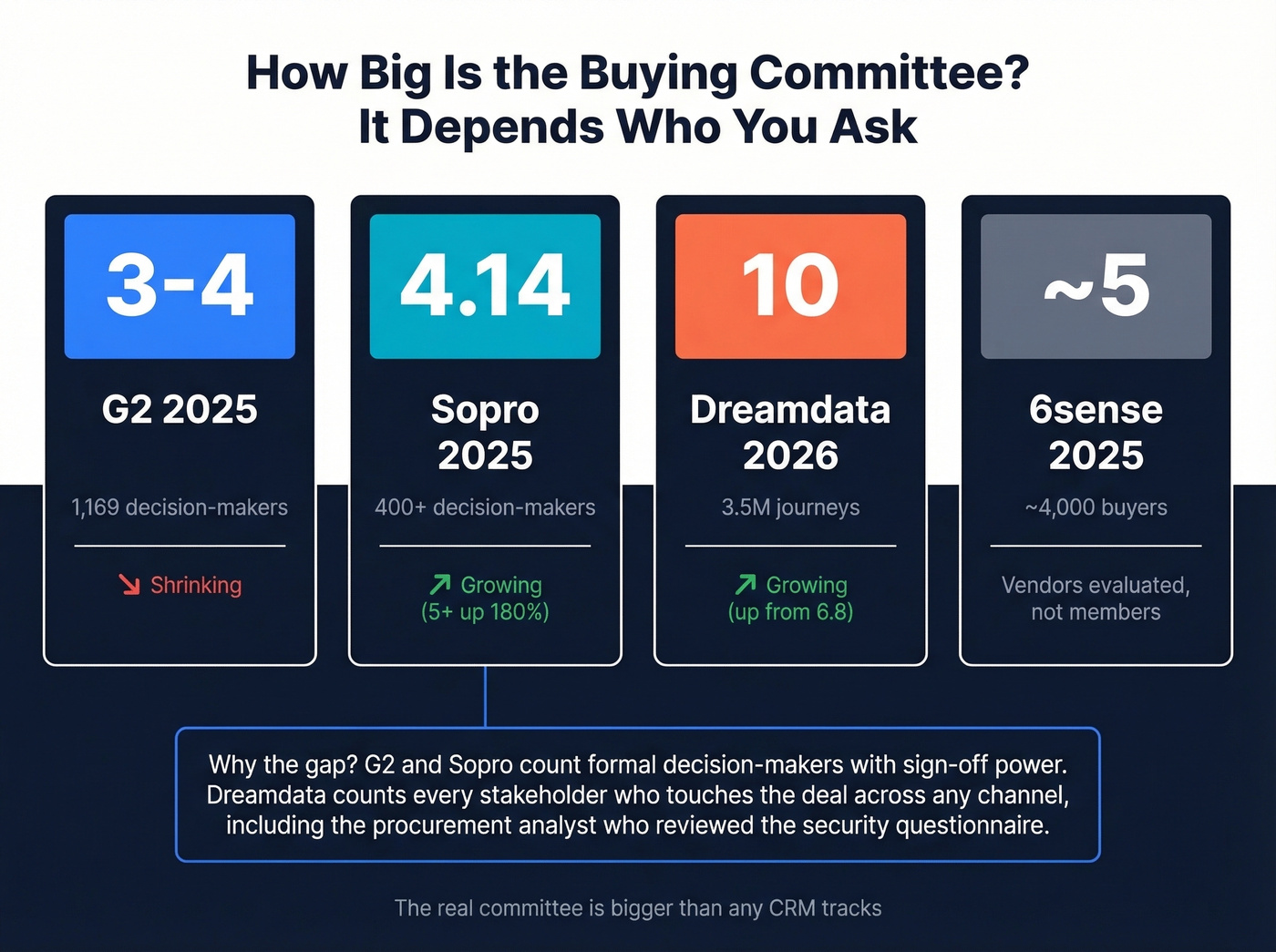
| Source | Sample | Field Date | Committee Size | Trend |
|---|---|---|---|---|
| 6sense 2025 | ~4,000 buyers | 2025 | ~5 vendors evaluated* | N/A |
| Sopro 2025 | 400+ decision-makers | 2025 | 4.14 avg (5+ up 180%) | Growing |
| G2 2025 | 1,169 decision-makers | April 2025 | 3-4 (down from 5-8) | Shrinking |
| Dreamdata 2026 | 3.5M journeys | 2025-2026 | 10 (up from 6.8) | Growing |
*6sense measures vendors evaluated, not committee members.
The gap comes down to definitions. G2 and Sopro measure formal decision-makers - people with budget authority or sign-off power. Dreamdata tracks every stakeholder who touches the deal across any channel, which naturally inflates the count. When someone on r/b2bmarketing says "there are 10 people in the deal," they're counting everyone from the champion to the procurement analyst who reviewed the security questionnaire. When G2 says "3-4," they mean the people in the room when the decision gets made.
And that doesn't even account for invisible buying networks - peers, online communities, and increasingly AI agents that influence decisions outside any formal process. The real committee is bigger than any CRM tracks.
How Buyers Research Now
Channels are fragmenting fast. McKinsey's B2B Pulse survey (3,800+ B2B customers and sellers across 13 countries, fielded Dec 2022) found B2B buyers now use 10 or more channels on average, with e-commerce ranked #1 for effectiveness at 35%, followed by in-person at 26% and video at 12%. About 70% of buyers are comfortable making purchases up to $500K through digital self-service, and willingness to spend $10M+ digitally jumped 83%.

Dreamdata's data shows the typical journey spans 88 touchpoints across 4 channels - up from 76 touchpoints across 3.7 channels the prior year. TrustRadius reports that the top three resources buyers consult are product demos, prior experience, and user reviews, with 73% of organic traffic going to reviews, pricing, and competitive comparisons.
For teams building a repeatable outbound motion, these touchpoints should map cleanly into your sales funnel and your lead generation workflow, not live as disconnected channel tactics.
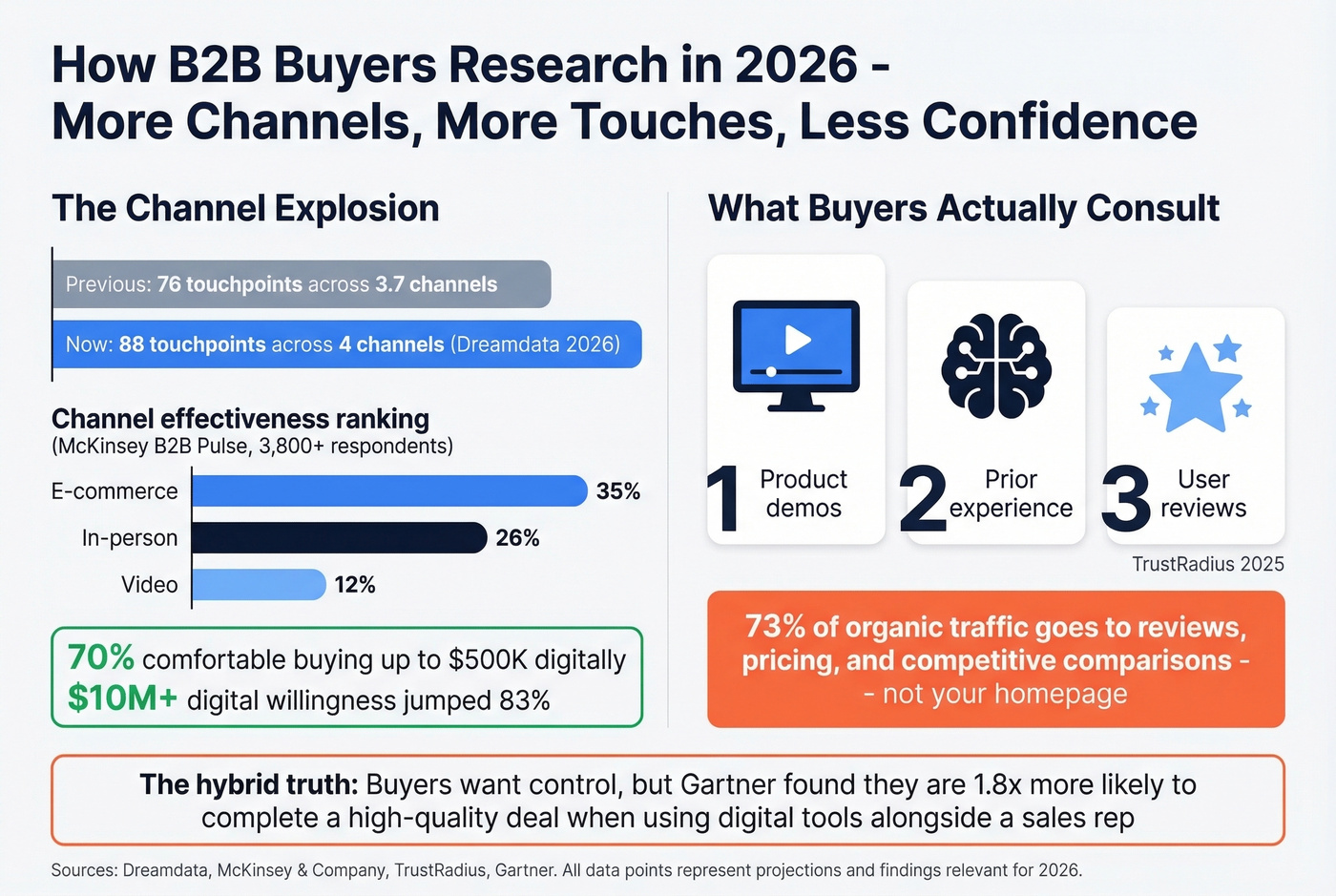
Gartner's widely cited stat - 75% of B2B buyers prefer a rep-free experience - tells only half the story. Their own data shows buyers are 1.8x more likely to complete a high-quality deal when they use supplier-provided digital tools alongside a sales rep. We've seen teams misquote that 75% figure without the hybrid caveat, and it leads to bad strategy. Buyers want control, but hybrid selling still wins on deal quality.
Let's be honest about what's happening: purchase regret is rising. Information overload across 10+ channels means buyers often feel less confident, not more, by the time they sign. That's a real problem for everyone in the pipeline.
57% of buyers anticipate spending more on software next year. The money is there. The problem isn't budget - it's that most sellers don't exist in the buyer's world until month eight of a nine-month journey.
What These Stats Mean for Pipeline
Dreamdata's most striking finding isn't the 272-day journey - it's that marketing owns 81% of it. Buyers spend roughly 220 days forming decisions before they ever enter a sales pipeline. If your pipeline strategy starts when an SDR books a meeting, you're ignoring the first three-quarters of the game.
That’s also why lead scoring and identifying buying signals matter more than “more activity” once the market is already in motion.
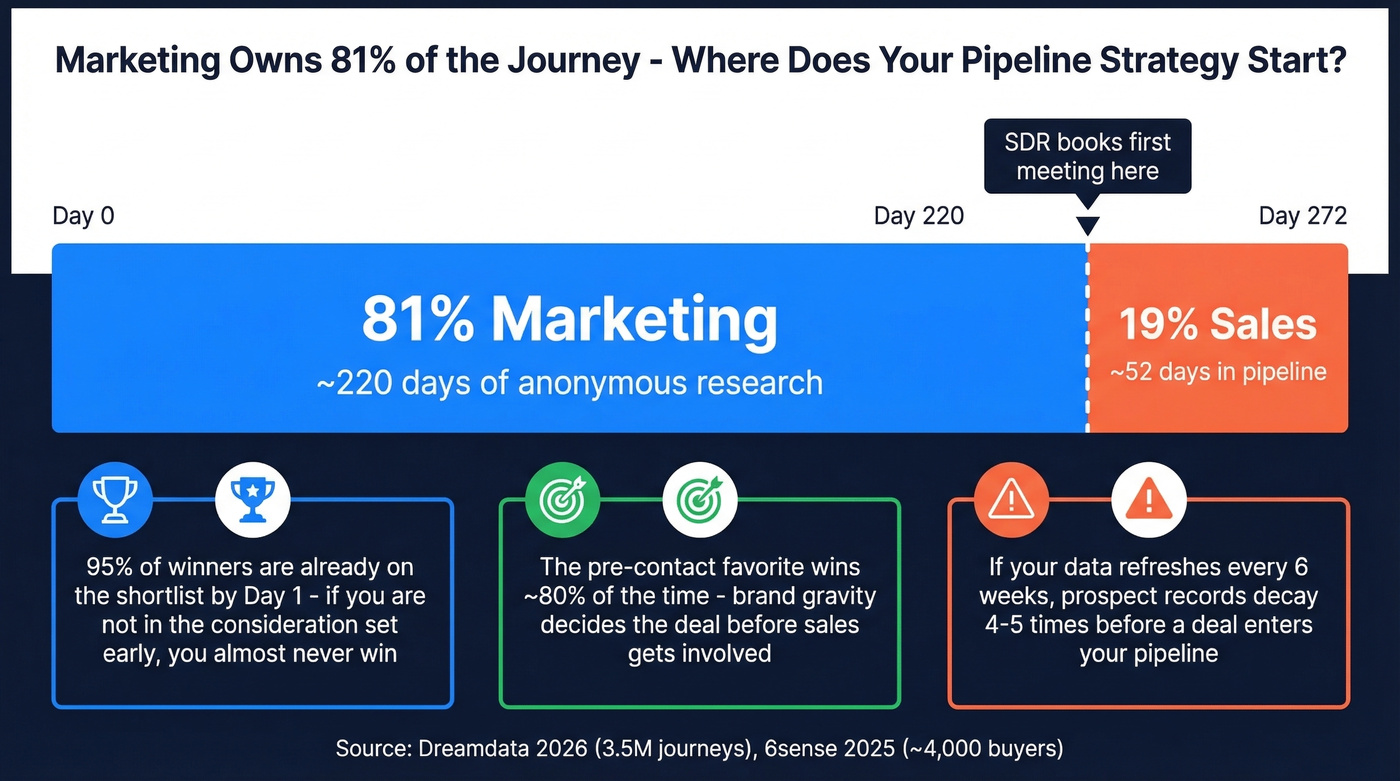
In our experience, the committee size debate matters less than whether you're reaching the right stakeholders with accurate data during that anonymous research window. When the average journey takes 272 days and most data providers refresh records every 6 weeks, prospect data decays multiple times before a deal enters your pipeline. Prospeo's 7-day refresh cycle and 98% email accuracy close that gap - pair it with intent data across 15,000 Bombora topics to spot accounts while they're still researching.
If you’re rebuilding your outbound motion around this reality, start with sales prospecting techniques and a modern SDR tool stack that can actually operationalize the timing.
Skip the "spray and pray" approach if your average deal size is above $50K. At that price point, you can't afford to reach the wrong person with stale data on month nine of a ten-month journey. Focus on getting into the consideration set during months one through three, when 95% of the outcome is already being decided.
The average deal now involves 88 touchpoints across 4 channels. That means more stakeholders to reach with verified contact data. Prospeo gives you 300M+ profiles, 125M+ verified mobiles, and 30+ filters - including buyer intent signals across 15,000 topics - so you reach the full committee, not just the one name in your CRM.
Reach every stakeholder in the buying committee with data you can trust.
Methodology Reference
| Source | Report | Sample | Field Date | Geography | Notes |
|---|---|---|---|---|---|
| 6sense | Buyer Experience 2025 | ~4,000 + 766 supplemental | 2025 | NA 46%, Continental Europe 20%, UK & Ireland 20%, APAC 14% | 49% VP+; 42% tech, 38% services |
| G2 | Buyer Behavior 2025 | 1,169 decision-makers | April 2025 | NA, EMEA, APAC | Online survey |
| Dreamdata | LinkedIn Ads Benchmarks 2026 | 66M sessions, 3.5M journeys | 2025-2026 | Global (customer base) | Data-driven attribution |
| McKinsey | B2B Pulse | 3,800+ decision-makers | Dec 2022 | 13 countries | Longitudinal since 2016 |
| Sopro | State of Prospecting 2025 | 400+ decision-makers + 97.9M emails | 2025 | Not disclosed | Prospecting-focused |
| Gartner | State of B2B Buying | Not disclosed (gated) | Not disclosed | Not disclosed | Methodology gated |
| TrustRadius | Review Quality 2025 | 17,000+ reviews, 15,500+ individual users | 2024 | Not disclosed | Vendor-side report |
FAQ
How long is the average B2B buying cycle in 2026?
Between 9 and 10 months. 6sense reports 10.1 months across ~4,000 buyers; Dreamdata measures 272 days (roughly 9 months) across 3.5M journeys. The gap reflects different methodologies - Dreamdata tracks digital touchpoints while 6sense surveys self-reported timelines.
How many stakeholders are involved in a B2B purchase?
Between 4 and 10, depending on how you count. Sopro and G2 measure formal decision-makers with sign-off authority at 3-4. Dreamdata tracks every stakeholder who touches the deal across any channel, landing at 10. Use the narrower number for sales planning and the wider one for content distribution.
Do B2B buyers decide before talking to sales?
Yes - overwhelmingly. 6sense's 2025 data shows the pre-contact favorite wins ~80% of the time, and 95% of eventual winners are on the buyer's Day One shortlist. Intent data tools help you identify accounts during that anonymous research phase so you're on the list before outreach begins.