

B2B Cold Calling Statistics That Actually Help You Plan
Your manager quotes a 4.8% success rate. Your dashboard says 1%. You're not failing - the metric definition changed. Most B2B cold calling statistics floating around mix incompatible denominators: call-to-conversation, call-to-meeting, call-to-closed-deal. That makes them useless for forecasting.
Let's fix that.
2026 Cold Calling Benchmarks at a Glance
"Success rate" here means conversations that result in a booked meeting - not dials, not pickups.
| Metric | 2025 to 2026 | Source |
|---|---|---|
| Industry avg success rate | 2.3% to 2.7% | Cognism 2026 Report |
| Avg calls to reach prospect | 2.9 to 1.55 | Cognism 2026 Report |
The trend is positive. Success rates ticked up and calls-to-reach dropped by about 47%. HubSpot's 2025 survey of 379 sales pros found 24% still use cold calling as their primary channel, while 21% have never tried it. This isn't a dead channel - it's one that rewards better data and sharper targeting.
Funnel Tiers: Bad to Great
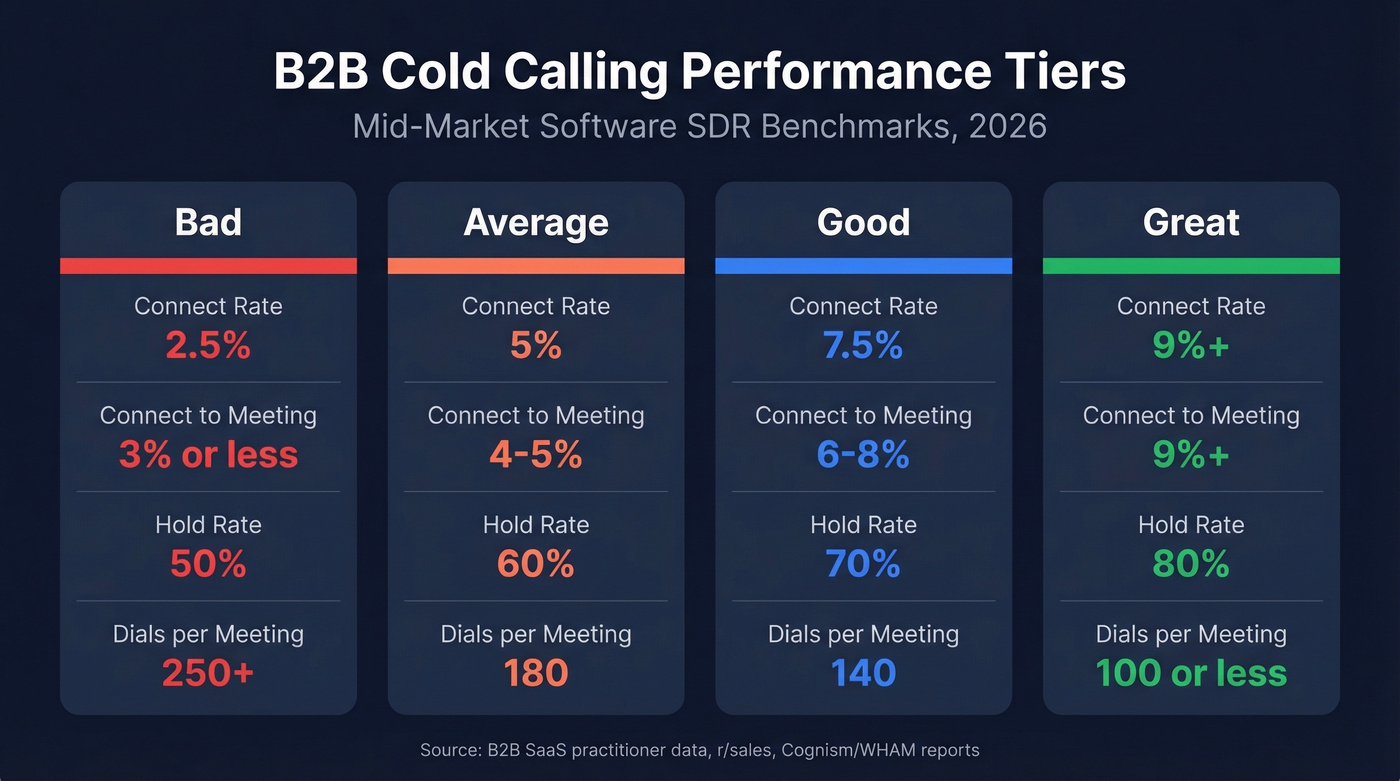
These tiers come from B2B software practitioners on r/sales and align with what we've seen across SaaS SDR teams. They apply to mid-market B2B software - if you're selling $250k+ enterprise deals or sub-$1k products, your numbers will look different.
| Metric | Bad | Average | Good | Great |
|---|---|---|---|---|
| Connect rate | 2.5% | 5% | 7.5% | 9%+ |
| Connect to meeting | 3% or less | 4-5% | 6-8% | 9%+ |
| Hold rate | 50% | 60% | 70% | 80% |
| Dials per meeting | 250+ | 180 | 140 | 100 or less |
A SaaS SDR making 180-200 cold calls per day without an auto-dialer reports roughly 5-8% connect rates and about 1 meeting per 200 dials - squarely "average." Cognism/WHAM puts conversation-to-meeting at 4.82%, which lines up with that 4-5% tier. If your team hits 6%+, you're outperforming most of the market.
Here's the thing: most teams trying to fix cold calling performance add more dials. That's exactly backwards. The gap between 250 dials-per-meeting and 100 is almost entirely list quality and call skill - not volume.
Industry and Deal-Size Ranges
A Focus Digital analysis breaks conversion rates by industry and deal size, and the spread is massive. A single blended average hides enormous variation, which is why we always tell teams to segment by vertical before drawing conclusions from any B2B cold calling statistics.
| Industry | Conversion Rate |
|---|---|
| Janitorial/Cleaning | 2.85% |
| Business Services | 2.61% |
| Financial Services | 1.54% |
| Software/Technology | 0.95% |
| Deal Size | Conversion Rate |
|---|---|
| $500-$10k | 2.64% |
| $100k-$500k | 1.74% |
| $1M-$5M | 1.16% |
Higher-ticket, longer-cycle deals convert at lower rates per dial. Software sits near the bottom because buyers are drowning in outreach. At the extreme end, one recruiter on Reddit tracked 300-500 calls over four weeks and booked zero placements - every result came from email, text, and InMail instead. That's an outlier, but it illustrates what happens when the channel-persona fit is wrong.

The gap between 250 dials-per-meeting and 100 is list quality - not effort. B2B data decays at 2.1% per month, which means a 6-week refresh cycle guarantees stale numbers in your dialer. Prospeo refreshes 125M+ verified mobile numbers every 7 days with a 30% pickup rate - so your reps spend time talking, not listening to disconnected tones.
Stop burning dials on dead numbers. Start with verified data.
Persistence Math
The diminishing returns are stark: 93% of all conversations happen by call 3, and 98.6% by call 5. Beyond five attempts, you're burning dials for almost nothing. Move on or switch channels.
If you want a repeatable cadence across phone + email, build it into your sales follow-up process.
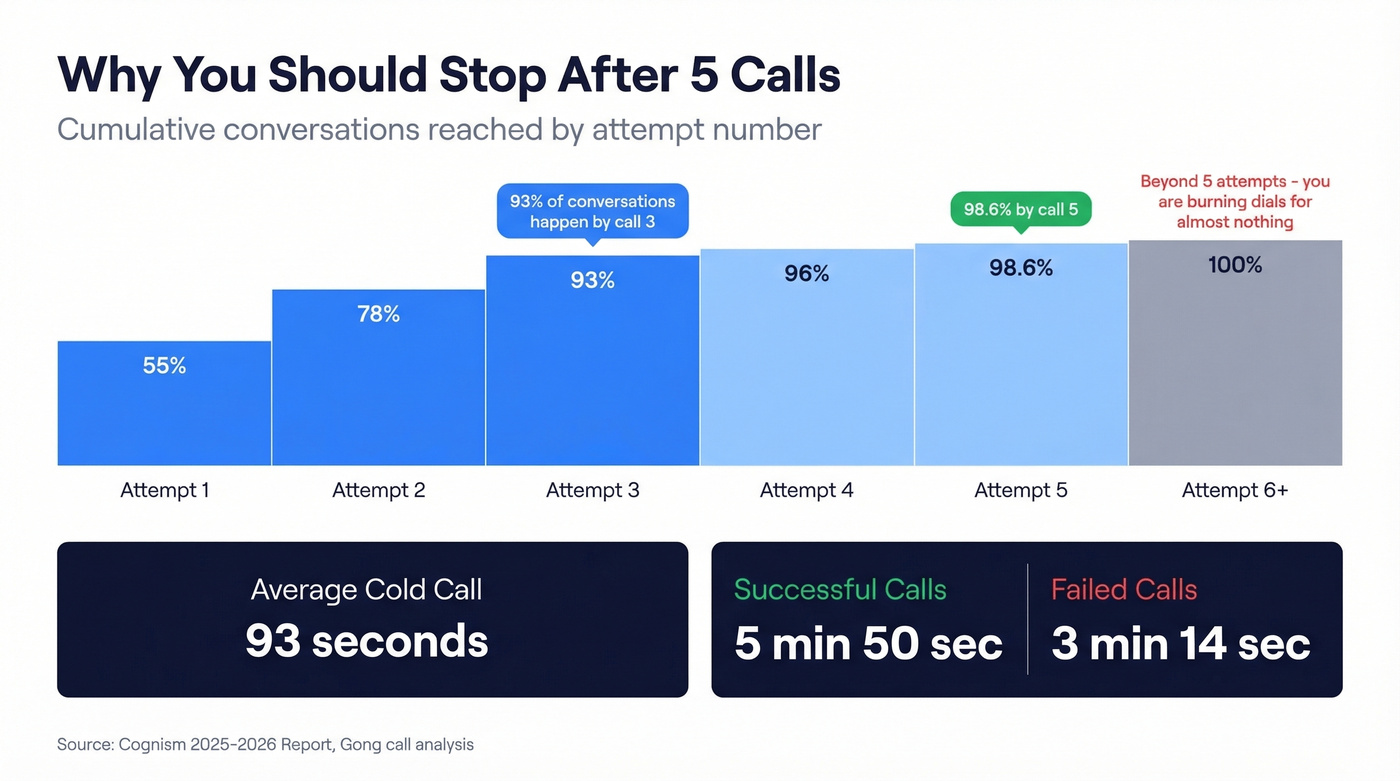
The average cold call lasts 93 seconds, up from 83 the prior year. Successful calls average 5 minutes 50 seconds; failed calls average 3 minutes 14 seconds per Gong's analysis of millions of calls. Getting cut off before 3 minutes consistently? That's a script problem. Can't break 93 seconds on average? List problem.
Best Time to Call
Every source disagrees, and that's the point.
One dataset says 10-11 AM is the best window, with 2-3 PM as runner-up. Best day: Tuesday. Worst: Monday. Revenue.io cites an InsideSales study showing 8-11 AM with a 15% higher connection rate - but their own 90-day analysis found peak engagement at 4-5 PM. They openly acknowledge the contradiction.
Timing depends on your persona. A VP of Engineering and a Director of Facilities Management have wildly different phone habits. Test 10-11 AM and 4-5 PM local time first, then optimize from there. Anyone selling you a universal answer is oversimplifying.
If you're coordinating timing across channels, pair this with the best time to send cold emails for your persona.
What Actually Moves the Numbers
Four levers matter more than anything else.
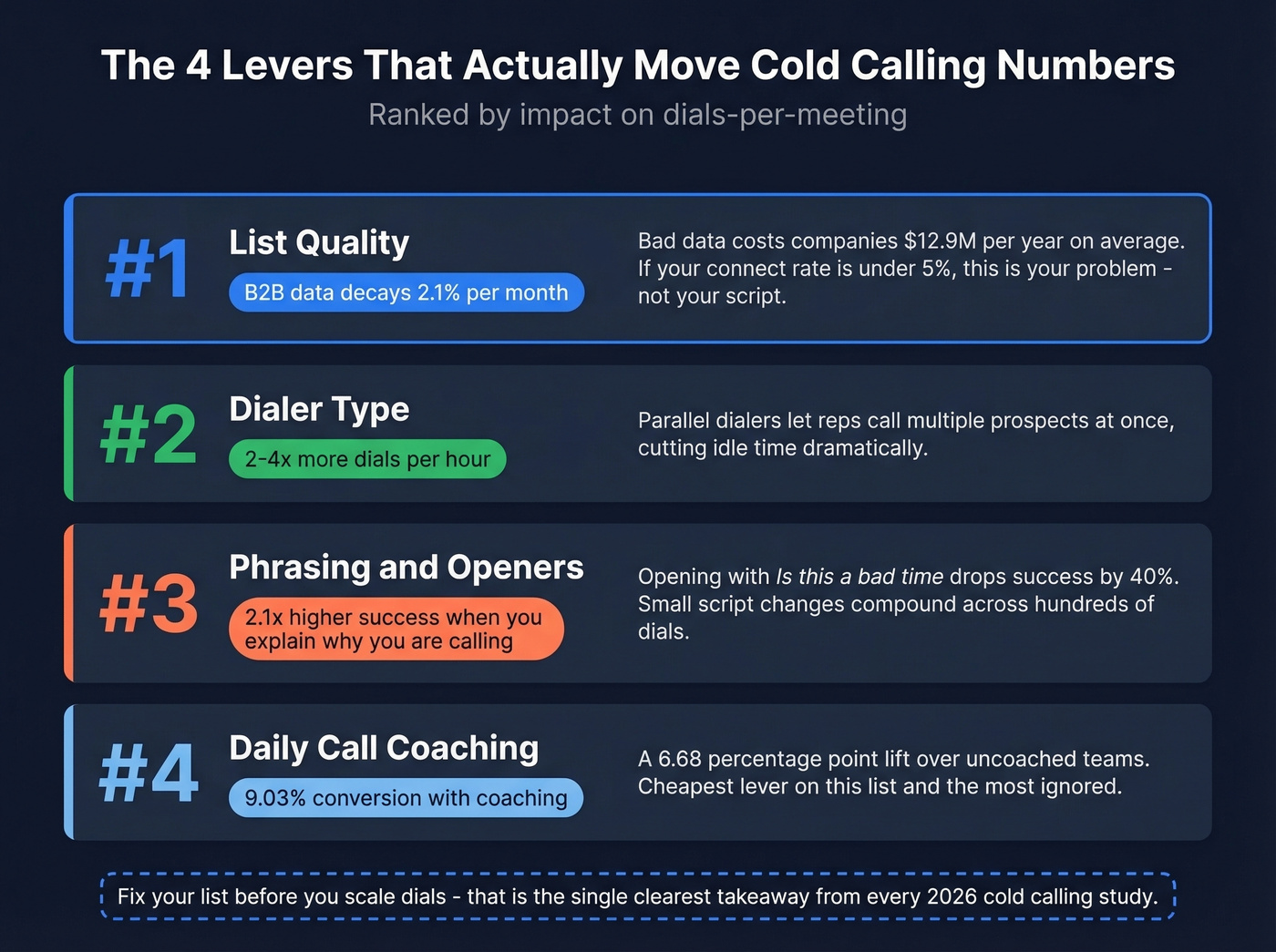
List quality is lever #1. B2B data decays at 2.1% per month - roughly 22.5% of your list going stale every year. Bad data costs the average company $12.9 million annually. If your connect rate is under 5%, you don't have a script problem. You have a data problem.

Before you dial 200 numbers, make sure they're real. We've watched teams jump 2-3 percentage points on connect rate within weeks just by switching to verified mobile data with a short refresh cycle. Prospeo refreshes its 125M+ verified mobile records every 7 days - versus the 6-week industry average - which cuts a big chunk of the decay problem before it ever hits your dialer.
If you're cleaning and updating records at scale, use a proper data enrichment workflow.
Dialer type is lever #2. Parallel dialers let reps call multiple prospects simultaneously, often driving 2-4x more dials per hour by reducing idle time. That's why "dials per day" benchmarks vary so wildly across teams using different setups.
This is also why a documented cold calling system matters more than raw activity.
Phrasing is lever #3. Gong found that explaining why you're calling drives 2.1x higher success rates. Opening with "Is this a bad time?" drops success by 40%. Small script changes compound across hundreds of dials daily.
If you need tighter openers, steal from proven talk track examples.
Training is lever #4. Focus Digital estimates teams with daily call coaching hit a 9.03% conversion rate - a 6.68 percentage point lift over uncoached teams. It's the cheapest lever on this list and the most ignored.
Teams jump 2-3 percentage points on connect rate by switching to fresh, verified mobile data. Prospeo delivers 98% email accuracy and 125M+ verified mobiles at $0.01/email - 90% cheaper than ZoomInfo. No contracts, no sales calls, no stale lists tanking your cold calling metrics.
Move your team from 'average' to 'great' tier this week.
Dials-Per-Meeting Calculator
The formula is simple: Meetings needed / (connect rate x connect-to-meeting rate) = dials required.
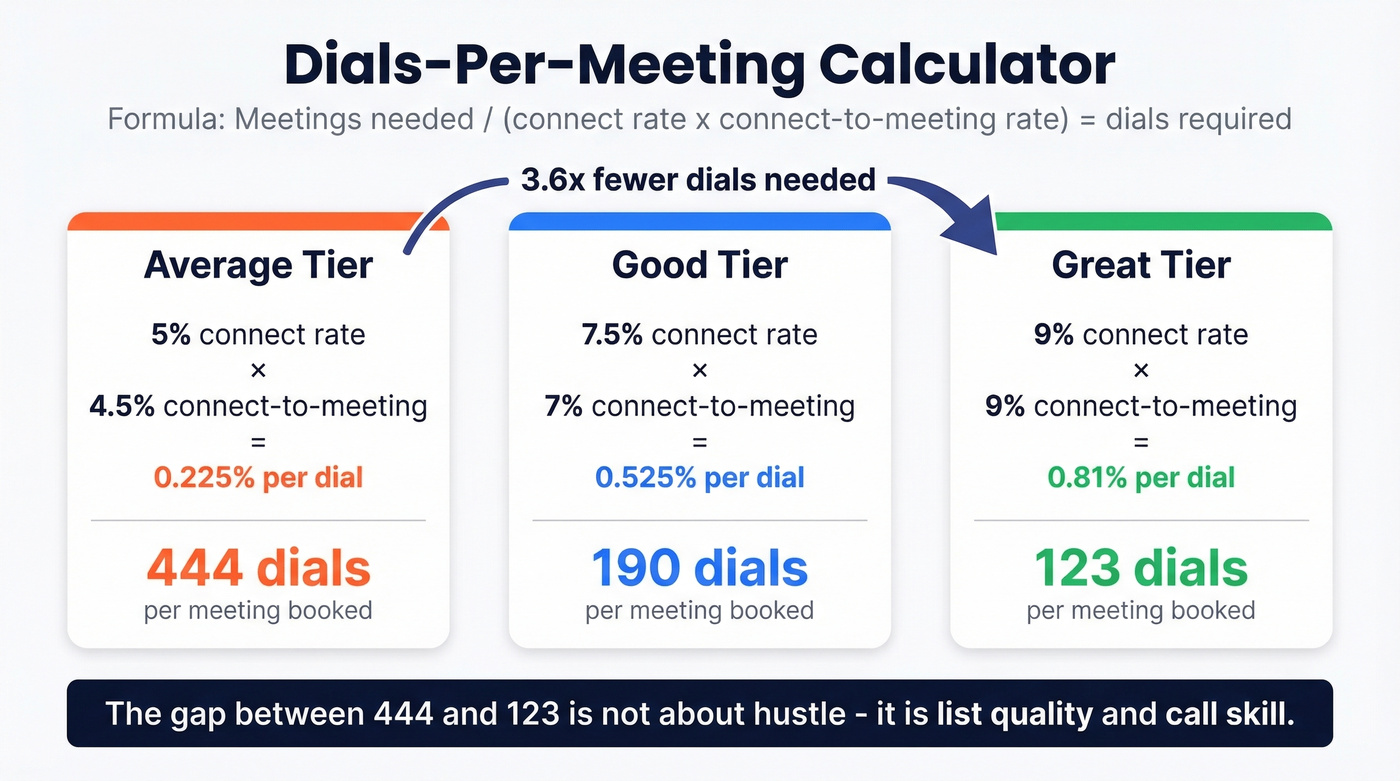
At the "average" tier, that's 5% connect x 4.5% connect-to-meeting = 0.225% per dial, or about 444 dials per meeting. At the "good" tier: 7.5% x 7% = 0.525% per dial - roughly 190 dials. Great tier: 9% x 9% = 0.81% per dial - about 123 dials.
The gap between 444 and 123 isn't about hustle. It's driven almost entirely by list quality and call skill. A small improvement in connect rate from better data has an outsized impact on total effort, because it compounds through every stage of the funnel. Fix your list before you scale dials - that's the single clearest takeaway from every set of B2B cold calling statistics published this year.
To forecast this properly, map it to your funnel metrics and keep the definitions consistent.
FAQ
Is cold calling still effective in 2026?
Yes. The industry average success rate rose to 2.7% in 2026, and 24% of sales pros still use it as their primary channel. It works with verified data and disciplined follow-up - teams dialing stale lists see sub-1% rates and blame the channel instead of the data.
How many cold calls does it take to book one meeting?
For average B2B software teams, 180-250 dials. Top performers hit around 100 by improving connect rates through better data, smarter timing, and sharper openers. The gap is a data and skill problem, not a volume problem.
How do I improve my cold call connect rate?
Fix your list first - B2B data decays 2.1% per month. Verify mobiles and emails before dialing, test call windows at 10-11 AM and 4-5 PM local time, and cut any prospect after five unanswered attempts. Skip anyone who hasn't been verified in the last 30 days.
What's a good connect rate for B2B cold calls?
For mid-market software, 5% is average and 7.5%+ is good. Teams consistently above 9% typically combine verified direct dials, persona-specific timing, and daily coaching. Below 4% almost always signals a data quality issue rather than a skills gap.